Breaking Borders: Report on Anarchist Organizing in Solidarity with Migrants in Chicago
Web PDF • Imposed PDF• Raw TXT (OCR)

A deepening economic crisis resulting from U.S.
sanctions, colonial extractivism, and inter-imperial
disputes has been fueling forced migration north from
Venezuela. Since August 2022, governors of US border
states, especially Texas, have spent lavishly on
corralling and shipping migrants seeking asylum to
northern Democratic-party strongholds, a program
explicitly targeted at gaining leverage in the spectacle
of two party politics. %/Iore than 26,100 migrants, the
vast majority from Venezuela, have been shipped to
Chicago since 2022. As of January 2024, over 600
migrant busses have arrived in C?A’icago as well as
several chartered planes. Busses continue to arrive
every day and more recently the drivers have began
dropping people outside of the designated intake
location and even outside of the city altogether,
leaving people in random parking lots with no
information, no winter clothes, no food and no water.
QSFUGER,
LcoM®
Part 1. Manufactured Crisis
Once in Chicago, the migrants face a third manufactured cri:
the logistics of warehousing and relocation built over two
successive “progressive” democratic administrations — first Lori
Lightfoot and now Brandon Johnson. This involves several
stages of containm processing and relocation across distinct
tiers of carceral facilities rebranded by the city as shelters.
Migrants are initially taken to the so-called Landing Zone
downtown for processing, where they wait for days before
being shipped to police districts or airports, designated as
initial influx shelters. Here, they wait by the hundreds,
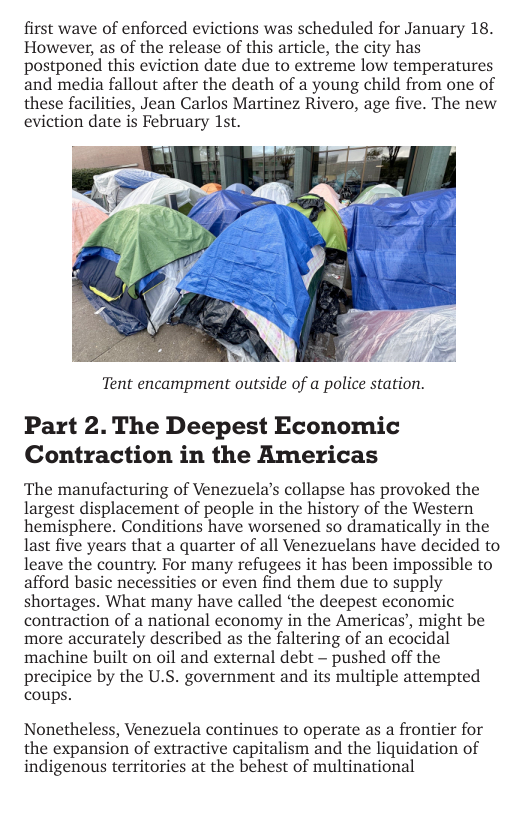
surviving for weeks or months either on the floors inside or in
tents outside the facilities, until they are again picked up en
masse and relocated to a second tier of so-called shelters.
Many of these are vacant industrial warehouses, where
between 2,000-3,000 people are held under toxic
environmental conditions, an extreme lack of hygiene access
and strict regimes of surveillance and control.
As of January 2024, official figures report more than 15,000
migrants still living in these shelters. The city government had
imposed a 60-day limit on shelter stays for all migrants
entering the city after the 17th of November, meaning that the
first wave of enforced evictions was scheduled for January 18.
However, as of the release of this article, the city has
postponed this eviction date due to extreme low temperatures
and media fallout after the death of a young child from one of
these facilities, Jean Carlos Martinez Rivero, age five. The new
eviction date is February 1st.
i o
Tent encampment outside of a police station.
Part 2. The Deepest Economic
Contraction in the Americas
The manufacturing of Venezuela’s collapse has provoked the
largest displacement of people in the history of the Western
‘hemisphere. Conditions have worsened so dramatically in the
last five years that a quarter of all Venezuelans have decided to
leave the country. For many refugees it has been impossible to
afford basic necessities or even find them due to supply
shortages. What many have called ‘the deepest economic
contraction of a national economy in the Americas’, might be
more accurately described as the faltering of an ecocidal
machine built on oil and external debt — pushed off the
precipice by the U.S. government and its multiple attempted
coups.
Nonetheless, Venezuela continues to operate as a frontier for
the expansion of extractive capitalism and the liquidation of
indigenous territories at the behest of multinational
corporations and foreign creditors. Now, the country is
threatening military action against Guyana over control of the
oil-rich region of Esequibo, and auctioning off its state-owned
refineries abroad. The situation only seems to be getting worse.
It is in this bleak context that many have embarked on long
journeys across the continent, surviving the Darien Gap,
paramilitary violence, gangs, narcos, human traffickers, trains,
military check points, police mordidas and more, only to arrive
to “sanctuary” characterized by extreme dehumanization and
constant surveillance; their survival made into a pissing contest
between governors and a spectacle of suffering for the media.
As the effects of this crisis progress in Chicago, we are finding
it increasingly important to deepen our analysis of the political
motivations behind fabricated resource crises particularly as
they relate to all non-white / non-European immigrants, and
the goals that such narratives serve. The already existing
rhetoric surrounding immigration from central and South
America, concurrent with the visibility of the city’s solutions of
povertized and carceral shelter has fueled xenophobic attitudes
and fears rooted in hegemonic nationalism and a deep
internalization of resource scarcity. While we ultimately seek to
dethrone anything that comes close to civilization’s concept of
and relation to “resources” or “resource management”, we also
need to locate and dispel it’s “lack of resource” crises within an
empirical arsenal of tools meant to prevent an intercultural,
interracial, inter-generational solidarity that is threatening to
state power.
Part 3. Houses Not Camps / Casas No
Carpas!
This fall, Chicago’s liberal mayor signed a $29 million contract
with Gardaworld, a transnational private security corporation,
with plans to build enormous barbed wire fenced winter base
camps and hold migrants there through the sub-freezing
winter. People would be stuffed in soft tents rated to only 40°F
(pg. 101 of contract) and forced to abide by rules and curfews,
with the flow of people and resources managed by a military
contractor.
Anarchist responses to this so far have consisted of several
street demos, strategy sessions, a ton of research, lawsuits,
FOIA-ing, compiling of information about GardaWorld’s other
“shelter” operations, extensive self-organized autonomous
mutual aid projects, and possibly some well aimed graffiti.
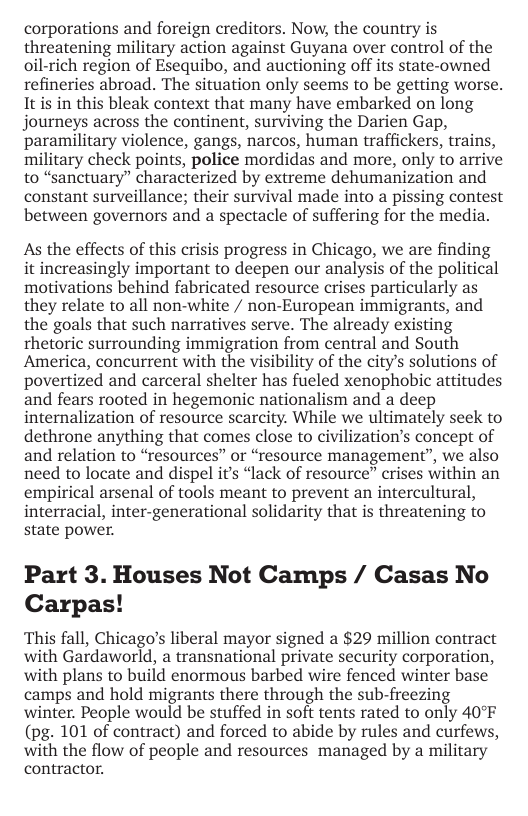
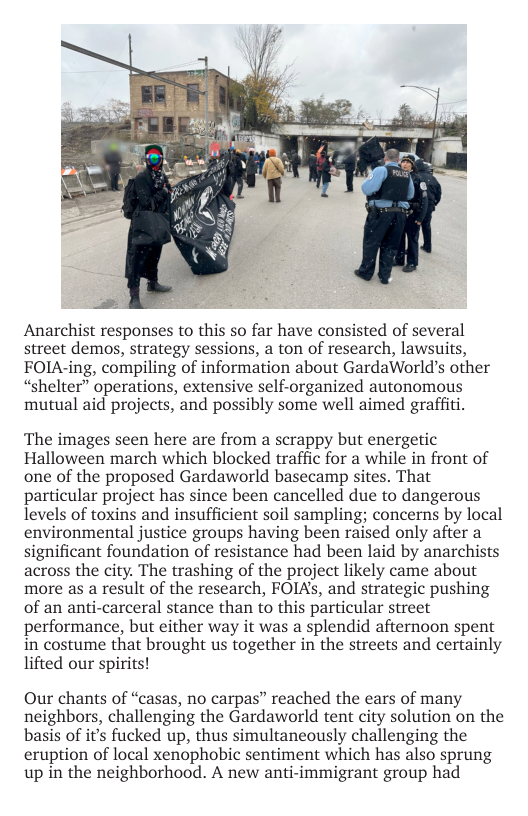
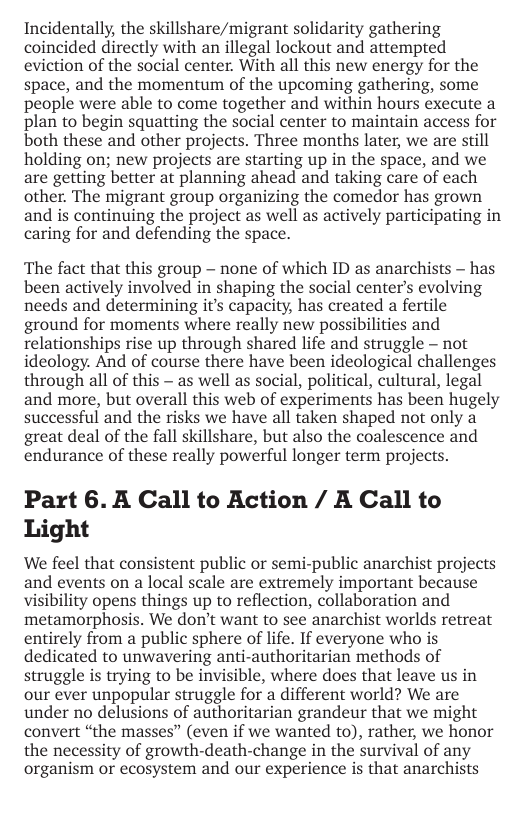
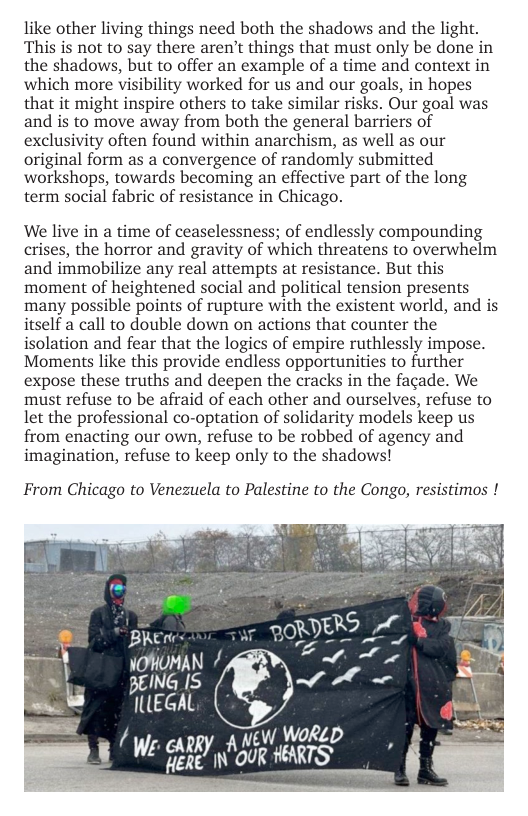
The images seen here are from a scrappy but energetic
Halloween march which blocked traffic for a while in front of
one of the proposed Gardaworld basecamp sites. That
particular project has since been cancelled due to dangerous
levels of toxins and insufficient soil sampling; concerns by local
environmental justice groups having been raised only after a
significant foundation of resistance had been laid by anarchists
across the city. The trashing of the project likely came about
more as a result of the research, FOIAs, and strategic pushing
of an anti-carceral stance than to this particular street
performance, but either way it was a splendid afternoon spent
in costume that brought us together in the streets and certainly
lifted our spirits!
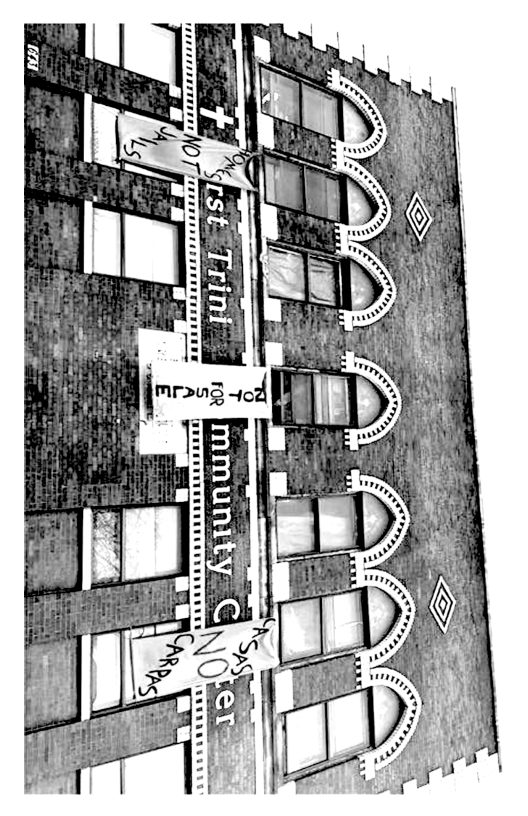
Our chants of “casas, no carpas” reached the ears of many
neighbors, challenging the Gardaworld tent city solution on the
basis of it’s fucked up, thus simultaneously challenging the
eruption of local xenophobic sentiment which has also sprung
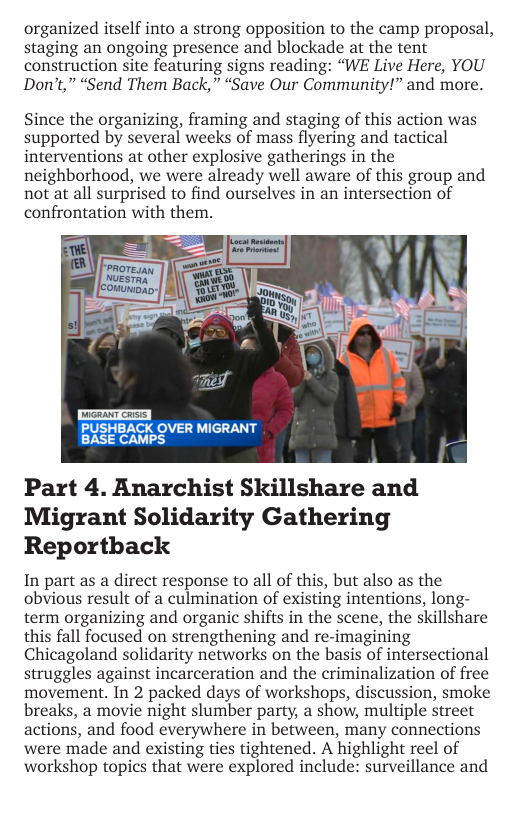
up in the neighborhood. A new anti-immigrant group had
organized itself into a strong opposition to the camp proposal,
staging an ongoing presence and blockade at the tent
construction site featuring signs reading: “WE Live Here, YOU
Don’t,” “Send Them Back,” “Save Our Community!” and more.
Since the organizing, framing and staging of this action was
supported by several weeks of mass flyering and tactical
interventions at other explosive gatherings in the
neighborhood, we were already well aware of this group and
not at all surprised to find ourselves in an intersection of
confrontation with them.
Part 4. Anarchist Skillshare and
Migrant Solidarity Gathering
Reportback
In part as a direct response to all of this, but also as the
obvious result of a culmination of existing intentions, long-
term organizing and organic shifts in the scene, the skillshare
this fall focused on strengthening and re-imagining
Chicagoland solidarity networks on the basis of intersectional
struggles against incarceration and the criminalization of free
movement. In 2 packed days of workshops, discussion, smoke
breaks, a movie night slumber party, a show, multiple street
actions, and food everywhere in between, many connections
were made and existing ties tightened. A highlight reel of
workshop topics that were explored include: surveillance and
operational technology, ongoing community jail support,
“shelter” as carceral politic, prison censorship and state
repression, and solidarity across borders. This was the Sth
anarchist skillshare held in a year and a half - sorry it’s the first
reportback, but let’s make up for it by offering some reflection.
Every past skillshare had produced feedback and reflection on
the desire for less exclusivity, for more direct involvement from
people we don't already know/work with. The question arose
(and not for the first time): how do we actually do that? How
do we change the space to allow for more collaboration? How
do we break out of the insular nature of a scene without
foregoing the necessary levels of trust, security and
commonality? Maybe it comes down to a question of
anarchism itself: whether or not it can let go of it’s own self-
imposed limitations to allow itself to become what many of us
actually want from it — messiness, growth, experimentation,
multiplicity. And how do we move towards that?
Certainly the paths are many. One step we took this time
around was to open up the actual planning process. It felt
important to do things really differently this time, but to do it
in a way that wasn’t going to compromise our existing goals,
needs or the work we'd already done. So with the nuts and
bolts of the event already in place we hosted a public potluck
and planning meeting, inviting others to fill in the empty
spaces intentionally left in the schedule. We knew there were
tons of other people fighting for abolition, tons of other people
trying to figure out how to respond in solidarity with new
asylum seekers, and many already taking action, so in creating
space for a larger conversation we were able to 1. get a better
idea of what was already happening and what needed to be
happening, 2. meet more people with common struggles and
commitments/ vibe each other out, and 3. bring new people
with shared dreams of abolition into autonomous spaces and
modes of organizing. Conversely, over the past few months
more anarchists have moved themselves into non-anarchist
spaces/responses; keeping a close eye on lib chats, engaging
more with non-politicized mutual aid groups and firing them
up, pushing far more critical stances and inserting antagonisms
when there are none.
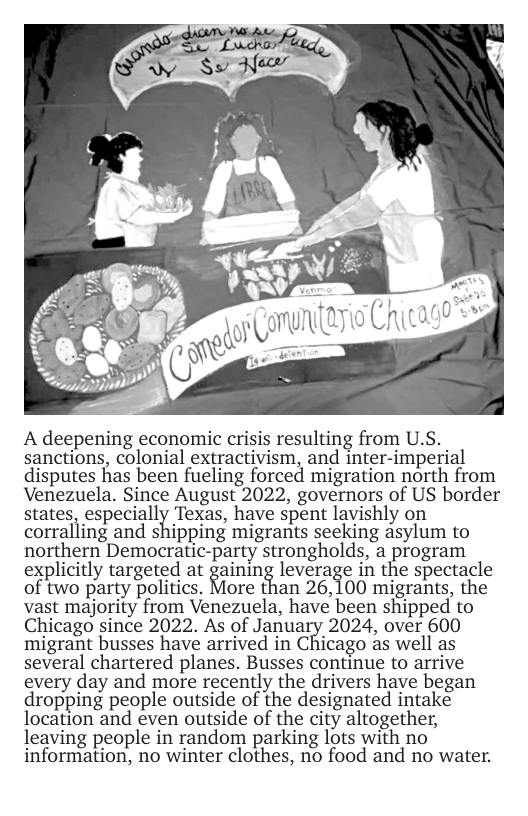
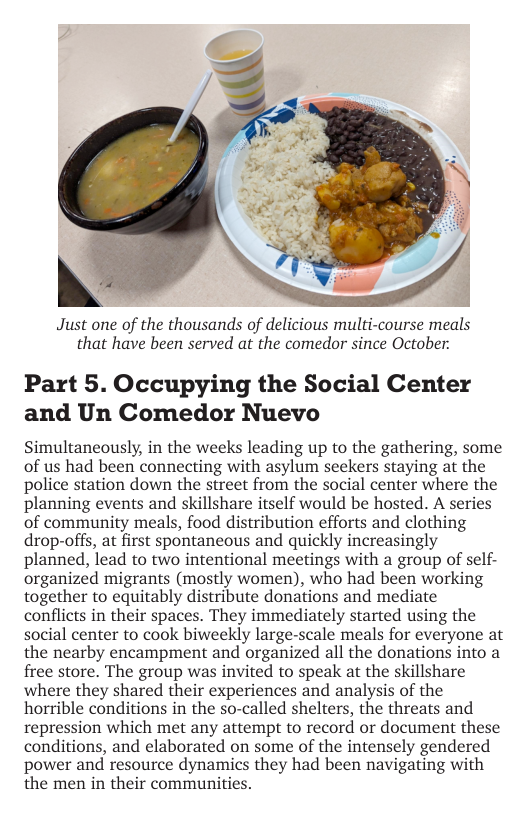
Just one of the thousands of delicious multi-course meals
that have been served at the comedor since October:
Part 5. Occupying the Social Center
and Un Comedor Nuevo
Simultaneously, in the weeks leading up to the gathering, some
of us had been connecting with asylum seekers staying at the
police station down the street from the social center where the
planning events and skillshare itself would be hosted. A series
of community meals, food distribution efforts and clothing
drop-offs, at first spontaneous and quickly increasingly
planned, lead to two intentional meetings with a group of self-
organized migrants (mostly women), who had been working
together to equitably distribute donations and mediate
conflicts in their spaces. They immediately started using the
social center to cook biweekly large-scale meals for everyone at
the nearby encampment and organized all the donations into a
free store. The group was invited to speak at the skillshare
where they shared their experiences and analysis of the
horrible conditions in the so-called shelters, the threats and
repression which met any attempt to record or document these
conditions, and elaborated on some of the intensely gendered
power and resource dynamics they had been navigating with
the men in their communities.
Incidentally, the skillshare/migrant solidarity gathering
coincided directly with an illegal lockout and attempted
eviction of the social center. With all this new energy for the
space, and the momentum of the upcoming gathering, some
people were able to come together and within hours execute a
plan to begin squatting the social center to maintain access for
both these and other projects. Three months later, we are still
holding on; new projects are starting up in the space, and we
are getting better at planning ahead and taking care of each
other. The migrant group organizing the comedor has grown
and is continuing the project as well as actively participating in
caring for and defending the space.
The fact that this group - none of which ID as anarchists - has
been actively involved in shaping the social center’s evolving
needs and determining it’s capacity, has created a fertile
ground for moments where really new possibilities and
relationships rise up through shared life and struggle — not
ideology. And of course there have been ideological challenges
through all of this — as well as social, political, cultural, legal
and more, but overall this web of experiments has been hugely
successful and the risks we have all taken shaped not only a
great deal of the fall skillshare, but also the coalescence and
endurance of these really powerful longer term projects.
Part 6. A Call to Action / A Call to
Light
We feel that consistent public or semi-public anarchist projects
and events on a local scale are extremely important because
visibility opens things up to reflection, collaboration and
metamorphosis. We don’t want to see anarchist worlds retreat
entirely from a public sphere of life. If everyone who is
dedicated to unwavering anti-authoritarian methods of
struggle is trying to be invisible, where does that leave us in
our ever unpopular struggle for a different world? We are
under no delusions of authoritarian grandeur that we might
convert “the masses” (even if we wanted to), rather, we honor
the necessity of growth-death-change in the survival of any
organism or ecosystem and our experience is that anarchists
like other living things need both the shadows and the light.
This is not to say there aren’t things that must only be done in
the shadows, but to offer an example of a time and context in
which more visibility worked for us and our goals, in hopes
that it might inspire others to take similar risks. Our goal was
and is to move away from both the general barriers of
exclusivity often found within anarchism, as well as our
original form as a convergence of randomly submitted
workshops, towards becoming an effective part of the long
term social fabric of resistance in Chicago.
We live in a time of ceaselessness; of endlessly compounding
crises, the horror and gravity of which threatens to overwhelm
and immobilize any real attempts at resistance. But this
moment of heightened social and political tension presents
many possible points of rupture with the existent world, and is
itself a call to double down on actions that counter the
isolation and fear that the logics of empire ruthlessly impose.
Moments like this provide endless opportunities to further
expose these truths and deepen the cracks in the facade. We
must refuse to be afraid of each other and ourselves, refuse to
let the professional co-optation of solidarity models keep us
from enacting our own, refuse to be robbed of agency and
imagination, refuse to keep only to the shadows!
From Chicago to Venezuela to Palestine to the Congo, resistimos !
e i BORDERS A4
VOHOMAN / i
BEING [S ~ A -
JULEGAL
/ WEW WoRLD
§ * We ARV iR HEARTS'