Bounty Hunters and Child Predators: Inside the FBI Entrapment Strategy
Web PDF • Imposed PDF• Raw TXT (OCR)
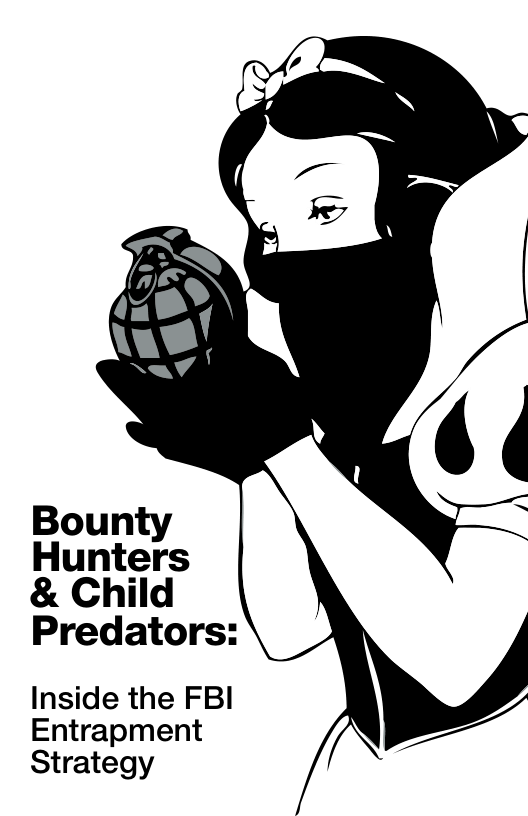




Bounty
Hunters
& Child
Predators:
Inside the FBI
Entrapment
Strategy
Perhaps, gentle reader, youve never been partof a social body targeted by the US gov-
ernment. Imagine undercover agents infiltrating your community with the intention
of setting people up to be framed for llegal activity. Most of your friends and family
would have the sense to keep themselves out of trouble, of course—but can you be.
absolutely sure everyone would?
‘What if someone fell in love with the agent and was desperate to impress him o
her, and the agent took advantage of this? Every community has people in it that may
sometimes be gullible or vulnerable, who may not display the best judgment at all
times. And whatif the agent provocateur i a person everyone trusts and looks up to?
‘Government agents aren't always outsiders—the FBI often recruit or blackmail long-
time participants, or even well-known leaders.
Perhaps you'e still saying to yourself “It would never happen—all of us are law-
abiding citizens.” Sure you are, every last one of you. The US has 2.3 million people in
prison, and over 5 million more on probation and parole—if there isn'ta ingle person
in your whole community who has ever broken a law, you're exceptional, and prob-
ably exceptionally privileged. Anyway, it doesn't matter—your unfortunate friend or
‘neighbor doesn't even have to do anything illegal to get framed by the government.
He just has to end up in a situation in which its possible to make it appear that he
could have considered doing something illegal.
Often the evidence i so tenuous that it takes the government multiple attempts
to obtain a conviction. In an entrapment case resuling from the protests against the
2008 Republican National Convention, defendant David McKay received a hung jury
atial, only to be coerced into pleading guilty afterward behind closed doors. In an-
other entrapment case, it took two hung juries before a third jury finally convicted
some of the defendants—prompting a law professor quoted by the New York Timesto
say, “It goes to show that if you try it enough times, you'll eventually find a ury that
will convict on very litle evidence.”
‘Agents provocateurs pick on the most vulnerable people they can find: the lonely,
thetrusting, the mentally or emotionally unstable, people who lack close friendships
o life experience. This is easier than messing with shrewd, well-connected organiz-
ers. The point is not to catch those who are actually involved in ongoing resistance,
o much as to discredit resistance movements by framing somebody, anybody, as a
dangerous terrorist. If this means destroying the lfe of a person who never would
have actually harmed anyone, so be it—honest, compassionate people don't become
infiltrators in the first place.
‘Thisis not to blame the victims of entrapment. We al have moments of weakness.
‘The guilt lies on those who prey on others' weakness for their own gain.
The Latest Trend in Repression
Not so long ago, it seemed that the FBI focused on pursuing accomplished anarchists:
Marie Mason and Daniel McGowan were both arrested after lengthy careers involving
everything from supporting survivors of domestic violence to ecologically-minded
arson. It isn't surprising that the security apparatus of the state targeted them: they
were threatening the inequalities and injustices the state is founded upon.
However, starting with the entrapment case of Eric McDavid—framed for a single
conspiracy charge by an infiltrator who used his attraction to her to manipulate him
into discussing illegal actions'—the FBI appeared to switch strategies, focusing on
younger targets who hadn't aetually carried out any actions.
‘They stepped up this new strategy during the 2008 Republican National Conven-
tion, at which FBI informants Brandon Darby and Andrew Darst set up David McKay,
Bradley Crowder, and Matthew DePalma on charges of possessing Molotov cocktails
in two separate incidents® It important to note that the only Molotoy cocktails that
figured in the RNC protests at any point were the ones used to entrap these young
‘men: the FBI were not responding to a threat, but inventing one.
At the end of April 2012, the FBI shifted into high gear with this approach. Im-
‘mediately before May Day, five young men were set up on terrorism charges in Cleve-
land after an FBI infiltrator apparently guided them into planning to bomb a bridge,
in what would have been the only such bombing carried out by anarchists in living
‘memory. During the protests against the NATO summit in Chicago, three young men
were arrested and charged with terrorist conspiracy once again involving the only
Molotov cocktails within hundreds of miles, set up by at least two FBI informants.
None of the targets of these entrapment cases seem to be longtime anarchist
organizers. None of the crimes they're being charged with are representative of the
tactics that anarchists have actually used over the past decade. All of the cases rest
on the efforts of FBl informants to manufacture conspiracies. All of the arrests have
taken place immediately before mass mobilizations, enabling the authorities to frame
anarrative justifying their erackdowns on protest as thwarting terrorism. And in all of
these cases, the defendants have been described as anarchists in the legal paperwork
filed against them, setting precedents for criminalizing anarchism.
Why Entrapment? Why Now?
‘Why is the FBI focusing on entrapping inexperienced young peaple rather than sea-
soned anarchists? Isn't that just plain bad sportsmanship? And why are they intensi-
fying this now?
For one thing, experienced activists are harder to catch. Unlike anarchists, FBI
agents work for money, not necessarily out of passion of conviction. Their reports
often read like second-rate homework assignments even as they wreck people’s ives.
‘Agents get funding and promotions based on successful cases, so they have an incen-
tive to set people up; but why go after challenging targets? Why not pick the most
‘marginal, the most vulnerable, the most isolated? If the goal s simply to frame some-
body,it doesn' really matter who the target is.
Likewise, the tactics anarchists have actually been using are likely to be more pop
1 ARterwards, e Magazine quoted segesfljurors a3 sying “the FB was an erbarrassment” and T hope.
he gets new eal.” He i serving a 20-year sentence and has o been granted a new trial.
2 DePalma was approached by Dars, federal nfltraor posingas 3 member ofthe RNC Welcoming Cor-
‘mitee a group planning protests against the Republican National Converiion. Darst persuaded DePalma
toasis himin manufactuing explosivs,rcorded conversatons with himina wired aparement,and.
drove him around 1o do esearch nd purchase supplis; Darst. ulimatelypleaded iyt elony charges
o possssion of unregistered firearms.” The traiesory of Darby’s entrapment of McKay and Crowder
has been widely publicized. including i the PES documentary Bcter This World.
ular with the general public than the tactics infiltrators push them towards. Smash-
ing bank windows, for example, may be illegal, but it is increasingly understood as a
meaningful politieal statement; it would be difficult to build a convincing terrorism
case around broken glass.
‘Well-known activists also have much broader support networks. The FBI threat-
ened Daniel McGowan with a mandatory life sentence plus 335 years in prison; wide-
spread support enabled him to obtain a good lawyer, and the prosecution had to
settle for a plea bargain for a seven-year sentence or else admit to engaging in illegal
wiretapping. Going after disconnected young people dramatically decreases the re-
sources that will be mobilized to support them,. If the point is to set precedents that
criminalize anarchism while producing the minimurm blowback, then i is easier to
manufacture “terror” cases by means of agents provocateurs than to investigate actual
anarchist activity.
Above all, this kind of proactive threat-creation enables FBI agents to prepare
make-to-order media events. If a protest is coming up at which the authorities antici-
‘pate using brutal force, it helps to be able to spin the story in advance as a necessary,
measured response to violent criminals. This also sows the seeds of distrust among
activists, and intimidates newcomers and fence-sitters out of having anything to do
with anarchists. The long-range project, presumably choreographed by FBI leader-
ship rather than rank-and-file agents,is not just to frame a few unfortunate arrestees,
but thus to hamstring the entire anti-capitalist movement.
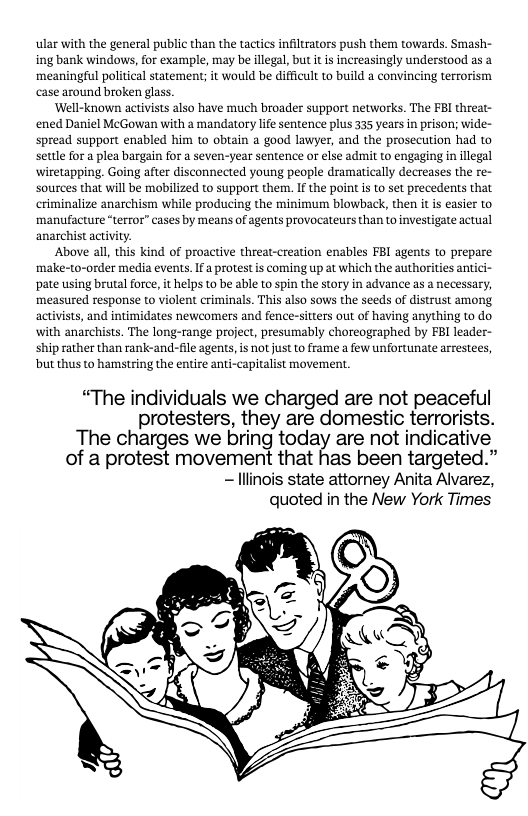
“The individuals we charged are not peaceful
protesters, they are domestic terrorists.
The charges we bring today are not indicative
of a protest movement that has been targeted.”
- llinois state attorney Anita Alvarez,
quoted in the New York Times
How to Destroy a Movement
FBI repression often does not begin in earnest until a movement has begun to frac-
ture and subside, diminishing the targets’ support base. The life cycle of movements
‘passes ever faster in our hyper-mediatized era; the Oceupy phenomenon that peaked
in November 2011 and had slowed down by April 2012, emboldening the authorities
to consolidate control and take revenge.
As anarchist values and practices become inereasingly central to protest move-
‘ments, the authorities are anxious to incapacitate and delegitimize anarchists. Yet in
this context, it's still inconvenient to admit to targeting people for anarchism alone—
that could spread the wrong narrative, rallying outrage against transparently political
persecution. Likewise, they dare not initiate repression without a narrative portraying
thetargets asalien to the rest of the movement, even f that repression s caleulated to
destroy the movement itsel.
Fortunately for the FB, a few advocates of “nonviolence” within the Oceupy
‘movement were happy to provide this narrative, disavowing everyone who didn't af-
firm their narrow tactical framework. Journalists like Chris Hedges, author of “The
Cancer in Occupy,” took this further by framing the “black bloc” as a kind of people
rather than a tactic. Hedges led the charge to consign those who actively defended
themselves against state repression to this fabricated political category—in effect,
designating them legitimate targets. It no coincidence that entrapment cases fol-
lowed soon after.
‘The authorities swiftly took up this narrative. In a subsequent Fox News article
advancing the FBI agenda, the authorities parroted Chris Hedges' talking points—
they use the Occupy Movement as a front, but have their own violent agenda’—in
order to frame the black bloc as a “home-grown terror group.” The article also de-
scribed the Cleveland arrestees as “Black Bloe anarchists,” without evidence that any.
of them had ever participated in a black bloc.
‘The goal here was clearly to associate a form of activity—acting anonymously,
defending oneself against police attacks—with a kind of people: errorists, evildoers,
‘monsters. This is a high priority for the authorities: they were able to crush the Oc-
cupy movement much more quickly, at least relative to its numbers, in cities where
people did not act anonymously and defend themselves—hence Oceupy Oakland's
longevity compared to other Oceupy groups. The aim of the FBI and corporate media,
with the collusion of Chris Hedges and others, is to ensure that when people see a
‘masked crowd that refuses to kowtow to coercive authority, they don' think, “Good.
for them for standing up for themselves,” but rather, “Oh no—a bunch of terrorist
bombers.”
To recapitulate the FBI strategy:
« divide and conquer the movement by isolating the most combative participants
« stage-manage entrapments of vulnerable targets at the periphery
« use these arrests to delegitimize all but the most docile, and to justify eve
ereasing police violence.
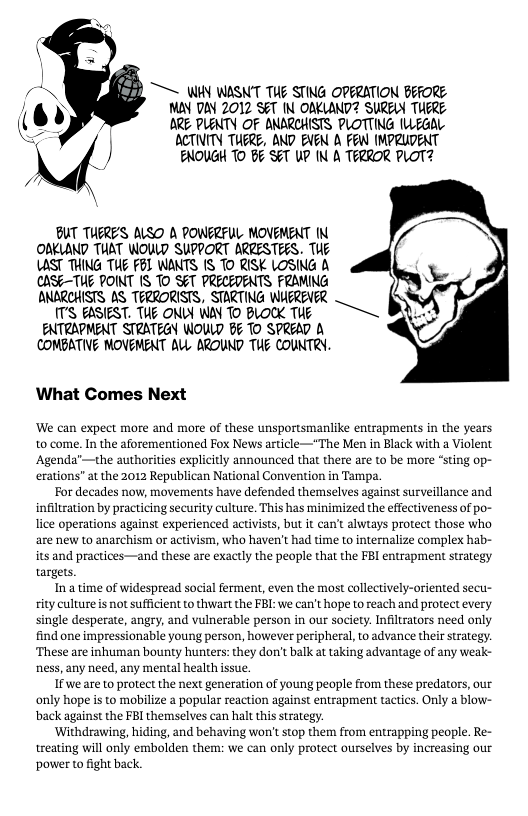
TS WHY WASN'T TUE STING OPERATION BEFORE
MAY DAY 2012 SET IN OAKLAND? SURELY TUERE
ARE PLENTY OF ANARCHISTS PLOTTING (L EGAL
ACTIVITY TUERE, AND EVEN A FEW MPRUDENT
ENOUGH TO BF SET UP (N A TERROR PLOT?
BUT TUERE'S ALSO A POWFRFL MOVEMENT N
OBKLAND TUAT WOULD SUPPORT ARRESTEES. TUE
AST THING TUE FBL WANTS IS TO RISK LOSING A
CASE-TUE POINT IS TO SET PRECEDENTS FRAMING
ONARCHISTS AS TERRORISTS, STARTING WHEREVER
TS EASIEST. THE ONLY WAV TO BLOOK TE
ENTRAPMENT STRATEGY WOWLD B¢ TO SPREAD A
(COMBATIVE MOVEMENT ALL AROUND TUE COUNTRY.
What Comes Next
‘We can expect more and more of these unsportsmanlike entrapments in the years
n the aforementioned Fox News article—"The Men in Black with a Violent
the authorities explicitly announced that there are to be more “sting op-
erations” at the 2012 Republican National Convention in Tampa.
For decades now, movements have defended themselves against surveillance and
infiltzation by practicing security culture. This has minimized the effectiveness of po-
ice operations against experienced activists, but it can't alwiays protect those who
are new to anarchism or activism, who haven't had time to internalize complex hab-
its and practices—and these are exactly the people that the FBI entrapment strategy
targets.
Ina time of widespread social ferment, even the most collectively-oriented secu-
ity culture is not sufficient to thwart the FBL: we can't hope to reach and protect every
single desperate, angry, and vulnerable person in our society. Infiltrators need only
find one impressionable young person, however peripheral, o advance their strategy.
‘These are inhuman bounty hunters: they don't balk at taking advantage of any weak-
ness, any need, any mental health isue.
If we are to protect the next generation of young people from these predators, our
only hope is to mobilize a popular reaction against entrapment tactics. Only a blow-
back against the FBI themselves can halt this strategy.
‘Withdrawing, hiding, and behaving won'® stop them from entrapping people. Re-
treating will only embolden them: we can only protect ourselves by increasing our
‘power to fight back.
Appendix: Protecting Ourselves, Protecting Each Other
Never undertake or discuss llegal activity with people you haven't known and trusted
for a long time. Don't trust people just because other people trust them or because
they are in influential positions. Don't et others talk you into tactics you'ee not com-
fortable with or ready for. Be aware that anything you say may come back to haunt
You, even if you don't mean it. Always listen to your instincts; if someone seems
pushy or t0o eager to help you with something, take some time to think about the
situation. Reflect on the motivations of those around you—do they make sense? Get
to know your comrades’ families and friends.
‘These practices are sensible, but insufficient; we can't only think of security indi-
vidualistieally. Even if 99 out of 100 are bl to avoid getting framed, when agents pro-
Vocateurs manage to entrap the 100" one we stll end up all paying the price. We need
asecurity culture that can protect others as well, including vulnerable and marginal
participants in radical spaces who may be particularly appeizing targets to federal
bounty hunters. In addition to looking out for yourself, keep an eye on others who
‘may put themselves atrisk.
For example, imagine that you attend a presentation, and one person in the audi-
ence keeps asking crazy questions and demanding that people escalate their tactics
1ts possible that this person is an agent provocateur; it also possible that he's not
an agent, but a hothead that might make a very atiractive target for agents. Such in-
dividuals are typically shunned, which only makes them more vul
Screw these squares—stick with me and we'l eally do somethiny
has nothing tolose should approach this person in 2 low-stress environment and em-
phasize the importance of proper security culture, describing the risks that one ex-
poses himself and others to by speaking so carelessly and urging him t0 be cautious
about trusting anyone who soliits his participation in illegal activity. A ten-minute
conversation like this might save years of heartache and prisoner support later on.
To learn more about federal repression and how to stop it
www.crimethinc.com
Never undertake or discuss
illegal activity with people you
haven’t known and trusted for
a long time. Don’t trust people
just because other people trust
them or because they are in
influential positions. Don’t let
others talk you into tactics
you’re not comfortable with
or ready for. Be aware that
anything you say may come
back to haunt you, even if you
don’t mean it. Always listen
to your instincts; if someone
seems pushy or too eager to
help you with something, take
some time to think about
the situation. Reflect on the
motivations of those around
you—do they make sense?
Get to know your comrades’
families and friends. $