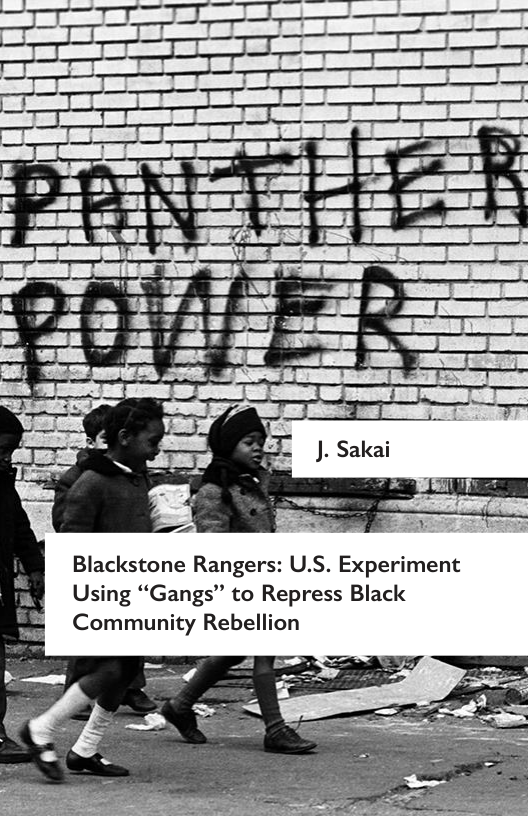
Blackstone Rangers: U.S. Experiment Using “Gangs” to Repress Black Community Rebellion
Web PDF • Imposed PDF• Raw TXT (OCR)


![by all the thousands of gang youth against the white establishment could “immobilize” the ciry.” The alluring prospect of real power was repeatedly held up for gang leaders. That June 11th, .C.L.C., and the A.C.L.U,, the street ministers of the Urban Training Center, the Y.M.C.A. and other social agencies held an all-day conference for the leaders of cight major gangs in the swank Sheraton-Blackstone Horel. Comically named, the “Turfmasters First Annual Convention,” this meeting once again tied 1o enlist the gangs into the liberal Although the Blackstone Rangers and the Disciples soon lostinterest in the rhetoric of the Southern Christian Leadership Conference, interest in them was far from over. Liberals and church progressives continued to view the gangs as important levers for social reform in Chicago. Rev. John Fry and the First Presbyterian Chutch encouraged the “Stones” to use the church as a center, and Fry himself became a controversial public defender of the gangs. Police harassment was countered by a well-financed defense program. Right-wing insurance-man Clement Stone, Charles Merril, Jr. (of the founding family of Merril, Lynch, ete.), Charles E. Kertering I, (who gave $260,000 out of GM profits) and other capialists built up a sizable fund for bail and legal expenses.’ The Hlinois Black Pancher Party was also trying hard to enlist the gangs, temporarily achieving a well-publicized alliance with the Disciples. The “Stones™ and “Ds” were widely viewed as latent revolutionary organizations, This trend achieved its purest expression in the realm of iterature, in Sam Greenlee’s The Spook Who Sat by the Door.* In this bestselling novel, a Southside Chicago youth gang is sccrerly reorganized by a Black rebel who learned guerrilla warfare within the C.LA. The novel ends in a powerful, but doomed, all-out armed assault by the gang against the U.S. Army. 5 John Fry, Fire and Blackstone, ] B. Lippincott & Co, 1969, Page 5. 6 Daily Defender, June 13, 1966. Chicago Sun-Times, June 12, 1966. 7 Chicago Tribune, Auguse 23, 1970. Chicago Tribune, Seprember 24, 1970, 8 Sam Greenlee, The Spaok Who Sat by the Door, Bantam, 1970,](blackstone-rangers-us-experiment-using-gangs-to-repress-black-community-rebellion-j-sakai 11.png)
![arrest in the Negeo slums are just as apt to wigger a riot as their heavy-handed brethren. “In fact, those who know the Negro slums best are pessimisic. They are sure only that the sole force of dicipline in those slums are the anonymous gang laders [ous exmphasis]. Thus, the splic of the whiteesablishment aver how t deal with thse gangs,as scn in Chicago, is Il furcher cause for pessimism.” This split in the capitalist government made for not a few ironies. Jerome Bernstein, the “Godfather” of the vry successful gang project, was fired from O.E.O. by Sargent Shriver for having become to0 pol explained, being fired for producing the only successful federal “anti- ioc” program for the ghetto. He flely pointed out how Woodlawn was kept from exploding, unlike Was, Detroir, Newark, Harlem. and Chicago’s Westside™ ally controversial. Bernstin was frustrated at, as he repeatedly Boch i g0t to ty their strategies for repression. This produces the irony of rals and conservatives (inadequate categories in this case) gang leaders having “delivered the goods™ for the government, now serving time in a federal prison for “conspiracy to commit fraud” in handling O.E.O. funds. OF course, the government officials and Black community leaders who gor the gangs involved in this project, who gave them informal approval to rip-off” funds, who virtually set them up, walked away clean after the project collapsed. The final irony came with President Richard Nixon’s inauguration in January, 1969. During this triumphant celebration of Republican victory, the gangs weren forgotten. Jeff Fort, already under Federal Investigation, received a formal invitation to Nixon’s Inaugural Ball Fort sent Mickey Cogwell and Bobby Jennings, complete with “white ties and tails,” as Ranger representatives to the Inaugural Ball. The white public in Chicago was astonished. Veteran Black journalist Lou Palmer saw it as the Nixon Administration’s recognition of the potential vote power: “Nixon squeaked into the Presidency with few Black vores. The Black P Stones had campaigned to persuade Blacks 39 Washinglon Post July 5, 1967 40 Chicago Tribune, March 30, 1972, 2](blackstone-rangers-us-experiment-using-gangs-to-repress-black-community-rebellion-j-sakai 28.png)
![0 boycort the polls™! Naturally vote boycorts of predominantly Democratic Black voters could only help Nixon and the Republicans, and Nixon had encouraged such campaigns conclusion We should now be able to see clearly what Marx and Engels meant when they said that the lumpenprolecariar *...May, here and there be swept into the Movement...Its conditions of life, however, prepare it far more for the part of a bribed tool of reactionary intrigue.” Groupings of the oppressed must be understood in terms of class. Black gangs are composed primarily of working-class youth, many of whose families are in what Marx referred to as the “Reserve Army” of the unemployed. These youths, because of their colonial and class oppression, are logically pulled towards rebellion. We know that some members of the Black P. Stones and Disciples participated enthusiasticaly in the defense of the literally besicged Black community of Cairo, llinois. Some joined the Black Panther Party and other organizations. At least part of the leadership was at one time strongly motivated to drive heroin pushers out of the “wrf” The gang structure effectively “locked up” this pull towards rebellion. The gang leadership not only used the power of their own organizations to “police” the ghetto, but, most importandy of all, neutralized their organizations the critical straa of the most oppressed working-class youth, There i, of course, no precise dividing line “on the streets” berween the lumpenproletariat and the lower working clas. Further, clements of the “lumpen” — angry, desperate — have always been drawn into the struggle, usually during its most militant or violent stages. All previous Marist experience, internaionally, has taught us to use these elements but not build primarily on them. Many organizers 41 Chicago Daily News, January 21, 1969, L.E Palmer, ], “Behind the Insugural Invication.”](blackstone-rangers-us-experiment-using-gangs-to-repress-black-community-rebellion-j-sakai 29.png)


Blackstone Rangers: U.S. Experiment
Using “Gangs” to Repress Black
Community Rebellion
“Blackstone Rangers: ULS. Experiment Using Gangs to Repress Black
Community Rebellion” was taken from J. Sakats The Dangerous
Class and Revolutionary Theory. Monueal: Kersplebedeb, 2017.
ill-will-cditions.cumblr.com
illwill@riscup.net
BLACKSTONE
RANGERS:
The U.S. Experiment Using Gangs to
Repress Black Community Rebellion
J. Sakai
introduction (IWE)
Our purpose in reprinting Sakai's picce s to share an ofien neglected
episode of Chicago history as an entry point into theoretical and
practical questions about local insurrectionary porential. The story he
shares s the following: in the late 19605, members of the city's Civil
rights movement sough to ally themselves with the most powerful
black street gangs in Chicago. Together they secured a $927,000
annual geant through the federal Office of Economic Opportunity. The
Chicago police department eventually gor involved and worked with
liberal “community leaders” to use the gangs as a counter-insurgency
force. Black gangs — especially the Black P Stone Rangers — were
regularly relied upon to suppres rioting and revolutionary organizing
in their territories.
This history and the problems it poses are sill with us insurgents ac
present. We've scen liberal lefiists and gangs alike threaten fiereely
anti-cop forces at demonstrations afier police shootings through
aggressive marginalization, snitching, and threats of direct violence.
Lefists cynically consolidate political authority by constructing “the
community” through the constitutive exclusion of the “Outside
Agitator” whom they are always ready to hand over to the police
And gang leaders dont mince words about their willingness to shoot
anyone who interferes with the territorial economy they operate for
their individual aspirations of upward mobility i the capitalis system.
Theoretically, we do not follow Sakai's class analysis of the black
lumpenproletariat (which is orthodox-Marsist by his own admission),
save heuristically.’ Its limits are evident throuhgour, though they are
beyond the scope of this introduction to discuss in detail. To cite one
example, the following text ultimately lacks 2 palitical analysis of late-
605 Chicago, though one may catch a glimpse of it from time to time
in peculiar, unexplained passages. At one point Sakai discusses how the
1 For Sakai's broader analyss of the lumpenproletaiar, sce: J. Sakai,
The Dangerous Class: Thoughts on the Mating of the LumpentProltaria.
(Montreal: Kersplebedeb, 2017)
gangs functioned to suppress riotous crowds and break up Pancher
organizing efforts. And then, pages later, he mentions thar the
Panthers themselves also prevented riots from breaking out (albeit
in California). The politically strategic question of the insurgent
value of the riot never arises, nor does the question of authority in
‘moments of spontancous revol.
Practically, the problem for us, however, is a question of what
strategy 1o take with respect to the wiangular counter-insurgency
apparatus made up of lefiism, police, and gangs? How to navigate
their counter-insurgent history while also recognizing that there
are fragments of the lefi and the gangs that are irreducible to the
existing order of things?
The past thirty years have seen the police pursue a strategy of
“decapitation’: going after shot-callers and warching like vultures as
the gang hierarchies implode into organized disorder. The resultant
genocide is the cheap price of the boost in police legitimacy; as
citizens cry out for protection from the multiplication of gang wars
The civil rights campaigns and “community organizations” of the
lefi, meanwhile, have fragmented and muliplied into an expansive
N.G.0. nework asits more revolutionary tendencies have retreated
10 abolicionism. We are familiar with peace-policing in the streets,
but rarely do we reflct on how to organize ourseles vis--vs the
aforementioned. triangle outside of head-to-head confrontations
with the cops. In general, we lack a contemporary. political
analysis of the counter-insurgent shape of power relacions that has
emerged through the Lefi-cop-gang triangle in Chicago. Despite its
predominanly class-based analysis, we hope that the following text
by J. Sakai can provide some orientaion to that end.
preface (Sakai, 2017)
The following investigation in using class analysis to cut into current
pol
state is always running different trial projects in violently repressing
the Black community; seldom can we document the political details.
s was written in the carly fall of 1976. Even though the capicalist
Often they are clandestine, of course. So this was a rare opporaunity
o do thar
My politics then were more standard Marsist on a theoretical level,
and chis paper reflects those primary criticisms of the lumpen/
prolecariac as a parasitic class casily bought off by capitalism against
its own people. In practice, my political lfe was somewhat different
even at that time; both in anti-war activity and in revolutionary
working class organizing,
and also working against an assortment of lumpen guys both white
as simultancously working closely with
and New Afikan. My own theoretical view of the lumpen/proletariat
has shified its angle of vision since then, though much of what i
analyzed in chis situation in 1976 was obviously facrually true. We
decided to leave this writing as it originally was, as an example of that
thorny period politically.
Whar hasnt been said is that on a_ personal level while wi
&
i was really pissed at the practice of street organizations like thar
Their development was obviously brilliant, but also ke terrorism
enforced on the Woodlawn community and the New Afrikan working
people there. It was il
final exasperating touch was that both the white liberal community
and the white lefi in town were strongly pro-gang. Excusing every
misdeed, hoping mostly to opporwnistically cash in somehow on
the paramiliary rise of the lumpen-led organizations. It wasn't
a white supremacist fantasy come true. The
such a nice time for families caught in the beat down, as the state
happily ex
was also, coincidencally, where i had graduated from Wadsworth
ented in using Black t0 step on Black. Woodlawn
elementary school (my one academic degree), and where i went @
the same secondary school as JeffFort, the founder and leader of the
Blackstone Rangers
One morning a co-worker who sat at the next desk at my job, came in
obviously upset. Earler that morning, while getting ready for school,
her young daughter had glanced out the window only to see two
Blackstone Ranger soldiers casually pull out guns and kil another
youth right on the sidewalk ouside. The daughter was completely
terrified and refusing to leave their apartment for any reason. Her
mom was equally frightened that the organization would somehow
find out that her kid was a witness t0 i all. She was crying and not
believing my assurances that even the street organization didn't have
xcray vision like Superman, or any magical means of discovering
her daughter. That the kind of fear that capitalism unleashes to
disconnect people from their own strengths and mess up their lives
It was hard for me to romanticize that away as so many movement
people were doing politicall.
Lastly, 1 have 10 acknowledge the comradeship and practical
assistance of the Chicago Repression Rescarch Group, who skillfully
managed 1o liberate from the U.S. govenment several file boxes
of cormespondence, grant applications, assorted documents and
departmental reports. Again, my thanks
blackstone rangers: the u.s.
experiment using "“gangs”
to repress black community
rebellion (1976)
A central confusion within the Movement ten years ago was the
question of class. Who are the revolutionary forces? Who are the
reactionary forces? Typical of that chaotic time of trying on different
ideologies as one ties on clothes of different styles, was the confusion
over the lumpenprolecariat and the *sreet people.”
The lumpenproletariat, long viewed by Marxists as an unstable and
“dangerous” class, were suddenly praised by many revolutionaries. In
1969, when the Black Panther Parcy was explaining the forcible ouster
of distuptive white lefsts from their Oakland United Front Against
Fascism Conference, the BPP defined the ouster s lumpenprolecariat
discipline.” Eldridge Cleaver, acting as one of the chief deologists of
the Panther Party, acclaimed the *Black urban lumpenproletariar” to
be “the vanguard of the proletariar This confused trend of hailing
“the Lumpen” as the most revolutionary strata in U.S. society was
widespread in various third world movements and the “New Lefi"
Students for a Democratic Society.
In this study, we show how the capicalist state, in the form of a
reform “poverty program,” reached down into the very mass of the
oppressed in one community in Chicago to recruit a force to keep a
repressive order for it. It was the leadership role played by lumpen/
prolecarian elements within that organization of oppressed that gave
the government its leverage. Further, the situation was both masked
and confused by a splic within the state, with certain police clements
savagely turning on their newly-bought “Lumpen” allies. During this
umpenprolecarian Discipline V. Bourgeois Reaction,” Black
Panther, Augus 9, 1969.
3 Eldridge Cleaver, “On the deology of the Black Panther Party,” Black
Panher, June 6, 1970
time the Movement was able neither to successfully intervene nor
even 10 expose this deadly maneuver, because of our confused ideas
about the “lumpen.” This resulted in a situation where the De Faco
public emphasis of the Movement towards this development was to
support the repression. As starling as this may seem, it underlines
the practical necessity of class analysis in guiding our immediate
work. When radicals in the ‘605 spoke of “the lumpen” they were
wsually talking about what they also called “street people” as a whole.
So that a high-school-age gang member, an unemployed veteran just
back from Vietnam, and an aspiring pimp or heroin pusher might
be classed together as “lumpen.” Often, a personal involvement with
violence and erime was regarded as immediate proof of high potential
for revolutionary work. This confusion about class had tragic results.
Lack of a precise understanding about the lumpenproletariat s sl
50 dangerous because it blinds us t0 a key factor in the development
of repression against the oppressed. Marsists have tradicionally made
a sharp distinction between the poorest, most oppressed layers of
the working class — who are propertyless and often jobless — and
the lumpenproletariar. The latter, existing on the bortom edge of
society, no longer have any relation to the means of production and
distribution. The owe no loyalty save to their own personal interests,
and, far from having solidarity with any class they are all 100 willing
o live as parasites preying on their own people. At times this point is
obscured since the “lumpen” are traditional victims of police activiry:
In a famous passage in the Manifesto, Marx and Engels wrote: “The
‘dangerous class,’ the social scum, that passively rotting mass thrown
off by the lowest layers of old society: may; here and there, be swept
into the movement by 2 prolecarian revolution its conditions of
life, however, prepare it far more for the part of a bribed tool of
reactionary intrigue” That analysis is sill accurate, and helps us
understand how organizations of “street people”are successfully used
by the ruling class.
4 Karl Mars and Frederick Engels, “Manifesto ofthe Communicy
Pany,” Selecred Works, International Publishers, 1972. Page 44,
a case study in chicago
In 196570, national attention was focused on the explosive political
growth of Black youth gangs in Chicago, Illinois. Two Southside
gangs in parcicular, the Black P Stone Nation and their rivals, the
Disciples, rapidly became empires; thousands of youth could be
mobilized wearing either the red berets of the “Stones” or the blue
berets of the “Ds.” Immediately, both the Civil Rights Movement
and the white liberal community saw these gangs as ready-made
organizations to advance the interests of social eform. Both believed
that police harassment of ghetto youth and the poverty of gang
members opened the door to recruiting these gang strucrures en
masse into the Movemen.
The Black P Stone Nation, the largest of the two youth gangs, was
pethaps the most successfully publicized organization of its kind in
the U.S. From its origins as a grammar school marching group for
the Annual Bud Billiken Day (2 traditional celebration sponsored
by the Chicago Defender and participated in by tens of thousands
of Chicago Blacks), the “Stones” soon grew into a local Woodlawn
gang. In the carly sixtis that gang, the Blackstone Rangers, became
the “General Morors” of Southside Chicago gangs. I found the key
to growth by becoming a “conglomerate” of gangs by convincing
local gangs to affliate into the Blackstone structure. The local gang
leaders were represented on the “Main 21, the leadership council of
what later became known s the Black I: Stone Nation. At their peak
the “Stones” had most of the gang youth on the Southside from 23rd
Street to the City's southern edge, with addicional affliates in the
Black suburbs, the Westside and Northside, and claimed membership
was between 5,000-7,000.
The
more of “fighting gang” and less political than the “Stones” They
were dominant in the Englewood area, West of Woodlawn. ‘Their
membership was generally put at around 1,000. In the Spring of
1966, Rev. Martin Luther King, James Bevl, Al Sampson and other
S.CLC. saff suried holding meetings with over thirty Chicago
youth gangs. In May, Rev. Bevel addressed 400 “Stones” in the
First Presbyterian Church of Woodlawn, stressing that a campaign
isciples (“Ds”) were generally conceded to be fewer in number,
by all the thousands of gang youth against the white establishment
could “immobilize” the ciry.” The alluring prospect of real power was
repeatedly held up for gang leaders. That June 11th, .C.L.C., and
the A.C.L.U,, the street ministers of the Urban Training Center, the
Y.M.C.A. and other social agencies held an all-day conference for the
leaders of cight major gangs in the swank Sheraton-Blackstone Horel.
Comically named, the “Turfmasters First Annual Convention,”
this meeting once again tied 1o enlist the gangs into the liberal
Although the Blackstone Rangers and the Disciples soon lostinterest
in the rhetoric of the Southern Christian Leadership Conference,
interest in them was far from over. Liberals and church progressives
continued to view the gangs as important levers for social reform
in Chicago. Rev. John Fry and the First Presbyterian Chutch
encouraged the “Stones” to use the church as a center, and Fry
himself became a controversial public defender of the gangs. Police
harassment was countered by a well-financed defense program.
Right-wing insurance-man Clement Stone, Charles Merril, Jr. (of
the founding family of Merril, Lynch, ete.), Charles E. Kertering I,
(who gave $260,000 out of GM profits) and other capialists built
up a sizable fund for bail and legal expenses.’ The Hlinois Black
Pancher Party was also trying hard to enlist the gangs, temporarily
achieving a well-publicized alliance with the Disciples. The “Stones™
and “Ds” were widely viewed as latent revolutionary organizations,
This trend achieved its purest expression in the realm of iterature, in
Sam Greenlee's The Spook Who Sat by the Door.* In this bestselling
novel, a Southside Chicago youth gang is sccrerly reorganized by a
Black rebel who learned guerrilla warfare within the C.LA. The novel
ends in a powerful, but doomed, all-out armed assault by the gang
against the U.S. Army.
5 John Fry, Fire and Blackstone, ] B. Lippincott & Co, 1969, Page 5.
6 Daily Defender, June 13, 1966. Chicago Sun-Times, June 12, 1966.
7 Chicago Tribune, Auguse 23, 1970. Chicago Tribune, Seprember 24,
1970,
8 Sam Greenlee, The Spaok Who Sat by the Door, Bantam, 1970,
In a recent interview, Greenlee confirms that his novel was a fictional
vehicle for a “serious study of the revolutionary potential in the Black
community” He says the gangs had *..the greatest revolutionary
potential. All they lacked was orientation and leadership. I think they
had more revolutionary potential than the Panthers, for instance.™
Greenlee is only expressive of what many people believed a few years
ago - and perhaps many sill believe.
gang leadership not revolutionary
Contrary o the myth s0 often projected,the Blackstone Rangers and
the Disciples were never “revolutionary.” or even usually
The youth gang leadership openly and honestly looked to their own
interest, bargaining and maneuvering with all sides to get the best
“deal.” Andrew Barrer, Youth Director of the National Conference
of Christians and Jews (and a former street worker with 2 “Stone”
affliare), summed it up very concisely:
“The Rangers are becoming highly politicaly oriented. They are
interested in getting a piece of the action, not tearing down the
system.”0
As Greenlee himelf poins ou:
“Most of street gang activiry is antisocial, and it is and was a
serious problem to the community. They weren' robin-hoods;
they werent robbing from the rich to feed the poor. Their ip-
offs weren taking place in Highland Park, they were taking
place in Woodlawn and Lawndale. They were ripping off their
friends, neighbors, mothers, fathers and daughters™"*
While the Black liberacion organizations have always had to fight
the repressive police structures, to publicize their racist crimes
and organize against them, the “Stones” and “Ds” leadership had
9 Reader, Novernber 21,1975,
10 Chicago Tribune, June 16, 1969.
11 Reader, November 21, 1975,
1
2 policy of submission o the police. Time and again they hoped
that cooperation with the police might earn them favors, particularly
personal protection from arrests. What was the exact nature of
that cooperation with the Chicago Police Department? ‘The gang
leadership, parcicularly elements of the “Main 21 of Blackstone,
served the police as informers and enforcers, suppressing sparks of
Black unrest. 1966, 1967, and 1968 all saw massive Black “riors,”
rebellions in the Chicago Gherto. All three years the “Stones”
leadership worked with the police to keep the Woodlawn community
“quiec” In a geant application to the O.EO., the Woodlawn
Organization gave an example of this activity:
Ranger activity during the widely publicized Westside riots in
Chicago during the summer of 1966. At the time the riots were
undervay, the Rangers were under considerable pressure to join
the rioters because of their alliances with Westside groups. “The
Ranger leadership met and decided nor o participate in the riots
but, more importanly, decided to make an organized effort o
prevent
developed and carried out by the Rangers in conjunction with
the Chicago Police Department, the Woodlawn Organization,
and the First Presbyterian Church.
“First, the Ranger leadership planned a awenty-four hour phone
service at the Church during the time the riots were taking place
in the Westside. T-W.O. workers and police offers were called
into service every time there was any possibilcy of gang youth
becoming involved in a disurbance. The Ranger leadership, in
response to calls, went to the site of possible disturbances and
dispersed the youth involved. ‘There were over 30 such calls
concerned with possible unilareral action by a member handled
by the Rangers. Secondly, Ranger members were instructed to
allif approached by anyone inciting them to ror. There was one
such incident in which the person inciring to riot was idencified
and his name turned over to the Police... The Rangers' action
was one of the most relevant reasons that the on-going riots were
prevented from taking place in Woodlawn.™
12 Uniited grant proposal from TV.O. to Communicy Action
Many Black organizations in various cities, fearing the destruction
of these rebellions and viewing them as a furile direction, worked
their communities (the B.2P. itself did so in Oakland,
California, for example). But to these particular gang leaders this
“riot prevention” took the form of close cooperation with the police,
and was only the most visible tip of their submission to the state
apparatus.
federal recognition of the gangs
On May 30, 1967, Theodore Berry of the Community Action
Program, Office of Economic Opportunity (O.E0.) formally
approved a$927,341 Federal Grant to the Woodlawn Organization.*
This decision funded an experimental project to give basic literacy
and job-skill training to 800 Black gang members. The real point of
this experiment, however, was that the leadership of the Blackstone
Nation and the Disciples were in realty full parmers in the grant,
sharing in the money and the staff positions. Within a year this
project was a national scandal, the subject of intense police repression
and on the verge of closing down. The political eoup de grace was
delivered by Senator McClellan, who in July, 1968, held a Senate
inquisition designed t0 stir up headlines and racist stercotypes.'*
This federal grant was the high-water mark of the influence of the
Blackstone Nation and its best-known leader, Jeff Fort
Its quite easy 10 evaluate the efectiveness of the grant. As of June,
1968, only 105 youth had been placed in jobs during the previous
year, of whom 65 were sill employed." Microscopic results for a
million-dollar project. ‘The reason, of course, is that there is a
Program, O.E.O., but clearly 1967. Page 10
13 “Tiwo-Track Manpower Demonstration for 800 Unemployed
Disadvantaged Young Adults,” CAT Project No. (G8734/A/0).
14 Riots, Civil and Criminal Disorders, Part 9-17. Hearings held by
the U.S. Senate Committee on Government Operations, Permanent
Subcommiitee on Investigations.
15 “Tiwo Major Isues (Charges and Answers)” Page 5. (This is an
O.E.O. background paper, written in anticipation of the McClelland
Hearings and given to Senators Muskie, Javis and Harris)
shortage of jobs in the U.S. for Black youth. ‘This is parcicularly
true for youth with police records and a gang history. An internal
O.EO. memorandum, dated April 2, 1968, admitced that the lack
of jobs was “the most glaring problem.”* The only area where the
grant showed practical results was in the reduction of gang violence
between “Stones” and “Ds.” Youth gang murders dropped 44% in
the 3rd Police District becween the Summers of 1966 and 1967,
as gang leadership restrained fighting lest it endanger the flow of
OEO. dollars.
Itis important to understand that for the government, the success
or failure of this project had licle to do with how many Black
youth found jobs, or didn' kill each other. This O.E.O. grant was a
disguised Vietnam-style counterinsurgency program, an experiment
in enlisting lumpenproletarian gang elements to help police the
ghetto. In the early Spring of 1967, a quiet meeting was held at the
Woodlawn Organization offices on East 63rd Steeet in Chicago. Six
men, representing T:W.0., Chicago Urban League and the Office of
Economic Opportunity; took part in this meeting. The Chicagoans
wanted to make certain there were no misunderstandings about the
proposed gang project. In particular, they wanted it understood in
advance that the “Main 21” and the “Ds” leadership would use their
power 1o “rip-off” funds from the project. There was no other way
the project could work.
Thesenior O.E.O. representative replied that he understood quite well
and that it posed no problems for Washingon. He then went ahead
0 sketch out, “Off the record,” the dynamics of the project. The real
goal of the project was to help create a “Black Mafia.” O.E.O. knew
that the Blackstone “Main 21" had fantasies of becoming another
syndicate, taking over control of drugs, numbers, prosticution, and
protection in the Southside ghetto. O.E.O., by giving them hundreds
of thousands of dollars, job patronage for their members, Federal
“legitimization” and helping arrange police connections, would give
them at least a chance at their goal. Since white ethnic groups had
advanced themselves through organized crime, O.E.O. was willing
16 C.AR. Memorandum from Dennis Porter to Donald K. Hess, April
2, 1968, Page 10.
0 help Blacks do the same. All the participants agreed that the “Main
217 had poor odds for success, but that they owed it to the Black
community to try and help chem.
Many believe that promoting Black control of organized crime is
an imporant step upwards for the Black community, but ics hard
0 imagine the government acting from that morive. It would make
much more sense to assume that a large, sable criminal organization
would be created by the government because they saw it as an
imporant tool for social control. All the evidence bears this our. In
his tescimony before the McClellan Subcommittee in 1968, Jerome S
Bemstein, O.E.O. Project Manager for the Woodlawn grant, proudly
cited the political fruits of funding the Rangers and Disciples:
“These two youth gangs were responsible for preventing a Black
Pancher meeting on August 1,1967 which was to be held on
the Westside of Chicago for the express purpose of forging a
coalition of youth gangs to collectively ‘take on the City’ during
the summer of 1967. These two gangs proclaimed thar there
would be no iots and that there would be no Black Panther
meeting. There were no riots and there was no Black Panther
meeting. On more than one occasion, these youth took over
the streets of Woodlawn and prevented bloodshed and property
destruction when police control over the situation had seriously
deteriorated””
What could be more clear? As one Disciple leader told a Black
newspaper: “We can control and police our people better than
the police and the Army™"* Even more pointed was the private
memorandum Bernstein wroe on his return to Washington from
Chicago. In July, 1967. Bernstein had oriented the “Main 21" o their
new role by bringing n as teachers three “Black Power Militants” from
Watts who were working in O.E.O. Poverty Programs. These “Black
Power Milicants” were, of course very friendly to the government and
“vehemently opposed to Black Nationalist movements."”
17 Statement of Jerome S. Bernstein. Page 12.
18 Daily Defonder, April 9, 1968,
19 Jerome 5. Bernstein, “Memorandum For the Record. TW.O. Field
16
Bernstein soon got a report from Rev. Archur Brazier, President of
TW.O., that their new pupils had learned their lessons quickly:
“Rev. Brasier informed us that the meeting of the Rangers with
the Waus group had a profound effect on both gangs. He stated
that, whereas, on Tuesday, the day before, the gangs were ready to
shoot it out n the street, e first thing Wednesday morning, the
two leaders of each gang came into T-W.O. ‘arm in arm.” They
informed Rev. Brazier that they were opposed to any rioting in
Chicago and that they would not permit any riors to take place
in their ‘hood". They stated thar they would not tolerate ourside
agitators coming into their community to provoke riots and that
they would run them out of Woodlawn, and, if necessary, shoot
them.
“Rev. Brazier informed me that he had received 2 call from
Commander Griffin who was concerned about a rumor that an
agitator from Detroit had arrived in Chicago to foment riots and
that he was operating in South Chicago. Commander Griffin
stated that his men could not identify who this individual was
nor could his men locate him. Rev. Brazier transmitted this
information to the Rangers who later that day idenified the
individual and informed the police of his name and whereabouts,
and he was subsequently apprehended and, I believe, sent out of
the City (1 do not know if this information was transmitted to
Commander Griffin through TW.O. or not).™
This is what the government was paying for, and even at a million
dollars a year it was a bargain. In Vietam, the US. was paying much
more for native counter-insurgency troops and not gereing half the
service. It should be clear that in return for government favor
was expected that the gangs would use the threat of violence to keep
Blacks in their place. The defense of white business propery-capiral,
in other words, was a top priority. This project was so important
t0 O.E.O.s own procedures it became the only project in Chicago
funded dis
iy from O.E.O. to the community, bypassing Ciry Hall,
“Teip of July 25-27, 1967,” August 12, 1967 Page 3.
20 Tbid, 25.
Aletter from Rev. Brasier to Jerome Bernstein on August 3, 1967,
gives us a good example of this According to the letter and
supporting newspaper accounts, the new Woodlawn grant passed a
practical test of its effectiveness. The previous Tuesday, August 1,
Nicholas . Nickolaou, owner of Big Jim's Cut-Rate Liquors ac 7th
Street and Cottage Grove, shot a Black man and killed him. The white
merchant had accused a Black child of breaking his store window and
had confiscated the child's bike. The child’ facher angrily came and
confronted Nickolaou, who then shot him twice s he was leaving,
claiming self.defense.
Since the killing was witnessed, community anger quickly rose as
the news spread. Within 45 minutes of the killing, Leon Finney
of TW.O. received an urgent telephone call from George Collar,
President of The Woodlawn Businessmen's Association. Finney went
out to the scene to help police pacify the crowd of angry residents
Parents from the area refused to be dispersed and were talking about
burning the white-owned liquor store ou. Finally, Finney gor Nick
Lotenzo, a leader of the Disciples, to take action with 50 of his
members. To quote Finney, “The Disciples walked up to the corner
in a body and demanded to have the corner clean. In 2 few seconds,
all the adults quietly dispersed and went home.”
Lotenzo boasted 1o the Chicago Daily News: “The people in the
neighborhood know our strength. They moved. Yesterday it was quiet
and today ics quiet”** Brazier, whose organization was complimented
by the police and the daily newspapers, was quite pleased over the
incident. As he wrote to O.E.O.: I think that without a doubt the
constructive activity of the group in this sicuation can be traced
direcly to the O.E.O. Youth Grant™*
21 Letter to Jerome 5. Bemstein from Rev. Arthur Brasier, August 3,
1967.
22 Chicago Sun-Times, August 2, 1967. Chicago Daily News, August 4,
1967.
23 Letter to Jerome 5. Bemstein from Rev. Arthur Brasier, August 3,
1967.
15
Instead of organizing protests agains the white merchans or taking
action against racists themselves or even just standing aside and
ltting some rough justice be attempted, TW.0. and the gangs had
0 act as police auxilries and protect white business property. In
both Braziers letter to O.E.O. and Finney’s statements to the press,
the sporlight is on how the T:W.0.-gang combination prevented the
liquor store from being destroyed; in both accounts one is struck
by how unimporaant the murder of a Black father scems. In the
congrarulatory newspaper editorials, statements by liberal politicians,
memos to Washington, etc. the use of the threat of violence by a
gang against community residents — clearly illegal by existing laws
is warmly applauded. ‘This reveals the essence of capitalist “law and
order”
Such cooperation with the police against the people was the
condition of the grant, and built into the program. Every day project
scaff met with Sgt. Wilson, 31d District Chicago Police Department
t0 exchange information. Twice a month, Commander Griffin of
the 3rd District met with Rev. Brazier and other project officials ac
2 “monitoring meeting” at Regional O.E.O. offices.* T:W.O. was
trusted sufficiently by the police to be given copies of the reports
turned in by police informers inside the gangs themselves 2
the politics of gang leadership
Tt would be wrong to view the lumpenproletarian gang leadership as
politically passive, a tabula rasa, willing to go in whatever direction
the momentary advantage directed. On the surface that seems true,
with the Rangers and Disciples Rirting with both sides. They went to
the Poor Peoples Campaign in Washington, they swelled the ranks of
Rev. Jesse Jackson's campaign about job discrimination, they joined
24 “Tiwo Major lsues (Charges and Answers)” Page 5. Monthly
reports from Rev. Brasier 10 O.E.O. confirm these frequent meetings
with the Chicago Police Department
25 Chicago Sun-Times, March 15,1972,
any emporary liberal cause or event that promised publicity and/
or money. In a deeper sense, however, these gang leaders had several
imporant poins of political unity with the government.
First, the gang leaders had a strong natural orienation towards
protecting white business in Woodlawn. They viewed the community
~ people and commerce and real estate — as a resource to be mined
for its profibility. Every white businessman who lefi the area
simply meant a source of potenial income lost. When the liquor
store incident happened the Rangers and Disciples et and assessed
the situation. According to Nick Lorenzo, “We agreed that this
community is ours and we'e going t keep it
An interesting example of this atitude was the Red Rooster Super
Markets, which had a large store at 62nd Street and Dorchester in the
center of Woodlawn. Red Rooster was infamous for i untestrained
consumer fraud tactics, and over the years gathered many slap-on-
the-wrist violations for rigged scales, etc. A favorite Red Rooster
fraud was soaking packaged meat in water, then fieezing the whole
mess. Result: with each package of meat the Black shopper also paid
for as much as one-half pound of ice.
In March, 1969, Rev. Jesse Jackson’s Operation Breadbaske started
picketing Red Rooster over these abuses. The protest was soon settled
by the Red Rooster chain hiring twenty-two “Stones,” including Jeff
Fort, Mickey Cogwell, and other “Main 21.” The jobs appear to have
been mostly a pay-off to let Red Rooster go on exploiting the Black
In the same way, every time a major rebellion broke out in Chicago's
ghetto, the “Main 21" would move to protect Woodlawns white
businesses with “do not touch” signs. Black homeowners were also
important o the “Stones,” since they could be encouraged to buy
“window insurance.” Small wonder that when the police accused
the Blackstone Rangers of extorting protection money, both
the Woodlawn Businessmen's Associacion and the Jackson Park
Businessmen's Association held a press conference to defend and
26 Chicago Sun-Times, Auguse 4, 1967
27 Chicago Tribane, Match 8, 1970
2
praise the “Stones.” At that meeting, Father Tracy O'Sullivan of St.
Cyril Church said: “The youths really delivered, and this artack by
the police was the thanks they gor*"
While movements of the oppressed usually clash with exploitarive
business interests, this was not true with the gangs. We could say
that white business interests and the gang leadership gor along so
well because they both viewed the Black community in the same way.
Secondly, the gang leadership shared with the government an
opposition to grasstoors Black organizaion. After all, a successful
mass Black organization in Woodlawn would have crowded the
“Stones,” even recruited people away from them. So that as their
troubles increased, as police artests and court cases piled up, as Fort
and others were indicted on federal charges of embezzling O.E.O.
funds, the gang leadership was paralyzed. By 1968, the police
repression was so heavy against the “Stones” as to be crushing. Fort
himself was arrested one hundred fify times in six months — almost
once a day!
Al the “Main 21” could do was to keep cooperating with the police,
begging for favors. We know that members of the “Main 21” secretly
kept the police informed about Black Panther Party activity, pointing
outas they did so how useful they could be to the police if the police
let them survive. It was only patheric in January 1969, when Leonard
Sengali of the Black P: Stones announced that the gang was starting
a whole new program of protecting Blacks from crime. Sengali said
that “Stones” would don green uniforms (the same color as the
official Community Police Aides paid for by Model Cities Poverty
Funds) and patrol the community; reporting all suspicious activity
0 the police.”
The Chicago Police Department was inexorably purting the “Stones”
out of business,licerall. Even then, the leadership was so submissive
that the police could repress them and use them at the same time.
In August, 1968, when Mayor Daley and his Machine were girding
o put down the expected mass demonstrations at the Democratic
28 Daily Defender, April7, 1965,
29 Chicago American, January 25, 1969.
National Convention, the police arranged to have bail suddenly
lowered for a number of the “Main 21" who were in jail. The secret
condition was that the “Stones” would forcibly stop Dick Gregory
from leading an announced march through “Stones” territory. The
Machine was frightened that Gregory’s protest march might touch
off mass demonstrations or “rioting” by Blacks. Once released, the
“Main 21" threatened Gregory with death if his march entered
their areas, and indeed, the march plans were hastily changed. Of
course, once their usefulness was over, these gang leaders soon found
themselves back n jail
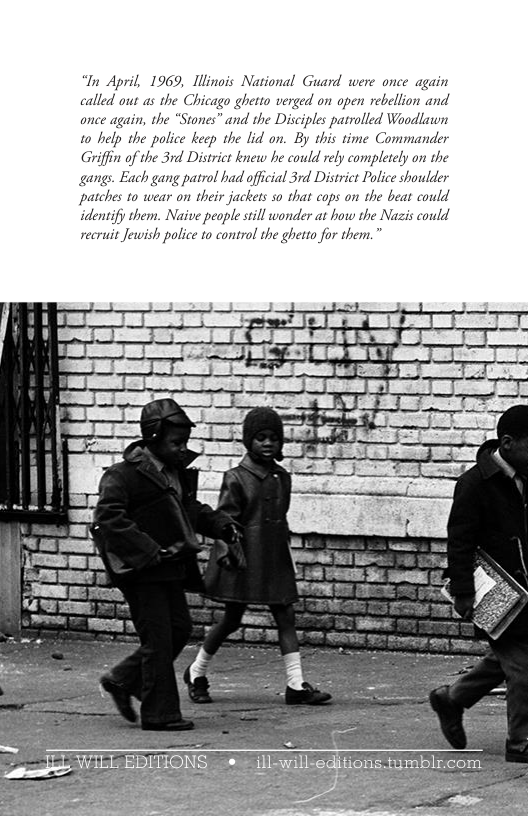
In April, 1969, Illinois National Guard were once again called ou
the Chicago ghetto verged on open rebellion and once again, the
tones” and the Disciples patrolled Woodlawn to help the police
keep the lid on. By this time Commander Griffin of the 3rd District
knew he could rely completely on the gangs. Each gang patrol had
official 31d District Police shoulder patches to wear on their jackets
50 that cops on the beat could identify them. Naive people sl
wonder at how the Nazis could recruit Jewish police to control the
ghetto for them,
the split over repressive strategy
The open police harassment of the gangs and their O.E.O. project
was 5o obviously illegal that it became itself a major political issue.
Church offices sympacheric to the gang youth were repeatedly
raided o the background music of breaking doors and ripped-
apart furnicure. Youth Action, “a street-work project funded by the
four most prestigious social agencies in Chicago” was raided three
times. During the raid on their Auburn Highland Center, two staff
members were “roughed up” and $2,500 property damage was done
~ although the police found no weapons or drugs and made no
arrests. Gang members themselves were often arrested and rearrested
30 Henry De Zutter, “The Pres: Loyal Troops in the City’s War on
Gangs” Chicago Journalism R, June, 1969,
2
on any pretext. Fighting and retaliacion raids between the “Stones™
and “Ds” were carefully promoted and touched off by the police
Gang Intelligence Unit (GIU)."
This open display of police power aroused many sectors of Chicago's
liberal and Black communities. Youth Action, T:W.0., the Urban
League, Chicago ‘Theological Seminary, the A.C.L.U., the Better
Boys Foundation, 5th Ward Alderman Leon Depres and Gth Ward
Alderman “Sammy” Rayner (both anti-Daley independents), and
many other liberal institutions and personaliies prorested these police
activities. Many genuinely were infuriated at the police persecution
of these Black youth from “poverty backgrounds.”
Out of chis clash came a mythology which has been widely accepted:
the picture is of poverty-stricken gang youth trying o move away
from “Anti-social behavior” towards constructive community
concerns, being crushed by the racist machine of Mayor Richard
Daley because the ciry couldn't tolerate any threat of independent
organization. This familiar all- American scenario is incomplete and
misleading. ‘The full story of this living interplay berween federal
government, the local city machine, the police and the gangs is far
sicher in lessons, although more complex, than the mythology of
good guys vs. bad guys.
Itis widely assumed that Mayor
grant and the gangs as a threat to
used repression to crush them. On the contrary, Mayor Daley always
appreciated how useful the gangs could be. In 1966, Jeff Fort was
given a job at the City's Woodlawn Urban Progress Center. At that
time, Denton Brooks, head of the City's “Anti-Poverty” program
(Chicago Committee on Usban Opportunity) took Fort and other
“Main 21" to lunch and suggested that the *Stones” submita proposal
for an “anti-poverty” grant.* Black youth gangs had previously been
used by the Chicago Police Dept. in order to harass and drive our
Black community organizers. In 1965, Chicago SNCC's attempr to
hard Daley viewed the O.E.O.
Machine and that he therefore
31 For a good liberal account of this police harassmer
Journalism Review, January, 1969 and June, 1969-
32 hicago Journalism Reviete, November-December, 1968,
see Chicago
do “grasstoots” organizing came under heavy atack from local gangs,
with vandalization of the SNCC. office, intimidation of children
at the SNCC “Freedom School” and beatings of SNCC workers
contributing to the death of the project. It was alleged that this
conflct was caused by the police, who gave the gangs a “license” o
commit crimes in recurn for artacking SNCC.
To be sure, Mayor Daley was enraged about the gang leaders floating
their O.E.O. grant with T.W.O., rather than with the Ciry’ agency,
C.CUO. (which would have poured part of those funds into
patronage channels). Buc Daley never opposed that grant, despite
what the liberals said. He was, among other things under heavy
pressure from Washington to “OK” the grant.
As Jerome Bernstein pointed out to the MeClellan Subcommittee (a
point that went studiously unreported in the Chicago media)
“For the record, the Mayor did, in fact, concur in the funding
of the program and did so in the form of a telephone call which
he, Mayor Daley, initiated to Sargent Shriver, then Director of
O.EO. To be more explicit, the T:W.O. ‘program’ would not
have been funded at all without the support of Mayor Daley:
Sargent Shriver stated so on several occasions and held up
funding of the program for two weeks pending communication
of the Mayor' support for the program. The TW.0. program
in a sense was in reality as much the result of actions of Mayor
Daley as those of V.. and O.E.O. The Mayor’s support for
funding of the program is a matter of written record which is
both known to the Subcommittee and the Acting Director of
0EO™
Washingion Post columnists Rowland Evans and Robert Novak made
the same poin a full year carlier, as they revealed, “The decp split
among the authorities over how to deal with the decpening riot
problem.”
“Highly respected Police Superintendent Orlando Wilson (who
has just recired) led the anti-gang faction in opposing the grant.
33 Bernstein Testimony. Page 19.
2
He was joined by local Poverty Program officials, who view The
Woodlawn Organization as far too radical
“Although anathema to Negro radicals, Daley happens to be a
pragmatic politician...fearing a bloody summer, he was willing
o give the liberals a chance at doing business with the gangs.”*
Furcher, it curns out that the Chicago police themselves were split
exactly as Evans and Novak discussed. Commander Griffn of the 3rd
District warmly supported the grant. He communicated this support
t0 O.E.O. and agreed that his men would take part in it. The 3rd
District after all, had practical experience at how useful the gangs
were in controlling the Black community:
Griffin was at odds with L. Buckney of the new Gang Intelligence
Unit, who from the start was out to destroy the gangs. Buckney was
so fanatical that his men twice took Jerome Bernstein of O.E.0). into
custody. During a meeting with O.E.O., this disagreemen within
the Chicago Police came out:
“At the mention of Buckney’s name, Griffn threw up his hands
and stated that Buckney did not understand his job, he did not
know what he was doing, and that something had to be done
about him.""
On August 9, 1967, Rev. Brazier and Leon Finney of TW.0. met
with Superintendent Conlisk and seven other Chicago police brass
According to Rev. Brazier, Commander Griffin argued that the police
should take advantage of “the beneficial effects of the youth project
on the gang yourh in Woodlawn.” Lt. Buckney, Gang intelligence
Unit, disagreed and pointed to Jeff Fort 2s a problem (Fort had
been arrested by G.LU. for probation violation), Commander
Griffin defended Fort, and then pointed out that, “Ac the time of
Jeffs arrest, Commander Griffin was waiting to meet with Jeff in
his office 1o discuss with Jeff and some of his associates ways and
means of preventing riot agitators from circulating in the Woodlawn
34 Rowland Evans and Robert Novak, “Inside Report” The Washingion
Po, July 5, 1967
35 “Memorandum For the Record,” August 12,1967. Page 24
community” Superintendent Conlisk chen promised that the
police Dept. wouldnc oppose Forc’ defense when they testified ar
his parole rehearing, and that the gang project would receive police
“cooperation and support.™
It was Capuain Edward N. Buckney (promoted 2 year afer that
meeting) and his Gang Intelligence Unit which iniiated and led the
‘campaign to repress the “Stones” and Disciples. This was the unit that
led the raids, made the constant arrests, maintained informers inside
the gangs and tried 1o get them 10 war on each other. Buckney did
50 not t carry out orders from Mayor Daley, but despite his orders
Again, it was Robert Novak who revealed that the entire Senate
inquisition into the O.E.O. project by Senator McClellan had been
initiated by Gang intelligence Uit “without authorization by the
Mayor.” And by helping Congessional reactionaries create a nar
scandal, Buckney and G.LU. forced the Mayor into a pos
‘open opposition to the gangs and the O.E.O. project.”
As late as May, 1968, Rev. Brazier and Mayor Daley were still rying
0 work out a deal over the O.E.O. project. At an April 22, 1968
meeting, Rev. Brazier was asked by Mayor Daley to keep the project
going unil at least next September, as Brazier was threatening to
dlose it before the Summer. Daley asked Rev. Brazier if TW.O.
could “come under the C.C.U.O. umbrella.” Brazier offered Mayor
Daley the right to “pick the Project Director,” but said that working
under Deton Brooks and C.C.U.O. was unacceprable. Brazier then
“reminded the Mayor that T:W.O. had never directly attacked the
Mayor publicly” Mayor Daley ended the meeting by urging Brazier
and Brooks to work something out* All this maneuvering was, of
course, torpedoed by the Senare investigation and its publiciy.
36 Letter 1o Jerome Bernstein from Rev. Arthur Brazier, August 15,
1967.
57 Robere Novak, “The Story Behind the Rangers Probe.” Chicago Sun-
Times, July 12, 1968,
38 “Memo to the Acting Ditector, O.E.O., from Community Action
Progeam,” April 29, 1968
2%
The question of why Lt. Buckney and his G.LU. played such a
role is an interesting one. It was true that the Black satraps of the
Democratic Party Machine viewed the Black gangs as potenial rvals
0o close to home, s0.as o speak.
Having more weight is the influence of the Syndicate. Some who
worked within the O.E.O. project believe that it was precisely the
Rangers’ dream of 2 ghetto organized crime empire that led to
their downfall. They believe that the Syndicate, secing a powerfully
organized rival, demanded that the police “deliver” some repression
for all the protection money they were being paid. A reader who
believes this is all an exaggeratedly cynical view of police-Syndicate
relations has not factually studied this subject. To take just one
publicly documented fact out of many: Commissioner Orlando
Wilson's Chief Assistant, Paul Quinn, was demoted when it was
revealed that he was one of the Syndicate pay-off coordinators within
the C.D. There were clear channels of possible Syndicate influence
on the policy of the G.LU.
It is important o see that there was a sharp splic in the white
government over how to pacify the ghetto. The gang project, an
advanced counterinsurgency program with cercain real similarities to
U.S. programs in Vietnam and the Philippines, brought this splic
out in the open. In Viewam, we saw this split between the “civic
action” programs of the U.S. Special Forces, which sought o use
bribes/reforms to recruit ethnic minority native forces to fight the
‘communist insurgency, vs. the conventional warfare of annihilation
using massive levels of U.S. regular troops and firepower so clumsily
wielded by General Westmoreland and his clan. The analogy lends
insight o Chicago. ‘The liberals wanted to use reforms to recruit
“native” forces to pacify the ghetto, while the conservarives wanted
0 turn the police loose to repress anything Black tha lfted its head.
Some wanted to do both, which is what happened both in Vietnam
and Chicago.
Evans and Novak commented in 1967:
“The Negro slums of America today comprise secret arsenal of
firearms, zip-guns and knives ready for use at a moment’s notice.
Besides, police officers who practice diplomacy in making an
arrest in the Negeo slums are just as apt to wigger a riot as their
heavy-handed brethren.
“In fact, those who know the Negro slums best are pessimisic.
They are sure only that the sole force of dicipline in those slums are
the anonymous gang laders [ous exmphasis]. Thus, the splic of the
whiteesablishment aver how t deal with thse gangs,as scn in
Chicago, is
Il furcher cause for pessimism.”
This split in the capitalist government made for not a few ironies.
Jerome Bernstein, the “Godfather” of the vry successful gang project,
was fired from O.E.O. by Sargent Shriver for having become to0
pol
explained, being fired for producing the only successful federal “anti-
ioc” program for the ghetto. He flely pointed out how Woodlawn
was kept from exploding, unlike Was, Detroir, Newark, Harlem.
and Chicago's Westside™
ally controversial. Bernstin was frustrated at, as he repeatedly
Boch i
g0t to ty their strategies for repression. This produces the irony of
rals and conservatives (inadequate categories in this case)
gang leaders having “delivered the goods™ for the government, now
serving time in a federal prison for “conspiracy to commit fraud”
in handling O.E.O. funds. OF course, the government officials and
Black community leaders who gor the gangs involved in this project,
who gave them informal approval to rip-off” funds, who virtually set
them up, walked away clean after the project collapsed.
The final irony came with President Richard Nixon's inauguration
in January, 1969. During this triumphant celebration of Republican
victory, the gangs weren forgotten. Jeff Fort, already under Federal
Investigation, received a formal invitation to Nixon's Inaugural
Ball Fort sent Mickey Cogwell and Bobby Jennings, complete with
“white ties and tails,” as Ranger representatives to the Inaugural Ball.
The white public in Chicago was astonished. Veteran Black journalist
Lou Palmer saw it as the Nixon Administration's recognition of the
potential vote power: “Nixon squeaked into the Presidency with few
Black vores. The Black P Stones had campaigned to persuade Blacks
39 Washinglon Post July 5, 1967
40 Chicago Tribune, March 30, 1972,
2
0 boycort the polls™! Naturally vote boycorts of predominantly
Democratic Black voters could only help Nixon and the Republicans,
and Nixon had encouraged such campaigns
conclusion
We should now be able to see clearly what Marx and Engels meant
when they said that the lumpenprolecariar *...May, here and there
be swept into the Movement...Its conditions of life, however,
prepare it far more for the part of a bribed tool of reactionary
intrigue.”
Groupings of the oppressed must be understood in terms of class.
Black gangs are composed primarily of working-class youth, many
of whose families are in what Marx referred to as the “Reserve
Army” of the unemployed. These youths, because of their colonial
and class oppression, are logically pulled towards rebellion. We
know that some members of the Black P. Stones and Disciples
participated enthusiasticaly in the defense of the literally besicged
Black community of Cairo, llinois. Some joined the Black Panther
Party and other organizations. At least part of the leadership was
at one time strongly motivated to drive heroin pushers out of the
“wrf” The gang structure effectively “locked up” this pull towards
rebellion. The gang leadership not only used the power of their own
organizations to “police” the ghetto, but, most importandy of all,
neutralized their organizations the critical straa of the most
oppressed working-class youth,
There i, of course, no precise dividing line “on the streets” berween
the lumpenproletariat and the lower working clas. Further, clements
of the “lumpen” — angry, desperate — have always been drawn into
the struggle, usually during its most militant or violent stages. All
previous Marist experience, internaionally, has taught us to use
these elements but not build primarily on them. Many organizers
41 Chicago Daily News, January 21, 1969, L.E Palmer, ], “Behind the
Insugural Invication.”
here in the U.S. have long since come o a similar conclusion. The
BLA, to take one example, has seriously taken up the discussion of
this question:
“It is clear 10 us that the so-called lumpen class cannor carry
our liberation struggle forward on its own. “This is because of
their class nature: undisciplined, dogmatic, and easily prone
o diversion. This class however will supply some of the most
dedicated comrades to the struggle. But we must clarify our view
ofthe lumpen class asa whole. The traditional concepr of lumpen
2s a category of the lowest social strata in an industrialized
society, unemployed, etc, is a description that fits not only
brothers and sisters that hang out in the street all day long and
survive in that fashion, but it also fits a great segment of black
people who are marginally employed and who for various socio-
economical reasons think essentially the same as the classical
lumpen. Therefore, we must make a clear distinction between
the cconomic definition of lumpen (the relacionship of thar
classto the means of production) and the arciudinal, behavioral
definicion which can readily apply to larger proportion of our
people. When we use the term lumpen we are using a broad
definition.”:
Itis interesting to norice that the B.L.A., like much of the white "New
Left” mistakenly defines the “lumpen’ to equate to the unemployed
and marginally employed. This blurs our class analysis, since it uses
the word “lumpenproletariar” to include both that class and the
lowest stratas of the working class “reserve army.” Thus a teen-age
“Stone” who joined out of group loyalty or friendship or survival
protection would be placed in the same class as Mickey Cogwell
on the “Main 21.” Cogwell “joined” by bringing the gangs in the
Robert Taylor-Washington Park Projects into the Blackstone Rangers
— in return for $5,000. After the gang hustle collapsed he then went
to work for the Syndicate’s Hotel and Restaurant Employees and
Bartenders Union. In 1973, Cogwell got an exclusive franchise for all
Black areas in Chicago, and worked at extorting “dues” money our
42 Coordinating Committee of the Black Liberation Army, Mesage to
the Black Movement, 1975. Page 10.
30
of Blacks to be split between him and the white Syndicate.** This is
a classic lumpenproletarian carcer of preying on the working class
Clearly, the need for this class analysis is as acute today as a decade
ago, and applies sharply to the prison struggle and proliferation of
“miliant” community organizations
The other point that emerges is how liberals and conservatives, for
all their antagonisms, remain united in the common defense of
capitalism by repression against the oppressed. It was, after all, the
activise liberals — Black as well as white ~ who promoted the use of
youth gangs to strong-arm the ghetto into “peace.” This is the bitter
Fruit of liberal social pacification. Only with class understanding
of the concrete situation can we effectively grasp who are the
revolutionary forces.
43 Chicago Tribune, November 3, 1974,
31
postscript (2017)
This rescarch paper was originally writien only for other
revolutionaries, working in oppressed communities, to better help
rebels protect themselves from state repression. It was never thought
of for any general distribution, even within the lefi. Published
initially in 2 small anci-imperialist journal, its largest readership
probably came when a Puerto Rican revolutionary group reprinted it
as part o the study materials at a national anti-grand jury repression
conference. At some point, a cheap pamphlet edicion was done, solely
for convenience in answering the occasional requests for copies.
So this paper has remained largely unknown, just like the federal
counterinsurgency project itslf. A recent favorably reviewed book
on the history of the Blackstone Rangers, by two Chicago Affican-
American journalists, barely mentions the government repression
project, while giving a false, “white-wash” impression of what i was
In 2 number of ways, this novel but logically evil experiment in
structuring pay-offs for street gangs in return for their crushing any
anti-white rebellions, was a project built around the schemes of the
Black bourgeoisie. Thi i alluded to in the paper, but hardly analyzed
seriously in any depth. In recrospect, this is the weakness i find most
glaring now.
TWO. ~ The Woodlawn Organization — featured prominently
in our story as the main sponsoring community non-profic
organization. It s closed down now. TW.0. was fist injected into
2 poor New Afrikan community as a highly-funded virus, designed
by Saul Alinsky's Induserial Areas Foundation (LAE). It was to
be a spodighted demonstration that the LAF’s patented, pro-
capitalst reform organizing could smother grassroots New Afrikan
insurgencies. LAE. was, of course, where Barack Obama’s white
handlers sent him to learn the tactics of top-down “community
organizing.” Long led by Rev. Leon Finney Jr. and his wife, Georgette
Greenlee, TW.O. was always highly successful before its recent
demise — at least for the Black bourgeoisie. Rev. Finney Jr. and his
, for instance, were paid $293,000 in 2010 by the organization.
2
Plus an addicional $190,000 paid to Finney-owned companies for
providing rental space and food for TX.O. The neighborhood is
now steadily gentrifying while working class New Afrikans are being
driven out, so T-W.O.s historic pacification mission is now “mission
accomplished.” Although the non-profic organization's end was due
o the State of Illinois’s findings that T:W.O. recently defrauded the
state of $689,000 in various no-show grants, no criminal prosecution
is yet n sight. Business as usual for neo-colonial “democracy”
Perhaps the most interesting feedback I received on the paper came
from the respected revolutionary theorist and reacher, Atiba Shanna
When we discussed it at length, he said that everything written in
the paper was true, but the paper as a whole sill wasn' true. In his
opinion, so much had been lef out about the stret organization and
the nature of his People's community that it was too unbalanced. In
‘Shanna’s view, i their powerless community where New Afrikans are
tightly ruled but have no governing of their own, any self-organized
New Aftikan body is positive, no mater how confused or off-course
it may be at one time.
He spoke about his gang in its El Rukn stage, with the ex-theater
building curned inco a large “Moorish temple” where they would
hold open court to sertle disputes benween community residents on
the spor, from marital discord to auto accidents. Just as the Taliban
does in Afghanistan villages despite the u.s.-backed government and
its “legal” courts. Also important to the picture but largely lefi out,
‘Shanna continued, was the fact that most of the street organization
soldiers were simply poor working-class teenage boys, who have
no chance of ever finding a real job. i agreed readily to the parcal
weight of his points, but stated that it was hardly my task to put
together any overall understanding of the bloody contradictions of
the street organizations. It was his movement’ job, which they had
largely avoided, in my belief. We parted with respectful snarls of
disagreement.
Last words: that familiar liché ~ “Those who don't learn from history
are doomed to repeat it™not true here. No, it wonit be even that
good
3
“In April, 1969, llinois National Guard were once again
called out as the Chicago ghetto verged on open rebellion and
once again, the *Stones” and the Disciples patrolled Woodlawn
1o help the police keep the lid on. By this time Commander
Griffin of the 3rd District knew he could rely completely on the
gangs. Each gang patrol had offcial 3rd District Police shoulder
‘patches to wear on their jackets so that cops on the beat could
identify them. Naive people sill wonder at how the
recruit Jewish police to control the ghetto for them.”
Vazis could