Black Is Crime: Notes on Blaqillegalism
Web PDF • Imposed PDF• Raw TXT (OCR)


Black Is Crime: Notes on
Blagillegalism
“As long as I'm alive I'ma live illegal, and once I get on I'ma put on all my people”
-Prodigy
“The fugitive nature of Blackness, the inherent outlawing of our bodies by the
state and our positionality as being already outside of the law, gives rise to a
Black illegalism where extralegal activities to further our survival are
foregrounded.”
— Anarkata: A Statement
What a crime it is to be Black. To have the police be called on you for sitting in a
restaurant, for grilling at a cookout, selling water, going to the pool, taking a nap,
standing on the corner; to be Black and to have the presence of one’s very own
body break the law and to know at any given moment a police officer can slam
you to the ground and cuff you for resisting arrest, which is to say, arrest you for
absolutely no reason at all. Blackness carries this implication that a law is or has
been broken and is about to be broken in the future. It is the color and sign of
criminal activity under white supremacist capitalism used to justify the mass
incarceration and extra-judicial murder of Black people by and large.
But what are the origins of this strenuous relationship between Blackness and the
law? In what ways is Black criminalization constituted under the state? And if
Blackness is already criminalized in the eyes of the law, what are the features of
already existing Black illegal forms and what might the theoretical contours of
Black illegalism (Blaqillegalism) that is principled and above all revolutionary look
like?
Blagillegalism is of course not to be confused with illegalism, the mostly white
anarchist movement originating in Europe. Influenced by thinkers such as Max
Stirner, illegalist base their view on an individualist egoism that embraces illegal
activity solely for the benefit of the individual person. The individual through
illegal acts seeks personal restoration, be it the financial gain one gets from
stealing from the capitalist ruling class, or the catharsis involved in criminal
activity. Although later formulations used illegal activity as a “propaganda of the
deed” meant to incite revolt among the masses, for illegalist criminal activity is
still very much a personal, individualistic rejection of the status quo that is not
necessarily moralistic or even principled.
In fact, for illegalist the mere presence of the law is understood as an affront to
personal freedom and may be rejected to assert the spirit of the individual. The
law here is opposed for the sake of being opposed. It is seen as a barrier, an
impediment that prevents the individual from exercising their personal will. The
individual, in this case, is, of course, the white citizen who resents their passions
being held in check by their state’s legal system. White illegalists contest the
law's authority to place limits on their personal freedom, and if the concept of
personal freedom in the West has always roughly translated into white freedom,
the illegalist pursuit of individual liberties is an exercise in pushing white privilege
to its limits.
But where white illegalism understands the law as an unjust restraint on the white
citizen’s personal liberties and uses it as an excuse to engage in reckless and
selfish pursuits of adventurism and catharsis, Black relationship to the law (and
by consequence, Black illegal forms) rest on an entirely different register. The
difference is where the white citizen might experience the law as a mere nuisance
keeping them from doing what they want to do, the Black person experiences the
law as an absolute violence on their very being, is fully impaled by the legal
system and is always already marked as the criminal element that enables the
law's possibility. This is because Black life itself is constituted by illegality and we
can attribute this to transatlantic slavery.
In the colonial Americas, Black people first appear within the law not as subjects
or citizens, but as objects managed through the legal codes of slavery. Slave
codes became necessary in a context where civil law failed to stick to or be
applicable to chattel. It required new kinds of legislation in order to manage those
beings who were considered property and essentially substituted civil law with a
form of property law. The slave codes were the collection of regulations each
colonial power put forward to rule enslaved Africans in their respective colonies.
There were slave codes in the British Caribbean, including Barbados and
Jamaica. The infamous Code de Noir was a collection of slave codes established
in the French West Indies, San Domingue (modern-day Haiti), French Guiana,
and Louisiana. The Spanish had their own set of slave codes established in
Central and South America. Later the United States kept and modified existing
slave codes while enacting new ones. Every place where enslaved Africans were
brought had its own laws regarding slavery.
Generally, these laws all had the same function: to restrict the movement and
assembly of the enslaved, to restrict access to education (particularly reading), to
prevent intermixing, to legally permit the torture and killing of the enslaved, and to
legislate the trade and commerce involving enslaved people. Slavery was not
only the law but was the legal precedent for dealing with Blackness. And this
legal precedent as Calvin Warren notes provided the foundations for modern-day
law and the means by which Blackness appears within the law today: Contract
law (law of chattel) is perhaps the hallmark of modern legal development, given
the need to regulate commerce and specify the rights and entitiement of property
holders. But this corpus of law emerges because one needs to integrate the slave
into the world. In other words, contract law conceals an ontological project”
(Calvin Warren, Ontological Terror)
Under these conditions, the law deprived the enslaved not only of the personal
freedom so coveted by the white illegalist, but the very modes of personhood that
enable freedom’s possibility. The aims of this ontological project, concealed by
legal discourse, was to provide the legal ground for slavery's continuation
through regulating Blackness to the status of property under the law and dividing
breaching this line. To maintain slavery’s coherence the law became a means to
make the distinction between human and Black concrete and tangible. In this
way, the law became the first site in which slavery, racism, and white supremacy
were institutionalized.
Trapped within the confines of a structural and ontological position of unfreedom,
(a position which is regulated and codified by the law), the Black enslaved were
forced to occupy the cramped positionality of what Fred Moten calls ‘the hold’.
Here, Blackness twists and turns uncomfortably stretches out against the walls
meant to contain and regulate it, and in the most natural of impulses attempts to
escape. The regulations meant to restrict every aspect of Black life could not do
so fully, and if containerization was the law’s basic function for Blackness, then
Blackness could not help but break the law. Be it by accident, circumstance,
resistance, or necessity, Blackness defied the boundaries of the law every day
precisely as this twist and turning struggle intrinsic to a people kept in bondage.
The U.S. Fugitive Slave Laws enacted in 1793 and 1850 made escape from
slavery a federal offense and expanded the legal measures to retrieve fugitives.
Yet any free Black could be accused of being a fugitive, even if their freedom had
been legitimate. In effect, Fugitive Slave Law made freedom illegal for Black
people and rendered all emancipated Blacks as possible fugitives of the law
regardless of whether they had proper documentation or not. To borrow a Tina
Campt quote from Another Life is Possible: Black Fugitivity and Enclosed Places
by Damien M. Sojoyner: “the concept of fugitivity highlights the tension between
the acts or flights of escape and creative practices of refusal, nimble and
strategic practices that undermine the category of the dominant.” Fugitivity is the
tendency or quality of Blackness to flee, subvert, or evade the reaches of capture
and breach the thresholds of state containment.
Fugitivity, this defining struggle of Blackness to perpetually escape and refuse
the terms of enclosure and domination imposed by colonialism and white
supremacist capitalism, finds in the law its most concrete analogy. To be a
fugitive in the most basic sense was to engage in an act of flight from the law. But
these acts of flight were not just singular moments of resistance but also features
inherent to Blackness. Fugitivity is useful for our analysis here because it
provides a theoretical framework for examining both the ways in which Black
illegal forms emerge (as acts of flight) and the means by which Blackness is, in
turn, is perpetually criminalized by the state (illegality as an ontological feature of
Blackness).
Black criminalization under the state is the enduring legacy of slave law and its
afterlives (to channel Saidya Hartman). Sometime during the history of
enslavement, this refusal that marked the fugitivity of Black life and survival in the
hold became collapsed into the racialization of Black people and was read by the
state as a disposition toward criminality. This was in line with earlier antiblack
formulations that justified slavery by utilizing biblical references to argue the
morally corrupt nature of African people. The formation of slave patrols and use
of the white citizenry to police the boundaries of Black containment were
crystalized around the emerging notion of Black criminality in the white
imagination and anchored by the emerging technologies of the state. The fact
that the very origins of law enforcement in the Americas came from the slave
patrols drives home the point that the law only ever needed to be enforced when
it came to the question of Black people. Blackness becomes criminal precisely at
this point, where its refusal is read as an ontological malady, and where the
securance of white property interests compel the use of organized law
enforcement. Containment again becomes the principal occupation of the state,
the law codifies this containment, and the police carry out its enforcement.
Where Fugitive Slave Law regulated emancipated Black life as perpetually
outside of the law and subject to recapture, Jim Crow and later mass
incarceration repackaged the same legal precedent while revising its application.
Of course, the most relevant of these developments in the U.S. is the
constitutionality of slavery under the 13th amendment’s “punishment for a crime”
clause. For if the legality of slavery rest on being punishment for a crime,
Blackness itself is a crime, has already been constituted as a crime, and is the
symbolic indication of future crime, making it perpetually eligible for enslavement
under the law. Emancipation could not change the precedent at its core, which
understands the emancipated Black person as runaway merchandise, assumes
Black deviancy, and requires Black discipline and containment. Today the law
underwrites all instances of police brutality, mass incarceration, and the
extrajudicial killing of Black people. “Law and order” is a synonym for waging
state violence against Black people.
Likewise, the positionality of Blackness makes it almost impossible to appeal to
the law as a form of justice or legal restitution. Countless examples of failed
attempts at justice through legal channels confirm that Black injury cannot be
seen by the justice system, and does not register as injury in the eyes of the law.
In fact, to deliver justice to Black people is actually counterintuitive to the project
of the law, which is always, the containment of Blackness. As Calvin Warren
explains:
“The Law recognizes the black only in its destruction, and this destruction is
required for legal intelligibility. Thus, something like black redress is outside of the
law's jurisdiction to the extent that the aim of redress is restorative, and restoring
black being is not only impossible but antithetical to the law’s aim” (Calvin
Warren, Ontological Terror)
Two Black revolutionary formations become important to analyze here for their
markedly different approaches to the law and its relevance to Black struggle. The
early years of the Black Panther Party saw the law as a tool that could be used to
push Black revolution forward. The first armed demonstrations organized by the
Party constantly reference the Second Amendment right to bear arms. New
members of the Party were encouraged to read Mao’s Red Book and the United
States Constitution. Huey P Newton personally studied the law fervently and for
all of the loud and bombastic declarations made at the armed demonstrations, a
great effort was made to keep them squarely within the bounds of the law.
What the Party did not foresee is that when the law could not perform its function
to contain and regulate Blackness, the law could be changed. Months after the
1967 Panther demonstration at the California Capitol, the Mulford Act was
passed effectively banning the open carry of loaded weapons. As police
repression increased, amounting later to shootouts, raids, and assassinations of
key BPP leaders, it became clear that legality did not matter when Black
revolutionaries pose a threat to the white power structure. The systematic attack
on the Black Panther Party forced Newton and many others to dial back on
armed demonstrations. The law remained unavailable for use as a form of
redress in the pursuit of Black liberation, for Black liberation is against the law
and antithetical to the laws aim. Huey himself briefly turned towards criminal
activities later in his life in an attempt to organize gangs but was killed in the
process.
The Black Liberation Army emerged largely out of the fallout of the Black Panther
Party and took an extralegal approach to Black liberation. It engaged in armed
attacks, robberies, prison breaks, and other activities while rejecting the
legitimacy of the law itself. Taking the lessons learned from the Black Panther
Party seriously, the BLA understood that breaking the law would be required for
Black liberation but refused to see what they were doing as truly criminal. They
made distinctions between illegal activities that were explicitly political and those
that were criminal. They argued that because their actions were political they
should be tried not as criminals but as prisoners of war. When Black Liberation
Army members were tried in court for crimes such as ‘domestic terrorism’ they
famously rejected the legitimacy of U.S. courts maintaining that the court lacked
the moral authority to do so. Kuwasi Balagoon in his trial statement said boldly:
“I'am a prisoner of war and | reject the crap about me being a defendant, and |
do not recognize the legitimacy of this court. The term defendant applies to
someone involved in a criminal matter, in an internal search for guilt or
innocence.”
The BLA's refusal both recognized the court as an illegitimate colonizing
institution and rejected the terms in which Black radical activity is marked as
criminal. Instead, BLA members reframed their activity as existing outside of the
jurisdiction of the law and requiring different legal machinery. The BLA members
appealed not to U.S. law but international law pertaining to the treatment of
prisoners of war. In his essay The Vengeance of Vertigo, Frank Wilderson had
this to say about Balagoon’s statement:
“Its deepest insight is the conclusion that it reaches that the law is White, coupled
with the inference that Balagoon was guilty prior to the Brinks expropriation. His
innocence cannot be vouchsafed until all semblance of the law has been
eradicated.”
The way in which the BLA positioned themselves in relation to the law, both as
the wholehearted embrace of Black illegal forms coupled with the refusal to
recognize the legitimacy of the law, has been an inspiration for this paper. |
disagree with Wilderson's complaint that the fault of the approach was the
inability to empathetically account for Black suffering within the courtroom.
Rather, the only fault was the assumption that an appeal toward ‘prisoner of war’
as a viable legal standing for BLA members could or would be heard at all by the
court. Their non-cooperation with the law still relied on the law to see BLA
members as subjects eligible to be tried as prisoners of war (when as Calvin
Warren reminds us, the law ‘recognizes the black only in its destruction’). It
represents an inability for the law to extend legal status to Black people that
would absolve them of criminality. Further, it reveals the inability of the law to
recognize Black people as Humans or anything other than runaway
merchandise. The BLA was correct in claiming their activities were outside of the
law's jurisdiction, for Blackness itself is outside of the law and in perpetual
contempt of the court. It ruptures the very coherence of the law since laws apply
to those considered humans, yet the legal precedent is invested in recognizing
the black only in its destruction.
Given this context, where the law codifies Black containment, engenders Black
criminalization, underwrites antiblack state violence, and denies Black appeal to
the law as a form of redress, we can finally begin to make the case for a Black
illegalism (Blagillegalism). Blagillegalism takes the fugitivity of Blackness, that is,
the perpetual refusal of and flight from enclosure inherent in Blackness, as its
basic starting place. It argues that Blackness breaks the law by its very nature; it
is a fissure within the law.
This fissure is read by the state as perpetual criminality and is the source of the
systematic criminalization of Blackness under the state. Furthermore, Blackness
is made into the perpetual criminal element that enables the law and its
enforcement. Blagillegalism maintains that the law remains necessarily
unavailable to Blackness for making appeals of redress, that the law ‘recognizes
the black only in its destruction’. Finally, Blagillegalism understands Black life,
Black survival, Black restitution, and above all Black freedom to be outlawed and
in so many words illegal.
The Blagillegalist postulates that breaking the law is not only good praxis but
becomes necessary for Black survival and even further, for the pursuit of Black
liberation. If the law’s main function is to discipline and codify the state
containment of Blackness, then breaking the law becomes an act of flight from
the enclosure that the law engenders, and is thus a fugitive act. Due to the
everyday conditions of Black oppression, which emerge as a consequence of
white supremacist capitalism and state repression, Black people again cannot
help but break the law be it by accident, circumstance, resistance, or necessity.
Fugitive acts occur always in response to these conditions and are compounded
by the criminalization that already marks Blackness. For these reasons, the
Blagillegalist says that under white supremacy the Black person already breaks
the law as a consequence of their very being, and as a refusal to die under white
capitalist oppression. This renders all efforts to remain lawful pointless and
undoes any moral obligation Black people might have had in abiding by the law.
Since we are ‘damned if we do, damned if we don't, the Black person might as
well engage in illegal activity if it is responsible and for the survival of themselves
and their communities.
Of course, on the ground, Black people have already arrived at this conclusion.
There are a great variety of illegal activities that are already employed by Black
people every day. Of these, only some constitute a Blagillegalist praxis, while
others don't. A Blagillegalist position generally embraces both small and large-
scale illegal activity pointed in the direction of Black collective survival and Black
liberation and is critical of illegal forms that are ultimately detrimental to that
project. Here we will examine and reclaim the Black illegal forms that would fall
under a Blagillegalist praxis.
Disorderly Conduct
Definitions for what actually constitutes disorderly conduct remain arbitrary, and
on the ground, disorderly conduct could refer to any normal activity Black people
do that break some arbitrary law imposed by the state. This could be anything
from “being too loud” in a public place, playing loud music, selling goods without
a permit, soliciting, loitering, trespassing, squatting, protesting without a permit,
to even resisting arrest. These laws are almost always meant to target Black
people specifically and are a residue of the slave codes that regulated Black
movement and assembly in public spaces. Black people always break these
laws, usually unbeknownst to them, because what is being regulated here is
Black everyday life. Blaqillegalist praxis asserts that we should break as many of
these arbitrary laws as possible while evading the police.
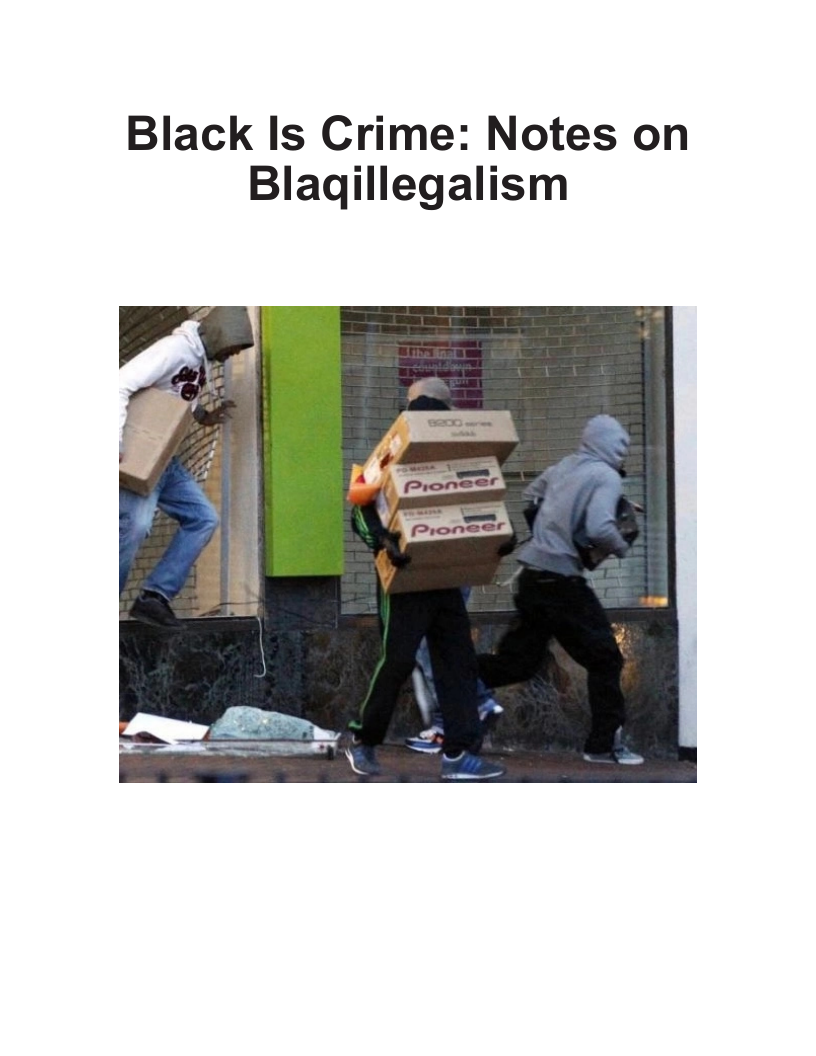
Theft
Under white supremacist capitalism, all theft by Black people that targets white
individuals, institutions, and businesses are reparations. This includes
shoplifting, petty theft, burglary, looting, expropriation, grand larceny, scamming,
embezzlement, piracy, and fraud. Colloquially called swiping in the Black
community, these acts have always been practiced and for some have been a
viable means of survival. Black theft emerges as a direct refusal of capitalist
oppression and resistance against a system that has stolen from Black people for
centuries. A Blagillegalist praxis would encourage continued decentralized theft
of white institutions as the best means to obtain reparations for slavery and
colonialism. Furthermore, the stealing and redistribution of food, medication,
toiletries, clothing and other necessities serve the collective survival of Black
communities. As long as the targets of such activities are white, this is
Blaqillegalist praxis.
Sex Work
Sex work continues to be criminalized in general which pushes many people
especially Black sex workers into dangerous situations with both police and
clients. Many Black femmes, especially Black trans femmes involved in sex work
do so for survival. When anti-prostitution laws are enforced, they are more
aggressively targeted at Black sex workers. Although the criminalization of sex
work is not ideal, Black sex workers have and will continue to break the law
regardless. Black sex work defies the jurisdiction of the state and refuses to be
subsumed by the law. On the ground, money generated from sex work is often
shared by a community of sex workers to ensure the collective survival and well-
being of that community. When police officers refuse to protect sex workers from
violence, this fugitive community is often the first line of defense in keeping sex
workers safe. Sex work is a fugitive act for Black people and is a reclamation of
bodily autonomy in a world where Black people’s bodies are rendered as
property not belonging to them. It is an act of flight from the bodily directives that
are the secretion of patriarchy.
Vandalism
Activities that destroy, deface, or beautify public and private property generally
fall under the category of vandalism. Tagging up buildings, train cars, and other
surfaces continue to be a strong Black artistic tradition and is one of the five
elements of hip hop culture. The New York City crackdown on graffiti artists in the
80s and 90s notoriously imprisoned many Black artists and reinforced the
illegality of tagging. Although graffiti is slightly more accepted (and gentrified)
today, it is still generally outlawed especially when the artists are Black. Other
activities that also fall under vandalism include sabotage, arson, and general
property damage. Vandalism continues to be used strategically by Black people
to forestall the encroachment of gentrification in the Black community.
Furthermore, property damage that targets white businesses, institutions, and
personal holdings is in direct resistance to white supremacist capitalism and is a
strong Blagillegalist praxis. Vandalism is also a key component of revolutionary
activities and employs the use of sabotage and arson in particular to further the
project of Black liberation.
Inciting to Riot
Any unauthorized public gathering could generally be interpreted as a riot under
the law. Historically however Black unauthorized gatherings have always been
more likely to be read as riots since the age of the slave codes. Anti-riot laws are
another legal residue of slave law, which outlawed Black public assembly of any
kind and saw it as a threat to white safety. Over the course of racial history and
as consistent Black revolts ensued, legal precedents adopted from slave law
became codified in the language surrounding rioting and inciting to riot. Black
people have been breaking this law since we have arrived in the Americas as
both a feature of Black social life, and as moments of Black uprising. From the
countless uprisings during and after slavery, the race riots of 1919, the 1943
Detroit riots, the 1965 Watts riots, 1968 race riots, the 1969 Stonewall uprising,
the 1992 LA riots, to the contemporary uprisings in Ferguson and Baltimore,
rioting fits squarely within the Black radical tradition and is a part of Blagillegalist
praxis.
Treason
Treason is legally defined as any activity that is an act of war against the state,
seeks to destroy the state, overthrow the state, or collude with its enemies.
These include espionage, sabotage, and some forms of terrorism. Black
revolutionary activities that seek the elimination of the white supremacist state as
a requirement for Black liberation are marked as acts of treason by the law. If the
state is the principal instrument of anti-Black oppression, which props up white
supremacy and facilitates colonialism and imperialism, then it is the state who
has already waged war on Black people. Similar to the BLA, a Blagillegalist
praxis rejects the legitimacy of the white court of law in its entirety and
recognizes it as an extension of the state’s undeclared war on Blackness.
Black people tend to fight for their liberation and fighting for liberation means
fighting to destroy the state that oppresses us and subjects us to super-
exploitation. Black revolutionary activity breaks the law by definition.
Those criminal activities that do not lend themselves to Black liberation or
survival would not constitute a Blagillegalist praxis and would be considered
counterrevolutionary. Although these still might be understood as fugitive in so far
as they are still acts of flight from the law and possess a quality of refusal that is
innate to Blackness, the refusal does not present itself as a gesture towards
freedom. Criminal activity that steals from poor and working-class Black people,
murders indiscriminately, peddles self-destructive drugs into the community,
engages in domestic violence, assault, rape, and other violence especially
against femmes and LBGTQIA people, do direct harm to Black people and could
not be said to be Blagillegalist. Much of this activity invites increased police
repression in Black communities, foster unsafe environments for Black people,
and is generally never for the collective wellbeing of Black people on the ground.
A Blagillegalist position must remain critical of counterrevolutionary Black illegal
forms which very often are encouraged by the state because they destroy the
social fabric of Black communities and make them easier to police and contain.
This is a distinct turn away from the individualist line of white illegalism which
makes no distinctions between revolutionary and counterrevolutionary illegal acts
and puts emphasis on personal freedom. Where the centrality of the individual
drives the actions of the white illegalist, the Blagillegalist is driven by the pursuit
of collective freedom for Black people everywhere and locates individual illegal
activity as grounded within the collective struggle for Black liberation. It
understands and situates individual Black illegal acts as operating within the
matrix of countless moments of refusal and flight taking place all over the African
diaspora and across past, present, and future temporalities. For the Blaqillegalist,
no illegal activity we engage in occurs in isolation and is intimately connected
with our local and global contexts as well as our history, immediate present, and
afro future.
Text by Afrofuturist Abolitionists of the Americas