Black and Brown Vegan Power
Web PDF • Imposed PDF• Raw TXT (OCR)
![with, and later toward organized religion as a whole. In addition, I came out as bisexual, and became more interested in radical politics, and eventually, anarchism. I found myself attracted to anarchism, and the ‘do-it-yourself” ethic (which in a way, came naturally to a creative person who’s also an environmentalist; why throw out glass or plastic Jars when they can be reimagined as pencil holders, drinking glasses, or change jars, I say). In addition, I became more serious about animal rights, and began going to protests in Washington, DC with the now- defunct grassroots group, Defending Animal Rights Today and Tomorrow (DARTT). A certain word I came across in my first women’s studies class at community college was “intersectionality.” I didn’t have that great a grasp on its meaning as a younger woman, especially since even though [ was a queer woman of color with mental illness, I had benefitted from certain privileges. For example, class privilege; I never knew what it was like to be a child or teenager who had limited or no access to healthy, fresh food, or to grow up in an unsafe neighborhood, or to never even think of going to college. I had comprehensive sex education in school, and that, combined with my fear of intimacy brought on by being bullied for years (mostly by boys), I never had sex with anyone, let alone children (unlike my mother, who had three children by the time she was ‘my current age). While I never thought of myself as snobbish or looking down on people who didn’t have much money, I don’t think I really understood, on even an intellectual level, how their experiences differ from mine. I realize now that a large part of intersectionality is recognizing that even my experience as a queer, mentally ill woman of color is not the same as the experiences of other LGBTQ+ people, other people with mental illness, other women, other people of color, etc. What’s more, I consider recognizing this as key in advocating veganism and animal rights in the most effective way. I know a lot of vegans get defensive when people label them as “self-righteous” or “elitist,” or when people trivialize animal rights. However, I must point out that a lot of the vegan advocacy I’ve seen (PETA’s comparison of animal exploitation to African enslavement, the Holocaust, and Jim-Crow era lynching, vegan YouTube activists constantly pushing the ‘it easy to be vegan/there’s no excuse for not being vegan” mantra, and Gary Yourofsky’s infamous [and falsehood- laden] tirade against Palestinians, the #BlackLivesMatter movement, and Nepalese people come to mind), and the fact that so_ much of that goes largely unchallenged by vegans does make it seem like this movement is](black-and-brown-vegan-power 7.png)

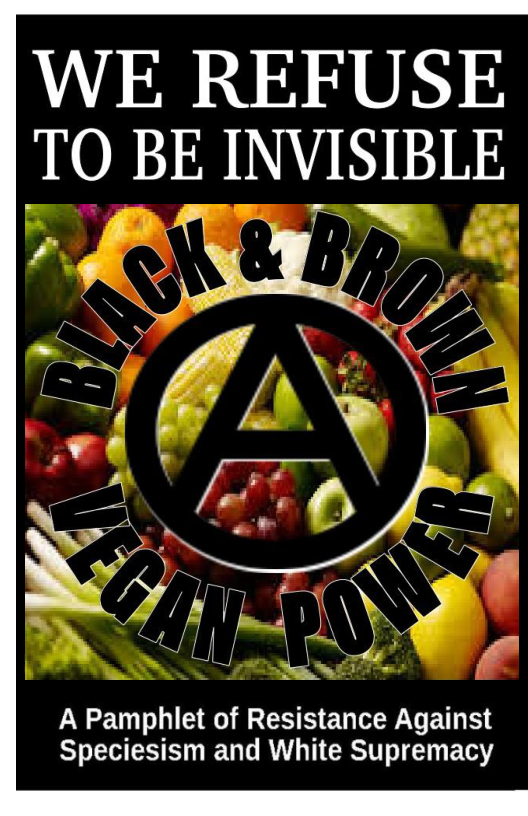
WE REFUSE
TO BE INV}SIBLE
I 4
A Pamphlet of Resistance Against
Speciesism and White Supremacy
INTRODUCTION
‘The purpose of this pamphlet is to create a platform for black and brown
radical vegans to illustrate their experiences which not only negate
settler-colonial white supremacy, but also institutional and cultural
speciesism. While this pamphlet can not include the words of every
black and brown vegan anarchistanti-authoritarian, it is considered a
good starting point in creating much needed dialog on speciesism, white
supremacy and anarchy/anti-authoritarianism. Unfortunately, veganism
is still predominately associated with the Westernized stereotype of a
white, classist privileged diet — marginalizing low-income radical vegans
of color.
‘White supremacy is reinforced when veganism is confined to a liberal
interpretation and misrepresented as merely a “white” consumer activity.
Not only does this erase radical vegans of color and the history of pre-
colonial plant-based lifestyles, but also assumes non-white people have
no interest in non-human animal and earth liberation. When veganism
and anti-speciesism are regarded as merely liberal ~secondary
movements, information regarding dietary de-colonization, health and
the oppression of other animals loses atiention. This lost attention plays
avital in our cyclic reproduction of authoritarian behaviors involving the
objectification and consumption of bodies from which human
supremacy has reduced to “food items”. From an anarchistanti-
authoritarian perspective, veganism is a bold, necessary act of negating
speciesism and the anthropocentric oppression stemming. from our
assumed entitlment to dominate the earth and other animals. Being a
black or brown radical vegan means putting into effect a combined
praxis against both speciesism and white supremacy.
Note: While the focus of this particular pamphlet is not on “straight
edge” or sobriety, some authors do speak briefly about “straight edge”
in their essays on veganism since some people consider both forms of
resistance inseperable. XVX = vegan straight edge.
Rob (Black Panther)
Many years ago I would've never dreamed that I wouldnt miss eating a
steak, or rotisserie chicken. I loved eating meat, I would at times bypass
any other sides and just cat the dead flesh in front of me. I know when it
happened, I was out of the military for some time already, and I was
struggling with PTSD and also dealing with being recently diagnosed as
a diabetic. I met a short dark skinned man who stayed mostly to himself,
I remember sitting next to him while watching my friends playing
basketball. 1 was pretty hostile to people, I had a rough upbringing (my
father murdered when 1 was 7, hustling drugs as a kid, went into
military right after high school and saw combat in Desert Storm).
We began talking and he was telling me a lot of interesting stuff about
his life. But then he started talking to me about not eating meat, (in my.
head I was like okay, bro! That's you not me). I did, however, listen to
what he told me, but didn't change my lifestyle. I joined facebook and a
mutual friend posted a video of cows being beaten and tortured, and I
said to myself "WTF? This is wrong!" After watching the MFA video, T
started to look into vegetarianism and veganism. I thought I should be
careful because I was diabetic and wanted to make sure I would get the.
proper nutrition. But I went full vegan (skipped being a vegetarian) I just
couldn't handle seeing the videos I was seeing. After a while, I was losing
a ton of weight and really just eating broccoli and rice everyday. I went
to my doctors appointment and they were surprised at my blood work
came back, it seemed I beat diabetes without even trying. But this was a
much bigger deal than just my health (which of course is important), this
was about injustice and murder... and I connected to it. You see, when I
was in the military I saw the most horrible and ugliest things, I saw
innocent people die, and I saw these videos of animals, and noticed there
was no difference in how humans and animals die, there was no
difference in the bloodshed, the fight for life, and their subsequent death.
Around that same time, I was signing petitions, begging for justice for
these innocent creatures, and again I was befriended by another friend,
who introduced me to anarchism, I was always a person who was proud
to have served in the military, I carried it like a chip on my shoulder. But
I never saw that I was just a pawn in a bigger scheme, I began reading
Kropotkin (Mutual Aid) and Bakunin. I was always hesitant on reading
anything that dealt with Socialism or Communism due to Stalin and
other despotic governments. I realized that those regimes had nothing to
do with the original concepts of socialism, and definitely nothing to do
with anarchy. My eyes were wide open, and saw that we were the actual
terrorists, we were the ones creating chaos and murdering innocent
people for their resources, we had no right — as we have no right to
take the lives of innocent animals — to invade or enter into those
countries. Meanwhile, here at home, we people of color were being
terrorized for years by the police. The bottom line is that I found my
voice for justice, and it wasn't in the military, it wasn't until I saw what
was happening in the world, and how our fellow earthlings suffered
every second of every day. The lies we've been told about people in
other countries, the environmental destruction humanity takes part in,
the unnecessary killing of animals for food, imprisonment in zoo's and
aquariums, torture and murder in test labs. Why do these things
resonate so much with me? Because as a black man, we also suffered
these injustices and were marginalized in much the same way animals
are and have been centuries before the African holocaust.
Veganism, Sobriety and Autonomy by Alberto XVX
I became vegan and straight edge about a year ago, and by doing so [
have started to undermine authoritative discourses and practices of meat
and drug consumption which are so rampant and pervasive . Since the
advent of colonialism, white men endowed with reason and culture have
been deemed as human. Meanwhile those that have been enslaved and
oppressed have been cast aside as the "other”. The Western philosophical
project has disavowed the non-human animal to the extent that
countless atrocities have been committed against non-human animals,
which has increased as theyve become viewed as commodities within
the capitalist system.
We can see these heinous atrocities manifest themselves in factory
farms, circuses, and vivisections in the labs. The modes of thought which
have permeated society with anti-speciesist views is connected with the
denial of our own animality. We have become so estranged from the fact
that we ourselves are animals because we have created modes of
thought and ways of living that seek to transcend the finitude of our
knowledge, and the brevity of life. Therefore civilized humans have
created metaphysical doctrines which have served to sustain religious,
cconomic, and political principles which serve as the underlying
foundations that give way to the institutions and systems that seck to
exploit and dominate both human and non-human animals. Veganism
and straight edge practices should be viewed as anti political
positions, which subvert the anthropocentric notion that we are the apex
of all living things. Beginning to deconstruct the "human” allows us to
broaden our struggle as anarchists in order to accompany our anti
colonial, anti prison, and anti-racist, and anti patriarchal practices. The
struggle for earth and animal liberation are part and parcel of the
aforementioned struggles. It is normal to have vegan potlucks when we
gather with other radicals, but it isn't very often that we engage in
forums to discuss how vegan and straight edge practices can enhance our
own struggles in the pursuit of total liberation.
We must start having discussions with our neighbors as to why our
poc neighborhoods are left in tter desolation. As we continue to be
afflicted with environmental racism in our communitiess, we must begin
to posit alternatives to private property and start to consider unraveling
the relationship that we have to private property alongside providing
community gardens and modes of living that are congruent to black and
brown cosmological point of views. We tend to think of veganism as a
white phenomenon when indeed much of the food that our poc ancestors
ate would be considered vegan by todays standards. Much of the food
that is caten in rural places in the global south do not contain meat
either. Therefore, to think that meat has been vital component of our diet
as a people s a total fallacy. We tend to think of someone who is sober as
someone who is an industrious white protestant with a strong work ethic.
In indigenous commaunities sobriety is a powerful weapon in the anti
colonial struggle. Women in Zapatista communities who first proposed
banning alcohol in the autonomous territories did so with the intention
to halt abusive sexist practices. Revolutionary groups such as the Brown
Berets, the American Indian Movement, and the Black Panthers and the
during the 1960's and 1970's abhorred the practice of alcohol usage.
Here in Chicago you see countless liquor stores throughout different
hoods. In places in which there is no hope for the future it is easy to fall
prey to drug addiction. When I attended high school in the back of the
yards I saw an inordinate percentage of kids become victims drug abuse
due to a massive amounts of gang violence, and lack of job employment
Itis not easy to give up an addiction, and it is vital that networks arise in
order to help those that want to give up drug usage . Chastising those
who we seek to help doesn't bode well for those of us that seek total
liberation. Accompanying individuals, families, and collectives in the
hood is imperative in this process, and in due time once there is a
relationship based on reciprocity we will start to leam from each other as
autonomy is built from the ground up with people in the hood forging
strong, and resilient communities in resistance.
Ashleigh Mott XVX
I don't remember the exact date I became vegan. For me, that's
unimportant. What matters with any sort of epiphany I have, especially
one that causes a drastic change in my everyday life, it doesn't matter
when it happens; the fact that it happens is what matters. Al I know s
that I became vegan sometime in my carly 20s, for ethical reasons.
I've always been a bit out of place, even in my own family (having four
brothers and no sisters, for one thing). I was always an introvert, a
bookworm, and very earnest and serious, even since childhood. I had
always been an animal lover (since I was a toddler who would pet and
hug my family’s cat, despite her protests), but still ate meat until my
preteen years (especially ground beef, a bit of which I once ate raw off
the cutting board when my mother was cooking; not enough to make me
sick though). I think my status as the “weird girl” at school (being a
black girl who kept to herself, loved reading the dictionary, always
befriended the targets of bullying in class from a young age, and
mumbled a lot was considered enough to make me “weird”) caused me
to gravitate more toward animals. We had many different cats and dogs
as part of our family during my childhood, teenhood, and young
adulthood. The loss of my dog Bailey, who we had had since I was 10
years old, was like losing a brother. My becoming vegan was inevitable.
I was an on-off vegetarian from the time I was 12 through my teenage
years. I didn't eat very healthily (1 remember most of my dinners
consisted of side dishes, and lunches were mainly Little Debbie snack
cakes and chips), which made it kind of hard to stick with. Like probably
a lot of young people in the age of the Internet, my first exposure to
veganism came from watching videos online. PETA’s “Chew on This” and
“Meet Your Meat” videos were incredibly jarring to me, especially since,
between my preteen years and my 20's, I had been diagnosed with
depression and convinced to incorporate some meat in my diet to see if
that would help. Again, can't pinpoint the exact date, but eventually,
realizing I could not live with myself as a lacto-ovo (sometimes)
vegetarian, I decided to make the switch for good.
My mid-twenties were a turning point for me in other ways, too. I was
something of a “late bloomer,” right down to having completed my
college education at age 26; I had been a teen who always played it safe,
in large part due to my illness, introverted nature, and having been
bullied from third grade through junior year. I much preferred thinking
of new ideas for artwork or searching for random things on the Internet
over dating, parties, or breaking the rules. As such, my “coming of age”
came somewhat late. In the years wherein I took community college and
university classes, I became more skeptical of the Christianity I grew up
with, and later toward organized religion as a whole. In addition, I came
out as bisexual, and became more interested in radical politics, and
eventually, anarchism. I found myself attracted to anarchism, and the
‘do-it-yourself” ethic (which in a way, came naturally to a creative
person who's also an environmentalist; why throw out glass or plastic
Jars when they can be reimagined as pencil holders, drinking glasses, or
change jars, I say). In addition, I became more serious about animal
rights, and began going to protests in Washington, DC with the now-
defunct grassroots group, Defending Animal Rights Today and Tomorrow
(DARTT).
A certain word I came across in my first women’s studies class at
community college was “intersectionality.” I didn't have that great a
grasp on its meaning as a younger woman, especially since even though [
was a queer woman of color with mental illness, I had benefitted from
certain privileges. For example, class privilege; I never knew what it was
like to be a child or teenager who had limited or no access to healthy,
fresh food, or to grow up in an unsafe neighborhood, or to never even
think of going to college. I had comprehensive sex education in school,
and that, combined with my fear of intimacy brought on by being bullied
for years (mostly by boys), I never had sex with anyone, let alone
children (unlike my mother, who had three children by the time she was
‘my current age).
While I never thought of myself as snobbish or looking down on people
who didn't have much money, I don't think I really understood, on even
an intellectual level, how their experiences differ from mine. I realize
now that a large part of intersectionality is recognizing that even my
experience as a queer, mentally ill woman of color is not the same as the
experiences of other LGBTQ+ people, other people with mental illness,
other women, other people of color, etc. What's more, I consider
recognizing this as key in advocating veganism and animal rights in the
most effective way. I know a lot of vegans get defensive when people
label them as “self-righteous” or “elitist,” or when people trivialize animal
rights. However, I must point out that a lot of the vegan advocacy I've
seen (PETA's comparison of animal exploitation to African enslavement,
the Holocaust, and Jim-Crow era lynching, vegan YouTube activists
constantly pushing the ‘it easy to be vegan/there’s no excuse for not
being vegan” mantra, and Gary Yourofsky’s infamous [and falsehood-
laden] tirade against Palestinians, the #BlackLivesMatter movement, and
Nepalese people come to mind), and the fact that so_ much of that goes
largely unchallenged by vegans does make it seem like this movement is
perfectly fine with throwing large groups of marginalized people under
the bus in the name of this cause. And I don't feel that a movement
about justice should be fine with that.
For that reason, I've taken my YouTube channel and WordPress blog in a
different direction than I originally intended. T've made videos and
written blog posts/responses talking about veganism, and why it's
important to consider how we spread the message. This movement
doesn't need echo chambers; what makes me mad is not just seeing
rhetoric spread by vegans like Yourofsky, Freelee the Banana Girl, and
PETA, but the fact that so many other vegans think it's okay (at least,
that it's okay-enough to scold people for eriticizing them). But yes, it's
just vegans thinking it okay (as in, people who don't need to be
reached with the message); is that what we want? It not what I want.
And that isn't “going soft,” nor is it “apologetics,” “being too PC,” ad
nauseum; that's acknowledging reality, and genuinely caring about
spreading the message in a way that gets people on our side (and
ultimately, the side of the animals)
Resisting Speciesism by Armando Desmadre
Speciesism is like racism and other forms of oppression that can manifest
themselves through actions, words, and political structures. Speciesism
specifically points to the actions and behaviors that openly suggest the
superiority and the dominance of one species over another; speciesism
unapologetically and arbritrarily discriminates based on species.
A fact that cannot be denied is that the current political structure,
namely the State, is patriarchal, sexist, white supremacist, and classist. If
we agree that the State is all of these things, then it follows that it
should also be considered speciesist. The State needs to also be regarded
as speciesist for the fact that it seeks to arbitrarily secure the lives of
some and not others based on species. For the most part, us human
animals do not see animals being killed in the slaughter house, we rather
pay a corporation or someone to kill a non-human animal for us. It is
completely legal and part of a regular day to buy meat, see meat at the
store, at school, in the garbage. It is not legal, however, to kill a human
animal and sell the meat to a store or to throw the body in the garbage,
to wear the skin, to unapologetically post pictures of it on Facebook.
Killing non-human animal is legal and even protected by the State; to
kill a human animal and parade the body is not.
The history of speciesism is as old as sexism, racism, ableism; it
can be traced back to the ages of colonization. Seeking a difference
between two bodies to justify oppression and submission is the logic that
we all must try to deconstruct and decolonize. To see a non-human
animal as being more natural and closer to nature is the same logic that
got us where we are in the first place. Ancestral and indigenous
communities did not have the institutions and language we now have to
hierarchicalize things and bodies. A body, even though different, it had
complementry qualities that made two or more bodies whole, unique,
and essential to a community. Non-human animals and plants, to
ancestral and indigenous communities were kin; they were part of a
family and a clan. Today, the only non-human animal that is normalized
tobe part of a family is a pet, dog, cat, bird, fish. In today's world,
seeking the protection of non-human animals and feeling a kinship with
non-humans must be done underground and illegally. To openly feel a
connection with other species and to feel equal with non-human animals
is illegal and repressed by the State.
Going underground and engaging in illegal activities to shed light
on to speciesism and other forms of oppression is a form of resistance
against the State. Resistance can be seen as being like a circle, once it
starts it can never stop. Any one person, human and non-human, is an
agent of resistance. The form of resistance that is most moral, radical,
and easily accesible is being vegan.
Veganism is a local form of resistance that some might consider
too radical and only possible by those who have the economic means and
leisure time to properly cook it. Some say that being vegan is a white
privilege since whites have the economic means to go ahead and buy
food from Whole Foods or Trader Joe’s, where they specialize on ‘being
green’ and environment friendly. It is true that whites, for the most part,
buy food from Whole Foods and Trader Joe's because it is ‘organic’ and
have an easier way of accessing products that would otherwise be too
expensive for people of color who believe in change. It is also true that
there is an overwhelming amount of whites who are vegan and
vegetarian, but just because there is a large amount of whites who are
vegan and vegetarian does not necessitate a natural connection between
the two. It is not a ‘white thing’ to be vegan or vegetarian. The lack of
vegans of color can be explained by analyzing our current socioeconomic
situation and the nature of a white capitalist State.
The State is white supremacist and it seeks the protection of
whites, just as it secks the protection of heterosexual, fully body able,
protestant men. Look around a white neighborhood and compare it to a
poor color neighborhood. There are more McDonalds, churches, corner
stores, gas stations, currency exchanges, and liquor stores within a mile
than there are within 3 or four in white neighborhoods. It is not that the
people demand them, it is that those institutions produce the demand in
those neighborhoods where property taxes are low. These institutions
thrive from the poverty and the drunkedness of those who they serve. It
is hard for people of color to become vegan if they are constantly
bombarded with meals that cost less than a dollar. It is hard for people
of color to become straight-edge when institutions promise a drug that
will make them cope with their structural subordination for less than
five dollars. Our State would not the way it is now if whites had the
same treatment as people of color.
‘The best way to resist capitalism, speciesism, and the institutions
that people of color are inevitably forced to engage with is to become
vegan. It is hard but it is not impossible. It is not a matter of being white
with money, it is a matter of knowing the interconnectedness of
oppressions and the context of people. As a vegan of color, it was hard
to cut off from chips and burgers, but once I realized how much money I
spent on garbage and how much dead bodies I consumed for pocket
change, I could not go back. It was personally hard, since I did not want
to spend money on healthy food, specially living in Englewood. Now, I
get my food from pantries that happen once a week from neighborhood
organizations. If you go to three pantries a week, you just got yourself
exactly what a white counterpart did from Wole Foods, and the best
thing is that it was for free.
“Alittle extra somethin” by Rob (Black Panther)
Idowhat I do for the animals, the children, and the earth.
I think I chose this at birth, we admire people based on their
economic worth.
We see these creatures that share our living space, and say we are a
dominant species. Others say to our own, "we're a dominant race."
With all my heart and soul, I will keep fighting, keep hoping... That
my words touch you, that they will uplift, that they stir up the
frustration, the anger... That they penetrate your mind. And create
solutions for those issues I bring up constantly.
That we value all creatures... Not for what they can do for us. But
because they exist, and have every right to... That in itself should be
sufficient. If I sound like I'm pleading, it's because I am. Before those
frustrations manifest physically. Freedom... For everyone.
Keerry Redwood Atjecoutay XVX
Animal agriculture is one of the reasons besides the cruelty committed
by industrial civilization, the consciousness of the people are in this
"form" of a trap, or mold created by the dominant culture, I feel. Animal
agriculture dominates the landscape of the prairie, my homeland. For me
this oceupation s obvious. Living on the reservation, we are surrounded
by monoculture and factory farms and are coerced into eating the
domesticated animal. The packaging of meat allows the people to believe
they have a luxury, of course this is an illusion, suffering, sickness and
torture candy coated with sanitary sometimes beautiful packaging - all
part of capitalism. Realizing that we are surrounded by industrial society,
the majority of my people in a way both accept it and "protest” against it.
Itis a contradiction and a conflict of interest, when referring to
spirituality and in a sense a hypocrisy, a disconnection from the natural
reality. We all are
This is why I became a anarchist vegan, but I realize that I am only
practising in a philosophical sense, the reality of anarchy is smothered
due to my reliance of this society. I would rather be somewhere
else....not where freedom is dead! I feel that my struggle with society is
rather a drudge through a thickness of spiritual emotional - psychological
and material collaboration, a cohorted collaboration. Like i stated we are
surrounded, and et this sense of pessimism that I have, not lost. But 1
still have one thing, my attempt to write and communicate my
experience in a language that is not mine. I fight with this new weapon,
safe and peaceful, without physical violence, but not safe for my purpose,
but safe for the others who support industrial society. Over time I have
become inherently aggressive as a result of domination and the
occupation of my homeland - forced re-education.
1 am Ka-wezauce “Little Boy First Nation (cowessess Saskatchewan
Canada) Saulteaux/Cree of the Ojibwa Nation, a descendant of the
Anishinabek. And yet what I write you here, s only the basic reason why
I am vegan anarchist. For an in depth reason, which should be
acknowledged, simply just look at us all, we are but children, misguided
and misdirected, a deep root in our psyche - mass manipulation and only
very few of us have "THOUGHT" OUR WAY THROUGH THIS, but yet we
are stuck with limited tools to perform optimally, for the good of all
beings, and yet the contradiction thought, in the "old ways" the world
view was that the physical body is not what is important, but the spirit
was to be free from the confinement of the body. Total liberation, for
ALL!
Interview with Kevin Tillman/Vegan Hip Hop Movement
1. When was Vegan Hip Hop Movement born and what was the
primary purpose behind it?
—circa 2005. hip hop is the love of my life, it shaped my identity, it
educated and liberated me. veganism breathed new life into me,
reclaiming my power over what and how i consume. feeling alicnated
being brown and vegan in portland, oregon--both the most vegan
friendly city at the time and also the whitest major city in the us. ive
always loved making mixtapes and once i became vegan i started
making the soundirack to my new lifestyle, entitled the “fresh veg mix,”
which quickly evolved into the vegan hip hop movement.
the purpose of the vhhm i to give voice to the voiceless or rather
amplify the voices of the unheard or silenced, all marginalized and
exploited communities suffering from capitalism, racism/white
supremacy, sexism, heteronomativity, ableism, homophobia,
transphobia, speciesism, sizeism, islamophobia, etc. with hip hop,
liberation music. holistic activism s the main aim of the vhhm,
recognizing the “unity of oppression’”.
2. What kind of responses has VHHM received from both the hip
hop community and the vegan community?
hip hop community mostly positive, as long as we're talking about the
folks who identify as hip hop heads and know the origins of it especially
where it relates to the struggle of people of color and people in poverty.
whereas the largely white vegan community can't seem to cope with
intersectionality nor recognize the blatant cultural appropriation going
onin hip hop. yes, hip hop is universal but considering how accessible
hip hop s as a relatively young artform/culture you would think it
started with eminem or better yet iggy azaela based on how many folks,
mostly white respond to the messages transmitted by the vhhm via social
media. the biggest obstacle i face with attempting to bring awareness to
the "unity of oppression” are messages challenging structural
racism/white supremacy and sexism/misogyny and you can guess who
finds their uncarned privilege being challenged the most difficult: cis
white men.
overwhelmingly folks of various backgrounds embrace intersectionality,
but every once in awhile some find their privilege being challenged too
confronting. the vhhm is most interested in building with like-minded
and like-experienced folks, not interested in hand holding or spoon
feeding—if you can't look past your unearned privilege and truly be that
compassionate person you purport to be then i don't have time for you.
like the brother oddisce said, “like minded people are the only ones im
messin’ with.
3. How has VHHM debunked the myths surrounding veganism
including the common perception of veganism being white, colonial
and classist?
—the vhhm highlights non-mainstream voices/experiences
(underground/independent artists) where it relates to a plant-based
decolonial diet. the vhhm secks to emphasize that all communities have a
vested interest in health and wellness and not just of their respective
communities but also other inhabitants of the planet to include other
animals and the planet as a whole. all pre-colonial cultures had food
ways that were compromised or erradicated by colonization. many
people of the global majority, otherwise known as people of color
worldwide were eating cither an exclusively or mostly plant-based diet
with variation depending on where in the world they were. so if anything
this notion that eating plants alone s a white and wealthy phenomenon
is offensive and goes back to that notion of cultural appropriation or
“columbusing," which is a more appropriate term. the documentary
"cowspiracy," though it was a great film overall it did what most vegan
films do, it presented the problem overlooking the ultimate culprit of
these vicious unsustainable conditions we as humans and other animals
live in--curopean colonization and its offspring capitalism, which put a
price on all life everywhere. so all the mostly white experts in the film
offering up solutions to the problems that their ancestors created, as if
people of the global majority haven't been resisting colonization
/capitalism all along, they don't get to be our white saviors, e got this--
tell all your ceo and banker buddies how theyre fucking up, we'll keep
resisting like we always have.
i need to shout out "black vegans rock” and the many vegans of
color/vegans of the global majority communities everywhere who are
reclaiming/celebrating their foodways/health and wellness.
4. What future goals and objectives can we see VHHM working
towards?
the vhhm plans on connecting and building with more vegan hip hop
artists(ie interviewing and collaborating) and working with youth
around food justice with a plant-based decolonial diet/lifestyle
framework. the vhhm will continue doing work around other social
justice issues particularly hyper-masculinity and misogyny because
though they're expressions in hip hop are symptomatic of our patriarchal
society, they do have a greater impact on marginalized communities,
particularly people of color because we cannot forget who is running the
show. it typically white men who own these major record labels or
clear channel for that matter, and its mostly white men pushing toxic so-
called hip hop on the masses, perpetuating stereotypes and that "self-
destruction” the stop the violence movement rapped about back in the
late 80s. however, poc and particularly people of african descent are
more commonly living in critical conditions compared to white folks so
before anyone tries to read "black on black crime” into this you have to
do the math, "white folks say, 'why should they have to pay for
something that was done way back in the day?, what f i came through
and shook your hand, rape your women, and i took your land, put you in
chains and make you work for free, how would you feel?, what would
you see?, you inherited the wealth from slavery, we inherited the
poverty.” stic.man of dead prez. so not only do we have to navigate that
reality, we are also being targeted at an alarming rate by those who
“serve and protect"* capitalism and white supremacy as well as other
vigilantes and domestic terrorists (i.e. minute men, kkk, neo nazis), who
feel that their unsustainable and unjust way of life is being threatened
because guess what, it is!
“cops, not pigs, the actual other animal because they're our friends, silly.
love the pigs!! fuck the police!!
SP.
Unless you hold the traditional view of a soul, there isn't any reason
to believe that complex emotions are the exclusive province of humans.
Ever since Darwin set in motion our modern understanding of evolution,
we've known humans are one branch in the evolutionary tree. Not the
trunk, just one thin lttle branch. Human anatomy shares so much
overlap with other animals, particularly other mammals, implying
overlap in sentience.
Humans have always found it convenient to reduce other animals to
this unfecling monolith, the inferior Other. No surprises there. When
weignore any of the qualities in our victims that might elicit sympathy,
whether humans or nonhumans, it becomes far asier to justify
domination. It's a kind of boundless narcissism, very similar to human-
on-human oppression.
There are so many other ways humans try to undercut any moral
consideration. We rush to say we're acting in accordance with external
forces like "God" or "nature.” Whenever people want to justify their
position in a hierarchy, they blame what seems like an unalterable
system, so they can downplay their own moral agency as individuals. Its
the definition of bad faith. Humans have one responsibility unlike other
animals here: the capacity to choose from options and not unnecessarily
take others' lives.
‘The concentration of economic and state power in private hands has,
on another level, not only only deepened but widened the scope of these
problems, from both human and nonhuman perspectives. To begin, it's
split the realm of production from consumption, rendering the suffering
of others invisible to people, and created a model built on maximizing
profit no matter the costs. The spatial and mental distance from animals
‘makes what scientists call 'the denial of animal mind” possible; animals
seem like organic machines.
‘Human oppression and animal oppression are also intimately linked,
reinforcing and interpenetrating each other. The way this system
structures the landscape so that entire communities are thrown into
poverty s an injustice by itself. But it also makes animal suffering seem
secondary, even trivial; that's an important dimension here, often ignored
by some people.
In the end, I think it clear we need some self-scrutiny concerning the
moral status of animals. Not just about "the conditions on factory farms,"
which are hideous, but about killing of animals for food when other
options exist. Changes in lifestyle are tough, I get that. And it' often even
tougher to look objectively at habits which you enjoy, and which, on the
deepest psychic level, are tied to the familial, cultural, and social
memories. But in the end, the most trivial of human interests (aste,
convenience, tradition) don't eclipse the fundamental nonhuman interest
to live their lives.
Thanks to all the authors who put forth the time and effort to share
their experiences and everyone else who helped in making this project
possible! For anyone else interested in contributing writing on the
subject matter for possible future projects send an email to
warzone_distro@riseup.net
Created and distributed by
Warzone Distro & The Feral Space collective
www.theferalspacecollectivexvx. blogspot.com