beneath the concrete, the forest Accounts from the Defense of the Atlanta Forest
Web PDF • Imposed PDF• Raw TXT (OCR)

![the latter. Forcibly displacing Indigenous peoples, carving up the natural world into private property, burying the fertile carth under concrete, and. terrorizing the inhabitants with police violence are all expressions of the same logic. Catastrophic climate change is the large-scale consequence of a series of smaller steps that are no less catastrophic in the lives of indi- vidual human beings. ‘The defense of the forest in Atlanta is only one of many such struggles over land and housing across the continent, including People’s Park in Berkeley, Echo Park in Los Angeles, and the camp defending the UC Townhomes in Philadelphia. As investment capital floods the real estate marke, it has become increasingly difficult for to afford housing, let alone maintain collective space in which to experiment and build a com- mon context. These movements have responded by defending a shared space of life and struggle. Most of the following accounts describe the events of the week of ac- tion at the end of July 2022, when people from around Atlanta and other parts of the United States gathered for a week of discussions, protests, and concerts. The week of action culminated with a festival during which DJs, bands, and speakers performed, showing how the forest serves as an autonomous zone beyond the constraints of the capitalst economy: The forest is not just a particular concentration of trees; we can also understand it as a network of relationships between living creatures of all species. Life ourishes when it is liberated from control. This was palpable in the festival at the conclusion of the week of action. In a club, a breakdown or a breakbeat functions as a kind of lubricant to grease the gears of exploitation, bringing in business and (at best) advancing the career of a particular D] or band. In a liberated zone, the collective experience of music can signify shared power, the joyous realization of potential, showing how cach person’s creativity can contribute to the lib- eration ofall. The South River Forest is not an old-growth forest. If anything, this makes the movement o defend it more inspiring. This land was already brutalized—yer, given a few years of peace, it became a wilderland ca- pable of sustaining spaces of frecdom. Any patch of flowers growing out of the cracks in the concrete could become a forest if we defend it. The possibility of freedom awaits all around and within us, even in the most repressive environments The forest—which is w0 say; the web of life—extends beyond the bounds of any designated park, into each of our bodies. This web is what BENEATH THE CONCRETE 2](beneath-the-concrete-the-forest-accounts-from-the-defense-of-the-atlanta-forest-crimethinc 4.png)
![165 also clear that nobody misses the police, who no longer fecl com- fortable circling the parking lot or coming at night to harass “suspicious looking individuals” despite the old park being open 24 hours a day. Unlike a public park, which is defined by a lis of things you’e not al- lowed to do, the peoples’ park invites your participation on all levels. You can drive on the bike path. You can dig up the grass and plan a garden. You can put up signs asking people to drive slower on the bike path. You can get a piano on Craigslist and bring it to the woods and play it at 3 am. You can park your car and slecp here because it’s safer than the Walmart parking lot and the communal kitchen is cooking a meal every day. You can throw a huge dance party under the canopy and the stars and fall aslecp on the soft pine strav. “DEEP INTO THE FUTURE" WHEN IT STAKTED RAINING ON THE THIRD NIGHT, | WONDERED HOW | would make it back to my tent. 1 also wondered what that truck looked like in the parking lot, soot washing off its charred remains, perhaps mixing with the paint and chalk that redecorated the iron frame. In the madness of the night, the status of the music was the only thing I did not question. One of my friends spun in circles, shoeless,in the downpour. I saw people kissing in the mud. The large blue tarp overhead, which just an hour carlier had almost come crashing down on our heads as reckless punks used it to facilitate stage dives and other antics, now shiclded hun- dreds of people from the storm. T was standing on the side, beneath a smaller tarp, next to the makeshift bar. The pulsing of the dance music wasn’ quite so loud that you couldn’c talk, but with the sound of the rain on top of it, I had to yell to be heard. My friend and I were discussing the morning, We had woken up with a start some 18 hours carlier to the sound of yelling: [self-described owner of the forest] Ryan Millsap had brought police to the parking lot and they were threatening o tow cars. Although we had only slept in our tent for a few hours, my friend and 1 pulled on our shoes and jackets and rushed through the forest to defend the newly christened Weelaunce People’s Park. In the parking lot, people were throwing stones and cans of sparkling water n THE FOREST](beneath-the-concrete-the-forest-accounts-from-the-defense-of-the-atlanta-forest-crimethinc 13.png)
![grimey hardcore sounds. Tivo hours to release anger, anxiety about what will come in the next few days, weeks, months, years to the forest, to my friends, to my lfe in Atanta. The Weelaunce Forest is a land of resistance. The lineage of the land of Muscogee people, their forced removal, enslaved West Africans, incar- cerated people in the Adlanta Prison Farm, and the fight to resist the state and colonialism continues in Weelaunee every day. DJing is an extension of my everyday acts of resistance, feeling true to the roots of Techno and. Jungle that grew out of Black curiosity to find a place. DJing in a con- structed money-maker will never compare to D]ing in the fight for open spaces. My place is nuzzled between the pocke of trees “THE SWEAT LODGE" SCRAPPIN SLOD AND TARPS, FROCKLING AMONG CARCASS AND DEBRIS, screaming songs of moto exhaust and white throated swallows, here among the Weelaunee. Mudracks of ATV lead us to wheelbarrows, tarps, abandoned cloth- ing, slashed and trashed camps. Above, glorious clouds threatening us with 2 humid breath. That same rain that, we fear, will revolt in the strengeh of the kudzu and muldiplying mold spores is also the rain that we crave to feed our gardens and crecks. A humidity that encourages the vining reach capable of overpowering the forgotten billboard, tagged with evidence of an incredible feat. So high, we both reach. Palpating ‘canopies alive with green lichen, expanding arms for a choking embrace. Waterlogged tarps fastened into a caved dome, slugs ling in every direc- tion as we snip the paracord that held this forgotten structure in place. Spiders emerge from the folds, where mosquitoes breed in stagnant pud- dles. Not so long ago, this sweat lodge was sanctuary for the iual of gathering—of celebrating this forest—this land that haunts us with trag- ic horrors of nightmares past and the future that may emerge without our presence. We break down and repurpose our leftovers, we dismantle sites of abandon and ereate through decay. With the speed of acceleration, the drops that were once tender, hitlike pellets, blinding my ability to admire the canvas of lightning against the dank green horizon. 15 THE FOREST](beneath-the-concrete-the-forest-accounts-from-the-defense-of-the-atlanta-forest-crimethinc 17.png)





BENEATH THE
CONCRETE, THE FOREST
ACCOUNTS FROM THE DEFENSE OF THE ATLANTA FOREST
large swaths of what remains of the South River Forest—also known
by the Muskogee name for the river, Weelaunee. In place of one stretch
of woods, they aim to build a police training compound; they have sold.
the neighboring part to Blackhall Studios exccutive Ryan Millsap, who
intends to build a giant soundstage. Yet for more than a year now; activ-
ists have protected the forest against their plans. In a previous article, we
chronicled how this campaign got started and the strategies that have
driven it; in the following collection of narratives, participants in the
movement describe their experiences and explain what makes this fight
meaningful to them.
The fight to defend the forest brings together locals whose neighbor-
hood will be gentrified by the developments, environmentalists who rec-
ognize the importance of the forest in mitigating the impact of climate
change, forest defenders who have been occupying the trees for months,
abolitionists who oppose the expansion of racist policing in Adlanta, and
young people who desperately need a free space to build community out-
side the high prices and profit imperatives of Adanta corporate nighlife.
These are not discrete issues, but aspects of a coherent whole.
The destruction of the tree canopy and the gentrification of neigh-
borhoods are stages in the same process: the former paves the way for
Iu ATLANTA, GEORGIA, THE CITY GOVERNMENT INTENDS TO DESTROY
the latter. Forcibly displacing Indigenous peoples, carving up the natural
world into private property, burying the fertile carth under concrete, and.
terrorizing the inhabitants with police violence are all expressions of the
same logic. Catastrophic climate change is the large-scale consequence of
a series of smaller steps that are no less catastrophic in the lives of indi-
vidual human beings.
‘The defense of the forest in Atlanta is only one of many such struggles
over land and housing across the continent, including People's Park in
Berkeley, Echo Park in Los Angeles, and the camp defending the UC
Townhomes in Philadelphia. As investment capital floods the real estate
marke, it has become increasingly difficult for to afford housing, let
alone maintain collective space in which to experiment and build a com-
mon context. These movements have responded by defending a shared
space of life and struggle.
Most of the following accounts describe the events of the week of ac-
tion at the end of July 2022, when people from around Atlanta and other
parts of the United States gathered for a week of discussions, protests,
and concerts. The week of action culminated with a festival during which
DJs, bands, and speakers performed, showing how the forest serves as an
autonomous zone beyond the constraints of the capitalst economy:
The forest is not just a particular concentration of trees; we can also
understand it as a network of relationships between living creatures of
all species. Life ourishes when it is liberated from control. This was
palpable in the festival at the conclusion of the week of action. In a club,
a breakdown or a breakbeat functions as a kind of lubricant to grease
the gears of exploitation, bringing in business and (at best) advancing
the career of a particular D] or band. In a liberated zone, the collective
experience of music can signify shared power, the joyous realization of
potential, showing how cach person's creativity can contribute to the lib-
eration ofall.
The South River Forest is not an old-growth forest. If anything, this
makes the movement o defend it more inspiring. This land was already
brutalized—yer, given a few years of peace, it became a wilderland ca-
pable of sustaining spaces of frecdom. Any patch of flowers growing out
of the cracks in the concrete could become a forest if we defend it. The
possibility of freedom awaits all around and within us, even in the most
repressive environments
The forest—which is w0 say; the web of life—extends beyond the
bounds of any designated park, into each of our bodies. This web is what
BENEATH THE CONCRETE 2
sustains our lives, not the extraction industries that are currently destroy-
ing the basis of existence for countless species
Tiwo decades ago, the authors of Fighting for Our Lives suggested that
“The best reason to be a revolutionary is that it is simply a better way to
live™ As state violence accelerates the catastrophes resulting from capital-
ist industrialism, it may turn out that it is also the only way to liv.
“THE FOREST WITHIN ME"
THE FOREST IS A BREATHING BARRICADE. LIKE ANY BREATHING MECHA-
nism, the boundaries continuously undo themselves. Inputs and outputs
collide—berween the city and the woods, the feral and the tame, the
safe and the dangerous. What qualifies as violence becomes murky in
the woods. Violence as negation manifests itslf in the form of the state,
helicopters fiying overhead and cops on the edge of the barricade to arrest
the forest dwellers, sometimes they dare to enter, with their machines
and their armor. Violence as creation manifests in the destruction of this
negation: playful sabotage and joyful tricks. Anarchic violence becomes a
productive flux of becoming. For the police, the inputs and outputs are
far clearer and qualifications are far more rigid: the forest is a dangerous
place, unknown territory understood in opposition to their cosmopoli-
an termain.
For us, the forest is a haven. The threat of the state is different than
the peril of the woods. Stumbling upon a decaying coyote carcass fecls
like a blessing—to witness a transformation of flesh into soil in the soft
fallen pine leaves is nothing like stumbling upon a clear cut where the
limbs of trees lie severed, their torsos hacked up into discarded bits. The
Severing of treesis the precondition for the construction of the dystopian
simulators through which the apparatuses of power will perpetuate their
orgiastic fantasies of violence and capital. But this will not happen, be-
cause the forest is an ungovernable, indestructible, breathing barricade.
In the forest, the boundaries lapse between the content of space, how
things were constructed—by machine or by hand or, often, a combi-
nation of the two—and to what degree things become consumed and
consumable. But there are also lapses between different kinds of time.
The time it takes to walk from one patch of woods to another may rake
3 THE FOREST
minutes or hours. I¢s easy to get lost under the trees, to lose yourself in
movement and recurn to the slimier flows of collective being within the
barricade. To lose yourself intentionally or try to make yourself unlocat-
able—from the helicoprers overhead and what lies beyond the barricade.
Yet the barricade does not delineate a concrete edge. The edges of the
forest do not indicate an end. The forest is indestructible because it is
ever-expanding and constantly transforming. The forest here is a node
that connects to many nodes and has many nodes within— including
our bodies. The boundary of the body slowly erodes here. A viral out-
break reminds us we are perforated bags of water within perforated bags
of water, including the forest.
Find ticks burrowed in your skin and you slowly become a deer. In
our camouflaged garb we cosplay trees. It is something erotic to live in
trees and to dress like them. We multiply ourselves through pseudonyms
and costumes. We multiply ourselves by becoming deer, becoming tree,
becoming decaying matter and waste. Eventually, in our deterioration
and deterricorialization, movement and occupation, gathering and dis-
persal, taking up of space, and place taking us up, we become forest. We
become barricade. Forever ungovernable and infinitely becoming.
“THE FOREST IS A PORTAL"
T FOREST 15 A PORTAL. THE CONCRETE BLOCKS SPREAD WIDE, ALLOW-
ing entry into the graffiti-filled lot. Anarchist sprites and other mischie-
vous spirits have painted, scratched, stapled, pasted, singed signs every-
where conveying our welcome, our allegiance to this new world that calls
t0 the depth and courage of our hearts. As I walk the liberated path,
purple swirls form messages that guide me like breadcrumbs. My fac kin
appear around me in gauze, denim, and metal, resplendently eschewing
gender. Entering the wild, T return to my stirring self: this intimate green.
BENEATH THE CONCRETE 4
“LETTER FROM A TREESITTER"
T'VE BEEN PREPARING MYSELF FOR WHAT FEELS LIKE THE INEVITABLE: A
raid, an attempted extraction—or will they choose to siege?
T've become attached to my trechouse, thinking of it almost as an exten-
sion of myself. I found myself questioning this, questioning the connection
I fecl t0 a temporary structure. But | realized that what I was feeling was
beyond that. From my feet high above the canopy to the roots buried deep
in the ground, I could fecl . | wondered if this energy was spiteful, a land
so scarred and blood-stained, never given a moment to heal. Was I here
because of spite? Yes. But the spite I feel toward the police is also born of
love: love for the land and all of my friends here and beyond. This forest is
not something I am going to give up without a fight.
Every delay opens up more possibilities. Every contractor that backs
away brings us closer to victory. Each of our moves keeps them guessing,
Whether or not they choose to destroy our homes, I'll be here keeping up
the struggle. Tl be here for as long as T can, for as long as i takes. They
can try 1o eviet us, but they will never be able to make us stop fighting
There’s joy in our fight. This spirit, this forest, will never be able to
be contained. Everywhere you look, the police are trying to shrink our
worlds, shrink our lives. But we have chosen to say no. Our fight extends
beyond the borders of this forest—it extends through our expressions of
collective and individual joy, incomprehensible to the narrow imagina-
tions of the police and the ruling class that they prorect. We laugh harder
than them, we feel more pleasure even in the midst of their assaults.
Falling in love with these woods has meant faling in love with one an-
other and with the possibiliies of this world—a love that the police will
never understand, and therefore cannot crush.
“"WHEN THE BARRIERS CAME DOWN"
WHEN THE CONCRETE BARRIERS WENT UP AT THE PARK AT THE BEHEST OF
alocal real estate baron, it felt so banal. What—another space in the city
enclosed, forbidden, made concrete? Long before this struggle began—a
struggle for my neighborhood park, my local forest—1 could trace my
s THE FOREST
life through a string of interactions with police in public parks, or a sring
of neighborhood parks and natural spaces closed, contaminated, forbid-
den. I could trace a line through this lfe: if you want to be outside, you
have to pay o you have to trespass
The concrete road barriers were standard issue, but the real punch was
when T saw that they took the sign and replaced it with a much smaller
one, a generic one reading “Park Closed.” As f the public park, the fores
our entitlement o the land could be made or unmade with sign. As if
we would abide by the sign, something so “neutral,” produced to justify
the land grab as offcial. It migh as well say Forger being outdoors, catch
the forest on Netfis
Like me, my neighbors didn't stop when they saw the barriers. If they
noticed that the park sign was gone, it didnt turn anyone around. The
stream of cyclists, trail explorers, and dog walkers continued, pushing
through the small opening that immediately appeared between the barri-
ers. Soon enough, just as | expected, the barriers were pushed open all the
way, the parking lot effectively re-opened. People make the spaces they
nced. I smiled when I saw them opened up: a sign of complete indiffer-
ence to the roadblocks in our way. A disregard for property lines.
‘Anweek has passed since the barriers went up. Today isthe first Saturday
of the fourth week of action. Hundreds of people stream into the forest o
enjoy a free concert, a barbecue, the company of others in the movement.
As the day cools down, a crowd gathers around the front of the bar-
siers. 1 notice that people are hoisting a new sign, painted with a new
name. They welcome me in through the barriers. I help hold the sign,
heavy in my hands, as it is affixed to the old sign stand. We drape a sheet
overit. A few moments later, a Dekalb County police SUV slow-rolls by,
but a crowd has already started o amass at the barrier entrance. Some
shouts of mocking harassment from a crew of masked people send the
cop down the road. “He won' be back.” Maybe he will, but with a dif-
ferent kind of calculus.
The crowd murmars, carrying plates of grilled chicken and vegan hot
dogs 1o come perch on the barricrs. Somcone has strung a fancy red
ribbon across the barriers, tied in a bow. It fecls like we are saying: this
forest is ours, and these barriers are a gift. We call to others in the lot to
come watch the sign unveiling unfold. Some make speeches, reclaiming
the park. Excitement in the air, true feelings of power, laughter at the
exaggerated speeches
Now the sheet is finally pulled off, revealing the sign: “South River
BENEATH THE CONCRETE 6
Forest Park” reads one side; “Weclaunce People’s Park” reads the other.
Within seconds, [ hear loud pops and champagne sprays, covering us al,
showering a 20-foot radius. Cheers rise from the people gathered, then a
chant: “People’s Park! People’s Parkl”
With a dramatic flourish, R— cuts the red ribbon, and everyone is
yelling, celebrating, a burst of joy. Spontancously, now we are running.
Running past the new sign through the barriers, as if for the first time, as
if something has been unveiled to us: a gift we've given ourselves.
"ATOUR OF THE FOREST"
AT DAYBREAK, THE BIRDS TURN ON AS THE MUSIC TURNS OFF. I'VE BEEN
dancing for almost twelve hours. It carly Sunday morning, the end of
my birthday. I feel blessed to have spent it in the forest with my friends
and many strangers. This was the last day and night of the three-day
Defend the Adanta Forest music festival, an explosive culmination to the
fourth week of action. We spent whole days and nights dancing, groov-
ing, moshing to the rhyhms of the fre forest. My body is filled with an
energy that I know doesn't come from it, from the food or water or sleep.
that sustains it. It comes from a more diffuse and mystical power. A pow-
er that only emerges in the connection between many bodies engaged in
frecly creating a shared world.
The festival began with a friend speaking about the movement to the
growing assembly of people standing under and around the massive tarp.
and stage that has been constructed here. It serves as a temporary venue,
no less historic, for shelter, gathering, rage, expression, joy, communing,
As she explained that this is a decentralized and autonomous movement,
inviting everyone to repeat back those two fundamental words, I felt 2
buzz of excitement.
This s an almost 800 acre autonomous forest within the city of
Adanta. It was abandoned, then reclaimed, then sold, swapped, and
again abandoned by the city. Now it is used and cared for by us—the
people, the public.
When my friend wrapped up her welcome speech, another
friend caught my attention through the crowd and asked me to lead
some newcomers o the forest on a tour to a trechouse. I made an
7 THE FOREST
announcement and a couple dozen people followed me along a path
through the trees.
T made stops along the way to point out where the kitchen is and
the additional do-it-yourself kitchen where there are always snacks and
sometimes people cooking special additional meals. I pointed out the
sweat lodge that a Lakota comrade built during the last week of action.
1 told the story of how this movement became one of the many embers
that were scattered when the boot of the state violently stomped out the
sacred fire that was Standing Rock. I led them up the hill and encouraged
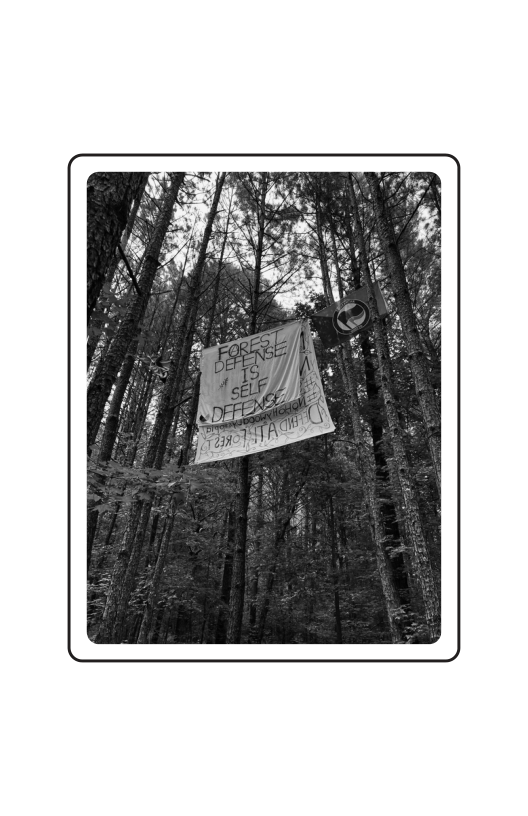
everyone o look up. High above us, we saw a large platform in the tree
covered by a domed tarp. There was a hanging poted plant with flowers;
someone said, “Ooh, look, they are making it cute, like a home.” I an-
swered, “That is her home.” Others asked, How do they get up there? How
did peaple get everything up there: Exveryone looked up at their childhood
dreams come truc.
At dusk, the sky glows out from the negative space, forming shapes
benween the thin pine trees. The sun is lighting up the the world from
below. People roam around the Living Room, our name for the part of
the forest where pine straw provides a clean ground for public gather-
ings, meals, meetings, events, music, and art happenings. Everyone is
standing or sitting in circles, eating, chatting, scheming, encountering or
reencountering each other; dogs run around us playing and chasing with
abandon. It is dinner time. All the hard work of carrying boxes of pro-
duce, jug after jug of water, chopping vegetables, stirring massive pots,
washing the dishes from lunch, carrying them and the fresh hor food
from the kitchen (in the woods) to the serving arca in the living room has
paid off. Everything we do here, we do voluntarily—a labor expressing
faith in abundance, creating a free meal, a free show, a free experience.
This simple fact is more significant than I know how to explain.
One of the highlights for me, this week, has been secing some co-
workers from the restaurant I work at come out into the forest. At work,
T'm always bringing fliers, putting up posters, begging my coworkers to
come. The way we normally relate is always mediated by work—how
miserable but resigned we are to be there, doing what we are doing, day
after day, cleaning the bottles and floors just so we can clean them again
when we close the next night. Out here in the forest, they ask me, Do
you live out here? Did you put this all ogether? 1 say, Sometimes, 1 say, Yes,
we all did.
9 THE FOREST
“THE TRUCK BECAME AN ATTRACTION"
WHEN THE FIRST CAN OF Dit PRIESTLEY' Ser1zer WATER FLEW THROUGH
the air and exploded onto the windshield of the excavator, temporarily
blocking the view of its operator and complicating his attempr to destroy
the parking lot gazebo at the newly opened Weelaunee Peoples’ Park, it
felt to me like a small but important milestone had been reached—an-
other indication that the movement to defend the Adlanta forest contin-
ues to grow and to outgrow its limits.
The sudden ubiquity of the cans of seltzer water themselves, cases of
them sitting around the forest free for the drinking, felt like one such
milestone in its own right. When an occupation reaches a certain level
of power and prominence, resources begin to flow and strange abun-
dances appear. I remember boxes of thousands of loose cigarettes arriving
at Standing Rock and a small pious circle of chain-smokers forming to
package them for distribution to the wider camp. Nobody knew where
they came from. As far as T know, the seltzer water came to the Weelaunee
Forest from the warchouse of a failed startup somewhere and quickly
became the unofficial beverage of the week of action.
The confrontation with the excavator ended with its operator, 2
neighbor and henchman of Hollywood billionaire Ryan Millsap, flecing
along with the off-duty police working security for him. They left behind
Millsaps truck, 2 2020 Dodge Ram 5500, which was soon set ablaze.
This ended Milsap's second attempt to close down Intrenchment Creek
Park and establish his private ownership over it. His first attempt had
occurred over a week before, when he sent workers to remove the offcial
park sign, close the parking lot with concrete barricades, and put signs
up around the area declaring it “private property.” Our response had been
to paint the barricades vibrant colors, keeping them in place but open
them enough to allow vehicles through, and to declare the opening of 2
Peoples Park.
The park feels different now. Millsap attempred to forcibly impose his
private ownership but instead shattered it, and now the burnt-out husk
of his $80,000 truck serves as visual proof of how easily such illusions can
be dispelled. Instead of scaring away regular park-goers, the burned ruck
has become an attraction. People come just to look at it and take pictures
of it. Something about it brings them joy; they leave visibly clated by
what theyve seen.
BENEATH THE CONCRETE 10
165 also clear that nobody misses the police, who no longer fecl com-
fortable circling the parking lot or coming at night to harass “suspicious
looking individuals” despite the old park being open 24 hours a day.
Unlike a public park, which is defined by a lis of things you'e not al-
lowed to do, the peoples' park invites your participation on all levels. You
can drive on the bike path. You can dig up the grass and plan a garden.
You can put up signs asking people to drive slower on the bike path.
You can get a piano on Craigslist and bring it to the woods and play it
at 3 am. You can park your car and slecp here because it’s safer than the
Walmart parking lot and the communal kitchen is cooking a meal every
day. You can throw a huge dance party under the canopy and the stars
and fall aslecp on the soft pine strav.
“DEEP INTO THE FUTURE"
WHEN IT STAKTED RAINING ON THE THIRD NIGHT, | WONDERED HOW |
would make it back to my tent. 1 also wondered what that truck looked
like in the parking lot, soot washing off its charred remains, perhaps
mixing with the paint and chalk that redecorated the iron frame. In the
madness of the night, the status of the music was the only thing I did not
question. One of my friends spun in circles, shoeless,in the downpour. I
saw people kissing in the mud. The large blue tarp overhead, which just
an hour carlier had almost come crashing down on our heads as reckless
punks used it to facilitate stage dives and other antics, now shiclded hun-
dreds of people from the storm.
T was standing on the side, beneath a smaller tarp, next to the
makeshift bar. The pulsing of the dance music wasn' quite so loud
that you couldn'c talk, but with the sound of the rain on top of it, I
had to yell to be heard. My friend and I were discussing the morning,
We had woken up with a start some 18 hours carlier to the sound
of yelling: [self-described owner of the forest] Ryan Millsap had
brought police to the parking lot and they were threatening o tow
cars. Although we had only slept in our tent for a few hours, my
friend and 1 pulled on our shoes and jackets and rushed through the
forest to defend the newly christened Weelaunce People’s Park. In the
parking lot, people were throwing stones and cans of sparkling water
n THE FOREST
at the police. Elsewhere, someone was anxiously hiding the sound
equipment in case a raid was imminent.
I stll can't believe we managed to pull this off. I shouldn' be so
surprised, but ic’ hard to overstate the magic of what took place. There
we were, perhaps 500 punks, dancers, anarchists, artists, partiers, rap-
pers, indic rockers, forest defenders: if the police couldn't stop us, if the
developers couldn't disperse us, the rain certainly wouldnt. How many
people had come over the previous days? There's really no telling. The
only thing certain is that on this final night, all of them walked through
the cement barriers past the smoldering truck, deep into the forest, decp
into the future.
“THIS TIME, WE WERE THERE"
ROCKING WITH THE PINES, AIR THICK WITH CICADAS, THE FIRST NIGHT,
the night of my arrival. The breeze shakes the trectops, rustles their nee-
dles together, cradles e in the sway of this forest
T miss my friends back home already. I wish they could be here with
me, looking up at the cloud-mottled night—my last sight before shut-
eye, giving myself over to the charming clicks of bugsong. A hammock
can be a lonely place to sleep, but less so when you find that people you
‘once knew in a past life are suddenly your neighbors once more, stepping
through the portals of their tents and raising their arms to the sun.
As camo-clad demonstrators beat that truck mercilessly with a shovel,
ripped its doors from their hinges, empried its cab, I told the Rolling
Stone reporter that what we were doing was building a new world. The
music of these woods shows how we can find beauty in the scraps we've
been handed, the cut cleared and replanted like the weeds growing from
the old prison farm. Punk asks for no more than three chords, a rave no
more than bass and bodies to populate the dance floor. In this world, we
sway unbound by the weight of debt that i intrinsic to the success and
poverty of city life. In this world, I find I can stretch my sleeplessness a
few hours longer, waking life more nourishing than slumber. At night,
our generations constellate with the stars
Along the glowing trails, I find faces new to these woods. I see kids
ten years my junior showing up bright-cyed and ready to mosh under the
BENEATH THE CONCRETE 12
dusty rain tarp. I see friends that I have known for the past decade carry-
ing guitars and speakers, noting that we have come to be the elders of this
scene. We are weathering life’s seasons in this world that we are building.
Spring and summer happen simultancously; slowly; we are bringing fall
and winter back into the fold.
By the time you get the norifications, its already t0o late. The forest
has been sealed off by police or barricaded by protesters. You'e left pac-
ing the hardwood floors of your apartment, wondering how you can help
from afar. In the world we're building, you just have to be there. News
of the forest isn'tdigested over breakfast, it's made before a drop of coffee
hits your lips. When morning comes and the cops raid, o defenders
reduce construction equipment o rubble and ash, you'e cither in the
woods or you're at your table. This time, we were in the forest
“DJING IS AN EXTENSION OF
MY EVERYDAY ACTS OF RESISTANCE"
AL WEEK THE SUN IS BEAMING, SWEATY BODIES RUSTLING THROUGH THE
woods, minds wondering what will come next, what will I need to do
next2 The threat of downpour loomed all week it finally blessed us bricfly
on Saturday when the full rinse came. The darkening yellow sky, light-
ning pulses, damp pine starkly reminds me of carly memories of Adanta
sunshine unveiling after afiernoon showers. T worry how today will go
after the downpour.
The tarp bowl quickly fills up as the day continues and the pines dry.
Suddenly, i fecls like a music festival. There are pockets of people laying
down on blankes, dancing, moshing, talking, and looking at zines.
As it gets darker and darker, I start hearing "When are you Djing?”
T'm the last to play to close out the Fourth Week of Action and the mu-
sic festival. T've Dled in the Weclaunee forest before, but, this felt dif-
ferent. As I stepped to the stage, I stepped into the hips of the woods.
Swaying, Jungle-infused pop and locking, and Techno bouncing between
the bones of the forest. The bowl flowed into late-nigh freaks, dancing to
the hard bass, fuzzy mids, and ethereal highs. An all-consumption by the
woods, by the energy bouncing off the pine, by my love for dancing and
BENEATH THE CONCRETE I
grimey hardcore sounds. Tivo hours to release anger, anxiety about what
will come in the next few days, weeks, months, years to the forest, to my
friends, to my lfe in Atanta.
The Weelaunce Forest is a land of resistance. The lineage of the land
of Muscogee people, their forced removal, enslaved West Africans, incar-
cerated people in the Adlanta Prison Farm, and the fight to resist the state
and colonialism continues in Weelaunee every day. DJing is an extension
of my everyday acts of resistance, feeling true to the roots of Techno and.
Jungle that grew out of Black curiosity to find a place. DJing in a con-
structed money-maker will never compare to D]ing in the fight for open
spaces. My place is nuzzled between the pocke of trees
“THE SWEAT LODGE"
SCRAPPIN SLOD AND TARPS, FROCKLING AMONG CARCASS AND DEBRIS,
screaming songs of moto exhaust and white throated swallows, here
among the Weelaunee.
Mudracks of ATV lead us to wheelbarrows, tarps, abandoned cloth-
ing, slashed and trashed camps. Above, glorious clouds threatening us
with 2 humid breath. That same rain that, we fear, will revolt in the
strengeh of the kudzu and muldiplying mold spores is also the rain that
we crave to feed our gardens and crecks. A humidity that encourages
the vining reach capable of overpowering the forgotten billboard, tagged
with evidence of an incredible feat. So high, we both reach. Palpating
‘canopies alive with green lichen, expanding arms for a choking embrace.
Waterlogged tarps fastened into a caved dome, slugs ling in every direc-
tion as we snip the paracord that held this forgotten structure in place.
Spiders emerge from the folds, where mosquitoes breed in stagnant pud-
dles. Not so long ago, this sweat lodge was sanctuary for the iual of
gathering—of celebrating this forest—this land that haunts us with trag-
ic horrors of nightmares past and the future that may emerge without our
presence. We break down and repurpose our leftovers, we dismantle sites
of abandon and ereate through decay. With the speed of acceleration, the
drops that were once tender, hitlike pellets, blinding my ability to admire
the canvas of lightning against the dank green horizon.
15 THE FOREST
“TO DEFEND THE FOREST,
EVERYONE HAS TO FIGHT”
‘THE FIRST NIGHT OF THE MUSIC FESTIVAL | HAD AN AFFECTIVE EPIPHANY.
T was humbled by the glowing social armosphere of everyone around me.
Yet when standing still I realized I felc out of place. When in movement,
when busying myself with tasks, I elt necessary, like I was part of some-
thing, but I found myself unable to relax, unable to dance with friends
and strangers.
The second night, | examined the faces around me—so many un-
known youth, people who are just coming into the Atlanta music scene
or who have been occupying a different section of it. For a moment, the
nostalgia for people and places long gone overtook me. My surroundings,
my home, friends, were foreign. I started ignoring people, walking alone.
An old friend who had performed the night before came up to me. He
said he was looking for a familiar face. I felt massive roots pulling me
back down to earth, to the moment.
Saturday morning, Ryan Millsap’s truck drove an excavator into the
ICP parking lot. The driver slammed the excavator into the roof of the
gazebo where people were standing. He dug a random hole in the path.
He screamed profanities at people and threatened more violence. People
fought back. They destroyed his excavator, chased him and the police out
of the park, scavenged the good bits from the truck and burned the rest
Encouraged by the exuberance of the morning’s win, my band played
later that night. As a band, we are situated in realistic grief for our apoc-
alyptic era, but we know that we can still fight for a freer future. I don't
think I've ever felt more grounded than when I took the stage that nighr.
My goal was to portray the desperate reality: that to defend the forest,
everyone has to fight. We can no longer be idle spectators of the state’s
apitalist war on our bodies and our futures. Watching everyone move
together in front of the stage, I felt a release of hopelessness. I felt the
creative force of bodies moving and breathing together. There, we shaped
abrief temporality; an energy that willlive forever in us and in the forest
as long as it stands.
During our set, I read this excerpt from Diane di Primals Revolutionary
Letters:
BENEATH THE CONCRETE 16
1
REVOLUTIONARY LETTER #34
hey man, lec’s make a revolution, lec's tun off the power,
turn on the stars at night, put metal back in the carth, or
at least not take it out anymore, make lots of guitars and.
futes, teach the chicks how to heal with herbs, let’ learn
0 live with each other in a smaller space, and build ho-
gans, and domes and teepees all over the place BLOW UP
THE PETROLEUM LINES, make the cars into flower
pots or sculptures or live in the bigger ones, why not?
REVOLUTIONARY LETTER #35
sise up, my brothers, do not bow your heads any longer, or
pray except to the spirit you waken, the spirit you bring to
birch, it never was on earth, rise up, do not droop, smok-
ing hash or opium, dreaming sweetness, perhaps there will
be time for that, on the long beaches lying in love with the
few of us who are left, but now the earth cries out for aid,
our brothers and sisters set aside their childhoods, prepare
0 fight, what choice have we but join them, in their hands
rests the survival of the very plant, the health of the solar
system, for we are one with the stars, and the spirit we
forge they wait for, Christ, Buddha, Krishna Paracelsus,
had bua taste, we must reclaim the planet, re-occupy this
ground the peace we seck was never seen before, the carth
BELONGS, at last, TO THE LIVING
THE FOREST
APPENDIX: (NOT) A MUSIC FESTIVAL
THE FOLLOWING TEXT WAS DISTRIBUTED ON A FLIER DURING THE FOURTH,
week of action in the Atlanta Forest
Tis Is NoT A Music FESTIVAL
__BECAUSE WE ARE NOT HERE AS CONSUMERS OR AS MERE SPECTATORS.
This is not another photo op, another “nerworking opportunity” We are
here because our need for a free forest, culture, and existence can't be
crushed by the police, nor can it be sold back to us as an image in an
uninspired Hollywood rip-off.
Ina cave called Divie Babe, located in present-day Slovenia, archeol-
ogists have recently discovered a 60,000 year old flute. The human need
for music has been with us since the very beginning. We are here to affirm
that this deep and timeless desire, which has survived an Ice Age, the rise
of empires and states, the advent of borders; slavery, war, famine, and
Holocausts, is an important part of the current struggle.
This movement is ot just about a picce of land. It is not being fought
between the police and their goons on one hand and some activists and their
Sfiends on the other. We are witnessing the collsion of too competing ideas of
life and the future.
If they win, they will pollute all of the rivers, destroy all o the forests,
pave over everything beautiful, and they will use the police to assure un-
limited profits as our civilization chokes out ts dying breaths.
If we win: human needs will be measured against the imagination,
against our collective ambitions and dreams, not held hostage by a system
of artificial scarcity and waste. Our commaunities will not be held togeth-
ex by their ability to kill and maim enemies or heretics. They will be held
together by music, and the ability to generate common luxuries.
So lecs not say, “Of, THEY don't really care about the struggle, they are
only here for the party. " or, “This is not about music and festivals and all of
that crap, this is about serious politics and organizing.” Instead, let’ say
the truth; this is only a glimpse of what we could give one another if we
manage to outlive the oil-based economics of the current world system.
The emancipation of the senses, the free development of the imagination
and the passions: this is precisely what we are fighting for.
No cop city. mo Hollywood dystopia!
BENEATH THE CONCRETE 18
CRIMETHING.COM
)