Become an Anarchist or Forever Hold Your Peace
Web PDF • Imposed PDF• Raw TXT (OCR)





BECOME
AN ANARCHIST
OR
- FOREVER HOLD
YOUR PEACE
Y
.
1 "
Tyranny Is the Opposite of Anarchism
On February 8, the editorial board of the New York Times wrote that
Elon Musk
“is on @ mission to rampage through the government's confiden-
tal payment systems with an anachist’s glee”
Ifyou know any real-lfe anarchists, you know how absurd this is.
Given access to the government's payment systems, no anarchist
would begin by cutting off esources to starving children or medical
research. An anarchist would begin by cutting off fanding to the
police and the other instruments of state violence—precisely the insti-
tutions that Donald Trump and Elon Musk will expand at any cost.
Anyone who tells you anarchism is about abolishing the social
safety net for the sake of unbridled profit is lying to you outright.
There are other words for that—for example, neoliberalism.
Anarchism is something else entirely. Anarchists propose to
abolish all institutional means of coercion, so that no one can
dominate or oppress anyone else:
Anarchism is the idea that everyone is entitled to complete
self-determination. No law, government, o decision-making,
process s more important than the needs and desires of actual
human beings. Peaple should be free to shape their relations to
their mutual satisfaction, and to stand up for themselves as they.
see fit.
Anarchists oppose all forms of hierarchy—every currency
that concentrates power into the hands of a few, every mecha-
s that puts us at » distance from our potential,
“To Change Everything
In other words, anarchists seek to bring about a situation in which
1o politcian or billionaire, elected or not, could ever be in a position
to cut off essential resources to millions of people with the flick of a
pen. This is profounder commitment to freedom, equality, and the
well-being of the general public than one can find within the halls of
any government
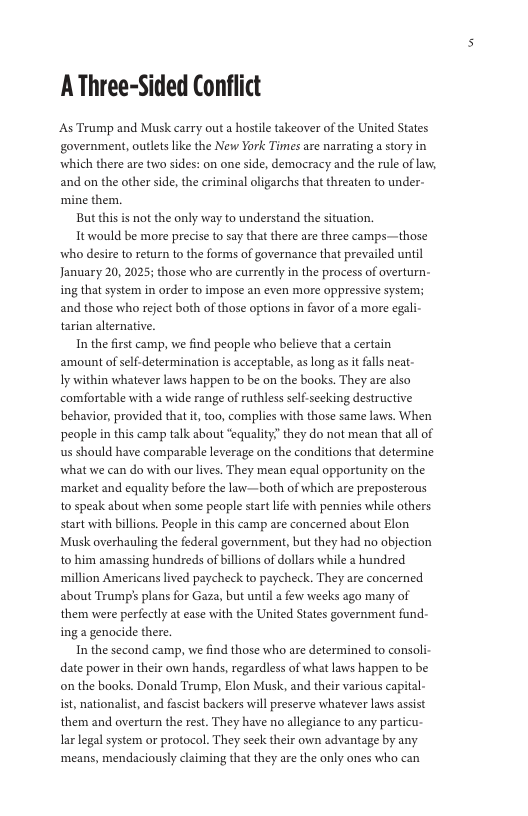
‘At this moment of peril, when aspiring autocrats have taken
power and are attempting to consolidate permanent control of
the state, why would the New York Times muddy the waters by
taking a cheap shot at some of Donald Trump's most determined
enemies? Looking more closely at the quote above, it seems that
the editorial board's chief concern is not what will happen as a
consequence of Elon Musk’ actions, but whether Musk and his
cronies are following the rules properly.
AThree-Sided Conflict
As Trump and Musk carry out a hostile takeover of the United States
government, outlts like the New York Times are narrating a tory in
which there are two sides: on one side, democracy and the rule of law,
and on the other side, the criminal oligarchs that threaten to under-
mine them.
But this is not the only way to understand the situation
Ttwould be more precise to say that there are three camps—those
who desire to return to the forms of governance that prevailed until
January 20, 2025; those who are currently in the process of overturn-
ing that system in order to impose an even more oppressive system;
and those who reject both of those options in favor of a more egal-
tarian alternative.
In the first camp, we find people who believe that a certain
amount of self-determination is acceptable, as long asit falls neat-
Iy within whatever laws happen to be on the books. They are also
comfortable with a wide range of ruthless self-seeking destructive
behavior, provided that it too, complies with those same laws. When
people in this camp talk about “equality” they do not mean that all of
us should have comparable leverage on the conditions that determine
what we can do with our lives. They mean equal opportunity on the
‘market and equality before the law—both of which are preposterous
to speak about when some people start life with pennies while others
start with billions. People in this camp are concerned about Elon
Musk overhauling the federal government, but they had no objection
to him amassing hundreds of billions of dollars while a hundred
‘million Americans lived paycheck to paycheck. They are concerned
about Trump’s plans for Gaza, but until a few weeks ago many of
them were perfectly at ease with the United States government fund-
ing a genocide there.
In the second camp, we find those who are determined to consoli-
date power i their own hands, regardless of what laws happen to be
on the books. Donald Trump, Elon Musk, and their various capital-
ist, nationalist, and fascist backers will preserve whatever laws asist
them and overturn the rest. They have no alegiance to any particu-
lar legal system or protocol. They seck their own advantage by any.
‘means, mendaciously claiming that they are the only ones who can
address the problems of our time (*I alone can fixit”). Such people
have always existed, but only over the past few years have resources
become so unevenly distributed that a handful of them could take
over the United States government.
Finally, in the third camp, we find anarchists and other rebels who
also have no allegiance to the system of governance that has prevailed
until now, but for entirely different reasons. Anarchists believe that
everyone deserves the maximum amount of freedom, regardless of
what laws happen to be on the books—and therefore, that no one
deserves to be able to dominate anyone else, whether by hoarding
access to resources or wielding the instruments of state repression.
People in this camp hold that regardless of what any constitution
proclaims, regardless of how an electorate votes in an election, none
of us owe any allegiance to institutions that exist solel for the pur-
pose of imposing disparities in power, whether we are talking about
government departments, banks, or private military contractors. In
contrast to those who are comfortable with oligarchy and ethnic
cleansing as long as no one breaks the rules, there is no way to bribe
or blackmail anarchists into making excuses for oppression.
‘Whatever your politics, you are probably sympathe
chist analysis to some degree—perhaps more than you think. Try this
thought experiment:
to the anar-
How much do you buy into the idea that the democratic pro-
cess should trump your own conscience and values? Imagine
yourselfin a democratic republic with slaves—say, ancient
Athens, or ancient Rome, or the United States of America until
the end of 1865. Would you obey the law and treat people as
property while endeavoring to change the laws, knowing full
well that whole generations might ive and die in chains in the
‘meantime? Or would you act according to your conscience in
defiance of the law, like Harriet Tubman and John Brown?
1f you would follow in the footsteps of Harriet Tubman, then
you, too, believe that there is something more important than
the rule of law. This is a problem for anyone who wans to make
conformity with the law or with the will of the majority into the
final arbiter of legitimacy.
“From Democracy to Freedom
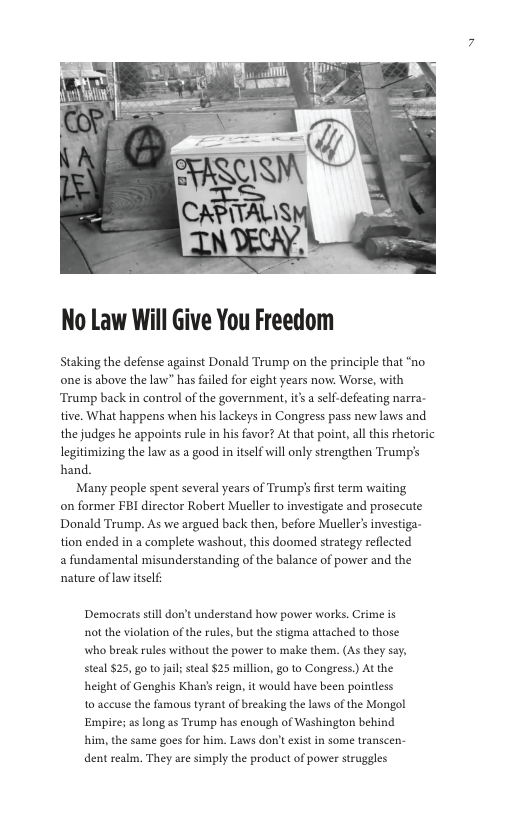
No Law Will Give You Freedom
Staking the defense against Donald Trump on the principle that “no
one is above the law” has failed for eight years now: Worse, with
‘Tramp back n control of the government, it's a self-defeating narra-
tive. What happens when his lackeys in Congress pass new laws and
the judges he appoints rule in his favor? At that point, al this rhetoric
legitimizing the law as a good in itself will only strengthen Trump's
hand.
Many people spent several years of Trump's first term waiting
on former FBI director Robert Mueller to investigate and prosecute
Donald Trump. As we argued back the, before Mueller’s investiga-
tion ended in a complete washout,this doomed strategy reflected
a fundamental misunderstanding of the balance of power and the
nature of aw itself:
Democrats still don't understand how power works. Crime is
ot the violation of the rules, but the stigma attached to those.
who break rules without the power to make them. (As they say,
steal $25, go 1o jail; steal $25 million, go to Congress.) At the
height of Genghis Khan's eign, it would have been pointless
10 accuse the famous tyrant of breaking the laws of the Mongol
Empire; a long as Trump has enough of Washington behind
him, the same goes for him. Laws don't exist in some transcen-
dent realm. They are simply the product of power struggles
amang the elite—not to mention the passivity of the governed—
and they are enforced according to the prevailing balance of
power. To fetishize the law is to accept that might makes right.
It means abdicating the responsibility to do what is ethical
segardless of what the laws happen to be.
In the long run, the courts cannot constrain Donald Trump. He
controls the exccutive branch, the part of the government that is
supposed to enforce their rulings.
Nor will the courts constrain Elon Musk. Even apart from Trump's
support, he has unlimited money for court cases. If the courts at-
tempt to punish him by imposing fines, he can afford to pay for tens
of bllions of dollars’ worth of illegal activity: He already routinely
refuses to pay rent and other bills that no ordinary person could ever
get away with shrugging off.
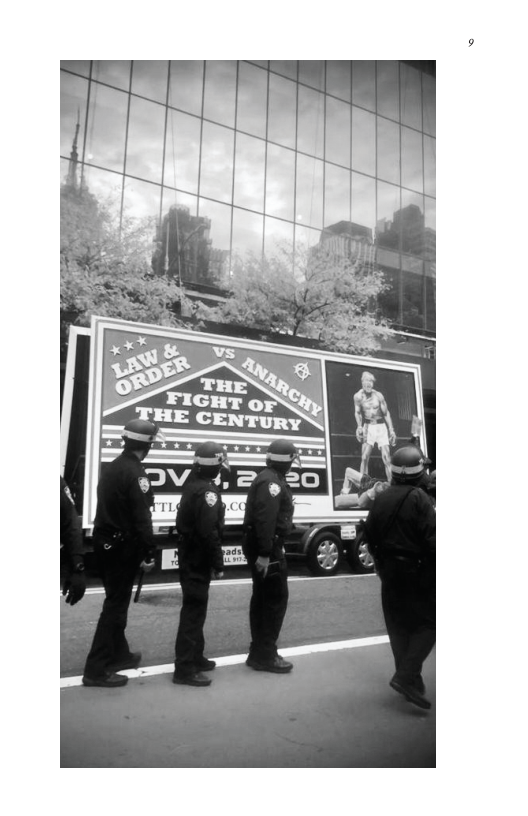
Nor will the police and other law-enforcement agencies con-
strain Trump or Musk. In theory, the police exist to enforce laws; in
practice, the average cop knows very lttle about the law—they re not
lawyers, after all—but a great deal about obeying orders. Trump is
the favorite politician of the mercenary caste, the ones who sell their
capacity to inflict violence to the highest bidder (be that the state or
private security contractors). Just as Trump has flled his government
with disgraced public figures who depend on him, the police are his
natural allies—the more so as a consequence of their compromised
relationship with the general public.
Continuing to emphasize the centrality oflaw in objections to
‘Tramp’s agenda can only hamstring future movements, discouraging
the emergence of the only kind of resistance that could offer any hope
once he has completed his takeover of the federal governmen
The truth is, nether the powerful nor the oppressed have ever
had good cause to obey laws—the former because the same
privileges that enable the to write the laws release them
from the necessity of obeying them, the later because the laws
weren't established for their benefit i the first place.
““Tuke Your Pick: Law or Frecdont”
10
Remember How We Got Here
‘The binary narrative about criminal oligarchs undermining democ-
racy and the rule of law is misleading in another way: The authori
ians who are overhauling the government do not represent the oppo-
site of the preceding order, but the inevitable consequence ofit. Their
power grab i the result of several decades of democratically-man-
aged capitalism, which enabled a coterie of billionaires to accumulate
o much wealth and power that they no longer believe that they need
the trappings of democracy to keep the populace appeased.
Itwas the rules of the previous game that created this situation.
‘Wanting to go backa single step in history; to the previous stage of
the process, is foolish, because that was the stage that led us directly
o this one. It s impossible to rewind the clock—and even if we could,
that would only mean arriving once again at the same situation.
‘The problem is not simply that MusK’s protégés have run rampant
through the databases of the government, though that is already
producing consequences that willlkely be impossible to undo. The
real problem is the emergence of a caste of billionaires who no longer
require the services of democracy and have enough power to do away
with it
‘These billionaires can buy up communication platforms, buy up
both politicians and voters, use the global infrastructure under their
control to determine the outcome of geopolitical struggles. Donald
Tramp and Elon Musk are the ones who are currently attracting the
‘most attention, but behind them are Peter Thiel, Marc Andreessen,
and many more. The individual character flaws o these men are
beside the point; the significant thing is that the mechanisms of
neoliberal capitalism are systematically concentrating power in the
hands of people who are completely disinterested in others'agency or
well-being,
“Thisis why milquetoast centrism cannot offer a convincing alter-
native to the despotism of the fascists and technocrats.
Describing the Democrats’ unsuccessful strategy of chasing Re-
publicans further and further to the right, one Democratic
quipped that “voters who ordered a Coca-Cola don't want a Diet
Coke? This doesn't put things strongly enough. Considering that
‘Tramp won the election on an explicit platform of mass deportations
I
and autocracy, Democrats imitating Republican talking points while
promising to “defend democracy” i like offering Diet Coke to a co-
caine addict. Today's Republican voters are motivated in great part by
the desire to see violence directed against those more vulnerable than
themselves. It s autocracy itself they desire, not any particular policy:
“This bloodlust is the consequence of the avarice and narcissism
that neoliberal capitalism fostered in so many people and then failed
to fulfill Those who have become accustomed to powerlessness and
who urgently desire revenge but do not understand who is
e for their situation, will elevate tyrants to power for the
vicarious thrill of seeing someone made to suffer even if the conse-
quences make life worse for practically everyone. Doubtless some of
them would change sides if they saw a real opportunity to improve
their lives, but that would require much more than a promise to go
backto the Biden era.
Ifthe defenders of democracy cannot offer anything more in-
spiring than a return to the previous state of affairs—the one that
caused this catastrophe in the first place—they willlose, and they will
deserve to lose. It wll take a more ambitious and far-reaching vision
to defeat oligarchy:
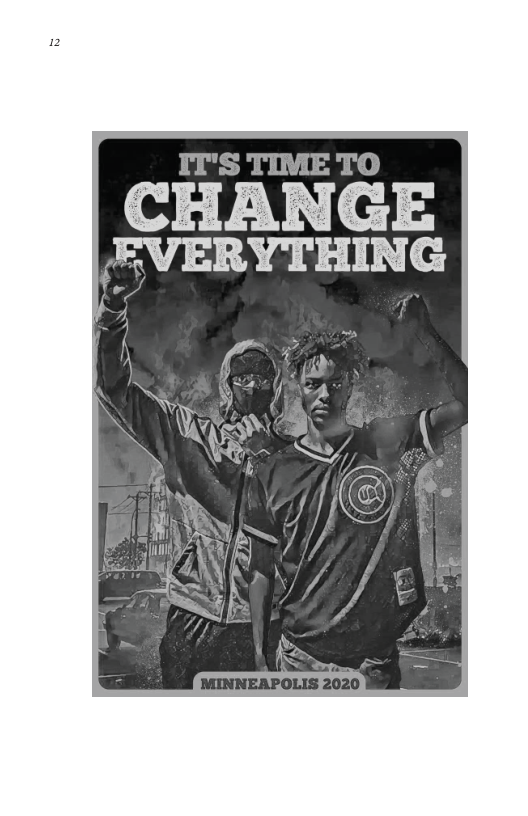
MIE TO
CHANGE
FVERYTHING
5
Become an Anarchist or Forever Hold
Your Peace
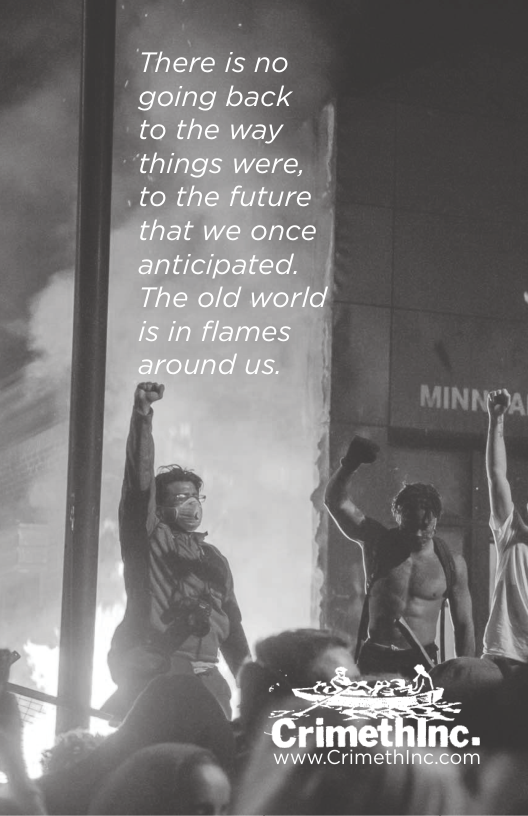
In 2020, the most powerful uprising in living memory took place in
the United States. Millions of people filled the streets. They were not
galvanized by a timid electoral campaign, nor simply by the footage
of police murdering George Floyd, but by the brave actions of ordi-
nary people who stood up to injustice—above all by the burning of
the Third Precinct in Minneapolis. By driving the political discourse
in the election year, this uprising not only turned voters away from
Donald Trump—it also showed billionaires that Trump would not
be able to preserve conditions suitable for business, forcing them to
temper their ambitions.
One poll showed Americans supporting the burning of the police
precinct by a larger margin than any victorious presidential candidate
this century.
In response to the uprising, Joe Biden and other Democrats
doubled down on supporting the police. This shows that the Demo-
crats believe that it is impossible to maintain power under capitalism
without channeling more and more resources towards repression,
tasking the police with keeping an increasingly desperate population
under control.
‘Today, the Republicans are going even further, cultivating sup-
port for explicitly patriarchal, racst, xenophobic, and authoritarian
politics—in short, for fascism. The implication is that a billionaires
accumulate more and more power and the consequences of their
rapaciousness trickle down to the rest of us, it will take more than
police to keep the population under control: it willalso take informal
militias, and falsehoods about why some demographics deserve to
have more power than everyone else, and probably in the long run,
ethnic cleansing and genocide on a larger scale than we have yet seen.
Dr. Martin Luther King, Jr. invited us to trust that “the arc of the
‘moral universe is long, but it bends toward justice” But today it is
clear that things are not slowly; steadily getting better, neither in the
field of civil rights, nor in regards to the natural environment, nor
justice, nor governance.
"
The state is not the solution to these problems. It s a protection
racket that—until recently—purported to solve our problems in order
tolull us into dependence (*I alone can fixit"!) while suppressing our
ability to meet our needs without it. Now, under Trump and Musk.
inthe United States and rulers like Javier Milei elsewhere, there is no
longer any pretense that the state exists to do anything besides op-
press people and defend the profits of the rich. All this time, the state
has been accumulating the means—both technological and social —
that are required to force this new reality on us, and now the tyrants
are intent on using them.
Yet in doing so, Elon Musk and Donald Tramp are giving millions
of people cause to reevaluate their priorities and dedicate their lives
to profound social change. The 2020 uprising offered a glimpse of
what it looks like for large numbers of people to act on their own
initiative, creating a groundswell of resistance that is much greater
than the sum ofits parts. Our chief error, in 2020, was in imag
that we could simply return to business as usual afierwards, when in
fact our only hope s to change the world.
As Trump and Musk gut every aspect of the sate that is not about
profiteering and repression, the stakes of this moment are coming
into focus. There is no more middle ground. If you care about pul
health, you have to become a revolutionary. If you care about medical
research, you have to become a revolutionary. If you care about
climate change, about labor conditions, about the well-being of chil-
dren in warzones, there is nothing else for it—you have to become a
revolutionary.
In the movements to come, we must make space for the civil
servants Elon Musk has fired, for the scientists and academics whose
funding has dried up, for those who once sought social change
through electoral politics. They should put alltheir skills to work
in new contexts, experimenting with new forms of resistance and
spreading whatever strategies work far and wide. But we should not
simply try to rebuild the broken system that brought us to this dire
situation. We must build a new vision together along with the means
to bring it into being.
Anarchists propose to build our collective capacity to act on a
horizontal and decentralized basis, ather than entrusting our agency
to leaders. We seek to create a lattice of overlapping participatory and
voluntary associations that can meet people’s material and spiritual
is
needs. Rather than hoarding resources for ourselves the way the
billionaires do, we seek to abolish all of the mechanisms that impose
artificial scarcity,to create commons that benefit everyone. We seck
to generate abundance, not profit
To be an anarchist means to recognize that our freedom and
well-being are inextricably bound up with the freedom and well-be-
ing of billions ke us. It means discarding all the old excuses for
remaining subservient to those who only endeavor to enrich them:
selves at others’ expense. It means becoming fiercely loyal to what
i best in ourselves and each other, to our capacity for compassion
and cooperation and courage. Across two centries, anarchists have
resisted under monarchies and persisted through dictatorships. Now
that liberal democracy and neoliberal capitalism are concluding in a
new form of tyranny, a new generation must draw on this long legacy
of struggle.
There is no going back to the way things were, to the future that
we once anticipated. The old world isin flames around us. Become
an anarchist, or forever hold your peace.
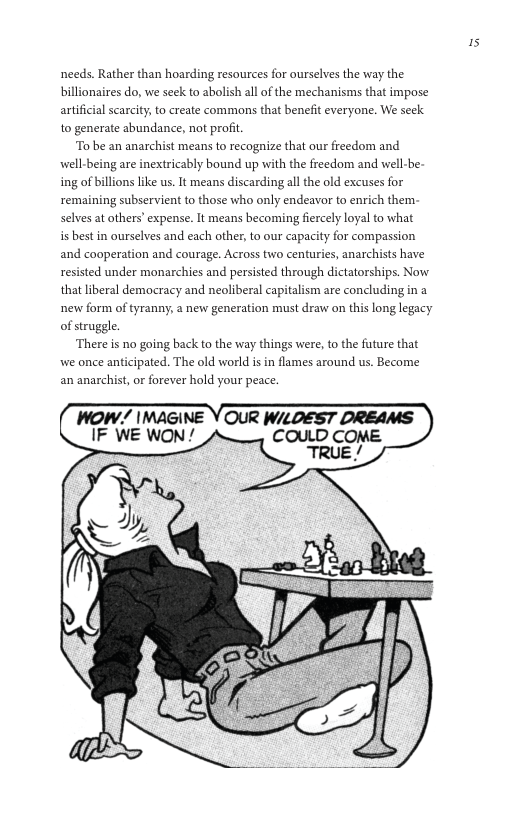
WOW/ IMAGINE Y OUR W/LDEST DREAMS
IF WE WON/
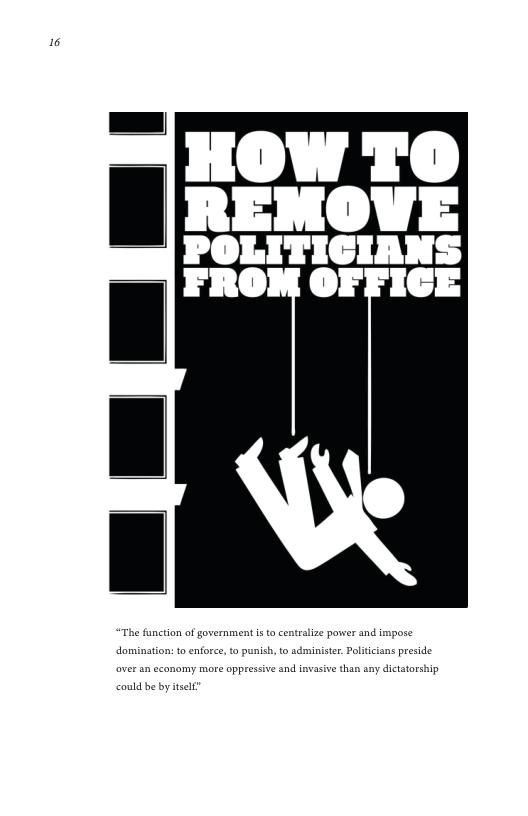
The function of government s to centrlize power and impose
domintion: to enforce, o punish, to administer Polticians preside
aver an ecanomy more oppressive and invasive than any dictstorship
could be by tself”
”
Further Reading
+ o Change Everything: An Anarchist Appeal available from
Crimethinc.
+ The Case for Resistance: What We're Up Against—and What It
Could Look Like o Fight available from Crimethinc.
« Ahead of Another Summer of Climate Disasters, Let’s Talk about
‘Real Solutions available from Crimethinc.
+ Life Without Law available from by Strangers in a Tangled Wil-
demess
+ A Communism We Can Use available from Living and Fighting
« AGift To Humanity: The George Floyd Rebellion available from
inhabit global
+ Ecosystems of Revalt available from 1ll Will