Banking on Bondage
Web PDF • Imposed PDF• Raw TXT (OCR)
![BANKING ON BONDAGE: Private Prisons and Mass Incarceration November 2, 2011 ACLU AMERICAN CIVIL LIBERTIES UNION AMERICAN CIVIL LIBERTIES UNION 125 Broad Street, 19th Floor New York, NY 10004 www.aclu.org ACKNOWLEDGEMENTS This report has been a project of the ACLU National Prison Project and Center for Justice and was authored by David Shapiro (Staff Attorney, National Prison Project]. First and foremost, the author would like to thank Mike Tartaglia (Paralegal, National Prison Project] for his many contributions to the report, and David Fathi [Director, National Prison Project] and Vanita Gupta [ACLU Deputy Legal Director] for their support of the project. Numerous individuals generously reviewed drafts or otherwise contributed their wisdom and insight. including Anjali Abraham, Rachel Bloom, Mike Brickner, Inimai Chettiar, Scott Crichton, Shakyra Diaz, Terence Dougherty, Marjorie Esman, Alex Friedmann, Jennifer Giuttari, Lisa Graybill, Judy Greene, Rachel Jordan, Bob Libal, Victoria Lopez, Will Matthews, Rachel Myers, Nila Natarajan, Stephen Pevar, Daniel Pachoda, Judy Rabinovitz, Chris Rickerd, Tom Stenson, Willa Tracosas, Jennifer Wedekind, Margaret Winter, and Paul Wright. Cover Image: Steve McAlister/Photographer’s Choice/Getty Images](banking-on-bondage 2.png)


![ADanger to State Finances While supporters of privatization tout the idea that governments can save money through private facilities, the evidence for supposed cost savings is mixed at best.” As state governments across the nation confront deep fiscal deficits, the assertion that private prisons demonstrably reduce the costs of incarceration can be dangerous and irresponsible. Such claims may lure states into building private prisons or privatizing existing ones rather than reducing incarceration rates and limiting corrections spending through serious criminal justice reform This year, advocates of for-profit prisons trotted out privatization schemes as a supposed answer to budgetary woes in numerous states: = Arizona has announced plans to award 5,000 additional prison beds to private contractors,® despite a recent statement by the Arizona Auditor General that for- profit imprisonment in Arizona may cost more than incarceration in publicly-operated facilities." Arizona’s Department of Corrections is the only large agency in that state not subject to a budget cut in fiscal year 2012—in fact, the Department’s budget increased by $10 million." According to a news report, private prison employees and corporate officers contributed money to Governor Jan Brewer’s reelection campaign, and high ranking Brewer Administration officials previously worked as private prison lobbyists. ™ Florida has responded to exploding incarceration costs largely through increasing reliance on private prisons.™ Although the assertion that private prisons save taxpayer money is highly questionable, supporters of privatization, according to a recent news report, claim that privatization in Florida is necessary to rein in the prison system’s budget, which stood at $2.3 billion in 2010." A recent editorial in the Orlando Sentinel expressed the view that privatization “has eclipsed and shelved potentially more fruitful, cost-effective changes. One of them is sentencing reform.” On September 30,2011, a Florida court enjoined the Department of Corrections from implementing the privatization of prisons in 18 counties, finding that the planned privatization failed to comply with procedures mandated by state law.” The court stated, “[tlhe decision to issue only one [request for proposal] and only one contract for all 29 prison facilities [subject to proposed privatization] was based on convenience and speed, .. rather than on any demonstrated savings or benefit advantage.”™ = Ohio recently announced that it will become, on December 31, 2011, the first state in the nation to sell a publicly operated prison, Lake Erie Correctional Facility, to a private company, CCA."" Notably, the head of Ohio’s corrections department had served as a managing director of CCA.® The claim that prison privatization demonstrably reduces costs and trims government budgets may detract from the critical work of reducing the state’s prison population.” AMERICAN CIVIL LIBERTIES UNION | 6](banking-on-bondage 6.png)
![= Louisiana narrowly defeated a proposal, pushed by Governor Bobby Jindal in a desperate attempt to generate short-term revenue, to sell off three state prisons to private companies.’ The Louisiana House Appropriations Committee blocked the bill by a vote of 13-12, with legislators expressing deep concern about the wisdom of selling off the state’s assets. = The federal government is in the midst of a private prison expansion spree, driven primarily by Immigration and Customs Enforcement (ICE], an agency that locks up roughly 400,000 immigrants each year and spends over $1.9 billion annually on custody operations.*ICE nowintends to create a new network of massive immigration detention centers, managed largely by private companies, in states including New Jersey, Texas, Florida, California and Illinois.* According to a news report, in August 2011, ICE’s plans to send 1,250 immigration detainees to Essex County, New Jersey threatened to unravel amid allegations that a private prison company seeking the contract, whose executives enjoyed close ties to Governor Chris Christie, received “special treatment” from the county.* The fiscal crisis confronting the federal government, however, has done nothing to dampen Washington’s spending binge on privatized immigration detention. Atrocious Conditions While evidence is mixed, certain empirical studies show a heightened level of violence against prisoners in private institutions. This may reflect in part the higher rate of staff turnover in private prisons, which can result in inexperienced guards walking the tiers.” After an infamous escape from an Arizona private prison in 2010, for example, the Arizona Department of Corrections reported that at the prison, “[sltaff are fairly ‘green’ across all shifts,” “are not proficient with weapons,” and habitually ignore sounding alarms.? Private facilities have also been linked to atrocious conditions. In a juvenile facility in Texas, for example, auditors reported, “[clells were filthy, smelled of feces and urine.”" Just three weeks before the release of this report, prisoner fights in several locations throughout a private prison in Oklahoma left 46 prisoners injured and required 16 inmates to be sent to the hospital, some of them in critical condition. The risks to safety confronting inmates in private prisons are especially relevant at present, as the U.S. Supreme Court considers a case that could, depending on the outcome, prevent federal prisoners in private institutions from seeking compensation for constitutional violations—including deliberate indifference to prisoners physical well being* AMERICAN CIVIL LIBERTIES UNION | 7](banking-on-bondage 7.png)

![Early Experiments in For-Profit Imprisonment Early forms of prison privatization yielded horrific results. In eighteenth-century England, private “keepers” ran prisons, making their Living by extracting lodging fees from those they incarcerated —and by operating coffee shops and beer taps for affluent prisoners. The rich may have lived well even behind bars, but private jailers had litle stake in the well-being of poor prisoners, who were “gouged for fees, cheated on their provisions, loaded with irons, [and] exposed to disease."* Fortunately, a movement to improve prison order and establish public control began to gather force in England in the late Eighteenth Century.” Inthe years following the Civil War, the United States also experimented with a form of privatization. The convict lease system—which has been called a “substitute for slavery“—took hold in the South. Under this system, state and local governments managed the prisons, but prisoners were leased out to work for private companies or individuals.‘! Like the private “keepers” in England, these contractors had little incentive to treat prisoners humanely. According to Professor Michelle Alexander, “Death rates were shockingly high, for the private contractors had no interest in the health and well-being of their laborers, unlike the earlier slave-owners who needed their slaves, at minimum, to be healthy enough to survive hard labor." Toward the end of the Nineteenth Century, states began to outlaw convict leasing, and Congress forbade the leasing of federal prisoners in 1887. By 1900, virtually all governments around the world had assumed responsibility for management of their own prisons.‘ The Exponential Growth of Private Prisons Atthe beginning of the 1980s, private prisons for adults did not exist in the United States, but recent years have witnessed a reemergence and dramatic expansion of this form of incarceration.** The private prison explosion went hand-in-hand with a massive increase in incarceration rates. Since President Richard Nixon first announced the “war on drugs” forty years ago, the United States has adopted “tough on crime” laws that have given it the dubious distinction of having the highest incarceration rate in the world. These laws include: Mandatory minimum sentencing laws: Such laws impose long sentences and prevent judges from exercising discretion to impose more lenient punishments, where appropriate, based on the circumstances of the crime and the defendant’s individual characteristics. Truth in sentencing laws: Such laws sharply curtail probation and parole eligil requiring inmates to remain in prison long after they have been rehabilitated AMERICAN CIVIL LIBERTIES UNION | 10](banking-on-bondage 10.png)
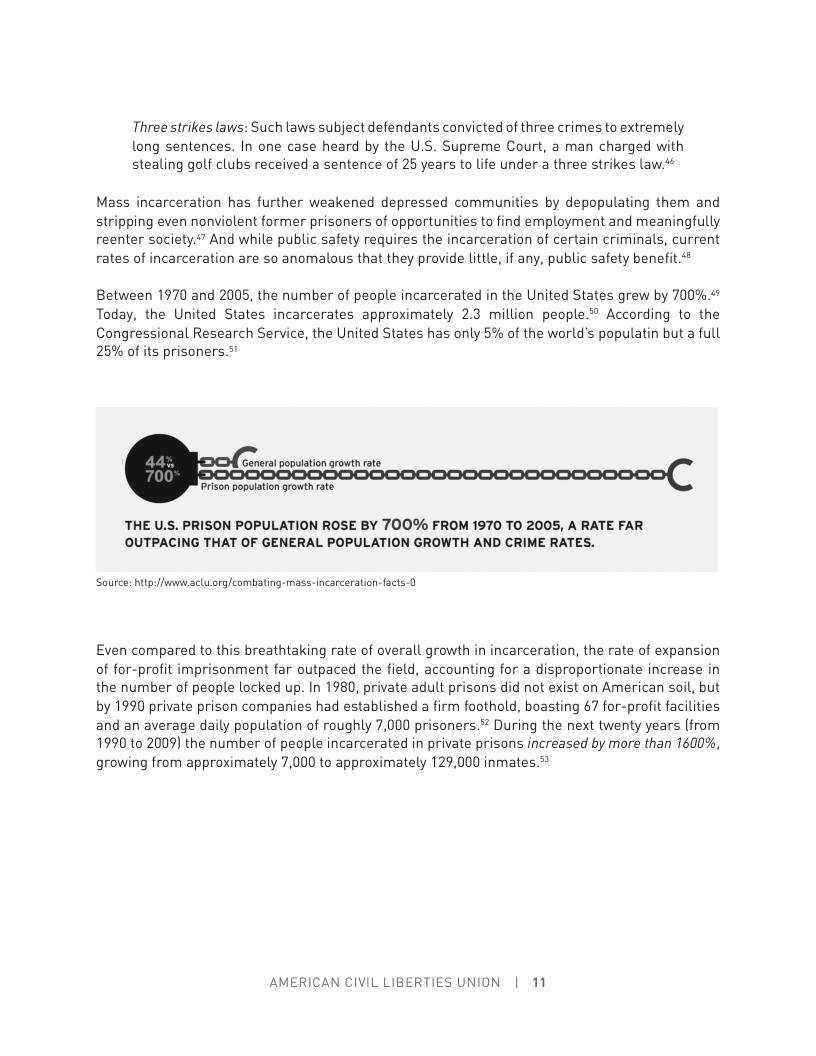
![Average number of prisoners in private facilities in 1990: 7,771 Number of prisoners in private facilities on December 31, 2009: 129,336 Percentage increase 1990-2009: 1664% SOURCE forprisoner numbers: United States Department of Jusice (Bureau of Justice Satistics) NUMBER OF PRISONERS Increasing incarceration rates fueled this massive expansion of private corrections. CCA— the largest private prison company in the United States—admits that current sentencing laws increase the company’s profits by swelling prison populations, whereas policies aimed at reducing incarceration rates create financial risks for the corporation. Specifically, in a 2010 Annual Report submitted to the Securities and Exchange Commission (SEC], CCA stated, under the heading “Risks Related to Our Business and Industry”: Our ability to secure new contracts to develop and manage correctional and detention facilities depends on manyfactorsoutside our control. Our growthis generallydependent upon our ability to obtain new contracts to develop and manage new correctional and detention facilities. This possible growth depends on a number of factors we cannot control, including crime rates and sentencing patterns in various jurisdictions and acceptance of privatization. The demand for our facilities and services could be adversely affected by the relaxation of enforcement efforts, leniency in conviction or parole standards and sentencing practices or through the decriminalization of certain activities that are currently proscribed by our criminal laws. For instance, any changes with respect to drugs and controlled substances or illegal immigration could affect the number of persons arrested, convicted, and sentenced, thereby potentially reducing demand for correctional facilities to house them. Legislation has been proposed in numerous jurisdictions that could lower minimum sentences for some non-violent crimes and make more inmates eligible for early release based on good behavior. Also, sentencing alternatives under consideration could put some offenders on probation with electronic monitoring who would otherwise be incarcerated. Similarly, reductions in crime rates or resources dedicated to prevent and enforce crime could lead to reductions in arrests, convictions and sentences requiring incarceration at correctional facilities. AMERICAN CIVIL LIBERTIES UNION | 12](banking-on-bondage 12.png)

![Private Prisons, Mass Incarceration, and the American Legislative Exchange Council CCA, the leading private prison company, has long provided major support to, and had close ties with, the American Legislative Exchange Council [ALEC]—an organization of state legislators that has advocated harsh sentencing and detention laws, such as mandatory minimum sentencing statutes. ALEC provides state legislators with model legislation, and each year, ALEC members introduce hundreds of these model bills in statehouses across the country.* ALEC operates by hosting lavish retreats that bring together state legislators and corporate executives. Almost 2,000 state legislators belong to the organization.* According to National Public Radio, at ALEC annual conferences, “companies get to sit around a table and write ‘model bills’ with the state legislators, who then take them home to their states.”* Legislators, it has been reported, pay nominal fees to attend the meetings ($50 for an annual membership), while the corporate participants pay thousands of dollars in membership dues.* As one ALEC member Top Private Prison Companies Corrections Corporation of America (CCA) 2010 Revenue: $1,700,000,000 Prisoner Capacity: 90,037 Year Founded: 1983 Headgquarters: Nashville, Tennessee Head: Damon Hininger (President and CEO) Executive Compensation: $3,266,387 compensation package for Hininger in 2010 (according to Morningstar) 2. The GEO Group 2010 Revenue: $1,269,968,000 Prisoner Capacity: 81,000 Year Founded: 1984 (founded as Wackenhut Corrections Corporation) Headgquarters: Boca Raton, Florida Head: George Zoley (Chairman, CEO, Founder) Executive Compensation: $3,484,807 compensation package for Zoley in 2010 (according to Morningstar) Sources: CCA: 2010 Annual Lette to Shareholders: A Quarter Century of Serice to America: About CCA; Morningstar, Correctians Corporation of America, Key Executive Compensation. GEO Group: 2010 Annual Report; 2010 Letter o Sharshelders: Morningstar, The GEO Group, Inc.. Key. Executive Compensation AMERICAN CIVIL LIBERTIES UNION | 14](banking-on-bondage 14.png)
![allegedly stated in the late 1990s: “The organization is supported by money from the corporate sector, and, by paying to be members, corporations are allowed the opportunity to sit down at the table and discuss the issues that they have an interest in."" After ALEC meetings, legislators return to their home states with ALEC model legislation. ALEChaspushedlegistationthat benefitsprivateprisoncompanies by promoting policies that result in mass incarceration.’” In the 1990s, ALEC championed—and, according to one report by an advocacy group, succeeded in enacting in 27 states—"truth in sentencing” and “three strikes” legislation. Such laws were certain to increase prison populations (whether public o private) and the amount of taxpayer money funneled into prisons. In the 1990s, ALEC’s mass incarceration legislation met with overwhelming success. In a 1996 article entitled Getting Tough Works: Old Strategies Are the Weapons in the New War on Crime, a former ALEC Task Force Director boasted, “[nlow, truth in sentencing laws, based on an ALEC model bill, require inmates to serve 80 to 90 percent of their sentences before becoming eligible for parole.” While private prison companies deny taking steps to affirmatively support legislation that promotes mass incarceration,”? and although CCA left ALEC in 2010, according to a recent news report, “for the past two decades, a CCA executive has been a member of the council’s [task force that] produced more than 85 model bills and resolutions that required tougher criminal sentencing, expanded immigration enforcement and promoted prison privatization senior director of business development was the private-sector cf to late 90s when it produced a series of model bills promoting would send more people to prison for a longer organization, “[iln 1999, CCA made the [ALEC] President’s List fo “The demand for our faci . le or parole standards and sentencing practices...” —Corrections Corporation of America, Annual Report filed with the Securities and Exchange Commission “Now, truth in senten laws, based on an ALEC model bill, require inmates to serve 80 to 90 percent of their sentences before becoming eligible for parole.” —Former ALEC Task Force Director Michael Hotra CCAs hair of the task force in the mid- tough-on-crime measures that e."7 According to one report by a non-profit r contributions to ALEC’s States and National Policy Summit; Wackenhut also sponsored the conference.”” Even as ALEC has recently pushed certain piecemeal reforms for low-risk prisoners, the organization continues to trumpet harsh mandatory minimums, stating on its website Each year, close to 1,000 bills, based at least in part on ALEC Model Legisl introduced in the states. Of these, an average of 20 percent become law . founding, ALEC has amassed an unmatched record of achieving ground-breaking AMERICAN CIVIL LIBERTIES UNION [R5](banking-on-bondage 15.png)
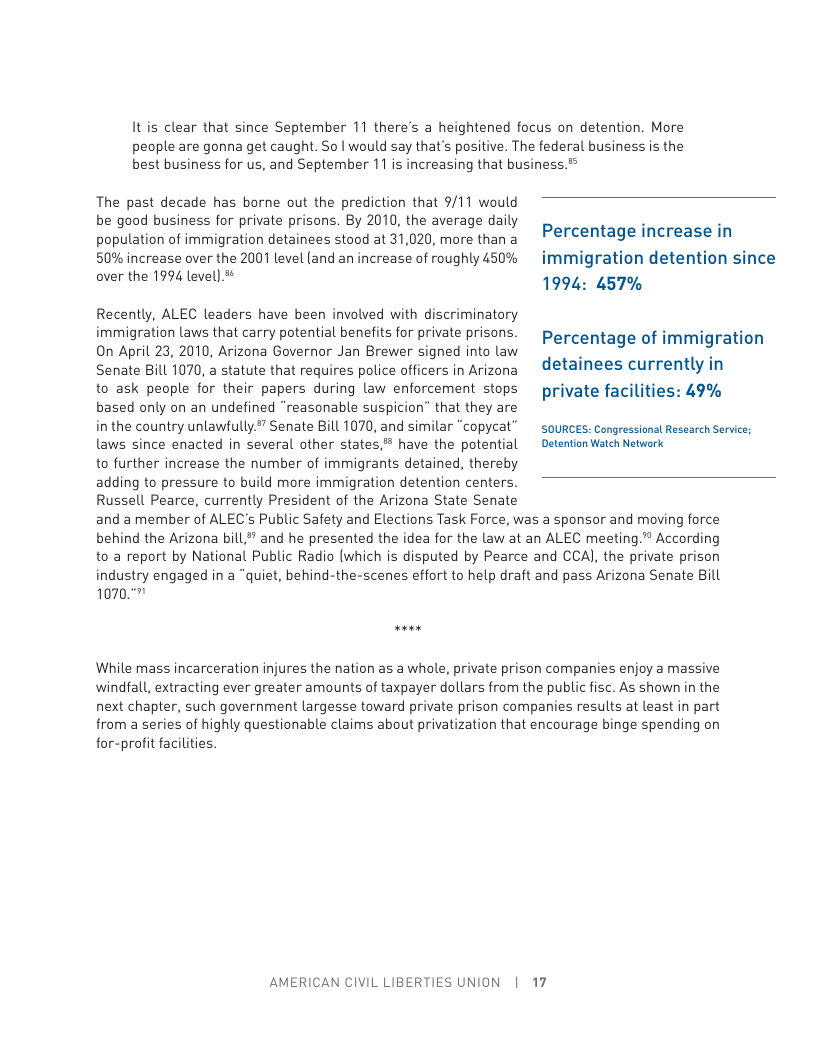
![changes in public policy. Palicies such as mandatory minimum sentencing for violent criminals represent just a handful of ALEC’s victories in the states. ™ ALEC has not only done work that helped increase the amount of taxpayer money spent on corrections generally but has also supported policies likely to increase the proportion of corrections spending funneled to private corporations. In fact, the “Private Correctional Facilities Act,” another ALEC model bill, authorized for-profit incarceration contracts between state and local governments and private prison operators. The model act stated: “This Act would allow any unit of government to contract with the private sector to perform services currently performed by a corrections agency."” The model act further provided that a state prisoner “may be incarcerated in a facility constructed or operated by a private entity pursuant to contract under this Act,” and permitted contracts for the private purchase or lease of correctional facilities for periods of up to 30 years.™ According to a report by an advocacy group, ALEC’s Criminal Justice Task Force at one point reported that prison privatization was a “major issue” on which it was focusing,” and according to a recent news report, “[sltarting in the 1990s, [an] ALEC task force ... produced model bills directly promoting prison privatization. These included bills to let private prisons house inmates from other states without permission of local governments, require privatization of prisons and correctional services and encourage contracting for prison labor." Immigration Detention and Private Prison Expansion In recent years, private prisons have profited not only from harsh sentencing policies but also from an unprecedented increase in the number of detained immigrants—a group incarcerated pursuant to civil detention authority but housed in prison-like conditions. According to one group, facilities operated by private prison companies currently house nearly 50% of the more than 30,000 immigrants detained by Immigration and Customs Enforcement (ICE] at any given time.s! Like imprisonment, immigration detention has expanded dramatically in recent years. In 1994, the average daily population of detained immigrants stood at 6,785.% In 1996, Congress passed the lllegal Immigrant Reform and Immigrant Responsibility Act (IIRIRA], which massively expanded the detention of immigrants. Some of the statute’s provisions were aimed at noncitizens with criminal convictions, authorizing their mandatory (and in some cases indefinite) detention. Other provisions targeted asylum seekers, who became subject to an expedited removal process that also mandated detention. By 2001, the number of immigrants detained at any given time had more than tripled, to 20,429.5 Yet even that number would continue to grow, as the September 11, 2001 attacks further fueled the reliance on immigration detention, in turn bringing new business for the private prison industry. Just weeks after September 11, the head of a private prison company spoke with stock analysts. According to one report submitted to the U.N. Special Rapporteur on the Rights of Migrants, he stated: AMERICAN CIVIL LIBERTIES UNION | 16](banking-on-bondage 16.png)

![Accordingly, an analysis of the key benefits supposedly associated with private prisons—that for- profit prisons save money, stimulate economic growth, and adequately ensure the well-being of prisoners—is especially relevant in the present moment. Such claims are examined below. Supposed Cost Savings Evidence that private prisons save public money is mixed at best. While some research supports such a view,” numerous other studies and reports have indicated that private prisons do not save money, cannot be demonstrated to save money in meaningful amounts, or may even cost more than governmentally operated prisons. For example: ® 102010, the Arizona Auditor General stated that analysis by the Arizona Department of Corrections “indicated that it may be more costly to house inmates in private prisons” than public institutions. Indeed, after making adjustments to allow for a more accurate comparison, “rates paid to private facilities were higher for both minimum- and medium-custody beds—the two categories of beds for which the [Arizona Department of Corrections] contracts.” ! ® 12010, the Hawaii State Auditor issued a scathing report which found that the state’s Department of Public Safety “repeatedly misled policymakers and the public by reporting inaccurate incarceration costs.” In justifying the decision to send prisoners to CCA prisons in the continental United States, rather than publicly operated prisons in Hawaii, the Department used a “flawed methodology,” “provideld] artificial inmate costs,” and engaged in “skewed cost reporting.”’" = 1n 2010, a Legal Review Committee, established by Monmouth County, New Jersey, to study the legal implications of privatizing the Monmouth County Correctional Institution, reported: “Many studies have been done regarding prison privatization, most of which conclude that the legal implications associated therewith make privatization unattractive. Specifically, increased Liability to the public entity, increased reported escapes, private prison guards who are not trained to the level of law enforcement officers, increased number of lawsuits and increased violence and disturbances at correction facilities ... Most objective cost studies showlittle or no cost savings to taxpayers coupled with an increased safety risk .. [Plrivatization does not appear to be a viable option for Monmouth County’s maximum security facility due to the potential increased risk of liability and safety risks without proof of cost savings. """ = n 2007, the Government Accountability Office (GAO) reported that the Federal Bureau of Prisons failed to collect adequate data to determine whether private federal prisons were more or less expensive than publicly operated federal prisons. "™ AMERICAN CIVIL LIBERTIES UNION | 19](banking-on-bondage 19.png)
![= A2007 meta-analysis of previous privatization studies by University of Utah researchers found: "Cost savings from privatization are not guaranteed and quality of services is not improved. Across the board effect sizes were small, so small that the value of moving to a privately managed system is questionable.”’" = While a judicial decision does not constitute a study, it is noteworthy that on September 30, 2011, a Florida court enjoined the Florida Department of Corrections from implementing the privatization of prisons in 18 counties, finding that the planned privatization failed to comply with procedures mandated by state law, including provisions regarding cost effectiveness."™ The court stated that the Department of Corrections “has not prepared any cost comparison study, cost-benefit analysis, or business case analysis. It has not consulted the Auditor General ... The decision to issue only one RFP and only one contract for all 29 prison facilities was based on convenience and speed, ... rather than on any demonstrated savings or benefit advantage ... From the record, it appears that the rush to meet [certain] deadlines has resulted in many shortcomings in the evaluation of whether privatization is in the best public interest as it relates to cost savings and effective service.”"” As this report went to press, Governor Rick Scott reportedly had not decided whether to appeal the ruling. While other studies have reported cost savings, ™ the independence of at least one researcher who supported private prisons has come into question based on his links to private prison companies. Charles Thomas, a University of Florida academic and one of the most outspoken proponents of private prisons, reportedly received $3 million in consulting fees from private prison companies or related entities."™ Although a potential conflict of interest does not necessarily imply flawed research, the Florida Commission on Ethics stated that Thomas’ “contractual relationships with private corrections companies, or companies related to the private corrections industry conflicted with his duty to objectively evaluate the corrections industry through his research with the University of Florida. ™" Scant Economic Benefit for Local Communities Aside from supposed cost benefits, the leading for-profit private prison companies assert that private prisons spur economic growth for local communities. The GEO Group’s website, for example, claims that GEO prisons provide lacal communities with an “influx of capital [that] has the ability to stimulate the economic makeup of a community through consumer spending, new business enterprises, and capital improvements.”’? Similarly, CCA promises that “[o]ur presence means more revenue for counties, towns, cities and states. Our facilities mean more local jobs for hardworking residents.”"* AMERICAN CIVIL LIBERTIES UNION | 20](banking-on-bondage 20.png)

![[TEF00@ Hardin’s Empty Prison In 2004, 2 group of businessmen had a proposal for the small town of Hardin, Montana: build a private detention center.’” The theory was that such a facility would lead to economic benefits for the community.”*In 2004, the city’s economic development director predicted that at the new facility, a job seeker “with a GED or high school diploma’ might be able to “get a job with significantly higher income.”’= To finance the project in Hardin, the economic development authority created by the town issued $27 million worth of municipal bonds that were both uninsured and unrated. ™ But once the facility had been built, it was unable to obtain a contract to house prisoners, and its 464 beds remained empty.” One news report described the facility as follows: “Inside its concrete walls, orange jumpsuits, rubber sandals and stacks of white tube socks weigh down the shelves of the storeroom. Computers, phones and video monitors line the tables in the control room. In the cafeteria, stacks of plastic trays and cooking utensils wait to be put to use.” Because the jail remained empty, the $27 million worth of bonds issued by the economic development authority created by the town lacked sufficient revenue to back them. ’ The authority defaulted on the bonds. ™ Roughly 67 people had been offered jobs and cleared background checks—but they could not report to work because the facility never opened.™" Just preventing the empty building from falling apart became a financial burden for the town. Pipes. began to leak in late 2009, more leaks were discovered in 2010, and repairs were slated to total $8,000."% In the winter, gas bills ran as high s $10,000 per month.’™* Desperate for a solution, the town turned to increasingly outlandish alternatives to fill the facility. For atime, it appeared that an individual by the name of Michael Hilton, the head of a company called "American Police Force” would provide the answer to Hardin’s prayers. ’ Hilton proposed not only to fill the jail with prisoners but to construct a “para-military training center” close to the jail ™ Hilton pledged to provide fees, in addition to such things as computers for schools and a homeless shelter. " Hardin’s economic development authority signed a ten-year contract with Hilton’s company,’” and Hilton arrived in Hardin with SUVs outfitted with a logo for the “Hardin Police Department” (an entity that does not exist] " It soon came to light, however, that Hilton had, according to the Associated Press, “gone by at least 17 aliases and hald] a history of fraud and theft ... He spent three years in prison in California and hald] $1.1 million in outstanding civil judgments against him."* According to a news report, American Police Force claimed that ts services included "sellling] assault ifles and other weapons in Afghanistan on behalf of the U.S. military...""*" ‘The town’s deal with Hilton and his "American Police Force” fell through, but the town still sought away tofill ts empty jail. When President Barack Obama pledged to remove all detainees from Guantanamo Bay, the Hardin City Council voted unanimously in favor of receiving Guantanamo AMERICAN CIVIL LIBERTIES UNION | 22](banking-on-bondage 22.png)


![the females to exit the vehicle, then mislead each of the victims to believe that he was conducting a legitimate search of their bodies, when in fact, the defendant touched the victims in a sexual manner and for the purposes of self gratification.”™ Dunn earlier pled guilty to state charges of official oppression and unlawful restraint in connection with the molestation of five immigration detainees. ’ On October 19, 2011, the ACLU of Texas brought suit against defendants including Dunn, the private prison company, and Immigration and Customs Enforcement, on behalf of immigration detainees alleging sexual abuse. ™ In August 2011, according to a Department of Justice press release: “former Contract Security Officer Edwin Rodriguez, 30, pleaded guilty to engaging in sexual abuse of a female detainee under his supervision and control. The sexual act occurred inside the Willacy Detention Center while Rodriguez was on duty.”™" 1n 2009, State of Hawail investigators sent to Otter Creek Correctional Center, a private prison for women in Kentucky that held Hawail prisoners, found, according to a news report, that “at least five corrections officials at the prison, including a chaplain, had been charged with [engaging in sexual intercourse] with inmates in the last three years, and four were convicted.”’** Evidence recently obtained by the ACLU through a Freedom of Information Act request, submitted in 2011 to the Department of Homeland Security, provides a further window into assault in private prisons. These documents suggest that the Department’s Office of Inspector General, which investigates sexual abuse of individuals held in immigration detention facilities, received numerous sexual abuse complaints between 2008 and 2010 regarding the Willacy Detention Center in Raymondville, Texas—a private facility operated by Management & Training Corporation. Excerpts from these documents, which were heavily redacted by the government, appear below. [Or Jure 22, 2009, the Ofice o Professional Resporsibilty, Haringen, TX (OPR/Faringen] received information from Immigration and Custors Enforcement (ICE), Willacy Detention (Center (WDC), Raymondle, TX, detaine N alleged that Management Traning Corporation (MTC) Cortract Security Officer (CS0) —wm o o cetane S [On March 11, 2003, the Joint Intake Center UIC), Washington, D.C. received information reporting the alleged misconduct of an Immigration and Customs Enforcement (CE), Detention and Removs! Offc (DRO) Conract Securiy Guard (CSG) in Raymondile T etain s the CSG mm.“ sieeping between th hours of 220 a2 225 . on February , 2009 [beleves the C55’s name may be IS Wilcy Detention Center employee ogs| centity 6 Raymondile, T ondutyon the date naueston. -receve Lo AMERICAN CIVIL LIBERTIES UNION | 25](banking-on-bondage 25.png)
![The following case studies further illustrate unacceptable levels of violence and unsafe conditions in private prisons. Appalling Conditions at a For-Profit Youth Facility Walnut Grove Youth Correctional Facilty, a juvenile prison in Mississippi operated by the GEO Group, is currently the target of a lawsuit and a Department of Justice investigation regarding conditions alleged to be so horrific that a former resident reportedly calls the facility “the deepest depths of hell." Another former prisoner indicates that violence is so pervasive that it has become "entertainment” for guards."" The facility has averaged as many as three injuries per day due to violence.* Oversight at the faciliy is highly questionable, as the GEO Group provides reimbursement for the salary of the individual appointed by the state to monitor conditions. ™ Alawsuit iled by the ACLU and the Southern Poverty Law Center in 2010 alleges a pattern of horrendous physical and sexual abuse by security staff, use of prolonged solitary confinement, abuse and neglect of mentally ll youth, and failure to provide basic mental health care. " While juveniles allegedly suffer in atrocious conditions, private companies including the GEO Group have, according to one report, extracted more than $100 million i revenue from the facility’s operation The Death of Jesus Manuel Galindo After spending a month in solitary confinement in a Texas private prison, 32-year-old Jesus Manuel Galindo, according to the complaint filed in a pending lawsuit, was found dead in his cellin December 2008."” According to papers filed in the case, the GEO Group operated the prison; a second private entity, Physicians Network Association (PNAI, provided medical care for prisoners ’ As court papers and news reports assert, Galindo was an epileptic, and thus in need of regular medical care and attention, but his body allegedly was found after rigor mortis had set in, indicating that prison officials did not discover his death for some time.’*” According to the complaint filed in the lawsuit, Galindo died of an epileptic seizure while in solitary confinement, left in a cell with a broken intercom that prevented him from calling for help.” According to a neurologist who reviewed Galindo’s autopsy, he was “set up to die """ Galindo’s death is all the more tragic because several years earlier, in 2003, the Civil Rights Division of the United States Department of Justice had found that another correctional facility, through PNA, "provideld] inadequate medical services in the following areas: intake, screening, and referral; acute care; emergent care; chronic and prenatal care; and medication administration and management. As a result, inmates at the [facility] with serious medical needs [were] at risk for harm. " Despite these findings of serious neglect, the federal Bureau of Prisons rewarded the company by entering into a contract to house federal prisoners at the Texas facility where PNA provides medical care, and where Galindo’s death would later occur. AMERICAN CIVIL LIBERTIES UNION | 26](banking-on-bondage 26.png)
![71338 Rampant Violence at the Idaho Correctional Center The ldaho Correctional Center (ICC] is owned and operated by CCA. Levels of violence at the facility have been so extreme that it has been dubbed the “Gladiator School."™ A study conducted by the Idaho Department of Correction in 2008 found that there were four times as many prisoner- on-prisoner assaults at ICC than at Idaho’s other seven prisons combined."™ In a lawsuit filed by the ACLU on behalf of ICC prisoners, which settled in September 2011, the Complaint alleged that quards “cruelly use prisoner violence as a management tool,” that “violence is epidemic at ICC," and that staff "fail to adequately investigate assaults,” “frequently place vulnerable prisoners with predators,” and “fail to protect prisoners who request and need protection from assault.” In 2010, the Associated Press obtained video footage showing a prisoner being mercilessly beaten by another inmate, while guards reportedy failed to intervene. ™ Ina letter to the ACLU, one prisoner described the lack of treatment he received after being attacked: Iwas treated horribly. Like it was my fault .. | was then taken to the ‘hole,” stripped to my underwear and left. | was shaking and cold. | was bleeding and [I kept goingl in and out of consciousness. | had a concussion with loss of balance and headache—many, many hours. later | was given my clothes and a blanket. The ice was all the medical [treatment] | had. The parties reached a settlement agreement in September 2011 that requires CCA to make major improvements in facility conditions, including a requirement that the corporation perform an investigation of all assaults and increase staffing levels. ™ Flawed Incentives and Private Prison Violence Dangers in private prisons may reflect, at least in part, financial incentives to minimize costs and thereby maximize profits. Indeed, according to one scholar, “there is a much stronger incentive for private [prison] companies to save costs, not for the public’s benefit, but for their own profit."” In particular, low pay for private prison staff may result in a higher level of staff turnover. As stated in one study, “private operators are running prisons with workers who are generally paid less than their public-sector counterparts,” and “privately operated prisons ... had much higher separation rates for correctional officers.”"” Similarly, according to another study, private prisons, as compared to public facilities, pay correctional officers less and face a higher rate of staff turnover.’® AMERICAN CIVIL LIBERTIES UNION | 27](banking-on-bondage 27.png)

![(ZEIEUNE A Horrific Escape from an Arizona Private Prison The infamous escape of three prisoners, including convicted murderer Tracy Province, from a private prison in Kingman, Arizona on July 30, 2010, provides a tragic illustration of the dangers created in one private prison’™—and the use of inexperienced correctional officers. The results of the escape were horrific, and escapees were charged with allegedly murdering, while on the run, an elderly Oklahoma couple vacationing in New Mexico, and setting fire to their camper.™ One of the prisoners was recaptured only after a chase in which he fired bullets at a police car; another was caught while hitchhiking with a pistoL."* The Director of the Arizona Department of Corrections described the prison break as the state’s worst escape in 30 years.’”’ The escape s all the more tragic because security lapses may have been a contributing factor."* Although alarms went off as the prisoners escaped, state officials would later report that private prison guards ignored the alarms, deeming them false. ™ In August 2010, shortly after the escape, the Arizona Department of Corrections produced a scathing security assessment of the private prison, finding, among numerous other problems, that the private prison’s staff lacked experience and routinely ignored alarms. Findings in the report included the following: ™ “Alarms regularly and routinely activate throughout the day ....This has become such a “norm’ that zone activation events are treated at a lower priority than other duties such as answering the telephone, issuing keys, checking staff in, etc.”"* ® “The alarm system in the perimeter zones has not been serviced or maintained by trained experts ... The sensitivity of the zones is not routinely tested or adjusted. This has led to constant false alarms [during one five minute period ... the auditor] noted six alarm activations) which, over the course of months, has led to staff being desensitized."" ™ “Staf are fairly ‘green’ across all shifts. Many staff have under one year of service. Finding staff with 2 or more years of service is rare.” " ™ Itwas estimated that "one third of security employees have less than three months on the job or in their promoted position.” " ™ “Staff are not proficient with weapons." ™ “Weapons are stored loaded and drills are not being conducted regularly.”* Despite this tragic escape, the same private prison company (Management & Training Corporation] continues to operate private prisons in Arizona, including the Kingman facility." AMERICAN CIVIL LIBERTIES UNION | 29](banking-on-bondage 29.png)
![[YEFSUIM A Travesty of Juvenile Justice in Pennsylvania In February 2011, a jury convicted former Luzerene County, Pennsylvania Judge Mark Ciavarella of racketeering, money laundering, and conspiracy in connection with his acceptance of nearly one million dollars from the developer of a private juvenile facility.™ Prosecutors reportedly referred to these activities s "kids for cash” scheme ™ Ciavarella was responsible for an enormous share of imprisoned juveniles. Indeed, in the span of five years, Ciavarella’s rulings. accounted for 22% of decisions to detain children in Pennsylvania—even though Luzerne county accounts for less than 3% of Pennsylvania’s population. ™ Ciavarella has appealed the convictions According to families with children tried by Ciavarella, the judge would hold trials only minutes long 2% He allegedly ordered a ten-year-old incarcerated and locked up a high school girl for three months because she mocked a school official on a website. In another reported instance, a twelve-year-old boy took his mother’s car and got into an accident * The mother filed a police report, concerned that insurance otherwise would not cover the damage *” Ciavarella reportedly jailed the boy for a full two years ™ In another instance, Ciavarella allegedly based a juvenile’s sentence on “the number of birds perched outside a courtroom window."” The payments received by Ciavarella from the private prison developer ultimately led not only to Ciavarella’s criminal conviction but also to the dismissal, by the Supreme Court of Pennsylvania, of 4,000 juvenile cases handled by Ciavarella " The Court stated: Ciavarella admitted under oath that he had received payments from Robert Powell, a co-owner of the [two private facilities], and from Robert K. Mericle, the developer who constructed the juvenile facilities, during the period of time that Ciavarella was presiding over juvenile matters in Luzerne County ... Ciavarella’s admission that he received these payments, and that he failed to disclose his financial interests arising from the development of the juvenile facilities, thoroughly undermines the integrity of all juvenile proceedings before Ciavarella ... [Tlhis Court cannot have any confidence that Ciavarella decided any Luzerne County juvenile case fairly and impartially while he labored under the specter of his self-interested dealings with the facilities.?" AMERICAN CIVIL LIBERTIES UNION | 33](banking-on-bondage 33.png)
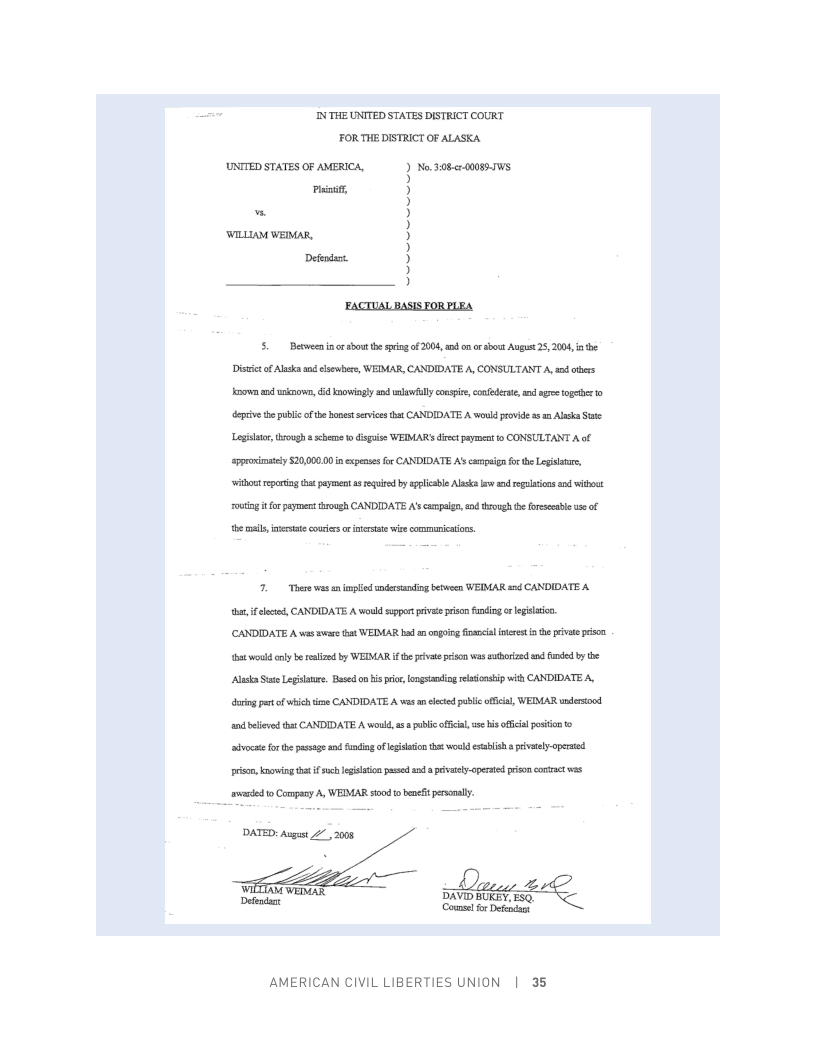
![(L1338 Operation Polar Pen The federal probe of political corruption in Alaska that culminated in the trial of Senator Ted Stevens and the guilty plea of ol executive Bill Allen began as "Operation Polar Pen’—an investigation of corruption connected to a scheme to build 2 private prison in Alaska 2" The federal investigation Led to charges not only against politicians and oil industry moguls but also against Bill Weimar, an individual who ultimately pled quilty to criminal counts, including conspiracy to engage in honest services mail and wire fraud* in connection with efforts to win passage of legislation that could have resulted in construction of a private prison.?** Sections of the factual basis for his guilty plea, which Weimar signed, are shown on the following page. Before the scandal, Weimar had made enormous profits in private corrections. In the late 19905, he had sold, at a price tag of $21 million, five private halfway houses in Alaska to Cornell Companies 2 Weimar then moved to Montana and acquired a personal compound that reportedly included "a six-bedroom home, two-bedroom caretakers cottage, indoor shooting and archery ranges, equestrian center, two-lane bowling alley, heated swimming pool, racquetball and tennis courts and helipad, all on 60 acres."* But Weimar had an opportunity to make even more money if a private prison were constructed in Alaska. His company, Allvest—along with Cornell Companies and Veco (the company led by Allen]—were part of a consortium called *Corrections Group North” that was seeking to acquire a$1 billion, 25-year contract to build and operate such a prison. " Weimar retained an interest in the plan and would have made another $5.5 million if the prison were constructed #* To push the plan forward, Weimar focused on an individual—identified only as "CANDIDATE A" in legal papers filed by federal prosecutors—who was running for a seat in the Alaska State Legislature " According to news reports, the candidate described in legal papers matched the description of Jerry Ward, who had previously served in the legislature and was seeking reelection o his former position. Ward has been described as “one of the [Alaskal Legislature’s biggest advocates of hiring private contractors to provide public services, " and a representative who “fervently pushed private prison projects.” = Weimar provided financial support totaling approximately $20,000 to the campaign of “CANDIDATE A,” and Weimar, according to his guilty plea, "understood and believed that CANDIDATE A would, as a public official, use his official position to advocate for the passage and funding of legistation that would establish a privately-operated prison, knowing that if such legislation passed and a privately-operated prison contract was awarded to Company A, WEIMAR stood to benefit personally. Ultimately, the private prison that Weimar corruptly sought to build was never constructed, thanks to resistance from local communities, correctional officers” unions, and other Alaska lawmakers. ™ Weimar himself served his sentence in a governmentally operated federal prison in Arizona. AMERICAN CIVIL LIBERTIES UNION | 34](banking-on-bondage 34.png)

![Former GEO Employees Fail To Report Children Living in Squalor In 2007, the Texas Youth Commission fired employees responsible for monitoring a West Texas juvenile prison run by GEO because the employees failed to report horrid conditions at the prison 2 In fact, the employees "not only failed to report substandard conditions but praised the operation. In the monitors’ most recent review ... the prison was awarded an overall compliance score of 97.7 percent. I that review, monitors also thanked GEO staff for their positive work with [Texas] youth. " It later came to light that some of the monitors—immediately before commencing their employment as state monitors of GEO’s contract performance—had worked for the GEO Group.™* When Texas finally sent independent auditors to the youth faciliy, the auditors reportedly “got so much fecal matter on their shoes they had to wipe their feet on the grass outside.”* Findings in the independent report included all of the following: ® “The GEO Group does not ensure that the youth are provided with a clean and orderly living environment.” m “Cells were filthy, smelled of feces and urine, and were in need of paint." ® “[Tlhere are serious problems with insects throughout the facility and grounds.” ™ “Plumbing chases were not secure at the time of the inspection. Contraband and pests were found in these areas.” B “Water leaks are numerous throughout the faciliy, creating an unsanitary and unsafe environment for all youth and staff.” ™ “There s racial segregation [in] the dorms; Hispanics are not allowed to be cell mates with African Americans.” B “Youth sprayed with [Oleoresin Capsicum] pepper spray are not routinely decontaminated. The Texas Youth Commission auditors also held focus groups, in which children at the facility reported B They have "not received church services in over two months.” ™ They are “disciplined for speaking Spanish.” B They “are sometimes not allowed to brush their teeth for days at a time.” ™ They “had been forced to urinate or defecate in some container other than a toilet. " AMERICAN CIVIL LIBERTIES UNION | 37](banking-on-bondage 37.png)
![The Private Prison Lobby Certain private prison companies, according to a recent report by Detention Watch Network, spend large sums of money to lobby the House of Representatives, the Senate, and several federal agencies, including the Federal Bureau of Prisons (which incarcerates over 200,000 prisoners at any given time) and the Department of Homeland Security (which detains over 30,000 immigrants at any given timel.#* According to nonprofit groups, CCA alone spent over $18 million on federal lobbying between 1999 and 2009, “often employing five or six firms at the same time, ™" and in 2010, CCA spent another $970,000 lobbying the federal government. These figures capture only federal government lobbying—but private prison companies also lobby heavily in statehouses across the country. While total expenditures on state lobbying are impossible to calculate because lobbying disclosure requirements vary from state to state, ’ what is clear is that lobbyists for private prisons have fanned out from coast to coast. For example, the Justice Policy Institute recently reported that “[iln Florida alone, [the three largest private prison companies] utilized 30 lobbyists to advocate for private prison contracts and policies to promote the use of [private] prisons. " Between 2003 and 2011, according to the National Institute on Money in State Politics, CCA hired 199 lobbyists in 32 states: Alabama, Alaska, Arizona, California, Colorado, Connecticut, Florida, Georgia, Hawail, Idaho, Indiana, Kansas, Kentucky, Louisiana, Maine, Minnesota, Mississippi, Missouri, Montana, Nevada, New Hampshire, New Mexico, Oklahoma, Pennsylvania, Tennessee, Texas, Utah, Vermont, Virginia, Washington, West Virginia, and Wisconsin.** During the same period, GEO hired 72 lobbyists in 17 states. AMERICAN CIVIL LIBERTIES UNION | 38](banking-on-bondage 38.png)
![States Lobbied by CCA and GEO, 2003-2011 KEY: [l States lobbied by CCA [ States lobbied by both [ states lobbied by GEO [ ] States lobbied by neither ‘SOURCE: National Institute on Money n Stat Politcs Campaign Contributions In addition to lobbying, for-profit prison companies also spend vast sums of money on campaign contributions. Since 2000, the leading private prison companies—CCA, GEO, and Cornell (which has since been absorbed by GEO in a merger)—have contributed over six million dollars to candidates for state office and over $800,000 to candidates for federal office, according to the Justice Policy Institute.# The organization further reports that in 2010 alone, these companies contributed over two million dollars to state political campaigns, with a large fraction of the money funneled to state party committees ¢ Data maintained by the National Institute on Money in State Politics also reveal the following about private prison campaign contributions: Between 2003 and 2011, CCA contributed ta over 600 state candidates, and GEO contributed to over 40047 Both corporations have established their own Political Action Committees (PAC).“* These companies backed a high proportion of candidates who ultimately won elections, which may indicate a strategy of focusing contributions on candidates likely towield power. GEO, for example, made 506 campaign donations toincumbents and only 12 donations to challengers between 2003 and 201,47 AMERICAN CIVIL LIBERTIES UNION | 39](banking-on-bondage 39.png)
![The following case study illustrates the combined effect that campaign contributions and the revolving daor may have had on the expansion of privatized incarceration in Arizana. [(Z T3 (UE More Prisons for Profit in Arizona Faced with fiscal crises, states across the country, including “tough on crime” jurisdictions such as Texas and South Carolina, have labored to reduce corrections spending = But Arizona’s Department of Corrections is the only large agency in that state not subject to a budget cutin fiscal year 2012—in fact, the Department’s budget increased by over ten million dollars *’ Despite a recent statement by the Arizona Auditor General that for-profit imprisonment in Arizona may cost more than incarceration in publicly-operated facilities, Arizona has announced plans to contract out an additional 5,000 prison “beds.”** The 5,000 bed private prison expansion was included in Arizona Governor Jan Brewer’s 2010 executive budget. * CCA employees and executives reportedly contributed over $1,000 to Governor Brewer’s reelection campaign, and CCA’s Political Action Committee and lobbyists. “contributed another $40,000 to Brewer’s top legislative priority, Proposition 100, a sales tax to help avoid budget cuts to education.”* In late 2010, CBS § News in Arizona reported that Chuck Coughlin, Brewer’s campaign chairman and policy advisor, worked as a lobbyist for CCA; that Brewer’s communications director, Paul Senseman, used to lobby for CCA; and that Senseman’s wife continued to lobby for the corporation = Control of Information For-profit prison companies go to great lengths, and apparently spend significant funds, to put forth a positive public image. Certain private prison companies offer the public well-manicured websites with extensive press releases and video footage touting their accomplishments, and the industry praises itself in publications such as Service, Security and Solutions (published by CCA) and GEOworld (published by GEO). Puf pieces on private prison websites cover such topics as the Paws in Prison program [which pairs prisoners with dogs), awards given to the industry, and a charity golf tournament hosted by CCA’s chairman " Private prison companies also funnel money (which, of course, initially comes largely from taxpayers) into communications departments, which churn out positive stories about private prisons. CCA employs a Vice President for Communications, whose duties include “strategic marketing communications, media management, land] brand positioning. = Management & Training Corporation likewise has a Vice President for Communications. " Meanwhile, private prison websites rarely report negative information: no one would know from CCA’s website that one of its employees sexually abused multiple female immigration detainees, AMERICAN CIVIL LIBERTIES UNION | 40](banking-on-bondage 40.png)
![ENDNOTES 0 " 2 “The P Cenren on e STaes, ONe i 100: Beuno Bass i Awerica 20085, 35 (2008]; Rough Justice n America: Too Many Laws, Too Many Prisaners, Tve Econows, July 22, 2010; Adam Liptak, US. Prisan Population Duarfs That of Other Natians, N.Y. Twcs, Apr. 23, 2008, See Rough Justice in America; Too Many Laws, Too Many Prisoners, The Econowsr, July 22, 2010, Currently, the United States incarcerates over 2.3 milion people, approximately one out of every 100 adults. id MicHeLLE ALOXMoER, Twe New Ji Crow: MAss INCARCERATON I THE AGe 0F COLORBLNDNESS 67 (2010); THe Pow CenTeR on e S7ares, ONe 1 100: B B ANERIch 2008 35 [2008); Tooo R. CLoAR, IaPRsoning Coumunics: How Mass Icarcesanon Maces Dissousnraced Neeusoaioons Wars 6-7, 9-10 (2007, See,e.g. Greg Bluestein, Associated Press, State Budget Crises Push Sentencing Reforms, Bosron Guoue, Apr. 2, 2011 Juoi Geen & Magc Mauer, Tre SevTencive Proser, Domscag Prsons: Lissos rrou Four Sraes 12 (2010); Avica o Liscrnes Union, St Reroi 5 Possi: STATES REDUCING INCARCEAATON RATES AND CosTs WHLE PROTECTIG COMMNTIES 57(2011) Conaccrons Cossomanon o Augic, 2010 Annual Revos on Fosw 10-K 19 (20101 Th full paragraph stated: “Our abilty o secure new contracts to develop and manage correctional and detention facltes depends on many factors outside our contral. Our growth is generally dependent upan our abilty to obtain new caniracts to develop and manage new carrectional and detention faciltes. This possible grawth depends on a number af factors we cannat control, including crime rates and sentencing patterns in various jurisdictions and acceptance of privatization. The demand for our faciltes and services could be adversely affected by the relaxation of enforcement effarts, leniency in conviction or parole standards and sentencing practices or through the decriminalization of certain activiies that are currently proscribed by our criminal aws. For instance, any changes with respect to drugs and controlled substances or legal immigration could afect the number of persans arrested, convicted, and sentenced, thereby potentially reducing demand for correctional facilties to house them. Legislation has been proposed in numeraus jurisdictions. that could lower minimum sentences for some non-violent crimes and make more inmates eligible for early rlease based on good behavior Also, sentencing alternatives under consideratian could put same offenders on probatian with electronic monitoring who would otherwise be incarcerated. Similarly,reductions in crime rates of resources dedicated to prevent and enforce crime could lead to reductions in arests, convctions and sentences requiring incarceration at carrectional facltes.” d, at 19-20. From 1990 to 2009, the number of peaple incarcerated in private prisons grew from approsimately 7,000 to ‘approximately 129,000 inmates. UITED STATes DEssaren oF JUsTce, BUREAL 0F JUSTce STaTimcs, Census o STTE Ao FeerutCorveeriona. Facines, 1995 v (1997); Hearv C. WesT, E1 AL, Unrieo Staes Depasinent o Justce, BUREwy oF Justice Statics, Prsonces i 2009, 33 App. Table 19 2010). Hesrhen C. West, ¥ AL, UNTED STaTes DEPARTMENT of Jusrice, BUReay o JUTice ST, Prsoness i 2009, 34 App. Table 20 (2010] 6.8% of adult state prisoners and 16.4% of adult ederal prisoners in private prisons in 2009); Derennon Watch NETwoR, THE INFLUENGE O THE PRIATE PRiso IousTas i Iianon DETENTon, wok detentionwiatchnetwork.org/ privateprisons 149% of immigration detainees in private faciltes in 2009) (ast visited Oct. 4, 2011 Conaecons Cospomann o Augic, 2010 Lertea 1o Susaewowoeas 1 (2010) [1$1.7 bilion in 2010 CCA revenuel; The GEO Grour, Inc, 2010 At Resor 3, 20 2010) [$1.27 bilio in 2009 GEO revenuel; MoRicsias, CoRsecrions Conromnon o Augaica, Kex Exccutie Convensaron, hp:/finsiders. morningstar.com (under “search insiders by ticker,” search for ‘CXA’] [CCA executive compensation); Mogniisias, Tue GEO G, ., Kev Exccurie CoupensaTon, htp/insiders. morningstar.com lunder “search insiders by ticker,” search for “GEO"] [BE0 executive compensation] For a discussion of the canflicting evidence regarding cost savings, see ifra at 19-20 and nn. 100-109. Bob Ortega, Arizona To Expand Prvate Prisons, Anzona Resusiic, Jul.3, 2011 St o Azons, OFFce oF THE AubToR GENERAL, Resor No. 10-08, DEpARTHENT oF CoRscTions- Pison PoruLAToN GRowTh 19. 21 (2010) citing Azoua Deaaruet o CoRaecrons, FY 2009 OreatnG P Casia Cost Repoar: Cost oenmiicanon 540 Compason or Stare o Prvare Conrc Beos (201011 Bob Ortega, Arizona To Expand Prvate Prisons, Arzowa Resusuic, Jul.3, 2011 AMERICAN CIVIL LIBERTIES UNION | 43](banking-on-bondage 43.png)
![1 i 15 1% ” 1 19 2 2 2 % % 2 2% 2 b » Y E 2 £ Morgan Loew, Srawer Linked to Private Prisons Housing itegal Immigrants, KPHO.cov, (Sept. 1, 2010), hitp:/fuwwkpho. com/story/14791252/brewer-linked-to-private-prisans-hausing-llegal-immigrants-9-01-2010, Real Savings Neaded for Private Prisons, Fuosioa Tss-Union, June 22, 2010; see also Richard A. Oppel, Jr, Private Prisons Found To Offer Liti in Savings, N.Y. Twes, May 18, 2011; Tom Brown, Private Prison Business Eyes 8ig Florida Prize, Revres, May 12, 2011 Scott Hiaasen, Efort to Pivatize Florida Prisans Raises Questions of Cost, M Herauo, Apr. 22, 2011, see also David Royse, News Service of Florida, Florida State Senator Wants Answers on §25 Milion Prison Priatization Costs, FLorox Counier, Aug. 16, 2011; Teamster Natian, Florida Prison Privatization Already Open for Bids, July 26, 2011 hitp// teamsternation.blogspot.com/2011/07/farida- prisan-privatization-already html lastviited Sept. 30, 2011) Seek Savings Beyand Privalizing Prisons, OsLanpo SenTieL, Aug. 23, 2011, Final Declaratory and Injunctive Judgment at 6, Baiardi v, Tucker, No. 2011 CA 1838 [Fa. Cir.Ct. Sept. 30, 2011) 1d.a15. As this report went to press, Governar Rick Scott reportedly had not decided whether to appeal the ruling. Mary Ellen Kias, Grand Jury Probes Panhandie Private Prison Deal, M Heo, Oct. 9, 2011 Jutie Carr Smyth, Associated Press, 0o Tst in US To Sell rison to Private Company, SF GATe, Sept. 1, 2011; Press. Release, ACLU of Ohio, State’s Decision To Sell Only One Prison Underscores Problems for Taxpayers, Says ACLU, Sept. 1, 2011 [on fle with author] Joe Guillen, Gov-elect John Kasich Picks Private Corrections Consultant and Former Warden To Run Ohio’s Prisans Systom, Puin Do, Jan. &, 2011; Chilicothe’s Gary Mohr Named Ohio Prisons Chief, Crcorse Gazerre, Jan. 4, 2011 ACLU o+ Ouo, Prsons sog Prosr: A Look a Prison Prnarzsnon 1, 18-20 (2011); Avecan Coa. Liscnes Uniow, S Resoson 15 PossioL STATES REDUCIG INCARGERATION RATES 0 CosTs WHE PROTECTIG Comunres 50-51 (2011, Jan Moller, Gox Jindals Plan To Sell State Prisons fs Klled by House Committee, Twcs-Picayune, June 6, 2011; Julle Carr Smyth, Associated Press, Ohio Tst in US To Sell Prison to Private Company, SF GATs Sept. 1, 201 Jan Moller, Gox Jindals Plan To Sell State Prisons fs Killed by House Committee, Tzs-Prcavune, June 6, 2011; see also ‘generally Augaican G, Lissics Uniow, Swa Reson Is Possite: STaTes Reouows Icascensnon Rares o Costs Wie PrRorecn Conunines 54-55 (2011], ULS. Depsaruen o HoeLan Secuny, U.S. uuGaarion ano Cusrons ENFOREEHENT SALARES v EXsenses Fiscas Yeun 2012 Conseessionu. Justicanon 57 2011 Susan Carroll, ICE Upgrades Standards for Detention Facilties, HousTox Cron., Sept. 28,2010 La Opinién, ICE Builds More Immigration Detention Canters, New Aucica Meo, June 28, 2011; Jason Buch, New Detention Center in Karnas County, S Axtowd Excss-News, Dec. 9, 2010; Sam Dolnick, Reversing Course, Officals in New Jorsey Cancel One-id Immigrant Jail Deal, NY. Ties, Aug. 15, 2011; Trais Pillos, Corrections Corporation Partaering with Broward Town To Compete For Immigration Detention Facilty, FLowios Inoepexcn, May 27, 2011 Sam Dolnick, Reversing Course, Oficial i New Jersey Cancel One-Bid Immigrant Jail Deal, N.Y. Tes, Aug. 15,2011, See infra a1 23-28, Security Assessment, ASP-Kingman August -, 2010, Memorandum from Therese Schraeder, Security Operations. Administrator, to Charles L. Ryan, Director, Arizana Department of Corrections 3,9 [Aug. 18, 2010][on file with author). Tows Yours Comassio, Core Counry Juvewie Jusriee Cenren Avorr 7 (2007 Henry K. Lee, Caifornia Conicts Brawt in Oklahoma Prison, Sw Feswcisco Curon., Oct. 13, 2011 Pollard v. The GEO Group, Ic., 629 F-34 843 9th Cir. 2010, cort. granted, 131 5.CL. 2449 [May 16, 2011] [No. 10-1104). Mived Verdictfor Disgraced Judge, N.Y. Tnes, Feb. 18, 2011; Press Release, U.S. Attorney’s Office for the Middle District of Pennsylvania, Former Pennsylvania County President Judge and Juvenile Judge Mark Ciavarella Sentenced to 28 Years in Prison [Aug. 1, 2011][on fle with author| Ciavarella has appealed the convictions. Dave Janoski Ciavarells Movedto Federal Prison in linois, Tws-Triune, Sept. 13, 2011 0f course, not every privte prison company has been found to engage in each of these tactcs. AMERICAN CIVIL LIBERTIES UNION | 44](banking-on-bondage 44.png)
![u E3 % Ed ] Bl « @ “ @ w 50 51 52 5 s 55 5 Hestuea €. West, €1 ., UNITED STATEs Depuswent oF Jusie, Bukeau oF Justce Sarsrcs, Prisoncss i 2009, 34 App. Table 20 120101 This figure refers to convicted prisoners serving sentences and generally excludes pretrial detainees held in Jaits, DErEnon Warcs NETWOR, THE INFLUENCE 0 T4 PAAATE PASoN INUSTRY I IMGRATON DETENTIN, W, detentionwatchnetwork org/privateprisons. Conaecons Cossonanon o Augic, 2010 Lertea 1o Susaewowoeas 1 (2010) $1.7 billon in 2010 CCA revenuel; Tue GEO Grour, Inc, 2010 Awna. Resos 3,20 2010) 81,27 bilion in 2009 GEO revenuel Michact, onaress, A Just Measure oF Pan: THe Penrenmusy w 1o Inoustaut RevoLutow, 1750-1850, 30 (1978]. 14,2152 Jorn W, Rosears, Reror o RETRISUTON: AN ILLUsTRATED Hstony oF AwEcan Prisons 17 (1997 1 MicheLte ALouuioes, Twe New Jiu Caow: Mass INcasceraron i e Ace o CoLomsLwonss 31 (2010);see also BRierre Suaus: & Eomn Benoer, Westen Prison Prosecr o WEsTesn STaTEs CENTER, T Prson Parors: T RoLe o Pouics o PRuire PRsons THe Incavecranon Boow 1 2000 MicHeLLE ALENDER, THe New i CRow: MASS INCARGERATIN I T4 Age 0 CoLonaLoness 31 (2010) Joun W, Roears, Resom o RETRuToN: AN ILusTRaTeo Histony oF Ausican Prisons 82 (1997). Ao AssocuTes ., PRVATE PRISONS N THE UNITED STATES: AN ASSEssuenT oF Cuseen Prscrice & (1998] 14t 5 [stating that the federal government began contracting out imigration detention faciliies to private firms in 1979, which “provided the seedbed for the contemporary private imprisonment industry in the United States|; Alex Friedmann, The Societal Impac of the Prison Industrial Comples, or Incarceration for Fun and Proft .. Mostly Profit Iforthcoming chapter in Anp e Crnanacs Wik Hi: Essars i Honorm o Wi D. Caupsu o ALL e RECONCLED [E0. Ricwsao C. Gooeel) ‘See Ewing . Calfornia, 538 U.S. 11 (2003 ‘Se Tono R. Cleas, Isssons Coumunrics: How Mass INcarcerarion Makes Dissounaceo Neiokaonsooos Wosse 7 (2007). 1d.at6T. PusLic Sacery Pessomunce, Pusc SAFer, PUsLic Seenoms: FORECASTING AMERICK’s Paison PoruLaTon 2007-2011, 11 revised June 2007). Busi or Jusnce Stnsrics, Pison PoruLarion Couns, htp://bj.ofp.usdo]gov/index clmtystp&tid=131 llast viewed Jul. 2%, 2011). Suzanie M. KRcitoer, CONRESSoNAL RESEARes: SERvc, ECoNowIc INPACTs o Prison Growr (20101 Unieo Sares DesaRrient o Jusniee, BUscay oF Jusic STATSTs, CEnsus of STATE ko Feochal Compecnonas FACLITES, 1995 v 11997]The figures in this paragraph include prisons that hold people who have been convicted. The figures generally do ot include pre-trial detainees held in jals or immigration detainees held in immigration detention facltes Unieo Sares DesaRrient o Jusniee, BUscay oF Jusi STATST, CEnsus oF STATE ko Feochal Compecnonas FACLITES, 1995 v 11997); HeAToeR C. Wesr, €1 AL, UNIED STares DepnRTMENToF JUsTce, BUREA 07 JusTice STTsTics, PRisoness i 2009, 33 App. Table 19 (20101 Conaccons Cossomnon o Aucic, 2010 Anvual Resos on Fosw 10-K 19-20 (2010) lemphasis removedl: see also Judith Greene, Banking on the Prison Boom, in Prison Prorresss: Wro Mares Money Frow Mass Incascesarion 3 (Tara Herivel & Paul Wright ed. 2007]. “THe G Grour, Ic., o 10-K ANUAL REFORT For THe FiscaL Y ENDED Jawuasy 2, 2011, 33 [emphasis removed). The private prisan industry has denied claims that it is “motivated to take proactive steps i pursuing legislation to keep their private facilties filed.” The Sentencius PRoJCCT, Prson PRinizanon s he Use o Incasceaaron 4 (January 2002 updated September 2004). MicHeLLE ALOXuoER, Twe New Ji Crow: MAss INCARCERATON THE AGe 0F COLORBLNDNESS 67 (2010); THE Pow CenTeR on e S7ares, O 1 100: Berno B 1 AERIc 2008, 35 (2008); Topo R. CLeas, MPRSONING ComMONTES: How MAss INCARSEsTon AMERICAN CIVIL LIBERTIES UNION | 45](banking-on-bondage 45.png)
![Bl 5 5 @ o @ @ n o o & @ il n n Makes Dissowaraced Neiuscauooos Wosse 6-7, 9-10 [2007]; Greg Bluestein, Associated Press, State Budget Crises Push Sentencing Reforms, Bosron GLose, Apr.2, 2011; Juorh GREENE & Masc MAUER, THE SENTENCING PROJELT, DOWNSCALNG PRSOS: Lessons rrou Foug Siares 1-2 (2010]; Awerican Crn, Liseses Union, Suast Reroms I Possiate: STes REDUeiG Icascenaton R axo Costs W Paorecri Coumuns [2011] THe GEO Grour I, Histonc MuLesTones, hitp:/fwww.thegeogroupine.com/history.asp (lat viewed Oct. 11, 2011); Ast ASSOCTES Inc, PRVATE PRSons i The UNTED STates: AN ASSESSMENT 0 CORRENT Pascrice 5 1998). Conaecons Cossomnon o Augica, 2010 Lerieg 1o Susaevowoess 1 (2010) [1$1.7 bilion in 2010 CCA revenuel; The GEO Grour, e, 2010 Awwua. Resorr 3, 20 2010) 81,27 bilion n 2009 GEO revenuel Meredith Kolotner, Private Prisons Expect a Boom; Immigration Enforcement to Beneit Detention Companies, N.Y. Twes, Jul. 19, 2006, “The vast majorit of tis taxpayer money no doubt came fram taxpayers i the United States. CCA does not operate. prisons outside of the United States; GEO operates a limited number of prisons in South Africa, the United Kingdom, and Australia, but a far greater number in the United States. Cosreerions Consoranon os Awcca, CCA Faciry Locarns, http:/fwowvicca.comfaciliies [last visited Oct. 6, 2011; Tue GEO Grour, Guooas Opesanons, htp//wnw thegeogroupinc. com/locations.asp (last visited Oct. &, 20111 Morcsras, Comnccnons Cosponsrion of Augica, Kev Exseunve Conpensarion, htp:/finsiders.morningstar.com lunder search insiders by ticker,” search for "CXW~] Mossngsrae, Twe GEO Gaour, Inc. Kev Execurie Conrensaron, hps// insiders. morningstar.com (under “search insiders by tcker,” search for "GO Avcrican Lessuinwe Bxcusnce Counct, Histony, hitp:/fwww alec.org/AM Template cfm?Sections History&Template=/CM/ HTMLDisplayciméContentiD=1364 lLast viewed July 8, 2011). Laura Sullvan, Shaping State Laws With Litle Scrutiny, Natows: Pusuc Rano, Oct. 29, 2010 Videos and photos from ane recent ALEC conference show banquets, open bar parties and baseball games - all hosted by corporations. Tax records show the group spent $138,000 to keep legistators’ children entertained for the week."|. See also Averican Assocuon for Jusnce, ALEC: GAOSTWRIING The Liv ok CoRposaTe Auica & (2010] American Legistative Exchange Council, Legislative Membership, (1ast iewed Jul. 7, 2011, http/fwwnw.alec org/AM/ Template.cfm7Section-Legisiative_Merbership&Template=/CMJHTMLDisplay cfmaContentiD=15995. Laura Sullivan, Shaping State Laws With Litle Scrutiny, Narowa. Pusuc Raio, Oct. 29, 2010, 10 ["Here’s how it works: ALEC is a membership organization. State legistators pay $50 a year to belong. Private. corporations can jin, 00 .. [Some] pay tens of thousands of dolars a year. Tax records show that corporations collectively pay as much a5 S6 million a year."); AMERCAN ASSocATION 10 JusTce, ALEC: GHOSTWRITNG THE L 07 CorroRaTe Auceica 5 [2010); Karen Olsson, Ghostwriting the Law: A Litte-Known Corporate Lobby i Draiting Business-Friendly Bills for State Legistators Across the Couniry, MoTiea Joncs, Sept.-Oct. 2002. Dennis Bartlett, American Legistative Exchange Council, 1997, quoted i Drexocs o WiLoure & Narusa, Resources DEFinE Counc., CoRpoRaTe AMERICs Taoia HORSe I Th STTEs: THe STomy BENND THE ANERca LEGSLATHE EXCHANGE CoueiL B 120021, Karen Olsson, Ghastwiting the Law: 4 Litie-Known Corporate Lobby is Drafting Business-Friendly Bilsfor State Legisiators Across the Country, Maniga Jows, Sept.-Oct. 2002; Laura Sullivan, Shaping State Laws With Litle Scruiny, Nariona Pusuic Raoo, Oct. 29, 2010. Bob Ortega, Political Tis Give Loverage to CCA, Awz. ResuaL, Sept. 4, 2011: Karen Olsson, Ghostwriting the Law: A Litle-Known Corparate Lobby i Dralting Business- Friendly Bl for State Legislators Across the Country, MoeR Jouss, Sept.-Qct. 2002; Beau Hodai, Corporate Con Game: How the Private prison Industry Helped Shape Arizona’s Anti- Immigrant Law, In Tuese Tws, June 21, 2010; Justce PoLcy INSTIUTE, BAwni T SisTeu: How The POLITCAL STRATESS 0F Pt Prson Coupanics PRoware Ieseeciie ncascenanon Pouies 29 (2011]; In the Public Interest, Private Prisons vs. the Public Interest,llast viewed Oct. 7, 2011 htp://org2.democracyinaction.org/of6488t/0/blastContent jsp7email_ blast_KEY=1161818; see also generally Mike Elk & Bab Sloan, The Hidden History of ALEC and Prison Labor, Tve Naon, Aug. T, 2011 BRGETE Suais & Eowi BeNoce, WesTan PrsoN PRoscct &Wesreaw STares Center, The Prson Pavors: THe RoLE o PoLIncs ano Pt Prsons i e hcascenation Boow & (20001 Michael Hotra, Getting Tough Works: 0ld Strategies Are the Weapons in the New War an Crime, AeRcas LEGisuarve Excimse Couucr, O, 9, 1995, a 6 AMERICAN CIVIL LIBERTIES UNION | 46](banking-on-bondage 46.png)
![n n i3 7 7% ” k] kil 0 o 2 n a £ 5 £ 8 £l % 7 2 The SuTenciG PRoCT, PASon PRVATIZATON kD he Use 0 Incascesanon & (20041 Bob Ortega, Political Ties Give Leverage to CCA, Anz. Resusuic, Sept. 4, 2011 14, see atso Karen Dlsson, Ghastariting the Law: A Litle-Known Corporate Lobby i Dralting Business-Friendly Bils for State Legistatars Across the Country, Morhcs Jouss, Sept.-Oct. 2002 THE SeTENCING ProJECT, PRSON PRVATIATION AND ThE U 0 INcAReEaTn 5 (20041 Avcrican Lessuinwe Bxcusnce Counct, Histony, hitp:/fwww alec.org/AM Template cfm?Sections History&Template=/CM/ HIMLDisplay.cfmaContentiD=1364 ILast viewed July 8, 2011) lemphasis added!. Averian Leasuanme Excrnne Counet, VoLoME I: Souscesoox oF AMERan STaTe Lebsuaion 1995, at 144 (1995) (emphasis added]. 14,1145, BRGETE Suais & Eowi Bewoce, WesTean Prson PRoscct &Wesreaw STares CenTer, The Prson Pavors: THe RoLE o PoLIncs ano PR Pasons i T Icancesation Boow & (2000] Bob Ortega, Political Tis Give Leverage to CCA, Ansz. ResusLic, Sept. 4, 2011 Detention Watch Network, The Influence o the Private Prison Indusry in Immigration Detention, last visited Oct. 7, 2011), hitp:/fwww detentionwatchnetwork org/privateprisons|. i C. Hupoa. & Auson Sski, COnGagssiona. RESCAReH ST, icaanon-ReLared DETenTions: Cuseent LEcsLanve 5sues 12 120101 1.t H.at1z. Judy Greene & Sunita Patel, The Immigrant Gold Rush: The Profit Motive Sehind Immigration Detention [subritted 1 the UN. Special Rapporteur on the Human Rights of Migrants]. In another account of what appears to be the same telephane call, the head of the company is reported as instead saying: | think i clear that vih the events of September 11 there’s heightened focus on detention, both on the borders and vithin the US. .. So | would say the. events of September 11, um, Lot me back up. The federal business is the best business for us. IUs the most consistent business for us, and the events of September 11 s increasing that lovel o business.” Prison Privisation Report International, No. 44, Nov. 2011, at -6 [on file with author]. o C. Hupoa. & Auson Sski, ConGagssionas RESCAReH ST, icaanon-ReLared DETEnTion: Cuseent LEcsLarve 5sues 12 120101 Avceicn Cont Liseares Union, Wiar Hasees i ARzows STas i ARZous, http:/fwwi aclu. org/what-happens-arizona- stops-arizona [lastvisited Oct. 7, 2011]; see also Daniel Gonzalez, Senate Bil 1070: One Year Later, Az Resusc, Apr 23, 2011. Afederal caurtin Arizona Later ruled that much of SB 1070 s unconstitutional and enjoined enforcement ofthe Law, and the Ninth Circuit affirmed the ruling. Awgicax Cu. Lisesrics Uniow, FAGauenTLy ASKeD QUESToNs - Usosre on Legu. Chuienaes 7o Anzone’s Ricia. Proriun L (SB 1070), hitp:/fanwwaclu org/immigrants- rights-racial-justice/ frequently-asked-questions-update-legal-challenges-arizonas-racial-. last viewed Oct. 3, 20111 Seth Froed Wesser, Bills Modeled After Arizona’s S8 1070 Spread Through States, CouoRuies, Mar. 2, 2011 Beau Hodai, Corporata Con Game: How the Private Prison Industry Helped Shape Arizona’s Anti-Immigrant Law, I Tucse Tiis, June 21, 2010; see also Daniel Gonzalez, Senate Gill 1070: One Year Later, Az. Resus, Apr. 23, 2011 Alia Beard Rau & Casey Newion, Sen. Russell Pearce: S8 1070 Story A L Astz. Resustic, Oct. 29, 2010, Laura Sullvan, Prison Economics Help Drive Ariz. Immigration Law, Natowac Puauic Rioo, Oct. 28, 2010; Nate Rau, Ariz Immigration Law Pushed for TN, Tve Tewnessean, Dec. 5, 2010. But see Alia Beard Rau & Casey Newtan, Sen. Russell Pearce: SB 1070 Story A Lie, Axz. Resustic, Oct. 29, 2010. Richard A. Oppel, Jr, Private Prisons Found To Offer Litle in Savings, N.Y. Twes, May 18, 2011 [“The conviction that private prisons save money helped drive more than 30 sates to turn o then for housing inmates... [MJany poliicians. have pramised ta ease budget prablems by trimming state agencies. Florida and Ohio are planning major shifts toward private prisons, and Arizona s expected to sign deals doubling its private-inmate population’); D.M. Levine, What’s Costier Than A Government Run Prison? A Private One, CNN, Aug. 18, 2010 "In recent years, the trend toward AMERICAN CIVIL LIBERTIES UNION | 47](banking-on-bondage 47.png)
![privatization, both among state governments and at the federal level has been part of an attempt o address serious budget troubles and crisis-level prisan overcrowding by outsourcing mare and more corrections operations to private companies. The move has translated into big business for industry leaders like Corrections Carporation of America and] The Geo Group .); Scott Hiaasen, Effort to Privatze Florida Prisons Raises Questions of Cost, M Heauo, Apr 26, 2011 [stating that further prison privatization in Florida “is needed, backers say, o rein in the prison system’s budget - which totaled $2.3 bilion Last year - at time of mammoth deficits.”| 93 Connecnons Conroranon oF Aucecs, PANRG Wik CCA, htp/fwwwcca.com/partnering-with-ccaf (1ast viewed Sept. 13, 20111 9 The GEO Group, GED Advantages, htp://wwwgeogroup.com/benafitsAdvantages asp [1ast viewed Sept. 13, 2011); see also Emerald Companies, Correctional Management, itp://ww emeraldcompanies com/diisionscorr_mgrt. htm [Last viewed Oct. 13, 2011] "Emerald Correctional Management . is dedicated to meating the collective needs of governmental public safety and criminal ustice agencies (U.S. Marshal, ICE, BOP, state and county) in their endeavors to deliver competent, cost-effective and secure correctional faclties management and financing.”} ferphasis added; Management & Training Corporation, Corrections Overuiew, hitp:/foww.mtctrains.com/ corrections/corrections-overview [last viewed Gct. 13, 2011} ’MTC’s proven performance and high integrity provide delivery of quality services o customers through innovation, adaptabilty and cost efectiveness.”| [emphasis added! Bob Ortega, Arizona Prison Businesses Are 8ig Political Contributors, Asz. REsua.c, Sept. 4, 201 1; Jues AusTi & Gssar Covenar, Unieo Stres Depasment o Jusice. EMeRanG lsues on Panarzep Prsons 15 12001) ’Representatives of private- sector fitms assert that they can save taxpayers maney by providing correctional services traditionally supplied by government at less cost” . 95 Seeinraat 23-31. 96 See, e.g. Juoi Gacene & Masc Mauce, Downscauns Prisons: LEssons Feow Foug Sres 1-2 (2010); Augaican Ca. Lisses Uniow, Swaer Reomn Is Possiats: Stres Reoucis hcascenation Rares s Costs W Prorecrivg Communes 5-7 (20111 97 Connccnons Conroranon oF Aucecs, 2010 Ankuat Resosr on Fomu 10-K 18,20 (20101 For the fulltext of this paragraph, which is excerpted above, see supran.5. 98 Sratt o Anzons, OFFi oF THE AUDIToR GengeaL, ResokT No. 10-08, DepakTuenT oF Corsscrions-Prison Posutron Growi 19-20 (2010) cting Aeizon Dessarwen oF Corscions, FY 2009 Opessrnc Pes Capia Cost REvog: COsT I0ENTICATON kD Conpason or Stare no Prvare Conrc Beos (201011 99 Bob Ortega, Arizona To Expand Private Prisons, Az, Repusuic, Jul.3, 2011 100 See, e.g., LEowso C. GiLior €1 AL, ReASoN Foun. & HOwARD Jass TAGPAYERs Founn, PUBLIC-PRIATE PARINERSHS 05 CoRRECTONS W Causorasa: BROGG The Gsp BETwen Crsts o Resog [2010]; see also Dina Perrone & Travis C. Prat, Comparing the Quality of Canfinement and Cost-Elfectiveness of Publc Versus Private Prisons: What We Know, Why We Do Not Know More, and Where To Go from Here, 83 Pason J. 301, 31516 [2003) [reviewing cost studies and stating. neither side of the correctional privatization debate should, at this time, be able to legitimately claim that the weight of the empirical evidence is on their side.”). 101 Soate oF Anzons, OFFi oF T AUDToR GengeaL, ResokT No. 10-08, DepakTuenT oF CoRsscrions: PRison PosuLsron Gt 19- 202010). 102 St or Hawan, Tve Avorion Genea, Rerorr No. 10-10, Manasenenr Auor of 1o DersTuenT oF Pusuc SAEr’s Conrcri #0r Prison BEos a0 SEREs: A REFORT 10 THE GOIGRNOR AND THE LEGSLATURE OF THE STATE F Hawa’t 16 (2010]. 103 Memorandum from the Legal Review Comm. to the Corr. Facility Evaluation Task Force (Nov. 3, 2010) femphasis. added] [on file with author] 104 Gov’r AccountaaLr Osice, GAD-08-8, Cost o Prusons: Buncau oF Prisons NEEos BEFTER DATa 0 AGSESS ALTERNATHES o Acouni Low o Mo Securry Facimes 2, 4 (2007). 105 Biao Lunoa €7 AL, Uran Cama Jusrice Cenres, Prison PRuaTizanon: A MEra-Anayss oF Cost EFFECTNENESS AND QUALTY oF Conmemnt horcaors 20 (2007) 106 Final Declaratory and Injunctive Judgment at , Baiardiv. Tucker, No. 2011 CA 1838 (Fla. Cir. Ct. Sept. 30, 2011). W Hdates, 108 Mary Ellen Klas, Grand Jury Probes Panhanle Private Prison Deal, M Hesauo, Oct. 9, 2011. For further discussions of supposed cost savings, see Richard Culp, The Failed Promise of Prison Privatization, Puson Lesat News, Oct. 2011, at AMERICAN CIVIL LIBERTIES UNION | 48](banking-on-bondage 48.png)
![109 10 m n2 " e s 16 " 8 "9 120 2 12 7 2 125 1,8("The big promises of prison privatization - less cost, higher qualit - have simply not materialized .. Ifa quarter century of experience with prison privatization has not led o batter guality and cost outcomes, it s time to take @ more sane approach.”); HusLey G. Lipe r L, Unred Stares DesakTuenr of Justce, EWALLATON of e ToeT DENONSTRATIN PRosEcr: PERFoRMANCE oF » PAVATE-SEcros Paison o Twe BOP 34 [2005] [“The evidence produced by the cost and quality studies for a federal prison] suggest that the cost of operating [the prison] was comparable whether [a private prison company] operated the [the prison] o the BOP operated the prison.”); Richard A. Oppel, Jr Privae Prisons Found To Offer Litle in Savings, N.Y. Twics, May 18, 2011 See supra n.100. Dara Kam, Ethics Board Fines UF Professor $20,000, Sscasors Hesaco-Ta. Oct. 22, 1999. See also Andrew L. Spivak & Susan F. Sharp, Inmate Recidivism as a Measure o Private Prison Performance, 54 CRit & DeLavecy 482, 459 (2008); Judith Greene, Baiing Out Private Jails, Au. Proseecr, Sept. 9, 2001 Kev P, Pasate Coss. ., Cost-Sun o Cost- SHFTING: THE FISCAL INPACT 0F PRISON PRAATZATON I AMERICA 8 1.0 PHIL MATTRS € A GaasseooTs LEngERs?, CORRECTONS Conporaton o Awica: A Caica. Lo a7 1s Fisst Twenry Yeas 3 [2003]; Eitorial, Private Prison Problems, Sr. Peressausc Thes, Oct. 27, 2000 I re Charles W. Thomas, No. 99-21, Fla. Ethics Comm. Oct. 21, 1999](final order and pub. reportl THe GED Grous I, Couuney Iwousewen, hitp:/fowie thegeogroupin. com/communityinvolverent. asp [tast viewed Sept 13,2011 Connecrons Cosporaon or A, Econowc DeveLoruent o Coununy OuTeescs i CCA, hitp:/ /v correctionscorp. com/economic-development llast iewed Sept. 13, 2011). Gregory Hooks et aL, Revisiting the Impact of Prison Building an Job Growth: Education, Incarceration, and County-Level Employment, 1976-2006, 91 Soci Scence 0. 228, 240 (2010) Clayton Mosher, Gregory Hooks & Peter B. Wood, Don’t Buld it Here: The Hype Versus the Reality of Prisons and Local ‘Employment in Prson Prosicss: Wio Maes Money Frow Mass Incascceaton 90, 91-92 [Tara Herivel & Paul Wright eds. 2007 R S. Kino, Miac MAveR & Traey Huve, THe SenTencins Projier, B Prisons, SuL. Towns: Prison ECooucs i RuR. Aveeca 2 (2003 P Marrci & Masauzs Kian, G000 Joss Fiss, Jal BRgars: ECONOWc DEVELOPMENT SUSSis Gien To PRvare PRSons v 12001]; see also Tom Barry, A Death in Texas: Profits, Poverty, and Immigration Converge, Boston Rev., Nov.-Dec. 2009. Pl Marrcea & Masauzs Koo, G000 Joss Fiss, Jat BRcass: ECONOMIc DEVELOPMENT SUSSis Given To PRware PRsons, v 12001]. Tom Barry, A Death in Texas: Profts, Poverty, and Immigration Converge, Bosron Rev, Nov.-Dec. 2009; Eric Schlosser, The Prison-Industrial Complex, T Arusae, Dec. 1998, St o Azow, OfFce o THe Auoon G, Resort No. 10-08, Depasruent o Consecrions: Prson PosuLanion Grons 20 120101 Lesie Berestein, Datention Dollars: Tougher fmmigration Laws Turn the Aling Private Prison Sector into a Revenue. Maker, San Dicco Uniow-Tai., May 4, 2008 John Burnett, Private Prison Promises Leave Texas Towns in Trouble, NaTona. Puac Riio, Mar. 28, 2011 [‘The packages ook sweet. A town gets 2 new detention center without costing the taxpayers anything. The private operatar finances, constructs and operates an oversized facility. The contract inmates pay off the debt and generate exira revenue. ‘The economic model works fine untiL they can’t find inmates.”l; Kyte Pope, Execuives Dropped from Prison Project/ Pair Cannected to Scandal in Texas, Housron Cuson. Mar. &, 1992; Kevin Pranis, Doing Barrowed Time: The High Cost of ‘Backdoor Prison Finance, in Prson PRoFezss: Wit Maccs Mone From Mass Icasceraton 36, 50-51 (Tara Herivel & Paul Wright ed., 2007); Matthéuw Reichbach, Private Prison Developer Behind Montana Fiasco Involved in Construction of NM Private Prisons, New Meuco oee., Oct. 12, 2009; WillSwarts, Jai Bonds Can’t Bar Defaults, SwisiMoney, Sept. 1, 2010. Mike Stark, Detention Facilty Would Offer Hardin 150 Jobs, BiuLos GAzerr, July 22, 2004; Rulfin Prevost, Bond Default Could Hinder Future Projects, Buwnss Gzerr, Oct. 18, 2009. Jennifer McKee, Empty Hardin Jai Puts New Director n Tough Spot, Tve Missouix, Jan. 11, 2010. Mike Stark, Detention Facilty Would Offer Hartin 150 Jobs, BuLos Gxzere, July 22, 2004. AMERICAN CIVIL LIBERTIES UNION | 49](banking-on-bondage 49.png)
![126 127 128 129 130 i 2 13 1% 135 13 17 138 139 110 w 12 4 04 s 144 wr i i 150 151 Rulfn Prevost, Bond Defaut Could Hinder Futare Projects, Biucs GAzeTe, Oct. 18, 200. Jennifer McKee, Empty Hardin Jai Puts New Director n Tough Spot, Tve Missouix, Jan. 11, 2010. Matthew Brown, Montana Town Eager To Put Gitmo Inmates i ts Jail, Deseaer News, May 31, 2009. Rulfn Prevost, Bond Defaut Could Hinder Future Projects, BLunss GrrTe, Oct. 18, 200%; Sarah Graviee, Hardin Jail Then and Now - Financing, KULR-8 New, Nov. 18, 2009. Jenniter McKse, Empty Hardin Jai Puts New Directar i Tough Spo, T Mo, Jan. 1, 2010 Becky Shay, Jail Backers Rally Business Community, Biuncs Gerr, Dec. 11, 2007 Jenniter McKee & Matthew Brown, Hardin Agency Fxing Pies in Jil, Bungs Gazere, June 26,2010, Lorna Thackeray Praducers Eye Empty Hardin Jil for Rality TV Show, Biuncs Gazere, Jan. 13, 2011 Megia accounts refer variously o this group as “American Police Force” and “American Private Police Force.” This Feport refers to the group as “American Police Force. Jenniter McKse, Empty Hardin Jai Puts New Directar i Tough Spa, T Missoua, Jan. 1, 2010 Lorna Thackeray, Praducers Eye Empty Hardin Jil for Rality TV Show, Biunes Gazere, Jan. 13, 2011 Becky Shay, Hardin Agency’s Exec Put on Leave, Buncs GAzeTe, Sept. 16,2009 Jenniter McKse, Empty Hardin Jai Puts New Directar i Tough Spo, T Mssouav, Jan. 1, 2010 Matthew Brown, Company Run by Ex-con Drops Montana Jail Plan, Sesms Ties, Oct. 9, 2009 Matthew Brown, Security Firm’s Deal for Fillng Empty Montana Jal s Raising Quastions, DEscrer N, Sept. 13, 200. Mantana Town Wnts ts Empty Jail 0 be the New Guantanamo Bay, Fox Nevs, Apr. 23, 2009; Editorial, After Guantanarmo, Bason Dauy News, July 9, 2009 Jenniter McKee, Two Rivers Board Considered Many Options for Hardin Jai, BLunss GAzere, Oct. 9, 2009 Lorna Thackeray, Prodacers Eye Empty Hardin Jail for Reality TV Show, Bues Gazere, Jan. 13,2011 Mike Stark, Detention Facilty Would Offr Hardin 150 Jobs, B Gxzee, July 22, 2006 CorpLan Coecrons, htp:f/wwwecorplancarrections.com/ last vsited June 27, 2011). Management & Training Corporation, MTC Keys to Success, http/fwww.mictrains com/corrections/mtc-keys-to- success [lastvisited Oct. 6, 2011] The GEO Grous, Cuus, htp:/fwwnw thegeogroupinc. comculture.asp (last visted Oct. 6 2011). Corrections Corporation of America, Safety and Security with CCA, htp://uwwcca.com/facilty-operations/security/ llast viewed Oct. 13, 20111 See, .3, Scarr D. Cau & Dawn M. DisGer, Qua 0F OPERATIONS AT PRAATE Ao PUBLIC PRt USiG TReNos i huaste Misconoucr To Courase Prisons 26 (2005] [“The results demonstrated that the private prison did not perform as well as the three comparison prisons in the publi sector, on the whole. For certain measures, the performance of the private prison was exemplary. as was noted for violent misconduct and security-related misconduct. For the other forms of misconduct, the resulis were less favorable for the private prison.”}; Dina Perrone & Travis C. Pratt, Comparing the Quality of Confinement and Cost.Effectiveness of Public Versus Private Prisons: What We Know, Why We Do Not Know. More, and Where To Go from Here, 83 Prison J. 301, 309 [2003) [summarizing prior studies comparing private and governmental prisons and stating “[Inconclusive results were also found in the domain of safety.”). Curtis R.Blakely & Vic W. Bumphus, Private and Public Sector Prisons - A Comparison of Select Characteristics, 68 Feo. Prosarion 27, 30 (20041 Jiues Aust & Gases CovewTs, U S. Des’f o Jusice, EMERGING 5sugs on Pawarzeo Prisons 52 (20011 The study noted that ItJhese diferences may be related to other factors such as reporting standards or the fact that correctional faciltes often experience management iffcultes when they are newly opened,” but that “insuficient training for and lack of qualified saff in key positions may also be a valid explanation for these diferences.” 0. AMERICAN CIVIL LIBERTIES UNION | 50](banking-on-bondage 50.png)
![152 153 15 155 156 157 158 159 160 161 102 16 164 165 166 167 168 16 m m 1 s " s i 7 ScorrD. Gl 40 G G. B, Feokna. BUREAU o Prsons, Gowi 4o QuaLy oF LS. PRIATE Prsons: EVDENGE Fom & Naowa. Sumver 9 (2001) Hust G. Luge €7 AL, US. Des’ o JusTice, EVUsToN oF ThE Tart DeuonsTaarion Prosecr: PERFoswance of 4 PRATE-SEcron Prson 4o e BOP 47, 48 (2005) Hatx. Henry K. Lee, Caifornia Conicts Brawt in Oklahoma Prison, Sw Feswcisco Curon., Oct. 13, 2011 Press Release, U.S. Dep’t of Justice, Former T_ Don Hutto Correction Center Employee Pleads Guily to Cl Rights Charges [Sept.7, 2011) on fle vith author). Shannon Wolfson & Erin Cargile, Former Guard Takes Plea Deal for Abuse, KXAN, Now.9, 2010, Complaint at 5, Doe v Nevelelf, No. 1:11-cv-00907 (W.D. Tex. Oct. 19, 2011]. Press Release, U.S. Dep’t of Justice, Former Willacy Detention Contract Security Officer Pleads Guilty to Sexual Abuse of a Femate Detainee in Texas [Aug. 4, 2011][on file with author). Yan Urbina, Hawai To Remove Inmats Over Abuse Charges, N.Y. Tnes, Aug. 25, 2009 Patsy R. Brumfield, Watnut Grove Called The Depths of Hell, Neus340.cow, May 17, 2011 John Burnet, Toun Relis on Troubled Youth Prison for Profits, Narows. PusLc R, Mar. 25, 2011 i i Complaint 2, C.5. v Walnut Grove Correctional Authority, No. 31064663 [5.D. Miss. Nov. 18,2010) Tracey Dalzell Walzh, Brutal Youth JalCalled a Private Gold Mine, Couariouss News Scce, Nov. 18, 2010. Bob Campbell, Dead Man’s Family Seeks Answvers in Wake of Prison Riots, MoLwo Re.-Tescorau, June 17, 2009; Tom Barry. A Death in Texas: Profits, Poverty, and Immigration Converge, Boson Rev., Nov.-Dec. 2009; First Amended Complaint 1 1-2, Galindo . Reeves County, No. 3:10-cy-00454 [W.D. Tex. Aug, 8, 2011). First Amended Complaint {5, Galindo v Reaves County, No. 3:10-cv-00454 (W.D. Tex. Aug. 8, 2011 Tom Barry, A Death in Texas: Profts, Povrty, and Immigration Converge, Bosron Rev, Nov-Dec. 2009; First Amended Complaint 11 1-2, Galindo v. Reeves County, No. 3:10-cv-00454 [W.D. Tex. Aug. 8, 2011). First Amended Complaint 1 1, 136, 141, Gatindo v Reeves County, No. 3:10-cv-00454 (W.D. Tex. Aug. 8, 2011 Forest Wilder, The Pecos Insurrection: How a Private Prison Pushed Immigrant mates to the Brink, Tex. Osscaves, Oct. 7, 2009, Letter from Ralph . Boyd, Jr. Assistant Attorney General, to Jack Sulivan, County Commission Chairman (Mar. , 2003) {on fle with author). Editorial, Our View: Another Lesson from “Gladiator School,” louso Srwicsu Oct. 11, 2011; Rebecca Boone, idaho Inmates Settle Lawsuit Over Prison Vislence, Onas Wosto Heauto, Sept. 20, 2011 Letter from Randy Blades, Warden, [daho Department of Correction, o Phillp Valdez, Warden, Idaho Correctional Center T (Aug. 28, 2008)[on file with authorl. Amended Class Action Complaint for Declaratry and Injunctive Relief 11 1-2, Riggs v Valdez No. 1:09-cv-0010-BLW D.Idaho Mar. 11, 2010) Rebecca Boone, Prison Violence: At Gladiator School, Help Never Comes, Sur Live Trs., Dec. 10, 2010. The video is ‘available a hitg:/blogs.seatileweekly.com/dailyweskly/2010/11Aideo_shows_idaho_prison_guard ph. Settlement Agreement 2, 4, Kelly . CCA, No. 1:11-cv-00185 [Sep. 16, 2011, avalable atnttp:/fwrw.acluidaho.org/ images/Settiement_Agreement pdf; Rebecca Boone, ldaho Inmates Settle Lawsuit Over Prison Vislence, Ovisa Woreo Heaaio, Sept. 20,2011 AMERICAN CIVIL LIBERTIES UNION | 51](banking-on-bondage 51.png)
![8 1 180 181 182 15 8 185 186 187 188 189 190 91 192 193 19 195 19 197 198 199 20 Do Swcion, Pusisuwew 0% Paori: Paare Pasous/Pusu Concesis 187 [1995); see aso Jaues AusTi & G ComenTay, U’S.Des’ o Justic, EweRci Issues on Panarco Pasous 17 2001) (noting that “clrtis of prison privatization argue that firms wil cut corners, from consiruction materials to hiring inexperienced persannel,forsaking security and quality o service in the process of making a profit . [0]ne of the central concerns raised by critcs of correctional privatizationis that frms motivated by financial gain might make decisions that enhance profits at the expense ofthe rights and well-being of inmates. Histary shows that privately operated prisan facilities were plagued by problems associated with the quest for higher earnings. The profit motive produced such abominable conditions and exploitation of the inmates that public agencies were forced o assume responsibity.” citation omitted] ScortD. Gl 40 G G. B, Feokna. BUREAU oF Prsons, Grawi 4o QuaLy oF LS. PRIATE Prsons: EVDENGE Fom & Nariona, Sumver 3, 9 (20011 Curtis R.Blakely & Vic W. Bumphus, Private and Public Sector Prisons - A Comparison of Select Characteristics, 68 Feo. Prowaon 27,29 (20041 1d.at30. ScorrD. o & Gevato 6. Gacs, FeogaaL BURCAL o PRsons, GRou: Ao QUALTY 7 U.S. PRraTe Prisons: EVOENGE Frok & Nariona Surver 16 (20011 1d.at18 13 Hensey ot al, Arizona Prisoners’Risk Ratings n Question, ARz, Revusuic, Aug. 23, 2010; Jim Robbins, Arizona Prison Escapee is Captured, N.Y. Twes, Aug. 9, 2010. Jim Rabbins, Arizona Prison Escapee is Captured, N.Y. Twes, Aug. 9, 2010; JJ Hensley and Ginger Rough, Kingman Prison StillUnder Scrutiny, Asz. Resus.ic, Jan. 30, 2011; Bob Ortega, Arizona Prison Oversight Lacking for Prvate Facltis, Az ResueLi, Aug. 7, 2011 Jim Rabbins, Arizona Prison Escapee is Captured, N.Y. Tnes, Aug. 9, 2010. 13 Hensiey, Report Rips Private Ariz.Prison After Escape, US.A. Toow, Aug. 20, 2010 See 1. Hensley & Ginger Rough, Kingman Prison Still Under Scrutiny, Axz. Resusic, Jan. 30, 2011; Bob Ortega, Security Lapses Found at Al of Arizona’s Prisons, Az Rewuauc, Jun. 26, 2011 13 Hensley ot al, Arizana Prisoners’Risk Ratings in Question, Az Revusuc, Aug. 23, 2010 Security Assessment, ASP-Kingman August -6, 2010, Memorandum from Therese Schraeder, Security Operations. ‘Administrator, to Charles L. Ryan, Director, Arizana Department of Corrections 9 [Aug. 18, 2010) [on file with author]. 1d ats, 1d.ats, i a2 i at3 e Mausenenr & Teanins Consorsrion, AT-4-Guimce CoRpecrions Ficrs (2011)[on file with autharl; ManscesenT & Tunni Conponaton, CoRseCTouiL. Faciires, htp:fwwwk. mictrains.com/locations/correctional-facilltes [tast visited Oct. 7, 2011]; Bob Ortega, Arizona Prison Oversight Lacking for Prvate Facilies: State Weighs Expansion Even as Costs Run High, Asz. Resunu, Aug. 7, 2011 Do Swichon, Punisivent ror Prorr: Prare Prsons/Pusuic Concenns 153 (19951, Statements compiled by the Private Corrections Working Group Website, winw. privateci org/religion htmi (last viewed July 7, 2011) Isource for al quotations from religious groups cited] Andrew L. Spivak & Susan . Sharp, Inmate Recidivism a5 a Measure of Private Prison Performance, 54 v & Deuouewer 503 (2008). Earter studies of Forida prisons had found “some degree of support for a lower rate of ecidivism among private prison inmates.” d. at 488-89. Lindsey Davis et al., Pennsylvania Judge Convicted in Alleged Kids for Cash’ Scheme, ABC News, Feb. 21, 2011. The jury acquitted Ciavarella of other counts, including bribery and extortion. 10 AMERICAN CIVIL LIBERTIES UNION | 52](banking-on-bondage 52.png)
![2 w2 0 2w 205 20 2w 208 29 210 m 202 23 21 25 2 2 218 29 2 2 m 2 2 25 2 27 28 2 20 1 Trish Wilson, Luzerne County ‘Gash for Kids® Defendants Finding Wheets of Justice Spin Slowly, PuiAocLpua Iaurcs, Jun. 21,2010, Dave Janeski,Ciavarella Moved to Federal Priso i linais, T Triung, Sept. 13,2011 Lindsey Davis et L, Pennsybvania Judge Convicted i Alleged ids forCash’ Scheme, ABC News, Feb. 21, 2011 o i i i Editrial, Shauldn’t Detay Justice, Pt Inauses, Aug. 11, 2010 Lindsey Davis et L, Pennsybvania Judge Canvicted in Alleged ‘ds for Cash’ Scheme, ABC News, Feb. 21, 2011 In e Expungement of Juvenile Records and Vacatur of Luzerne County Juvenile Court Cansent Decrees or Adjudications from 2003-2008, No. 81 MM 2008, at *5-*6 (Pa. Oct. 29, 2009) [emphasis added!. Lisa Demer, Lagistators Weigh Cost of Contractar perating New Prison, Avcuosuse Daty News, Feb. 10, 2010; Lisa Demer, Senator Remembers Corruption Fightar Dee Hubbard, Acuosuse Dy News, Feb. 15, 2010. Plea Agreement at 3-4, United States v. Weimar, No. 3:08-cr-00089 (D. Alaska Aug. 11, 20081 Factual Basis for Plea at 3, United States v. Weimar, No. 3:08-cr-0008 D. Alaska Aug. 11, 2008). Lisa Demer & Richard Mauer, Businessman Weimar Paid Candidate To Push Private Prison, Ancyossce Daty News, Aug. 12, 2008, Lisa Demer, Weimar Goes o Prison; Montana Spread for Sale, Axcroraoe Daty News, Jan. 6, 2009. Tom Kizzia, Push fo Private Prison Was Downfall, Avcwcxsse Dy News, Aug. 12, 2008, 10 Factual Basis for Plea at 2, United States v Weimar, No. 308-cr-00085 D. Alaska Aug. 11, 2008]. Lisa Demer & Richard Mauer, Businessman Weimar Paid Candidate To Push Private Prison, Anciorsce Dty News, Aug. 12, 2008; Lisa Demer, Weimar Goes fo Prison: Montana Spread for Sale, Anciosscs Day NEs, Jan. 7, 2009, Richard Maser, Judge Calls Hearing fo Flp-Flopping Stevens Trial Withess, Anchrsas Dacy News, Nov. 26, 2006 Lisa Demer, Weimar Sentenced fo Six Months, Axcronsas Dass News, Nov. 13, 2008, Lisa Demer & Richard Mauer, Businessman Weimar Paid Candidate To Push Private Prison, Ancyossce Daty News, Aug. 12, 2008, Factual Basis for Plea at 3, United States v. Weimar, No. 3:08-cr-0008 D. Alaska Aug. 11, 2008). Sean Cockerham, Prisan Costs Raise Concern, Axchorace Dty News, M. 15, 200 Bill Weimar Begins Six-Month Sentence, Juncau Exise, Jan. 8, 2009. St o New Monco Leisuamve Fance Commrres, Revew or Pvare Prison Corracts Penaur Assessuenr (2010); Trip Jennings, Sen. Smith: Williams; Work for GEO Casts ‘Cloudover Decision Not to Fine Firms, New Moxco hogsenoexT, Sept. 21,2010 Torry Frieden, Retiring Head of Fedral Bureau of Prisans Apologizes for DUI Arrest, CNN, Mar. 30,2011 Corrections Corporation of America, CCA Welcomes New CCO, Harley G. Lappin, available at wwnw.nsidecea.com/ inside-ccalcca-welcomes-new-cco-harley-g-lappin llast viewed July 6, 20111 Corrections Corporation of America, CCA Officers, htp://w cca.com/about/managerent-tear/ccaroficers/ llast viewed Oct. 20, 2011, Letter from John Gage, National President, American Fedoration of Government Employees, to Honorable Patrick Leany, Chairman, Senate Judiciary Committee [Nov. 16, 2010) (on file ith author). AMERICAN CIVIL LIBERTIES UNION | 53](banking-on-bondage 53.png)
![53 523 2 2 25 2% < = 29 20 21 %2 % 2w us 2% w7 s % 250 251 252 253 250 U’S. Marshals Service, Stacia A. Hylton, Director, http:/fwww.usmarshals gov/contacts/bio/hytton. htm (tast viewed 0ct.21,2011). Steve McGonigl, Fired TYC Monitors Had Worked for Faclty’s Operator, DaLLxs Moss News, Oct. 12, 2007. Doug J. Swanson & Steve McBonigle, Seven TYC Workers Fired After inmates Found Living n Filth, DaLuxs Mosaing News, 0ct.3,2007. Steve McGoile, Fired TYC Manitors Had Worked for Facily’s Operatar, Datsss Mo News, Oct. 12, 2007. Doug J. Swanson, TYC Ivestigates Staf for Tiesto Jail Operator, Dass Mossone Nevs, Dct. &, 2007 Texas Youth Comission, Cake County Juvenile Justice Center Audi at 4-7 (2007 1d.at8-. D C. HADOAL & ALISon Sski, CONGRESSIONAL RESEARSH SERVIC, IIRATION-RELWTED DETENTION: CURRENT LEGISLATHE 5sugs 12 (2010] limmigration detainee numbersl: Hextics C. Wsr, E AL, UNTED STaTes Depastuea o Jusice, BUResy oF Justice Statcs, Pasonces i 2009, at 2 (2010)[prisoner numbers]: Dereamion Watcn Nerwoss, TWe INFLUENCE 0 Tt PRiaTe Prason Inoustey i bacsarion Derexion IMay 2011, available at ht:/fowww detentionwatchnetwork. org/privateprisons obbying]. DErenTion Warcs NErWogs, THE INFLUENCE 0 T4 PRvaTE PRson Ious ey Iosaton DETENTon (May 20111, htp://ww. dotentionwatchnetwork org/privateprisons. Center for Respansive Palitcs, Annual Lobbying by Corrections Corporatian of America, wwiw.opensecrets.org/lobby/ firmsum.php7id-DO0DO219408year=2010 llast viewed Sept. 16, 20111 Justice Poucy INSTIuTE, Gasis T S 26 Llune 2011). 1d.at22 National Institute on Money In State Politcs, Client Summary: Corrections Corporation of America, htp://whw. followthemoney.org/database/ lobbyistelient phimic<1005528=0 ltast viewed July 6, 2011). Note that the number of lobbyists lsted above “may include the same lobbyist working in multiple states.” Id. National Institute on Money In State Politcs, Client Summary: GEO Group, htp:/fw.followthemaney.org/database/ lobbyistcliont phtmiic=1005148y=0 [tast viowed Sept. 16, 2011]. Note that the number of obbyists listed above “may include the same lobbyist working in multiple states.” 1o Justce Pouicy hsriute, Gaus e Srsteu 16 Lune 2011]. 1422021 Natianal Insiute on Meney I Stae Politcs, Notewerthy Contrbutor Summary: Corrections Corp. of America, hip(/ i ollowthemoney.org/database/opcontr butor phimi7u-b95y-D 1at viewed Sept. 16, 2011; National Insitute on Money I State Poitics, Noteworthy Cantributor Summary: GEO Group, htp:/fwww followthemoney.org/database/ topeontributor phimi7us 1096870 last viewed Sept. 16, 2011 National Insiute on Meney In Stae Politcs, Natewerthy Contrbutor Summary: Corrections Corp. of America, hip(/ ‘i followthemoney.org/database/topcontributor phimi7u=b95y =D 1t viewed Sept. 16, 2011; National Insitute on Money In State Politics, Noteworthy Contributor Summary: GEO Group, htp:/fww followthemoney.org/database/ topeontributor phimi7us10968y=0 lat viewed Sept.16, 20111 National Institute on Money In State Politcs, Noteworthy Contributor Summary: GEO Group, http:/fww. followthemaney.org/database/topcontributor phtmi7u=10968y=0 liast viewed Sept. 16, 2011]. Bob Ortega, Arizona To Expand Prvate Prisons, Anzona Resusiic, Jul.3, 2011 1 Ofsice 0 The Anzows AuoiToR Gencsat, PAson Poputsrion Gaowi 19, 20 (2010) eiting Arizona Department of Corrections analysis] Bob Ortega, Arizona To Expand Prvate Prisons, Arzowa Resusuic, Jul.3, 2011 1 AMERICAN CIVIL LIBERTIES UNION | 54](banking-on-bondage 54.png)
![255 256 257 258 259 2%0 2%1 %2 % 2% %5 2%6 2%7 Morgan Loew, Brwer Linked to Private Prisons Housing ilegal Immigrants, KPHO.com, Aug. 31, 2010 (updated Sept. 2, 2010 1. E4. Corrections Corporation of America, CCA’ 19th Annual Chairman’s Charity Golf Classic, Oct. 16, 2010, hitp:/ vewn.correctionscorp.cominewsroom/newsreleases/229/ (last iewed Sept. 21, 2011]; Pen Pals: An Innovative Private Program Teaming Rescued Dogs with Texas Inmates, 13 GEO Woauo No. &, 2007, ai 8 (reprinted from the Fort Worth Star- Telegram). Corrections Corporation of America, CCA Dfficers, wwh.correctionscorp.comjabout/management-teamycca- officers/ Ilast viewed Sept. 21, 2011]. Management & Training Corporation, Leaders, wwww.mictrains.com/about-mtc/leaders (last viewed by author Sept. 21,2011). Specificaly. the author’s searches on CCA’ wabsite for “gladiator,” “sexual abuse,” and “sexval assault”yielded no relevant results. For a discussion of the sexual assault ncidents and the prison dubbed the “Gladiatar School” see. supra at 26, 27. ‘The GEO Group, Media Contacts, aailable at wiwthegeogroupine.com/lnfoforMedia.asp liast viewed Sept. 21, 2011]. “Tom Barry, The Shadow Prison Industry and is Government Enablers, available at www.cipamericas.org/archives/ 1995 Specificay, federal entites that incarcerate people, such as the Federal Bureau of Prisons and Department of Homeland Security, undoubtedly qualify as “agenclies]” under the FOIA; recards in the custady of governmentally operated facilities are therefore subject ta FOIA requests, enforceable thraugh Ligation i federal court. 5 US.C. §552(a]31(A) [’[Elach agency, upon any request for records . shall make the records promptly available to any. person.”| Id.§ 552111](defining "agency” as “any executive department, miliary department, Government corporation, Government controlled corporation, or other establishment in the executive branch of the Government lincluding the Executive Office of the President], or any independent regulatory agency..”); Berry v U.S. Dep’tof Justice, 733 F24 1363, 1344 [9th Cir. 1984) (stating that documents in BOP’s possession are “agency records-]. By contrast, private eniites, such as for-profitprison companies, do not quality as ~agenclies]” under the FOIA, and therefore are exempt from the disclosure requirements of the statute. 5 US.C. § 552(l11 Corrections Corporation of America, Schedule 144, Procy Statement to Section 14(al of the Securities and Exchange Actof 1934, a1 29 (2007) 1at3 Corrections Corporation of America, Form 10-Q forthe Quarterly Period Ended June 30, 2007, at 40 2007); see aso Geert De Lombaerde, Persistent Sisters Stllat CCA’s Heels, Nasuvivs Posr, Apr. 7, 2009 Geert De Lombaerde, Persistent Sisters Stllat CCA’s Heels, NasiuLs Posr, Apr. 7, 2005. AMERICAN CIVIL LIBERTIES UNION | 55](banking-on-bondage 55.png)

BANKING ON BONDAGE
Private Prisons and Mass Incarceration
—
a
—
ol
BANKING ON BONDAGE:
Private Prisons and Mass Incarceration
November 2, 2011
ACLU
AMERICAN CIVIL LIBERTIES UNION
AMERICAN CIVIL LIBERTIES UNION
125 Broad Street, 19th Floor
New York, NY 10004
www.aclu.org
ACKNOWLEDGEMENTS
This report has been a project of the ACLU National Prison Project and Center for Justice and was authored
by David Shapiro (Staff Attorney, National Prison Project]. First and foremost, the author would like to
thank Mike Tartaglia (Paralegal, National Prison Project] for his many contributions to the report, and David
Fathi [Director, National Prison Project] and Vanita Gupta [ACLU Deputy Legal Director] for their support of
the project. Numerous individuals generously reviewed drafts or otherwise contributed their wisdom and
insight. including Anjali Abraham, Rachel Bloom, Mike Brickner, Inimai Chettiar, Scott Crichton, Shakyra
Diaz, Terence Dougherty, Marjorie Esman, Alex Friedmann, Jennifer Giuttari, Lisa Graybill, Judy Greene,
Rachel Jordan, Bob Libal, Victoria Lopez, Will Matthews, Rachel Myers, Nila Natarajan, Stephen Pevar,
Daniel Pachoda, Judy Rabinovitz, Chris Rickerd, Tom Stenson, Willa Tracosas, Jennifer Wedekind, Margaret
Winter, and Paul Wright.
Cover Image: Steve McAlister/Photographer’s Choice/Getty Images
TABLE OF CONTENTS
EXECUTIVE SUMMARY
PART I: THE PRIVATE PRISON EXPLOSION.
Early Experiments in For-Profit Imprisonment
The Exponential Growth of Private Prisons.
Enormous Profits for the Private Prison Industry. 13
Private Prisons, Mass Incarceration, and the American
Legislative Exchange Council 1%
Immigration Detention and Private Prison Expansion. 16
PART II: THE FALSE PROMISE OF PRIVATE PRISONS ..
Supposed Cost Savings.
Scant Economic Benefit for Local Communities.
Limited Incentives to Curb Recidivism and Prison Violence
PART Ill: THE PRIVATE PRISON PITCH
Questionable Financial Incentives
The Revalving Door Between Public and Private Corrections 36
The Private Prison Lobby. 38
Campaign Contributions. 39
Control of Information 4“0
CONCLUSION ..
ENDNOTES..
EXECUTIVE SUMMARY
The imprisonment of human beings at record levels is both a moral failure and an economic
one—especially at a time when more and more Americans are struggling to make ends meet
and when state governments confront enormaus fiscal crises. This report finds, however, that
mass incarceration provides a gigantic windfall for one special interest group—the private
prison industry—even as current incarceration levels harm the country as a whole. While
the nation’s unprecedented rate of imprisonment deprives individuals of freedom, wrests
toved ones from their families, and drains the resources of governments, communities, and
taxpayers, the private prison industry reaps lucrative rewards. As the public good suffers from
mass incarceration, private prison companies obtain more and more government dollars, and
private prison executives at the leading companies rake in enormous compensation packages,
in some cases totaling millions of dollars.
The Spoils of Mass Incarceration
The United States imprisons more people—both per capita and in absolute terms—than any other
nation in the world, including Russia, China, and Iran." Over the past four decades, imprisonmentin
the United States has increased explosively, spurred by criminal laws thatimpose steep sentences
and curtail the opportunity to earn probation and parole.* The current incarceration rate deprives
record numbers of individuals of their Liberty, disproportionately affects people of color, and has
at best a minimal effect on public safety.” Meanwhile, the crippling cost of imprisoning increasing
numbers of Americans saddles government budgets with rising debt and exacerbates the current
fiscal crises confronting states across the nation.*
Leading private prison companies essentially admit that their business model depends on high
rates of incarceration. For example, in a 2010 Annual Report filed with the Securities and Exchange
Commission, Corrections Corporation of America (CCA, the largest private prison company,
stated: “The demand for our facilities and services could be adversely affected by . . . leniency in
conviction or parole standards and sentencing practices . . ..">
As incarceration rates skyrocket, the private prison industry expands at exponential rates, holding
ever more people in its prisons and jails, and generating massive profits. Private prisons for
adults were virtually non-existent until the early 1980s, but the number of prisoners in private
prisons increased by approximately 1600% between 1990 and 2009.: Today, for-profit companies
are responsible for approximately 6% of state prisoners, 16% of federal prisoners, and, according
to one report, nearly half of all immigrants detained by the federal government.” In 2010, the two
largest private prison companies alone received nearly $3 billion dollars in revenue, and their top
executives, according to one source, each received annual compensation packages worth well
over $3 million.#
AMERICAN CIVIL LIBERTIES UNION | §
ADanger to State Finances
While supporters of privatization tout the idea that governments can save money through private
facilities, the evidence for supposed cost savings is mixed at best.” As state governments across
the nation confront deep fiscal deficits, the assertion that private prisons demonstrably reduce
the costs of incarceration can be dangerous and irresponsible. Such claims may lure states into
building private prisons or privatizing existing ones rather than reducing incarceration rates and
limiting corrections spending through serious criminal justice reform
This year, advocates of for-profit prisons trotted out privatization schemes as a supposed answer
to budgetary woes in numerous states:
= Arizona has announced plans to award 5,000 additional prison beds to private
contractors,® despite a recent statement by the Arizona Auditor General that for-
profit imprisonment in Arizona may cost more than incarceration in publicly-operated
facilities." Arizona's Department of Corrections is the only large agency in that state
not subject to a budget cut in fiscal year 2012—in fact, the Department's budget
increased by $10 million." According to a news report, private prison employees and
corporate officers contributed money to Governor Jan Brewer's reelection campaign,
and high ranking Brewer Administration officials previously worked as private prison
lobbyists.
™ Florida has responded to exploding incarceration costs largely through increasing
reliance on private prisons.™ Although the assertion that private prisons save taxpayer
money is highly questionable, supporters of privatization, according to a recent news
report, claim that privatization in Florida is necessary to rein in the prison system’s
budget, which stood at $2.3 billion in 2010." A recent editorial in the Orlando Sentinel
expressed the view that privatization “has eclipsed and shelved potentially more
fruitful, cost-effective changes. One of them is sentencing reform.” On September
30,2011, a Florida court enjoined the Department of Corrections from implementing
the privatization of prisons in 18 counties, finding that the planned privatization failed
to comply with procedures mandated by state law.” The court stated, “[tlhe decision to
issue only one [request for proposal] and only one contract for all 29 prison facilities
[subject to proposed privatization] was based on convenience and speed, .. rather than
on any demonstrated savings or benefit advantage.”™
= Ohio recently announced that it will become, on December 31, 2011, the first state in
the nation to sell a publicly operated prison, Lake Erie Correctional Facility, to a private
company, CCA."" Notably, the head of Ohio’s corrections department had served as a
managing director of CCA.® The claim that prison privatization demonstrably reduces
costs and trims government budgets may detract from the critical work of reducing
the state's prison population.”
AMERICAN CIVIL LIBERTIES UNION | 6
= Louisiana narrowly defeated a proposal, pushed by Governor Bobby Jindal in a
desperate attempt to generate short-term revenue, to sell off three state prisons
to private companies.’ The Louisiana House Appropriations Committee blocked the
bill by a vote of 13-12, with legislators expressing deep concern about the wisdom of
selling off the state’s assets.
= The federal government is in the midst of a private prison expansion spree, driven
primarily by Immigration and Customs Enforcement (ICE], an agency that locks up
roughly 400,000 immigrants each year and spends over $1.9 billion annually on custody
operations.*ICE nowintends to create a new network of massive immigration detention
centers, managed largely by private companies, in states including New Jersey, Texas,
Florida, California and Illinois.* According to a news report, in August 2011, ICE's
plans to send 1,250 immigration detainees to Essex County, New Jersey threatened to
unravel amid allegations that a private prison company seeking the contract, whose
executives enjoyed close ties to Governor Chris Christie, received “special treatment”
from the county.* The fiscal crisis confronting the federal government, however, has
done nothing to dampen Washington's spending binge on privatized immigration
detention.
Atrocious Conditions
While evidence is mixed, certain empirical studies show a heightened level of violence against
prisoners in private institutions. This may reflect in part the higher rate of staff turnover in private
prisons, which can result in inexperienced guards walking the tiers.” After an infamous escape
from an Arizona private prison in 2010, for example, the Arizona Department of Corrections
reported that at the prison, “[sltaff are fairly ‘green’ across all shifts,” “are not proficient with
weapons,” and habitually ignore sounding alarms.? Private facilities have also been linked to
atrocious conditions. In a juvenile facility in Texas, for example, auditors reported, “[clells were
filthy, smelled of feces and urine.”"
Just three weeks before the release of this report, prisoner fights in several locations throughout
a private prison in Oklahoma left 46 prisoners injured and required 16 inmates to be sent to the
hospital, some of them in critical condition. The risks to safety confronting inmates in private
prisons are especially relevant at present, as the U.S. Supreme Court considers a case that
could, depending on the outcome, prevent federal prisoners in private institutions from seeking
compensation for constitutional violations—including deliberate indifference to prisoners
physical well being*
AMERICAN CIVIL LIBERTIES UNION | 7
Shrewd Tactics
Certain private prison companies employ shrewd tactics to obtain more and more government
contracts to incarcerate prisoners. In February 2011, for example, a jury convicted former
Luzerene County, Pennsylvania Judge Mark Ciavarella of racketeering, racketeering conspiracy,
and money laundering conspiracy in connection with payments received from a private prison
developer.# Tactics employed by some private prison companies, or individuals associated with
the private prison industry, to gain influence or acquire more contracts or inmates include: use
of questionable financial incentives; benefitting from the “revolving door” between public and
private corrections; extensive lobbying; lavish campaign contributions; and efforts to control
information.®
Part One of this Report traces the rise of the for-profit prison industry over the past 30 years,
demonstrating that private prisons reaped lucrative spoils as incarceration rates reached historic
levels. Part Two focuses on the supposed benefits associated with private prisons, showing that
the view that private prison companies provide demonstrable economic benefits and humane
facilities is debatable at best. Part Three discusses the tactics private prison companies have
used to obtain control of more and more human beings and taxpayer dollars.
The time to halt the expansion of for-profit incarceration is now. The evidence that private prisons
provide savings compared to publicly operated facilities is highly questionable, and certain studies
point to worse conditions in for-profit facilities. The private prison industry helped to create the
mass incarceration crisis and feeds off of this social ill. Private prisons cannot be part of the
solution—economic or ethical—to the problem of mass incarceration.
AMERICAN CIVIL LIBERTIES UNION | 8
PART I:
THE PRIVATE PRISON EXPLOSION
Mass incarceration strains state budgets and deprives individuals of liberty in record numbers.
But the social ill of mass incarceration is a bonanza for the private prison industry, which has
extracted more and more taxpayer dollars from state budgets as governments dispatch prisoners
to private facilities in ever-increasing numbers.
This chapter chronicles the rapid ascent of the private prison industry over the past 30 years—a
development that went hand-in-hand with explosive growth in incarceration rates. Although
various forms of correctional privatization had existed in earlier centuries, for-profit incarceration
seemed destined for extinction—until, beginning in the 1980s, private prisons suddenly reemerged
and proliferated with breathtaking speed.
Today, private companies imprison roughly 130,000 prisoners® and, according to one group,
16,000 civil immigration detainees in the United States at any given time.* As states send more
and more people to prison, they funnel ever greater amounts of taxpayer money to private prison
operators. By 2010, annual revenues of the two top private prison companies alone stood at nearly
$3 billion.*
Terminology Used in This Report
The terms “private prison operator” and “private prison company” are used to describe companies
that own and/or operate for-profit facilities that incarcerate people—including facilities such as
prisons, jails, and immigration detention centers.
The term “private prison industry” is a somewhat broader category. In addition to private prison
operators and private prison companies, “the private prison industry” may also include other
companies or individuals that profit from private prisons, such as companies that provide
consulting services in connection with private prison construction.
A statement in this report that private prison companies, private prison operators, or the private
prison industry made a certain claim, engaged in a certain practice, or exhibited a certain feature
is not meant to imply that the same statement applies to all private prison companies or operators,
or that all members of the private prison industry did the same.
AMERICAN CIVIL LIBERTIES UNION | 9
Early Experiments in For-Profit Imprisonment
Early forms of prison privatization yielded horrific results. In eighteenth-century England, private
“keepers” ran prisons, making their Living by extracting lodging fees from those they incarcerated
—and by operating coffee shops and beer taps for affluent prisoners. The rich may have lived
well even behind bars, but private jailers had litle stake in the well-being of poor prisoners, who
were “gouged for fees, cheated on their provisions, loaded with irons, [and] exposed to disease."*
Fortunately, a movement to improve prison order and establish public control began to gather
force in England in the late Eighteenth Century.”
Inthe years following the Civil War, the United States also experimented with a form of privatization.
The convict lease system—which has been called a “substitute for slavery“—took hold in the
South. Under this system, state and local governments managed the prisons, but prisoners were
leased out to work for private companies or individuals.‘! Like the private “keepers” in England,
these contractors had little incentive to treat prisoners humanely. According to Professor Michelle
Alexander, “Death rates were shockingly high, for the private contractors had no interest in the
health and well-being of their laborers, unlike the earlier slave-owners who needed their slaves,
at minimum, to be healthy enough to survive hard labor."
Toward the end of the Nineteenth Century, states began to outlaw convict leasing, and Congress
forbade the leasing of federal prisoners in 1887. By 1900, virtually all governments around the
world had assumed responsibility for management of their own prisons.‘
The Exponential Growth of Private Prisons
Atthe beginning of the 1980s, private prisons for adults did not exist in the United States, but recent
years have witnessed a reemergence and dramatic expansion of this form of incarceration.** The
private prison explosion went hand-in-hand with a massive increase in incarceration rates. Since
President Richard Nixon first announced the “war on drugs” forty years ago, the United States
has adopted “tough on crime” laws that have given it the dubious distinction of having the highest
incarceration rate in the world. These laws include:
Mandatory minimum sentencing laws: Such laws impose long sentences and prevent
judges from exercising discretion to impose more lenient punishments, where
appropriate, based on the circumstances of the crime and the defendant’s individual
characteristics.
Truth in sentencing laws: Such laws sharply curtail probation and parole eligil
requiring inmates to remain in prison long after they have been rehabilitated
AMERICAN CIVIL LIBERTIES UNION | 10
Three strikes laws: Such laws subject defendants convicted of three crimes to extremely
long sentences. In one case heard by the U.S. Supreme Court, a man charged with
stealing golf clubs received a sentence of 25 years to life under a three strikes law.*
Mass incarceration has further weakened depressed communities by depopulating them and
stripping even nonviolent former prisoners of opportunities to find employment and meaningfully
reenter society.#” And while public safety requires the incarceration of certain criminals, current
rates of incarceration are so anomalous that they provide little, if any, public safety benefit.
Between 1970 and 2005, the number of peaple incarcerated in the United States grew by 700%."
Today, the United States incarcerates approximately 2.3 million people.** According to the
Congressional Research Service, the United States has only 5% of the world's populatin but a full
25% of its prisoners.”
General popuition arowth rate
Prison poputation growth rate
THE U.S. PRISON POPULATION ROSE BY 700% FROM 1970 TO 2005, A RATE FAR
OUTPACING THAT OF GENERAL POPULATION GROWTH AND CRIME RATES.
Source: htp:/funw.aclu.org/combating-mass- incarceration-facts-0
Even compared to this breathtaking rate of overall growth in incarceration, the rate of expansion
of for-profit imprisonment far outpaced the field, accounting for a disproportionate increase in
the number of people locked up. In 1980, private adult prisons did not exist on American soil, but
by 1990 private prison companies had established a firm foothold, boasting 67 for-profit facilities
and an average daily population of roughly 7,000 prisoners.* During the next twenty years (from
1990 to 2009) the number of people incarcerated in private prisons increased by more than 1600%,
growing from approximately 7,000 to approximately 129,000 inmates.
AMERICAN CIVIL LIBERTIES UNION | 11
Average number of prisoners in
private facilities in 1990:
7,771
Number of prisoners in
private facilities on December 31, 2009:
129,336
Percentage increase 1990-2009:
1664%
SOURCE forprisoner numbers: United States Department of Jusice (Bureau of Justice Satistics)
NUMBER OF PRISONERS
Increasing incarceration rates fueled this massive expansion of private corrections. CCA—
the largest private prison company in the United States—admits that current sentencing laws
increase the company’s profits by swelling prison populations, whereas policies aimed at reducing
incarceration rates create financial risks for the corporation. Specifically, in a 2010 Annual Report
submitted to the Securities and Exchange Commission (SEC], CCA stated, under the heading
“Risks Related to Our Business and Industry”:
Our ability to secure new contracts to develop and manage correctional and detention
facilities depends on manyfactorsoutside our control. Our growthis generallydependent
upon our ability to obtain new contracts to develop and manage new correctional
and detention facilities. This possible growth depends on a number of factors we
cannot control, including crime rates and sentencing patterns in various jurisdictions
and acceptance of privatization. The demand for our facilities and services could be
adversely affected by the relaxation of enforcement efforts, leniency in conviction or
parole standards and sentencing practices or through the decriminalization of certain
activities that are currently proscribed by our criminal laws. For instance, any changes
with respect to drugs and controlled substances or illegal immigration could affect the
number of persons arrested, convicted, and sentenced, thereby potentially reducing
demand for correctional facilities to house them. Legislation has been proposed in
numerous jurisdictions that could lower minimum sentences for some non-violent
crimes and make more inmates eligible for early release based on good behavior.
Also, sentencing alternatives under consideration could put some offenders on
probation with electronic monitoring who would otherwise be incarcerated. Similarly,
reductions in crime rates or resources dedicated to prevent and enforce crime could
lead to reductions in arrests, convictions and sentences requiring incarceration at
correctional facilities.
AMERICAN CIVIL LIBERTIES UNION | 12
The GEO Group, the second largest private prison operator, identified similar “Risks Related to
Our Business and Industry” in SEC filings:
Our growth depends on our ability to secure contracts to develop and manage
new correctional, detention and mental health facilities, the demand for which is
outside our control ... [Alny changes with respect to the decriminalization of drugs
and controlled substances could affect the number of persons arrested, convicted,
sentenced and incarcerated, thereby potentially reducing demand for correctional
facilities to house them. Similarly, reductions in crime rates could lead to reductions
in arrests, convictions and sentences requiring incarceration at correctional facilties
Immigration reform laws which are currently a focus for legislators and politicians at
the federal, state and local level also could materially adversely impact us.
Enormous Profits for the Private Prison Industry
The incarceration explosion over the past several decades produced very few winners. Mass
imprisonment broke state budgets, tore families and communities apart, and failed to promote
public safety in any significant way. But as mass incarceration led to disastrous effects for the
nation as a whole, one special interest group—the private prison industry—emerged as a clear
winner. A massive transfer of taxpayer dollars to the private prison industry accompanied the
unprecedented increase in incarceration and the rapid ascent of for-profit imprisonment
Inthe early 1980s, private prisons barely existed i the United States, but that decade would witness
the founding of the two companies that dominate the industry today—Corrections Corporation of
America (CCA) and the GEO Group [then called Wackenhut Corrections Corporation).” By 2010,
annual revenues for these two companies alone had grown to nearly $3 billion.
Government contracts (state, local, and federal) provide the dominant source of private prison
revenue." Therefore, these astronomical revenue figures demonstrate that private prison
companies receive massive amounts of taxpayer dollars
The ability of private prison companies to capture taxpayer dollars results in handsome rewards
for their top executives. According to one source, in 2010, CCA's President and CEO received more
than $3.2 million in executive compensation, and GEO's Chairman and CEO received nearly $3.5
millon.
AMERICAN CIVIL LIBERTIES UNION | 13
Private Prisons, Mass Incarceration, and the American Legislative
Exchange Council
CCA, the leading private prison company, has long provided major support to, and had close ties
with, the American Legislative Exchange Council [ALEC]—an organization of state legislators that
has advocated harsh sentencing and detention laws, such as mandatory minimum sentencing
statutes. ALEC provides state legislators with model legislation, and each year, ALEC members
introduce hundreds of these model bills in statehouses across the country.*
ALEC operates by hosting lavish retreats that bring together state legislators and corporate
executives. Almost 2,000 state legislators belong to the organization.* According to National
Public Radio, at ALEC annual conferences, “companies get to sit around a table and write ‘model
bills’ with the state legislators, who then take them home to their states.”* Legislators, it has
been reported, pay nominal fees to attend the meetings ($50 for an annual membership), while
the corporate participants pay thousands of dollars in membership dues.* As one ALEC member
Top Private Prison Companies
Corrections Corporation of America (CCA)
2010 Revenue: $1,700,000,000
Prisoner Capacity: 90,037
Year Founded: 1983
Headgquarters: Nashville, Tennessee
Head: Damon Hininger (President and CEO)
Executive Compensation: $3,266,387 compensation package for
Hininger in 2010 (according to Morningstar)
2. The GEO Group
2010 Revenue: $1,269,968,000
Prisoner Capacity: 81,000
Year Founded: 1984 (founded as Wackenhut Corrections
Corporation)
Headgquarters: Boca Raton, Florida
Head: George Zoley (Chairman, CEO, Founder)
Executive Compensation: $3,484,807 compensation package for Zoley in 2010
(according to Morningstar)
Sources: CCA: 2010 Annual Lette to Shareholders: A Quarter Century of Serice to America: About CCA; Morningstar, Correctians Corporation
of America, Key Executive Compensation. GEO Group: 2010 Annual Report; 2010 Letter o Sharshelders: Morningstar, The GEO Group, Inc.. Key.
Executive Compensation
AMERICAN CIVIL LIBERTIES UNION | 14
allegedly stated in the late 1990s: “The organization is supported
by money from the corporate sector, and, by paying to be
members, corporations are allowed the opportunity to sit down
at the table and discuss the issues that they have an interest in.""
After ALEC meetings, legislators return to their home states with
ALEC model legislation.
ALEChaspushedlegistationthat benefitsprivateprisoncompanies
by promoting policies that result in mass incarceration.’” In the
1990s, ALEC championed—and, according to one report by an
advocacy group, succeeded in enacting in 27 states—"truth in
sentencing” and “three strikes” legislation. Such laws were
certain to increase prison populations (whether public o private)
and the amount of taxpayer money funneled into prisons.
In the 1990s, ALEC's mass incarceration legislation met with
overwhelming success. In a 1996 article entitled Getting Tough
Works: Old Strategies Are the Weapons in the New War on Crime,
a former ALEC Task Force Director boasted, “[nlow, truth in
sentencing laws, based on an ALEC model bill, require inmates
to serve 80 to 90 percent of their sentences before becoming
eligible for parole.”
While private prison companies deny taking steps to affirmatively
support legislation that promotes mass incarceration,”? and
although CCA left ALEC in 2010, according to a recent news
report, “for the past two decades, a CCA executive has been a
member of the council's [task force that] produced more than
85 model bills and resolutions that required tougher criminal
sentencing, expanded immigration enforcement and promoted prison privatization
senior director of business development was the private-sector cf
to late 90s when it produced a series of model bills promoting
would send more people to prison for a longer
organization, “[iln 1999, CCA made the [ALEC] President's List fo
“The demand for our
faci
. le
or parole standards and
sentencing practices...”
—Corrections Corporation of America,
Annual Report filed with the Securities
and Exchange Commission
“Now, truth in senten
laws, based on an ALEC
model bill, require inmates to
serve 80 to 90 percent of their
sentences before becoming
eligible for parole.”
—Former ALEC Task Force Director
Michael Hotra
CCAs
hair of the task force in the mid-
tough-on-crime measures that
e."7 According to one report by a non-profit
r contributions to ALEC’s States
and National Policy Summit; Wackenhut also sponsored the conference.””
Even as ALEC has recently pushed certain piecemeal reforms for low-risk prisoners, the
organization continues to trumpet harsh mandatory minimums, stating on its website
Each year, close to 1,000 bills, based at least in part on ALEC Model Legisl
introduced in the states. Of these, an average of 20 percent become law .
founding, ALEC has amassed an unmatched record of achieving ground-breaking
AMERICAN CIVIL LIBERTIES UNION
[R5
changes in public policy. Palicies such as mandatory minimum sentencing for violent
criminals represent just a handful of ALEC's victories in the states. ™
ALEC has not only done work that helped increase the amount of taxpayer money spent on
corrections generally but has also supported policies likely to increase the proportion of
corrections spending funneled to private corporations. In fact, the “Private Correctional Facilities
Act,” another ALEC model bill, authorized for-profit incarceration contracts between state and
local governments and private prison operators. The model act stated: “This Act would allow any
unit of government to contract with the private sector to perform services currently performed by
a corrections agency."” The model act further provided that a state prisoner “may be incarcerated
in a facility constructed or operated by a private entity pursuant to contract under this Act,” and
permitted contracts for the private purchase or lease of correctional facilities for periods of up
to 30 years.™ According to a report by an advocacy group, ALEC's Criminal Justice Task Force
at one point reported that prison privatization was a “major issue” on which it was focusing,”
and according to a recent news report, “[sltarting in the 1990s, [an] ALEC task force ... produced
model bills directly promoting prison privatization. These included bills to let private prisons
house inmates from other states without permission of local governments, require privatization
of prisons and correctional services and encourage contracting for prison labor."
Immigration Detention and Private Prison Expansion
In recent years, private prisons have profited not only from harsh sentencing policies but also
from an unprecedented increase in the number of detained immigrants—a group incarcerated
pursuant to civil detention authority but housed in prison-like conditions. According to one group,
facilities operated by private prison companies currently house nearly 50% of the more than
30,000 immigrants detained by Immigration and Customs Enforcement (ICE] at any given time.s!
Like imprisonment, immigration detention has expanded dramatically in recent years. In 1994, the
average daily population of detained immigrants stood at 6,785.% In 1996, Congress passed the
lllegal Immigrant Reform and Immigrant Responsibility Act (IIRIRA], which massively expanded
the detention of immigrants. Some of the statute’s provisions were aimed at noncitizens with
criminal convictions, authorizing their mandatory (and in some cases indefinite) detention. Other
provisions targeted asylum seekers, who became subject to an expedited removal process that
also mandated detention. By 2001, the number of immigrants detained at any given time had
more than tripled, to 20,429.5
Yet even that number would continue to grow, as the September 11, 2001 attacks further fueled the
reliance on immigration detention, in turn bringing new business for the private prison industry.
Just weeks after September 11, the head of a private prison company spoke with stock analysts.
According to one report submitted to the U.N. Special Rapporteur on the Rights of Migrants, he
stated:
AMERICAN CIVIL LIBERTIES UNION | 16
Itis clear that since September 11 there's a heightened focus on detention. More
people are gonna get caught. So | would say that's positive. The federal business is the
best business for us, and September 11 is increasing that business.*
The past decade has borne out the prediction that 9/11 would
be good business for private prisons. By 2010, the average daily . .
population of immigration detainees stood at 31,020, more than a Percentage increase in
50% increase over the 2001 level (and an increase of roughly 450% immigration detention since
over the 1994 level) 1994: 457%
Recently, ALEC leaders have been involved with discriminatory
immigration Laws that carry potential benefits fo private prisons. prcentage of immigration
On April 23, 2010, Arizona Governor Jan Brewer signed into law N )
Senate Bill 1070, a statute that requires police officers in Arizona ~ d€tainees currently in
to ask people for their papers during law enforcement stops private facilities: 49%
based only on an undefined “reasonable suspicion” that they are
in the country unlawfully” Senate Bill 1070, and similar “cOpyCal” soURCES. Congressonst Research Sarice:
laws since enacted in several other states, have the potential ~ Detention Watch Network
to further increase the number of immigrants detained, thereby
adding to pressure to build more immigration detention centers.
Russell Pearce, currently President of the Arizona State Senate
and a member of ALEC's Public Safety and Elections Task Force, was a sponsor and moving force
behind the Arizona bill* and he presented the idea for the law at an ALEC meeting.”® According
to a report by National Public Radio (which is disputed by Pearce and CCAJ, the private prison
industry engaged in a “quiet, behind-the-scenes effort to help draft and pass Arizona Senate Bill
10707
While mass incarceration injures the nation as a whole, private prison companies enjoy a massive
windfall, extracting ever greater amounts of taxpayer dollars from the public fisc. As shown in the
next chapter, such government largesse toward private prison companies results at least in part
from a series of highly questionable claims about privatization that encourage binge spending on
for-profit facilities.
AMERICAN CIVIL LIBERTIES UNION | 17
PART II:
THE FALSE PROMISE OF PRIVATE PRISONS
Although mass incarceration strains state budgets while rewarding for-profit companies, certain
private prison supporters and policymakers have put forth privatization as part of a solution
to budgetary crises confronting states across the nation.” Similarly, leading private prison
companies promise to provide cost-effective alternatives to governmentally operated prisons.
CCA asserts on its website, “[wlith state and federal budgets stretched and public needs always
competing with limited dollars, legislators are faced with critical choices on where to spend scarce
resources. Creating a partnership with CCA to construct, manage and maintain their prisons
allows governments to care for hardworking taxpayer dollars, while protecting critical priorities
like education and health care."” Other private prison companies assert that privatization saves
money, or is otherwise cost-effective. GEO, for example, claims to provide "20% to 30% cost
savings” in facility development, and “10% to 20% cost savings” in facility management
This chapter demanstrates that the supposed benefits leconomic and otherwise of private
prisons often fail to withstand scrutiny. The view that private prisons save taxpayer money, fuel
local economies, and adequately protect the safety of prisoners helps to feed mass incarceration
by making privatization appear to be an attractive alternative to reducing prison populations. But
the evidence for such benefits is mixed at best. Not only may privatization fail to save taxpayer
money, but private prison companies, as for-profit institutions, are strongly incentivized to cut
corners and thereby maximize profits, which may come at the expense of public safety and the
well being of prisoners.”
Inflated hopes about the supposed benefits of privatization are especially dangerous now,
as several states, spurred by fiscal necessity, have begun the difficult work of reducing mass
incarceration.” Such progress threatens the private prison industry. As CCA stated in its 2010
Annual Report, under the heading Risks Related to Our Business and Industry,” “[llegislation
has been proposed in numerous jurisdictions that could lower minimum sentences for some non-
violent crimes and make more inmates eligible for early release based on good behavior. Also,
sentencing alternatives under consideration could put some offenders on probation ... who would
otherwise be incarcerated.””
The danger currently posed by the private prison industry is that legislators, operating under
the highly questionable view that private prisons save money, will turn to privatization as a fiscal
solution, rather than cutting corrections spending by reducing the number of people behind
bars. For example, despite a recent statement by the Arizona Auditor General that for-profit
imprisonment in Arizona may cost more than incarceration in publicly-operated facilities,’™
Arizona has announced plans to contract out an additional 5,000 prison "beds.” "
AMERICAN CIVIL LIBERTIES UNION | 18
Accordingly, an analysis of the key benefits supposedly associated with private prisons—that for-
profit prisons save money, stimulate economic growth, and adequately ensure the well-being of
prisoners—is especially relevant in the present moment. Such claims are examined below.
Supposed Cost Savings
Evidence that private prisons save public money is mixed at best. While some research supports
such a view,” numerous other studies and reports have indicated that private prisons do not save
money, cannot be demonstrated to save money in meaningful amounts, or may even cost more
than governmentally operated prisons. For example:
® 102010, the Arizona Auditor General stated that analysis by the Arizona Department of
Corrections “indicated that it may be more costly to house inmates in private prisons”
than public institutions. Indeed, after making adjustments to allow for a more accurate
comparison, “rates paid to private facilities were higher for both minimum- and
medium-custody beds—the two categories of beds for which the [Arizona Department
of Corrections] contracts.” !
® 12010, the Hawaii State Auditor issued a scathing report which found that the state’s
Department of Public Safety “repeatedly misled policymakers and the public by
reporting inaccurate incarceration costs.” In justifying the decision to send prisoners
to CCA prisons in the continental United States, rather than publicly operated prisons
in Hawaii, the Department used a “flawed methodology,” “provideld] artificial inmate
costs,” and engaged in “skewed cost reporting.”'"
= 1n 2010, a Legal Review Committee, established by Monmouth County, New Jersey,
to study the legal implications of privatizing the Monmouth County Correctional
Institution, reported: “Many studies have been done regarding prison privatization, most
of which conclude that the legal implications associated therewith make privatization
unattractive. Specifically, increased Liability to the public entity, increased reported
escapes, private prison guards who are not trained to the level of law enforcement
officers, increased number of lawsuits and increased violence and disturbances at
correction facilities ... Most objective cost studies showlittle or no cost savings to taxpayers
coupled with an increased safety risk .. [Plrivatization does not appear to be a viable option
for Monmouth County’s maximum security facility due to the potential increased risk of
liability and safety risks without proof of cost savings. """
= n 2007, the Government Accountability Office (GAO) reported that the Federal Bureau
of Prisons failed to collect adequate data to determine whether private federal prisons
were more or less expensive than publicly operated federal prisons. "™
AMERICAN CIVIL LIBERTIES UNION | 19
= A2007 meta-analysis of previous privatization studies by University of Utah researchers
found: "Cost savings from privatization are not guaranteed and quality of services is
not improved. Across the board effect sizes were small, so small that the value of
moving to a privately managed system is questionable.”'"
= While a judicial decision does not constitute a study, it is noteworthy that on
September 30, 2011, a Florida court enjoined the Florida Department of Corrections
from implementing the privatization of prisons in 18 counties, finding that the planned
privatization failed to comply with procedures mandated by state law, including
provisions regarding cost effectiveness."™ The court stated that the Department of
Corrections “has not prepared any cost comparison study, cost-benefit analysis, or
business case analysis. It has not consulted the Auditor General ... The decision to
issue only one RFP and only one contract for all 29 prison facilities was based on
convenience and speed, ... rather than on any demonstrated savings or benefit
advantage ... From the record, it appears that the rush to meet [certain] deadlines
has resulted in many shortcomings in the evaluation of whether privatization is in the
best public interest as it relates to cost savings and effective service.”"” As this report
went to press, Governor Rick Scott reportedly had not decided whether to appeal the
ruling.
While other studies have reported cost savings, ™ the independence of at least one researcher who
supported private prisons has come into question based on his links to private prison companies.
Charles Thomas, a University of Florida academic and one of the most outspoken proponents of
private prisons, reportedly received $3 million in consulting fees from private prison companies
or related entities."™ Although a potential conflict of interest does not necessarily imply flawed
research, the Florida Commission on Ethics stated that Thomas' “contractual relationships
with private corrections companies, or companies related to the private corrections industry
conflicted with his duty to objectively evaluate the corrections industry through his research with
the University of Florida. ™"
Scant Economic Benefit for Local Communities
Aside from supposed cost benefits, the leading for-profit private prison companies assert that
private prisons spur economic growth for local communities. The GEO Group's website, for
example, claims that GEO prisons provide lacal communities with an “influx of capital [that] has
the ability to stimulate the economic makeup of a community through consumer spending, new
business enterprises, and capital improvements.”'? Similarly, CCA promises that “[o]ur presence
means more revenue for counties, towns, cities and states. Our facilities mean more local jobs for
hardworking residents.”"*
AMERICAN CIVIL LIBERTIES UNION | 20
The view that prisons substantially promote economic
development is highly questionable. According to certain studies,
new prisons appear to bring few, if any, economic benefits. A
2010 study by researchers at Washington State University and
Ohio State University examined data on “all existing and new
prisons in the United States since 1960," reporting findings that
“cast doubt on claims that prison building is worth the investment
for struggling rural communities.”™ A 2005 nationwide study
reported similar results.” Yet another empirical study, which
was conducted by an advocacy organization and which focused
on rural counties in New York State, found that although new
prisons create jobs, “these benefits do not aid the host county to
any substantial degree since local residents are not necessarily
ina position to be hired for these jobs.” " While it should be noted
that these studies did not differentiate between governmental and
private prisons, the evidence contained in such studies supports
the view that opening new prisons provides scant benefit to local
communities.
“The findings reported here
cast doubt on claims that
prison building is worth the
vestment for struggling
rural communities.”
—Gregory Hooks et al., Revisiting the
Impact of Prison Building on Job Growth:
Education, Incarceration, and County-
Level Employment, 1976-2004, 91 Social
Science Quarterly 228 (2010)
Furthermore, private prisons can impose costs on local communities by obtaining subsidies,
enjoying property tax exemptions, and receiving municipal services (such as water and sewer
services) that cost taxpayer money.'" In 2001, a report by one advocacy group stated that nearly
three quarters of large private prisons received development subsidies from the government.'"®
Meanwhile, the benefit to counties where private prisons are built and operated can be quite
scant—some receive less than $2 per prisoner per day from the private prison operator.” The
private prison companies themselves receive a far greater payoff from the government entity
(such as a state corrections department) whose prisoners the company incarcerates. For example,
private prison operators in Arizona were paid $63.52 per medium security prisoner per day in
2009, and as early as 2000, the federal government agreed to pay CCA almost $90 per day for
each detained immigrant at a San Diego facility."™
Furthermore, in some cases, local communities eager to build private prisons have set up
financial arrangements that ultimately damage their fiscal standing.'* The following case study
exemplifies this problem.
AMERICAN CIVIL LIBERTIES UNION
2
[TEF00@ Hardin's Empty Prison
In 2004, 2 group of businessmen had a proposal for the small town of Hardin, Montana: build a
private detention center.'” The theory was that such a facility would lead to economic benefits
for the community.”*In 2004, the city’s economic development director predicted that at the
new facility, a job seeker “with a GED or high school diploma’ might be able to “get a job with
significantly higher income.”'=
To finance the project in Hardin, the economic development authority created by the town issued
$27 million worth of municipal bonds that were both uninsured and unrated. ™ But once the
facility had been built, it was unable to obtain a contract to house prisoners, and its 464 beds
remained empty.” One news report described the facility as follows: “Inside its concrete walls,
orange jumpsuits, rubber sandals and stacks of white tube socks weigh down the shelves of the
storeroom. Computers, phones and video monitors line the tables in the control room. In the
cafeteria, stacks of plastic trays and cooking utensils wait to be put to use.”
Because the jail remained empty, the $27 million worth of bonds issued by the economic
development authority created by the town lacked sufficient revenue to back them. ' The
authority defaulted on the bonds. ™ Roughly 67 people had been offered jobs and cleared
background checks—but they could not report to work because the facility never opened.™" Just
preventing the empty building from falling apart became a financial burden for the town. Pipes.
began to leak in late 2009, more leaks were discovered in 2010, and repairs were slated to total
$8,000."% In the winter, gas bills ran as high s $10,000 per month.'™*
Desperate for a solution, the town turned to increasingly outlandish alternatives to fill the facility.
For atime, it appeared that an individual by the name of Michael Hilton, the head of a company
called "American Police Force” would provide the answer to Hardin’s prayers. ' Hilton proposed
not only to fill the jail with prisoners but to construct a “para-military training center” close to
the jail ™ Hilton pledged to provide fees, in addition to such things as computers for schools and
a homeless shelter. " Hardin's economic development authority signed a ten-year contract with
Hilton's company,'” and Hilton arrived in Hardin with SUVs outfitted with a logo for the “Hardin
Police Department” (an entity that does not exist] "
It soon came to light, however, that Hilton had, according to the Associated Press, “gone by
at least 17 aliases and hald] a history of fraud and theft ... He spent three years in prison in
California and hald] $1.1 million in outstanding civil judgments against him."* According to a
news report, American Police Force claimed that ts services included "sellling] assault ifles and
other weapons in Afghanistan on behalf of the U.S. military...""*"
‘The town’s deal with Hilton and his "American Police Force” fell through, but the town still sought
away tofill ts empty jail. When President Barack Obama pledged to remove all detainees from
Guantanamo Bay, the Hardin City Council voted unanimously in favor of receiving Guantanamo
AMERICAN CIVIL LIBERTIES UNION | 22
detainees at the local facility, a proposal that of course never materialized.'! Other ideas for what to
do with the empty jail included using it "as an enormous indoor greenhouse for medical marijuana,
a fight site for paintball or as low income housing.” In early 2011, the makers of the show Dealiest
Catch [a program about crabbing boats in Alaskal were exploring whether to use the facility for a
potential reality series on prisons (and how to fillthe jail with inmates in order to make such a series
possible).
According to a news report, one of the groups involved in the plan to construct the facility in 2004
was Corplan Corrections.'* Corplan Corrections currently states on its website:
Many prisons bring 150 to 400 new jobs to a community, not to mention the additional
impact of the income that flows into city and county budgets from prisons. Plus, we have
found that well managed prisons also provide substantial "free” and “donated” labor for
civic projects, parks, schools and public needs.
We Look forward to working with you. Now, there are many more communities wanting
detention centers than are available. But if your community qualifies, Corplan Corrections,
will make it possible for you. We may even be able to show you how your community can
qualify’©
Limited Incentives to Curb Recidivism and Prison Violence
Leading private prison companies assert that for-profit facilities protect the safety of prisoners.
Management & Training Corporation states on its website: “Our staff training, operational policies,
and systems of accountability emphasize not only safe and secure operations, but rehabilitation
and protection of human rights. " Similarly, GEO asserts, “We are committed to establishing and
maintaining a workplace that is safe, secure and humane, not only for our trained and experienced
professionals, but for the offenders entrusted in our care.”” CCA states: “On the frontline level,
being a member of the security team at CCA means more than performing routine checks on a
shift; it means being an ambassador of safety and security for inmates, the surrounding community
and fellow staff."*
As detailed below, however, certain research suggests that for-profit prisons may be associated
with heightened levels of violence toward prisoners. The perverse incentives to maximize profits
and cut corners—even at the expense of safety and decent conditions—may contribute to an
unacceptable level of danger in private prisons.
AMERICAN CIVIL LIBERTIES UNION | 23
Violence in Private Prisons
Although there is some evidence to the contrary, several studies suggest that prisoners in
private facilities may face greater threats to safety than those in governmentally operated prisons.
One study concluded that "the private sector is a more dangerous place to be incarcerated,” and
reported, based upon an analysis of national data, that “the private sector experienced more
than twice the number of assaults against inmates than did the public sector.”® Similarly, a
United States Department of Justice study, based on a national survey of private prisons, reported
that “the privately operated facilities have a much higher rate of inmate-on-inmate and inmate-
on-staff assaults and other disturbances” than publicly operated facilities, when institutions of
similar security levels are compared.'™ Another study reported: “[Tlhe survey data presented
in this paper show that privately operated prisons ... had much higher escape rates from secure
institutions, and much higher random drug hit rates than the Bureau of Prisons. "
Another Department of Justice study, which compared a private federal prison, Tait Correctional
Institution (*TCI"), with certain other institutions operated by the federal Bureau of Prisons
("BOP"), reported lower levels of violent inmate misconduct at the private prison but also stated
that the private prison “contributed to higher probability that inmates would be involved in overall
misconduct for much of the time period than any of the [governmentall comparisan prisons.”'s*
The study also stated:
TCI consistently demonstrated lower levels of performance on the performance
measures examined here, primarily inmate misconduct and illegal drug use. This
relationship holds both when TCI is compared to the three BOP comparison prisons
as well as when TCI is compared to other BOP low-security prisons. TCI experienced
three significant incidents that did not occur at the BOP comparison prisons. TCI
experienced two escapes ... and one large-scale disturbance in which at least 1,000
inmates refused to return to their cells. These instances endangered both public
safety and institution safety.’™
Recent examples of unsafe conditions in private prisons include the following:
™ Just three weeks before the release of this report, prisoner fights in several locations
throughout a private prison in Oklahoma left 46 prisoners injured and required 16
inmates to be sent to the hospital, some of them in critical condition.'s*
= InSeptember2011,DonaldDunn, a private prison employee responsible for transporting
immigration detainees pleaded guilty, according to a Department of Justice press
release, to two federal deprivation of rights charges: “While transporting the females
between the correctional center and either Austin Bergstrom International Airpart or
the Greyhound Bus Terminal in Austin, Dunn admittedly would stop the vehicle, order
AMERICAN CIVIL LIBERTIES UNION | 24
the females to exit the vehicle, then mislead each of the victims to believe that he was
conducting a legitimate search of their bodies, when in fact, the defendant touched the
victims in a sexual manner and for the purposes of self gratification.”™ Dunn earlier
pled guilty to state charges of official oppression and unlawful restraint in connection
with the molestation of five immigration detainees. ' On October 19, 2011, the ACLU of
Texas brought suit against defendants including Dunn, the private prison company, and
Immigration and Customs Enforcement, on behalf of immigration detainees alleging
sexual abuse. ™
In August 2011, according to a Department of Justice press release: “former Contract
Security Officer Edwin Rodriguez, 30, pleaded guilty to engaging in sexual abuse of a
female detainee under his supervision and control. The sexual act occurred inside the
Willacy Detention Center while Rodriguez was on duty.”™"
1n 2009, State of Hawail investigators sent to Otter Creek Correctional Center, a private
prison for women in Kentucky that held Hawail prisoners, found, according to a news
report, that “at least five corrections officials at the prison, including a chaplain, had
been charged with [engaging in sexual intercourse] with inmates in the last three
years, and four were convicted.”'**
Evidence recently obtained by the ACLU through a Freedom of Information Act request,
submitted in 2011 to the Department of Homeland Security, provides a further window
into assault in private prisons. These documents suggest that the Department's Office
of Inspector General, which investigates sexual abuse of individuals held in immigration
detention facilities, received numerous sexual abuse complaints between 2008 and
2010 regarding the Willacy Detention Center in Raymondville, Texas—a private facility
operated by Management & Training Corporation. Excerpts from these documents,
which were heavily redacted by the government, appear below.
[Or Jure 22, 2009, the Ofice o Professional Resporsibilty, Haringen, TX (OPR/Faringen]
received information from Immigration and Custors Enforcement (ICE), Willacy Detention
(Center (WDC), Raymondle, TX, detaine N
alleged that Management Traning Corporation (MTC) Cortract Security Officer (CS0)
—wm o o cetane S
[On March 11, 2003, the Joint Intake Center UIC), Washington, D.C. received information
reporting the alleged misconduct of an Immigration and Customs Enforcement (CE),
Detention and Removs! Offc (DRO) Conract Securiy Guard (CSG) in Raymondile T
etain s the CSG mm.“
sieeping between th hours of 220 a2 225 . on February , 2009
[beleves the C55's name may be IS Wilcy Detention Center employee ogs|
centity 6 Raymondile, T ondutyon the date naueston. -receve
Lo
AMERICAN CIVIL LIBERTIES UNION | 25
The following case studies further illustrate unacceptable levels of violence and unsafe conditions
in private prisons.
Appalling Conditions at a For-Profit Youth Facility
Walnut Grove Youth Correctional Facilty, a juvenile prison in Mississippi operated by the GEO
Group, is currently the target of a lawsuit and a Department of Justice investigation regarding
conditions alleged to be so horrific that a former resident reportedly calls the facility “the deepest
depths of hell." Another former prisoner indicates that violence is so pervasive that it has
become "entertainment” for guards."" The facility has averaged as many as three injuries per
day due to violence.* Oversight at the faciliy is highly questionable, as the GEO Group provides
reimbursement for the salary of the individual appointed by the state to monitor conditions. ™
Alawsuit iled by the ACLU and the Southern Poverty Law Center in 2010 alleges a pattern of
horrendous physical and sexual abuse by security staff, use of prolonged solitary confinement,
abuse and neglect of mentally ll youth, and failure to provide basic mental health care. " While
juveniles allegedly suffer in atrocious conditions, private companies including the GEO Group
have, according to one report, extracted more than $100 million i revenue from the facility’s
operation
The Death of Jesus Manuel Galindo
After spending a month in solitary confinement in a Texas private prison, 32-year-old Jesus
Manuel Galindo, according to the complaint filed in a pending lawsuit, was found dead in his
cellin December 2008."” According to papers filed in the case, the GEO Group operated the
prison; a second private entity, Physicians Network Association (PNAI, provided medical care for
prisoners '
As court papers and news reports assert, Galindo was an epileptic, and thus in need of regular
medical care and attention, but his body allegedly was found after rigor mortis had set in, indicating
that prison officials did not discover his death for some time.'*” According to the complaint filed
in the lawsuit, Galindo died of an epileptic seizure while in solitary confinement, left in a cell with
a broken intercom that prevented him from calling for help.” According to a neurologist who
reviewed Galindo's autopsy, he was “set up to die """
Galindo's death is all the more tragic because several years earlier, in 2003, the Civil Rights
Division of the United States Department of Justice had found that another correctional facility,
through PNA, "provideld] inadequate medical services in the following areas: intake, screening,
and referral; acute care; emergent care; chronic and prenatal care; and medication administration
and management. As a result, inmates at the [facility] with serious medical needs [were] at risk
for harm. " Despite these findings of serious neglect, the federal Bureau of Prisons rewarded the
company by entering into a contract to house federal prisoners at the Texas facility where PNA
provides medical care, and where Galindo’s death would later occur.
AMERICAN CIVIL LIBERTIES UNION | 26
71338 Rampant Violence at the Idaho Correctional Center
The ldaho Correctional Center (ICC] is owned and operated by CCA. Levels of violence at the
facility have been so extreme that it has been dubbed the “Gladiator School."™ A study conducted
by the Idaho Department of Correction in 2008 found that there were four times as many prisoner-
on-prisoner assaults at ICC than at Idaho's other seven prisons combined."™ In a lawsuit filed by
the ACLU on behalf of ICC prisoners, which settled in September 2011, the Complaint alleged that
quards “cruelly use prisoner violence as a management tool,” that “violence is epidemic at ICC,"
and that staff "fail to adequately investigate assaults,” “frequently place vulnerable prisoners with
predators,” and “fail to protect prisoners who request and need protection from assault.” In
2010, the Associated Press obtained video footage showing a prisoner being mercilessly beaten by
another inmate, while guards reportedy failed to intervene. ™
Ina letter to the ACLU, one prisoner described the lack of treatment he received after being
attacked:
Iwas treated horribly. Like it was my fault .. | was then taken to the ‘hole,” stripped to my
underwear and left. | was shaking and cold. | was bleeding and [I kept goingl in and out of
consciousness. | had a concussion with loss of balance and headache—many, many hours.
later | was given my clothes and a blanket. The ice was all the medical [treatment] | had.
The parties reached a settlement agreement in September 2011 that requires CCA to make major
improvements in facility conditions, including a requirement that the corporation perform an
investigation of all assaults and increase staffing levels. ™
Flawed Incentives and Private Prison Violence
Dangers in private prisons may reflect, at least in part, financial incentives to minimize costs and
thereby maximize profits. Indeed, according to one scholar, “there is a much stronger incentive
for private [prison] companies to save costs, not for the public’s benefit, but for their own profit."”
In particular, low pay for private prison staff may result in a higher level of staff turnover. As
stated in one study, “private operators are running prisons with workers who are generally
paid less than their public-sector counterparts,” and “privately operated prisons ... had much
higher separation rates for correctional officers.”"” Similarly, according to another study, private
prisons, as compared to public facilities, pay correctional officers less and face a higher rate of
staff turnover.'®
AMERICAN CIVIL LIBERTIES UNION | 27
These shortcuts potentially create grave risks, as pay and turnover may "contribute to the higher
levels of violence seen in the private sector.” ' More specifically:
Privately operated prisons appear to have systemic problems in maintaining secure
facilities ... Advocates of prison privatization have argued that private prisons can
pay workers less, offer fewer benefits, and still deliver a product that is as good o
better than that provided by the public sector. The evidence to date contradicts such an
encompassing assertion. "
The same study continued: “[tlhe data presented here indicate that less costly workers in private
prisons have not produced an acceptable level of public safety or inmate care to date.”™*
Private Prison Incentives:
The more things change...
Eighteenth Century: The private keepers who ran jails had little incentive to spend money on
impoverished inmates, subjecting them to meager rations and disease.
Nineteenth Century: The contractors who “rented” prisoners for the day under the convict
lease system had no financial reason to keep them alive; prisoners died in droves.
Today: Private prison operators have incentives to improve their bottom line by cutting
corners—potentially at the expense of both public safety and prison conditions.
the more they stay the same.
The following case study shows that an Arizona private prison was staffed with inexperienced
guards, and that better management of the facility might have avoided a horrific escape.
AMERICAN CIVIL LIBERTIES UNION | 28
(ZEIEUNE A Horrific Escape from an Arizona Private Prison
The infamous escape of three prisoners, including convicted murderer Tracy Province, from a
private prison in Kingman, Arizona on July 30, 2010, provides a tragic illustration of the dangers
created in one private prison'™—and the use of inexperienced correctional officers. The results
of the escape were horrific, and escapees were charged with allegedly murdering, while on the
run, an elderly Oklahoma couple vacationing in New Mexico, and setting fire to their camper.™
One of the prisoners was recaptured only after a chase in which he fired bullets at a police car;
another was caught while hitchhiking with a pistoL."* The Director of the Arizona Department of
Corrections described the prison break as the state's worst escape in 30 years.'”’
The escape s all the more tragic because security lapses may have been a contributing factor."*
Although alarms went off as the prisoners escaped, state officials would later report that private
prison guards ignored the alarms, deeming them false. ™ In August 2010, shortly after the
escape, the Arizona Department of Corrections produced a scathing security assessment of the
private prison, finding, among numerous other problems, that the private prison's staff lacked
experience and routinely ignored alarms. Findings in the report included the following:
™ “Alarms regularly and routinely activate throughout the day ....This has become such a
“norm’ that zone activation events are treated at a lower priority than other duties such as
answering the telephone, issuing keys, checking staff in, etc.”"*
® “The alarm system in the perimeter zones has not been serviced or maintained by trained
experts ... The sensitivity of the zones is not routinely tested or adjusted. This has led
to constant false alarms [during one five minute period ... the auditor] noted six alarm
activations) which, over the course of months, has led to staff being desensitized.""
™ “Staf are fairly ‘green’ across all shifts. Many staff have under one year of service. Finding
staff with 2 or more years of service is rare.” "
™ Itwas estimated that "one third of security employees have less than three months on the
job or in their promoted position.” "
™ “Staff are not proficient with weapons."
™ “Weapons are stored loaded and drills are not being conducted regularly.”*
Despite this tragic escape, the same private prison company (Management & Training
Corporation] continues to operate private prisons in Arizona, including the Kingman facility."
AMERICAN CIVIL LIBERTIES UNION | 29
Private Prisons and Rehabilitation
Private prison operators have limited incentives to reduce future crime. As one scholar notes,
“[ilt very well may be that companies operating private prisons ... will be so concerned with
cost cutting, profit making, and satisfying their stockholders that some major goals of the
institution will be neglected or overlooked. For instance, some aspects of rehabilitation ... may
be affected.””” Numerous religious groups have condemned the perverse incentives inherent in
for-profit incarceration—including the absence of incentives to devote resources to rehabilitation.
According to the Private Corrections Working Group, statements by religious groups in opposition
to private prisons include the following
Catholic Bishops Resolution (2000): "We bishops question whether private, for-profit
corporations can effectively run prisons. The profit motive may lead to reduced efforts
to change behaviors, treat substance abuse, and offer skills necessary for reintegration
into the community.”
Presbyterian Church USA (2003): “Since the goal of for-profit private prisons is earning
a profit for their shareholders, there is a basic and fundamental conflict with the
concept of rehabilitation as the ultimate goal of the prison system. We believe that this
is a glaring and significant flaw in our justice system and that for-profit private prisons
should be abolished.
United Methodist Church (2000): “The United Methadist Church declares its opposition
to the privatization of prisons and jails and to profit making from the punishment of
human beings.”
Episcopal Diocese of Newark (2002): “The industry of warehousing prisoners in private
prisons has presented a temptation to those who would profit from the punishment of
human beings.”
While the empirical evidence is mixed, individuals released from private prisons may be more
likely to commit future crimes than people released from publicly operated prisons. According to a
2008 study of Oklahoma prisons, “private prison inmate groups had a greater hazard of recidivism
than did public inmate groups.”'™
Not only is there little incentive to spend money on rehabilitation, but crime, at least in one sense,
i good for private prisons: the mare crimes that are committed, and the more individuals who are
sent to prison, the more money private prisons stand to make. Increased recidivism gives private
prisons a steady clientele but has negative consequences for the public—more crime, and more
money spent re-incarcerating former prisoners.
AMERICAN CIVIL LIBERTIES UNION | 30
For Private Prisons, More Crime = More Profits
Our growth ... depends on a number of factors we cannot control, including crime rates ..
[Rleductions in crime rates ... could lead to reductions in arrests, convictions and sentences
requiring incarceration at correctional facilities.
—Corrections Corporation of America, Securities and Exchange Commission Form 10-K,
at19-20(2010)
One day, as a 14-year-old boy was being released after serving his sentence [at a private prison
operated by CCAJ, the guard offered him some friendly advice.
“Stay out of trouble,” he said. “I don't want to see you back here.”
“Why not?” the kid responded. “That's how you make your money.
—Eric Bates, Private Prisons: Over the Next Five Years Analysts Expect the Private Share of the Prison
“Market” to More than Double, Tve Narow, Jan. 5, 1998
Although supporters of for-profit prisons contend that such institutions provide an answer to
bloated state corrections budgets, these facilities offer no solution—financial or otherwise—to
the mass incarceration crisis confronting state governments. The evidence that private prisons
provide demonstrable financial savings is mixed at best, and prisons do not appear to provide
economic benefits to local communities. Private prisons suffer from flawed incentives and may
face heightened levels of violence.
Giventhese enormous potential drawbacks, why have private prison companies been so successful
in persuading policymakers to build more and more private prisons? Much of the answer lies in
shrewd—and sometimes cynical—efforts used by some members of the private prison industry to
curry political favor. The following chapter explores this topic.
AMERICAN CIVIL LIBERTIES UNION | 31
PART Il1:
THE PRIVATE PRISON PITCH
In order to increase revenue and maximize profit, private prison companies must obtain more
and more contracts to lock up increasing numbers of people. Some private prison companies, or
individuals associated with these companies, employ a range of aggressive tactics to expand the
reach of for-profit imprisonment. This chapter examines such tactics, which include:
= Questionable financial incentives
= Benefitting from the “revolving door” between public and private corrections
= Extensive lobbying
® Lavish campaign contributions.
= Control of information
Notevery private prison company has been found to engage in each tactic discussed in this chapter,
but the tactics used by some companies may pose an especially grave concern at present, as
state governments struggle to reduce incarceration costs. Such tactics threaten to undermine
real solutions to overincarceration by encouraging cash-strapped state governments to turn to
privatization rather than serious criminal justice reform. The highly questionable view that private
prisons provide advantages (financial or otherwise) over governmental facilities, discussed in the
previous chapter, may become all the more dangerous when coupled with the influence-peddling
strategies discussed in this chapter.
Questionable Financial Incentives
The private prison industry has managed to expand its reach in part because some private prison
companies, or individuals associated with those companies, have provided questionable financial
incentives to legislators or other government officials. Two case studies of recent events in
Pennsylvania and Alaska ilustrate the use of questionable financial incentives in connection with
private prisons.
AMERICAN CIVIL LIBERTIES UNION | 32
[YEFSUIM A Travesty of Juvenile Justice in Pennsylvania
In February 2011, a jury convicted former Luzerene County, Pennsylvania Judge Mark Ciavarella
of racketeering, money laundering, and conspiracy in connection with his acceptance of nearly
one million dollars from the developer of a private juvenile facility.™ Prosecutors reportedly
referred to these activities s "kids for cash” scheme ™ Ciavarella was responsible for an
enormous share of imprisoned juveniles. Indeed, in the span of five years, Ciavarella’s rulings.
accounted for 22% of decisions to detain children in Pennsylvania—even though Luzerne
county accounts for less than 3% of Pennsylvania’s population. ™ Ciavarella has appealed the
convictions
According to families with children tried by Ciavarella, the judge would hold trials only minutes
long 2% He allegedly ordered a ten-year-old incarcerated and locked up a high school girl for
three months because she mocked a school official on a website. In another reported instance,
a twelve-year-old boy took his mother's car and got into an accident * The mother filed a police
report, concerned that insurance otherwise would not cover the damage *” Ciavarella reportedly
jailed the boy for a full two years ™ In another instance, Ciavarella allegedly based a juvenile’s
sentence on “the number of birds perched outside a courtroom window."”
The payments received by Ciavarella from the private prison developer ultimately led not only to
Ciavarella’s criminal conviction but also to the dismissal, by the Supreme Court of Pennsylvania,
of 4,000 juvenile cases handled by Ciavarella " The Court stated:
Ciavarella admitted under oath that he had received payments from Robert Powell, a
co-owner of the [two private facilities], and from Robert K. Mericle, the developer who
constructed the juvenile facilities, during the period of time that Ciavarella was presiding
over juvenile matters in Luzerne County ... Ciavarella’s admission that he received these
payments, and that he failed to disclose his financial interests arising from the development
of the juvenile facilities, thoroughly undermines the integrity of all juvenile proceedings
before Ciavarella ... [Tlhis Court cannot have any confidence that Ciavarella decided any
Luzerne County juvenile case fairly and impartially while he labored under the specter of his
self-interested dealings with the facilities.?"
AMERICAN CIVIL LIBERTIES UNION | 33
(L1338 Operation Polar Pen
The federal probe of political corruption in Alaska that culminated in the trial of Senator Ted
Stevens and the guilty plea of ol executive Bill Allen began as "Operation Polar Pen’—an
investigation of corruption connected to a scheme to build 2 private prison in Alaska 2" The
federal investigation Led to charges not only against politicians and oil industry moguls but
also against Bill Weimar, an individual who ultimately pled quilty to criminal counts, including
conspiracy to engage in honest services mail and wire fraud* in connection with efforts to win
passage of legislation that could have resulted in construction of a private prison.?** Sections of
the factual basis for his guilty plea, which Weimar signed, are shown on the following page.
Before the scandal, Weimar had made enormous profits in private corrections. In the late
19905, he had sold, at a price tag of $21 million, five private halfway houses in Alaska to Cornell
Companies 2 Weimar then moved to Montana and acquired a personal compound that reportedly
included "a six-bedroom home, two-bedroom caretakers cottage, indoor shooting and archery
ranges, equestrian center, two-lane bowling alley, heated swimming pool, racquetball and tennis
courts and helipad, all on 60 acres."*
But Weimar had an opportunity to make even more money if a private prison were constructed
in Alaska. His company, Allvest—along with Cornell Companies and Veco (the company led by
Allen]—were part of a consortium called *Corrections Group North” that was seeking to acquire
a$1 billion, 25-year contract to build and operate such a prison. " Weimar retained an interest in
the plan and would have made another $5.5 million if the prison were constructed #*
To push the plan forward, Weimar focused on an individual—identified only as "CANDIDATE A"
in legal papers filed by federal prosecutors—who was running for a seat in the Alaska State
Legislature " According to news reports, the candidate described in legal papers matched the
description of Jerry Ward, who had previously served in the legislature and was seeking reelection
o his former position. Ward has been described as “one of the [Alaskal Legislature’s biggest
advocates of hiring private contractors to provide public services, " and a representative who
“fervently pushed private prison projects.” =
Weimar provided financial support totaling approximately $20,000 to the campaign of
“CANDIDATE A,” and Weimar, according to his guilty plea, "understood and believed that
CANDIDATE A would, as a public official, use his official position to advocate for the passage
and funding of legistation that would establish a privately-operated prison, knowing that if such
legislation passed and a privately-operated prison contract was awarded to Company A, WEIMAR
stood to benefit personally.
Ultimately, the private prison that Weimar corruptly sought to build was never constructed,
thanks to resistance from local communities, correctional officers” unions, and other Alaska
lawmakers. ™ Weimar himself served his sentence in a governmentally operated federal prison in
Arizona.
AMERICAN CIVIL LIBERTIES UNION | 34
INTHE UNITED STATES DISTRICT COURT
FOR THE DISTRICT OF ALASKA
UNITED STATES OF AMERICA,
Pl
WILLAM WEIMAR,
5. Bewecnincrsbost the o of 200, s sost Avgist 2, 2004, b
Distitof Ak snd b, WEDMAR, CANDIDATE A, CONSULTANT A, 1 ot
oo ad ko, i nowingly d el cospve, confedrte, s s g
e tepulc o the Bonest evices that CANDIDATE A vl provide s Al i
Leghltr, g b o digios WEDMAR'dirt pymct o CONSULTANT Aof
proimatty S20,000.0 i xpeses o CANDIDATE A's cepig o he Lo,
ot eoria hat pment i b aplicble Al o s s it
ouing it for pmrsrough CANDIDATE A's cempig, dongh e ol of
the il e o s wie ommunicatios.
7. Thore we nmpled i e WEIMAR sd CANDIDATE &
s, e, CANDIDATE A would spor vt peion o o egilion
(CANDIDATE A was v st WEIMAR b s il st i pson
ot oty b s by WEIMAR ifthe v s ws risd o aded b e
s St Leglace. Bseco i i, ngetmniog st it CANDIDATE A,
ot of whic tine CANDIDATE A s an e bl ficil, WEDMAR wndersod
el it CANDIDATE A would, . pablic officil, s i of5ci oo o
ot o he e i of ilion o ssbish vy pemed
e, Koming tht i s giltinpased s priely-cperied prion et .
vt Compacy A, WEIMAR sod o bt prsly.
;%
= M
b d Counsel for |
DAVID BUKEY ESQ.
Defodant
AMERICAN CIVIL LIBERTIES UNION | 35
The Revolving Door Between Public and Private Corrections
Private prison companies make their money through contracts for prison construction and
operation negotiated with public officials. Many in the private prison industry, however, once
served in state corrections departments, and numerous state corrections officials formerly worked
for private prison companies. In some cases, this revolving door between public corrections and
private prisons may contribute to the ability of some companies to win contracts or to avoid
sufficient scrutiny from the corrections departments charged with overseeing their operations. A
full examination of the numerous instances in which private prison contractors have been hired
into and out of government posts could fll an entire report. Select examples include the following:
™ Prior to becoming the New Mexico Secretary of Corrections, Joe Williams worked for
the GEO Group as a warden. In 2010, the New Mexico Legislative Finance Committee
reported that although private prisons, including GEO, failed to maintain prison staffing
levels required by contract, the state corrections department—headed by Williams—
declined to collect contractual fines. The Committee found that the state might have
collected an estimated $18 million from the private prison companies if the corrections
department had enforced the contractual rules applicable to private prisons.
= Former BOP Director Harley Lappin, after being arrested for alleged drunk driving, left
government service in early 2011 Lappin clearly remained valuable to the private
prison industry, and soon began work for CCA, as the company's Chief Corrections
Officer. As the corporation’s CEQ stated, “Harley values correctional partnerships ... |
am very excited to have him as part of our leadership team. " The company’s payroll
also includes a second former BOP Director: J. Michael Quinlan serves as a Senior Vice
President of CCA"
= According to a letter from the American Federation of Government Employees to
Senator Patrick Leahy, during Stacia A. Hylton's tenure as Federal Detention Trustee,
GEO obtained contracts to house federal prisoners, including U.S. Marshals Service
detainees, that generate more than $80 million in annual revenue for the company.
The letter asserts that even before she retired as Federal Detention Trustee, Hylton
formed a private consulting company. Shortly after retiring, the letter continues, Hylton
accepted $112,500 from the GEO Group, her only client.# In 2010, Hylton reentered
the federal government, as head of the U.S. Marshals Service.'
The following case study further illustrates the problems created by the revolving door between
public and private corrections.
AMERICAN CIVIL LIBERTIES UNION | 36
Former GEO Employees Fail To Report Children
Living in Squalor
In 2007, the Texas Youth Commission fired employees responsible for monitoring a West Texas
juvenile prison run by GEO because the employees failed to report horrid conditions at the
prison 2 In fact, the employees "not only failed to report substandard conditions but praised the
operation. In the monitors’ most recent review ... the prison was awarded an overall compliance
score of 97.7 percent. I that review, monitors also thanked GEO staff for their positive work with
[Texas] youth. "
It later came to light that some of the monitors—immediately before commencing their
employment as state monitors of GEO's contract performance—had worked for the GEO Group.™*
When Texas finally sent independent auditors to the youth faciliy, the auditors reportedly “got so
much fecal matter on their shoes they had to wipe their feet on the grass outside.”* Findings in
the independent report included all of the following:
® “The GEO Group does not ensure that the youth are provided with a clean and orderly living
environment.”
m “Cells were filthy, smelled of feces and urine, and were in need of paint."
® “[Tlhere are serious problems with insects throughout the facility and grounds.”
™ “Plumbing chases were not secure at the time of the inspection. Contraband and pests were
found in these areas.”
B “Water leaks are numerous throughout the faciliy, creating an unsanitary and unsafe
environment for all youth and staff.”
™ “There s racial segregation [in] the dorms; Hispanics are not allowed to be cell mates with
African Americans.”
B “Youth sprayed with [Oleoresin Capsicum] pepper spray are not routinely decontaminated.
The Texas Youth Commission auditors also held focus groups, in which children at the facility
reported
B They have "not received church services in over two months.”
™ They are “disciplined for speaking Spanish.”
B They “are sometimes not allowed to brush their teeth for days at a time.”
™ They “had been forced to urinate or defecate in some container other than a toilet. "
AMERICAN CIVIL LIBERTIES UNION | 37
The Private Prison Lobby
Certain private prison companies, according to a recent report by Detention Watch Network,
spend large sums of money to lobby the House of Representatives, the Senate, and several federal
agencies, including the Federal Bureau of Prisons (which incarcerates over 200,000 prisoners at
any given time) and the Department of Homeland Security (which detains over 30,000 immigrants
at any given timel.#* According to nonprofit groups, CCA alone spent over $18 million on federal
lobbying between 1999 and 2009, “often employing five or six firms at the same time, ™" and in
2010, CCA spent another $970,000 lobbying the federal government.
These figures capture only federal government lobbying—but private prison companies also
lobby heavily in statehouses across the country. While total expenditures on state lobbying are
impossible to calculate because lobbying disclosure requirements vary from state to state, ' what
is clear is that lobbyists for private prisons have fanned out from coast to coast. For example, the
Justice Policy Institute recently reported that “[iln Florida alone, [the three largest private prison
companies] utilized 30 lobbyists to advocate for private prison contracts and policies to promote
the use of [private] prisons. "
Between 2003 and 2011, according to the National Institute on Money in State Politics, CCA hired
199 lobbyists in 32 states: Alabama, Alaska, Arizona, California, Colorado, Connecticut, Florida,
Georgia, Hawail, Idaho, Indiana, Kansas, Kentucky, Louisiana, Maine, Minnesota, Mississippi,
Missouri, Montana, Nevada, New Hampshire, New Mexico, Oklahoma, Pennsylvania, Tennessee,
Texas, Utah, Vermont, Virginia, Washington, West Virginia, and Wisconsin.** During the same
period, GEO hired 72 lobbyists in 17 states.
AMERICAN CIVIL LIBERTIES UNION | 38
States Lobbied by CCA and GEO, 2003-2011
KEY: [l States lobbied by CCA [ States lobbied by both
[ states lobbied by GEO [ ] States lobbied by neither
‘SOURCE: National Institute on Money n Stat Politcs
Campaign Contributions
In addition to lobbying, for-profit prison companies also spend vast sums of money on campaign
contributions. Since 2000, the leading private prison companies—CCA, GEO, and Cornell (which has
since been absorbed by GEO in a merger)—have contributed over six million dollars to candidates
for state office and over $800,000 to candidates for federal office, according to the Justice Policy
Institute.# The organization further reports that in 2010 alone, these companies contributed over
two million dollars to state political campaigns, with a large fraction of the money funneled to
state party committees ¢
Data maintained by the National Institute on Money in State Politics also reveal the following
about private prison campaign contributions: Between 2003 and 2011, CCA contributed ta over
600 state candidates, and GEO contributed to over 40047 Both corporations have established
their own Political Action Committees (PAC).“* These companies backed a high proportion of
candidates who ultimately won elections, which may indicate a strategy of focusing contributions
on candidates likely towield power. GEO, for example, made 506 campaign donations toincumbents
and only 12 donations to challengers between 2003 and 201,47
AMERICAN CIVIL LIBERTIES UNION | 39
The following case study illustrates the combined effect that campaign contributions and the
revolving daor may have had on the expansion of privatized incarceration in Arizana.
[(Z T3 (UE More Prisons for Profit in Arizona
Faced with fiscal crises, states across the country, including “tough on crime” jurisdictions
such as Texas and South Carolina, have labored to reduce corrections spending = But Arizona’s
Department of Corrections is the only large agency in that state not subject to a budget cutin
fiscal year 2012—in fact, the Department’s budget increased by over ten million dollars *' Despite
a recent statement by the Arizona Auditor General that for-profit imprisonment in Arizona may
cost more than incarceration in publicly-operated facilities, Arizona has announced plans to
contract out an additional 5,000 prison “beds.”**
The 5,000 bed private prison expansion was included in Arizona Governor Jan Brewer’s 2010
executive budget. * CCA employees and executives reportedly contributed over $1,000 to
Governor Brewer's reelection campaign, and CCA's Political Action Committee and lobbyists.
“contributed another $40,000 to Brewer's top legislative priority, Proposition 100, a sales tax to
help avoid budget cuts to education.”* In late 2010, CBS § News in Arizona reported that Chuck
Coughlin, Brewer's campaign chairman and policy advisor, worked as a lobbyist for CCA; that
Brewer's communications director, Paul Senseman, used to lobby for CCA; and that Senseman’s
wife continued to lobby for the corporation =
Control of Information
For-profit prison companies go to great lengths, and apparently spend significant funds, to put
forth a positive public image. Certain private prison companies offer the public well-manicured
websites with extensive press releases and video footage touting their accomplishments, and the
industry praises itself in publications such as Service, Security and Solutions (published by CCA)
and GEOworld (published by GEO). Puf pieces on private prison websites cover such topics as the
Paws in Prison program [which pairs prisoners with dogs), awards given to the industry, and a
charity golf tournament hosted by CCA's chairman "
Private prison companies also funnel money (which, of course, initially comes largely from
taxpayers) into communications departments, which churn out positive stories about private
prisons. CCA employs a Vice President for Communications, whose duties include “strategic
marketing communications, media management, land] brand positioning. = Management &
Training Corporation likewise has a Vice President for Communications. "
Meanwhile, private prison websites rarely report negative information: no one would know from
CCA's website that one of its employees sexually abused multiple female immigration detainees,
AMERICAN CIVIL LIBERTIES UNION | 40
orthat one of its facilities s allegedly so violent that it has been
dubbed the “gladiator school."** GEO unabashedly conditions
the right to use its media materials on a reporter's agreement
to write positive stories about the company: “The following
photographs have been pre-approved for media publication
use. A license to reproduce and publish such photographs is
hereby granted, provided, the use will not disparage GEO..."!
Meanwhile, according to journalist and policy analyst Tom
Barry: A near-total absence of committed oversight has al-
lowed the prison industry to flourish in the shadows. Requests
for the most basic information about the functioning of these
prisons and detention centers routinely lead nowhere."
A private prison loophole in open records laws contributes to
this lack of accountability. Under the Freedom of Information
Act (FOIA), members of the public can request documents from
federal prisons and immigration detention facilities—but when
the federal government sends prisoners to a private prison,
the private prison is exempt from FOIA requests.* Under
many state open records laws, the same asymmetry applies
to state prisoners in state institutions and state prisoners in
private prisons,
CCA has also blocked efforts by some of its own shareholders
(specifically, a coalition of religious groups that own stock,
including the Sisters of Charity of the Blessed Virgin Mary and
the Mercy Investment Program) to bring greater transparency
to the corporation’s political contributions. A 2007 stockholder
proposal put forward by these groups would have required
“an accounting of our Company’s funds that are used for
political contributions or expenditures” and disclosure of “the
internal guidelines or policies, if any, governing our company’s
“The following photographs
have been pre-approved
for media publication use.
A license to reproduce and
publish such photographs is
hereby granted, provided, the
use will not disparage GEO..
—GEO Group Website
“A near-total absence of
committed oversight has
allowed the prison industry
to flourish in the shadows.
Requests for the most
basic information about the
functioning of these prisons
and detention centers
routinely lead nowhere.”
—Journalist Tom Barry
political contributions and expenditures. " CCA's Board of Directors unanimously recommended
that stockholders reject the proposal,* and the measure was voted down.* More recently,
according to a news report, CCA's Board has continued to oppose similar proposals for corporate
transparency brought by religious groups that own stock in the company.
Arange of aggressive and shrewd tactics drive the expansion of private incarceration. The private
prison industry thrives in part by empl
effective solutions.
AMERICAN CIVIL LIBERTIES UNION
g effective marketing strategies, rather than offe
9
4
CONCLUSION
In America, our criminal justice system should keep us safe, operate fairly, and be cost-effective.
Mass incarceration, however, deprives record numbers of individuals of their liberty, has at best a
minimal effect on public safety, and cripples state budgets. Meanwhile, the private prison industry
rakes in profits by obtaining government money in increasing amounts, by depriving Americans of
liberty in ever greater numbers, and potentially by cutting corners at the expense of public safety
and prison security.
For-profit prisons are a major contributor to bloated state budgets and mass incarceration—not
a part of any viable solution to these urgent problems. In order to reduce corrections spending
and mitigate mass incarceration, governments must focus on the hard work of criminal justice
reform, and not the false promise of for-profit imprisonment
AMERICAN CIVIL LIBERTIES UNION | 42
ENDNOTES
0
"
2
“The P Cenren on e STaes, ONe i 100: Beuno Bass i Awerica 20085, 35 (2008]; Rough Justice n America: Too Many
Laws, Too Many Prisaners, Tve Econows, July 22, 2010; Adam Liptak, US. Prisan Population Duarfs That of Other
Natians, N.Y. Twcs, Apr. 23, 2008,
See Rough Justice in America; Too Many Laws, Too Many Prisoners, The Econowsr, July 22, 2010, Currently, the United
States incarcerates over 2.3 milion people, approximately one out of every 100 adults. id
MicHeLLE ALOXMoER, Twe New Ji Crow: MAss INCARCERATON I THE AGe 0F COLORBLNDNESS 67 (2010); THe Pow CenTeR on e
S7ares, ONe 1 100: B B ANERIch 2008 35 [2008); Tooo R. CLoAR, IaPRsoning Coumunics: How Mass Icarcesanon
Maces Dissousnraced Neeusoaioons Wars 6-7, 9-10 (2007,
See,e.g. Greg Bluestein, Associated Press, State Budget Crises Push Sentencing Reforms, Bosron Guoue, Apr. 2, 2011
Juoi Geen & Magc Mauer, Tre SevTencive Proser, Domscag Prsons: Lissos rrou Four Sraes 12 (2010); Avica
o Liscrnes Union, St Reroi 5 Possi: STATES REDUCING INCARCEAATON RATES AND CosTs WHLE PROTECTIG COMMNTIES
57(2011)
Conaccrons Cossomanon o Augic, 2010 Annual Revos on Fosw 10-K 19 (20101 Th full paragraph stated: “Our abilty
o secure new contracts to develop and manage correctional and detention facltes depends on many factors outside
our contral. Our growth is generally dependent upan our abilty to obtain new caniracts to develop and manage
new carrectional and detention faciltes. This possible grawth depends on a number af factors we cannat control,
including crime rates and sentencing patterns in various jurisdictions and acceptance of privatization. The demand
for our faciltes and services could be adversely affected by the relaxation of enforcement effarts, leniency in
conviction or parole standards and sentencing practices or through the decriminalization of certain activiies that are
currently proscribed by our criminal aws. For instance, any changes with respect to drugs and controlled substances
or legal immigration could afect the number of persans arrested, convicted, and sentenced, thereby potentially
reducing demand for correctional facilties to house them. Legislation has been proposed in numeraus jurisdictions.
that could lower minimum sentences for some non-violent crimes and make more inmates eligible for early rlease
based on good behavior Also, sentencing alternatives under consideratian could put same offenders on probatian
with electronic monitoring who would otherwise be incarcerated. Similarly,reductions in crime rates of resources
dedicated to prevent and enforce crime could lead to reductions in arests, convctions and sentences requiring
incarceration at carrectional facltes.” d, at 19-20.
From 1990 to 2009, the number of peaple incarcerated in private prisons grew from approsimately 7,000 to
‘approximately 129,000 inmates. UITED STATes DEssaren oF JUsTce, BUREAL 0F JUSTce STaTimcs, Census o STTE Ao
FeerutCorveeriona. Facines, 1995 v (1997); Hearv C. WesT, E1 AL, Unrieo Staes Depasinent o Justce, BUREwy oF
Justice Statics, Prsonces i 2009, 33 App. Table 19 2010).
Hesrhen C. West, ¥ AL, UNTED STaTes DEPARTMENT of Jusrice, BUReay o JUTice ST, Prsoness i 2009, 34 App. Table
20 (2010] 6.8% of adult state prisoners and 16.4% of adult ederal prisoners in private prisons in 2009); Derennon
Watch NETwoR, THE INFLUENGE O THE PRIATE PRiso IousTas i Iianon DETENTon, wok detentionwiatchnetwork.org/
privateprisons 149% of immigration detainees in private faciltes in 2009) (ast visited Oct. 4, 2011
Conaecons Cospomann o Augic, 2010 Lertea 1o Susaewowoeas 1 (2010) [1$1.7 bilion in 2010 CCA revenuel; The GEO
Grour, Inc, 2010 At Resor 3, 20 2010) [$1.27 bilio in 2009 GEO revenuel; MoRicsias, CoRsecrions Conromnon
o Augaica, Kex Exccutie Convensaron, hp:/finsiders. morningstar.com (under “search insiders by ticker,” search for
‘CXA'] [CCA executive compensation); Mogniisias, Tue GEO G, ., Kev Exccurie CoupensaTon, htp/insiders.
morningstar.com lunder “search insiders by ticker,” search for “GEO"] [BE0 executive compensation]
For a discussion of the canflicting evidence regarding cost savings, see ifra at 19-20 and nn. 100-109.
Bob Ortega, Arizona To Expand Prvate Prisons, Anzona Resusiic, Jul.3, 2011
St o Azons, OFFce oF THE AubToR GENERAL, Resor No. 10-08, DEpARTHENT oF CoRscTions- Pison PoruLAToN GRowTh
19. 21 (2010) citing Azoua Deaaruet o CoRaecrons, FY 2009 OreatnG P Casia Cost Repoar: Cost oenmiicanon 540
Compason or Stare o Prvare Conrc Beos (201011
Bob Ortega, Arizona To Expand Prvate Prisons, Arzowa Resusuic, Jul.3, 2011
AMERICAN CIVIL LIBERTIES UNION | 43
1
i
15
1%
”
1
19
2
2
2
%
%
2
2%
2
b
»
Y
E
2
£
Morgan Loew, Srawer Linked to Private Prisons Housing itegal Immigrants, KPHO.cov, (Sept. 1, 2010), hitp:/fuwwkpho.
com/story/14791252/brewer-linked-to-private-prisans-hausing-llegal-immigrants-9-01-2010,
Real Savings Neaded for Private Prisons, Fuosioa Tss-Union, June 22, 2010; see also Richard A. Oppel, Jr, Private
Prisons Found To Offer Liti in Savings, N.Y. Twes, May 18, 2011; Tom Brown, Private Prison Business Eyes 8ig Florida
Prize, Revres, May 12, 2011
Scott Hiaasen, Efort to Pivatize Florida Prisans Raises Questions of Cost, M Herauo, Apr. 22, 2011, see also David
Royse, News Service of Florida, Florida State Senator Wants Answers on §25 Milion Prison Priatization Costs, FLorox
Counier, Aug. 16, 2011; Teamster Natian, Florida Prison Privatization Already Open for Bids, July 26, 2011 hitp//
teamsternation.blogspot.com/2011/07/farida- prisan-privatization-already html lastviited Sept. 30, 2011)
Seek Savings Beyand Privalizing Prisons, OsLanpo SenTieL, Aug. 23, 2011,
Final Declaratory and Injunctive Judgment at 6, Baiardi v, Tucker, No. 2011 CA 1838 [Fa. Cir.Ct. Sept. 30, 2011)
1d.a15. As this report went to press, Governar Rick Scott reportedly had not decided whether to appeal the ruling.
Mary Ellen Kias, Grand Jury Probes Panhandie Private Prison Deal, M Heo, Oct. 9, 2011
Jutie Carr Smyth, Associated Press, 0o Tst in US To Sell rison to Private Company, SF GATe, Sept. 1, 2011; Press.
Release, ACLU of Ohio, State’s Decision To Sell Only One Prison Underscores Problems for Taxpayers, Says ACLU,
Sept. 1, 2011 [on fle with author]
Joe Guillen, Gov-elect John Kasich Picks Private Corrections Consultant and Former Warden To Run Ohio’s Prisans
Systom, Puin Do, Jan. &, 2011; Chilicothe’s Gary Mohr Named Ohio Prisons Chief, Crcorse Gazerre, Jan. 4, 2011
ACLU o+ Ouo, Prsons sog Prosr: A Look a Prison Prnarzsnon 1, 18-20 (2011); Avecan Coa. Liscnes Uniow, S Resoson
15 PossioL STATES REDUCIG INCARGERATION RATES 0 CosTs WHE PROTECTIG Comunres 50-51 (2011,
Jan Moller, Gox Jindals Plan To Sell State Prisons fs Klled by House Committee, Twcs-Picayune, June 6, 2011; Julle Carr
Smyth, Associated Press, Ohio Tst in US To Sell Prison to Private Company, SF GATs Sept. 1, 201
Jan Moller, Gox Jindals Plan To Sell State Prisons fs Killed by House Committee, Tzs-Prcavune, June 6, 2011; see also
‘generally Augaican G, Lissics Uniow, Swa Reson Is Possite: STaTes Reouows Icascensnon Rares o Costs Wie
PrRorecn Conunines 54-55 (2011],
ULS. Depsaruen o HoeLan Secuny, U.S. uuGaarion ano Cusrons ENFOREEHENT SALARES v EXsenses Fiscas Yeun 2012
Conseessionu. Justicanon 57 2011 Susan Carroll, ICE Upgrades Standards for Detention Facilties, HousTox Cron.,
Sept. 28,2010
La Opinién, ICE Builds More Immigration Detention Canters, New Aucica Meo, June 28, 2011; Jason Buch, New
Detention Center in Karnas County, S Axtowd Excss-News, Dec. 9, 2010; Sam Dolnick, Reversing Course, Officals
in New Jorsey Cancel One-id Immigrant Jail Deal, NY. Ties, Aug. 15, 2011; Trais Pillos, Corrections Corporation
Partaering with Broward Town To Compete For Immigration Detention Facilty, FLowios Inoepexcn, May 27, 2011
Sam Dolnick, Reversing Course, Oficial i New Jersey Cancel One-Bid Immigrant Jail Deal, N.Y. Tes, Aug. 15,2011,
See infra a1 23-28,
Security Assessment, ASP-Kingman August -, 2010, Memorandum from Therese Schraeder, Security Operations.
Administrator, to Charles L. Ryan, Director, Arizana Department of Corrections 3,9 [Aug. 18, 2010][on file with
author).
Tows Yours Comassio, Core Counry Juvewie Jusriee Cenren Avorr 7 (2007
Henry K. Lee, Caifornia Conicts Brawt in Oklahoma Prison, Sw Feswcisco Curon., Oct. 13, 2011
Pollard v. The GEO Group, Ic., 629 F-34 843 9th Cir. 2010, cort. granted, 131 5.CL. 2449 [May 16, 2011] [No. 10-1104).
Mived Verdictfor Disgraced Judge, N.Y. Tnes, Feb. 18, 2011; Press Release, U.S. Attorney’s Office for the Middle District
of Pennsylvania, Former Pennsylvania County President Judge and Juvenile Judge Mark Ciavarella Sentenced to 28
Years in Prison [Aug. 1, 2011][on fle with author| Ciavarella has appealed the convictions. Dave Janoski Ciavarells
Movedto Federal Prison in linois, Tws-Triune, Sept. 13, 2011
0f course, not every privte prison company has been found to engage in each of these tactcs.
AMERICAN CIVIL LIBERTIES UNION | 44
u
E3
%
Ed
]
Bl
«
@
“
@
w
50
51
52
5
s
55
5
Hestuea €. West, €1 ., UNITED STATEs Depuswent oF Jusie, Bukeau oF Justce Sarsrcs, Prisoncss i 2009, 34 App. Table 20
120101 This figure refers to convicted prisoners serving sentences and generally excludes pretrial detainees held in
Jaits,
DErEnon Warcs NETWOR, THE INFLUENCE 0 T4 PAAATE PASoN INUSTRY I IMGRATON DETENTIN, W,
detentionwatchnetwork org/privateprisons.
Conaecons Cossonanon o Augic, 2010 Lertea 1o Susaewowoeas 1 (2010) $1.7 billon in 2010 CCA revenuel; Tue GEO
Grour, Inc, 2010 Awna. Resos 3,20 2010) 81,27 bilion in 2009 GEO revenuel
Michact, onaress, A Just Measure oF Pan: THe Penrenmusy w 1o Inoustaut RevoLutow, 1750-1850, 30 (1978].
14,2152
Jorn W, Rosears, Reror o RETRISUTON: AN ILLUsTRATED Hstony oF AwEcan Prisons 17 (1997
1
MicheLte ALouuioes, Twe New Jiu Caow: Mass INcasceraron i e Ace o CoLomsLwonss 31 (2010);see also BRierre Suaus: &
Eomn Benoer, Westen Prison Prosecr o WEsTesn STaTEs CENTER, T Prson Parors: T RoLe o Pouics o PRuire PRsons
THe Incavecranon Boow 1 2000
MicHeLLE ALENDER, THe New i CRow: MASS INCARGERATIN I T4 Age 0 CoLonaLoness 31 (2010)
Joun W, Roears, Resom o RETRuToN: AN ILusTRaTeo Histony oF Ausican Prisons 82 (1997).
Ao AssocuTes ., PRVATE PRISONS N THE UNITED STATES: AN ASSEssuenT oF Cuseen Prscrice & (1998]
14t 5 [stating that the federal government began contracting out imigration detention faciliies to private firms
in 1979, which “provided the seedbed for the contemporary private imprisonment industry in the United States|;
Alex Friedmann, The Societal Impac of the Prison Industrial Comples, or Incarceration for Fun and Proft .. Mostly Profit
Iforthcoming chapter in Anp e Crnanacs Wik Hi: Essars i Honorm o Wi D. Caupsu o ALL e RECONCLED [E0. Ricwsao
C. Gooeel)
‘See Ewing . Calfornia, 538 U.S. 11 (2003
‘Se Tono R. Cleas, Isssons Coumunrics: How Mass INcarcerarion Makes Dissounaceo Neiokaonsooos Wosse 7 (2007).
1d.at6T.
PusLic Sacery Pessomunce, Pusc SAFer, PUsLic Seenoms: FORECASTING AMERICK's Paison PoruLaTon 2007-2011, 11 revised
June 2007).
Busi or Jusnce Stnsrics, Pison PoruLarion Couns, htp://bj.ofp.usdo]gov/index clmtystp&tid=131 llast viewed Jul.
2%, 2011).
Suzanie M. KRcitoer, CONRESSoNAL RESEARes: SERvc, ECoNowIc INPACTs o Prison Growr (20101
Unieo Sares DesaRrient o Jusniee, BUscay oF Jusic STATSTs, CEnsus of STATE ko Feochal Compecnonas FACLITES, 1995 v
11997]The figures in this paragraph include prisons that hold people who have been convicted. The figures generally
do ot include pre-trial detainees held in jals or immigration detainees held in immigration detention facltes
Unieo Sares DesaRrient o Jusniee, BUscay oF Jusi STATST, CEnsus oF STATE ko Feochal Compecnonas FACLITES, 1995 v
11997); HeAToeR C. Wesr, €1 AL, UNIED STares DepnRTMENToF JUsTce, BUREA 07 JusTice STTsTics, PRisoness i 2009, 33 App.
Table 19 (20101
Conaccons Cossomnon o Aucic, 2010 Anvual Resos on Fosw 10-K 19-20 (2010) lemphasis removedl: see also Judith
Greene, Banking on the Prison Boom, in Prison Prorresss: Wro Mares Money Frow Mass Incascesarion 3 (Tara Herivel &
Paul Wright ed. 2007].
“THe G Grour, Ic., o 10-K ANUAL REFORT For THe FiscaL Y ENDED Jawuasy 2, 2011, 33 [emphasis removed). The
private prisan industry has denied claims that it is “motivated to take proactive steps i pursuing legislation to keep
their private facilties filed.” The Sentencius PRoJCCT, Prson PRinizanon s he Use o Incasceaaron 4 (January 2002
updated September 2004).
MicHeLLE ALOXuoER, Twe New Ji Crow: MAss INCARCERATON THE AGe 0F COLORBLNDNESS 67 (2010); THE Pow CenTeR on e
S7ares, O 1 100: Berno B 1 AERIc 2008, 35 (2008); Topo R. CLeas, MPRSONING ComMONTES: How MAss INCARSEsTon
AMERICAN CIVIL LIBERTIES UNION | 45
Bl
5
5
@
o
@
@
n
o
o
&
@
il
n
n
Makes Dissowaraced Neiuscauooos Wosse 6-7, 9-10 [2007]; Greg Bluestein, Associated Press, State Budget Crises Push
Sentencing Reforms, Bosron GLose, Apr.2, 2011; Juorh GREENE & Masc MAUER, THE SENTENCING PROJELT, DOWNSCALNG PRSOS:
Lessons rrou Foug Siares 1-2 (2010]; Awerican Crn, Liseses Union, Suast Reroms I Possiate: STes REDUeiG Icascenaton
R axo Costs W Paorecri Coumuns [2011]
THe GEO Grour I, Histonc MuLesTones, hitp:/fwww.thegeogroupine.com/history.asp (lat viewed Oct. 11, 2011); Ast
ASSOCTES Inc, PRVATE PRSons i The UNTED STates: AN ASSESSMENT 0 CORRENT Pascrice 5 1998).
Conaecons Cossomnon o Augica, 2010 Lerieg 1o Susaevowoess 1 (2010) [1$1.7 bilion in 2010 CCA revenuel; The GEO
Grour, e, 2010 Awwua. Resorr 3, 20 2010) 81,27 bilion n 2009 GEO revenuel
Meredith Kolotner, Private Prisons Expect a Boom; Immigration Enforcement to Beneit Detention Companies, N.Y. Twes,
Jul. 19, 2006,
“The vast majorit of tis taxpayer money no doubt came fram taxpayers i the United States. CCA does not operate.
prisons outside of the United States; GEO operates a limited number of prisons in South Africa, the United Kingdom,
and Australia, but a far greater number in the United States. Cosreerions Consoranon os Awcca, CCA Faciry Locarns,
http:/fwowvicca.comfaciliies [last visited Oct. 6, 2011; Tue GEO Grour, Guooas Opesanons, htp//wnw thegeogroupinc.
com/locations.asp (last visited Oct. &, 20111
Morcsras, Comnccnons Cosponsrion of Augica, Kev Exseunve Conpensarion, htp:/finsiders.morningstar.com lunder
search insiders by ticker,” search for "CXW~] Mossngsrae, Twe GEO Gaour, Inc. Kev Execurie Conrensaron, hps//
insiders. morningstar.com (under “search insiders by tcker,” search for "GO
Avcrican Lessuinwe Bxcusnce Counct, Histony, hitp:/fwww alec.org/AM Template cfm?Sections History&Template=/CM/
HTMLDisplayciméContentiD=1364 lLast viewed July 8, 2011).
Laura Sullvan, Shaping State Laws With Litle Scrutiny, Natows: Pusuc Rano, Oct. 29, 2010 Videos and photos from
ane recent ALEC conference show banquets, open bar parties and baseball games - all hosted by corporations. Tax
records show the group spent $138,000 to keep legistators’ children entertained for the week."|. See also Averican
Assocuon for Jusnce, ALEC: GAOSTWRIING The Liv ok CoRposaTe Auica & (2010]
American Legistative Exchange Council, Legislative Membership, (1ast iewed Jul. 7, 2011, http/fwwnw.alec org/AM/
Template.cfm7Section-Legisiative_Merbership&Template=/CMJHTMLDisplay cfmaContentiD=15995.
Laura Sullivan, Shaping State Laws With Litle Scrutiny, Narowa. Pusuc Raio, Oct. 29, 2010,
10 ["Here's how it works: ALEC is a membership organization. State legistators pay $50 a year to belong. Private.
corporations can jin, 00 .. [Some] pay tens of thousands of dolars a year. Tax records show that corporations
collectively pay as much a5 S6 million a year."); AMERCAN ASSocATION 10 JusTce, ALEC: GHOSTWRITNG THE L 07 CorroRaTe
Auceica 5 [2010); Karen Olsson, Ghostwriting the Law: A Litte-Known Corporate Lobby i Draiting Business-Friendly Bills
for State Legistators Across the Couniry, MoTiea Joncs, Sept.-Oct. 2002.
Dennis Bartlett, American Legistative Exchange Council, 1997, quoted i Drexocs o WiLoure & Narusa, Resources
DEFinE Counc., CoRpoRaTe AMERICs Taoia HORSe I Th STTEs: THe STomy BENND THE ANERca LEGSLATHE EXCHANGE CoueiL B
120021,
Karen Olsson, Ghastwiting the Law: 4 Litie-Known Corporate Lobby is Drafting Business-Friendly Bilsfor State
Legisiators Across the Country, Maniga Jows, Sept.-Oct. 2002; Laura Sullivan, Shaping State Laws With Litle Scruiny,
Nariona Pusuic Raoo, Oct. 29, 2010.
Bob Ortega, Political Tis Give Loverage to CCA, Awz. ResuaL, Sept. 4, 2011: Karen Olsson, Ghostwriting the Law:
A Litle-Known Corparate Lobby i Dralting Business- Friendly Bl for State Legislators Across the Country, MoeR
Jouss, Sept.-Qct. 2002; Beau Hodai, Corporate Con Game: How the Private prison Industry Helped Shape Arizona’s Anti-
Immigrant Law, In Tuese Tws, June 21, 2010; Justce PoLcy INSTIUTE, BAwni T SisTeu: How The POLITCAL STRATESS 0F
Pt Prson Coupanics PRoware Ieseeciie ncascenanon Pouies 29 (2011]; In the Public Interest, Private Prisons vs.
the Public Interest,llast viewed Oct. 7, 2011 htp://org2.democracyinaction.org/of6488t/0/blastContent jsp7email_
blast_KEY=1161818; see also generally Mike Elk & Bab Sloan, The Hidden History of ALEC and Prison Labor, Tve Naon,
Aug. T, 2011
BRGETE Suais & Eowi BeNoce, WesTan PrsoN PRoscct &Wesreaw STares Center, The Prson Pavors: THe RoLE o PoLIncs ano
Pt Prsons i e hcascenation Boow & (20001
Michael Hotra, Getting Tough Works: 0ld Strategies Are the Weapons in the New War an Crime, AeRcas LEGisuarve
Excimse Couucr, O, 9, 1995, a 6
AMERICAN CIVIL LIBERTIES UNION | 46
n
n
i3
7
7%
”
k]
kil
0
o
2
n
a
£
5
£
8
£l
%
7
2
The SuTenciG PRoCT, PASon PRVATIZATON kD he Use 0 Incascesanon & (20041
Bob Ortega, Political Ties Give Leverage to CCA, Anz. Resusuic, Sept. 4, 2011
14, see atso Karen Dlsson, Ghastariting the Law: A Litle-Known Corporate Lobby i Dralting Business-Friendly Bils for
State Legistatars Across the Country, Morhcs Jouss, Sept.-Oct. 2002
THE SeTENCING ProJECT, PRSON PRVATIATION AND ThE U 0 INcAReEaTn 5 (20041
Avcrican Lessuinwe Bxcusnce Counct, Histony, hitp:/fwww alec.org/AM Template cfm?Sections History&Template=/CM/
HIMLDisplay.cfmaContentiD=1364 ILast viewed July 8, 2011) lemphasis added!.
Averian Leasuanme Excrnne Counet, VoLoME I: Souscesoox oF AMERan STaTe Lebsuaion 1995, at 144 (1995) (emphasis
added].
14,1145,
BRGETE Suais & Eowi Bewoce, WesTean Prson PRoscct &Wesreaw STares CenTer, The Prson Pavors: THe RoLE o PoLIncs ano
PR Pasons i T Icancesation Boow & (2000]
Bob Ortega, Political Tis Give Leverage to CCA, Ansz. ResusLic, Sept. 4, 2011
Detention Watch Network, The Influence o the Private Prison Indusry in Immigration Detention, last visited Oct. 7,
2011), hitp:/fwww detentionwatchnetwork org/privateprisons|.
i C. Hupoa. & Auson Sski, COnGagssiona. RESCAReH ST, icaanon-ReLared DETenTions: Cuseent LEcsLanve 5sues 12
120101
1.t
H.at1z.
Judy Greene & Sunita Patel, The Immigrant Gold Rush: The Profit Motive Sehind Immigration Detention [subritted
1 the UN. Special Rapporteur on the Human Rights of Migrants]. In another account of what appears to be the
same telephane call, the head of the company is reported as instead saying: | think i clear that vih the events of
September 11 there’s heightened focus on detention, both on the borders and vithin the US. .. So | would say the.
events of September 11, um, Lot me back up. The federal business is the best business for us. IUs the most consistent
business for us, and the events of September 11 s increasing that lovel o business.” Prison Privisation Report
International, No. 44, Nov. 2011, at -6 [on file with author].
o C. Hupoa. & Auson Sski, ConGagssionas RESCAReH ST, icaanon-ReLared DETEnTion: Cuseent LEcsLarve 5sues 12
120101
Avceicn Cont Liseares Union, Wiar Hasees i ARzows STas i ARZous, http:/fwwi aclu. org/what-happens-arizona-
stops-arizona [lastvisited Oct. 7, 2011]; see also Daniel Gonzalez, Senate Bil 1070: One Year Later, Az Resusc, Apr
23, 2011. Afederal caurtin Arizona Later ruled that much of SB 1070 s unconstitutional and enjoined enforcement
ofthe Law, and the Ninth Circuit affirmed the ruling. Awgicax Cu. Lisesrics Uniow, FAGauenTLy ASKeD QUESToNs - Usosre
on Legu. Chuienaes 7o Anzone's Ricia. Proriun L (SB 1070), hitp:/fanwwaclu org/immigrants- rights-racial-justice/
frequently-asked-questions-update-legal-challenges-arizonas-racial-. last viewed Oct. 3, 20111
Seth Froed Wesser, Bills Modeled After Arizona’s S8 1070 Spread Through States, CouoRuies, Mar. 2, 2011
Beau Hodai, Corporata Con Game: How the Private Prison Industry Helped Shape Arizona’s Anti-Immigrant Law, I Tucse
Tiis, June 21, 2010; see also Daniel Gonzalez, Senate Gill 1070: One Year Later, Az. Resus, Apr. 23, 2011
Alia Beard Rau & Casey Newion, Sen. Russell Pearce: S8 1070 Story A L Astz. Resustic, Oct. 29, 2010,
Laura Sullvan, Prison Economics Help Drive Ariz. Immigration Law, Natowac Puauic Rioo, Oct. 28, 2010; Nate Rau, Ariz
Immigration Law Pushed for TN, Tve Tewnessean, Dec. 5, 2010. But see Alia Beard Rau & Casey Newtan, Sen. Russell
Pearce: SB 1070 Story A Lie, Axz. Resustic, Oct. 29, 2010.
Richard A. Oppel, Jr, Private Prisons Found To Offer Litle in Savings, N.Y. Twes, May 18, 2011 [“The conviction that
private prisons save money helped drive more than 30 sates to turn o then for housing inmates... [MJany poliicians.
have pramised ta ease budget prablems by trimming state agencies. Florida and Ohio are planning major shifts
toward private prisons, and Arizona s expected to sign deals doubling its private-inmate population’); D.M. Levine,
What's Costier Than A Government Run Prison? A Private One, CNN, Aug. 18, 2010 "In recent years, the trend toward
AMERICAN CIVIL LIBERTIES UNION | 47
privatization, both among state governments and at the federal level has been part of an attempt o address serious
budget troubles and crisis-level prisan overcrowding by outsourcing mare and more corrections operations to private
companies. The move has translated into big business for industry leaders like Corrections Carporation of America
and] The Geo Group .); Scott Hiaasen, Effort to Privatze Florida Prisons Raises Questions of Cost, M Heauo, Apr
26, 2011 [stating that further prison privatization in Florida “is needed, backers say, o rein in the prison system’s
budget - which totaled $2.3 bilion Last year - at time of mammoth deficits.”|
93 Connecnons Conroranon oF Aucecs, PANRG Wik CCA, htp/fwwwcca.com/partnering-with-ccaf (1ast viewed Sept. 13,
20111
9 The GEO Group, GED Advantages, htp://wwwgeogroup.com/benafitsAdvantages asp [1ast viewed Sept. 13, 2011);
see also Emerald Companies, Correctional Management, itp://ww emeraldcompanies com/diisionscorr_mgrt.
htm [Last viewed Oct. 13, 2011] "Emerald Correctional Management . is dedicated to meating the collective needs
of governmental public safety and criminal ustice agencies (U.S. Marshal, ICE, BOP, state and county) in their
endeavors to deliver competent, cost-effective and secure correctional faclties management and financing.”}
ferphasis added; Management & Training Corporation, Corrections Overuiew, hitp:/foww.mtctrains.com/
corrections/corrections-overview [last viewed Gct. 13, 2011} 'MTC's proven performance and high integrity provide
delivery of quality services o customers through innovation, adaptabilty and cost efectiveness.”| [emphasis added!
Bob Ortega, Arizona Prison Businesses Are 8ig Political Contributors, Asz. REsua.c, Sept. 4, 201 1; Jues AusTi & Gssar
Covenar, Unieo Stres Depasment o Jusice. EMeRanG lsues on Panarzep Prsons 15 12001) 'Representatives of private-
sector fitms assert that they can save taxpayers maney by providing correctional services traditionally supplied by
government at less cost” .
95 Seeinraat 23-31.
96 See, e.g. Juoi Gacene & Masc Mauce, Downscauns Prisons: LEssons Feow Foug Sres 1-2 (2010); Augaican Ca. Lisses
Uniow, Swaer Reomn Is Possiats: Stres Reoucis hcascenation Rares s Costs W Prorecrivg Communes 5-7 (20111
97 Connccnons Conroranon oF Aucecs, 2010 Ankuat Resosr on Fomu 10-K 18,20 (20101 For the fulltext of this paragraph,
which is excerpted above, see supran.5.
98 Sratt o Anzons, OFFi oF THE AUDIToR GengeaL, ResokT No. 10-08, DepakTuenT oF Corsscrions-Prison Posutron Growi
19-20 (2010) cting Aeizon Dessarwen oF Corscions, FY 2009 Opessrnc Pes Capia Cost REvog: COsT I0ENTICATON kD
Conpason or Stare no Prvare Conrc Beos (201011
99 Bob Ortega, Arizona To Expand Private Prisons, Az, Repusuic, Jul.3, 2011
100 See, e.g., LEowso C. GiLior €1 AL, ReASoN Foun. & HOwARD Jass TAGPAYERs Founn, PUBLIC-PRIATE PARINERSHS 05
CoRRECTONS W Causorasa: BROGG The Gsp BETwen Crsts o Resog [2010]; see also Dina Perrone & Travis C. Prat,
Comparing the Quality of Canfinement and Cost-Elfectiveness of Publc Versus Private Prisons: What We Know, Why We
Do Not Know More, and Where To Go from Here, 83 Pason J. 301, 31516 [2003) [reviewing cost studies and stating.
neither side of the correctional privatization debate should, at this time, be able to legitimately claim that the weight
of the empirical evidence is on their side.”).
101 Soate oF Anzons, OFFi oF T AUDToR GengeaL, ResokT No. 10-08, DepakTuenT oF CoRsscrions: PRison PosuLsron Gt 19-
202010).
102 St or Hawan, Tve Avorion Genea, Rerorr No. 10-10, Manasenenr Auor of 1o DersTuenT oF Pusuc SAEr's Conrcri
#0r Prison BEos a0 SEREs: A REFORT 10 THE GOIGRNOR AND THE LEGSLATURE OF THE STATE F Hawa't 16 (2010].
103 Memorandum from the Legal Review Comm. to the Corr. Facility Evaluation Task Force (Nov. 3, 2010) femphasis.
added] [on file with author]
104 Gov'r AccountaaLr Osice, GAD-08-8, Cost o Prusons: Buncau oF Prisons NEEos BEFTER DATa 0 AGSESS ALTERNATHES o
Acouni Low o Mo Securry Facimes 2, 4 (2007).
105 Biao Lunoa €7 AL, Uran Cama Jusrice Cenres, Prison PRuaTizanon: A MEra-Anayss oF Cost EFFECTNENESS AND QUALTY oF
Conmemnt horcaors 20 (2007)
106 Final Declaratory and Injunctive Judgment at , Baiardiv. Tucker, No. 2011 CA 1838 (Fla. Cir. Ct. Sept. 30, 2011).
W Hdates,
108 Mary Ellen Klas, Grand Jury Probes Panhanle Private Prison Deal, M Hesauo, Oct. 9, 2011. For further discussions
of supposed cost savings, see Richard Culp, The Failed Promise of Prison Privatization, Puson Lesat News, Oct. 2011, at
AMERICAN CIVIL LIBERTIES UNION | 48
109
10
m
n2
"
e
s
16
"
8
"9
120
2
12
7
2
125
1,8("The big promises of prison privatization - less cost, higher qualit - have simply not materialized .. Ifa quarter
century of experience with prison privatization has not led o batter guality and cost outcomes, it s time to take @
more sane approach.”); HusLey G. Lipe r L, Unred Stares DesakTuenr of Justce, EWALLATON of e ToeT DENONSTRATIN
PRosEcr: PERFoRMANCE oF » PAVATE-SEcros Paison o Twe BOP 34 [2005] [“The evidence produced by the cost and quality
studies for a federal prison] suggest that the cost of operating [the prison] was comparable whether [a private prison
company] operated the [the prison] o the BOP operated the prison.”); Richard A. Oppel, Jr Privae Prisons Found To
Offer Litle in Savings, N.Y. Twics, May 18, 2011
See supra n.100.
Dara Kam, Ethics Board Fines UF Professor $20,000, Sscasors Hesaco-Ta. Oct. 22, 1999. See also Andrew L. Spivak &
Susan F. Sharp, Inmate Recidivism as a Measure o Private Prison Performance, 54 CRit & DeLavecy 482, 459 (2008);
Judith Greene, Baiing Out Private Jails, Au. Proseecr, Sept. 9, 2001 Kev P, Pasate Coss. ., Cost-Sun o Cost-
SHFTING: THE FISCAL INPACT 0F PRISON PRAATZATON I AMERICA 8 1.0 PHIL MATTRS € A GaasseooTs LEngERs?, CORRECTONS
Conporaton o Awica: A Caica. Lo a7 1s Fisst Twenry Yeas 3 [2003]; Eitorial, Private Prison Problems, Sr. Peressausc
Thes, Oct. 27, 2000
I re Charles W. Thomas, No. 99-21, Fla. Ethics Comm. Oct. 21, 1999](final order and pub. reportl
THe GED Grous I, Couuney Iwousewen, hitp:/fowie thegeogroupin. com/communityinvolverent. asp [tast viewed
Sept 13,2011
Connecrons Cosporaon or A, Econowc DeveLoruent o Coununy OuTeescs i CCA, hitp:/ /v correctionscorp.
com/economic-development llast iewed Sept. 13, 2011).
Gregory Hooks et aL, Revisiting the Impact of Prison Building an Job Growth: Education, Incarceration, and County-Level
Employment, 1976-2006, 91 Soci Scence 0. 228, 240 (2010)
Clayton Mosher, Gregory Hooks & Peter B. Wood, Don't Buld it Here: The Hype Versus the Reality of Prisons and Local
‘Employment in Prson Prosicss: Wio Maes Money Frow Mass Incascceaton 90, 91-92 [Tara Herivel & Paul Wright eds.
2007
R S. Kino, Miac MAveR & Traey Huve, THe SenTencins Projier, B Prisons, SuL. Towns: Prison ECooucs i RuR.
Aveeca 2 (2003
P Marrci & Masauzs Kian, G000 Joss Fiss, Jal BRgars: ECONOWc DEVELOPMENT SUSSis Gien To PRvare PRSons v
12001]; see also Tom Barry, A Death in Texas: Profits, Poverty, and Immigration Converge, Boston Rev., Nov.-Dec. 2009.
Pl Marrcea & Masauzs Koo, G000 Joss Fiss, Jat BRcass: ECONOMIc DEVELOPMENT SUSSis Given To PRware PRsons, v
12001].
Tom Barry, A Death in Texas: Profts, Poverty, and Immigration Converge, Bosron Rev, Nov.-Dec. 2009; Eric Schlosser,
The Prison-Industrial Complex, T Arusae, Dec. 1998,
St o Azow, OfFce o THe Auoon G, Resort No. 10-08, Depasruent o Consecrions: Prson PosuLanion Grons 20
120101
Lesie Berestein, Datention Dollars: Tougher fmmigration Laws Turn the Aling Private Prison Sector into a Revenue.
Maker, San Dicco Uniow-Tai., May 4, 2008
John Burnett, Private Prison Promises Leave Texas Towns in Trouble, NaTona. Puac Riio, Mar. 28, 2011 [‘The packages
ook sweet. A town gets 2 new detention center without costing the taxpayers anything. The private operatar finances,
constructs and operates an oversized facility. The contract inmates pay off the debt and generate exira revenue.
‘The economic model works fine untiL they can't find inmates.”l; Kyte Pope, Execuives Dropped from Prison Project/
Pair Cannected to Scandal in Texas, Housron Cuson. Mar. &, 1992; Kevin Pranis, Doing Barrowed Time: The High Cost of
‘Backdoor Prison Finance, in Prson PRoFezss: Wit Maccs Mone From Mass Icasceraton 36, 50-51 (Tara Herivel & Paul
Wright ed., 2007); Matthéuw Reichbach, Private Prison Developer Behind Montana Fiasco Involved in Construction of NM
Private Prisons, New Meuco oee., Oct. 12, 2009; WillSwarts, Jai Bonds Can't Bar Defaults, SwisiMoney, Sept. 1, 2010.
Mike Stark, Detention Facilty Would Offer Hardin 150 Jobs, BiuLos GAzerr, July 22, 2004; Rulfin Prevost, Bond Default
Could Hinder Future Projects, Buwnss Gzerr, Oct. 18, 2009.
Jennifer McKee, Empty Hardin Jai Puts New Director n Tough Spot, Tve Missouix, Jan. 11, 2010.
Mike Stark, Detention Facilty Would Offer Hartin 150 Jobs, BuLos Gxzere, July 22, 2004.
AMERICAN CIVIL LIBERTIES UNION | 49
126
127
128
129
130
i
2
13
1%
135
13
17
138
139
110
w
12
4
04
s
144
wr
i
i
150
151
Rulfn Prevost, Bond Defaut Could Hinder Futare Projects, Biucs GAzeTe, Oct. 18, 200.
Jennifer McKee, Empty Hardin Jai Puts New Director n Tough Spot, Tve Missouix, Jan. 11, 2010.
Matthew Brown, Montana Town Eager To Put Gitmo Inmates i ts Jail, Deseaer News, May 31, 2009.
Rulfn Prevost, Bond Defaut Could Hinder Future Projects, BLunss GrrTe, Oct. 18, 200%; Sarah Graviee, Hardin Jail
Then and Now - Financing, KULR-8 New, Nov. 18, 2009.
Jenniter McKse, Empty Hardin Jai Puts New Directar i Tough Spo, T Mo, Jan. 1, 2010
Becky Shay, Jail Backers Rally Business Community, Biuncs Gerr, Dec. 11, 2007
Jenniter McKee & Matthew Brown, Hardin Agency Fxing Pies in Jil, Bungs Gazere, June 26,2010,
Lorna Thackeray Praducers Eye Empty Hardin Jil for Rality TV Show, Biuncs Gazere, Jan. 13, 2011
Megia accounts refer variously o this group as “American Police Force” and “American Private Police Force.” This
Feport refers to the group as “American Police Force.
Jenniter McKse, Empty Hardin Jai Puts New Directar i Tough Spa, T Missoua, Jan. 1, 2010
Lorna Thackeray, Praducers Eye Empty Hardin Jil for Rality TV Show, Biunes Gazere, Jan. 13, 2011
Becky Shay, Hardin Agency’s Exec Put on Leave, Buncs GAzeTe, Sept. 16,2009
Jenniter McKse, Empty Hardin Jai Puts New Directar i Tough Spo, T Mssouav, Jan. 1, 2010
Matthew Brown, Company Run by Ex-con Drops Montana Jail Plan, Sesms Ties, Oct. 9, 2009
Matthew Brown, Security Firm’s Deal for Fillng Empty Montana Jal s Raising Quastions, DEscrer N, Sept. 13, 200.
Mantana Town Wnts ts Empty Jail 0 be the New Guantanamo Bay, Fox Nevs, Apr. 23, 2009; Editorial, After Guantanarmo,
Bason Dauy News, July 9, 2009
Jenniter McKee, Two Rivers Board Considered Many Options for Hardin Jai, BLunss GAzere, Oct. 9, 2009
Lorna Thackeray, Prodacers Eye Empty Hardin Jail for Reality TV Show, Bues Gazere, Jan. 13,2011
Mike Stark, Detention Facilty Would Offr Hardin 150 Jobs, B Gxzee, July 22, 2006
CorpLan Coecrons, htp:f/wwwecorplancarrections.com/ last vsited June 27, 2011).
Management & Training Corporation, MTC Keys to Success, http/fwww.mictrains com/corrections/mtc-keys-to-
success [lastvisited Oct. 6, 2011]
The GEO Grous, Cuus, htp:/fwwnw thegeogroupinc. comculture.asp (last visted Oct. 6 2011).
Corrections Corporation of America, Safety and Security with CCA, htp://uwwcca.com/facilty-operations/security/
llast viewed Oct. 13, 20111
See, .3, Scarr D. Cau & Dawn M. DisGer, Qua 0F OPERATIONS AT PRAATE Ao PUBLIC PRt USiG TReNos i huaste
Misconoucr To Courase Prisons 26 (2005] [“The results demonstrated that the private prison did not perform as well as
the three comparison prisons in the publi sector, on the whole. For certain measures, the performance of the private
prison was exemplary. as was noted for violent misconduct and security-related misconduct. For the other forms of
misconduct, the resulis were less favorable for the private prison.”}; Dina Perrone & Travis C. Pratt, Comparing the
Quality of Confinement and Cost.Effectiveness of Public Versus Private Prisons: What We Know, Why We Do Not Know.
More, and Where To Go from Here, 83 Prison J. 301, 309 [2003) [summarizing prior studies comparing private and
governmental prisons and stating “[Inconclusive results were also found in the domain of safety.”).
Curtis R.Blakely & Vic W. Bumphus, Private and Public Sector Prisons - A Comparison of Select Characteristics, 68 Feo.
Prosarion 27, 30 (20041
Jiues Aust & Gases CovewTs, U S. Des'f o Jusice, EMERGING 5sugs on Pawarzeo Prisons 52 (20011 The study noted that
ItJhese diferences may be related to other factors such as reporting standards or the fact that correctional faciltes
often experience management iffcultes when they are newly opened,” but that “insuficient training for and lack of
qualified saff in key positions may also be a valid explanation for these diferences.” 0.
AMERICAN CIVIL LIBERTIES UNION | 50
152
153
15
155
156
157
158
159
160
161
102
16
164
165
166
167
168
16
m
m
1
s
"
s
i
7
ScorrD. Gl 40 G G. B, Feokna. BUREAU o Prsons, Gowi 4o QuaLy oF LS. PRIATE Prsons: EVDENGE Fom &
Naowa. Sumver 9 (2001)
Hust G. Luge €7 AL, US. Des' o JusTice, EVUsToN oF ThE Tart DeuonsTaarion Prosecr: PERFoswance of 4 PRATE-SEcron
Prson 4o e BOP 47, 48 (2005)
Hatx.
Henry K. Lee, Caifornia Conicts Brawt in Oklahoma Prison, Sw Feswcisco Curon., Oct. 13, 2011
Press Release, U.S. Dep't of Justice, Former T_ Don Hutto Correction Center Employee Pleads Guily to Cl Rights
Charges [Sept.7, 2011) on fle vith author).
Shannon Wolfson & Erin Cargile, Former Guard Takes Plea Deal for Abuse, KXAN, Now.9, 2010,
Complaint at 5, Doe v Nevelelf, No. 1:11-cv-00907 (W.D. Tex. Oct. 19, 2011].
Press Release, U.S. Dep't of Justice, Former Willacy Detention Contract Security Officer Pleads Guilty to Sexual Abuse of
a Femate Detainee in Texas [Aug. 4, 2011][on file with author).
Yan Urbina, Hawai To Remove Inmats Over Abuse Charges, N.Y. Tnes, Aug. 25, 2009
Patsy R. Brumfield, Watnut Grove Called The Depths of Hell, Neus340.cow, May 17, 2011
John Burnet, Toun Relis on Troubled Youth Prison for Profits, Narows. PusLc R, Mar. 25, 2011
i
i
Complaint 2, C.5. v Walnut Grove Correctional Authority, No. 31064663 [5.D. Miss. Nov. 18,2010)
Tracey Dalzell Walzh, Brutal Youth JalCalled a Private Gold Mine, Couariouss News Scce, Nov. 18, 2010.
Bob Campbell, Dead Man's Family Seeks Answvers in Wake of Prison Riots, MoLwo Re.-Tescorau, June 17, 2009; Tom
Barry. A Death in Texas: Profits, Poverty, and Immigration Converge, Boson Rev., Nov.-Dec. 2009; First Amended
Complaint 1 1-2, Galindo . Reeves County, No. 3:10-cy-00454 [W.D. Tex. Aug, 8, 2011).
First Amended Complaint {5, Galindo v Reaves County, No. 3:10-cv-00454 (W.D. Tex. Aug. 8, 2011
Tom Barry, A Death in Texas: Profts, Povrty, and Immigration Converge, Bosron Rev, Nov-Dec. 2009; First Amended
Complaint 11 1-2, Galindo v. Reeves County, No. 3:10-cv-00454 [W.D. Tex. Aug. 8, 2011).
First Amended Complaint 1 1, 136, 141, Gatindo v Reeves County, No. 3:10-cv-00454 (W.D. Tex. Aug. 8, 2011
Forest Wilder, The Pecos Insurrection: How a Private Prison Pushed Immigrant mates to the Brink, Tex. Osscaves, Oct. 7,
2009,
Letter from Ralph . Boyd, Jr. Assistant Attorney General, to Jack Sulivan, County Commission Chairman (Mar. ,
2003) {on fle with author).
Editorial, Our View: Another Lesson from “Gladiator School,” louso Srwicsu Oct. 11, 2011; Rebecca Boone, idaho
Inmates Settle Lawsuit Over Prison Vislence, Onas Wosto Heauto, Sept. 20, 2011
Letter from Randy Blades, Warden, [daho Department of Correction, o Phillp Valdez, Warden, Idaho Correctional
Center T (Aug. 28, 2008)[on file with authorl.
Amended Class Action Complaint for Declaratry and Injunctive Relief 11 1-2, Riggs v Valdez No. 1:09-cv-0010-BLW
D.Idaho Mar. 11, 2010)
Rebecca Boone, Prison Violence: At Gladiator School, Help Never Comes, Sur Live Trs., Dec. 10, 2010. The video is
‘available a hitg:/blogs.seatileweekly.com/dailyweskly/2010/11Aideo_shows_idaho_prison_guard ph.
Settlement Agreement 2, 4, Kelly . CCA, No. 1:11-cv-00185 [Sep. 16, 2011, avalable atnttp:/fwrw.acluidaho.org/
images/Settiement_Agreement pdf; Rebecca Boone, ldaho Inmates Settle Lawsuit Over Prison Vislence, Ovisa Woreo
Heaaio, Sept. 20,2011
AMERICAN CIVIL LIBERTIES UNION | 51
8
1
180
181
182
15
8
185
186
187
188
189
190
91
192
193
19
195
19
197
198
199
20
Do Swcion, Pusisuwew 0% Paori: Paare Pasous/Pusu Concesis 187 [1995); see aso Jaues AusTi & G ComenTay,
U'S.Des' o Justic, EweRci Issues on Panarco Pasous 17 2001) (noting that “clrtis of prison privatization argue
that firms wil cut corners, from consiruction materials to hiring inexperienced persannel,forsaking security and
quality o service in the process of making a profit . [0]ne of the central concerns raised by critcs of correctional
privatizationis that frms motivated by financial gain might make decisions that enhance profits at the expense
ofthe rights and well-being of inmates. Histary shows that privately operated prisan facilities were plagued by
problems associated with the quest for higher earnings. The profit motive produced such abominable conditions and
exploitation of the inmates that public agencies were forced o assume responsibity.” citation omitted]
ScortD. Gl 40 G G. B, Feokna. BUREAU oF Prsons, Grawi 4o QuaLy oF LS. PRIATE Prsons: EVDENGE Fom &
Nariona, Sumver 3, 9 (20011
Curtis R.Blakely & Vic W. Bumphus, Private and Public Sector Prisons - A Comparison of Select Characteristics, 68 Feo.
Prowaon 27,29 (20041
1d.at30.
ScorrD. o & Gevato 6. Gacs, FeogaaL BURCAL o PRsons, GRou: Ao QUALTY 7 U.S. PRraTe Prisons: EVOENGE Frok &
Nariona Surver 16 (20011
1d.at18
13 Hensey ot al, Arizona Prisoners’Risk Ratings n Question, ARz, Revusuic, Aug. 23, 2010; Jim Robbins, Arizona Prison
Escapee is Captured, N.Y. Twes, Aug. 9, 2010.
Jim Rabbins, Arizona Prison Escapee is Captured, N.Y. Twes, Aug. 9, 2010; JJ Hensley and Ginger Rough, Kingman
Prison StillUnder Scrutiny, Asz. Resus.ic, Jan. 30, 2011; Bob Ortega, Arizona Prison Oversight Lacking for Prvate
Facltis, Az ResueLi, Aug. 7, 2011
Jim Rabbins, Arizona Prison Escapee is Captured, N.Y. Tnes, Aug. 9, 2010.
13 Hensiey, Report Rips Private Ariz.Prison After Escape, US.A. Toow, Aug. 20, 2010
See 1. Hensley & Ginger Rough, Kingman Prison Still Under Scrutiny, Axz. Resusic, Jan. 30, 2011; Bob Ortega, Security
Lapses Found at Al of Arizona’s Prisons, Az Rewuauc, Jun. 26, 2011
13 Hensley ot al, Arizana Prisoners’Risk Ratings in Question, Az Revusuc, Aug. 23, 2010
Security Assessment, ASP-Kingman August -6, 2010, Memorandum from Therese Schraeder, Security Operations.
‘Administrator, to Charles L. Ryan, Director, Arizana Department of Corrections 9 [Aug. 18, 2010) [on file with author].
1d ats,
1d.ats,
i a2
i at3
e
Mausenenr & Teanins Consorsrion, AT-4-Guimce CoRpecrions Ficrs (2011)[on file with autharl; ManscesenT & Tunni
Conponaton, CoRseCTouiL. Faciires, htp:fwwwk. mictrains.com/locations/correctional-facilltes [tast visited Oct. 7,
2011]; Bob Ortega, Arizona Prison Oversight Lacking for Prvate Facilies: State Weighs Expansion Even as Costs Run
High, Asz. Resunu, Aug. 7, 2011
Do Swichon, Punisivent ror Prorr: Prare Prsons/Pusuic Concenns 153 (19951,
Statements compiled by the Private Corrections Working Group Website, winw. privateci org/religion htmi (last viewed
July 7, 2011) Isource for al quotations from religious groups cited]
Andrew L. Spivak & Susan . Sharp, Inmate Recidivism a5 a Measure of Private Prison Performance, 54 v &
Deuouewer 503 (2008). Earter studies of Forida prisons had found “some degree of support for a lower rate of
ecidivism among private prison inmates.” d. at 488-89.
Lindsey Davis et al., Pennsylvania Judge Convicted in Alleged Kids for Cash’ Scheme, ABC News, Feb. 21, 2011. The jury
acquitted Ciavarella of other counts, including bribery and extortion. 10
AMERICAN CIVIL LIBERTIES UNION | 52
2
w2
0
2w
205
20
2w
208
29
210
m
202
23
21
25
2
2
218
29
2
2
m
2
2
25
2
27
28
2
20
1
Trish Wilson, Luzerne County ‘Gash for Kids® Defendants Finding Wheets of Justice Spin Slowly, PuiAocLpua Iaurcs, Jun.
21,2010,
Dave Janeski,Ciavarella Moved to Federal Priso i linais, T Triung, Sept. 13,2011
Lindsey Davis et L, Pennsybvania Judge Convicted i Alleged ids forCash’ Scheme, ABC News, Feb. 21, 2011
o
i
i
i
Editrial, Shauldn't Detay Justice, Pt Inauses, Aug. 11, 2010
Lindsey Davis et L, Pennsybvania Judge Canvicted in Alleged ‘ds for Cash’ Scheme, ABC News, Feb. 21, 2011
In e Expungement of Juvenile Records and Vacatur of Luzerne County Juvenile Court Cansent Decrees or Adjudications
from 2003-2008, No. 81 MM 2008, at *5-*6 (Pa. Oct. 29, 2009) [emphasis added!.
Lisa Demer, Lagistators Weigh Cost of Contractar perating New Prison, Avcuosuse Daty News, Feb. 10, 2010; Lisa
Demer, Senator Remembers Corruption Fightar Dee Hubbard, Acuosuse Dy News, Feb. 15, 2010.
Plea Agreement at 3-4, United States v. Weimar, No. 3:08-cr-00089 (D. Alaska Aug. 11, 20081
Factual Basis for Plea at 3, United States v. Weimar, No. 3:08-cr-0008 D. Alaska Aug. 11, 2008).
Lisa Demer & Richard Mauer, Businessman Weimar Paid Candidate To Push Private Prison, Ancyossce Daty News, Aug.
12, 2008,
Lisa Demer, Weimar Goes o Prison; Montana Spread for Sale, Axcroraoe Daty News, Jan. 6, 2009.
Tom Kizzia, Push fo Private Prison Was Downfall, Avcwcxsse Dy News, Aug. 12, 2008,
10
Factual Basis for Plea at 2, United States v Weimar, No. 308-cr-00085 D. Alaska Aug. 11, 2008].
Lisa Demer & Richard Mauer, Businessman Weimar Paid Candidate To Push Private Prison, Anciorsce Dty News, Aug.
12, 2008; Lisa Demer, Weimar Goes fo Prison: Montana Spread for Sale, Anciosscs Day NEs, Jan. 7, 2009, Richard
Maser, Judge Calls Hearing fo Flp-Flopping Stevens Trial Withess, Anchrsas Dacy News, Nov. 26, 2006
Lisa Demer, Weimar Sentenced fo Six Months, Axcronsas Dass News, Nov. 13, 2008,
Lisa Demer & Richard Mauer, Businessman Weimar Paid Candidate To Push Private Prison, Ancyossce Daty News, Aug.
12, 2008,
Factual Basis for Plea at 3, United States v. Weimar, No. 3:08-cr-0008 D. Alaska Aug. 11, 2008).
Sean Cockerham, Prisan Costs Raise Concern, Axchorace Dty News, M. 15, 200
Bill Weimar Begins Six-Month Sentence, Juncau Exise, Jan. 8, 2009.
St o New Monco Leisuamve Fance Commrres, Revew or Pvare Prison Corracts Penaur Assessuenr (2010); Trip
Jennings, Sen. Smith: Williams; Work for GEO Casts ‘Cloudover Decision Not to Fine Firms, New Moxco hogsenoexT,
Sept. 21,2010
Torry Frieden, Retiring Head of Fedral Bureau of Prisans Apologizes for DUI Arrest, CNN, Mar. 30,2011
Corrections Corporation of America, CCA Welcomes New CCO, Harley G. Lappin, available at wwnw.nsidecea.com/
inside-ccalcca-welcomes-new-cco-harley-g-lappin llast viewed July 6, 20111
Corrections Corporation of America, CCA Officers, htp://w cca.com/about/managerent-tear/ccaroficers/ llast
viewed Oct. 20, 2011,
Letter from John Gage, National President, American Fedoration of Government Employees, to Honorable Patrick
Leany, Chairman, Senate Judiciary Committee [Nov. 16, 2010) (on file ith author).
AMERICAN CIVIL LIBERTIES UNION | 53
53
523
2
2
25
2%
<
=
29
20
21
%2
%
2w
us
2%
w7
s
%
250
251
252
253
250
U'S. Marshals Service, Stacia A. Hylton, Director, http:/fwww.usmarshals gov/contacts/bio/hytton. htm (tast viewed
0ct.21,2011).
Steve McGonigl, Fired TYC Monitors Had Worked for Faclty’s Operator, DaLLxs Moss News, Oct. 12, 2007.
Doug J. Swanson & Steve McBonigle, Seven TYC Workers Fired After inmates Found Living n Filth, DaLuxs Mosaing News,
0ct.3,2007.
Steve McGoile, Fired TYC Manitors Had Worked for Facily's Operatar, Datsss Mo News, Oct. 12, 2007.
Doug J. Swanson, TYC Ivestigates Staf for Tiesto Jail Operator, Dass Mossone Nevs, Dct. &, 2007
Texas Youth Comission, Cake County Juvenile Justice Center Audi at 4-7 (2007
1d.at8-.
D C. HADOAL & ALISon Sski, CONGRESSIONAL RESEARSH SERVIC, IIRATION-RELWTED DETENTION: CURRENT LEGISLATHE 5sugs
12 (2010] limmigration detainee numbersl: Hextics C. Wsr, E AL, UNTED STaTes Depastuea o Jusice, BUResy oF
Justice Statcs, Pasonces i 2009, at 2 (2010)[prisoner numbers]: Dereamion Watcn Nerwoss, TWe INFLUENCE 0 Tt PRiaTe
Prason Inoustey i bacsarion Derexion IMay 2011, available at ht:/fowww detentionwatchnetwork. org/privateprisons
obbying].
DErenTion Warcs NErWogs, THE INFLUENCE 0 T4 PRvaTE PRson Ious ey Iosaton DETENTon (May 20111, htp://ww.
dotentionwatchnetwork org/privateprisons.
Center for Respansive Palitcs, Annual Lobbying by Corrections Corporatian of America, wwiw.opensecrets.org/lobby/
firmsum.php7id-DO0DO219408year=2010 llast viewed Sept. 16, 20111
Justice Poucy INSTIuTE, Gasis T S 26 Llune 2011).
1d.at22
National Institute on Money In State Politcs, Client Summary: Corrections Corporation of America, htp://whw.
followthemoney.org/database/ lobbyistelient phimic<1005528=0 ltast viewed July 6, 2011). Note that the number of
lobbyists lsted above “may include the same lobbyist working in multiple states.” Id.
National Institute on Money In State Politcs, Client Summary: GEO Group, htp:/fw.followthemaney.org/database/
lobbyistcliont phtmiic=1005148y=0 [tast viowed Sept. 16, 2011]. Note that the number of obbyists listed above “may
include the same lobbyist working in multiple states.” 1o
Justce Pouicy hsriute, Gaus e Srsteu 16 Lune 2011].
1422021
Natianal Insiute on Meney I Stae Politcs, Notewerthy Contrbutor Summary: Corrections Corp. of America, hip(/
i ollowthemoney.org/database/opcontr butor phimi7u-b95y-D 1at viewed Sept. 16, 2011; National Insitute
on Money I State Poitics, Noteworthy Cantributor Summary: GEO Group, htp:/fwww followthemoney.org/database/
topeontributor phimi7us 1096870 last viewed Sept. 16, 2011
National Insiute on Meney In Stae Politcs, Natewerthy Contrbutor Summary: Corrections Corp. of America, hip(/
‘i followthemoney.org/database/topcontributor phimi7u=b95y =D 1t viewed Sept. 16, 2011; National Insitute
on Money In State Politics, Noteworthy Contributor Summary: GEO Group, htp:/fww followthemoney.org/database/
topeontributor phimi7us10968y=0 lat viewed Sept.16, 20111
National Institute on Money In State Politcs, Noteworthy Contributor Summary: GEO Group, http:/fww.
followthemaney.org/database/topcontributor phtmi7u=10968y=0 liast viewed Sept. 16, 2011].
Bob Ortega, Arizona To Expand Prvate Prisons, Anzona Resusiic, Jul.3, 2011
1
Ofsice 0 The Anzows AuoiToR Gencsat, PAson Poputsrion Gaowi 19, 20 (2010) eiting Arizona Department of Corrections
analysis]
Bob Ortega, Arizona To Expand Prvate Prisons, Arzowa Resusuic, Jul.3, 2011
1
AMERICAN CIVIL LIBERTIES UNION | 54
255
256
257
258
259
2%0
2%1
%2
%
2%
%5
2%6
2%7
Morgan Loew, Brwer Linked to Private Prisons Housing ilegal Immigrants, KPHO.com, Aug. 31, 2010 (updated Sept. 2,
2010
1.
E4. Corrections Corporation of America, CCA' 19th Annual Chairman's Charity Golf Classic, Oct. 16, 2010, hitp:/
vewn.correctionscorp.cominewsroom/newsreleases/229/ (last iewed Sept. 21, 2011]; Pen Pals: An Innovative Private
Program Teaming Rescued Dogs with Texas Inmates, 13 GEO Woauo No. &, 2007, ai 8 (reprinted from the Fort Worth Star-
Telegram).
Corrections Corporation of America, CCA Dfficers, wwh.correctionscorp.comjabout/management-teamycca- officers/
Ilast viewed Sept. 21, 2011].
Management & Training Corporation, Leaders, wwww.mictrains.com/about-mtc/leaders (last viewed by author Sept.
21,2011).
Specificaly. the author's searches on CCA' wabsite for “gladiator,” “sexual abuse,” and “sexval assault”yielded no
relevant results. For a discussion of the sexual assault ncidents and the prison dubbed the “Gladiatar School” see.
supra at 26, 27.
‘The GEO Group, Media Contacts, aailable at wiwthegeogroupine.com/lnfoforMedia.asp liast viewed Sept. 21, 2011].
“Tom Barry, The Shadow Prison Industry and is Government Enablers, available at www.cipamericas.org/archives/ 1995
Specificay, federal entites that incarcerate people, such as the Federal Bureau of Prisons and Department of
Homeland Security, undoubtedly qualify as “agenclies]” under the FOIA; recards in the custady of governmentally
operated facilities are therefore subject ta FOIA requests, enforceable thraugh Ligation i federal court. 5 US.C.
§552(a]31(A) ['[Elach agency, upon any request for records . shall make the records promptly available to any.
person.”| Id.§ 552111](defining "agency” as “any executive department, miliary department, Government
corporation, Government controlled corporation, or other establishment in the executive branch of the Government
lincluding the Executive Office of the President], or any independent regulatory agency..”); Berry v U.S. Dep'tof
Justice, 733 F24 1363, 1344 [9th Cir. 1984) (stating that documents in BOP's possession are “agency records-]. By
contrast, private eniites, such as for-profitprison companies, do not quality as ~agenclies]” under the FOIA, and
therefore are exempt from the disclosure requirements of the statute. 5 US.C. § 552(l11
Corrections Corporation of America, Schedule 144, Procy Statement to Section 14(al of the Securities and Exchange
Actof 1934, a1 29 (2007)
1at3
Corrections Corporation of America, Form 10-Q forthe Quarterly Period Ended June 30, 2007, at 40 2007); see aso
Geert De Lombaerde, Persistent Sisters Stllat CCA's Heels, Nasuvivs Posr, Apr. 7, 2009
Geert De Lombaerde, Persistent Sisters Stllat CCA's Heels, NasiuLs Posr, Apr. 7, 2005.
AMERICAN CIVIL LIBERTIES UNION | 55
www.aclu.org
The imprisonment of human beings at record levels is both a moral failure and
an economic one—especially at a time when more and more Americans are
struggling to make ends meet and when state governments confront enormous
fiscal crises. This report finds, however, that mass incarceration provides a
gigantic windfall for one special interest group—the private prison industry—
even as current incarceration levels harm the country as a whole. While the
nation's unprecedented rate of imprisonment deprives individuals of freedom,
wrests loved ones from their families, and drains the resources of governments,
communities, and taxpayers, the private prison industry reaps lucrative rewards.
As the public good suffers from mass incarceration, private prison companies
obtain more and more government dollars, and private prison executives at the
leading companies rake in enormous compensation packages, in some cases
totaling millions of dollars.