Another Word For White Ally is Coward
Web PDF • Imposed PDF• Raw TXT (OCR)
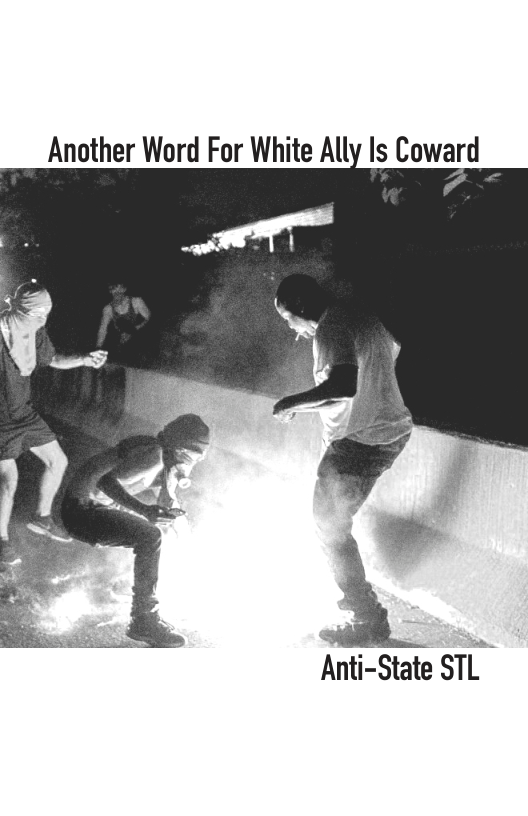


Another Word For White Ally Is Coward
Fear. Fear is real. Thee are times when fear should be listened to.
Like when shots ring out and fear tells you to duck and run. There
are other times when fear needs to be pushed through. We leave it
up to cach person to decide when to push and when to run. The
fear we criicize is not that of those who stay away from violent
and chaotic scenes, not that of those who listen to their bodies
telling them they cannot handle yet another trauma. We find no
fault in those who make these choices for themselves.
“The fear that we would like to critique here is the fear of forming
onc’s own opinion, the fear of developing one’s own analysis and
then acting upon it. We do find fault in this fear of the White
Ally. To bea White Ally s to stop thinking for one’s clf, to blind-
Iy follow a leader based on no other criteria than their identity. At
least this is what is demanded of us by those who would make us
into Allies.
“The concept of the White Ally is bankrupt. One cannot be an ally
to a category of people. To speak the words “I am a White Ally to
people of color” is to commit an act of double speak, to internal-
ize non-sense. There is no singular black voice that can be listencd
0, no authentic community leadership which to follow. There are
only many different people with different ideas, life experiences
and perspectives. To think otherwise, to hink that all black peo-
ple share a common opinion is extremely problematic, one might
even say racist. One can be an ally to individuals though there
are other words in the English language which describe this re-
Lationship with more grace: friend, lover, partner and sometimes
cellmate or co-defendant.
On Leadership
“There are two kinds of leadership. One which comes from orga-
nizations with acronyms for names and official ticles with paid
salaries and another which is created by activity, We will refer
0 the first as formal leadership and the second as informal lead-
ership. The reality of the current moment demands that white
people follow the leadership of black people while in the spaces
of majority black rebellion. We are currencly not in a position
to challenge this narrative though we would like to pur forward
the concepr of a multi-racial rebellion in which informal lead-
ership is picked up and put down again by all participants. As
ideal as that may be to us, that is not the situation in which we
continually find ourselves. Accordingly we choose to follow the
informal leadership of black people fighting back against police
terror. For better or worse, in some situations, a riot for example,
one cannot follow both the formal lcadership of those associated
with organizations and the informal leadership of those fighting
in the streets. In such situations the two forms of leadership move
in opposite directions.
As people who do not identify with the role of White Ally, we
choose the side of the fighters while the White Ally consistenly
chooses the side of the organizations.
Why do people associated with organizations find riotous be-
havior so objectionable? While we don't want to put words into
their mouths, we do have a few guesses. Paid organizers requirc
funding. Funding requires wealthy and often liberal bencfactors.
Don't bite the hand tha feeds, right? Organizers requirc a body
of people to be organized which is another way of saying manip-
ulated or controlled. When people refuse to be controlled, orga-
nizers don't know how to abandon their roles and participate in
the moment. They remain stuck between an instinct to rally and
dircet and the momentum of a body of people who have tempo-
ily escaped all mediation and control.
Where some claim to be building a movement, we sce only the
repression of the movement. What would it look like if instead of
organizing that repression, groups of trusted comrades took on
the task of giving the rioters a fighting chance of winning. What
supplics and materials are needed where and when in order to
actually win a confrontation with the police? How can we do this
in 2 way that strengthens our capacity instead of escalating to a
point at which all the gloves come off? What offensive objectives
could we set for ourselves — land, food, housing, infrastructurc?
What docs it cven mean to g frec and what would it take to get
there?
On Barricades
A barricade is a tool. We do not place objects in the street simply
in order to have fun. We do so in order to inhibit the flow of
traffic, to “shut shit down,” and sometimes to slow the advance
of the police and create a situation of greater safety for those who
wish to fight them. We sce the process of strect fighting which has
evolied over the past year as a process of lcarning, gaining con-
fidence and of setting precedents for future rebellions. An ideal
barricade would be large, tall and strong and potentially set on
firc only once the police have arrived. We think this would be an
effective tactic to employ in order to hold and defend space and as
a way to safely fight. Getting to the point where the construction
of such a baricade could take place would most likely entail a fair
amount of collective learning and creativity. In other words, we
all need to practice together.
“Thisis why we participate in riots instead of staying home or sim-
ply watching from the sidewalks like good White Alli
To those who say we'll run away when shit gets real, that others
will bear the consequences of our actions, that we never experi-
ence the repression that we instigate:
Over the past 15 years of participation in various social move-
ments and struggles we have gone through a lot. Collectively, we
have been shot with rubber bullets, tear gassed, pepper sprayed
and tazed. We have been arrested countless times racking up re-
cords that only increase the level of our bail and decrease our
employability. We have stared 10 year felony sentences in the face
and refused to break with our principles. Some of us have been
beaten within an inch of our lives by rabid police wiclding fash-
lights and metal capped clubs. One of us actually did die and
thanks only to a combination of luck, stubbornness and a doctor’s
hands came back to life. We have had our houses raided. We have
been placed under 24 hour FBI surveillance and subpoenaed by
federal grand juries. Some of s have permanent nerve damage
in our wrists duc to hand cuffs and pain compliance techniques.
Weve had our fingers intentionally broken by police. We've been
beaten during police intcrrogation. We could go on, but the point
is not to congratulate ourselves for the misery that we've lived
though. The point s to say that shit got real for us a long time ago
and we'ee sill here. We didnt run. We still come out for almost
every demo, though lately we've stopped making them happen
ourselves. We're sill confronting power and siding with those
who fight. After a decade and a half of beatings and court cases,
we're still on the same tip and we're not going anywhere.
To Those Who Say They Don't Trust Us:
You shouldn’t, and we don't trust you cither. Which is not o
say that we're immediately suspicious of all strangers. Trust, like
friendship, is a mutual relationship thatis built over time. It is not
one-sided. It is not something that White Allies have to carn. It
is something that comrades who struggle and live together over
many years develop. Hopefully, the past year of protests and riots
has produced many new relationships of trust throughout the city
welive in and across the country, We don't expect to be included
in all of these relationships, but just because we're not a pare of
your new crew doesn’t mean we have nothing to offer cach other.
To Those Who Would Try to Unmask Us:
We wear masks, not because we are police agents nor because we
arc always intent on startin somethin, but rather we cover our fac-
es to remain safe in conflice-filled situations involving the policc.
Contrary to the opinion popular among a certain scgment of the
protester population, white people do sometimes get targeted by
the police even when they arc in majority black crowds. In our
experence,police pick out and target or sapegot rebellous in-
a brightly colored picce
of clothing for example. They do this in order o make a quick
and successful arrest with easily communicated orders,
This is why we wear dark clothes and masks. I¢s not (juse) be-
cause we think we look good dressed up like ninjas. To act by,
say, de-arresting a fellow rebel and then change one’s clothing is
one way of avoiding police repression. The more people who do
this, the safer we all are. The fewer masked people there arc on
the strcets the more those who fight are left exposed. Even if you
are not going to break the law, wearing a mask is a subtle way of
increasing the safety and the power of the crowd. Where there arc
sceurity cameras or police video surveillance, which is to say al-
most everywhere these days, everyone should be wearing a mask.
‘The more the police recognize you, the more likely you are to be
targeted for arrest or additional surveillance.
To Those Who Say We've Started All the Fires:
A best this is che highest form of sclf-delusion. At worst it is
intentional manipulation that could lead to serious legal conse-
quences. In addition to simply being wrong, claiming that the
many acts of arson committed over the past year were perpetrated
by white people erases the agency of black rebels. According o
this logic black people will only violently rebel if they are put up
w0t by whites
To the Activists:
Ler’s make a deal. We promise not to disrupt your Non-Violent
Direct Actions and Civil Disobedience spaces. Hell, most of us
probably won't even show up. In return, the only thing we ask is
that you stop coming into the space of a riot and attempting to
control what is by definition an uncontrollable situation,
Unlike you, we don't want you to stop doing what you think
s right and we're not really interested in convincing you to see
things our way at all costs. If, when it comes down to it, we just
disagree on fundamental issues, then so be it. We'll have to find
some way of co-existing.
We could go further o criticize all the spcialized roles of the
official Movement like legal observer, strect medic, live strcamer
or citizen journalist. I¢s not that we think that no one should be
carrying medical supplics and possess the training to use them
under the most stressful of circumstances. Or that, even though
most footage taken at demonstrations serves the interest of the
police, there is never a uscful reason to have a camera, a note pad
and a pen. It just that the more people there are standing around
watching, spectating, the less people there are actually partici-
pating. And if we're actually going to win we'te going to need all
the active participation we can get. So by all means, bring your
camera, your maalox and your bandages, but also, bring your
gas mask, your leather gloves, and an extra tshirt to tic around
your face. Refuse to be confined to a single role that excludes you
from participation in all others. Break down the division between
fighters and cae-takers, between actors and supporters.
Even while we make this gentle criticism we also recognize that
not everyone feels comfortable doing everything. Different people
have different inclinations and comfort levels and we respeet this
difference. Hopefully others can begin to do the same.
— A few of the many anarchists in St. Louis
P.S. We're not all white!
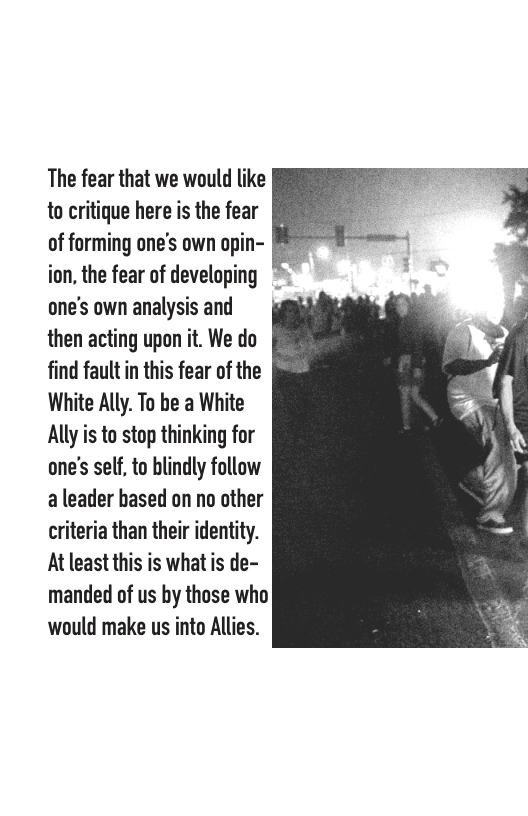
The fear that we would like
to critique here is the fear
of forming one’s own opin-
ion, the fear of developing *
one’s own analysis and
then acting upon it. We do
find fault in this fear of the
White Ally. To be a White
Ally is to stop thinking for
one’s self, to blindly follow
a leader hased on no other
criteria than their identity.
At least this is what is de-
manded of us by those who
would make us into Allies.