Anathema (Philadelphia Anarchist Periodical) (Summer 2025 and older)
Web PDF • Imposed PDF• Raw TXT (OCR)

![campaign have never been publicly written about or discussed. What looked like a chaotic, disorganized mess to many civil anarchists, democratic socialists, and other dweebs who can’t imagine life without formal organizing, was in fact often highly thought through and meticulously organized. At one point, a number of individuals came together to carry out a coordinated series of attacks targeting OCF Realty employees’ homes, alongside the ongoing attacks on OCF headquarters and OCF-owned properties. The idea was to make it personal for them, and to maximize the capacity of this small group of anarchists to disrupt the functioning of this company and of gentrification more broadly. This included an attack on the residence of widely hated CEO Ori Feibush, an action thatfeatureda brick being thrown through hiswindow that said “Enjoy your luncheon, Ori (A)." He was scheduled to appear ata real estate “influencers” lunch that next day. In mainstream news about the attack, Feibush said that there had been 42 attacks on OCF properties over that past year. In 2018, a similar secret campaign of attack among a network of comrades was carried out to prevent Amazon from choosing Philadelphia as its location for a second national headquarters. This campaign included posters and other propaganda, graffii,articles, sabotage, stealing and destroying large numbers of Ring cameras, and most notably, the arson of an Amazon Treasure Truck. It did not include any activist methods like putting pressure on lawmakers, making demands, holding protests, or litigating through the legal system. A short communique reported about the Treasure Truck attack: “There’s been almost no media coverage of this [attack] except for a short news story about a potential arson, which later got changed to a story that said that officials not suspect any suspicious activity.” How interesting! Amazon did not choose Philadelphia for its HQz. “The anti-gentrification struggle in Philly was an intentional struggle that sought to spread and deepen anarchist methods and ideas based on an analysis of the local context.” Over the past year or two, there’s been a lot of discourse among anarchists and anti-authoritarians across the country about forms of organization. Many feel an urgency around escalating and deepening practices of attack, and specifically for more coordination beyond small affinity groups. Lots of articles have touched on this need and made particular proposals, from “Subterranean Constellations” in Tinderbox this past spring t0 a text on It’s Going Down from July called “All Cocoons Are Temporary.” A variety of gatherings and conversations anathema.noblogs.org 7 have happened related to this topic. While there is still alot of enthusiasm for informal organizing — a method where individuals come together and act based on the needs of a particular project or action, rather than starting or joining an official formal organization — many ‘people associate informal organizing solely with acting in a small affinity group, and the possibility of coordination beyond that remains abstract. We might hear about it in other contexts like France and Germany, but are unsure of how to begin with such a method here. This leads to a tum, for some, to formal, militaristic, or even hierarchical organizations, like cadres or clandestine guerrilla formations, because they believe that that the only way to ensure consistency and quality of action. Tmention all this because in fact broad coordination using informal organizing methods already has a precedent in the US. The anti-gentrification struggle in Philly was an intentional struggle that sought to spread and deepen anarchist methods and ideas based on an analysis of the local context. An important but unpublicized part of that was ongoing experimentation with what we might call a diffuse network of attack. At times, this involved something like what others have more recently called a “constellation,” in which a larger number of specific comradesare invited to take part ina series of coordinated actions, as opposed to just two or three friends trying to do everything together. This struggle had its flaws and hardships, but it built the foundations of an anarchist space in Philly that is associated with autonomy, initiative, and attack. Using informal ~organizing methods enabled anarchists to explore and build their capacity to act together as a network of affinity groups, gave more people more experiences of anarchy, spread anarchist ideas, and minimized repression and capture. All this was carried out in the backdrop of widening ant fascist action during the first Trump administration, impending global ecological collapse, border violence, police murders, and prisoner strikes. That is to say, there was a lot of popular resistance in the streets, which spread anarchist and autonomous methods to more and more people, alongside these secret diffuse networks of attack, which experimented with deepening anarchist ‘methods and tactics. Ideally, as in that cra, these two approaches — broadening and deepening — happen alongside each other as complementary aspects of a whole ecosystem of anarchist action, rather than approaches we have to choose between. Similarly, the uprisings of 2020 broadened and popularized combative practices in the streets, while the years of anarchist attacks before and afterwards have honed anarchists’ ability to act independently of mass uprisings — but also to intervene decisively in those uprisings. Ten years from now, maybe we will have been more successful than we imagine. Bold anti-gentrification actions still happen in West anathemaphl@riseup.net](anathema-philadelphia-anarchist-periodical-summer-2025-and-older-anathema 7.png)


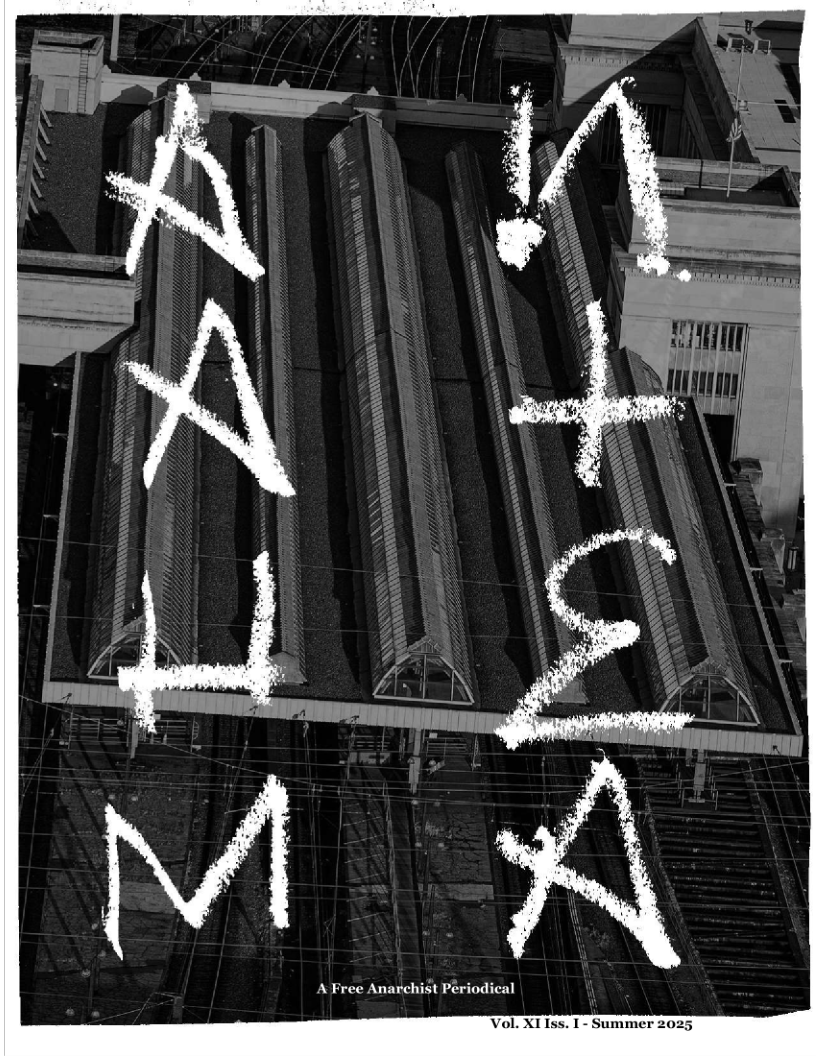
A Free Anarchist Periodical
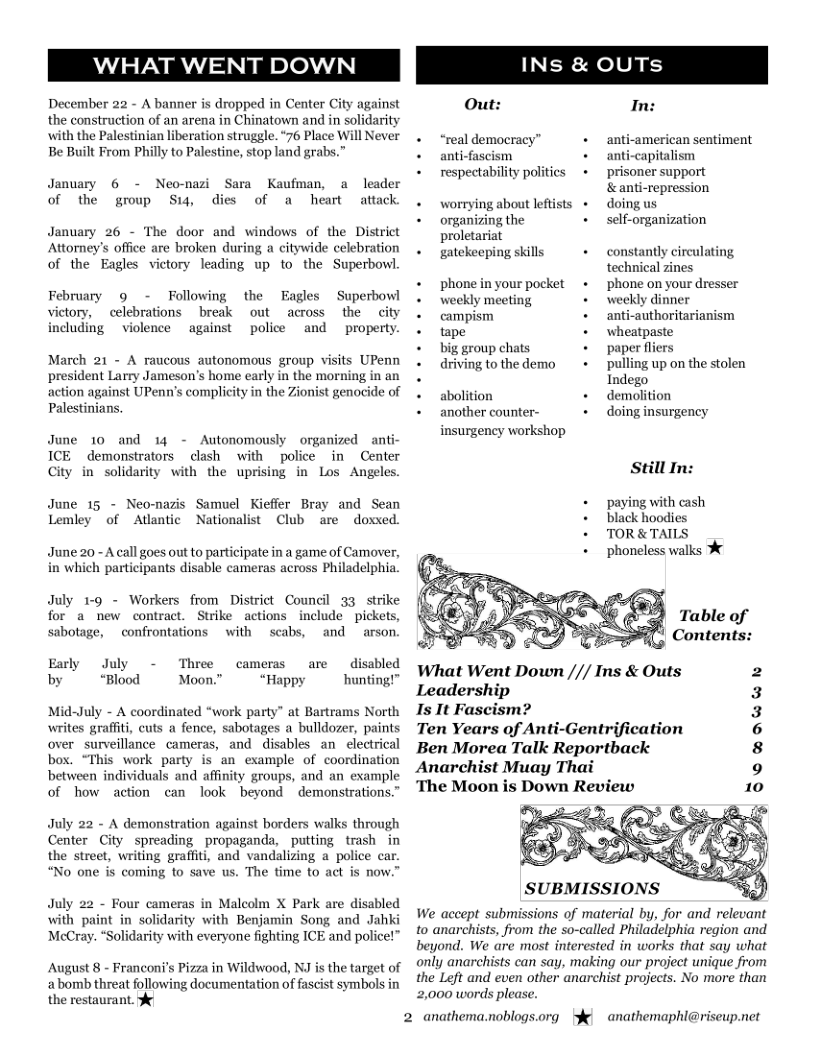
WHAT WENT DOWN
December 22 - A banner s dropped in Center City a
the construction of an arena in Chinatown and in solidarity
with the Palestinian liberation struggle. *76 Place Will Never
Be Built From Philly to Palestine, stop land grabs.”
January 6 - Neonazi Sara Kaufman, a leader
of the group Si4, dies of a heart -
January 26 - The door and windows of the District
Attorney’s office are broken during a citywide celebration
of the Eagles victory leading up to the Superbowl
February 9 - Following the Eagles Superbowl
victory, celebrations break out across the city
including violence against police and property.
March 21 - A raucous autonomous group visits UPenn
president Larry Jameson’s home early in the morning in an
st UPenn’s complicity in the Zionist genocide of
Palestinians.
Center
June 10 and 14
ICE demonstrators
City in- solidarity
Autonomously org:
dlash with police
in
with the uprising in Los Angeles.
June 15 - Neo-nazis Samuel Kieffer Bray and Sean
Lemley of Atlantic Nationalist Club are doxxed.
June 20 - A call goes out to participate in a game of Camover,
in which participants disable cameras across Philadelphia.
July 1-9 - Workers from District Council 33 strike
for a new contract. Strike actions include pickets,
sabotage, ~confrontations with scabs, and arson
Early
by
July
“Blood
Three
Moon.”
cameras
“Happy
are disabled
huntin
Mid-July - A coordinated “work party” at Bartrams North
writes graffiti, cuts a fence, sabotages a bulldozer, paints
ance cameras, and disables anelectrical
his work party is an example of coordination
between individuals and affinity groups, and an example
of how action can look beyond demonstrations.”
July 22 - A demonstration against borders walks through
Center City spreading propaganda, putting trash in
the street, writing graffiti, and vandalizing a police car.
“No one is coming to save us. The time to act is now.”
July 22 - Four cameras in Malcolm X Park are disabled
with paint in solidarity with Benjamin Song and Jahki
McCray. “Solidarity with everyone fighting ICE and police!”
August 8 - Franconis Pizza in Wildwood, N is the target of
abomb threat following documentation of fascist symbols in
the restaurant. k-
INs & OUTs
Out: In:
anti-american sentiment
anti-capitalism
“real democracy”
+ respectability politics + prisoner support
&anti-repression
+ worrying about leftists + doing us
organizing the self-organization
proletariat
gatekeeping skills constantly circulating
technical zines
« phoneinyourpocket + phone on your dresser
+ weekly mey + weekly dinner
+ campism + anti-authoritarianism
. tape + wheatpaste
+ big group chats + paper fliers
« drivingtothedemo + pulling up on the stolen
. Indego
demolition
doing insurgency
abolition
another counter-
insurgency workshop
Still In:
paying with cash
black hoodies
TOR & TAILS
phoneless walks
Table of
Contents:
What Went Down /// Ins & Outs 2
Leadership 3
Is It Fascism? 3
Ten Years of Anti-Gentrification 6
Ben Morea Talk Reportback 8
Anarchist Muay Thai 9
‘The Moon is Down Review 10
SUBMISSIONS
We accept submissions of material by, for and relevant
to anarchists, from the so-called Philadelphia region and
beyond. We are most interested in works that say what
only anarchists can say, making our project unigue from
the Left and even other anarchist projects. No more than
2,000 words please.
2 anathema.noblogs.org ki anathemaphl@riseup.net
WORDS MEAN THINGS:
LEADERSHIP
As anarchist ideas become more popular and widespread
they often lose meaning. We have witnessed the great
violence done to old favorites like mutual aid or direct
action. This Words Mean Things will flip the script a bit,
this term has not received enough hostility and this author
has seen it reconciled with anti-authoritarian notions of
freedom too many times. So in the spirit of fomenting
some negativity lets look at the word leadership.
To put it most simply leadership cither refers to the
leaders of a group, or the position or ability to lead.
For leadership to work there needs to be followershi
otherwise it is a failure, Directing, commanding, gui
governing, these are the things leadership entails
Noneofthesethingsmodelnon-hierarchical letalone anti-
hierarchical relations, yet too often radicals will advocate
for leadership while claiming to espouse horizontal or
non-hierachical politics or ns of freedom. Terms
like misleadership or collective leadership, the putting of
quotes around the word leader when it refers to someone
who is especially oppressive, or talking about “real
leaders” pulls discussion away from the fact that any
leading that has resulted in following was successful
leadership. It may not have led to anything good, but
the fact that it was followed means it was leadership.
For example, if someone were to lead a group of people
into a meatgrinder, though the consequences would be
grisly, no one can reasonably argue that they didn’t lead.
Asanarchistswearecritical ofall hierarchies, weaimtohave
irect and horizontal relations. Leadership and leaders
haveno placein ourvisions of freedom exceptas peopleand
systems toundermine. Instead, anarchic ways of living and
struggling revolve around self-organization, individually
and collectively. Deciding for ourselves the what and how
of our acti ithout top down or outside direction.
Like other anarchist concepts horizontal organization
is having a moment of popularity in the left and among
other not-necessarily-anarchist people discussing
struggle. Many of those talking about horizontal relations
genuinely envision freedom as a leaderless existence, but
some are using these concepts to make their authoritarian
ideas more palatable while secretly hoping to be the ones
holding the reins, stay sharp.
F———X
anathema.noblogs.org
3
IS IT FASCISM
Since President Trump came into office for the
second time, the country has been overwhelmed by
an onslaught of incredibly repressive executive orders
and legislation. This onslaught has been virtually
inseparable, moreover, from the hapless, disingenuous,
liberal outrage machine through which most of the
news coverage of it has been articulated. By describing
Trump’s regime as a fascist one that threatens the rule
of law and order, liberals and progressives portray
Trump's administration as an aberration and promote
democracy and the U.S. constitution as our savior.
As usual, most radicals have not been very helpful
either. Many have hopped onto the liberal antifascism
bandwagon, without thinking through the fact that
this “antifascist” discourse is coming from liberals
and that this group a as the absolute worst
ulterior motives. This is especially important to keep
in mind here in Philadelphia, which is one of the
nation’s major bases for reestablishing democracy and,
as part of that process, channeling peoples’ rage and
discontent back into voting and the electoral system.
The reality is that American democracy has always been
based in the elevation of some and the extreme oppression
of the rest. This includes the brutal exploitation. of
es at home, heartles
igrants coming from abroad, and consistent violent
interventions into other nations especially over the
course of the past century. From Guatemala to Vietnam
to Iraq and now Gaza, these atrocities are always in
the name of “democracy.” That's what democracy
looks like; that's what it's always been. And if what the
Trump admin ng is mostly legal, isn't this
just a more unapologetic side of democracy in action?
“American democracy has
always been based in the
elevation of some and the
extreme oppression of the rest.”
And what about the part that capitalism plays in all this?
Conveniently missing from all the talk about fascism is
capitalism as a global System and how its needs shape the
world that political authorities have to navigate. All nation-
states, all elected officals, all policy decisions are subject
to these considerations. Some of Trump’s economic
decisions — portrayed as insane and random by the media
— make some amount of sense, sort of, if we understand
that capitalism has been facing a erisis of accumulation
for decades and that governments are having to make
increasingly frantic and doomed attempts to resolve it
anathemaphl@ris
eup.net
“This is part of the reason for Trump's tariffs, which are
part of a worldwide trend away from globalization and
towards ethnonationalism. The US.’s national debt,
able and dangerous from
the standpoint of capitalism, and economists have been
warning about this for decades now. So again, Trump's
massive governmental reorganization and budget
cuts, while unhinged and chaotic in how they've been
targeted, are necessary from the standpoint of capitalism.
While the government's ethnonationalist economic
decisionsarein part a response toaglobal economicerisis,
so is the heinous and oppressive cultural environment it
s fostering with the enthusiastic assistance of much of
its people. For a while now, it's been getting harder and
harder for more and more people to survive, let alone live,
in the U.S. This, coupled with increasing environmental
disaster and misery, is potentially a very bad thing for
the government. So at times like these, we tend to see a
ot of cultural propaganda that redirects attention away
from the root causes of peoples’ misery. This typically
includes a renewal of traditional values, such as religion,
right-wing views, gender conformity, and so on. The
commercialization of relationships and the return of
traditional views around marriage can likewise also be
understood as a result of widespread desperation about
financial stability.
On the other hand, while we can use fancy language and
cconomic analysis to talk about all this, at the end of the
day i's not that complicated. 1 think it's important to
emphasize the economic reasons for what's going on, to
return our attention to capitalism as a major root cause
rather than just seeing what's happening as the result of
the random whims of our meglomaniac president. But
in addition to being a capitalist hegemon, America s a
settler state, and right now the settlers are going wild.
‘When white people panic about losing their dominance in
this country to non-white migrants, that's classic settler
behavior. When some people panic about other people
geting too free with their gender and sexuality or bodily
autonomy, that's them asserting a need for patriarchal
control that is a cornerstone of settler colonial states. For
a settler country to succeed, its people need to be cruel,
violent, entitled, and obsessed with racial hierarchy and
control.
As for the question of how fascism fits into all this,
there are two competing definitions of fascism and how
it relates to U.S. politics. The first understands fascism
as a historically specific phenomenon, distinct from
democratic governance, originating in Italy with the rise
of the Blackshirts street formations and the demand for
hierarchical, disciplined, ethnocultural unity. The second
way of thinking says that the United States has always
been fascist. This line of thought has historically been
especially present in the Black radical tradition. In 1936,
anathema.noblogs.org 4
Langston Hughes wrote that fascism “is a new name for
that kind of terror the Negro has always faced in America.”
The first definition understands fascism as a very
specific type of right-wing nationalism, while the second
sces it as an inherent feature of oppressive societies.
Both of these positions have different advantages in how
they point us towards liberation. By defining fascism as
qualitatively distinct from democratic governance, the
first definition helps us understand that democracy itself
isa specific method of white supremacist control. Vaguely
defined as a form of government in which power comes
from the people, in reality democracies have always
been controlled by a privileged minority. It is a method
of control that is typically more effective for maintaining
power, since, because it claims to include everyone
in governmental decision-making, it is able to easily
“recuperate revolutionary movements and co-opt popular
values so that they not only protect themselves from
their own underclasses but enlist those underclasses to
help manage the processes of exploitation” (Gelderloos,
Diagnostic of the Future).
“What this boils down to is
that America doesn’t need
Sascism to maintain a regime
of hyperexploitative racial
control.”
“This democratic approach to controlling a population,
combined with the project of colonial conquest and
settlement of the territory that is now known as the U.
has enabled the U.S.’s specific brand of white supremacy
Democracy claims to give everyone equal rights and
inclusion, but the state has the power to determine
who is a citizen and deserves those rights. Democracies
have always waged war, including genocidal campaigns,
against peoples wholived differently (for example, people
who do not accept property ownership) and are thus
not considered by democratic nation-states to deserve
human rights. And because of the democratic values
of equality and individual initiative, those genocidal
campaigns have historically been seen as the personal
responsibility of each American citizen and have been
voluntarily taken up by most of its white population.
What this boils down to is that America doesn't need
fascism to maintain a regime of hyperexploitative
racial control. From its earliest days, it has been
maintaining such a regime in the name of the
“democracy” that liberals are now longing to return
to. When we agitate for freedom, then, we should not
be agitating for “democracy.” Democracy is actually a
very specific form of unfreedom and always has been.
anathemaphi@riseup.net
Currently there is a spark of hope for democracy and
the Democratic Party in the form of Zohran Mamdani, a
charismatic young democratic socialist who recently won
the primary race for mayor of New York Ci
and progressives are embracing this man’s campaign as
though it's revolutionary, which it absolutely is not. But
by running his campaign on some basic, reasonable facts
about the brutal cost of living in New York City, Mamdani
carned the most total votes in a primary in New York
City history. While the city’s billionares are now openly
conspiringtobuytheelection to prevent Mamdani winning
the general election in the fall, in reality Mamdani is a
boon to the Democratic Party and the project of renewing
regular peoples’ faith in the electoral system. We see
this project reflected in Mamdani’s statement after the
primary election that his goal was “towin people back to a
Democratic Partythatputsworking people first.” Similarly,
his rival Andrew Cuomo's main reflection after the
primary was that Mamdani had *brought in a ot of votes.”
Supporters for Mamdani were making comments like,
“He gave us something to believe in,” and *I was amazed,
‘honestly. This is what an election should look like in a real
democracy.” These kinds of breathless, wide-eyed victory
declarations along with the talk of a “leftist resurgence”
all point to what his campaign is achieving on a more
structural level: pulling disillusioned left-leaning voters
backinto the electoral system and restoring our belief that
weliveina democracyin which regular peopleat least have
some amount of power in choosing who represents us.
Whether we call it fascist or not, the brutal violence
and hypoerisy of the democratic project is at the core of
this country’s oppression, and much of what the Trump
administration has done so far has a lot of continuity
with previous administrations. The Obama and Biden
inistrations set up the infrastructure currently
facilitating the deportations that liberals are now
denouncing as fascist, for example, and the numbers of
deportations remain around the same throughout the
three presidents’ administrations. The major distinction
sofaristhat Trump'sadministrationandits supportersare
openly celebrating the cruelties that are being committed.
As we have seen, violence is always needed to maintain
social hierarchies, especially those around citizenship;
what changes is how visible that violence is. That's part of
why a lot of the public doesn't sce the continuities: under
Demoeratic administrations, the depravity tends to be
covered up 50 most people don't even know thatit's going
on.
For example: recently, a report came out that ICE
(Immigrations and Customs Enforcement) has deported
70 people who were actually American citizens. A lot
of people saw this headline. If you read the article, it's
actually about a study of the years 2015-2020. So US.
citizens were already being deported under Obama and
anathema.noblogs.org 5
Trump (and presumably Biden later on), and we just
never heard about it.
The style in which the Trump administration has been
carrying out the current deportations — kidnappings
by masked agents with unmarked vans, the cruelty of
certain high-profile cases, threatening to deport anyone
who disagrees with the president, sending migrants to
a prison in El Salvador and threatening to do the same
to criminalized American citizens, the expanded use
of third-party countries to deport migrants to places
they're not from — does indicate a move towards
implementing ICE as a kind of secret police, which
would be a real shift away from democratic governance.
While the number of deportations themselves have not
significantly increased so far, the number of arrests in
the interior of the country (ICE’s domain) has doubled,
filling up migrant detention facilities across the country,
while the number of arrests at the southern border
(made by CBP officers) has gone down significantly.
“We're here to fight against
borders andnationsthemselves,
struggle against white
supremacy in all its forms,
and move towards an idea of
JSreedom and liberation that has
nothing to do with the law.”
‘The number of deportations and the manner in which
they're exccuted should be expected to dramatically
escalate soon, moreover, especially with Congress's
approval of Trump’s new budget bill. This bill,
terrifyingly, increases ICE's budget for detention alone
from $3.4 billion to $45 billion through 2029. What
that means for what migrant detention will look like, we
can only imagine. The bill makes ICE the largest federal
policing entity in U.S. history. This would potentially
give ICE more employees than the FBI and more
detention space than the Federal Bureau of Prisons.
A new era of the U.S.s notoriously cruel policing and
prison system is dawning, one that is both continuous
with previous regimes and qualitatively different.
There's no question that it’s critical to identify these
developments and fight against them. I do think its
important, however, to think about how we talk about
it, since this has implications for what exactly we're
fighting against and what we're fighting for. Do we,
as people who want a completely different kind of life
than anything the U.S. would ever give us, stand to gain
anything from referring to these new developments as
fascism or (my other favorite) the “dismantling of the
anathemaphl@riseup.net
federal government™? Does this help us draw attention
to the cruelty of the state and capitalism itself, to their
foundation in the horrors of colonialism and white
macy? In my view, the role of anarchists and other
insurgents is not to restore the rule of law or reafiirm
the constitution. We're here to fight against borders and
ions themselves, struggle against white supremacy
in all its forms, and move towards an idea of freedom
and liberation that has nothing to do with the law.
Historically, the transition from a democratic regime
10 a fascist one, for example one that has abolished the
electoral system, does not happen overnight. Maybe what
we have seen so far from the Trump administration —
which, as we've noted, has been facilitated by decades
of Democratic governance — really is moving in that
direction, towards an increasingly murderous vortex of
power-hungry hatred and self-destruction with global
implications. So we must prepare for this, as many of us
already are, and speak about it on our own terms. Not
those of our enemies
TEN YEARS OF
ANTI-GENTRIFICATION
STRUGGLE IN PHILLY
Amainstream news article came out recently about some
new businesses that had opened up on Baltimore Ave
in West Philly, and was received with widespread and
highly opinionated feedback on social media platforms.
As usual, the conversation was dominated by a bunch of
gentrifiers who popped up to complain about how hard
is to maintain a small business in this neighborhood.
In addition to a host of reasons like zoning laws about
which I am personally determined to remain ignorant,
‘many commentators cited a pattern of ceaseless broken
windows by disrespectful vandals as a major reason
for why certain kinds of small businesses are unable to
survive in this area. In the words of one individual, *It
feels like the constant vandalism has affected who wants
to come to the neighborhood.”
This type of disincentivization is one that L am much more
familiar with, and the conversation got me thinking about
the trajectoryof anti-gentrification strugglesin West Philly
and elsewhere in the city. Ten years ago, these kinds of
online discussions were filled with scandalized gentrifiers
(including some anarchists!) raging at, speculating about,
and mercilessly shaming the alleged vandals. What struck
me about this more recent discussion was that it seemed
that residents have now accepted anti-gentrification
vandalism as an unfortunate but inevitable fact of life in
West Philly,
It also struck me that in the eyes of many of our
adversaries, the anti-gentrification struggles have been
anathema.noblogs.org
6
successful. That didn't really resonate with me, as T look
around and see more and more ugly new housing going
up all over this side of the Schuylkill River, from West
to Overbrook and especially in Mantua. Not to mention
more and more white hipsters and yuppies walking
around looking comfortable in areas that 1 personally
do not believe they should feel comfortable in. But it is
arguably true that vandalism has helped shut down and
deter certain types of businesses on Baltimore Ave, and
who knows what kinds of horrors would be getting built
now if there had been no focused direct struggle around
development. These struggles have probably succeeded
in halting at least some aspects of development, and in
encouraging and popularizing an anti-authoritarian style
of anti-gentrification sentiment in certain neighborhoods.
Anti-gentrification was proposed as a focal point of
struggle for anarchists in Philadelphia back in 2015. A
call entitled A Concerted Effort Against Gentrification,
posted on Philly Anti-Capitalist in August of that year,
notes that there had already been a series of an
gentrification attacks, especially against the notoriously
terrible local company OCF Realty, and proposes that
anarchists collectively build on that momentum across
the city. It analyses the social tensions that already exist
around gentrification and discusses our reasons. for
fighting it, including personal survival and connections to
the movement for Black Lives that was gaining traction at
that time. It also notes the need to spread our ideas more,
with more dialogue about how and why we fight, to reach
potential allies and avoid remaining a small and isolated
minority.
“..there had been 42
attacks on OCF properties
over that past year.”
In retrospect, all of this is pretty much what happened
In 20152016, anti-gentrification struggles went from
extremely petty actions like pouring salt water into
small bu 5" flower pots, to a small autonomous
May Day march that put up posters and threw paint
at a police substation. By May Day of 2017, we were
seeing a massive anarchist demo in Kensington that
did hundreds of thousands of dollars of damage to
new developments and terrorized gentrifiers in their
own homes, and an unclaimed arson attack against an
entire block of new OCF Realty houses in South Philly
that rocked the whole city and for which no one was
ever arrested. More sabotage, arson, window-breaking,
and lots of grafiti followed, concentrated in the most
rapidly gentrifying parts of West and South Phill.
Most of the actions were unclaimed, and many of the
particular campaigns within that anti-gentrification
anathemaphl@riseup net
campaign have never been publicly written about or
discussed. What looked like a chaotic, disorganized mess
to many civil anarchists, democratic socialists, and other
dweebs who can't imagine life without formal organizing,
was in fact often highly thought through and meticulously
organized. At one point, a number of individuals came
together to carry out a coordinated series of attacks
targeting OCF Realty employees’ homes, alongside the
ongoing attacks on OCF headquarters and OCF-owned
properties. The idea was to make it personal for them,
and to maximize the capacity of this small group of
anarchists to disrupt the functioning of this company and
of gentrification more broadly. This included an attack on
the residence of widely hated CEO Ori Feibush, an action
thatfeatureda brick being thrown through hiswindow that
said “Enjoy your luncheon, Ori (A)." He was scheduled to
appear ata real estate “influencers” lunch that next day. In
mainstream news about the attack, Feibush said that there
had been 42 attacks on OCF properties over that past year.
In 2018, a similar secret campaign of attack among a
network of comrades was carried out to prevent Amazon
from choosing Philadelphia as its location for a second
national headquarters. This campaign included posters
and other propaganda, graffii,articles, sabotage, stealing
and destroying large numbers of Ring cameras, and most
notably, the arson of an Amazon Treasure Truck. It did
not include any activist methods like putting pressure
on lawmakers, making demands, holding protests, or
litigating through the legal system. A short communique
reported about the Treasure Truck attack: “There's
been almost no media coverage of this [attack] except
for a short news story about a potential arson, which
later got changed to a story that said that officials
not suspect any suspicious activity.” How interesting!
Amazon did not choose Philadelphia for its HQz.
“The anti-gentrification struggle
in Philly was an intentional
struggle that sought to spread
and deepen anarchist methods
and ideas based on an analysis of
the local context.”
Over the past year or two, there’s been a lot of discourse
among anarchists and anti-authoritarians across the
country about forms of organization. Many feel an
urgency around escalating and deepening practices of
attack, and specifically for more coordination beyond
small affinity groups. Lots of articles have touched on this
need and made particular proposals, from “Subterranean
Constellations” in Tinderbox this past spring t0 a text
on It's Going Down from July called “All Cocoons Are
Temporary.” A variety of gatherings and conversations
anathema.noblogs.org
7
have happened related to this topic. While there is still
alot of enthusiasm for informal organizing — a method
where individuals come together and act based on the
needs of a particular project or action, rather than
starting or joining an official formal organization — many
‘people associate informal organizing solely with acting in
a small affinity group, and the possibility of coordination
beyond that remains abstract. We might hear about
it in other contexts like France and Germany, but are
unsure of how to begin with such a method here. This
leads to a tum, for some, to formal, militaristic, or even
hierarchical organizations, like cadres or clandestine
guerrilla formations, because they believe that that
the only way to ensure consistency and quality of action.
Tmention all this because in fact broad coordination using
informal organizing methods already has a precedent in
the US. The anti-gentrification struggle in Philly was an
intentional struggle that sought to spread and deepen
anarchist methods and ideas based on an analysis of
the local context. An important but unpublicized part of
that was ongoing experimentation with what we might
call a diffuse network of attack. At times, this involved
something like what others have more recently called
a “constellation,” in which a larger number of specific
comradesare invited to take part ina series of coordinated
actions, as opposed to just two or three friends trying to
do everything together. This struggle had its flaws and
hardships, but it built the foundations of an anarchist
space in Philly that is associated with autonomy,
initiative, and attack. Using informal ~organizing
methods enabled anarchists to explore and build their
capacity to act together as a network of affinity groups,
gave more people more experiences of anarchy, spread
anarchist ideas, and minimized repression and capture.
All this was carried out in the backdrop of widening ant
fascist action during the first Trump administration,
impending global ecological collapse, border violence,
police murders, and prisoner strikes. That is to say,
there was a lot of popular resistance in the streets, which
spread anarchist and autonomous methods to more and
more people, alongside these secret diffuse networks of
attack, which experimented with deepening anarchist
‘methods and tactics. Ideally, as in that cra, these two
approaches — broadening and deepening — happen
alongside each other as complementary aspects of a whole
ecosystem of anarchist action, rather than approaches
we have to choose between. Similarly, the uprisings of
2020 broadened and popularized combative practices
in the streets, while the years of anarchist attacks before
and afterwards have honed anarchists’ ability to act
independently of mass uprisings — but also to intervene
decisively in those uprisings. Ten years from now, maybe
we will have been more successful than we imagine.
Bold anti-gentrification actions still happen in West
anathemaphl@riseup.net
Philly, from the demo-attack on the new Olympic Tower
Apartments on May Day in 2024 to the smashing of
almost all the first-floor windows on the new and widely
hated monstrosity The November, which
included a painted message that just read, “Fuck this
shit.” That latter attack was never ciaimed — it needed no
explanation. Experimentation with coordinated attack in
this city, bringing together different elements within the
anarchist space, and introducing newer people to direct
action, sstill happeningthroughanti-developmentaction.
Further Reading:
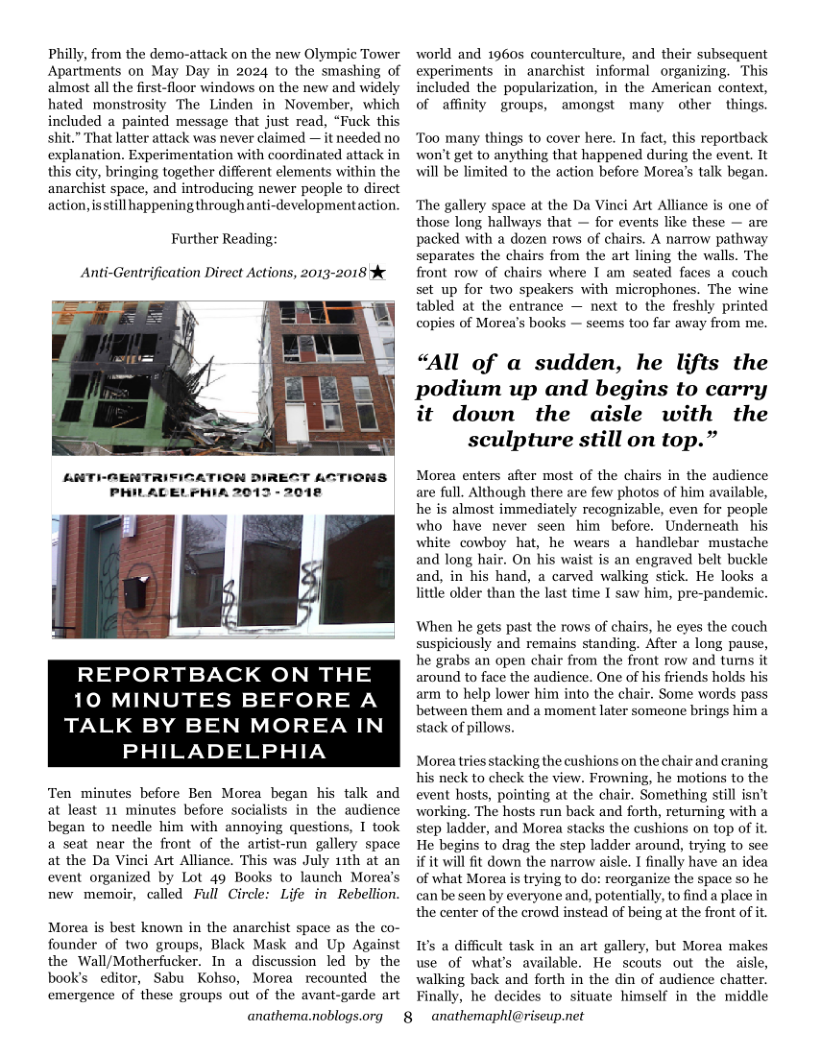
Anti-Gentrification Direct Actions, 2013-2018
ANTIENTRISICATION DIRECT ACTIONS
PHILACELFHIA 2013 - 2018
REPORTBACK ON THE
10 MINUTES BEFORE A
TALK BY BEN MOREA IN
PHILADELPHIA
Ten minutes before Ben Morea began his talk and
at least 11 minutes before socialists in the audience
began to needle him with annoying questions, T took
a seat near the front of the artistrun gallery space
at the Da Vinci Art Alliance. This was July 11th at an
event organized by Lot 49 Books to launch Morea's
new memoir, called Full Circle: Life in Rebellion.
Morea is best known in the anarchist space as the co-
founder of two groups, Black Mask and Up Against
the Wall/Motherfucker. In a discussion led by the
books editor, Sabu Kohso, Morea recounted the
emergence of these groups out of the avant-garde art
anathema.noblogs.org
8
world and 1960s counterculture, and their subsequent
experiments i anarchist informal organizing. This
included the popularization, in the American context,
of affinity groups, amongst many other things.
oo many things to cover here. In fact, this reportback
won't get to anything that happened during the event. It
will be limited to the action before Morea’s talk began.
“The gallery space at the Da Vinei Art Alliance is one of
those long hallways that — for events like these — are
packed with a dozen rows of chairs. A narrow pathway
separates the chairs from the art lining the walls. The
front row of chairs where I am seated faces a couch
set up for two speakers with microphones. The wine
tabled at the entrance — next to the freshly printed
copies of Morea’s books — seems too far away from me.
“All of a sudden, he lifts the
podium up and begins to carry
it down the aisle with the
sculpture still on top.”
Morea enters after most of the chairs in the audience
are full. Although there are few photos of him available,
he is almost immediately recognizable, even for people
who have never seen him before. Underneath his
white cowboy hat, he wears a handlebar mustache
and long hair. On his waist is an engraved belt buckle
and, in his hand, a carved walking stick. He looks a
little older than the last time I saw him, pre-pandemi
When he gets past the rows of chairs, he eyes the couch
suspiciously and remains standing. After a long pause,
he grabs an open chair from the front row and turns it
around to face the audience. One of his friends holds his
arm to help lower him into the chair. Some words pass
between them and a moment later someone brings him a
stack of pillows
Morea tries stacking the cushions on the chair and craning
his neck to check the view. Frowning, he motions to the
event hosts, pointing at the chair. Something still isn't
working. The hosts run back and forth, returning with a
step ladder, and Morea stacks the cushions on top of it
He begins to drag the step ladder around, trying to see
if it will fit down the narrow aisle. I finally have an idea
of what Morea is trying to do: reorganize the space so he
can be seen by everyone and, potentially, to find a place in
the center of the crowd instead of being at the front of it.
It's a difficult task in an art gallery, but Morea makes
use of what's available. He scouts out the aisle,
walking back and forth in the din of audience chatter.
Finally, he decides to situate himself in the middle
anathemaphi@riseup.net
of the aisle. Beside the rows, to everyone's left, and
directly in front of the art works installed on the walls.
At this point, he has abandoned the step ladder. Instead,
he eyes a podium holding up a sculpture, which is
sharing the aisle with him. He puts his hands around
the podium as if to test its weight. All of a sudden,
he lifts the podium up and begins to carry it down the
aisle with the sculpture still on top. As the sculpture
wobbles precariously atop the podium, T am reminded
of the time Morea visited me at a library archive
Itwas 10 years ago in New York City. We decided to meet
atthe Tamiment Library at NYUto lookat their collection
of Up Against the Wall/Motherfucker materials. There
are a lot of rules and procedures at a library archive. I
had been through it many times and knew the drill. So, I
signed in, filled out the request forms, and patiently sat
at an assigned table, while I waited for Morea to arrive.
Tlooked up at some point and noticed Morea was stuck
at the front desk. I quickly realized the problem: they
wanted him tosign inand asked himfor identification. He
had refused and the librarians were baffled. After what
seemed like along time, we were able to explain to one of
the archivists that Morea created materials they held in
their collection and, finally, bypassed their bureaucracy.
‘This memory flashes through my mind as the sculpture
threatens to fall offthe podium. Before that could happen
though, avery distressed event host bolts out from behind
thewinetableandrunsdowntheaisletocollect thesculpture.
Morea politely hands it off, oblivious of the host’s cold
sweat, and then proceeds to drag the podiuminto position.
‘The pillows are retrieved from the stepladder, and he
stacks them on top of the podium. Once everything is
in place, he props himself against the pillows to begin
his talk. From my vantage point, Morea looks like
one of those classic silhouettes of a leaning cowboy.
1 remember that he began the talk — microphones long
abandoned — by broaching the subject of art and its role
in revolution. Morea provided what must have been a
complex and sophisticated takedown of an artwork's
status as a commodity, and the vital need for creative acts
outside of and against institutions. For my money, his
point was best made in his actions before the talk. A
o
Q\?fi\é)q
B
%
()
anathema.noblogs.org
HAS ANARCHIST MUAY THAI
GONE TOO FAR?
SOME QUESTIONS FOR
THE MOVEMENT
9
A quick note: Anarchist martial arts culture is
a new phenomenon in the United States. It is
generally a welcome one in the author’s view.
Here's a few questions the author is pondering.
1. How do we scale up and increase our capacity for
training?
2. Should we even desire to scale up?
3. What model is best? Forward facing, semi-closed or
secret? Or something else?
4. Whatis the role of these projects in terms of supporting
revolt? Will these projects support revolt and resistance
as it happens? Perhaps that has already happened?
5. Can we riot if we're too tired from doing a thousand
Kicks on the bag?
6. Do we need mascots?
7. How should we relate to non-political gyms and
sympathetic fighters in our cities as our movement grows?
8. Is “de-arresting” on its own a useful skill to train?
What about more complicated group formations?
9
meet-ups
Are smokers the most useful way to organize
between different fight projects?
10. Should smokers have music during the fights?
1. Why do some of these projects break through
the racial segregation common in the anarchist
space? Why do some others not do that? How
can we further interrogate this question?
12, How do we resist specialization:
13. Do we need our own branded Muay Thai shorts:
What are the security culture ramifications of
branding your gym, everyone wearing the same
tshirt and yelling the name like idiots at the smoker?
14. Should spinning back elbows be allowed if you
are doing a “friendly spar” with the tiqqunist cadres/
socialist gun-bros/anarchist complainers of the world?
anathemaphl@riseup.net
15. How do we recover from longterm injuries? If those
injuries become disabling for long periods of time, what
happens to our comrades who can no longer train?
16. When is the appropriate time o initiate the forty
person bare knuckle brawl at the smoker?
17. Do we need more anarchist martial arts promotional
videos? Anarchist Muay Thai TikToks? If we start making
‘promotional content, will it draw the attention of enemies
like anti-social media anarchos (jk jk, a lot of us at the
‘gvm hate phones t00), clout-chasing activists, communist
baddie podeast influencers and the Feds? Maybe we want
the attention of the communist baddies? Enemies to
lovers arc?
18. What is the role of the one-time anarchist
fight workshop? Should we still be doing them?
19. How do we integrate political education into our
training in better way
20. Should every anarchist Muay Thai gym have their
‘own flag? Is joking about “franchising” the gym mean that
were actually part of the trend of everyone these days
being a Maoist?
21. What's most effective when fighting an ICE agent? A
thigh kick or a teep to the chest?
22. Are smoker report-backs really necessary? When you
could be burning down the city instead of hiding in the
safety of the rented warehouse, maybe we should ask
ourselves what s the role of the anarchist social event?
23. How do we relate to youth especially Black youth
and youth of color as some white youth seem intent on
organizing their own fascist active clubs? Our projects
seem to skew 25 and up, what could we do to change that?
Or s that just the nature of the project? If often seems
that only old traumatized and politically disillusioned
anarchists tryna train Muay Thai, why is that?
24. Anarchist Muay Thai theme song? Why are
the fights apart from Philly always so quiet?
25. Ts the real purpose of anarchist Muay Thai the friends
‘we made along the way? Yk
anathema.noblogs.org
REVIEW:
THE MOON IS DOWN
A foreign military has invaded a town. There was an
informant on the ground who simultancously led the
town’s small militia away while the military power took
over, and ambushed the militia upon their return. This
unnamed power, a not-so-vague stand in for the Nazis,
tries to appeal to the town’s well liked mayor, trying to
trap them into civility by saying they'd rather not bring
about violence - in fact, the killing of some members of the
militia could've been avoided if they just surrendered...
they just knew that they'd been beat.
Released in 1942, John Steinbeck’s The Moon is Down is a
curious novella n that it was funded by the predecessors of
the CIA to help grow anti-fascist sentiment in the United
States. Itis neither great literature nor overt propaganda,
but it is a decent little story. Actually focusing on the
human element within its landscape, it rightfully reads as
adrama - in fact it was also performed as a play on many
illcitly circulated across the European
languages, countering the German
occupation familiarin its characters
that Steinbeck accurately portrays common citizens, even
if it’s hard to imagine US Americans in the 21st Century
actually taking up acts of sabotage to stop the conquests
of fascism. The citizens seem equally as annoyed and
inconvenienced by the arrival of this military occupation,
as they are defensive of their homeland — whether as
patriots or more often because, as one character simply
describes, “they don'tlike to be conquered.”
There is still an air of civility in the interactions between
the local government and the occupying military force,
right to the very end, somewhat normalizing the concept
of conquering and being conquered early in the story —
if only problematizing it as an old concept. The conduct
in such a situation has become unfamiliar once more,
and the administration doesn't know how to “receive the
conqueror” — they don’t know “what is proper” etiquette.
The conqueror also tries to maintain civility, and i
Lieutenant even appears sympathetic at times, even while
appealing for the town to cease their resistance.
This speaks to what was criticized in the US reception
of the novella, but lauded in other countries as a more
accurate portrayal of the invading forces: all parties are
shown to be human. There are no caricatures of evil, only
some that feel a duty to follow orders and others with a
duty to resist. There is fear on both sides — passion, too, if
onlyabitstilted in the short story. Perhaps the discomfort
of those Americans ritics lay in something else, too.
It has been said many times over that the the US is a
10 anathemaphi@riseup.net
genocidal, white-supremacist state. It is the culmination
of many European invasions resulting in a settler-colonial
nation, attempting to expel and eradicate indigenous
peoples to build a new white homeland. The enslavement
of s0 many people, most notably the kidnapping of black
people from Africa for this purpose, built new empire
for these conquerors. There was less need for civility
when those populations could be othered to the point of
being considered less than human. Whether the American
critics were made uncomfortable by that truth deep inside
beyond the scope of this essay, but the current Federal
Administration (and many more local administrations)
have once more removed their mask of civility and have
begun openly pushing for their idealized white American
homeland.
The question is, at what point do the white Americans
allegedly resisting this government see the benefit of
bombing_infrastructure to stop the conquerors? At
what point do Steinbeck’s townspeople dynamiting
rail lines and mines resonate with common American
citizens, particularly those who see the current American
government’s policies as a continuation of its founding
principles? This is why the portrayal of the characters
feels farther afield of an American reality, because the
‘common citizen in this country is complicit,if not actively
a part of, the conquering force.
‘The sense of duty to follow orders fits into the paradigm
of respecting government and its civil processes. Most of
us are the beneficiaries of a quality of life carved out by
empire at the expense of so many others. The integration
of a wider variety of people into those lifestyles has been a
liberal strategy to quell dissent, or at least channel it into
less volatile means.
‘The familiar misinformation campai
narratives spread by the conqueror’s media proliferate
in this story, but their metaphor that “the flies have
conquered the flypaper,” can can be flipped on its head in
the context of a digital world. It's well documented that the
web has become rife with misinformation and conspiracy
theories, some also perpetuated by the government -- and
the intentional enshittification of the internet by search
engines making their sites less accurate, while offering AT
answers to every question, has further fueled this trend.
Returning to the story, there is something inspiring when
the conquering military finds its rank and file growing
paranoid. They begin to realize their government is lying
to them, and they also realize that they've come to be
surrounded by the townspeople. The traps laid and the
crimes of opportunity are both moving. But while the
noble end of the town’s top bureaucrat might occasionally
be an accurate portrayal in some places, it does not
resonate here. Maybe if more space had been available
for Steinbeck to warm us to this character, we could
anathema.noblogs.org
overcome the disdain for his position, but asingle official's
death does little when they are viewed as complicit in an
ongoing conquest. The debt has not been paid through
a single blood-letting, and our civility creates worthless
impasses.
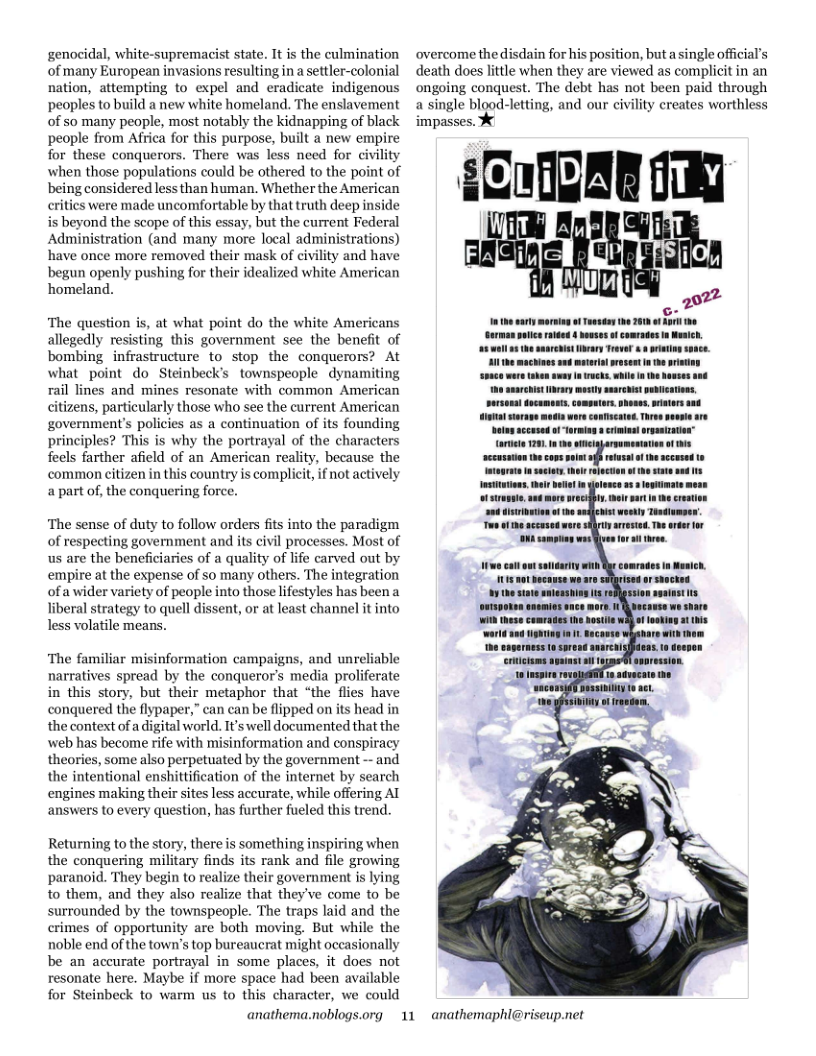
HOLJi Placfilt ¥
e
10100 sty morsag of Tonsda he 2600 1 Ko
Sorman paic atdes 4 souses o camrades i Masch.
s eary Trover 48 sl
A e machines audmateo resent e arining
auce war ahem away I rus, bl e Nowses 104
0 anarchit Irary mestly smarenistpubicaions,
sersona ducamenis. computers. phosss,pitors and
e strage modia werscontscaied Thre yonieare
elag accasedof “ormins 2 crimiea rganzat”
[ ——
anathemaphl@riseup.net
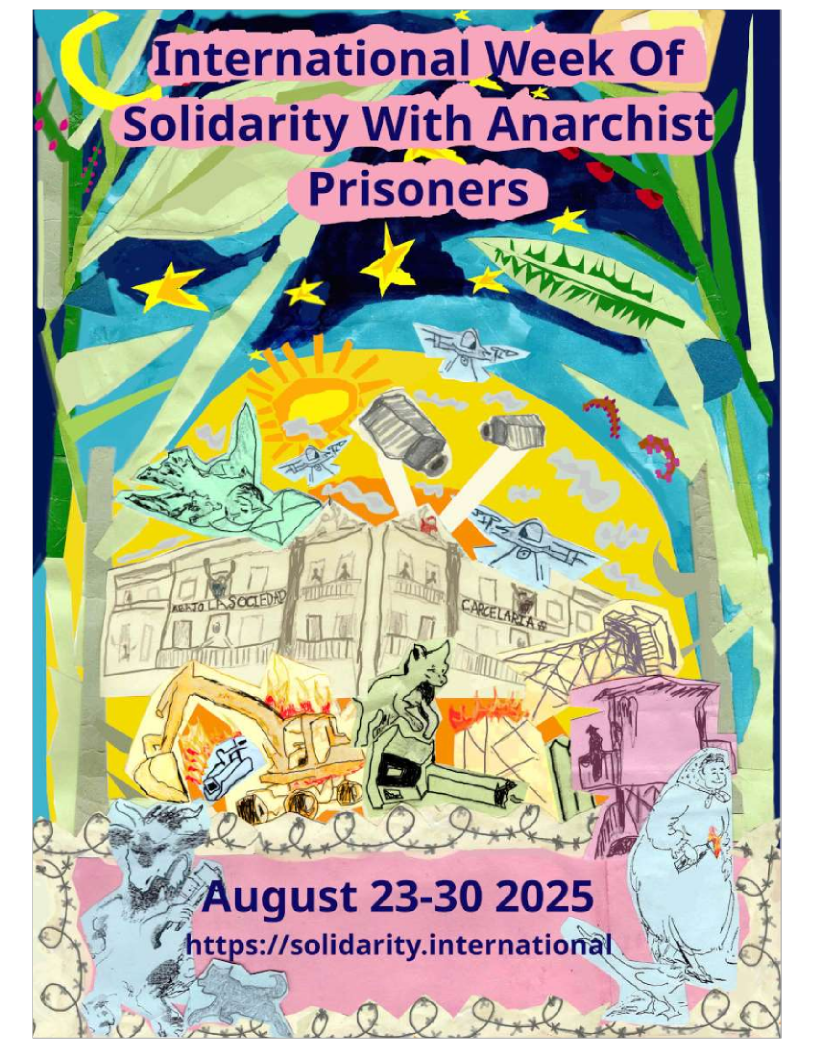
finternational W
nternational eek Of
Solldarlty W|th Anarchlst‘
Prlsoners
Wflugust 23-30 2025
O3 {hmflsolldar|W|nternat|oml
£
) e A AN . M D 7 TR %y X g e S —