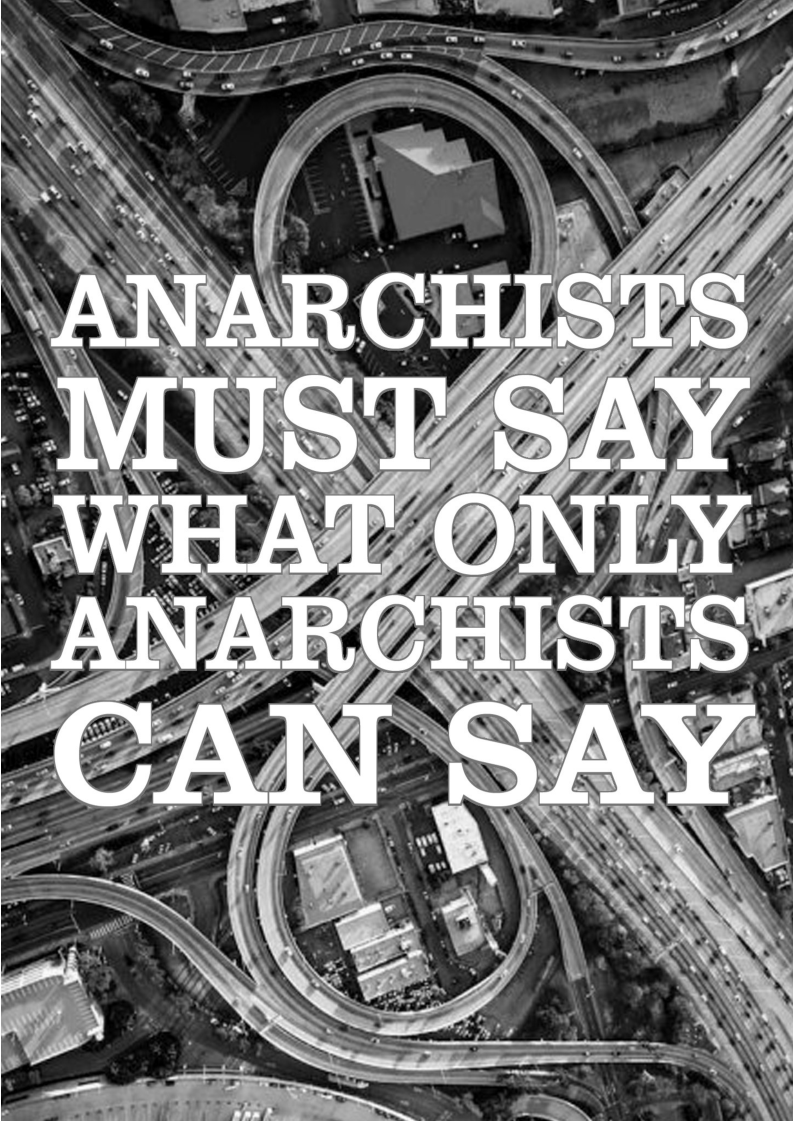
Anarchists Must Say What Only Anarchists Can Say
Web PDF • Imposed PDF• Raw TXT (OCR)


Part One
I stopped briefly on the bridge over the A14 near Milton’s Tesco and watched as cars,
vans and lorries appeared and vanished like shooting stars beneath my feet. For once
not content with the devil getting all the best lines I made a duce-like proclamation
from my impromptu balcony, ‘every vehicle on this road, I said, contains at least one
for-itself individual and yet from my perspective all this is just noisy, slightly
vertiginous traffic of a somewhat sinister connotation.
I could have made a subjective case here for the apparent divergence of traffic and
personhood based upon previous theoretical reflections on a theme of alienation, but
it would have been made against all objective evidence. Instead I wondered at the
contrary tendency, that of the steady integration of individuality and production —
someone once said to me, ‘I sat in my car in a London traffic jam and I looked, around
me, at the other cars all stuck just like me and I thought, all of this, so much of it, how
could there ever be a revolution? It is because all this modern life is so absurd that you
can't get rid of it, there’s no reality to appeal to! Of course, this comment is a
misunderstanding of things in the style of not being able to see the wood for the trees.
In another sense it highlights the childish despair of those who seem to want to change
the world by changing appearances, who give up because of the impossibility of the
(absurd) task they have set themselves. They can sense it but cannot grasp it: there is
no clear blue sea between the commodity and the human being.
There is no wild essence, like the red squirrel under threat but still holding on, which
we could use to repopulate the wilderness. There is nothing real to go back to, and
nothing at all of what existed before the motorway now survives.
Cycling away from the fact of the motorway my mind recoiled and sought some
ideational solace from the perpetual launchpad of all those banal journeys. I thought
on as I freewheeled down the hill, passed by white vans, park and ride buses and
brewery trucks. What exactly, I asked mysel, is the relation between the road (its
complex of habits, purposes, rules, laws, vehicles, surface, destinations etc) and the
individual beings that hurtle along it?
Is there not, I thought, an illustrative correlation here concerning human existence
lived within the frame of capitalism's soft totalitarianism?
The motorway’s example and metaphor of the maximised commodification of
individuality and the secondary integration of its figure within a stabilising albumen of
social admin.
First the law, then the policing of the law.
First the policing of the law, then the law.
The parable is also the paradigm. Isn't driving your car on a motorway a bit like
making love to a beautiful woman?
A bit like shopping, a bit like a maternity ward, a bit like filling in forms, a bit like
education?
The motorway is a sophisticated conveyor belt, a factory process that produces both
destination and a high velocity turnover of packaged units all done up in their cars like
unique and expensive chocolates. A bit like eating, a bit like having an operation, a bit
like emotions and stupid political solutions? A bit like dying, a bit like clicking on your
mouse, a bit like the fall of civilisations, a bit like reading novels? Appearing here,
ending there, distance and the time to cover that distance. Hold-ups, contra-flows,
accident blackspots, tail-backs.
It seems you can and you cannot travel the same motorway twice.
All the movement and the events borne of movement: disease, ideas, accidents,
disasters, military manoeuvres, and money (always money), getting to work, to the out
of town, off on our hols, the products rolling off the line, the waste products dragged
off to the dump, all that and the motorway itself untouched, ever present like a black
angel’s roar, like money washing over us; everything is integrated into the economy as
a commodity, even our underpants. The motorway is the site of movement, just as the
factory is the site of production, from a single of its products you may deduce the
capitalist economy, from one car you will understand distribution.
The motorway does not move but gives form to every possible movement from the
smooth flow to the grinding snarl-up.
Moving and non-movement, the motorway conditions all possible phenomena even
that which reflects critically upon it (anti-globalisers hop on aeroplanes to attend far
away conferences against aeroplanes, but to travel by mule would be mere conceit).
Yes you may alter your car, reform it, change it for another, try alternative fuels, you
can transform your driving habits, you can pledge yourself to the cause of safety; at the
level of your ownership you are free to do anything, but... nothing of what you choose
has any significance to anyone but yourself, all choices are conditioned. And ethical
choices, even if they are shared with a number of others remain at the level of ethics,
there is no true organisation in it, it is not a politics, it can have no impact on the
nature of the motorway.
The rules for the road are set by the road and not its users, there is imposition not
consensus.
The conditioned response, the effect, the result cannot reach round and alter the forces
determining its presence or its character. The road drives your car, it's in your
unconscious, you can't turn it off, you hear it on the other side of the hill, rubber
spinning water. Nobody can stop it because nobody chose it, it is a fact, the world we
live in. In the same way a television programme critical of the psycho-sociological
effects of television ultimately ends by affirming the amazing versatility of the
medium, it certainly cannot turn the box off and release people to do something less
boring instead. Television and the motorway, unlike the Roman Emperors, tolerate,
even encourage, dissent.
Outside the metaphor anarchists can refuse details and go on demonstrations, they can
change their life, they can try to will the future into existence, they can go vegan, they
can develop viable alternatives, can proclaim themselves against burger bars and
coffee shops, they can develop green, organic, co-operative ventures. They can attempt
to control every detail of their life and make it as alternative as is possible but the
system itself remains out of reach, capital is untouched. When they're saving the
environment by recycling their rubbish someone else is making a profit from their
unpaid labour. When they're printing leaflets and shouting slogans for the holy cause
someone less scrupulous and more organised is turning that to their political
advantage.
Within the metaphor, anarchists can disrupt local traffic with their critical masses, they
can park their cars on the hard shoulder and go and find themselves in the adjacent
field of sugarbeet, nobody notices the sparks that fly off into the dark periphery. They
can drive their tractors slowly, they can hold parties on the tarmac, they can dig up
chunks of what they hate, they can make other drivers feel very, very annoyed by their
pranks and provocations. But all of this is second level voluntarism (I am determined
by the road therefore I rebel against the road), it is not deep down structural, it's at the
level of ‘Starbucks bad, Fairtrade good), it’s secondary and not right in there, touching
the heart of it. The best second level structure for political reflection on economic
forces is democracy, but at all times in its history democracy has shown itself to be
controlled by and not in control of, the economy. Those ‘anarchists’ advocating
municipalism and ‘real’ democracy should take note of this failure.
Part Two
The system of the motorway, the social relation of the motorway is left untouched by
any attack on its specifics, untouched or is it reinvigorated? Does it bloom like the
desert in places where fire and rain have visited? Anarchism like that is an ethics, it
doesn’t hurt the motorway even though it wants to. It doesn’t hurt the motorway
because it is just one response to present conditions amongst many, and it takes its
place alongside all other theories and actions as an ideology, that is as one strand of
commodified consciousness. On the motorway, everything that can happen will
happen including dissent against it, but we see how achieving the blessed condition of
dissent does not naturally qualify the rebel to actually change anything or even to
escape the conditioning of the present. To say ‘no’ does not make you a time traveller
to the future. I have met anarchists who live like ironside puritans and others of a
deliberately decadent inclination, but whether you forbid or celebrate you do not
touch capitalism itself, at every point it holds you in its palm: sometimes allowing a
little more movement, sometimes gripping harder. Capitalism has encouraged
democracy, fascism, state socialism, theocracy, militarism, human rights, you name it,
every political vehicle is compatible with it.
Counter culture? Capital will commodify it, instigate it, reproduce it and sell it. There is
no outside the loop.
The motorway cannot be undone either by ideas or practice. It cannot be undone. You
think a million people like you could do the business? Well, where are they? If you
haven’t got them after two hundred years of agitation what makes you think they will
turn up now or some time in the future? And do you really think it possible that a
million people can believe the same thing at the same time? How would you check they
were really thinking what you thought and not hoping to get something else out of it, a
phd thesis, a promotion, a ministerial promotion, a groovy party, radical credibility, a
new girlfriend? And if they did truly believe as you believe, if they downloaded your
consciousness by what mechanism would that change the world? It sounds like magic:
if we all think the same thing then everything will come good. Why should people
believe what you say more than the promises of any other religion? The internet is full
of get rich quick schemes, anarchism is just one of them.
The easy anarchist answer is that it is not thoughts that change the world but acts. So
let's just pause there and consider three recent pro-action claims: on 31/10/02
activists called for the occupation of Parliament but really that was just a ruse to get
lots of police out of the way whilst the activists ‘acted’ on other stages, fine, except of
course not everyone was let in on the secret. This is not the only occasion such tricks
have been used and always there is some collateral damage where those not in the
know are run over like hapless hedgehogs by the exigencies of the protest elite. Why
don't they ask for volunteer sacrificial pawns? Brrrm Brrrm! Our second example
comes from Class War issue 84, in this it is advocated that Christians be locked inside
their churches, not Muslims, Jews or Hindus, only Christians, why? Don't ask us,
apparently Christians are wankers, although of course if the Christians thus
imprisoned were black then such actions would come close to resembling something
very unpleasant. Is revolution really to be kickstarted from cultivating prejudices
against irrelevant subcultures? Whatever next, doomed publicity stunts against the
monarchy? Our third example comes from the critique of recent Mayday events by
various class struggle anarchists; their argument runs that dressing up in silly clothes
and larking about is bourgeois (because the working class never do fancy dress) and
illustrates very well the trivialities of the middle class entrepreneurs who run the
unpolitical anti-capitalist scene. Their alternative proposal is a serious return to
working class actions, but there is a problem with this on two counts, the first is based
in mere jealousy, there is nothing wrong with people dressed up in silly costumes
running round London once a year, the problem lies in attempting to graft a pseudo-
revolutionary politics onto hi-jinks of any colour; secondly, if the actions were made
more militant or diffused into local working class communities (whatever they are),
nobody would show up. The fundamental flaw in political action is this: the more
militant (and therefore true) the action is the less people want to participate in it, the
more unreal and fluffy the more inclined they will be to turn up. Anarchists, being
mostly young men, still have not learnt that only young men like to fightback on the
streets, everyone else will find excuses not to be there. The choice is stark, it is
between numbers or ideological purity.
But even to say that rubs some up the wrong way, all discussion subverts the glory of
acts. Apparently talking and thinking gets you nowhere because ‘there is no point in
theory without action, s if the likes of Class War or RTS have ever got anywhere. How
could Monsieur Dupont demonstrate its activities on the streets? How is anarchism
demonstrated on the streets? It seems after all that all deliberate interventions made
by the pro-revolutionary minority are acts, what is important is whether they do what
it says they will do on the tin.
We shall quickly pass over the crude philosophical underpinnings of the direct action
is the only language they understand arguments because they are made tactically
merely to deflect attention from the small empires of established anarchist cults
dominated by backdoor authoritarians which have not increased their membership or
influence despite existing for many years and, what is worse, having recruited
hundreds of adherents in that time only to lose them very rapidly when it becomes
clear that these so called groups and federations are really only psychological
projections of one or two individuals, this not only puts people off the groups in
question but paints us all as brooding loonies obsessed with our own expertise.
Pro-activist anarchists are transfixed by the tableaux of street action but they cannot
be bothered to ask themselves whether what is happening is achieving anything more
than the spectacle itself; what they want is the reproduction of confrontation — the
recorded display of resistance becomes the end in itself, it is a fetish, it has a cyclical
temporality — check out any issue of Counter Information to confirm this, it’s raison
detre lies in an assumption of the accumulationary significance of tiny uncheckable
snippets of info. Have the editors of this and other similar newsheets ever considered
what the shelf-life is of their information? In what way do the struggles of the past still
count? Are they part of a movement to change, a brick placed on a revolutionary wall
that is slowly being built across the world by those fighting their bosses, or is each
act’s significance merely local in both place and time? A Zapatista says, ‘any struggle
that wins anywhere in the world is like a breath of oxygen to us’ We do not believe
him.
But that is not our point. What is important with regard to political action, and a
question that should be addressed by all interested parties is the decrease in
complexity of political acts as the numbers involved increase. Whilst it is easy to
programme a million people into accepting football and pop music as compensations
for living impoverished lives, a certain quantity of displaced violence is necessary
beforehand. Programmed or imposed behaviour is easily reproducible because of the
immediate alienation we are all born into. This is why there is essentially no difference
in attitudes to TV or supermarkets from one end of the country to the other; because
people are responding to objective reality on a secondary level, that is they act as
people who do not own the context of their experiences but even so have no option but
to experience life in the shadow of the volcano. In these situations their ‘free’ actions
conform very readily to half a dozen psychological types. Things are very different
though if you ask, as pro-revolutionaries do, people to take control of their lives, or at
least to protest against their conditions. If coercion is used in the name of
revolutionary values, as in Northern Ireland (and you have sufficient firepower), you
may impose on people a will to ‘act’ politically which they will do in the same passive
way as others visit DIY stores, it becomes their culture. But if you want to remove all
leadership structures and demand that people think and act for themselves then it
becomes almost impossible to motivate more than a few thousand individuals from a
wide geographical area to participate, and even then the specifics of the action will be
undertaken by a relatively small number of young men with the majority content with
an onlooker role. As the numbers of protesters increase, as with an anti-war march for
example, so the ‘action’ taken and the reason for the actions becomes more and more
simplified. To cut a long story short, it seems to us that the less people there are
participating in political actions the more the acts conform to a defined set of ideas but
this is felt to be not real enough because the numbers involved are so small.
Contrariwise, the more numbers there are involved the more restricted are the
possible actions and less defined the ideas. With the participation of a million people
acting against capital the actions open to them appear to us to be primarily negative,
namely the withdrawal of labour. The only other option is that of the mass
demonstration which when boiled down to its essence is a gathering together in one
place of many people for a set period of time beneath a one or two word slogan. To ask
anything more is unrealistic, everyone will find an excuse not to act and to limit their
participation because the pressures of reality carry too great a penalty. The exception
to this is when people are compelled to respond to an objective economic crisis, as in
Argentina at present, in this case they have no choice but to act. Even so, whilst the
demonstrations, collectivisations and occupations of this emergency communism are
interesting they are not an end in themselves, we must remember the lessons of the
self-managed counter-revolution. The workers in Argentina are only keeping the seat
warm as everyone awaits the boss’s return.
Itis not for anarchists to celebrate when ‘the people’ take over, anarchists ought not to
be so amazed at examples of natural ingenuity and resilience, that is after all what they
base all their principles on. Unfortunately their proper political task is less appealing
and more controversial, it is to poke their fingers into the wounds of revolution, to
doubt and to look for ways in which the Zapatistas, FLN, ANC or any other bunch of
leftwing heroes will sell out, because they always do. The questions we must ask of
civil emergency and economic breakdown, which are the occasions where various
social and pro-revolutionary movements appear is how exactly does capital re-
establish itself again and again despite the apparent revolutionary intent of the general
populace.
If the motorway is ever to fall into disuse then it will do so because of some internal
dysfunction, specifically when the costs become too high to maintain it. Cars will come
to a halt, the individuals inside will get out and they will walk away not looking back.
They will forget instantly the purpose of this architecture which within two years of
the cataclysm will fall into the field of archaeology. Anarchists have no role to play in
the initial downfall of capitalism, they have no means by which they could escalate
costs to the level where profits are put in danger and a crisis is brought on. It is
possible that the working class, because its labour is an integral cost of production,
could cause a systemic collapse by refusing to improve productivity and by fighting to
increase their wages. It is possible that they could bring on a revolution even though
their only aim is their own self-interest. They will never overthrow the system by
choice because that is a secondary political ambition produced as a mirage by the
system itself. If the working class aimed for revolution it would not achieve it since
political ambition is a readymade form held within capital’s array of determined
responses, ‘you don't like it then make it better, have a go! The working class is purely
an economic category, it cannot act politically except by accident.
It is significant, we think, that most anti-capitalists have no theory of capitalism or its
overthrow other than vague aboriginalism (Palestine for the Palestinians but not
Britain for the British?), productivism (small workshops, workers self-management,
localism etc ) or ‘direct democracy’ and as such, again in our opinion, the ideas they
espouse are really pro-capitalist albeit for a capitalism with a human face, for a
capitalism that is severely inhibited by autonomous ethical values (some hope of that).
They do not see how all elements within play, including themselves, are determined
and contained by capitalist reality and how they produce mere ideological reflections
on the same basic productive circuit. Such initiatives whether they are called ethical
capitalism or ‘socialism in one country’ can survive for a while by producing expensive
products for a specialised market but then they disappear or simply revert to an
uncomplicated adherence to the rules of the all encompassing generality. Isn't this
what happened to the communes of the Sixties and Seventies? Basic capitalist reality
always reasserts itself at the level of phenomena because its rules dominate the base;
rebellion and romanticism on the surface does not impact on the hidden machinery
below, eventually it must give way to what pursues it. Rebellion has always been
unsustainable.
There are no individual, entrepreneurial, solutions.
Part Three
The anarchists as an ethical body can continue their consumer/lifestyle protest for as
long as they have the strength (I, for one, will continue my quixotic struggle to the
death or some other finality) and that's fine. It is important to attempt to live the good
life, to resist and say no to arbitrary authority but they will never have the necessary
force to overthrow capitalism. Revolutionary agency is not the anarchists’ appropriate
function, this belongs to a non-political proletariat. That leaves their true political
mission which comes in two parts and is dependent on the accidents of economic
events. Firstly, in the present, anarchists must intervene in political debate with the
intent of destroying false hopes for reform by showing how proposed solutions alter
details but retain the general social relation. The role of the anarchists is that of the
popper of balloons, they must be agents of anti-ideology. They must say what only they
can say, they must refuse the script written for them by leftists and liberals — there is
nothing to be gained by repeating easy leftwing slogans, truth and not recruitment
should be the decisive factor. For example, the only reason to participate in
demonstrations against the proposed Iraq war is to subvert the political manoeuvres
of the ‘anti-war coalition’s’ popular-front ideology which would use anti-government
sentiment to draw power and wealth to itself. Specifically, in this case anarchists must
disrupt the proposed anti-imperialism of both Islam and leftism and in the place of
their national liberationism and state capitalist wealth redistribution projects they
must insert an unequivocal message that rejects all states, religions and nationalisms.
Despair and nihilism is a more appropriate response to the prospect of war than
calling for an end to US/Israeli imperialism (what, you think they’re so democratic that
they’re going to listen to you?)
In 1983 Kinnock, the leader of the Labour Party was robustly heckled at a CND march
by anarchists as a means of demonstrating that there was no common ground between
anti-capitalists and bandwaggoners, however at the recent anti-war demo in London
there was no equivalent action against the pro-Palestinian statists and religious
maniacs spouting their primitive accumulationist ideologies, why?
The recent tolerance of the ugly for political purposes, this ‘we mustn’t rock the new
left boat' implication means the anarchists have already been sidelined by their
leftwing adversaries. If in doubt critique is always more appropriate than affirmation,
nothing good has ever been harmed by intelligent doubt whilst current anarchist
affirmations of political struggles has severely impeded their own cause. For example,
that the message ‘war is always a struggle between competing capitalist elites — all
organisations on both sides are pro-capitalist’ has not been hammered home as it was
not hammered home during the Vietnam War and is/was stifled beneath the absurd
sub-nationalist/anti-imperialist propaganda of the left means anarchists end up
chanting for ‘victory to the Viet Cong’ or ‘victory to the Palestinians’, that is, against
their own principles. One thing is more stupid than patriotism for your country and
that's patriotism for someone else’s country.
There is no earthly reason for parroting ‘down with the USA and Israel’ or ‘They say
cutback we say fightback’ when you have already developed a position that is against
all states and all governments, and when your theory has established that all national
phenomena are organised by the movement of capital. Not only is it dishonest to
repeat such trivialities it is bad faith not to properly engage and dispute the
propagation of it by others. Anarchists should have no time to tolerate other ideologies
on protest marches. If it is not (as it cannot be) their role to overthrow capital then it is
certainly up to them to dispel the myths of their fellow protesters. The hundreds of
thousands of sheep-like followers not really sure why they are there all yearn to be
free of their ridiculous beliefs, let them at least be relieved of their leaders.
If as an anarchist you have said you are against capital then it means you are already
against war, it is the ‘against capital’ bit that is important, not your feelings for this
arbitrary incident of the moment. During every public manifestation you must show
the determination of war by capital and not, as the popular front leadership would
hope, ‘bury our differences’ for short term political expediency in the name of unity.
Anarchists must say what only anarchists can say, it is important to remain true to
theoretical positions and not get caught up in apparent resurgences of popular dissent.
Even if there were only ten anarchists left uncompromised so long as they kept to their
principles they would have a greater impact in critical moments than any phalanx of
flag waving activists and their watered down ‘popular’ anti-capitalism.
Anarchists must undermine faith in all proposed solutions to war, repression, cheap
labour etc and not promote their own. They must demonstrate how rubbish all left
wing solutions really are and how there are no solutions that do not end in
compromise with the generality. There is no relief, there is no peace, there is no
reform; so long as the system remains there is only intensification of productivity by
whatever means and that includes both war and ‘people’s governments'.
To be against capital in all its forms is sufficient, there is no need to tack a utopia at the
end as some kind of golden handshake, all such solutions smack of religious falsity. To
say ‘we want a better world free of this or that’ plays into their hands, it's so easy for
politicians to say, ‘we agree, we're all working together’ when really there is no
commonality of interest, the class system from its very origins robs some to pay
others. To say ‘we are against capitalism in all its forms’ is enough. The specifics of
what comes next is not ours to propose.
The anarchist role is negative, their aim is the destruction of all exploitative and
repressive false hopes. The history of popular fronts from the 30’s to the Anti-Nazi-
League, to Globalise Resistance shows the ‘we all march together’ strategy to be a
neutralising force which dissipates resistance to capital and plays down class struggle
in favour of a reformist political agenda (eg anti-fascism now, revolution later). The
exposure by critique of all ideologies is important because in any revolutionary
situation it will be the Trots and the religious nutters who will be trying to take over
and it simply makes no sense to be ‘uniting’ in the present with those organisations
that under different circumstances will be out to eliminate you — in organisation
terms there is no imperialist like an anti-imperialist.
The second function of the anarchists is highly speculative, and depends upon the
collapse of the capitalist system; under these circumstances groups like the anarchists
will have more of a say as people generally attempt to re-establish society. There will
come a moment during this period of reorganisation when things will either return to
the capitalist mode or will go somewhere else entirely (the end of the motorway), it is
at this moment that saying and doing the right thing will have profound effect.
My thoughts had taken me a long way from the motorway bridge at Milton so I was
pleased to get back home with the last of winter’s light still lingering in the sky. After
locking my bike away in the shed I paused before opening the backdoor and listened to
the domestic sounds of my family inside, warm, happy and safe. Once more the image
of the motorway returned to my mind, I thought of its strange black dominance of the
ground beneath our feet and I muttered to myself, ‘there is no hope, is that why I'm so
optimistic? I felt strangely exhilarated like a saint-knight of the errant fraternity, I may
never succeed but at least I have remained true. I opened the door, ‘get the kettle on
love, I've been philosophising fierce”
January 2003
Monsieur Dupont
Subversion press
= VA
subver SIONPress.wor dpr ess.com