Anarchist Resistance to the Trump Inauguration
Web PDF • Imposed PDF• Raw TXT (OCR)
![ANARCHISTS HAVE A LONG HISTORY OF DEMONSTRATING AGAINST PRESIDEN- tial inaugurations, including black bloc marches in 2001 and 2005. There had been abstract discussion about organizing for the 2017 inauguration since summer of 2016, but it didn really take shape unil November. Shortly afier Trump won the election, a call to action circulated under the title “No Peaceful Transition” for people to greet the arrival of the Trump era with 2 bold show of resistance. Meanwhile, organizers in Washington, DC formed the DC Counter-Inaugural Welcoming Committee and held two public meetings, cach drawing over 250 people. Locals put considerable effort into creating infrastructure, hosting an action camp with workshops the week before the inauguration, reserving a local church as a meeting place and convergence center in the days leading up t0 ]20, and coordinating three public spokescouncils ahead of the actions. Much of this organizing centered on blockading the checkpoints to the parade route. This was the chief focus of the first mass meetings at St Stephens. At the end of one meeting, someone asked if anyone was interested in discussing a march, and a large part of the audience stayed afterwards to hold another discussion about this. This was the origin of the call for the Anti-Capitalist/Ani-Fascist bloc. Tt took some time for this call to assume its final form. Early on, some DC organizers were promoting what they called “operation clusterfuck.” a plan to shut down traffc all around DC. (As grueling as the ]20 cases were, we can give thanks that the action got better branding; imagine if the arrestees had been known as the “Clusterfuck 200.7) Only a week before the inauguration, the point of departure for the Anti-Capitalist/Anti-Fascist March was planned for the Francis Scott Key Memorial in Georgetown, far from downtown DC. This could have been a disaster. The authorities had mobilized fully 28,000 personnel and the march was already on their radar. If the march had begun at such a distance from the rest of the demonstrations, the police likely would have had an casier time repressing it, and it would not have contributed to opening up an ungovernable zone around the inauguration in the way that it did. In the end, however, the call was changed to Logan Circle at 10 am. On the night of January 19, anarchists and others wrmed out to demon- strate against nationalists and fascists attending the “Deploraball” in down- town Washington, DC. The fact that so many people felt comfortable openly attending a racist event showed the extent to which white supremacist politics had been normalized. Although there were clashes, plenty of attendees and 4](anarchist-resistance-to-the-trump-inauguration-crimethinc 6.png)
![arrests. This shows that the police attacked the march at 10 am because it explicitly interfered with their objective of maintaining the illusion that the population of the United States was prepared to accept Trump as a legitimate ruler. They were willing to permit a certain amount of protest activity to keep up appearances, but they were ready to use brutal force to keep Washington, DC under their control throughout the inauguration. This only makes it more impressive that so many people turned out to the march. AT TWO: THE WARCH AT NC.1M/] 20ANALYSIS, YOU CAN SEE A SET OF GIFS CHARTING THE ROUTE. and chronology of the ]20 Anti-Capitalist/Anti-Fascist March, which will make the following analysis much easier to follow. You can also find time- stamped links to videos bearing out the accounts below: By 10 am, over 2 hundred people had gathered in the park, with more steadily arriving in feeder marches and affinity groups, many already masked. At least seven police vans were parked on the south side of the circle with groups of cops visible around them, along with some individual police cars. The understanding had been that the march would depart ar 10:30. This was widely known among locals and organizers, but the 10:30 departure time. did not appear in any public venues. At a quarter past ten, hundreds of people were assembled, chanting and burning flags. Several banners were lined up on the south edge of the island inside the trafic circle. The march spontancously departed ahead of schedule, several minutes before 10:30. People were still arriving at this point, and it is possible that the march could have been larger—and better organized:—if the participants had wait- ed a few more minutes. Many who wished to participate spent the following twenty minutes scrambling to catch up to the fast-moving and unpredictable march. OF course, police would also have benefitted from the extra time to mobilize more numbers—they were already calling for reinforcements before the march departed. But this is a recurring issue: precisely the same thing happened during the 2005 inauguration, when out-of-town anarchists inici- ated the anti-capitalist march at Logan Circle ahead of schedule before many locals had arrived or gotten the pieces in place for their plans. (“The eternal hourglass of existence is upended again and again—and you with it, speck of dustl’)](anarchist-resistance-to-the-trump-inauguration-crimethinc 8.png)
![Already, as the march stepped off the curb, at least one umbrella was vis- ible behind the banners in the front. The umbrella later became an iconic symbol of the day; umbrellas had been used to protect anarchists against video surveillance at previous marches, notably during resistance to the 2004 Republican National Convention in New York City, but people may have brought them to DC simply because the weather forecast for the day included a chance of rain. Police cars and vans were parked on either side of the entry to 13th Street The marchers made their way between them without encountering resistance, then fanned out to take the entire street. At this point, there were 500 or more people in the march; some estimate that up to a thousand participated at some point over the following half hou. The police do not appear to have been especially prepared for the march. Although they had a tremendous number of officers on duty, they already had their hands full communicating between different agencies and dealing with the blockades. Like everyone else, the police, too, seem to have been caught Hatfooted by the arrival of the Tramp era, in which a great many more people were willing to show up to confrontational demonstrations. Commander Keith Deville, who was in charge of police operations throughout DC during the inauguration, testified during the first ]20 trial that “Our information leading up to the inauguration was this particular group gathering at Logan Circle was going to be problematic. They were anarchists.” At 10:15 am on January 20, he reported over the radio: “This is a relacively large group and appears to be all anarchists.” Estimating the group at 300-350," he called for reinforcements, fearing that, “If they get inside a pedestrian-only area where our vehicles can’t go, we’re going to lose them.” This detail should not escape our notice. The march was loose, extending over a block. Two minutes in, people began dragging newspaper boxes and trashcans into street. Someone threw a projectile at the BP station a block south of Logan Circle; a block further, someone apparently started a fire in a trashean at M Street. As the crowd ap- proached L Streer, participants vandalized Au Bon Pain. There were cameras everywhere; several far-right reporters were livestream- ing, including an NRA TV reporter and pro-fascist Lauren Southern. One in- dividual attempted to block journalists who were ilming someone repeatedly. smashing a brick into the parking meter in front of Au Bon Pain. Generally speaking, it is more effective to block cameras with banners than by simply. raising one’s hands. Police were tailing the crowd in vans at this point, but not yet engaging. The police helicopter overhead contributed to the charged atmosphere. Debating 7](anarchist-resistance-to-the-trump-inauguration-crimethinc 9.png)
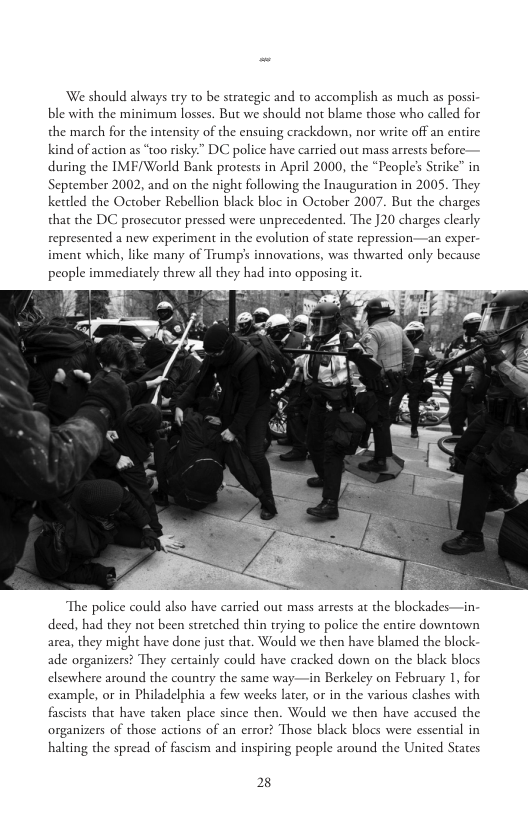
![“We’re being kettled," a comrade correctly pointed out. “We cant stay here, there’s more coming, they’re going to trap us, we have to break through. Tighten up and lock arms.” A cou- ple of us echoed his sentiment louder and we came together and locked arms. Before anyone could think about what the fuck would happen, someone started the countdown: Three!" More joined in: “TWO!" Then almost all of us: “ONE’ We charged the storm troopers swinging their clubs.” -#DISRUPT]20 Report Back: The Logan Circle Black Bloc Between the arrival of police at the intersection of 12¢h and L Street and the umbrella charge, fully two minutes passed—an extremely long amount of time under the circumstances. The remnants of the march sill consisted of more than 300 people. The ones in front linked arms, one person holding abattered umbrella. Someone shouted, “We’re going to do a countdown!” The crowd counted from ten down to one and charged, aiming at the north end of the police line. Remarkably, the battered umbrella at the front of the line blocked the nitial et of pepper spray and the crowd broke through the line. Approximately ffty people escaped this way, flceing northeast. As the police scrambled to reinforce their line o the norch, openings appeared in the middle of the line; a least one journalist simply stepped through here, and a demonstrator who charged the southern side of the police line alone, though initially thrown to the ground by an officer, managed to stand up and sprint through between the confused officers. If ac first you don’ succeed, try; ry again. But the remainder of the march did not attempr a second charge towards the middle of the line, instcad bogging down in a botlencck at the north side where a significant number of people had fallen down, blocking the way. The line of police swept in from the back, pinning the crowd. From this point forward, the police employed a tremendous amount of gratuitous violence with the intention of intimidating people into ceasing to try to escape or re- sist. First they struck out at random with batons and pepper spray, then they. threw sting-ball grenades right into the center of the trapped crowd. An offi- cer radioed in confusion as out-of-control cops bullied the caprive protesters: “Gas is being deployed at the 1100 block of 12¢h.... We’re not sure who ir’s by. We’re not sure who it by." Making their allegiances clear, the police let fascist cheerleader Lauren Southern out along with her cameraman and security detail while continuing 14](anarchist-resistance-to-the-trump-inauguration-crimethinc 16.png)
![0 hold everyone else inside, including lawyers and journalists. Inside the ketdle, everyone who was carrying something they did not wish to be arrested with let it fall from their pockets in what one eyewitess described as a “rain of sketch” onto the pavement. Outside the kettle, a couple individuals who had nearly escaped in the umbrella charge remained pinned down on the asphalt. “Fuck Donald Trump,” one repeated earnestly to videographers. “Fuck Donald Trump.” Within six minutes of the umbrella charge, a line of supporters had al- ready formed on the other side of the street, chanting “This is what a police state looks like!” and “Fuck the police!” More and more people gathered there. over the following hours, expressing support to the people in the kettle. AUT THHEE: CHAUS 1] DT AT NOON, A PERMITTED MARCH DEPARTED FROM COLUMBUS CIRCLE, CROSS- ing the city to McPherson Square. Meanwhile, participants who had escaped from the Anti-Fascist/Anti-Capitalist March filtered south, mingling with protesters returning north from the blockades around the checkpoints to Trumps parade and people coming and going from the daylong permitted rally at McPherson Square. Soon the crowd extended across several blocks. The area north of the parade route became an ungovernable zone. Around 1 pm, there were a hundred or more people still in black bloc gear in the vicinity of the permited rally at McPherson square when a group. of Trump supporters showed up wearing “Make America Great Again’ hats One of the Trump supporters gave a Nazi salute; another threw a projectile. Masked anarchists responded, inflicting significant injurics. The National Guard had to escort the injured Trump supporters out of the area. Something similar recurred around 2 pm. The police were bogged down carrying out the mass arrest at 12th and L Street. They had surrounded nearly 250 people. Guarding, processing, and arresting them took a considerable amount of personnel. They maintained a line of cops around the arrestees and another line holding back the increas- ingly thick crowds who gathered to support them. ‘Around 1:45 pm, a clash broke out with these supporters. The police line pushed people south on 12th Street, throwing sting-ball grenades at protest- ers who threw stones and bricks back in recurn. Pushing slowly forward, the police line eventually arrived at 12¢h and K, where they were held at bay for some time by a few protesters throwing 15](anarchist-resistance-to-the-trump-inauguration-crimethinc 17.png)
![together and present a strong, united front against police and Trump sup- porters, not to destroy property. It turned out that some artendees brought the opposite agenda, being prepared to break windows but scattering quickly in the face of police pressure. In the continuum between “rapport du force”™ and “smash and dash,” the march erred on the side of the latter. When it comes to the ambience of a march, “destructive but weak” s one of the worst combinaions Of course, if organizers had intended for people to come with a different agenda, they might have taken more steps to make that clear Years ago, during the anti-globalization era, a big black bloc march like the one that took place on January 20 would have included a scouting team on bicycles exploring the streets around the march to keep up with police movements, a comms team within the march communicating with the scouts and listening 0 a police scanner, and a group of locals near the front who could navigate wisely through the terrain—bringing the march towards its b objectives and, if necessary, t0 safe place to disperse. In those days, black blocs were ofien organized through a series of confidential spokescouncils in which the participants agreed in advance on shared visions and expectations. So far as we can tell, the ]20 march benefitted from none of these traditions 21](anarchist-resistance-to-the-trump-inauguration-crimethinc 23.png)
![LOC WORH? CONSIDERING HOW MUCH INFORMATION AS THE STATE WAS ABLE TO GATHER on the defendants, can you imagine how many criminal convictions there would have been if people had not been wearing masks and the same color? 16 true that in many cases, prosecutors believed that they could idenify the defendants even in their black clothing. But if they were not able to get convictions, this shows that the state needs more than data to target people. By creating confusion among the enforcers of authority and solidarity among demonstrators, the black bloc model served to keep arrestees safe in the worst conditions. The prosecutors wanted to use the fact that everyone was wearing the same color to as evidence of conspiracy, but ultimately, they overreached; jurors felt“reasonable doubt” both about whose face it was under any particu- lar black mask at any given time and also about whether wearing black proved that a defendant was attempting to facilizate criminal activity. If the police had snaiched 20 people and charged them with felonies, some of them might sill be in prison today. Instead, the sea of black made it through the streets and the court system together and came out the other side. Likewise, the vast majority of those who escaped in the umbrella charge were never charged. So the black bloc worked—this time. We can be certain that new technol- ogies and new laws are on the way: ]20 was a victory of sorts for the black bloc model, but one rarely gets to experience the same victory twice. The strongest argument against the black bloc model is that Commander Deville immediately identified the march from Logan Circle as “anarchists” and singled it out for repression. Deville may have been determined to attack the march regardless of what people were wearing, but it is noteworthy that he used the black bloc branding to identify the march as a legitimate targer. The paradox of the black bloc is thar it simultancously provides personal anonymity and collective political legibility. The question is what kind of political legibility will serve us best: what risks are we willing to run, when it comes to being politically legible to our enemies, in order to become politi- ally legible to potential comrades? In the era of doxxing and camera phones, we can hardly do without some way of preserving our anonymity in protest situations. It was prescient of the previous generation of anarchists to associate militant anonymity with anarchism in the popular imagination, since practiclly all who are pushed into conflict with the prevailing order will be compelled to experiment with forms of anonymity—and hopefuly,in the process, to consider whether they too might be anarchists. 25](anarchist-resistance-to-the-trump-inauguration-crimethinc 27.png)
![For that to be possible, we have to do everything in our power to normal- ize anonymous collective action and set wider precedents for it. Collective an- onymity should not be associated with the immediate escalation to property. destruction. It serves the authorities’ interests for every black bloc to imme- diately commit vandalism and be surrounded or break up in fight before it ‘can cross-pollinate with other groups. It would be better i, as in the anti-glo- balizacion days, there were regularly large black blocs that simply marched around, normalizing the tactic, assisting other groups, defending themselves as needed, and providing visibilty for anarchist values. We should also experiment with other means of preserving anonymity that do not immediately draw state attention or identify the participants as “extreme.” It i casier to hide in numbers than in the darkest shade of black. Ultimately, our safecy will derive from being part of broad, powerful, creative Social movements that are prepared to support us the way people supported the ]20 defendants, not from our technical skills when it comes to rendering ourselves invisible. The greatest danger that we will be isolated and contained is not that the police will race ahead of us in the streets and kettle us—it is that we will go on thinking of ourselves as excepional, missing one opportu- nity after another to make common cause with others. PERSPECTIVE: WHAT WE LEARNED I think that e can be positive about the lessons we learned via the prosecutions. Although it turmed our lives upside down, we learned a lot about the way the state. is and is not able to crack phones, about legal campaigns and how to get charges dropped. Over 200 strangers somehow managed to not snitch on each other We ex- panded our networks toresis repression and,againstall odds we overcame in totally ridiculous circumstances to win. s a former defendant, | personally am stil recovering from the ways it tumed my lfeinside out and the stress and trauma of the case, but am grateful fo the skills and insight | gained to support others on the receiving end of state repression. The case posed challenges we hadn’ met before and gave us an opportunity to learn and strengthen ourselves.If someane had asked me whether the action itself was worth it during the scariest parts of the case, | would have said no. But now: with the scope of the entire thing in view, | feelthat it was worth it A person’s perspective on such questions can change over time. 2](anarchist-resistance-to-the-trump-inauguration-crimethinc 28.png)
![WAS IT WORTH IT? WHATEVER VICTORIES WE WON ON 20 AND IN THE SUBSEQUENT COURT CAS- s, they came at a tremendous cost. Was it worth it? “To answer this question, we can’ just look at a single day of action; we have to cvaluate an entire way of lfe, the way of inhabiting the world that led anarchists like us to participate in the J20 march and so many other ac- tions before ir. Some of us have lived through years or decades of high-risk political activty. So many of the accomplishments of a century and a half of anarchist movements resulted from people like us throwing ourselves into the unknown, entering situations in which there are no guarantees. We have o weigh allof the victories that resulted from that way of being if we are to make a fir assessment of whether the risks we took on January 20, 2017 were wordhwhile For other defendants, ]20 was their first major action, and they were im- mediately subjected to an ordeal that some anarchiss have not experienced in two decades of black blocs. I is casy to understand hovw this might put one off from participating in high-risk political activity. Certainly that was the goal of the government, at a moment when more and more people are looking to join revolutionary movemens S amarehios were he only protagonists of revols, it might make sense to save ourselvs for contests with better odds. But the important thing s what everyone does, not what we do alone. There are certain times and places—cer- tain bricf windows in history—when single action can have tremendous im- pact. In such situations, we can humbly offer ourselves as catalysts, hoping to do our part to createsituations that everyone can participate in. If our actions on J20 helped inspire thousands outside our social circles to occupy airports and stand up to fascist, they may have been worth it,even if the upshot was that we ourselves were out of action for a year or more, We are never going have auspicious odds going into a frontal assault on the stae at s strongest. Unfortunately,there are times when the consequenc- s of no doing so will be even worse For those who were critical of the call for a confrontational march on ]20, then, in place of the question of whether people should have gone to DC, we propose another question. Ifwe are ever forced to confront the state again in the way that many felt compelled to that morning in 2017, whac will we wish we had done in advance to prepare for that? How can we be preparing vight now? 27](anarchist-resistance-to-the-trump-inauguration-crimethinc 29.png)
![0 rise up. If they involved some of the same risks that the ]20 actions did, we must also add those accomplishments to the list of reasons to be open to. taking risks like the ones we took on J20. The fact is: the kind of action that can interrupt a high-security specta- dle like a presidential inauguration is high-risk activity, just like the kind of action it will tzke to halt the rise of authoritarian nationalism and the kind of action it will take to stop the destruction of the natural world. The results of our efforts are never guaranteed in advance. Sometimes, in what scems a hopeless situation, the courage of a few people can become the power of thousands. Other times, one takes a risk and fails. We can analyze our victo- s and failures in hopes of being better prepared to identify the strategic op- portunities and risks the next time around, but the world will go on changing ahead of every effort to map it and predict the future. Some people in the US already experience more risk in their daily lives than any of us were exposed throughout the entire ]20 ordeal. Others who made the rational choice not o go to the demonstrations in DC sill found themselves confronted with the necessity of supporting their comrades through the ensuing court cases and bravely rose to the occasion. We don’t get to determine the level of risk that the state subjects us to or the challeng- es that come our way. What we can do is stand courageously by each other throughout the worst misfortunes, facing the unknowable future together. It may hold miracles or horrors—it almost cercainly holds both—but if we meet it together, we will learn more about each other and ourselves. PERSPECTIVE: I’D DU IT ABAL Now that the case has ended, its given me a chance to reflect There are many con- Versations that remain to be had amongst trusted friends about what happened that day,but now that the prospect of prison isn’t hanging over my head,fve finally had some room to breathe. Despite all the gref of the past year and a half—Id do t again. And know that will 2](anarchist-resistance-to-the-trump-inauguration-crimethinc 31.png)
![FURTHER HEADING « #Disrupt] 20 Report Back: The Logan Circle Black Bloc « #Disrupt]20 and the Black Bloc: An Opporunity Lost? * We’ve Got Your Back: The Srory of the ]20 Defense: * 1’Was )20 Street Medic and Defendant * Between the Sun and the Sea: Iearus at 12th and L—A Voice from the 120 Black Bloc and Kettle on the Practice of Anarchy * DC Office of Police Complaints Report on the Inauguration * 120 Protest Simulator—Choose Your Own Adventure in the Streets and Courts of Washington, DC When it comes to approxinting crowd size che confice between polie estimates and proteser estimates goes back generations. Regarding the accuracy of police scimates of crowd size on January 20, we simply note that when the march was ketled a 126h and L. Stsee,the firs oo offces o estimate the number ofaresees puc i berween 50 and 100 i fac, it vas more lke 250.](anarchist-resistance-to-the-trump-inauguration-crimethinc 32.png)




ANARCHIST
nnnnnnnnnnnnnnnnnnnn
HESISTANCE
nnnnnnnnnnnnn
INAUBURATION
TWO YEARS HAVE PASSED SINCE THE DEMONSTRATIONS
against Donald Trump's inauguration. Thanks o an epic le-
gal struggle, all the charges have been resolved or dropped.
Now we can discuss what there is to leam from the events
of January 20 and the ensuing court cases. This analysis fo-
cuses on the march that took place on the day itself, uriliz-
ing a wealth of information that came to light during the
subsequent investigation. It will be extremely useful to any-
one secking to organize or participate in similar large-scale
demonstrations that may face police repression.
ON JANUARY 20, ANARCHISTS TOOK ON THE MOST POWERFUL EMPIRE IN THE
history of the solar system at the heart of the spectacle intended to legitimize
its rule—at precisely the moment that a new administration sought to intro-
duce an even more authoritarian model of governance. This was a profoundly
courageous act. In recaliation, prosecutors attempred to set a legal precedent
that would criminalize protest itself, in hopes of being able to infict the full
force of felony prosecution on anyone in proximity to any act of resistance.
The ensuing legal battle lasted a year and a half.
The mass arrest that occurred on January 20, 2017 was not inevitable. It
was the consequence of specific decisions that the organizers and paricipants
in the march made; it could have turned out differently. Everyone who might
one day be compelled to take part in high-risk street protest stands to beneit
from an analysis of this action. Itis an especially interesting case study in that
it represents worst-case scenario: 500 demonstrators without scouts, a com-
munications network, or a solid plan taking on 28,000 sccurity personnel at
a pivotal historical moment.
Was it a good idea to mobilize against Trump's inauguration? Was it a
good idea to call for a confrontational march on that day? What did anar-
chists accomplish—and what can we learn from our mistakes and from the
strategy of the police? Here, we will present a blow-by-blow review of the
events of the day and address each of these questions in turn.
PERSPECTIVE: MAHNG A BREAH
Youre reading the news. You read about Trump's intention to ban Musiims from vis-
iting the United States, put children in concentration camps, suppress information
aboutclimate change, and build new pipelines. You see the Democrats trying to cash
inon yourangerin order to get back nto office and renew faithin the corporate media
andthe FBL You see the sneering face of power, and you seethe with rage—but most-
Iy you justfeel helpless. You are alone, staring at a screen.
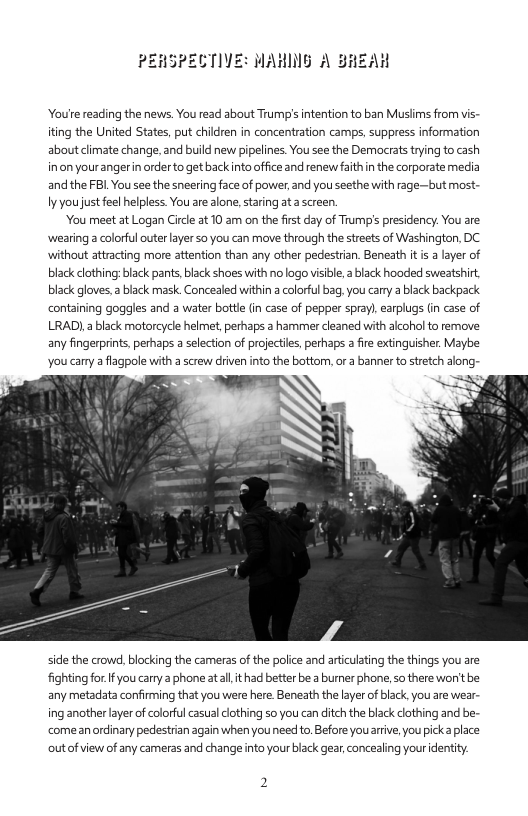
‘You meet at Logan Circl at 10 am on the first day of Trump's presidency. You are
wearing a colorful outer layer so you can move through the streets of Washington, DC.
without attracting more attention than any other pedestrian. Beneath it s a layer of
black clothing:black pants, black shoes with no logo visble, black hooded sweatshirt.
black gloves, 2 black mask. Concealed within a colorful bag, you carry a black backpack
containing goggles and a water bottle in case of pepper spray), earplugs (in case of
LRAD),a black motorcycle helmet, perhaps a hammer cleaned with alcohol to remove
any fingerprints, perhaps a selection of projectils, perhaps fire extinguisher. Maybe
You carry a flagpole with a screw driven into the bottom, or a banner to stretch along-
side the crowd, blocking the cameras of the police and artculating the things you are
fightingfor Ifyou carry 2 phone atall it had better be a burner phone, so there won'tbe:
any metadata confirming that you were here Beneath the layer of black,you are wear-
ing another layer of colorful casual clothing so you can ditch the black clothing and be-
comeanrdinary pedestrian again whenyouneed to.Before youarive, you picka place
outofview of any cameras and changeinto your black gear concealing youridentity:
Youre not alone with your anger here at Logan Circl, the convergence point for
the anti-capitalist and anti-fascist march. There are hundreds o you. Your ages, gen-
ders,ethnicities,and physiques blur togetherinto asingle seething sea of black.
Al your lfe, you have been taught to prize your individual identity, to cultivate
Your personal brand, so institutions can appraise and rank you or target and punish
You. Only now: shedding your identifying features in the company of your comrades,
can you freely act according to the dictates of your conscience. All your ife you have
accepted the supremacy of the police and the inevitabiliy of the world they enforce.
Now:you cross the line from using all your resources to accommodate yourselfto the
prevaiing order to using all your resources to contest . Everything you have turmed
inward, you tum autward.
Time tselfchanges. A hour's worth of intense events takes place in what tums out
tohave been sixty seconds. A few moments ke this can change a person forever. The.
people around you seem transfigured: you witness acts of courage and abandon so
far utside your ordinary experience they seem to defy the laws of physics, They are.
bathed in an unfamilar low: Perhaps the word for thisis dignity.
Andits terifying. You'eterrified of the police, of their ting-ball grenades and ets
of pepper spray. You'e terrfied of the cameras seeking to capture your image so your
body can be captured ater. But most of al, you'e terified of your own potential You
feel tin the ai, thicker than tear gas: freedom, the most powerful intoxicant there i,
Ordinarily, it seems that nothing you can do has any meaning, but here, every choice
has far-reaching consequences—both for you and for the world.Ifalof you tuly re-
leased yourselves to this moment. gave yourselves tot entirely. it fels like you could
tip ahole i history itself
Feeling your srength here together, nothing is more terrifying than the prospect
of acting on it You are terified that you will make a mistake, that you will falthat
Youill be caught—but above al, that you could succeed, that what you want might
be possible. o if the world you want is possible, then you have no choice bu to
drop everything and stake your ife on trying to achieve it and prepare to bear the
consequences.
‘The consequences, they tell you, could include up to 75 years i prison. This is how
they keep youisolated, staring at your news feed, feeling powerless.
ANARCHISTS HAVE A LONG HISTORY OF DEMONSTRATING AGAINST PRESIDEN-
tial inaugurations, including black bloc marches in 2001 and 2005. There
had been abstract discussion about organizing for the 2017 inauguration
since summer of 2016, but it didn really take shape unil November.
Shortly afier Trump won the election, a call to action circulated under
the title “No Peaceful Transition” for people to greet the arrival of the Trump
era with 2 bold show of resistance. Meanwhile, organizers in Washington,
DC formed the DC Counter-Inaugural Welcoming Committee and held
two public meetings, cach drawing over 250 people. Locals put considerable
effort into creating infrastructure, hosting an action camp with workshops
the week before the inauguration, reserving a local church as a meeting place
and convergence center in the days leading up t0 ]20, and coordinating three
public spokescouncils ahead of the actions.
Much of this organizing centered on blockading the checkpoints to
the parade route. This was the chief focus of the first mass meetings at St
Stephens. At the end of one meeting, someone asked if anyone was interested
in discussing a march, and a large part of the audience stayed afterwards to
hold another discussion about this. This was the origin of the call for the
Anti-Capitalist/Ani-Fascist bloc.
Tt took some time for this call to assume its final form. Early on, some DC
organizers were promoting what they called “operation clusterfuck.” a plan to
shut down traffc all around DC. (As grueling as the ]20 cases were, we can
give thanks that the action got better branding; imagine if the arrestees had
been known as the “Clusterfuck 200.7) Only a week before the inauguration,
the point of departure for the Anti-Capitalist/Anti-Fascist March was planned
for the Francis Scott Key Memorial in Georgetown, far from downtown DC.
This could have been a disaster. The authorities had mobilized fully 28,000
personnel and the march was already on their radar. If the march had begun
at such a distance from the rest of the demonstrations, the police likely would
have had an casier time repressing it, and it would not have contributed to
opening up an ungovernable zone around the inauguration in the way that
it did. In the end, however, the call was changed to Logan Circle at 10 am.
On the night of January 19, anarchists and others wrmed out to demon-
strate against nationalists and fascists attending the “Deploraball” in down-
town Washington, DC. The fact that so many people felt comfortable openly
attending a racist event showed the extent to which white supremacist politics
had been normalized. Although there were clashes, plenty of attendees and
4
supporters of the Deploraball walked among the protesters with impunity;
and the police kept their weapons pointed exclusively at anti-fasciss. Signs
of the times.
Things were tense going into the J20 protests. Every Nai troll
on the inernet was promising to gun us down in cold blood.
Newspapers were reporting that two million bikers had prom-
ised to form a “wall of meat” between us and the motorcade of
the President-clect. We were all going to prison—if we made
it our of surgery. If you want a picture of the future, imagine
Pepe the Frog stamping on a human face, forever.
AUT DME: THE BLOCHADES
GROUPS WORKING WiTH DISRUPT J20 HAD ORGANIZED 12 BLOCKADES, ONE
at each of the security checkpoints to the inaugural parade route and com-
mencement ceremony. At seven of these, activists explicitly set out to prevent
people from passing through. Over 2400 people participated. The blockades
were a tremendous success, offering a wide range of people an opportunity to.
work together to disrupt the inaugural ceremonies under a variety of banners.
You can read a full reportback on them on disruptj20.org via archive.org
One question remains: why didn't the police crack down on the block-
ades? There were practically no arrests, even at the checkpoints that were shut
down. Some of the most effective blockades were maintained by the most
targeted participants, such as Black Lives Matter. Lawsuits resulting from var-
ous civil rights violations have pressured DC police to be more cautious in
their response to civil disobedience, but this did not restrain the police from
responding aggressively to the march at 10 am.
Certainly, the diversity of the crowds that participated in the blockades
helped o discourage the police from attacking them. But had the police
believed that they could arrest people without escalating the situation, they
likely would have done so. In this regard, the fact that anarchists had orga-
nized confrontational plans for J20 likely tied the hands of the police. They
aimed to contain and suppress uncontrollable demonstrations, not to give
more people cause to paricipate in them. This illustrates how confrontational
organizing can open up space for a wide range of tactics
If the blockades had successfully shut down all access to the parade
route, the police would have been forced to attack them and carry out mass
5
arrests. This shows that the police attacked the march at 10 am because it
explicitly interfered with their objective of maintaining the illusion that
the population of the United States was prepared to accept Trump as a
legitimate ruler. They were willing to permit a certain amount of protest
activity to keep up appearances, but they were ready to use brutal force to
keep Washington, DC under their control throughout the inauguration.
This only makes it more impressive that so many people turned out to the
march.
AT TWO: THE WARCH
AT NC.1M/] 20ANALYSIS, YOU CAN SEE A SET OF GIFS CHARTING THE ROUTE.
and chronology of the ]20 Anti-Capitalist/Anti-Fascist March, which will
make the following analysis much easier to follow. You can also find time-
stamped links to videos bearing out the accounts below:
By 10 am, over 2 hundred people had gathered in the park, with more
steadily arriving in feeder marches and affinity groups, many already masked.
At least seven police vans were parked on the south side of the circle with
groups of cops visible around them, along with some individual police cars.
The understanding had been that the march would depart ar 10:30. This
was widely known among locals and organizers, but the 10:30 departure time.
did not appear in any public venues.
At a quarter past ten, hundreds of people were assembled, chanting and
burning flags. Several banners were lined up on the south edge of the island
inside the trafic circle. The march spontancously departed ahead of schedule,
several minutes before 10:30.
People were still arriving at this point, and it is possible that the march
could have been larger—and better organized:—if the participants had wait-
ed a few more minutes. Many who wished to participate spent the following
twenty minutes scrambling to catch up to the fast-moving and unpredictable
march. OF course, police would also have benefitted from the extra time to
mobilize more numbers—they were already calling for reinforcements before
the march departed. But this is a recurring issue: precisely the same thing
happened during the 2005 inauguration, when out-of-town anarchists inici-
ated the anti-capitalist march at Logan Circle ahead of schedule before many
locals had arrived or gotten the pieces in place for their plans. (“The eternal
hourglass of existence is upended again and again—and you with it, speck of
dustl’)
Already, as the march stepped off the curb, at least one umbrella was vis-
ible behind the banners in the front. The umbrella later became an iconic
symbol of the day; umbrellas had been used to protect anarchists against
video surveillance at previous marches, notably during resistance to the 2004
Republican National Convention in New York City, but people may have
brought them to DC simply because the weather forecast for the day included
a chance of rain.
Police cars and vans were parked on either side of the entry to 13th Street
The marchers made their way between them without encountering resistance,
then fanned out to take the entire street. At this point, there were 500 or
more people in the march; some estimate that up to a thousand participated
at some point over the following half hou.
The police do not appear to have been especially prepared for the march.
Although they had a tremendous number of officers on duty, they already had
their hands full communicating between different agencies and dealing with
the blockades. Like everyone else, the police, too, seem to have been caught
Hatfooted by the arrival of the Tramp era, in which a great many more people
were willing to show up to confrontational demonstrations.
Commander Keith Deville, who was in charge of police operations
throughout DC during the inauguration, testified during the first ]20 trial
that “Our information leading up to the inauguration was this particular
group gathering at Logan Circle was going to be problematic. They were
anarchists.” At 10:15 am on January 20, he reported over the radio: “This is a
relacively large group and appears to be all anarchists.” Estimating the group
at 300-350," he called for reinforcements, fearing that, “If they get inside
a pedestrian-only area where our vehicles can't go, we're going to lose
them.” This detail should not escape our notice.
The march was loose, extending over a block. Two minutes in, people
began dragging newspaper boxes and trashcans into street. Someone threw
a projectile at the BP station a block south of Logan Circle; a block further,
someone apparently started a fire in a trashean at M Street. As the crowd ap-
proached L Streer, participants vandalized Au Bon Pain.
There were cameras everywhere; several far-right reporters were livestream-
ing, including an NRA TV reporter and pro-fascist Lauren Southern. One in-
dividual attempted to block journalists who were ilming someone repeatedly.
smashing a brick into the parking meter in front of Au Bon Pain. Generally
speaking, it is more effective to block cameras with banners than by simply.
raising one’s hands.
Police were tailing the crowd in vans at this point, but not yet engaging. The
police helicopter overhead contributed to the charged atmosphere. Debating
7
whether to send officers on motorcycles and bicycles and whether to form a
line blocking the march, the officer at the Joint Operation Command Center
inquired as to what property destruction had occured. This corroborates
some participants' speculation that the march might not have been attacked
as quickly as it was if participants had held off on property damage, but ir's
hard to know for sure; certainly the police would not have been thrilled about
alarge black bloc moving freely around the city in any case.
When the march turned right on K Street at Franklin Square, the banners
were stil arrayed a the front in an orderly fashion. A limousine was parked
on the north side of the strect, not far from the corner. Several individuals
ran alongside it methodically knocking out its windows. The driver stood
beside the limousine on sidewalk, calmly recording the event with his phone;
mysteriously, someone threw a sandwich at him. Later, in court, when the
prosecution asked him if he was frightened, he emphasized that he was nor.
A handful of National Guard passed on the sidewalk to the south of this
scene without engaging. Throughout the day, the National Guard rarely in-
teracted with protesters. A massive line of police arrived at K Street behind
the march: squad vans, lots of bike cops, motorcycle cops, and officers on
foot. Ac this point, the order had gone out to get in front of the march and
block it officers nitially were told to hurry ahead to form a line at 13¢h and
K, but the march had already begun to zigrag.
The crowd turned south again, passing through the middle of Franklin
Square, then turned left once more on I Street. Commander Deville hoped to
surround the march in the park; officers scramble out to form a line on one.
side, but they were not moving swifily enough. A police van, a few police cars,
and a couple motoreycle cops were positioned on the south side of I streer,
along with a dozen bike cops who did not engage as the march passed them.
From this point on, there were sirens in the air
This video includes instructive footage of the middle portion of the
march, from the first time the crowd passed through Franklin Square until it
returned there some minutes later.
The march paused at the comer of I Street and 13th Street to wait for
people to catch up, then continued cast on I Street. Somcone threw a projec-
tile at a white government SUV in the south side of the intersection; others
smashed its headlights and windows and spray-painted it. South of I Street,
13th Street was blocked with four jersey barriers on the sidewalk and a dump
truck and several National Guard trucks parked sideways in the middle of the
road. At this point, the march had been in the street for about 15 minutes,
and appeared to have grown in numbers. It was a fierce but heterogencous
crowd, predominandly dressed in black.
8
Proceeding further down I Streer, the march encountered a Starbucks and
Bank of America; many people participated in thoroughly demolishing their
fagades. The march was large enough at this point that from the middle, it
was not easy to tell what the police were doing outside it. In fact, a large.
number of police on foot and many more on motorcycles were shadowing
the crowd from the back. They were already attacking civilians at random;
soon after they passed the intersection of 13th and I Street, police seized an
ordinary bicyclist and threw her to the ground for no apparent reason, then
continued around her
> SR
e
The march arrived at the traffic island between I Street, 12th and 11ch
Streets, and New York Avenue. Police were positioned at the intersection of I
Street and New York on the other side of the park, along with a few National
Guard and an armored vehicle. The march circled the traffic island indeci
sively. Things were becoming chaotic. Someone was grabbed and beaten by a
Trump supporter who held them until the cops came and arrested them; their
charges were later dropped, perhaps as a consequence of another demonstra-
or filming the confrontation.
Dozens of armored riot police blocked the intersection at 11th and 1
Street, sill scrambling and disorganized. The crowd returned west on I Street,
9
but the police who had been trailing the march were blocking the west and
north sides of 12th and I. Officers began pepper-spraying peaple at this in-
terscction. Some participants feared that the crowd would be kettled in this
area, though it was a relatively open space compared to the closed city block
where the march was ultimately trapped.
There were no police on New York Avenue at the intersection with 12th
Streer, only a parked city vehicle turned sideways to block the street. The
crowd headed southwest, breaking into run. The next city block was open
and clear. Devile ordered cops on bikes and mororeycles to pass the crowd on
the left in order to get in front of them to form a line, but they were stymied
by all the stragglers block behind the march. Police estimated the crowd at
500 at chis point; factoring in all the different groups that were spread out
over an area of two blocks, it may have been significantly more.
The march turned north on 13th Street at the McDonald, which some
participants briefly artacked. A this point, had the march proceeded fur-
ther southwest on New York Avenue, it was just a few blocks to the afore-
mentioned pedestrian arca around the inaugural parade route and the White
House, where Deville had said his officers would not be able to control the
march. Likewise, had the march turned south on 13th, it was only a few
blocks to the pedestrian area and the queer blockade at the checkpoint into
the parade route. According to USA Today, Trump lefi the White House only
ten minutes later. If the march had reached the checkpoints to the south, it
would have caused significantly more disruption; the participants might also
have escaped mass arrest. The difficulty of following with police vehicles and
the presence of mixed crowds would have posed considerable obstacles to the
police. O course, there might also have been violent confrontations with
Trump supporters
Why did the march go north at this point rather than southwest or south?
Throughout the half hour that the march moved through the streets, it of-
ten changed direction simply on account of meeting a line of riot police,
bouncing haphazardly around downtown DC like a ballin a pinball machine.
But there was not a large contingent of police blocking the way south on
13th Street. The crowd only encountered a few police at this intersection,
though this was the point at which officers began to employ sting-ball gre-
nades and pepper-spray liberally. Stil, there were so few that the march could
have headed south past them without much trouble. Rather, it appears that
the march went north simply as a result of internal miscommunication. This
suggests the absence of experienced locals at the front.
‘A minue after the report went out that the march was destroying the
McDonalds at the corner of 13th Street and New York Avenue, police were
10
ordered to mobilize a block west down New York, at 14th. Based on this tim-
ing, if the march had continued moving quickly down New York, the police
probably would not have arrived in time to block them, and the way directly
south on 13th Street would also have remained open.
As the march headed north, a few officers ran alongside it, pepper-spray-
ing the participants. One demonstrator answered in kind, fending off an offi-
cer with a pole. At the back of the march, a large number of officers on foor,
bikes, and motorcycles continued to shadow the crowd.
Now spread out, stressed, and disorganized, the march made its way
through the parked vehicles and jersey blockades that had made the south
side of the intersection of 13th and I Street appear impassable from the other
direction. Arriving back at Franklin Square, many people hurried along the
sidewalk, while others took the street. Footage shows the last arrivals to the
intersection of 13th and I Street running past a large number of stationary
police who did not attempt o engage.
The march was spread out over a wide area. It was almost a quarter to 11
as demonstrators made their way across the park, regrouping in the north-
west comer of Franklin Square. The police, too, paused on the south side of
Franklin Square to regain their bearings, then drove around the park to arrive
at the intersection of 14th and K Street from the south just as demonstrators
were arriving there through the park. This was probably the last opportunity.
the participants had to disperse before a mass arrest became inevitable.
A few officers and National Guardsmen had been positioned at 14th and
K Street; they spread out to block the way west on K Streer, reinforced by the
large number of police arriving on motorcycles and bicycles. Had the march
proceeded west here, it was one block to the permitted rally site at McPherson
Square. However, McPherson Square was still sparsely populated; there was
no large crowd to melt into. Heading for that rally might have been irrespon-
sible, as it could have brought police pressure o bear on the rally area. In any.
case, the march proceeded north.
After the crowd crossed K to the north, bike cops and motorcycle cops at
the back aggressively herded people into the march, riding their motorcycles
up on people’s heels. They were not aiming to carry out arrests, but rather
to concentrate the group they hoped to mass-arrest into a controllable area.
The police were likely relieved that the march was leaving the open square for
long, canyon-like blocks in which they could trap it. Another police platoon
was dispatched towards Logan Circle, to the north, in case the march contin-
ued in that direction,
At 10:46, demonstrators smashed another Starbucks, this one located in
a hotel between K and L Streets. At 10:48, meeting lines of police blocking
11
14th Street (o the north and L Street to the west, the march headed cast on
L Street. Motorcycle police pulled onto the sidewalk on the north side of
the street t0 race ahead of the demonstrators; this was the same strategy that
Deville had ordered them to employ when he hoped to surround the march
on New York Avenue. These same officers established the police line at the
intersection of 12th and L Street. This, t00, should not escape the notice of
those who may participate in furure marches: the police were not able to
surround and block the march until the participants permitted the line of
motorcycles to pass them. All it would have taken to block the motorcycles
would have been for groups o walk in front of them with banners as others
continued to launch projeciles or place things in the street.
At 10:49, there was an incident on the north side of L Street involving a
demonstrator using a patio chair; this interrupted the police operation for a
moment, leaving one police motorcycle disabled. Robert Hrifko, a sc
claimed biker for Trump, also sustained a blow to his face a this point. At
the time, he said something to the effect of “hell of a right hook,” acknowl-
edging the strengeh of the individual who allegedly hit him, but afterwards
he told reporters variously that it was a chair or a rock that struck him. A
confrontation erupted in which police pepper-sprayed people, bringing both
sides temporarily to a halt. The officers could have made arrests, but they did
not try t0; their aim had been to form a line trapping the entire crowd, and
pro-
when they realized that some people had already passed them going cast, they
resumed driving in that direction to try again at the intersection of 13th and
L Streer.
Ac chis poing, it was clear to experienced participants that a ketele was
imminent. Many participants had already split off from the march and dis-
persed. The streets were largely empty, enabling the police to treat everyone
present as a targer. Rather than staying tight, the best policy in such a situa-
tion may be for participants who are fleet of foot to sprint as fast as possible
whenever they see police lines forming, in hopes of getting to the other side.
and sandwiching the police between multiple groups of demonstrators; police
facing a hostile crowd will rarely risk being surrounded. It s also important to
avoid long closed stretches of street in which a march can be trapped—or clse,
if absolutely necessary; to traverse them as quickly as possible.
Sirens were ringing out continuously. When the crowd moved past the
site of the confrontation into the intersection of L and 13th Street, there were.
no police to be scen blacking the way north on 13, although a couple dozen
officers were visible further south on 13th Street (see 4:55 here). The march
had come full circle, crossing from west to cast the same intersection it had
crossed from north to south half an hour carlicr
12
As the march approached the intersection with 12th Street, more and
more mortorcycle and bicycle cops continued to ride past on the left. An alley
was open to the right on the south side of the street; a large number of partic-
ipants fled down it, hoping that they would not be caught in it the way that
participants in the night march following the 2005 inauguration were. The
police were not prepared to block them where the alley let out in the middle
of 12th Street, and they escaped; the mouth of the alley was strewn with
black clothing and accessories until conscientious demonstrators eventually
returned to gather them up.
The motorcycle and bicycle cops raced to the end of the block and formed
aline, backed by a few police cars. It was not a tremendous number of officers
blocking access to 12th Stree, but they made themselves look more imposing
by parking their vehicles behind them, creating an obstacle course of moror-
celes and cars. Ten or more members of the National Guard stood along the
building at the southern end of the street, ostensibly part of the police line
but not actually taking action to participate. Beyond the police line, the can-
yonlike street gave way to two blocks of open parks in which it would have
been much more difficult to kettle a dispersing crowd.
Unfortunately, rather than immediately charging the police line be-
fore it became any stronger, demonstrators paused and turned, hoping
to return to the alley, only o find the way behind them blocked by two
much larger lines of police: a large number of black-clad baton-wiclding
iot police on foot, backed by an even stronger line of police in fluores-
cent jackets. The black-clad police closed in with batons, while a few
cops doused people in pepper spray, aiming to force them forward into a
smaller and smaller area
As the march drew together in confusion on the northern side of L Streer,
a small group of people clustered together on the sidewalk on the southern
side of the street. This group managed to get away in the disorder afier the
umbrella charge, simply by letting the police run past them and then slip-
ping out where they saw an opening. Before the umbrella charge, individual
journalists managed o step right through the police line, and at least one.
black-clad marcher sprinted between officers to safety as well; the police were
sill serambling to get solid footing, with a commanding officer repeated-
Iy shouting “line formation.” In situations like this, when the orders of the
police are to get control of an area rather than to make targeted arrests, it is
often not worth it to them to pursue individuals who get through their lincs.
Demonstrators who can rapidly and correctly assess the priorities of the po-
lice can often escape at such a moment
13
“We're being kettled," a comrade correctly pointed out. “We
cant stay here, there’s more coming, they're going to trap us,
we have to break through. Tighten up and lock arms.” A cou-
ple of us echoed his sentiment louder and we came together
and locked arms. Before anyone could think about what the
fuck would happen, someone started the countdown: Three!"
More joined in: “TWO!" Then almost all of us: “ONE' We
charged the storm troopers swinging their clubs.”
-#DISRUPT]20 Report Back: The Logan Circle Black Bloc
Between the arrival of police at the intersection of 12¢h and L Street and
the umbrella charge, fully two minutes passed—an extremely long amount
of time under the circumstances. The remnants of the march sill consisted
of more than 300 people. The ones in front linked arms, one person holding
abattered umbrella. Someone shouted, “We're going to do a countdown!”
The crowd counted from ten down to one and charged, aiming at the
north end of the police line. Remarkably, the battered umbrella at the front
of the line blocked the nitial et of pepper spray and the crowd broke through
the line. Approximately ffty people escaped this way, flceing northeast. As
the police scrambled to reinforce their line o the norch, openings appeared
in the middle of the line; a least one journalist simply stepped through here,
and a demonstrator who charged the southern side of the police line alone,
though initially thrown to the ground by an officer, managed to stand up and
sprint through between the confused officers. If ac first you don' succeed, try;
ry again.
But the remainder of the march did not attempr a second charge towards
the middle of the line, instcad bogging down in a botlencck at the north side
where a significant number of people had fallen down, blocking the way. The
line of police swept in from the back, pinning the crowd. From this point
forward, the police employed a tremendous amount of gratuitous violence
with the intention of intimidating people into ceasing to try to escape or re-
sist. First they struck out at random with batons and pepper spray, then they.
threw sting-ball grenades right into the center of the trapped crowd. An offi-
cer radioed in confusion as out-of-control cops bullied the caprive protesters:
“Gas is being deployed at the 1100 block of 12¢h.... We're not sure who ir's
by. We're not sure who it by."
Making their allegiances clear, the police let fascist cheerleader Lauren
Southern out along with her cameraman and security detail while continuing
14
0 hold everyone else inside, including lawyers and journalists. Inside the ketdle,
everyone who was carrying something they did not wish to be arrested with let
it fall from their pockets in what one eyewitess described as a “rain of sketch”
onto the pavement. Outside the kettle, a couple individuals who had nearly
escaped in the umbrella charge remained pinned down on the asphalt.
“Fuck Donald Trump,” one repeated earnestly to videographers. “Fuck
Donald Trump.”
Within six minutes of the umbrella charge, a line of supporters had al-
ready formed on the other side of the street, chanting “This is what a police
state looks like!” and “Fuck the police!” More and more people gathered there.
over the following hours, expressing support to the people in the kettle.
AUT THHEE: CHAUS 1] DT
AT NOON, A PERMITTED MARCH DEPARTED FROM COLUMBUS CIRCLE, CROSS-
ing the city to McPherson Square. Meanwhile, participants who had escaped
from the Anti-Fascist/Anti-Capitalist March filtered south, mingling with
protesters returning north from the blockades around the checkpoints to
Trumps parade and people coming and going from the daylong permitted
rally at McPherson Square. Soon the crowd extended across several blocks.
The area north of the parade route became an ungovernable zone.
Around 1 pm, there were a hundred or more people still in black bloc
gear in the vicinity of the permited rally at McPherson square when a group.
of Trump supporters showed up wearing “Make America Great Again’ hats
One of the Trump supporters gave a Nazi salute; another threw a projectile.
Masked anarchists responded, inflicting significant injurics. The National
Guard had to escort the injured Trump supporters out of the area. Something
similar recurred around 2 pm.
The police were bogged down carrying out the mass arrest at 12th and L
Street. They had surrounded nearly 250 people. Guarding, processing, and
arresting them took a considerable amount of personnel. They maintained a
line of cops around the arrestees and another line holding back the increas-
ingly thick crowds who gathered to support them.
‘Around 1:45 pm, a clash broke out with these supporters. The police line
pushed people south on 12th Street, throwing sting-ball grenades at protest-
ers who threw stones and bricks back in recurn.
Pushing slowly forward, the police line eventually arrived at 12¢h and
K, where they were held at bay for some time by a few protesters throwing
15
rocks from within a heterogencous crowd that was sympathetic but not
particularly thick. The officers were coughing from their own pepper spray
and yelling
crashed into their ranks. For quite some time, they threw sting-ball gre
nades at random, mostly hitting the bystanders and photographers in front
of them.
By this point, police had shifted from an offensive strategy in which they
tried to control what happened everywhere to a defensive strategy in which
they maintained fixed territory by means of thick lines of riot police but ex.
ercised very litdle control over what occurred outside those lines. The more
pepper-spray and sting-ball grenades they threw at the crowds without suc
Vatch out!” to each other in unison as one rock after another
_ AN
ceeding in dispersing them, the more obvious it was that they were no longer
the dominant force in the streets.
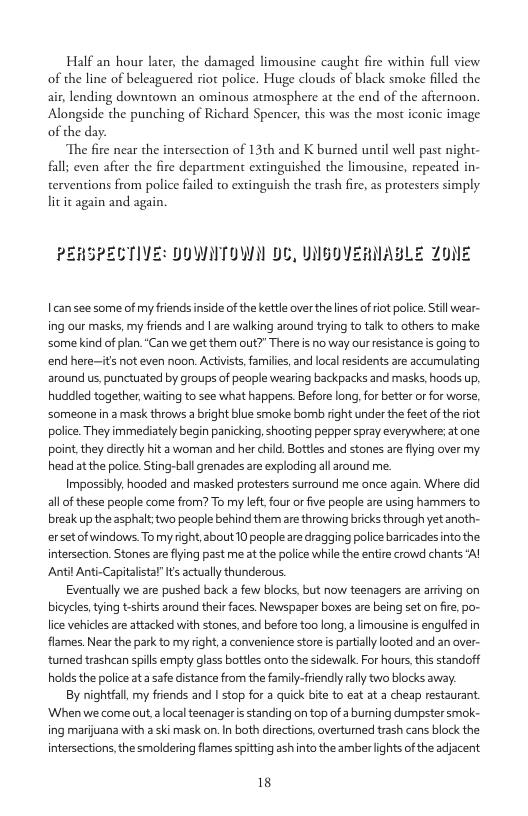
Footage shows masked vandals smashing up the limousine near the inter
section of 13th and K long after the Anti-Capitalist/Anti-Fascist March had
passed. People played on and inside it for hours. Beside the smashed limou
sine, a fire burned where trashcans and newspaper boxes remained heaped in
the middle of the street just west of the intersection.
16
Masked anarchists were able to move freely throughout this area, enjoying
the support of a plurality of the crowd, if not a majority. Police feared that
any addicional intervention would only escalate the situation further out of
their control. This is why they were powerless to protect the limousine, put
out the fire, or arrest the people who kept them at a distance with projectiles
By 2:25, the police line managed to push forward to the east side of 13th
and K by means of a tremendous amount of random violence. Here, they
reached an impasse. A crowd gathered in response, chanting “Whose streets?”
and definitively halting their progress. When a Trump supporter in a MAGA
hat objected to the behavior of the crowd, a native veteran shouted him down,
forcing him to take off his hat and withdraw to the police lines with his tail
between his legs. When a police SUV tried to drive through the crowd from
the west, endangering protesters, several people dressed in black blocked its
way and smashed in its rear window: It reversed out of the crowd in a hurry.
Over the following hours, this line of police repeatedly deployed pepper spray
and sting-ball grenades, severely harming an indigenous elder and a child,
among others, but the area before them remained an autonomous zone.
Around 2:30 pm, fascist spokesman Richard Spencer was answering inter-
view questions on the corner of 14th and K Street, where the Anci-Capitalist/
Anti-Fascist March had passed less than three hours carlier, when someone
ran up and punched him, generating the most memorable footage of Trump's
inauguration. Spencer had showed up to DC expecting to accept political
power on behalf of white supremacists across the country, as symbolized by
Trumps ascension to power; instead, he became a symbol of the widespread
refusal to legitimize Tramp and the determination o fight white supremacists
by all means. Judging by attire, the person who punched Spencer had partic-
ipated in the black bloc.
Around 3 pm, DC Mayor Muriel Bowser tweeted, “I respect your right
t0 peacefully protest but the damage tha has occurred today is unacceprable
and not welcome in DC.” Politicians and police had aimed to keep demon-
strations against Trump confined to respectful civil disobedience, hoping that
people would blow off steam by “speaking truth to power” so business as
usual could continue under the new administration. Instead, the riorous at-
mosphere in Washington, DC was setting a precedent that would help to
inspire countless further acts of rebellion around the United States over the
following months.
Around 4 pm, a sitin blocked traffic two blocks north of Franklin Square
at 13th and Massachusetts, where the march had passed five and a half hours
carler. Actions like this and the march that shut down highway 395 contin-
ued to spread chaos and disorder throughout the nation's capital.
17
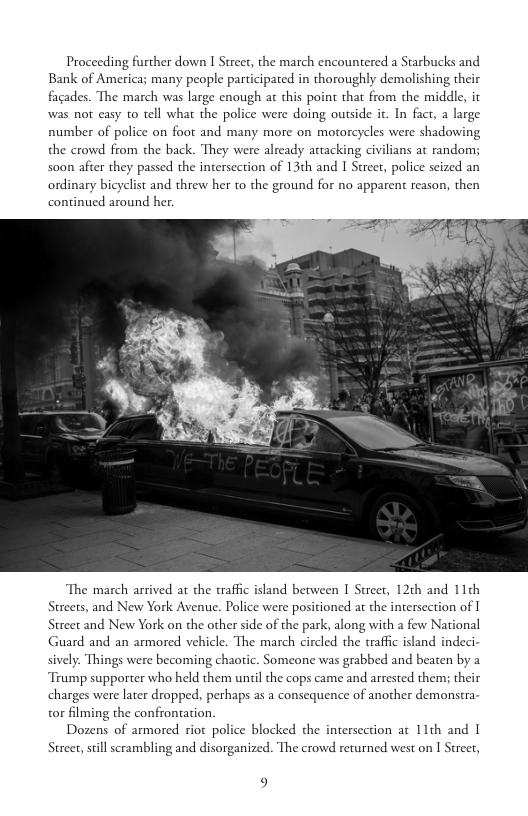
Half an hour later, the damaged limousine caught fire within full view
of the line of beleaguered riot police. Huge clouds of black smoke flled the
air, lending downtown an ominous atmosphere at the end of the afiernoon.
Alongside the punching of Richard Spencer, this was the most iconic image
of the day.
The fire near the intersection of 13th and K burned until well past night-
fall; even after the fire department extinguished the limousine, repeated in-
terventions from police failed to extinguish the trash fire, as protesters simply
litit again and again.
PEHSPECTIVE: DUWNTOWI DC, VNGOYERIABLE Z0)E
I can see some of my friends nside of the kettle over theines ofriot police Sl wear-
ing our masks, my friends and | are walking around trying to talk to others to make
some kind of plan. ‘Can we get them out?" There s no way our resistance s going to
end here—it's not even noon. Activists, families, and local residents are accumulating
around us, punctuated by groups of people wearing backpacks and masks, hoods up.
huddled together waiting to see what happens. Before long, for better or for worse,
someone in amask throws a bright blue smoke bomb right under the feet of the riot
police. They immediately begin panicking, shooting pepper spray everywhere;at one
point. they directy hit a woman and her chid. Bottles and stones are flying over my
head at the police.Sting-ball grenades are exploding al around me.
Impossibly. hooded and masked protesters surround me once again. Where did
all of these people come from? To my left four or five people are using hammers to
break up the asphal;two people behind them are throwing bricks through yet anoth-
ersetof windows. Tomy right, about 10 people are dragging police barricadesinto the
intersection. Stones are flying past me at the police while the entire crowd chants ‘Al
Antil Anti-Capitalista” It actually thunderous.
Eventually we are pushed back a few blocks, but now teenagers are ariving on
bicycles,tying tshirts around their faces. Newspaper boxes are being set on fire.po-
lice vehicle are attacked with stones, and before too long, a fmousine i engulfed in
flames. Near the park to my right, a convenience store s partaly ooted and an over-
tumed trashcan spils empty glass bottles onto the sidewalk.For hours, this standoff
holds the police at safe distance from the family-friendiy ally two blocks away.
By nightfal, my friends and | stop for a quick bite to eat at a cheap restaurant.
‘When we come ot local teenageris standing on top of a burning dumpster smok-
ing marijuana with a ski mask on. In both directions,overturned trash cans block the
intersections, the smoldering flames spitting ash nto the amber lights of the acjacent
18
buildings and ‘road closed” displays. Punk music i playing loudly from somewhere.
Ourtask s completeits time to leave. We couldn'tsave our fiendsin the kette but
the morning black bloc was not thefalure it appeared to b.
IN ASSESSING THE EVENTS OF J20, WE CAN IDENTIFY A FEW DISTINCT QUES-
tions. Lec’s address these one by one.
WAS IT A 600D IDEA TO MOBILIZE AGAINST TRUMP'S INAUGURATION?
Can we imagine the first day of the Trump era without the footage of
windows shattering in DC, the smashing and burning of the limousine, the
punching of Richard Spencer? Make no mistake, it was the Anti-Fascist/Ani-
Capicalist March that opened up space for these iconic moments in down-
town DC on January 20
1f no one had made an open cll for a concrete, confrontational action,
fewer people would have arrived in DC prepared to defy the control of the
police, and those who sought to do so would have had difficulty finding
each other. As it was, no significant disruption occurred before the march at
10 am, and afier the march dispersed, those who desired o engage in open
resistance never reached critical mass to assume the offensive again. Rumors
about another march never came to fruition; although an increasingly broad
range of people participated in ungovernable behavior, the vast majority of it
was reactive, responding to police incursions and defending territory that had
already been psychologically transformed by the passing of the Anti-Fascist/
Anti-Capitalist March. I¢s all well and good to argue that anarchists should
act alongside other rebels rather than in isolation—but when we do, we often
nced a way to find cach other in order to achieve critical mass and tzke the
iniciative.
We can critique the time (100 early?), place (to0 far from the other
crowds?), and tactics (100 costly?), but if the goal was to legitimize and in-
spire direct action at the opening of the Trump administration, there was no.
better way than o cll for confrontational action in DC. Downtown DC
was the epicenter of the world's attention: every burning piece of ltter on K.
Street was worth a burning bank or tank anywhere else. If the blockades had
been the most confrontational action that took place in response to Trump
19
assuming power, this would have sent a message to the st of the country that
people were responding to Trumps ascendancy with civil disobedience, not
by becoming ungovernable.
It possible that the airport blockades, the shutting down of Milo , the
bartles of Charlortesville and Berkeley, and all the other epic struggles that
wrenched the US off the course Trump had set for it would have occurred
even if there had not been an inspiring show of resistance in DC. But the
events of the inauguration occurred at such a pivotal point in the narrative
that it hard to imagine they didn't play any part in shaping what others
around the country expected of themselves and cach other. Sometimes there
are bartles one cannot afford to stand aside from, no matter how great the
risks, no matter how unready one is
DID THE WAHCH 50 WELLY
HOWEVER IMPORTANT IT WAS TO TAKE ACTION 1N WASHINGTON, DC AGAINST
the inauguration, our assessment of the results is complicated by the fact that
by almost any measure, the march went very badly indeed. It was disorga-
nized, dangerous, and disempowering; within a half hour of setting out, the
march had been dispersed, with a large number of participants caught in a
kettle. Considering how badly it went, it was amazing that anything inspiring
happened in DC at all
Who is responsible for the march going badly? There are four basic narra-
tives addressing this question. One blames individual participants; another,
the organizers; the third, the police; the fourth, the black bloc ractic itself.
Let's address cach of these in turn
Certainly, plenty of participants had never been in a black bloc before
Not all of them dressed in clothing that effectively concealed their identi-
ties. Some people have expressed frustration that property destruction began
almost immediately, assuming that this prompred the police to artack the
march carler than they otherwise would have; others felt that the seemingly
arbitrary choice of targets (a bus shelter, local café) and the carelessness with
which some of them were attacked (without giving customers enough warn-
ing t0 get away from the windows) only exacerbated the challenges arrestees
faced in the courtroom without making the message of the demonstration
any clearer
)chzrdmg property destruction, in the wecks leading up to the march,
many longrime anarchists agreed that the important thing would be to stay
2
together and present a strong, united front against police and Trump sup-
porters, not to destroy property. It turned out that some artendees brought
the opposite agenda, being prepared to break windows but scattering quickly
in the face of police pressure. In the continuum between “rapport du force”™
and “smash and dash,” the march erred on the side of the latter. When it
comes to the ambience of a march, “destructive but weak” s one of the worst
combinaions
Of course, if organizers had intended for people to come with a different
agenda, they might have taken more steps to make that clear
Years ago, during the anti-globalization era, a big black bloc march like
the one that took place on January 20 would have included a scouting team
on bicycles exploring the streets around the march to keep up with police
movements, a comms team within the march communicating with the scouts
and listening 0 a police scanner, and a group of locals near the front who
could navigate wisely through the terrain—bringing the march towards its
b
objectives and, if necessary, t0 safe place to disperse. In those days, black
blocs were ofien organized through a series of confidential spokescouncils in
which the participants agreed in advance on shared visions and expectations.
So far as we can tell, the ]20 march benefitted from none of these traditions
21
It debatable how much scouts could have helped—in a small area oc-
cupied by 28,000 law enforcement personnel, the scouts might simply have
repeated “OK, this block is crowded with cops 100" over and over into their
radios. But the absence of any sort of guidance, communication, or deci-
sion-making structure was painfully felt, as the march repeatedly made de-
cisions arbitrarily—crashing randomly around a city filled with targets and.
threats like a blind bull flecing butchers through a china shop.
Many people were understandably afraid to do more coordinating to pre-
pare for the Ani-Fascist/Anti-Capitalist March for fear that, in the repressive
dlimate of the dawning Trump era, this would result in conspiracy charges.
However, there are many different kinds of danger; it may have been worth it
for a few people to take on more risk as organizers f that could have offst the
sisk that hundreds of less experienced people would end up with conspiracy
charges of their own. There are ways to engage in public organizing for po-
tentially confrontational actions that minimize your vulnerability to charges.
As we enter an era of greater unrest, in which more people will be eager to.
participate in anarchist-organized actions, it may sometimes be worthwhile to
take courageous risks in public organizing as well as in street action.
Al that said, it is possible that the police forces arrayed against the J20
march were so powerful that the march could not realistically have turned
out much better than it did. If that is the case, then perhaps it was a good.
thing that the march immediately began destroying property and creating
chaos before the authorities were able to stop it. Certainly; it does not make
sense to lay all the blame for police repression on those who initiated property.
destruction when the police were sure to do their best to crush any group that
interfered with their mission of assuring Trump a peaccfil ransition to pover.
If the police were bound to come down hard on the march, then we
should ask if the black bloc tactic itselfis to blame for our not being able o
accomplish more than we did.
PERSPECTIVE: DG LONGTIME UHGANIZER
1 have mixed feelings about the bloc an J20. The tumout to the biack bloc was im-
pressive. But impressive is relaive. I relative to the context of the anarchist milieu
in the US, which,in my opinion, had been in state of stagnation and decline for the
ten years preceding 120, Folks of my generation largely seem to have taken their an-
archistpolitcs outofstreet-level grassroots activity and channels it nto other reas of
society—academia, non-profit rganizations, arts and culture or business ventures—or
2
ese quitaltogether Anarchist ideas are more popular than ever,and we've radicalzed
the left,even the mainstream let.in countless ways-—but despite this, the anarchist
movement has mostly stayed the same size.f not perhaps shrunk since the turn of
thecentury
s a consequence of this the grassroots anarchist movement in the US is per-
petually forced to reinvent the wheel. One generation after another of 20-something
anarchists cycles in and out of defaultleadership rles-—in the sense of contributing
the most time to anarchist pojects and taking up the most space n anarchist work.
My own involverment dates back to the mic-1990s.Ive particpated in organzing
most of the major anarchist gatherings in DC over the a5t 20 years. Older people ke
myself. who have tied hard to stay involved.often see younger folks dismissour ex-
perience or even respond with hostiy: it can be easiest o stay out o the way and
let younger anarchist renvent the wheel.J20 was no exception. Generally speaking.
there wasn' much room for experience orstrategic thinking in thelead-up to the dy.
til, experienced locals had engaged n some planning and srategy.This was un-
dermined when people from outof town departed from the convergence point arlier
than ocal organizers had planned and deviated from the route thatlocals had chosen
“This sabotaged plans to hit more strategic targets, engage in clearer messaging, and
bring more visibilty to anarchist politics on J20.
When the crowd gathered at Logan Circle that morning, | saw many faces | had
not seen in an organized anarchist contingent in almost a decade. It was clear that
many anarchists who had avoided the streets throughout the Obama years,oratleast
since Occupy. elt asense of urgency and responsiblty to assert a miltant resstance
to Trump and the authoriarian tur in American politcs tha hi victory represent-
ed. In returning to the streets, many on the radical let went to the ant fascist and
anti-capitalist bloc out of deological affnty, not necessariy because they were pre-
pared for direct action that day
“That day’s black bloc was comprised of an equal mix of the folowing diferent
demographics:
Racdicallefists who wanted to express oppositon to Trump by attencing the
gathering most aligned with thei poltcs, but not necessariy prepared to do
more than march,
Miltant anarchists and radicas who wanted to participate i 3 direct action
bloc a5 an anti-fascist and anti-capitalist contributon to 2 broader showing of
resistance.
Jouralists who wanted to go where the acton was.
A minority of afinity groups and individuals who wanted to use the bloc to
cany aut property destruction: some with a collective strategy in mind, some
simply playing outa role.
23
1 believe the property destruction on J20 was righteous It was necessary and
beautiful. But it was not the best thing tht we could have contrbuted to the day
a5 militant anarchists. Or else, even if it was under the circumstances, our standards
should be igher
Unlike the property destruction in Seattle during the 1999 World Trade
Organization summit, which targeted many of the same corporations, there was
o aticulation of why it made sense to target multinationals on that particular day
Downtown Washington, DC is crowdled with the headquarters of right-wing think
tanks and lobbysts who have played a direct role in the rise of the far ight and
Trump's ascension to power. Although corporations like Starbucks and McDonalds.
deserve the utmost fury and destructio, it senta confused message to our critcs and
theuninformed that we focused on those.Im not sayingitwas abad thing—butcould
the actions have been more targeted. spotiighting a more coherent anarchist analysis
of powerin this poltical moment?
1f we had defivered on that—could we have had 3 better impact on public is-
course? Would there have been more immediate public support for the J20 defen-
dants and ess supportforthe prosecution?
“This brings up more questions for me. Could the bloc have employed a srategy
that would have kept us in the streets longer? If we had managed to stay together
throughout the day.we probably would have gained more and more particpants over
fime What could we have done together f we had?
How ese could we have made anarchist politcs visible and accessible on J207Im
ot saying property destructionis atadds with accessbilty o the public-on the con-
rary—but breaking things is ot always suffcent,in and of tseto convey anarchist
poltics inal their uance.
In conclusion, think ts important o be able to consider the events of 120 suc-
cess and a failure at the same time. Whatever resistance we can muster in the face
of the assault that capitaists and the state are carrying out on people and the planat
counts a5 success. Buttis a failure that we can'tseen to access more of our poten-
tial. Many of our shortcomings are products of a falure to decolonize our minds and
tid ourselves of the mentaltyof thesystem we oppose.
Also,lets not underestimate howlong or how deep the trauma ofthe J20 charges
willlinger i our movement. We have to bear thi in mind when we discuss whether
to consider the day a success.Yes,the stat i to blame for the trauma and assauts
But fwe say itwas worth it on ourside. lets be sure we understand the fullmpact of
the consequences,
24
LOC WORH?
CONSIDERING HOW MUCH INFORMATION AS THE STATE WAS ABLE TO GATHER
on the defendants, can you imagine how many criminal convictions there
would have been if people had not been wearing masks and the same color?
16 true that in many cases, prosecutors believed that they could idenify
the defendants even in their black clothing. But if they were not able to get
convictions, this shows that the state needs more than data to target people.
By creating confusion among the enforcers of authority and solidarity among
demonstrators, the black bloc model served to keep arrestees safe in the worst
conditions. The prosecutors wanted to use the fact that everyone was wearing
the same color to as evidence of conspiracy, but ultimately, they overreached;
jurors felt“reasonable doubt” both about whose face it was under any particu-
lar black mask at any given time and also about whether wearing black proved
that a defendant was attempting to facilizate criminal activity. If the police
had snaiched 20 people and charged them with felonies, some of them might
sill be in prison today. Instead, the sea of black made it through the streets
and the court system together and came out the other side.
Likewise, the vast majority of those who escaped in the umbrella charge
were never charged.
So the black bloc worked—this time. We can be certain that new technol-
ogies and new laws are on the way: ]20 was a victory of sorts for the black bloc
model, but one rarely gets to experience the same victory twice.
The strongest argument against the black bloc model is that Commander
Deville immediately identified the march from Logan Circle as “anarchists”
and singled it out for repression. Deville may have been determined to attack
the march regardless of what people were wearing, but it is noteworthy that
he used the black bloc branding to identify the march as a legitimate targer.
The paradox of the black bloc is thar it simultancously provides personal
anonymity and collective political legibility. The question is what kind of
political legibility will serve us best: what risks are we willing to run, when it
comes to being politically legible to our enemies, in order to become politi-
ally legible to potential comrades?
In the era of doxxing and camera phones, we can hardly do without some way
of preserving our anonymity in protest situations. It was prescient of the previous
generation of anarchists to associate militant anonymity with anarchism in the
popular imagination, since practiclly all who are pushed into conflict with the
prevailing order will be compelled to experiment with forms of anonymity—and
hopefuly,in the process, to consider whether they too might be anarchists.
25
For that to be possible, we have to do everything in our power to normal-
ize anonymous collective action and set wider precedents for it. Collective an-
onymity should not be associated with the immediate escalation to property.
destruction. It serves the authorities' interests for every black bloc to imme-
diately commit vandalism and be surrounded or break up in fight before it
‘can cross-pollinate with other groups. It would be better i, as in the anti-glo-
balizacion days, there were regularly large black blocs that simply marched
around, normalizing the tactic, assisting other groups, defending themselves
as needed, and providing visibilty for anarchist values.
We should also experiment with other means of preserving anonymity
that do not immediately draw state attention or identify the participants as
“extreme.” It i casier to hide in numbers than in the darkest shade of black.
Ultimately, our safecy will derive from being part of broad, powerful, creative
Social movements that are prepared to support us the way people supported
the ]20 defendants, not from our technical skills when it comes to rendering
ourselves invisible. The greatest danger that we will be isolated and contained
is not that the police will race ahead of us in the streets and kettle us—it is
that we will go on thinking of ourselves as excepional, missing one opportu-
nity after another to make common cause with others.
PERSPECTIVE: WHAT WE LEARNED
I think that e can be positive about the lessons we learned via the prosecutions.
Although it turmed our lives upside down, we learned a lot about the way the state.
is and is not able to crack phones, about legal campaigns and how to get charges
dropped. Over 200 strangers somehow managed to not snitch on each other We ex-
panded our networks toresis repression and,againstall odds we overcame in totally
ridiculous circumstances to win.
s a former defendant, | personally am stil recovering from the ways it tumed
my lfeinside out and the stress and trauma of the case, but am grateful fo the skills
and insight | gained to support others on the receiving end of state repression. The
case posed challenges we hadn' met before and gave us an opportunity to learn and
strengthen ourselves.If someane had asked me whether the action itself was worth
it during the scariest parts of the case, | would have said no. But now: with the scope
of the entire thing in view, | feelthat it was worth it A person’s perspective on such
questions can change over time.
2
WAS IT WORTH IT?
WHATEVER VICTORIES WE WON ON 20 AND IN THE SUBSEQUENT COURT CAS-
s, they came at a tremendous cost. Was it worth it?
“To answer this question, we can' just look at a single day of action; we
have to cvaluate an entire way of lfe, the way of inhabiting the world that
led anarchists like us to participate in the J20 march and so many other ac-
tions before ir. Some of us have lived through years or decades of high-risk
political activty. So many of the accomplishments of a century and a half of
anarchist movements resulted from people like us throwing ourselves into
the unknown, entering situations in which there are no guarantees. We have
o weigh allof the victories that resulted from that way of being if we are to
make a fir assessment of whether the risks we took on January 20, 2017 were
wordhwhile
For other defendants, ]20 was their first major action, and they were im-
mediately subjected to an ordeal that some anarchiss have not experienced in
two decades of black blocs. I is casy to understand hovw this might put one off
from participating in high-risk political activity. Certainly that was the goal
of the government, at a moment when more and more people are looking to
join revolutionary movemens
S amarehios were he only protagonists of revols, it might make sense to
save ourselvs for contests with better odds. But the important thing s what
everyone does, not what we do alone. There are certain times and places—cer-
tain bricf windows in history—when single action can have tremendous im-
pact. In such situations, we can humbly offer ourselves as catalysts, hoping to
do our part to createsituations that everyone can participate in. If our actions
on J20 helped inspire thousands outside our social circles to occupy airports
and stand up to fascist, they may have been worth it,even if the upshot was
that we ourselves were out of action for a year or more,
We are never going have auspicious odds going into a frontal assault on
the stae at s strongest. Unfortunately,there are times when the consequenc-
s of no doing so will be even worse
For those who were critical of the call for a confrontational march on ]20,
then, in place of the question of whether people should have gone to DC,
we propose another question. Ifwe are ever forced to confront the state again
in the way that many felt compelled to that morning in 2017, whac will we
wish we had done in advance to prepare for that? How can we be preparing
vight now?
27
We should always try to be strategic and to accomplish as much as possi
ble with the minimum losses. But we should not blame those who called for
the march for the intensity of the ensuing crackdown, nor write off an entire
kind of action as “t0o risky” DC police have carried out mass arrests before-
during the IMF/World Bank protests in April 2000, the “Peoples Strike in
September 2002, and on the night following the Inauguration in 2005. They
Kettled the October Rebellion black bloc in October 2007. But the charges
that the DC prosecutor pressed were unprecedented. The J20 charges clearly
represented a new experiment in the evolution of state repression—an exper
iment which, like many of Trump’s innovations, was thwarted only because
people immediately threw all they had into opposing it
The police could also have carried out mass arrests at the blockades—in
deed, had they not been stretched thin trying to police the entire downtown
area, they might have done just that. Would we then have blamed the block
ade organizers? They certainly could have cracked down on the black blocs
elsewhere around the country the same way—in Berkeley on February 1, for
example, or in Philadelphia a few weeks later, or in the various clashes with
fascists that have taken place since then. Would we then have accused the
organizers of those actions of an error? Those black blocs were essential in
halting the spread of fascism and inspiring people around the United States
2
0 rise up. If they involved some of the same risks that the ]20 actions did,
we must also add those accomplishments to the list of reasons to be open to.
taking risks like the ones we took on J20.
The fact is: the kind of action that can interrupt a high-security specta-
dle like a presidential inauguration is high-risk activity, just like the kind of
action it will tzke to halt the rise of authoritarian nationalism and the kind
of action it will take to stop the destruction of the natural world. The results
of our efforts are never guaranteed in advance. Sometimes, in what scems
a hopeless situation, the courage of a few people can become the power of
thousands. Other times, one takes a risk and fails. We can analyze our victo-
s and failures in hopes of being better prepared to identify the strategic op-
portunities and risks the next time around, but the world will go on changing
ahead of every effort to map it and predict the future.
Some people in the US already experience more risk in their daily lives
than any of us were exposed throughout the entire ]20 ordeal. Others who
made the rational choice not o go to the demonstrations in DC sill found
themselves confronted with the necessity of supporting their comrades
through the ensuing court cases and bravely rose to the occasion. We don't
get to determine the level of risk that the state subjects us to or the challeng-
es that come our way. What we can do is stand courageously by each other
throughout the worst misfortunes, facing the unknowable future together.
It may hold miracles or horrors—it almost cercainly holds both—but if we
meet it together, we will learn more about each other and ourselves.
PERSPECTIVE: I'D DU IT ABAL
Now that the case has ended, its given me a chance to reflect There are many con-
Versations that remain to be had amongst trusted friends about what happened that
day,but now that the prospect of prison isn't hanging over my head,fve finally had
some room to breathe. Despite all the gref of the past year and a half—Id do t again.
And know that will
2
FURTHER HEADING
« #Disrupt] 20 Report Back: The Logan Circle Black Bloc
« #Disrupt]20 and the Black Bloc: An Opporunity Lost?
* We've Got Your Back: The Srory of the ]20 Defense:
* 1'Was )20 Street Medic and Defendant
* Between the Sun and the Sea: Iearus at 12th and L—A Voice from the 120
Black Bloc and Kettle on the Practice of Anarchy
* DC Office of Police Complaints Report on the Inauguration
* 120 Protest Simulator—Choose Your Own Adventure in the Streets and
Courts of Washington, DC
When it comes to approxinting crowd size che confice between polie estimates and
proteser estimates goes back generations. Regarding the accuracy of police scimates of
crowd size on January 20, we simply note that when the march was ketled a 126h and L.
Stsee,the firs oo offces o estimate the number ofaresees puc i berween 50 and 100
i fac, it vas more lke 250.
“We are often defeated. However, no matter how often beaten,
we cannor forget the joy we felt during the fight. The pleasure
of stretching our will power. The pleasure of trying out our
own strength. The pleasure of seeing a manifestation of real
comradely emotions among comrades. The pleasure of secing
the world clearly divided into friend and foe. And above all
of these various pleasures, the pleasure of secing fainely and
gradually our own future and society’s future. The pleasure of
Secing an improvement in our own personalities.”
~Osugi Sakae, 1920
Tagether, we would open up like an abyss, immeasurably deep, and
some unknotwable, uncontrollable future would pour out of s
Crimethinc.