An Herbal Medicine Making Primer
Web PDFImposed PDFRaw TXT (OCR)
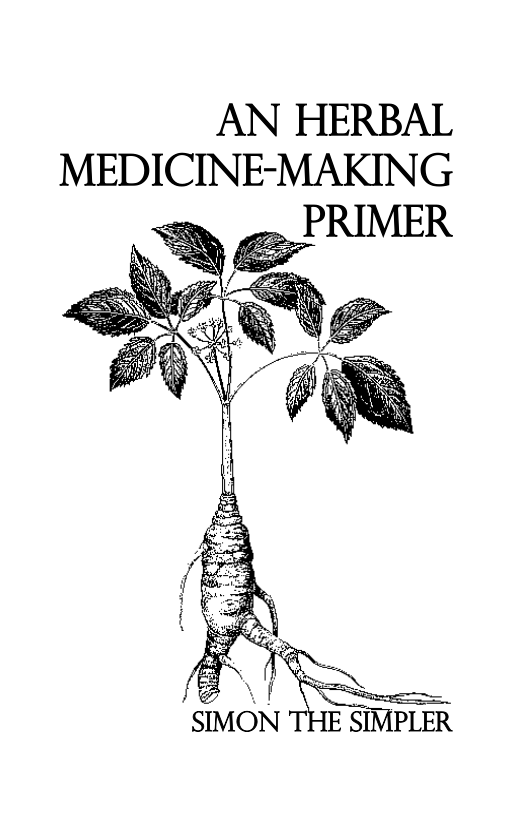
AN HERBAL MEDICINE-MAKING  -S|  SIMON THE SIMPLER

CONTENTS  This is Anarcho-Herbalism 2 An adapted essay originally by Laurel Luddite  Wildcrafting 8 Medicine-Making 11  Bibliography and Resources 24  AN HERBAL MEDICINE-MAKING PRIMER — 1
THIS IS ANARCHO-HERBALISM  Thoughts On Health and Healing For the Revolution Originally by Laurel Luddite  MY MEDICINE CHEST IS A COUNCIL of bioregions, with representatives gathered together as I make my way around the world west of the Rocky Mountains. The Coptis root was picked out of the churned-up scar left by an excavator, at the retreating edge of the Idaho wilderness. The tiny amount of Pipsissewa leaves came from an ancient grove above the Klamath River just feet away from where the District Ranger sat on a stump talking about his plans to cut it all down. 1 am drying Nettles from the California creck where salmon dic in the slt et after a century of industrial logg  Every jar holds a story (often a ghost story of dying ccosystems and places gone forever). | am honored to have known the plants in their home places and to have studied their uses as medicine. But for people not lucky enough to roam throughout the wilds, purchased herbal preparations such as tinctures may be the link back to this sort of heali  Like so much in this consumerist society, it is casy to ignore the connections between a bottle on a shelf in some store and a living, growing plant out in the world somewhere. It can be hard to know if the plant grows a mile away or on another continent. There is much to be said for reconnecting, for educating ourselves about the herbs we use and gathering our own medicine when we can. That’s how we will be able to build a whole new system of healing, one that can support our movement away from the corporate power structure that the practice of medicine has become.  The development of a new medical system, or the recovery of ancient ‘models, is another link in our safety net as industrialism fals. It kecps  2 ~THIS IS ANARCHO-HERBALISM
us alive and kicking out windows in these last days of the System when so many people have no acce reestablish our connection to the real medicine that s the Earth  to industrial medicine. It will  An Alternative to " Alternative Medicine"  THE SORT OF HERBAL MEDICINE popular these days (presented to us by the media and so-called Green Capitalists as yet another exciting fad) has brought with it very little thought of a new way of healing The plants, reduced to capsule form or, worse, to their "active ingredients”, are just new tools to work with in the same body- ‘machine that industrial medicine secs people as being They become no different than pharmaceutical drugs or a scalpel blade: something to pry into the body-machine with and use to mess around with the parts. Except, of course, much less effective, because the herbs have been taken out of the system of healing in which they have their strength. A system within which the individual has the power and knowledge and capability to heal themselves directly and without the ‘numbing influence of marketing and money,  When the marketers of herbal products get their hands on a new "miracle cure", it can mean extinction for the plant. This is especially sad when so many living creatures go into useless products or are wasted on conditions that they don’t treat. (Has anyone clse seen that Echinacea shampoo?) The classic example of this is Goldenseal, Hydrastis canadensis, a plant close to extinction in the wild. It has a couple of amazing actions in the human body marketed as a cure for the common cold, wl nothing to help. By the way, the largest brokers of wild-harvested Goldenscal and many other big-name herbs are multinational pharmaceutical corporations. Given American society’s obsession with herbal Viagra, weight loss pills, and stimulants, most of the herbs on the mass market are being sacrificed to these ridiculous causes.  but has mostly been  h it will do almost  AN HERBAL MEDICINE-MAKING PRIMER — 3
There is an alternative to "alternative medicine”. Southwestern herbalist, author, and teacher Michael Moore probably said it best in one of his recent digressions from a lecture: "In this country, the herb, business mostly revolves around recently marketed substances with new research, and it comes from them to us. Whereas we’re trying to establish as much as possible (in this lower lerel, if you will) the fact that we need to create a practice and a model that’s impervious to faddism. We’re trying to practice in a way that derives from practice rather than from marketing. Not from abose to below but from below around. Bioregionalism iiber alles. Keep it local. No centralization, because centralization kills everything "  Herbo-Primitivism  WE NEED ANOTHER WAY OF looking at our bodies and the plant ‘medicines. Sceing the two as interconnected and in balance is new to industrial culture, but in reality it is the most ancient healing model on carth. We knew it before we were “people”. Animals know how to use plants to medicate themselves; their examples surround us, from dogs cating grass to bears digging Osha root. Probably every human society has had some way of explaining how the body works and how plant medicines work in us.  One thing all herbalists know - dogs and bears included - is that a health problem s best treated before it begins. In more primitive societies where people have the luxury of listening to their own bodies it is casy to spot an imbalance before it turns into an acute discase state. This is where herbs are most effective. They work at this sub-clinical (and therefore invisible to industrial medicine) level of "imbalances" and "deficiency” and "excess". Their major task is in sustaining and maintaining a healthy organism and, in cases of illness, encouraging that organism to heal itself.  4 —THIS IS ANARCHO-HERBALISM
This old/new healing system is subtle and requires a lot of self- knowledge, or at least self-awareness. It uses intuition as a diagnostic tool. Emotion, spirituality, and environment become medicines. The spirit and environment of the plants we gather affects their healing propertics, and our relationship with those plants becomes very important.  Green Herbalogy  WHEN WE TAKE HERBAL MEDICINE we are taking in part of the plant’s environment. Everything it ate and drank and experienced has formed the medicine you’re depending on, so you better make sure it gets all the best, When we are healed by plants, we owe it to them to Took out for their kind and the places where they live. Traditional plant-gatherers often have a prayer they recite before they take anything from the wild. 1 usually say something along the lines of "OK, plant. You heal me and Il look out for you. T got your back. No one’s gonna build over you, or log you, or pick too much while I’m around." So this true herbal healing system has at its heart a decp and radical environmentalism and a commitment to the Earth.  ‘The bioregional concept is important to this model of healing. Plants’ actions in our bodies are really quite limited by the chemicals they can produce from sunlight and soil. For every big-name herb on the market cut from the rainforest or dug from the mountains, there is most likely a plant with a similar action growing in your watershed Some of the best medicines to maintain good health grow in vacant Tots and neglected gardens around the world.  AN HERBAL MEDICINE-MAKING PRIMER — 5
Anarcho-Herbalism  A SOCIETY OF PEOPLE WHO ARE responsible for their own health and able to gather or grow their own medicines is a hard society to rule. These days we are dependent on the power structure of industrial health care and medical specialization: the secret society of the doctors, the white-male-dominated medical schools, the corporate decision makers with their toxic pharmaceuticals and heartless greed and labs full of tortured beings. That dependence is one more thing keeping us tied down to the State and unable to rebel with all our hearts or even envision a world without such oppression With a new system of healing, based on self-knowledge and community herbal wisdom, we will be that much more free  Offering a real alternative health care system will help to calm some people’s fears about returning to an  anarcho-primitivist, Earth centered way of life. There is a false security in the men with the big ‘machines, ready to put you back together again (if you have enough ‘money). What is ignored is the fact that industrial society causes most of the dis-cases that people fear. Living free on a healing Earth while surrounded by true community and eating real food will prove to be a better medicine than anything you can buy.  What steps can we make now towards creating this new system of ‘medicine? We all need to learn what we can about our own health “This could mean training in one or more of the surviving models of traditional healing and/or through self-observation. How do you fecl when you’re just starting to get a cold? What kinds of problems come up repeatedly, especially when you’re stressed out? If you are female bodied, how long is your cycle and what does the blood look like? Understanding how our bodies act in times of health can help us recognize the very carly stages of dis-case when herbs are the most useful  6~ THIS IS ANARCHO-HERBALISM
People who have some background in healing (in the traditional or industrial systems) can be a great help to those of us who are just learning, Healers who are working to form this new model, whether collectively or through their individual practices, should keep in mind that they are practicing a truly revolutionary medicine which promotes  community-sufficiency,  decentralization,  and  an appreciation for the Earth  In these times of change, everything is being examined and cither destroyed, rebuilt, or created from our hearts. Industrialism has affectcd every aspect of our lives - we are just starting to realize how ‘much has been lost. Medicine is just one part of the machine that we have to take back and re-create in a form that works for the society we will become. Every herb, pill, and procedure should be judged on its sustainability (true sustainability, not just green-washed marketing) and accessibility to small groups of people. We can start with ourselves, with our communities and circles, but should never stop expanding outwards until industrial medicine rusts in a forgotten grave, a victim of its own imbalances.  AN HERBAL MEDICINE-MAKING PRIMER — 7
WILDCRAFTING  The Ethics and Methods of Foraging  ONE OFTHE MOST LIBERATING THINGS about herbalism is the ability to walk outside and pick a plant with your own hands and then use it to nourish and heal yourself  Ethical wildcrafting requires knowledge and respect (and, if it’s commercial, a permit). Learning your first few plants is the hardest part. Once you can learn to differentiate a few plants from the multitude, you’ll find you can’t walk around the block without noticing new plants and familiarizing yourself with your bioregion. A basic region-specific plant guide can be a really useful tool for the beginning forager as well as the experienced herbalist; you never know when you’ll run into a new plant friend or want to double check your knowledge  It can be casy to get intimidated by the amount of medicinal and botanical information out there. But, don’t get discouraged; all you really need to know is a handful of weeds to feed and heal yourself. If you are just beginning, try picking five or six plants to learn to identify and really focus on them 5o as not to overwhelm yourself When you take walks, try to identify them visually at various points in their growth cycle. Pick a leaf or flower to carry with you and remind yourself. If it’s a mild medicine or food plant, taste it and smell it often, paying attention to how it makes you feel. This wi working and intimate knowledge of the plants in your region  Once you’ve learned a few plants and are ready to harvest them, there are a few things to consider. First s the bio-availability of that plant in your arca, With plants that are rare, endangered or simply not common where you live, it is especially important to make sure that  8 - WILDCRAFTING
you harvest with caution. A good rule of thumb is to avoid harvesting plants from stands of less than twenty and to harvest no more than ten percent of what you see. It is also important to make sure you help to propagate the plants you are harvesting cither by spreading the sceds in the fall or, if you are harvesting roots, re-planting some root- crowns as you go. The United Plants Savers, founded by Rosemary Gladstar, has ongoing information about endangered and threatened plant species that is a great reference for the ethical wilderafter. The website is www. unitedplantsavers. org.  Season is also important to consider when harvesting, For instance, harvesting flowers when they are all withered and soaked in the fall will probably be less beneficial to you medicinally than harvesting them in full bloom. I’ve found that a nice way to think about it is this harvest plants in the season where their energy is flowing toward the part of the plant you are using, I the spring, energy is flowing up the plant’s stalk out of the root and into newly budding leaves, so this is usually a good season for fresh leafy greens, Summertime takes cnergy from the leaves up into flower buds, and when they begin to wither and turn to seed in the fall, everything is flowing back down the stalk to be stored in the oot for the winter, Different plants mature in different seasons, but this is a good generalization.  It’s also important to notice some things about the arca from which you are harvesting plants for ingestion. Herbs growing on roadsides, in ditches or waterways downstream from industrial sites, or in arcas exposed to pesticides and herbicides should probably not be harvested for medicinal purposes.  Above all, the most important thing to remember when wildcrafting is that you are taking something from another living organism and it should be done with the utmost respect. Some people have rituals they carry out while harvesting in order to remind themselves of this  AN HERBAL MEDICINE-MAKING PRIMER — 9
fact and to thank the plants for their gifts. T think it’s nice to sit with the plants you are about to harvest for a while before you begin When harvesting balsam root on one occasion, my friend Sara encouraged me to walk around the plants quictly and get to know. them rather than just picking one to pull out of the ground at random.  1 know another person who talks with the herbs he is about to harvest, letting them know he’s not picking them wastefully, thanking them, and reminding them that one day his flesh will return to the soil, giving them the gifts of his life in turn. This ritual harkens back to the pagan practice of reciting a poem (along a similar theme) to the elder before breaking a twig from her for wand-making,  Humans routinely steal, pillage, and plunder from the carth. The least we can do as mindful foragers is carry out our work with respect and give as much back as we can. I’m told by another herbalist friend that some North American tribes had a practice of leaving offerings of tobacco or other goods behind after harvesting medicines. Personally, 1 think that mindfulness and the practical habit of going back to stands in the fall to help propagate the plants you’ve harvested are really simple and important practices that even the most rationally-minded, spiritually-resistant herbalists can do.  10 - WILDCRAFTING
MEDICINE-MAKING  A Discussion of Menstra and Recipes  Drying and Processing  ONCE YOU’VE GROWN, HARVESTED, FORAGED or acquired your fresh herbs, it’s time to think about how you are going to process them. To dry the acrial parts of plants, the leaves and flowers still attached to the stalks, gather a handful and bind them together at the base (the part of the stalk that would’ve been closest to the ground when the plant was growing) and hang the bundle upside-down. If you are plucking leaves or flowers off of growing stalks, as with single calendula blossoms or nettle leaves, you can lay them out on a grilling rack or screen to dry. Grilling racks work well because they allow air to flow under the drying herbs, preventing mold. This method also works well for roots, berries and barks, as well as thicker, juicier plants. For roots and barks, brush the dirt and moss off of them, break them into smaller portions, lay them out on your rack or shady corner (direct sunlight tends to break plants down faster), and et them be. If you are worried about mold, the important things to remember are air flow and shade; the faster your plants can dry in these conditions the higher the quality of your final product  One last word on processing: once your herbs are dry, it’s time for my favorite part... Garbling! Garbling is the process of picking through ng umwanted twigs or sceds or whatever little bits you don’t want in the final product. All you need to do after this is store the plants in an air- tight container in a dark place  your dried plants, breaking them into smaller picces and remoy  Menstra THERE ARE MANY DIFFERENT WAYS to store herbs for later use, ‘many different methods of preservation and extraction. Drying herbs  AN HERBAL MEDICINE-MAKING PRIMER — 11
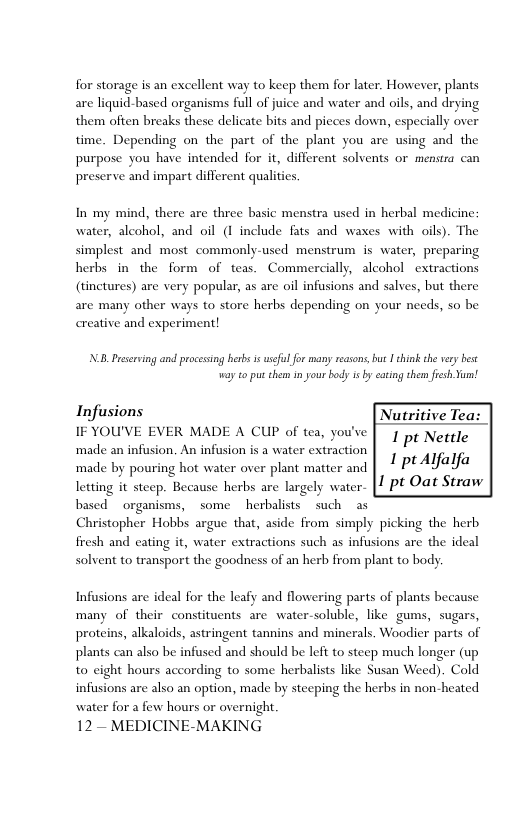
for storage is an excellent way to keep them for later. However, plants are liquid-based organisms full of juice and water and oils, and drying them often breaks these delicate bits and pieces down, especially over time. Depending on the part of the plant you are using and the purpose you have intended for it, different solvents or mensira can preserve and impart different qualities  In my mind, there are three basic menstra used in herbal medicine water, alcohol, and oil (I include fats and waxes with oils). The simplest and most commonly-used menstrum s water, preparing herbs in the form of teas. Commercially, alcohol extractions (tinctures) are very popular, as are oil infusions and salves, but there are many other ways to store herbs depending on your needs, o be ereative and experiment!  N.B. Preerving and procesing herbs i seful for many reasons, but 1 hink ch very best way to putthem i your body i by eating them fiesh !  Infusions Nutritive Te IEYOUVE EVER MADE A CUP of tea, you’se [ 1 b Negele ‘made an infusion, An infusion is a water extraction  made by pouring hot water over plant matter and | | PtAYalfa i steep. | 1 pt Oat Straw  letting it steep. Because herbs are largely water-  based organisms, some herbalists such as Christopher Hobbs argue that, aside from simply picking the herb fresh and cating it, water extractions such as infusions are the ideal solvent to transport the goodness of an herb from plant to body  Infusions are ideal for the leafy and flowering parts of plants because many of their constituents are water-soluble, like gums, sugars, proteins, alkaloids, astringent tannins and minerals. Woodier parts of plants can also be infused and should be left to steep much longer (up to cight hours according to some herbalists like Susan Weed). Cold infusions are also an option, made by stecping the herbs in non-heated water for a few hours or overnight.  2~ MEDICINE-MAKING
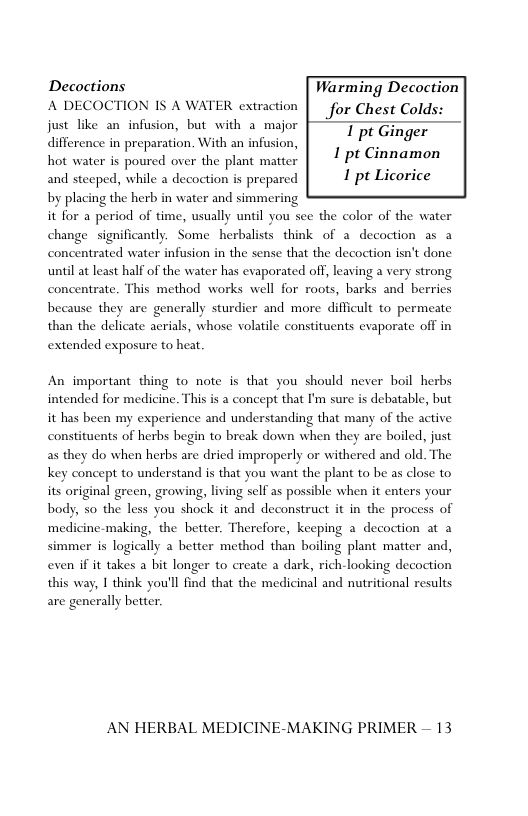
Decoctions Warming Decoction A DECOCTION IS A WATER extraction | for Chest Colds: just like an infusion, but with a major  difference in preparation. With an infusion, hot water is poured over the plant matter nanm and steeped, while a decoction is prepared 1 pt Licorice  Tpt Ginger 1 pt Cinnamon  the herb in water and simmering iod of time, usually until you see the color of the water change significantly. Some herbalists think of a decoction as a concentrated water infusion in the sense that the decoction isn’t done until at least half of the water has evaporated off, leaving a very strong concentrate. This method works well for roots, barks and berries  because they are generally sturdier and more difficult to permeate than the delicate acrials, whose volatile constituents evaporate off in extended exposure to heat.  An important thing to note is that you should never boil herbs intended for medicine, This is a concept that I’m sure is debatable, but it has been my experience and understanding that many of the active constituents of herbs begin to break down when they are boiled, just as they do when herbs are dried improperly or withered and old. The key concept to understand is that you want the plant to be as close to its original green, growing, living self as possible when it enters your body, 5o the less you shock it and deconstruct it in the process of ‘medicine-making, the better. Therefore, keeping a decoction at a simmer is logically a better method than boiling plant matter and, even if it takes a bit longer to create a dark, rich-looking decoction this way, I think you’ll find that the medicinal and nut are generally better  tional results  AN HERBAL MEDICINE-MAKING PRIMER — 13
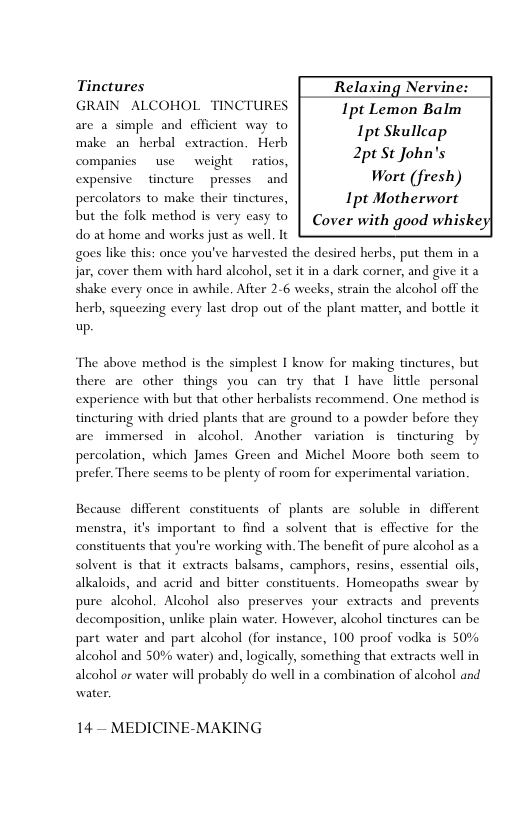
Tinctures Relaxing Nervine:  GRAIN ALCOHOL TINCTURES Ipt Lemon Balm are a simple and efficient way to Ipt Skullcap make an herbal extraction. Herb ! companics use  weight  ratios, 2pt St John’s expensive tincture  presses  and Wort (fresh) percolators to make their tincturcs, 1pt Motherwort  but the folk method is very easy 0 | Cover with good whiske do at home and works just as well. It  goes like this: once you’ve harvested the desired herbs, put them in a jar, cover them with hard alcohol, set it in a dark corner, and give it a shake every once in awhile. After 2-6 weeks, strain the alcohol off the  herb, squeezing every last drop out of the plant matter, and bottle it  up.  The above method is the simplest I know for making tinctures, but there are other things you can try that 1 have little personal experience with but that other herbalists recommend. One method is tincturing with dried plants that are ground to a powder before they are immersed in  alcohol. Another variation is tincturing by percolation, which James Green and Michel Moore both seem to prefer. There seems to be plenty of room for experimental variation.  Because different constituents of plants are soluble in  different menstra, its important to find a solvent that is cffective for the constituents that you’re working with. The benefit of pure alcohol s a solvent is that it extracts balsams, camphors, resins, essential oils, alkaloids, and acrid and bitter constituents. Homeopaths swear by pure alcohol. Alcohol also preserves your extracts and prevents decomposition, unlike plain water. However, alcohol tinctures can be part water and part alcohol (for instance, 100 proof vodka is 50% alcohol and 50% water) and, logically, something that extracts well in alcohol ar water will probably do well in a combination of alcohol and water  4~ MEDICINE-MAKING
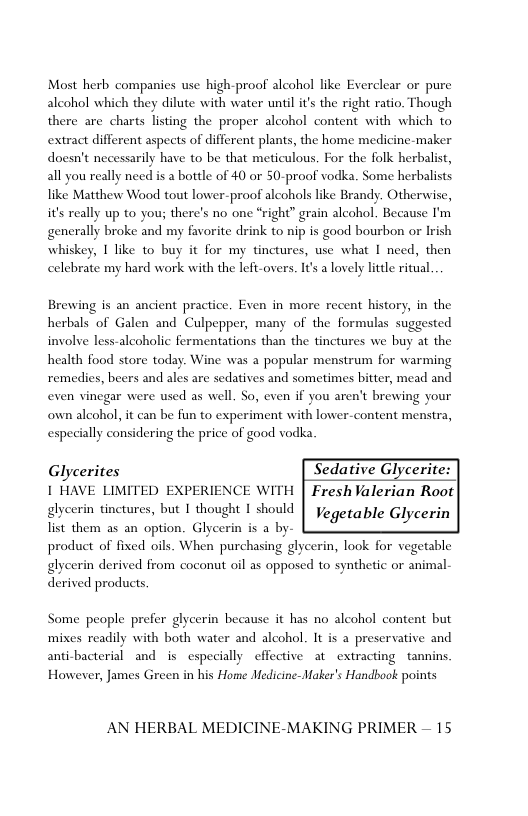
Most herb companies use high-proof alcohol like Everclear or pure alcohol which they dilute with water until i’s the right ratio. Though there are charts listing the proper alcohol content with which to extract different aspects of different plants, the home medicine-maker doesn’t necessarily have to be that meticulous. For the folk herbalist, all you really need is a bottle of 40 or 50-proof vodka. Some herbalists like Matthew Wood tout lower-proof alcohols like Brandy. Otherwise, it’s really up to you; there’s no one *right” grain alcohol. Because I’m generally broke and my favorite drink to nip is good bourbon or Irish whiskey, I like to buy it for my tinctures, use what I need, then celebrate my hard work with the left-overs. It’s a lovely litle ritual  Brewing is an ancient practice. Even in more recent history, in the herbals of Galen and Culpepper, many of the formulas suggested involve less-alcoholic fermentations than the tinctures we buy at the health food store today. Wine was a popular menstrum for warming remedies, beers and ales are sedatives and sometimes bitter, mead and even vinegar were used as well. So, even if you aren’t brewing your own alcohol, it can be fun to experiment with lower-content menstra, especially considering the price of good vodka  Glycerites Sedative Glycerite | HAVE LIMITED EXPERIENCE WITH | Fresh Valerian Root  glycerin tinctures, but I thought 1 should |y oerable Glycerin Tt them a5 an option. Glycerin is a by Lo b  product of fixed oils. When purchasing glycerin, look for vegetable glycerin derived from coconut oil as opposed to synthetic or animal- derived products.  Some people prefer glycerin because it has no alcohol content but mixes readily with both water and alcohol. It is a preservative and anticbacterial and is especially effective at extracting tannins However, James Green in his Home Medicine-Maker’s Handbook points  AN HERBAL MEDICINE-MAKING PRIMER — 15
out that it has a very limited range of solvency, not mixing well with resins or volatile or fixed oils. I would also like to point out from the DIY perspective that it is a highly processed substance and there are much simpler and more readily-available options. However, please experiment for yourself,  Fermenting  SOMETIMES ITHINK, “If... No, when industrial civilization collapses and 1 don’t have ecasy access to things like distilled alcohol or processed vegetable glycerin, how will 1 extract and preserve my medicines?” Aside from simply drying all of my herbs, 1 think the wild fermentation. Pickling and fermenting have been used for thousands of years. There are endless options and there are some really great books out there to help you explore the possibilities. Two of my favorites are Wild Fermentation and Sacred and Herbal Healing Beers.  ‘The subject of home brewing and wild fermentation is vast. In my very limited experience, the simplest way to begin home brewing is with mead because all you need is honey, water and a clean environment to store your mixture for a few weeks as it ferments. “There are plenty of excellent recipes available online and in the books I’ve listed above,  Another quicker method is lacto-fermentation, as with sauerkraut, relishes and kimchi. While many of these methods involve stecping ‘medicinal herbs in a solvent to extract their qualities, there are ways to ferment and preserve them whole. Pickling works well with fruits and vegetables, but some cultures use this method to preserve leafy herbs like grape leaves and roots like ginger. Lacto-fermentation can also be used to quickly ferment herbal water infusions in just a few days, producing a very low-alcohol, fizzy brew. All you need for lacto- fermentation is water, sweetener, whey (the liquid part of your organic yogurt), and maybe some salt and other seasonings. As with  6 — MEDICINE-MAKING
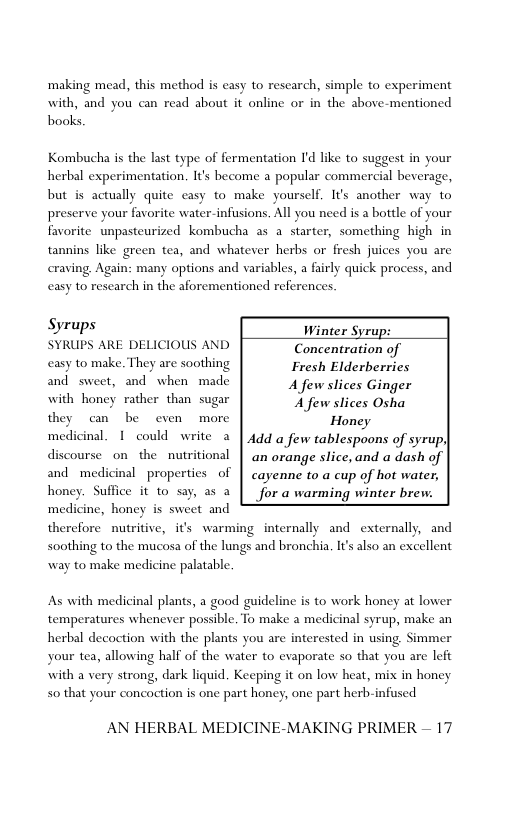
‘making mead, this method is casy to rescarch, simple to experiment with, and you can read about it online or in the above-mentioned books  Kombucha is the last type of fermentation I’d like to suggest in your herbal experimentation. It’s become a popular commercial beverage, but is actually quite casy to make yourself. It’s another way to preserve your favorite water-infusions. All you need is a bottle of your favorite unpasteurized kombucha as a starter, something high in tannins like green tea, and whatever herbs or fresh juices you are craving. Again: many options and variables, a fairly quick process, and casy to rescarch in the aforementioned references.  Syrups Winter Syrup: SYRUPS ARE DELICIOUS AND Concentration of casy to make. They are soothing Fresh Elderberries and sweet, and” when made Afew slices Ginger with honey rather than sugar Affcw tices st they can be even more Honey  ‘medi  nal. 1 could write a | Add a few tablespoons of syrup| discourse on_the nutritional | an orange slice, and a dash of and medicinal properties of | cayenne to a cup of hot water, honey. Suffice it to say, as a | for a warming winter brew.  medicine, honey is sweet and  therefore nutritive, its warming internally and externally, and soothing to the mucosa of the lungs and bronchia. I’ also an excellent way to make medicine palatable.  As with medicinal plants, a good guideline is to work honey at lower temperatures whenever possible. To make a medicinal syrup, make an herbal decoction with the plants you are interested in using. Simmer your tea, allowing half of the water to evaporate so that you are left with a very strong, dark liquid. Keeping it on low heat, mix in honey 5o that your concoction is one part honey, one part herb-infused  AN HERBAL MEDICINE-MAKING PRIMER — 17
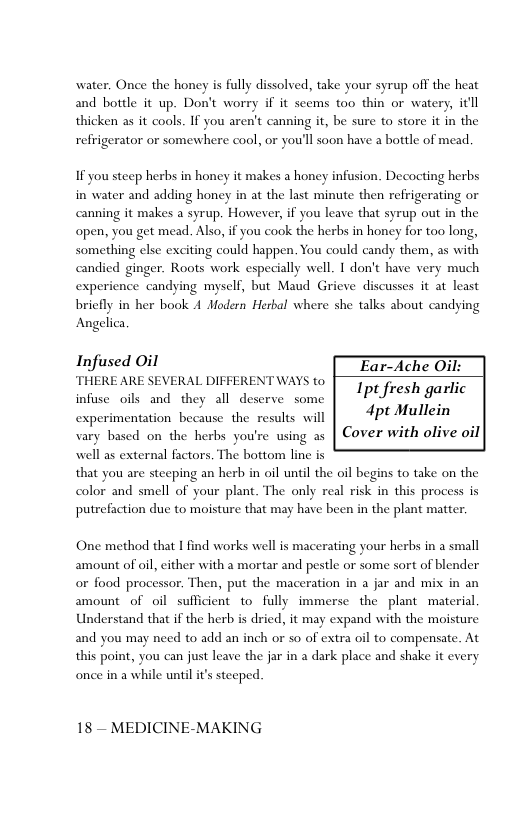
water. Once the honey is fully dissolved, take your syrup off the heat and bottle it up. Don’t worry if it seems too thin or watery, itll thicken as it cools. If you aren’t canning it, be sure to store it in the refri  igerator or somewhere cool, or you’ll saon have a borttle of mead. If you steep herbs in honey it makes a honey infusion. Decocting herbs in water and adding honey in at the last minute then refrigerating or canning it makes a syrup. However, if you leave that syrup out in the open, you get mead. Also, if you cook the herbs in honey for too long, something lse exciting could happen. You could candy them, as with candied ginger. Roots work especially well. I don’t have very much experience candying myself, but Maud Grieve discusses it at least briefly in her book 4 Modern Herbal where she talks about candying Angelica,  Infused Oil Ear-Ache Oil: THERE ARE SEVERAL DIFFERENTWAYS to [~ T rard infise oils and they all deserve some | [PLSTesh gartic experimentation because the results will | 4Pt Mullein  Cover with olive oil  vary based on the herbs you  e using as  well as external factors. The bottom line is that you are stecping an herb in oil until the ol begins to take on the color and smell of your plant. The only real risk in this process is putrefaction due to moisture that may have been in the plant matter  One method that I find works well is macerating your herbs in a small amount of oil, cither with a mortar and pestle or some sort of blender or food processor. Then, put the maceration in a jar and mix in an amount of oil sufficient to fully immerse the plant material Understand that if the herb is dried, it may expand with the moisture and you may need to add an inch or so of extra oil to compensate. At this point, you can just leave the jar in a dark place and shake it every once in a while until i’ steeped  8 — MEDICINE-MAKING
Another option that I find works well is to set the jar in a warm place like on top of a radiator; it seems to help the infusing process. You can also create a double-boiler in a rice cooker (or something that will ‘maintain a steady, low temperature) and heat the oil that way.  Some people recommend warming the oil in the sun, but I tend toward the idea that, once picked, herbs keep better when they are out of direct sunlight. The aforementioned radiator method works wonders on even hard-to-dissolve resins. If you don’t have a radiator, setting your oil-herb maceration in the oven with just the pilot light on works just as well. Whatexer you do, make sure the lid is slightly Toose so that any moisture in the plants doesn’t heat to the point that it breaks your glass jar. Goocy resins are difficult to clean up and a shame to waste.  Some plants yield their goodness to oil more casily than others. To deal with the more difficult plants, Michacl Moore recommends covering the plant matter first in a bit of alcohol and leting it sit for a few hours, then adding it all to a blender with oil. He says to mix the whole thing until the blender is hot to the touch, at which point you can strain out the plant matter and call it good. If you are infusing oil with fresh herbs- which I think, in general, is the most effective technique- there are a few ways to preserve the oil so that the plant’s water content docsn’t spoil it. I’ve noticed that olive oil is especially resistant to spoilage and, if all of the plant material is thoroughly covered, I never really have a problem with it. Another option is to add a natural preservative to the oil such as vitamin E oil or benzoin powder. Another method- one that I read about in Michacl Moore’s Medicinal Plants of the Pacific West- is to take your fresh plant and, instead of purceing it with oil nitially, use the alcohol method. This is especially effective in extracting saint john’s wort and calendula Alcohol is drying and, according to Moore and in my own experience, i you let this puree sit for a few hours or over night and then mix in the oil, it not only prevents putrefaction but also helps extract the ‘medicinal constituents of the plant.  AN HERBAL MEDICINE-MAKING PRIMER — 19
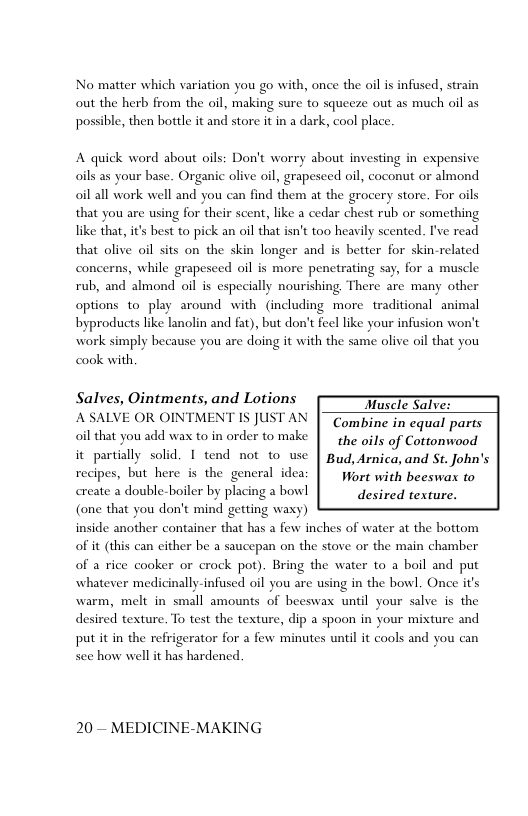
No matter which variation you go with, once the oil is infused, strain out the herb from the oil, making sure to squeeze out as much oil as possible, then bottle it and store it in a dark, cool place.  A quick word about oils: Don’t worry about investing in expensive oils as your base. Organic olive oil, grapeseed o, coconut or almond oil all work well and you can find them at the grocery store. For oils that you are using for their scent, like a cedar chest rub or something ke that, i’ best to pick an oil that isn’t too heavily scented. I’ve read that olive oil sits on the skin longer and is better for skin-related concerns, while grapesced oil is more penetrating say, for a muscle rub, and almond ol is especially nourishing, There are many other options to play around with (including more traditional animal byproducts like lanolin and fat), but don’t feel like your infusion won’t work simply because you are doing it with the same olive oil that you cook with,  Salves, Ointments, and Lotions Tfascle Salver ASALVE OR OINTMENT IS JUST AN [~Goriine in cqual pares | oil that you add wax-to in order to make | ghe oils of Cottonmood  it partially solid. I tend not 0 wse | Bud, Arnica, and St. John’s recipes, but here is the general idea: | Wore with beeswar to ereate a double-boiler by placing a bowl desired texture.  (one that you don’t mind getting waxy)  inside another container that has a few inches of water at the bottom of it (this can cither be a saucepan on the stove or the main chamber of a rice cooker or crock pot). Bring the water 10 a boil and put whatever medicinally-infused oil you are using in the bowl. Once it’s warm, melt in small amounts of beeswax until your salve is the desired texture. To test the texture, dip a spoon in your mixture and put it in the refrigerator for a few minutes until it cools and you can see how well it has hardened  — MEDICINE-MAKING
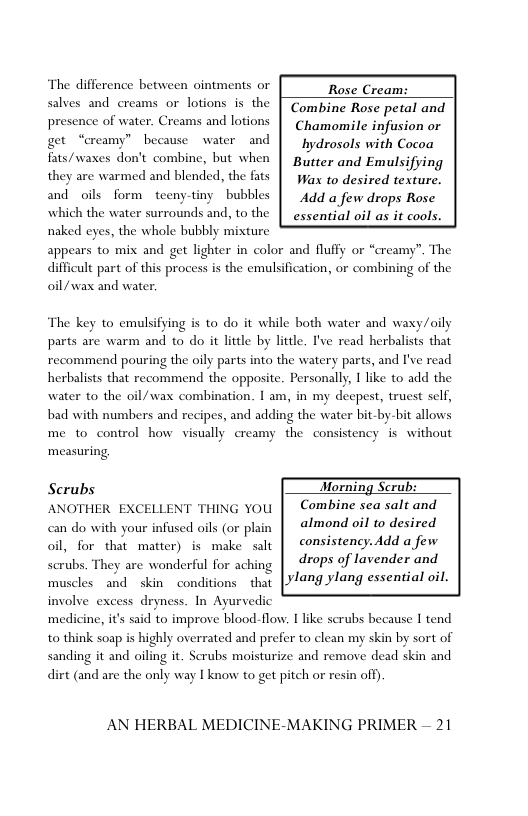
The difference between ointments or  Rose Cream: Combine Rose petal and Chamonmile infusion or get “creamy” becawse water and | hydrosols with Cocoa fts/waxes don’t combine, but when | Butter and Emulsifying Wax to desired texture. and oils form teeny-tiny bubbles | Add a few drops Rose which the water surrounds and, to the | essential oil as it cools.  salves and creams or lotions is the presence of water. Creams and lotions  they are warmed and blended, the fats  naked eyes, the whole bubbly mixture appears to mix and get lighter in color and fluffy or “creamy”. The difficult part of this process is the emulsification, or combining of the oil/wax and water  The key to emulsifying is to do it while both water and waxy/oily parts are warm and to do it little by little. I’ve read herbalists that recommend pouring the oily parts into the watery parts, and I’ve read herbalists that recommend the opposite. Personally, I like to add the water to the oil/wax combination. I am, in my deepest, truest self, bad with numbers and recipes, and adding the water bit-by-bit allows me to control how visually creamy the consistency s without ‘measuring  Scrubs Morning Scrul  ANOTHER EXCELLENT THING you | Combine sea salt and almond oil to desired  consistency. Add a few drops of lavender and | ylang ylang essential oil.  ith your infused ol (or plain oil, for that matter) is make salt scrubs. They are wonderful for aching muscles and skin ~conditions  that  involve excess dryness. In Ayurvedic ne, it’s said to improve blood-flow. 1 like scrubs because I tend to think soap is highly overrated and prefer to clean my skin by sort of sanding it and oiling it. Scrubs moisturize and remove dead skin and dirt (and are the only way I know to get pitch or resin off)  medi  AN HERBAL MEDICINE-MAKING PRIMER — 21
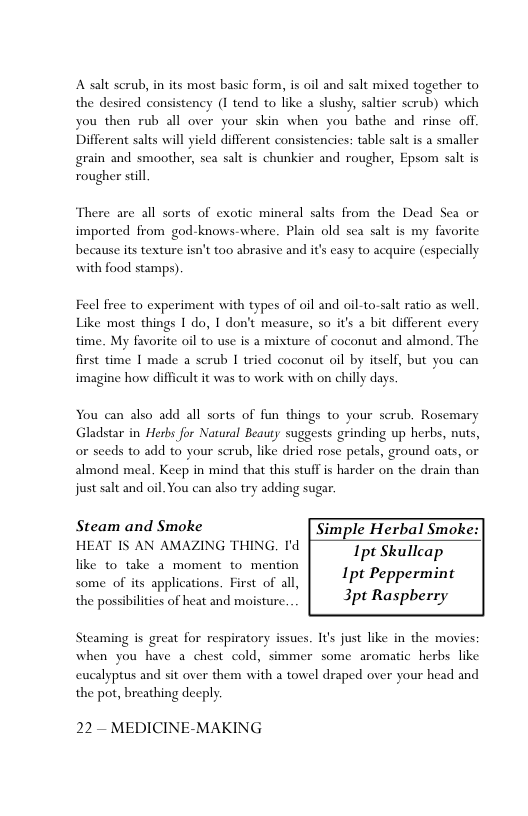
A salt scrub, in its most basic form, is oil and salt mixed together to the desired consistency (I tend to like a slushy, saltier scrub) which you then rub all over your skin when you bathe and rinse off. Different salts will yield different consistencies: table salt is a smaller grain and smoother, sea salt is chunkier and rougher, Epsom salt is rougher still  There are all sorts of exotic mincral salts from the Dead Sea or imported from god-knows-where. Plain old sca salt is my favorite because its texture isn’t too abrasive and it’s casy to acquire (especially with food stamps).  Feel free to experiment with types of oil and oil-to-salt ratio as well Like most things I do, 1 don’t measure, so it’s a bit different every time. My favorite oil to use is a mixture of coconut and almond. The first time 1 made a scrub I tried coconut oil by itself, but you can imagine how difficult it was to work with on chilly days.  You can also add all sorts of fun things to your scrub. Rosemary Gladstar in Herbs for Natural Beauty suggests grinding up herbs, nuts, or seeds to add to your scrub, like dried rose petals, ground oats, or almond meal. Keep in mind that this stuff is harder on the drain than just salt and oil. You can also try adding sugar.  Steam and Smoke Simple Herbal Smok HEAT IS AN AMAZING THING. I’d Ipt Skullcap like 10 take a moment 0 mention | Cp some of its applications. First of all, Pt Pepp:  the possibilities of heat and maisture. 3pt Raspberry  Steaming is great for respiratory issues. It’s just like in the movies: when you have a chest cold, simmer some aromatic herbs like  cucalyptus and sit over them with a towel draped over your head and the pot, breathing deeply  2~ MEDICINE-MAKING
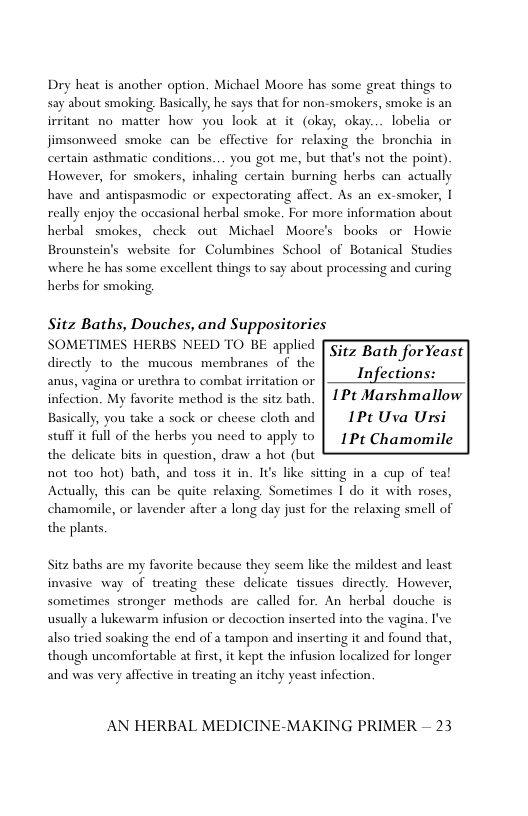
Dry heat is another option. Michacl Moore has some great things to say about smoking, Basically, he says that for non-smokers, smoke i irvitant no matter how you look at it (okay, okay... lobelia or jimsomweed smoke can be effective for relaxing the bronchia in certain asthmatic conditions.... you got me, but that’s not the point). However, for smokers, inhaling certain burning herbs can actually have and antispasmodic or expectorating affect. As an ex-smoker, | really enjoy the occasional herbal smoke. For more information about herbal smokes, check out Michacl Moore’s books or Howie  Brounstein’s website for Columbines School of Botanical Studies where he has some excellent things to say about processing and curing herbs for smoking  Sitz Baths, Douches, and Suppositories  SOMETIMES HERBS NEED TO BE applicd (G pep oy directly to the mucous membrancs of the  anus, vagina or urethra to combat irritation or | —Lfections: _| infection. My favorite method is the sitz bath. | [Pt Marshmallow Basically, you take a sock or cheese cloth and [ 1Pt Uva Ursi stuff it full of the herbs you need to apply 1o | | P Chamomile  the delicate bits in question, draw a hot (but not too hot) bath, and toss it in. Its like sitting in a cup of teal Actually, this can be quite relaxing. Sometimes 1 do it with roses, chamomile, or lavender after a long day just for the relaxing smell of the plants.  Sitz baths are my favorite because they seem like the mildest and least e way of treating these delicate tissues directly. However, sometimes stronger methods are called for. An herbal douche is usually a lukewarm infusion or decoction inserted into the vagina. I’ve also tried soaking the end of a tampon and inserting it and found that, though uncomfortable at first, it kept the infusion localized for longer and was very affective in treating an itchy yeast infection  AN HERBAL MEDICINE-MAKING PRIMER — 23
Similarly, suppositories are herb-infused butters which can  be inserted into the vagina or anus. They are really soothing to irritated skin and can be made by heat-infusing the desired herbs in cocoa  butter, then molding it into litle casily-inserted balls as it cools.  BIBLIOGRAPHY AND RESOURCES  A Few Favorites The Herbal Medicine-Makers Handbook, James Green Medicinal Plants of the Pacificest, Michael Moore (www.swsbm. com)  Sacred and Herbal Healing Beers: The Secrets of Ancient Fermentation, Stephen Harrod Buhner  The Practice of Traditional Western Herbalism: Basic Doctrine, Energetics, and Classification, Matthew Wood (www.matthewwoodherbs.com)  Herbs for Natural Beauty, Rosemary Gladstar  Rosemary Gladstar’s Family Herbal: A Guide to Living Life with Energy, Health, andVitality  Howie Brounstein (www.botanicalstudies.net)  A Modern Herbal, Maud Grieve  Wild Fermentation: The Flavor, Nurition, and Crafi of Live-Culture Foods, Sandor Ellis Katz  Wiselfoman Herbal for the ChildbearingYear, Susan Weed  24— BIBLIOGRAPHY AND RESOURCES
NOTES, RECIPES
Anti-Copyright 2010 yggdrasildistro.wordpress.com  intowishind@gmail.com

AN HERBAL
MEDICINE-MAKING

-S|

SIMON THE SIMPLER
CONTENTS

This is Anarcho-Herbalism 2
An adapted essay originally by Laurel Luddite

Wildcrafting 8
Medicine-Making 11

Bibliography and Resources 24

AN HERBAL MEDICINE-MAKING PRIMER — 1
THIS IS ANARCHO-HERBALISM

Thoughts On Health and Healing For the Revolution
Originally by Laurel Luddite

MY MEDICINE CHEST IS A COUNCIL of bioregions, with
representatives gathered together as I make my way around the world
west of the Rocky Mountains. The Coptis root was picked out of the
churned-up scar left by an excavator, at the retreating edge of the
Idaho wilderness. The tiny amount of Pipsissewa leaves came from an
ancient grove above the Klamath River just feet away from where the
District Ranger sat on a stump talking about his plans to cut it all
down. 1 am drying Nettles from the California creck where salmon
dic in the slt et after a century of industrial logg

Every jar holds a story (often a ghost story of dying ccosystems and
places gone forever). | am honored to have known the plants in their
home places and to have studied their uses as medicine. But for
people not lucky enough to roam throughout the wilds, purchased
herbal preparations such as tinctures may be the link back to this sort
of heali

Like so much in this consumerist society, it is casy to ignore the
connections between a bottle on a shelf in some store and a living,
growing plant out in the world somewhere. It can be hard to know if
the plant grows a mile away or on another continent. There is much to
be said for reconnecting, for educating ourselves about the herbs we
use and gathering our own medicine when we can. That's how we will
be able to build a whole new system of healing, one that can support
our movement away from the corporate power structure that the
practice of medicine has become.

The development of a new medical system, or the recovery of ancient
‘models, is another link in our safety net as industrialism fals. It kecps

2 ~THIS IS ANARCHO-HERBALISM
us alive and kicking out windows in these last days of the System
when so many people have no acce
reestablish our connection to the real medicine that s the Earth

to industrial medicine. It will

An Alternative to " Alternative Medicine"

THE SORT OF HERBAL MEDICINE popular these days (presented
to us by the media and so-called Green Capitalists as yet another
exciting fad) has brought with it very little thought of a new way of
healing The plants, reduced to capsule form or, worse, to their "active
ingredients”, are just new tools to work with in the same body-
‘machine that industrial medicine secs people as being They become
no different than pharmaceutical drugs or a scalpel blade: something
to pry into the body-machine with and use to mess around with the
parts. Except, of course, much less effective, because the herbs have
been taken out of the system of healing in which they have their
strength. A system within which the individual has the power and
knowledge and capability to heal themselves directly and without the
‘numbing influence of marketing and money,

When the marketers of herbal products get their hands on a new
"miracle cure", it can mean extinction for the plant. This is especially
sad when so many living creatures go into useless products or are
wasted on conditions that they don't treat. (Has anyone clse seen that
Echinacea shampoo?) The classic example of this is Goldenseal,
Hydrastis canadensis, a plant close to extinction in the wild. It has a
couple of amazing actions in the human body
marketed as a cure for the common cold, wl
nothing to help. By the way, the largest brokers of wild-harvested
Goldenscal and many other big-name herbs are multinational
pharmaceutical corporations. Given American society's obsession with
herbal Viagra, weight loss pills, and stimulants, most of the herbs on
the mass market are being sacrificed to these ridiculous causes.

but has mostly been

h it will do almost

AN HERBAL MEDICINE-MAKING PRIMER — 3
There is an alternative to "alternative medicine”. Southwestern
herbalist, author, and teacher Michael Moore probably said it best in
one of his recent digressions from a lecture: "In this country, the herb,
business mostly revolves around recently marketed substances with
new research, and it comes from them to us. Whereas we're trying to
establish as much as possible (in this lower lerel, if you will) the fact
that we need to create a practice and a model that's impervious to
faddism. We're trying to practice in a way that derives from practice
rather than from marketing. Not from abose to below but from below
around. Bioregionalism iiber alles. Keep it local. No centralization,
because centralization kills everything "

Herbo-Primitivism

WE NEED ANOTHER WAY OF looking at our bodies and the plant
‘medicines. Sceing the two as interconnected and in balance is new to
industrial culture, but in reality it is the most ancient healing model
on carth. We knew it before we were “people”. Animals know how to
use plants to medicate themselves; their examples surround us, from
dogs cating grass to bears digging Osha root. Probably every human
society has had some way of explaining how the body works and how
plant medicines work in us.

One thing all herbalists know - dogs and bears included - is that a
health problem s best treated before it begins. In more primitive
societies where people have the luxury of listening to their own
bodies it is casy to spot an imbalance before it turns into an acute
discase state. This is where herbs are most effective. They work at this
sub-clinical (and therefore invisible to industrial medicine) level of
"imbalances" and "deficiency” and "excess". Their major task is in
sustaining and maintaining a healthy organism and, in cases of illness,
encouraging that organism to heal itself.

4 —THIS IS ANARCHO-HERBALISM
This old/new healing system is subtle and requires a lot of self-
knowledge, or at least self-awareness. It uses intuition as a diagnostic
tool. Emotion, spirituality, and environment become medicines. The
spirit and environment of the plants we gather affects their healing
propertics, and our relationship with those plants becomes very
important.

Green Herbalogy

WHEN WE TAKE HERBAL MEDICINE we are taking in part of the
plant’s environment. Everything it ate and drank and experienced has
formed the medicine you're depending on, so you better make sure it
gets all the best, When we are healed by plants, we owe it to them to
Took out for their kind and the places where they live. Traditional
plant-gatherers often have a prayer they recite before they take
anything from the wild. 1 usually say something along the lines of
"OK, plant. You heal me and Il look out for you. T got your back. No
one's gonna build over you, or log you, or pick too much while I'm
around." So this true herbal healing system has at its heart a decp and
radical environmentalism and a commitment to the Earth.

‘The bioregional concept is important to this model of healing. Plants’
actions in our bodies are really quite limited by the chemicals they can
produce from sunlight and soil. For every big-name herb on the
market cut from the rainforest or dug from the mountains, there is
most likely a plant with a similar action growing in your watershed
Some of the best medicines to maintain good health grow in vacant
Tots and neglected gardens around the world.

AN HERBAL MEDICINE-MAKING PRIMER — 5
Anarcho-Herbalism

A SOCIETY OF PEOPLE WHO ARE responsible for their own
health and able to gather or grow their own medicines is a hard
society to rule. These days we are dependent on the power structure
of industrial health care and medical specialization: the secret society
of the doctors, the white-male-dominated medical schools, the
corporate decision makers with their toxic pharmaceuticals and
heartless greed and labs full of tortured beings. That dependence is
one more thing keeping us tied down to the State and unable to rebel
with all our hearts or even envision a world without such oppression
With a new system of healing, based on self-knowledge and
community herbal wisdom, we will be that much more free

Offering a real alternative health care system will help to calm some
people’s fears about returning to an anarcho-primitivist, Earth
centered way of life. There is a false security in the men with the big
‘machines, ready to put you back together again (if you have enough
‘money). What is ignored is the fact that industrial society causes most
of the dis-cases that people fear. Living free on a healing Earth while
surrounded by true community and eating real food will prove to be a
better medicine than anything you can buy.

What steps can we make now towards creating this new system of
‘medicine? We all need to learn what we can about our own health
“This could mean training in one or more of the surviving models of
traditional healing and/or through self-observation. How do you fecl
when you're just starting to get a cold? What kinds of problems come
up repeatedly, especially when you're stressed out? If you are female
bodied, how long is your cycle and what does the blood look like?
Understanding how our bodies act in times of health can help us
recognize the very carly stages of dis-case when herbs are the most
useful

6~ THIS IS ANARCHO-HERBALISM
People who have some background in healing (in the traditional or
industrial systems) can be a great help to those of us who are just
learning, Healers who are working to form this new model, whether
collectively or through their individual practices, should keep in mind
that they are practicing a truly revolutionary medicine which
promotes community-sufficiency, decentralization, and an
appreciation for the Earth

In these times of change, everything is being examined and cither
destroyed, rebuilt, or created from our hearts. Industrialism has
affectcd every aspect of our lives - we are just starting to realize how
‘much has been lost. Medicine is just one part of the machine that we
have to take back and re-create in a form that works for the society
we will become. Every herb, pill, and procedure should be judged on
its sustainability (true sustainability, not just green-washed marketing)
and accessibility to small groups of people. We can start with
ourselves, with our communities and circles, but should never stop
expanding outwards until industrial medicine rusts in a forgotten
grave, a victim of its own imbalances.

AN HERBAL MEDICINE-MAKING PRIMER — 7
WILDCRAFTING

The Ethics and Methods of Foraging

ONE OFTHE MOST LIBERATING THINGS about herbalism
is the ability to walk outside and pick a plant with your own hands
and then use it to nourish and heal yourself

Ethical wildcrafting requires knowledge and respect (and, if it's
commercial, a permit). Learning your first few plants is the hardest
part. Once you can learn to differentiate a few plants from the
multitude, you'll find you can't walk around the block without
noticing new plants and familiarizing yourself with your bioregion. A
basic region-specific plant guide can be a really useful tool for the
beginning forager as well as the experienced herbalist; you never
know when you'll run into a new plant friend or want to double
check your knowledge

It can be casy to get intimidated by the amount of medicinal and
botanical information out there. But, don't get discouraged; all you
really need to know is a handful of weeds to feed and heal yourself. If
you are just beginning, try picking five or six plants to learn to
identify and really focus on them 5o as not to overwhelm yourself
When you take walks, try to identify them visually at various points in
their growth cycle. Pick a leaf or flower to carry with you and remind
yourself. If it's a mild medicine or food plant, taste it and smell it
often, paying attention to how it makes you feel. This wi
working and intimate knowledge of the plants in your region

Once you've learned a few plants and are ready to harvest them, there
are a few things to consider. First s the bio-availability of that plant in
your arca, With plants that are rare, endangered or simply not
common where you live, it is especially important to make sure that

8 - WILDCRAFTING
you harvest with caution. A good rule of thumb is to avoid harvesting
plants from stands of less than twenty and to harvest no more than ten
percent of what you see. It is also important to make sure you help to
propagate the plants you are harvesting cither by spreading the sceds
in the fall or, if you are harvesting roots, re-planting some root-
crowns as you go. The United Plants Savers, founded by Rosemary
Gladstar, has ongoing information about endangered and threatened
plant species that is a great reference for the ethical wilderafter. The
website is www. unitedplantsavers. org.

Season is also important to consider when harvesting, For instance,
harvesting flowers when they are all withered and soaked in the fall
will probably be less beneficial to you medicinally than harvesting
them in full bloom. I've found that a nice way to think about it is this
harvest plants in the season where their energy is flowing toward the
part of the plant you are using, I the spring, energy is flowing up the
plant's stalk out of the root and into newly budding leaves, so this is
usually a good season for fresh leafy greens, Summertime takes cnergy
from the leaves up into flower buds, and when they begin to wither
and turn to seed in the fall, everything is flowing back down the stalk
to be stored in the oot for the winter, Different plants mature in
different seasons, but this is a good generalization.

It's also important to notice some things about the arca from which
you are harvesting plants for ingestion. Herbs growing on roadsides,
in ditches or waterways downstream from industrial sites, or in arcas
exposed to pesticides and herbicides should probably not be harvested
for medicinal purposes.

Above all, the most important thing to remember when wildcrafting
is that you are taking something from another living organism and it
should be done with the utmost respect. Some people have rituals
they carry out while harvesting in order to remind themselves of this

AN HERBAL MEDICINE-MAKING PRIMER — 9
fact and to thank the plants for their gifts. T think it's nice to sit with
the plants you are about to harvest for a while before you begin
When harvesting balsam root on one occasion, my friend Sara
encouraged me to walk around the plants quictly and get to know.
them rather than just picking one to pull out of the ground at
random.

1 know another person who talks with the herbs he is about to
harvest, letting them know he's not picking them wastefully, thanking
them, and reminding them that one day his flesh will return to the
soil, giving them the gifts of his life in turn. This ritual harkens back to
the pagan practice of reciting a poem (along a similar theme) to the
elder before breaking a twig from her for wand-making,

Humans routinely steal, pillage, and plunder from the carth. The least
we can do as mindful foragers is carry out our work with respect and
give as much back as we can. I'm told by another herbalist friend that
some North American tribes had a practice of leaving offerings of
tobacco or other goods behind after harvesting medicines. Personally,
1 think that mindfulness and the practical habit of going back to stands
in the fall to help propagate the plants you've harvested are really
simple and important practices that even the most rationally-minded,
spiritually-resistant herbalists can do.

10 - WILDCRAFTING
MEDICINE-MAKING

A Discussion of Menstra and Recipes

Drying and Processing

ONCE YOU'VE GROWN, HARVESTED, FORAGED or acquired
your fresh herbs, it's time to think about how you are going to process
them. To dry the acrial parts of plants, the leaves and flowers still
attached to the stalks, gather a handful and bind them together at the
base (the part of the stalk that would've been closest to the ground
when the plant was growing) and hang the bundle upside-down. If
you are plucking leaves or flowers off of growing stalks, as with single
calendula blossoms or nettle leaves, you can lay them out on a grilling
rack or screen to dry. Grilling racks work well because they allow air
to flow under the drying herbs, preventing mold. This method also
works well for roots, berries and barks, as well as thicker, juicier
plants. For roots and barks, brush the dirt and moss off of them, break
them into smaller portions, lay them out on your rack or
shady corner (direct sunlight tends to break plants down faster), and
et them be. If you are worried about mold, the important things to
remember are air flow and shade; the faster your plants can dry in
these conditions the higher the quality of your final product

One last word on processing: once your herbs are dry, it's time for my
favorite part... Garbling! Garbling is the process of picking through
ng
umwanted twigs or sceds or whatever little bits you don't want in the
final product. All you need to do after this is store the plants in an air-
tight container in a dark place

your dried plants, breaking them into smaller picces and remoy

Menstra
THERE ARE MANY DIFFERENT WAYS to store herbs for later use,
‘many different methods of preservation and extraction. Drying herbs

AN HERBAL MEDICINE-MAKING PRIMER — 11
for storage is an excellent way to keep them for later. However, plants
are liquid-based organisms full of juice and water and oils, and drying
them often breaks these delicate bits and pieces down, especially over
time. Depending on the part of the plant you are using and the
purpose you have intended for it, different solvents or mensira can
preserve and impart different qualities

In my mind, there are three basic menstra used in herbal medicine
water, alcohol, and oil (I include fats and waxes with oils). The
simplest and most commonly-used menstrum s water, preparing
herbs in the form of teas. Commercially, alcohol extractions
(tinctures) are very popular, as are oil infusions and salves, but there
are many other ways to store herbs depending on your needs, o be
ereative and experiment!

N.B. Preerving and procesing herbs i seful for many reasons, but 1 hink ch very best
way to putthem i your body i by eating them fiesh !

Infusions Nutritive Te
IEYOUVE EVER MADE A CUP of tea, you'se [ 1 b Negele
‘made an infusion, An infusion is a water extraction

made by pouring hot water over plant matter and | | PtAYalfa
i steep. | 1 pt Oat Straw

letting it steep. Because herbs are largely water-

based organisms, some herbalists such as
Christopher Hobbs argue that, aside from simply picking the herb
fresh and cating it, water extractions such as infusions are the ideal
solvent to transport the goodness of an herb from plant to body

Infusions are ideal for the leafy and flowering parts of plants because
many of their constituents are water-soluble, like gums, sugars,
proteins, alkaloids, astringent tannins and minerals. Woodier parts of
plants can also be infused and should be left to steep much longer (up
to cight hours according to some herbalists like Susan Weed). Cold
infusions are also an option, made by stecping the herbs in non-heated
water for a few hours or overnight.

2~ MEDICINE-MAKING
Decoctions Warming Decoction
A DECOCTION IS A WATER extraction | for Chest Colds:
just like an infusion, but with a major

difference in preparation. With an infusion,
hot water is poured over the plant matter nanm
and steeped, while a decoction is prepared 1 pt Licorice

Tpt Ginger
1 pt Cinnamon

the herb in water and simmering
iod of time, usually until you see the color of the water
change significantly. Some herbalists think of a decoction as a
concentrated water infusion in the sense that the decoction isn't done
until at least half of the water has evaporated off, leaving a very strong
concentrate. This method works well for roots, barks and berries

because they are generally sturdier and more difficult to permeate
than the delicate acrials, whose volatile constituents evaporate off in
extended exposure to heat.

An important thing to note is that you should never boil herbs
intended for medicine, This is a concept that I'm sure is debatable, but
it has been my experience and understanding that many of the active
constituents of herbs begin to break down when they are boiled, just
as they do when herbs are dried improperly or withered and old. The
key concept to understand is that you want the plant to be as close to
its original green, growing, living self as possible when it enters your
body, 5o the less you shock it and deconstruct it in the process of
‘medicine-making, the better. Therefore, keeping a decoction at a
simmer is logically a better method than boiling plant matter and,
even if it takes a bit longer to create a dark, rich-looking decoction
this way, I think you'll find that the medicinal and nut
are generally better

tional results

AN HERBAL MEDICINE-MAKING PRIMER — 13
Tinctures Relaxing Nervine:

GRAIN ALCOHOL TINCTURES Ipt Lemon Balm
are a simple and efficient way to Ipt Skullcap
make an herbal extraction. Herb !
companics use weight ratios, 2pt St John's
expensive tincture presses and Wort (fresh)
percolators to make their tincturcs, 1pt Motherwort

but the folk method is very easy 0 | Cover with good whiske
do at home and works just as well. It

goes like this: once you've harvested the desired herbs, put them in a
jar, cover them with hard alcohol, set it in a dark corner, and give it a
shake every once in awhile. After 2-6 weeks, strain the alcohol off the

herb, squeezing every last drop out of the plant matter, and bottle it

up.

The above method is the simplest I know for making tinctures, but
there are other things you can try that 1 have little personal
experience with but that other herbalists recommend. One method is
tincturing with dried plants that are ground to a powder before they
are immersed in alcohol. Another variation is tincturing by
percolation, which James Green and Michel Moore both seem to
prefer. There seems to be plenty of room for experimental variation.

Because different constituents of plants are soluble in different
menstra, its important to find a solvent that is cffective for the
constituents that you're working with. The benefit of pure alcohol s a
solvent is that it extracts balsams, camphors, resins, essential oils,
alkaloids, and acrid and bitter constituents. Homeopaths swear by
pure alcohol. Alcohol also preserves your extracts and prevents
decomposition, unlike plain water. However, alcohol tinctures can be
part water and part alcohol (for instance, 100 proof vodka is 50%
alcohol and 50% water) and, logically, something that extracts well in
alcohol ar water will probably do well in a combination of alcohol and
water

4~ MEDICINE-MAKING
Most herb companies use high-proof alcohol like Everclear or pure
alcohol which they dilute with water until i's the right ratio. Though
there are charts listing the proper alcohol content with which to
extract different aspects of different plants, the home medicine-maker
doesn't necessarily have to be that meticulous. For the folk herbalist,
all you really need is a bottle of 40 or 50-proof vodka. Some herbalists
like Matthew Wood tout lower-proof alcohols like Brandy. Otherwise,
it's really up to you; there's no one *right” grain alcohol. Because I'm
generally broke and my favorite drink to nip is good bourbon or Irish
whiskey, I like to buy it for my tinctures, use what I need, then
celebrate my hard work with the left-overs. It's a lovely litle ritual

Brewing is an ancient practice. Even in more recent history, in the
herbals of Galen and Culpepper, many of the formulas suggested
involve less-alcoholic fermentations than the tinctures we buy at the
health food store today. Wine was a popular menstrum for warming
remedies, beers and ales are sedatives and sometimes bitter, mead and
even vinegar were used as well. So, even if you aren't brewing your
own alcohol, it can be fun to experiment with lower-content menstra,
especially considering the price of good vodka

Glycerites Sedative Glycerite
| HAVE LIMITED EXPERIENCE WITH | Fresh Valerian Root

glycerin tinctures, but I thought 1 should |y oerable Glycerin
Tt them a5 an option. Glycerin is a by Lo b

product of fixed oils. When purchasing glycerin, look for vegetable
glycerin derived from coconut oil as opposed to synthetic or animal-
derived products.

Some people prefer glycerin because it has no alcohol content but
mixes readily with both water and alcohol. It is a preservative and
anticbacterial and is especially effective at extracting tannins
However, James Green in his Home Medicine-Maker's Handbook points

AN HERBAL MEDICINE-MAKING PRIMER — 15
out that it has a very limited range of solvency, not mixing well with
resins or volatile or fixed oils. I would also like to point out from the
DIY perspective that it is a highly processed substance and there are
much simpler and more readily-available options. However, please
experiment for yourself,

Fermenting

SOMETIMES ITHINK, “If... No, when industrial civilization collapses
and 1 don't have ecasy access to things like distilled alcohol or
processed vegetable glycerin, how will 1 extract and preserve my
medicines?” Aside from simply drying all of my herbs, 1 think the
wild fermentation. Pickling and fermenting have been used
for thousands of years. There are endless options and there are some
really great books out there to help you explore the possibilities. Two
of my favorites are Wild Fermentation and Sacred and Herbal Healing
Beers.

‘The subject of home brewing and wild fermentation is vast. In my
very limited experience, the simplest way to begin home brewing is
with mead because all you need is honey, water and a clean
environment to store your mixture for a few weeks as it ferments.
“There are plenty of excellent recipes available online and in the books
I've listed above,

Another quicker method is lacto-fermentation, as with sauerkraut,
relishes and kimchi. While many of these methods involve stecping
‘medicinal herbs in a solvent to extract their qualities, there are ways
to ferment and preserve them whole. Pickling works well with fruits
and vegetables, but some cultures use this method to preserve leafy
herbs like grape leaves and roots like ginger. Lacto-fermentation can
also be used to quickly ferment herbal water infusions in just a few
days, producing a very low-alcohol, fizzy brew. All you need for lacto-
fermentation is water, sweetener, whey (the liquid part of your
organic yogurt), and maybe some salt and other seasonings. As with

6 — MEDICINE-MAKING
‘making mead, this method is casy to rescarch, simple to experiment
with, and you can read about it online or in the above-mentioned
books

Kombucha is the last type of fermentation I'd like to suggest in your
herbal experimentation. It's become a popular commercial beverage,
but is actually quite casy to make yourself. It's another way to
preserve your favorite water-infusions. All you need is a bottle of your
favorite unpasteurized kombucha as a starter, something high in
tannins like green tea, and whatever herbs or fresh juices you are
craving. Again: many options and variables, a fairly quick process, and
casy to rescarch in the aforementioned references.

Syrups Winter Syrup:
SYRUPS ARE DELICIOUS AND Concentration of
casy to make. They are soothing Fresh Elderberries
and sweet, and” when made Afew slices Ginger
with honey rather than sugar Affcw tices st
they can be even more Honey

‘medi

nal. 1 could write a | Add a few tablespoons of syrup|
discourse on_the nutritional | an orange slice, and a dash of
and medicinal properties of | cayenne to a cup of hot water,
honey. Suffice it to say, as a | for a warming winter brew.

medicine, honey is sweet and

therefore nutritive, its warming internally and externally, and
soothing to the mucosa of the lungs and bronchia. I’ also an excellent
way to make medicine palatable.

As with medicinal plants, a good guideline is to work honey at lower
temperatures whenever possible. To make a medicinal syrup, make an
herbal decoction with the plants you are interested in using. Simmer
your tea, allowing half of the water to evaporate so that you are left
with a very strong, dark liquid. Keeping it on low heat, mix in honey
5o that your concoction is one part honey, one part herb-infused

AN HERBAL MEDICINE-MAKING PRIMER — 17
water. Once the honey is fully dissolved, take your syrup off the heat
and bottle it up. Don't worry if it seems too thin or watery, itll
thicken as it cools. If you aren't canning it, be sure to store it in the
refri

igerator or somewhere cool, or you'll saon have a borttle of mead.
If you steep herbs in honey it makes a honey infusion. Decocting herbs
in water and adding honey in at the last minute then refrigerating or
canning it makes a syrup. However, if you leave that syrup out in the
open, you get mead. Also, if you cook the herbs in honey for too long,
something lse exciting could happen. You could candy them, as with
candied ginger. Roots work especially well. I don't have very much
experience candying myself, but Maud Grieve discusses it at least
briefly in her book 4 Modern Herbal where she talks about candying
Angelica,

Infused Oil Ear-Ache Oil:
THERE ARE SEVERAL DIFFERENTWAYS to [~ T rard
infise oils and they all deserve some | [PLSTesh gartic
experimentation because the results will | 4Pt Mullein

Cover with olive oil

vary based on the herbs you

e using as

well as external factors. The bottom line is
that you are stecping an herb in oil until the ol begins to take on the
color and smell of your plant. The only real risk in this process is
putrefaction due to moisture that may have been in the plant matter

One method that I find works well is macerating your herbs in a small
amount of oil, cither with a mortar and pestle or some sort of blender
or food processor. Then, put the maceration in a jar and mix in an
amount of oil sufficient to fully immerse the plant material
Understand that if the herb is dried, it may expand with the moisture
and you may need to add an inch or so of extra oil to compensate. At
this point, you can just leave the jar in a dark place and shake it every
once in a while until i’ steeped

8 — MEDICINE-MAKING
Another option that I find works well is to set the jar in a warm place
like on top of a radiator; it seems to help the infusing process. You can
also create a double-boiler in a rice cooker (or something that will
‘maintain a steady, low temperature) and heat the oil that way.

Some people recommend warming the oil in the sun, but I tend
toward the idea that, once picked, herbs keep better when they are
out of direct sunlight. The aforementioned radiator method works
wonders on even hard-to-dissolve resins. If you don't have a radiator,
setting your oil-herb maceration in the oven with just the pilot light
on works just as well. Whatexer you do, make sure the lid is slightly
Toose so that any moisture in the plants doesn't heat to the point that it
breaks your glass jar. Goocy resins are difficult to clean up and a
shame to waste.

Some plants yield their goodness to oil more casily than others. To
deal with the more difficult plants, Michacl Moore recommends
covering the plant matter first in a bit of alcohol and leting it sit for a
few hours, then adding it all to a blender with oil. He says to mix the
whole thing until the blender is hot to the touch, at which point you
can strain out the plant matter and call it good. If you are infusing oil
with fresh herbs- which I think, in general, is the most effective
technique- there are a few ways to preserve the oil so that the plant's
water content docsn't spoil it. I've noticed that olive oil is especially
resistant to spoilage and, if all of the plant material is thoroughly
covered, I never really have a problem with it. Another option is to
add a natural preservative to the oil such as vitamin E oil or benzoin
powder. Another method- one that I read about in Michacl Moore's
Medicinal Plants of the Pacific West- is to take your fresh plant and,
instead of purceing it with oil nitially, use the alcohol method. This is
especially effective in extracting saint john's wort and calendula
Alcohol is drying and, according to Moore and in my own experience,
i you let this puree sit for a few hours or over night and then mix in
the oil, it not only prevents putrefaction but also helps extract the
‘medicinal constituents of the plant.

AN HERBAL MEDICINE-MAKING PRIMER — 19

No matter which variation you go with, once the oil is infused, strain
out the herb from the oil, making sure to squeeze out as much oil as
possible, then bottle it and store it in a dark, cool place.

A quick word about oils: Don't worry about investing in expensive
oils as your base. Organic olive oil, grapeseed o, coconut or almond
oil all work well and you can find them at the grocery store. For oils
that you are using for their scent, like a cedar chest rub or something
ke that, i’ best to pick an oil that isn't too heavily scented. I've read
that olive oil sits on the skin longer and is better for skin-related
concerns, while grapesced oil is more penetrating say, for a muscle
rub, and almond ol is especially nourishing, There are many other
options to play around with (including more traditional animal
byproducts like lanolin and fat), but don't feel like your infusion won't
work simply because you are doing it with the same olive oil that you
cook with,

Salves, Ointments, and Lotions Tfascle Salver
ASALVE OR OINTMENT IS JUST AN [~Goriine in cqual pares |
oil that you add wax-to in order to make | ghe oils of Cottonmood

it partially solid. I tend not 0 wse | Bud, Arnica, and St. John's
recipes, but here is the general idea: | Wore with beeswar to
ereate a double-boiler by placing a bowl desired texture.

(one that you don't mind getting waxy)

inside another container that has a few inches of water at the bottom
of it (this can cither be a saucepan on the stove or the main chamber
of a rice cooker or crock pot). Bring the water 10 a boil and put
whatever medicinally-infused oil you are using in the bowl. Once it's
warm, melt in small amounts of beeswax until your salve is the
desired texture. To test the texture, dip a spoon in your mixture and
put it in the refrigerator for a few minutes until it cools and you can
see how well it has hardened

— MEDICINE-MAKING
The difference between ointments or

Rose Cream:
Combine Rose petal and
Chamonmile infusion or
get “creamy” becawse water and | hydrosols with Cocoa
fts/waxes don't combine, but when | Butter and Emulsifying
Wax to desired texture.
and oils form teeny-tiny bubbles | Add a few drops Rose
which the water surrounds and, to the | essential oil as it cools.

salves and creams or lotions is the
presence of water. Creams and lotions

they are warmed and blended, the fats

naked eyes, the whole bubbly mixture
appears to mix and get lighter in color and fluffy or “creamy”. The
difficult part of this process is the emulsification, or combining of the
oil/wax and water

The key to emulsifying is to do it while both water and waxy/oily
parts are warm and to do it little by little. I've read herbalists that
recommend pouring the oily parts into the watery parts, and I've read
herbalists that recommend the opposite. Personally, I like to add the
water to the oil/wax combination. I am, in my deepest, truest self,
bad with numbers and recipes, and adding the water bit-by-bit allows
me to control how visually creamy the consistency s without
‘measuring

Scrubs Morning Scrul

ANOTHER EXCELLENT THING you | Combine sea salt and
almond oil to desired

consistency. Add a few
drops of lavender and
| ylang ylang essential oil.

ith your infused ol (or plain
oil, for that matter) is make salt
scrubs. They are wonderful for aching
muscles and skin ~conditions that

involve excess dryness. In Ayurvedic
ne, it's said to improve blood-flow. 1 like scrubs because I tend
to think soap is highly overrated and prefer to clean my skin by sort of
sanding it and oiling it. Scrubs moisturize and remove dead skin and
dirt (and are the only way I know to get pitch or resin off)

medi

AN HERBAL MEDICINE-MAKING PRIMER — 21
A salt scrub, in its most basic form, is oil and salt mixed together to
the desired consistency (I tend to like a slushy, saltier scrub) which
you then rub all over your skin when you bathe and rinse off.
Different salts will yield different consistencies: table salt is a smaller
grain and smoother, sea salt is chunkier and rougher, Epsom salt is
rougher still

There are all sorts of exotic mincral salts from the Dead Sea or
imported from god-knows-where. Plain old sca salt is my favorite
because its texture isn't too abrasive and it's casy to acquire (especially
with food stamps).

Feel free to experiment with types of oil and oil-to-salt ratio as well
Like most things I do, 1 don't measure, so it's a bit different every
time. My favorite oil to use is a mixture of coconut and almond. The
first time 1 made a scrub I tried coconut oil by itself, but you can
imagine how difficult it was to work with on chilly days.

You can also add all sorts of fun things to your scrub. Rosemary
Gladstar in Herbs for Natural Beauty suggests grinding up herbs, nuts,
or seeds to add to your scrub, like dried rose petals, ground oats, or
almond meal. Keep in mind that this stuff is harder on the drain than
just salt and oil. You can also try adding sugar.

Steam and Smoke Simple Herbal Smok
HEAT IS AN AMAZING THING. I'd Ipt Skullcap
like 10 take a moment 0 mention | Cp
some of its applications. First of all, Pt Pepp:

the possibilities of heat and maisture. 3pt Raspberry

Steaming is great for respiratory issues. It's just like in the movies:
when you have a chest cold, simmer some aromatic herbs like

cucalyptus and sit over them with a towel draped over your head and
the pot, breathing deeply

2~ MEDICINE-MAKING
Dry heat is another option. Michacl Moore has some great things to
say about smoking, Basically, he says that for non-smokers, smoke i
irvitant no matter how you look at it (okay, okay... lobelia or
jimsomweed smoke can be effective for relaxing the bronchia in
certain asthmatic conditions.... you got me, but that's not the point).
However, for smokers, inhaling certain burning herbs can actually
have and antispasmodic or expectorating affect. As an ex-smoker, |
really enjoy the occasional herbal smoke. For more information about
herbal smokes, check out Michacl Moore's books or Howie

Brounstein's website for Columbines School of Botanical Studies
where he has some excellent things to say about processing and curing
herbs for smoking

Sitz Baths, Douches, and Suppositories

SOMETIMES HERBS NEED TO BE applicd (G pep oy
directly to the mucous membrancs of the

anus, vagina or urethra to combat irritation or | —Lfections: _|
infection. My favorite method is the sitz bath. | [Pt Marshmallow
Basically, you take a sock or cheese cloth and [ 1Pt Uva Ursi
stuff it full of the herbs you need to apply 1o | | P Chamomile

the delicate bits in question, draw a hot (but
not too hot) bath, and toss it in. Its like sitting in a cup of teal
Actually, this can be quite relaxing. Sometimes 1 do it with roses,
chamomile, or lavender after a long day just for the relaxing smell of
the plants.

Sitz baths are my favorite because they seem like the mildest and least
e way of treating these delicate tissues directly. However,
sometimes stronger methods are called for. An herbal douche is
usually a lukewarm infusion or decoction inserted into the vagina. I've
also tried soaking the end of a tampon and inserting it and found that,
though uncomfortable at first, it kept the infusion localized for longer
and was very affective in treating an itchy yeast infection

AN HERBAL MEDICINE-MAKING PRIMER — 23
Similarly, suppositories are herb-infused butters which can be
inserted into the vagina or anus. They are really soothing to irritated
skin and can be made by heat-infusing the desired herbs in cocoa

butter, then molding it into litle casily-inserted balls as it cools.

BIBLIOGRAPHY AND RESOURCES

A Few Favorites
The Herbal Medicine-Makers Handbook, James Green
Medicinal Plants of the Pacificest, Michael Moore (www.swsbm. com)

Sacred and Herbal Healing Beers: The Secrets of Ancient Fermentation,
Stephen Harrod Buhner

The Practice of Traditional Western Herbalism: Basic Doctrine, Energetics, and
Classification, Matthew Wood (www.matthewwoodherbs.com)

Herbs for Natural Beauty, Rosemary Gladstar

Rosemary Gladstar's Family Herbal: A Guide to Living Life with Energy,
Health, andVitality

Howie Brounstein (www.botanicalstudies.net)

A Modern Herbal, Maud Grieve

Wild Fermentation: The Flavor, Nurition, and Crafi of Live-Culture Foods,
Sandor Ellis Katz

Wiselfoman Herbal for the ChildbearingYear, Susan Weed

24— BIBLIOGRAPHY AND RESOURCES
NOTES, RECIPES
Anti-Copyright 2010
yggdrasildistro.wordpress.com

intowishind@gmail.com