An Abbreviated DIY Guide to Making a Jail Support Plan
Web PDFImposed PDFRaw TXT (OCR)
An Abbreviated Do It Yourself Guide to Making a Jail Support Plan
Jail support can look like:  Creating an "ARREST WILL" before the action.  Identifying a trusted jail support person who is not attending the action to hold your “arrest will" and monitor your safety/arrest status and call your contacts if you get arrested.  Coordinating people to be your emergency contacts and take care of your family or pets if you get arrested. These are people whom Jjail support will contact in case of your arrest.  If org-affiliated, having lawyers to support in case of your arrest. If unaffiliated and attending an action autonomously, you (with the help of your personal network) will need to arrange a lawyer or wait assignment to a public defender.  *“lif cats could talk  to cops  they wouldn’t.  Securing bail funds or raising money to pay bail, if heeded.  Preparing a list of your medications and your medical provider’s contact info in case of arrest and any additional medical support in jail is needed.
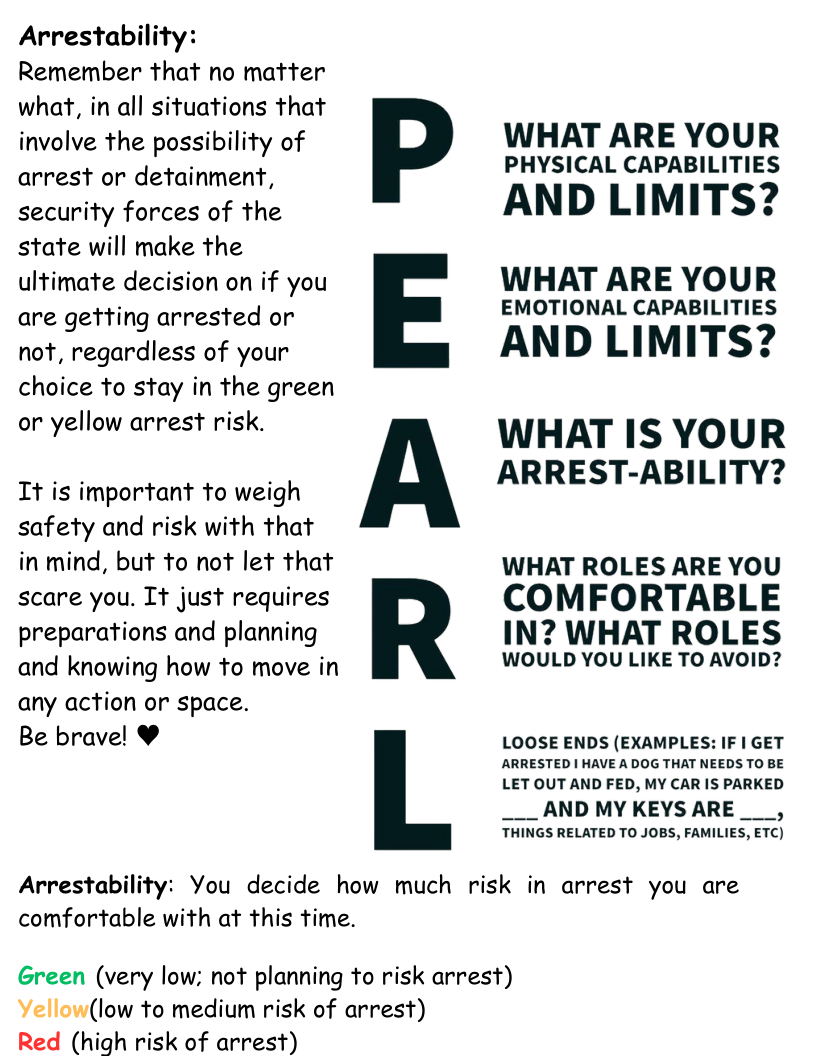
Arrestability:  Remember that no matter what, in all situations that involve the possibility of arrest or detainment, security forces of the state will make the ultimate decision on if you are getting arrested or not, regardless of your choice to stay in the green or yellow arrest risk.  It is important to weigh safety and risk with that in mind, but to not let that scare you. It just requires preparations and planning  and knowing how to move in  any action or space. Be brave! ®  P E A R L  WHAT ARE YOUR PHYSICAL CAPABILITIES  AND LIMITS?  WHAT ARE YOUR  EMOTIONAL CAPABILITIES  AND LIMITS?  WHAT IS YOUR ARREST-ABILITY?  WHAT ROLES ARE YOU COMFORTABLE IN? WHAT ROLES  WOULD YOU LIKE TO AVOID?  LOOSE ENDS (EXAMPLES: IF | GET ARRESTED | HAVE A DOG THAT NEEDS TO BE LET OUT AND FED, MY CAR IS PARKED  AND MY KEYS ARE ___,  THINGS RELATED TO JOBS, FAMILIES, ETC)  Arrestability: You decide how much risk in arrest you are  comfortable with at this time.  Green (very low; not planning to risk arrest) Vellow(low to medium risk of arrest)  Red (high risk of arrest)
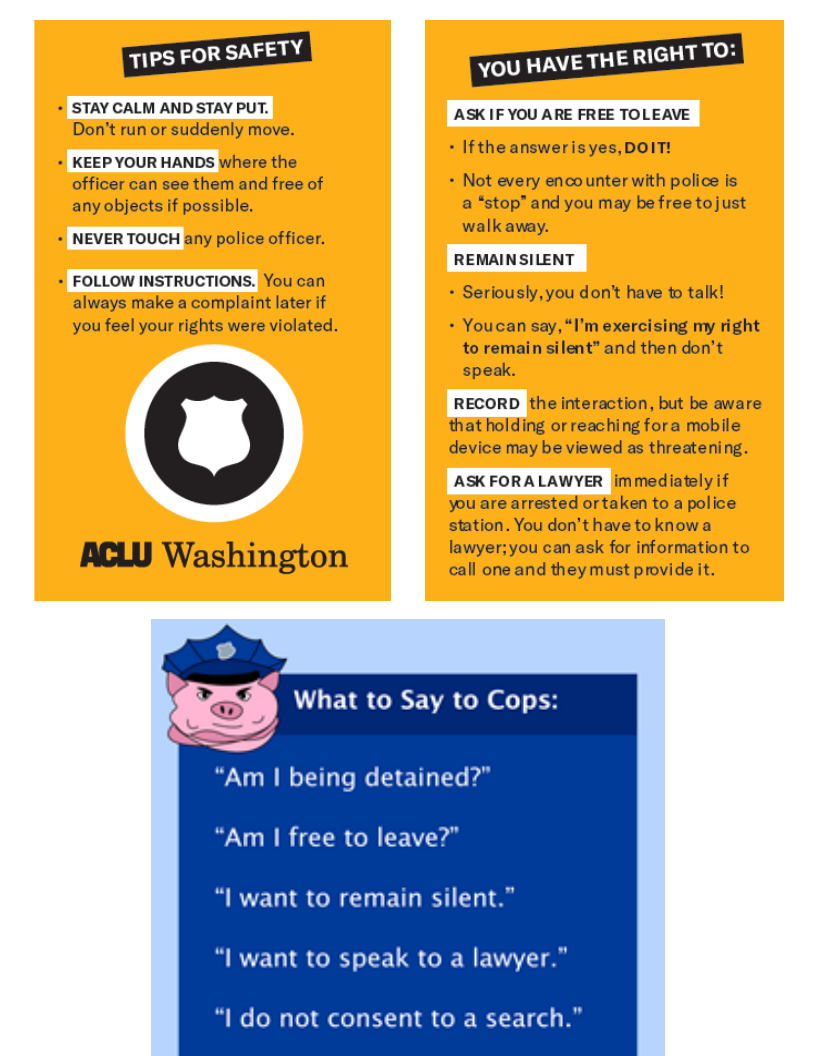
TIPS FOR SAFETY NOU HAVE THE RIGHT T0:  + STAY CALM AND STAY PUT.  ASK IF YOU ARE FREE TOLEAVE Don’t run or suddenly move.  - Ifthe answerisyes,DOIT! + KEEP YOUR HANDS where the  officer can see them and free of + Not every encounter with police is any objects if possible. a “stop” and you may be free tojust walk away.  - NEVER TOUCH any police officer. REMAINSILENT + FOLLOW INSTRUCTIONS. You can  . it ’ ! always make a complaint later if A o  you feel your rights were violated. - Youcan say, “I’m exercising my right to remain silent” and then don’t speak.  RECORD the interaction, but be aware that holding or reaching fora mobile device may be viewed as threatening.  ASK FORALAWYER immediately if you are arrested or taken to a police station. You don’t have toknow a  ACLU Washington lawyer;you can ask for information to  call one and they must provide it.  What to Say to Cops:  “Am | being detained?  “Am | free to leave?"  “I want to remain silent.”  “I want to speak to a lawyer.”  “I do not consent to a searc
Bail vs Bond:  Bail is the amount of money the state will charge you to be released from jail after arrest, before your court date. If you pay the full amount ("post bail"), once you have gone to all of your court dates, the money will be returned to you (fees could be taken out, or court costs, depending on your specific situation).  Your community members will use resources like crowdfunding and community bail funds to get you out, if possible and necessary. If you are able to have some cash set aside in advance that can go toward your bail, put it in an envelope for one of your emergency contacts. If you don’t end up using it, try to keep that cash on hand for future protests just in case! ’  If you do not have the entire bail amount, you can post bond through a bonding agency. This is a smaller amount, usually 10%, that you will pay fo the bonding agency, and they will post the full bail amount to the state on your behalf, under the assumption that you will go to all of your court appearances. However, you do not get this money back after going to court, and if you do not make your court appearances, the bond agency will demand that you pay them the remaining balance of the full bail amount (the other 90%).  For misdemeanor charges, bail can be up to $1,000 per charge. Another thing to consider is that before posting bail or bond, you could be released on personal recognizance (PR). This requires no money, but may not be processed until the next day depending on the time of your arrest - it could mean spending a night in jail. Courts are closed on Sundays and holidays, and in most cases if not facing felony or federal level charging you will be released on PR at the same speed that you would be able to get bailed out.
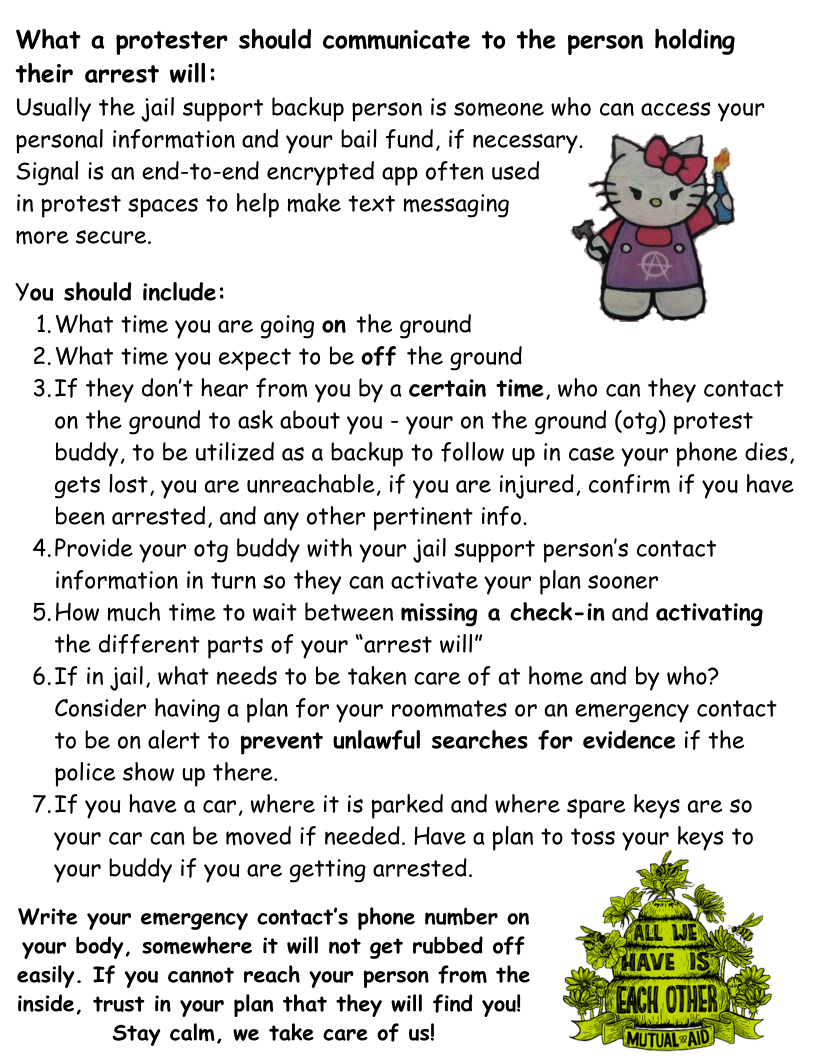
What a protester should communicate to the person holding their arrest will:  Usually the jail support backup person is someone who can access your personal information and your bail fund, if necessary. Signal is an end-to-end encrypted app often used in protest spaces to help make text messaging more secure.  You should include:  1.What time you are going on the ground  2.What time you expect to be off the ground  3.If they don’t hear from you by a certain time, who can they contact on the ground to ask about you - your on the ground (otg) protest buddy, to be utilized as a backup to follow up in case your phone dies, gets lost, you are unreachable, if you are injured, confirm if you have been arrested, and any other pertinent info.  4.Provide your otg buddy with your jail support person’s contact information in turn so they can activate your plan sooner  5.How much time to wait between missing a check-in and activating the different parts of your “arrest will"  6.If in jail, what needs to be taken care of at home and by who? Consider having a plan for your roommates or an emergency contact to be on alert to prevent unlawful searches for evidence if the police show up there.  7.If you have a car, where it is parked and where spare keys are so your car can be moved if needed. Have a plan to toss your keys to your buddy if you are getting arrested.  Werite your emergency contact’s phone number on {  your body, somewhere it will not get rubbed off  easily. If you cannot reach your person from the  inside, trust in your plan that they will find you! Stay calm, we take care of us!
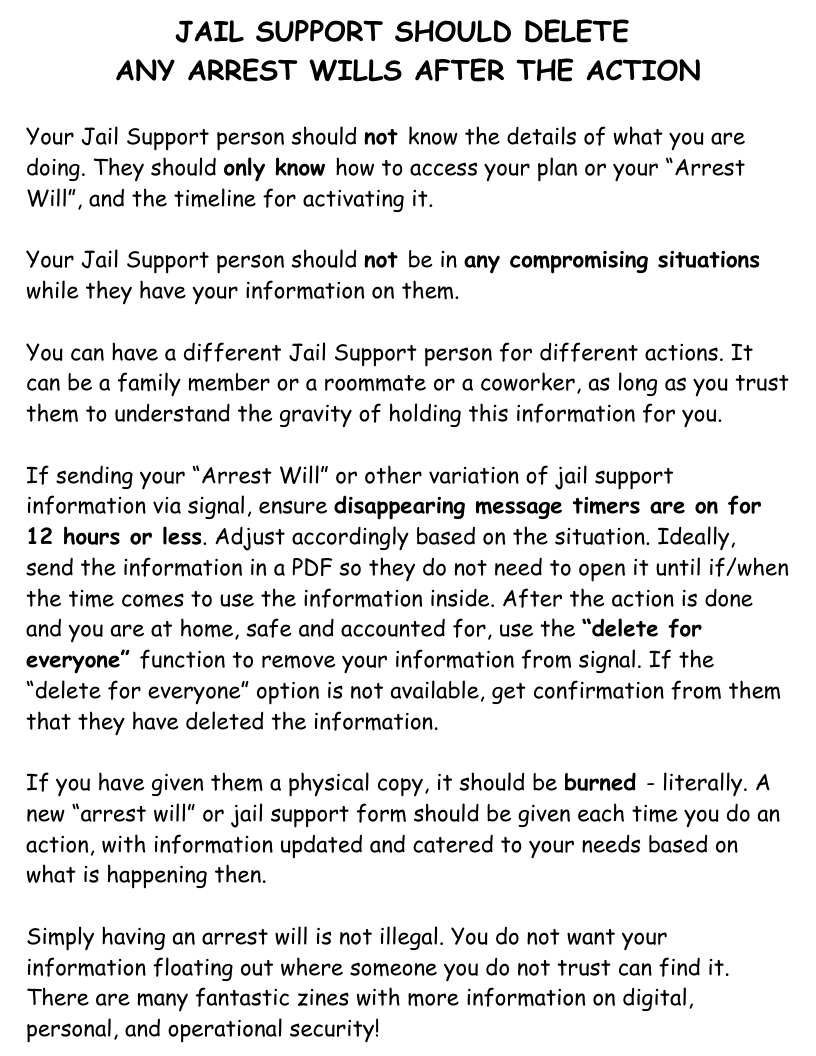
JAIL SUPPORT SHOULD DELETE ANY ARREST WILLS AFTER THE ACTION  Your Jail Support person should not know the details of what you are doing. They should only know how to access your plan or your “Arrest Will", and the timeline for activating it.  Your Jail Support person should not be in any compromising situations while they have your information on them.  You can have a different Jail Support person for different actions. It can be a family member or a roommate or a coworker, as long as you trust them to understand the gravity of holding this information for you.  If sending your "Arrest Will" or other variation of jail support information via signal, ensure disappearing message timers are on for 12 hours or less. Adjust accordingly based on the situation. Ideally, send the information in a PDF so they do not need to open it until if/when the time comes to use the information inside. After the action is done and you are at home, safe and accounted for, use the “delete for everyone” function to remove your information from signal. If the “delete for everyone” option is not available, get confirmation from them that they have deleted the information.  If you have given them a physical copy, it should be burned - literally. A new “arrest will" or jail support form should be given each time you do an action, with information updated and catered to your needs based on what is happening then.  Simply having an arrest will is not illegal. You do not want your information floating out where someone you do not trust can find it. There are many fantastic zines with more information on digital, personal, and operational security!
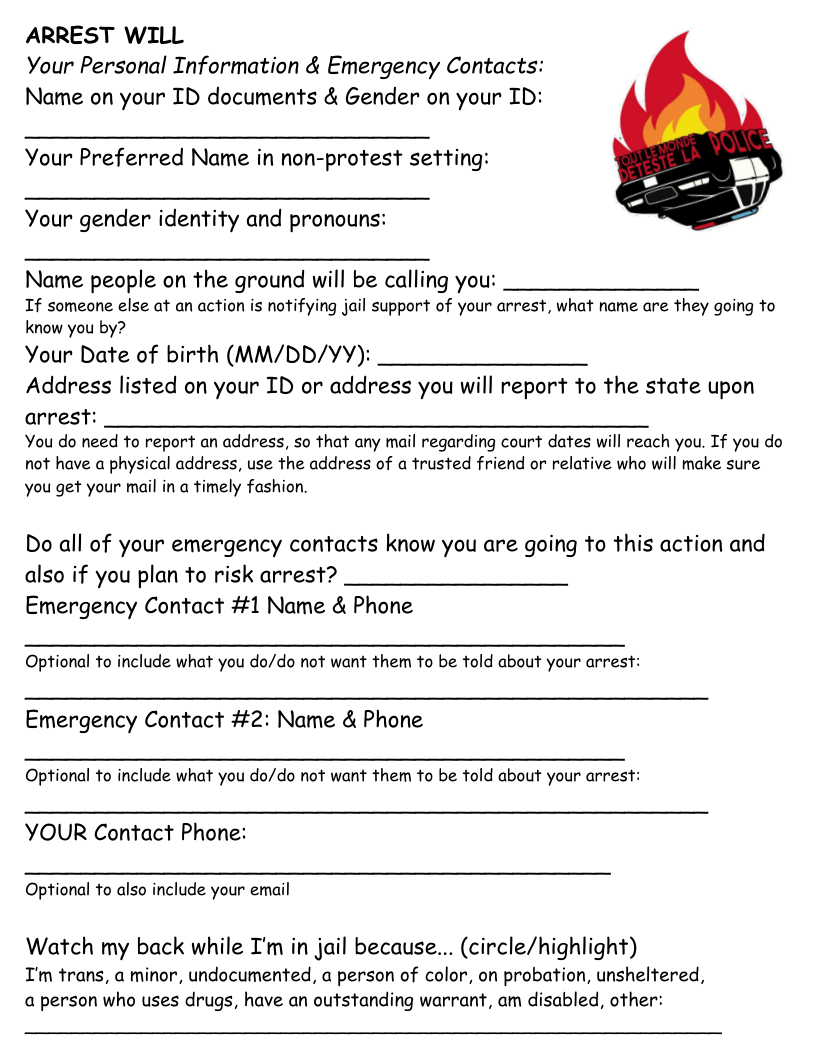
ARREST WILL Your Personal Information & Emergency Contacts: Name on your ID documents & Gender on your ID:  Your Preferred Name in non-protest setting:  Your gender identity and pronouns:  Name people on the ground will be calling you: If someone else at an action is notifying jail support of your arrest, what name are they going to know you by?  Your Date of birth (MM/DD/YY): Address listed on your ID or address you will report to the state upon arrest:  You do need fo report an address, so that any mail regarding court dates will reach you. If you do not have a physical address, use the address of a trusted friend or relative who will make sure  you get your mail in a timely fashion.  Do all of your emergency contacts know you are going to this action and also if you plan to risk arrest? Emergency Contact #1 Name & Phone  Optional to include what you do/do not want them to be told about your arrest:  Emergency Contact #2: Name & Phone  Optional o include what you do/do not want them to be told about your arrest:  YOUR Contact Phone:  Optional to also include your email  Watch my back while I’m in jail because... (circle/highlight) I’m trans, a minor, undocumented, a person of color, on probation, unsheltered, a person who uses drugs, have an outstanding warrant, am disabled, other:
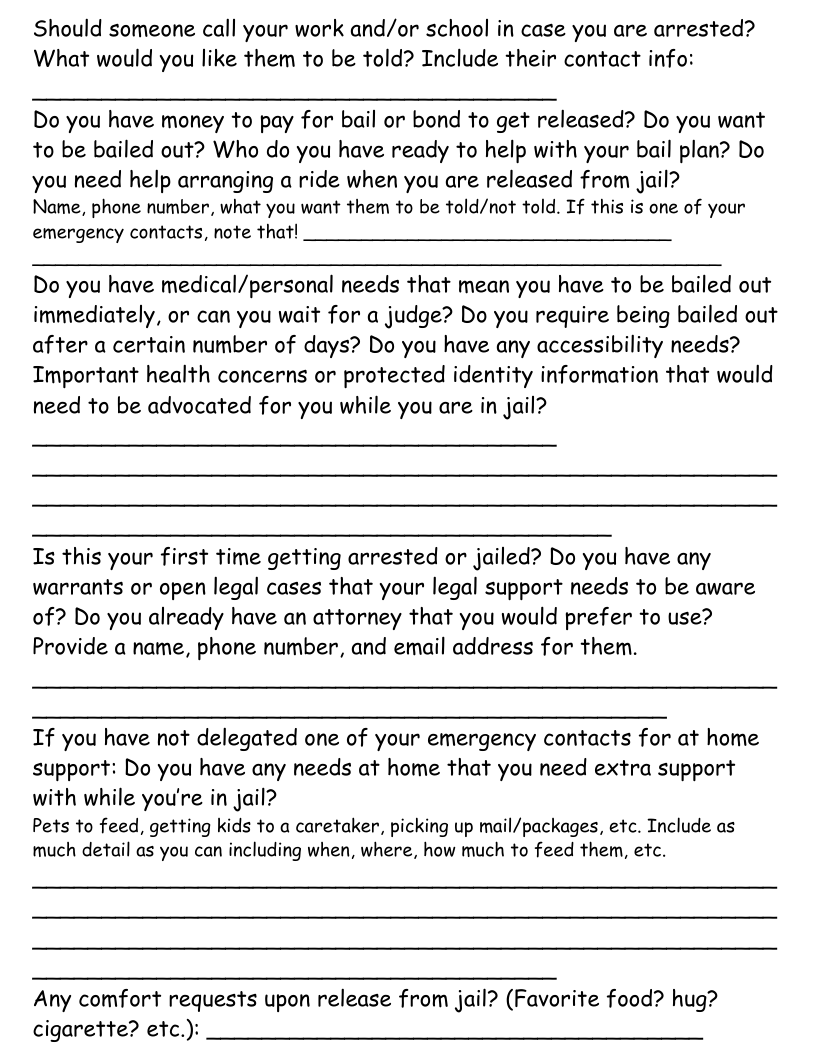
Should someone call your work and/or school in case you are arrested? What would you like them to be told? Include their contact info:  Do you have money to pay for bail or bond to get released? Do you want to be bailed out? Who do you have ready to help with your bail plan? Do  you heed help arranging a ride when you are released from jail? Name, phone number, what you want them to be told/not told. If this is one of your emergency contacts, note that!  Do you have medical/personal needs that mean you have to be bailed out immediately, or can you wait for a judge? Do you require being bailed out after a certain number of days? Do you have any accessibility needs? Important health concerns or protected identity information that would need to be advocated for you while you are in jail?  Is this your first time getting arrested or jailed? Do you have any warrants or open legal cases that your legal support needs to be aware of? Do you already have an attorney that you would prefer to use? Provide a name, phone number, and email address for them.  If you have not delegated one of your emergency contacts for at home support: Do you have any needs at home that you need extra support with while you’re in jail?  Pets to feed, getting kids to a caretaker, picking up mail/packages, etc. Include as much detail as you can including when, where, how much to feed them, etc.  Any comfort requests upon release from jail? (Favorite food? hug? cigarette? etc.):
Medical and access needs, health concerns to consider while protesting and while in jail:  Do you have medical/personal needs that mean you have to be bailed out immediately, or can you wait for a judge? Do you require being bailed out after a certain number of days?  Do you have any accessibility needs? Important health concerns that would need to be advocated for you while you are in jail?  Talk about these things with your jail support team. They will be your biggest advocates at the jail to address your health and well-being. If you take medication, consider including a list of meds and medical contact info for your team to try to hold jail accountable in getting you your meds if you are detained. Include when to take meds, what medication, total dose, dosing, and  what for. To make it less likely for cops to take your meds, keep your meds in  an original bottle with the prescription label.  If you are injured during or after the action, unless very serious to the point emergency services are required, the police and staff will not provide you with health care or treatment, especially if related to your arrest. This includes leaving you soaked in pepper spray and/or tear gas, bleeding or bruised, sprains, etc. If you can get your phone call, let supporting folks know you were injured by the arresting force or if you need a change of clothes brought to you at release.  For supporters and arrestees, be ready to record upon release: all bodily injuries, any broken medical equipment including glasses, and any medical items that were not returned to you. See a medical provider as soon as you can post-  release to create documentation. This can be used later for a lawsuit against whichever entity arrested you.
1T you are arresTed ana you have a disaplliTy, piease note:  * It’s agood idea fo review the route and make sure the route is accessible ahead of time. You may need to contact organizers for this info. Plan your route with rest stops if necessary. Consider bringing a buddy who knows your accessibility needs.  * If you use a mobility device like a cane, the cops might take it during your arrest and you will need to be very direct and persistent o get your mobility needs met. Same with wheelchairs, you may be able to keep it or they might give you a crappy one to use while in custody. If your mobility aid is damaged by the police while you are in custody, document all damage in detail. Calmly say, "I need/require a/my mobility aid, T am unable to walk/ stand/ whatever without assistance."  * For D/deaf/HoH folks, consider the following things: do you have hearing aids? implants? Do you speak ASL and need an interpreter? They are supposed to provide an interpreter upon request, but may not do so - the same can happen for non-English speakers. Do you lip read? As long as your hearing aids aren’t damaged when you are arrested, they should allow you to keep them. Usually cops aren’t masked, so if you can lip read, advocate for yourself by calmly telling them you need to see their lips clearly in order for you to understand them.  * For Blind or Low Vision folks, consider how you maneuver the world. Canes are usually allowed in the jail as long as you clearly identify yourself as Blind. You should expect you will most likely be manhandled/"escorted" by officers and correctional of ficers until you can get your mobility device.  Support in jail for people with disabilities is VERY BAD. Anything that your jail support system should know to advocate for on your behalf and to provide you with additional support on your release should be identified in advance. You may be evaluated by a psychiatrist or nurse in jail. If you admit to having had any recent/ previous suicidal ideations or substance use, you are unlikely to be released until arraignment and placed on an involuntary psych hold. In the psych hold, they might give you rx medications unlike in the general population section of the jail.  Strongly advise DO NOT disclose suicidal ideation or substance use unless it will cause you immediate and further harm to not say so.
This is not an official document and the contents are unaffiliated with any organizations. This zine serves as a starting point for people to support each other through potential arrest at direct actions such as protests. It is  designed to serve as a guide for how you communicate to the people you trust about what you need from them in the event of your arrest.  Pages 6-7 include a form you can fill out and give to your jail support team. You can make more than one version based on who needs to know what.  For example your on the ground buddy might only need to know the emergency contact’s info, while your emergency contact needs to know more personal details. Cater this to meet YOUR needs, and go over it with your team. Destroy copies after actions and make updates each time you need to note changes.  Please note that org-based jail support/legal support is usually only for related org members and is not generally accessible  for unaffiliated folks. If you are attending an action autonomously, please pre- arrange your own jail support using this guide for you to stay safe and dangerous!

An Abbreviated
Do It Yourself
Guide to Making a
Jail Support Plan

Jail support can look like:

Creating an "ARREST WILL" before the action.

Identifying a trusted jail support person who is not attending the
action to hold your “arrest will" and monitor your safety/arrest
status and call your contacts if you get arrested.

Coordinating people to be your emergency contacts and take care
of your family or pets if you get arrested. These are people whom
Jjail support will contact in case of your arrest.

If org-affiliated, having lawyers to support in case of your
arrest. If unaffiliated and attending an action autonomously, you
(with the help of your personal network) will need to arrange a
lawyer or wait assignment to a public defender.

*“lif cats could talk

to cops

they wouldn't.

Securing bail funds or raising money to pay bail, if heeded.

Preparing a list of your medications and your medical provider's
contact info in case of arrest and any additional medical support
in jail is needed.
Arrestability:

Remember that no matter
what, in all situations that
involve the possibility of
arrest or detainment,
security forces of the
state will make the
ultimate decision on if you
are getting arrested or
not, regardless of your
choice to stay in the green
or yellow arrest risk.

It is important to weigh
safety and risk with that
in mind, but to not let that
scare you. It just requires
preparations and planning

and knowing how to move in

any action or space.
Be brave! ®

P
E
A
R
L

WHAT ARE YOUR
PHYSICAL CAPABILITIES

AND LIMITS?

WHAT ARE YOUR

EMOTIONAL CAPABILITIES

AND LIMITS?

WHAT IS YOUR
ARREST-ABILITY?

WHAT ROLES ARE YOU
COMFORTABLE
IN? WHAT ROLES

WOULD YOU LIKE TO AVOID?

LOOSE ENDS (EXAMPLES: IF | GET
ARRESTED | HAVE A DOG THAT NEEDS TO BE
LET OUT AND FED, MY CAR IS PARKED

AND MY KEYS ARE ___,

THINGS RELATED TO JOBS, FAMILIES, ETC)

Arrestability: You decide how much risk in arrest you are

comfortable with at this time.

Green (very low; not planning to risk arrest)
Vellow(low to medium risk of arrest)

Red (high risk of arrest)
TIPS FOR SAFETY NOU HAVE THE RIGHT T0:

+ STAY CALM AND STAY PUT.

ASK IF YOU ARE FREE TOLEAVE
Don't run or suddenly move.

- Ifthe answerisyes,DOIT!
+ KEEP YOUR HANDS where the

officer can see them and free of + Not every encounter with police is
any objects if possible. a “stop” and you may be free tojust
walk away.

- NEVER TOUCH any police officer.
REMAINSILENT
+ FOLLOW INSTRUCTIONS. You can

. it ' !
always make a complaint later if A o

you feel your rights were violated. - Youcan say, “I'm exercising my right
to remain silent” and then don’t
speak.

RECORD the interaction, but be aware
that holding or reaching fora mobile
device may be viewed as threatening.

ASK FORALAWYER immediately if
you are arrested or taken to a police
station. You don’t have toknow a

ACLU Washington lawyer;you can ask for information to

call one and they must provide it.

What to Say to Cops:

“Am | being detained?

“Am | free to leave?"

“I want to remain silent.”

“I want to speak to a lawyer.”

“I do not consent to a searc

Bail vs Bond:

Bail is the amount of money the state will charge you to be
released from jail after arrest, before your court date. If you pay
the full amount ("post bail"), once you have gone to all of your court
dates, the money will be returned to you (fees could be taken out,
or court costs, depending on your specific situation).

Your community members will use resources like crowdfunding and
community bail funds to get you out, if possible and necessary. If you
are able to have some cash set aside in advance that can go toward
your bail, put it in an envelope for one of your emergency contacts. If
you don't end up using it, try to keep that cash on hand for future
protests just in case! ’

If you do not have the entire bail
amount, you can post bond through
a bonding agency. This is a smaller amount, usually 10%, that you will
pay fo the bonding agency, and they will post the full bail amount to
the state on your behalf, under the assumption that you will go to all
of your court appearances. However, you do not get this money back
after going to court, and if you do not make your court appearances,
the bond agency will demand that you pay them the remaining balance
of the full bail amount (the other 90%).

For misdemeanor charges, bail can be up to $1,000 per charge.
Another thing to consider is that before posting bail or bond, you
could be released on personal recognizance (PR). This requires no
money, but may not be processed until the next day depending on the
time of your arrest - it could mean spending a night in jail. Courts
are closed on Sundays and holidays, and in most cases if not facing
felony or federal level charging you will be released on PR at the same
speed that you would be able to get bailed out.
What a protester should communicate to the person holding
their arrest will:

Usually the jail support backup person is someone who can access your
personal information and your bail fund, if necessary.
Signal is an end-to-end encrypted app often used
in protest spaces to help make text messaging
more secure.

You should include:

1.What time you are going on the ground

2.What time you expect to be off the ground

3.If they don't hear from you by a certain time, who can they contact
on the ground to ask about you - your on the ground (otg) protest
buddy, to be utilized as a backup to follow up in case your phone dies,
gets lost, you are unreachable, if you are injured, confirm if you have
been arrested, and any other pertinent info.

4.Provide your otg buddy with your jail support person's contact
information in turn so they can activate your plan sooner

5.How much time to wait between missing a check-in and activating
the different parts of your “arrest will"

6.If in jail, what needs to be taken care of at home and by who?
Consider having a plan for your roommates or an emergency contact
to be on alert to prevent unlawful searches for evidence if the
police show up there.

7.If you have a car, where it is parked and where spare keys are so
your car can be moved if needed. Have a plan to toss your keys to
your buddy if you are getting arrested.

Werite your emergency contact's phone number on {

your body, somewhere it will not get rubbed off

easily. If you cannot reach your person from the

inside, trust in your plan that they will find you!
Stay calm, we take care of us!

JAIL SUPPORT SHOULD DELETE
ANY ARREST WILLS AFTER THE ACTION

Your Jail Support person should not know the details of what you are
doing. They should only know how to access your plan or your “Arrest
Will", and the timeline for activating it.

Your Jail Support person should not be in any compromising situations
while they have your information on them.

You can have a different Jail Support person for different actions. It
can be a family member or a roommate or a coworker, as long as you trust
them to understand the gravity of holding this information for you.

If sending your "Arrest Will" or other variation of jail support
information via signal, ensure disappearing message timers are on for
12 hours or less. Adjust accordingly based on the situation. Ideally,
send the information in a PDF so they do not need to open it until if/when
the time comes to use the information inside. After the action is done
and you are at home, safe and accounted for, use the “delete for
everyone” function to remove your information from signal. If the
“delete for everyone” option is not available, get confirmation from them
that they have deleted the information.

If you have given them a physical copy, it should be burned - literally. A
new “arrest will" or jail support form should be given each time you do an
action, with information updated and catered to your needs based on
what is happening then.

Simply having an arrest will is not illegal. You do not want your
information floating out where someone you do not trust can find it.
There are many fantastic zines with more information on digital,
personal, and operational security!
ARREST WILL
Your Personal Information & Emergency Contacts:
Name on your ID documents & Gender on your ID:

Your Preferred Name in non-protest setting:

Your gender identity and pronouns:

Name people on the ground will be calling you:
If someone else at an action is notifying jail support of your arrest, what name are they going to
know you by?

Your Date of birth (MM/DD/YY):
Address listed on your ID or address you will report to the state upon
arrest:

You do need fo report an address, so that any mail regarding court dates will reach you. If you do
not have a physical address, use the address of a trusted friend or relative who will make sure

you get your mail in a timely fashion.

Do all of your emergency contacts know you are going to this action and
also if you plan to risk arrest?
Emergency Contact #1 Name & Phone

Optional to include what you do/do not want them to be told about your arrest:

Emergency Contact #2: Name & Phone

Optional o include what you do/do not want them to be told about your arrest:

YOUR Contact Phone:

Optional to also include your email

Watch my back while I'm in jail because... (circle/highlight)
I'm trans, a minor, undocumented, a person of color, on probation, unsheltered,
a person who uses drugs, have an outstanding warrant, am disabled, other:

Should someone call your work and/or school in case you are arrested?
What would you like them to be told? Include their contact info:

Do you have money to pay for bail or bond to get released? Do you want
to be bailed out? Who do you have ready to help with your bail plan? Do

you heed help arranging a ride when you are released from jail?
Name, phone number, what you want them to be told/not told. If this is one of your
emergency contacts, note that!

Do you have medical/personal needs that mean you have to be bailed out
immediately, or can you wait for a judge? Do you require being bailed out
after a certain number of days? Do you have any accessibility needs?
Important health concerns or protected identity information that would
need to be advocated for you while you are in jail?

Is this your first time getting arrested or jailed? Do you have any
warrants or open legal cases that your legal support needs to be aware
of? Do you already have an attorney that you would prefer to use?
Provide a name, phone number, and email address for them.

If you have not delegated one of your emergency contacts for at home
support: Do you have any needs at home that you need extra support
with while you're in jail?

Pets to feed, getting kids to a caretaker, picking up mail/packages, etc. Include as
much detail as you can including when, where, how much to feed them, etc.

Any comfort requests upon release from jail? (Favorite food? hug?
cigarette? etc.):

Medical and access needs, health concerns to consider while protesting and
while in jail:

Do you have medical/personal needs that mean you have to be bailed out
immediately, or can you wait for a judge? Do you require being bailed out after
a certain number of days?

Do you have any accessibility needs? Important health concerns that would
need to be advocated for you while you are in jail?

Talk about these things with your jail support team. They will be your biggest
advocates at the jail to address your health and well-being. If you take
medication, consider including a list of meds and medical contact info for your
team to try to hold jail accountable in getting you your meds if you are
detained. Include when to take meds, what medication, total dose, dosing, and

what for. To make it less likely for cops to take your meds, keep your meds in

an original bottle with the prescription label.

If you are injured during or after the action,
unless very serious to the point emergency
services are required, the police and staff will
not provide you with health care or treatment,
especially if related to your arrest. This includes
leaving you soaked in pepper spray and/or tear gas,
bleeding or bruised, sprains, etc. If you can get your phone call, let supporting
folks know you were injured by the arresting force or if you need a change
of clothes brought to you at release.

For supporters and arrestees, be ready to record upon release: all bodily
injuries, any broken medical equipment including glasses, and any medical items
that were not returned to you. See a medical provider as soon as you can post-

release to create documentation. This can be used later for a lawsuit against
whichever entity arrested you.
1T you are arresTed ana you have a disaplliTy, piease note:

* It's agood idea fo review the route and make sure the route is accessible
ahead of time. You may need to contact organizers for this info. Plan your
route with rest stops if necessary. Consider bringing a buddy who knows your
accessibility needs.

* If you use a mobility device like a cane, the cops might take it during your
arrest and you will need to be very direct and persistent o get your mobility
needs met. Same with wheelchairs, you may be able to keep it or they might
give you a crappy one to use while in custody. If your mobility aid is damaged
by the police while you are in custody, document all damage in detail. Calmly
say, "I need/require a/my mobility aid, T am unable to walk/ stand/ whatever
without assistance."

* For D/deaf/HoH folks, consider the following things: do you have hearing
aids? implants? Do you speak ASL and need an interpreter? They are
supposed to provide an interpreter upon request, but may not do so - the
same can happen for non-English speakers. Do you lip read? As long as your
hearing aids aren't damaged when you are arrested, they should allow you to
keep them. Usually cops aren't masked, so if you can lip read, advocate for
yourself by calmly telling them you need to see their lips clearly in order for
you to understand them.

* For Blind or Low Vision folks, consider how you maneuver the world. Canes
are usually allowed in the jail as long as you clearly identify yourself as Blind.
You should expect you will most likely be manhandled/"escorted" by officers
and correctional of ficers until you can get your mobility device.

Support in jail for people with disabilities is VERY BAD. Anything that your jail
support system should know to advocate for on your behalf and to provide
you with additional support on your release should be identified in advance.
You may be evaluated by a psychiatrist or nurse in jail. If you admit to having
had any recent/ previous suicidal ideations or substance use, you are unlikely to
be released until arraignment and placed on an involuntary psych hold. In the
psych hold, they might give you rx medications unlike in the general population
section of the jail.

Strongly advise DO NOT disclose suicidal ideation or substance use unless it
will cause you immediate and further harm to not say so.
This is not an official document and the contents are
unaffiliated with any organizations. This zine serves as a
starting point for people to support each other through
potential arrest at direct actions such as protests. It is

designed to serve as a guide for how you communicate to the
people you trust about what you need from them in the event
of your arrest.

Pages 6-7 include a form you can fill out and give to your jail
support team. You can make more than one version based on
who needs to know what.

For example your on the ground buddy might only need to know
the emergency contact’s info, while your emergency contact
needs to know more personal details. Cater this to meet YOUR
needs, and go over it with your team. Destroy copies after
actions and make updates each time you need to note changes.

Please note that org-based jail support/legal support is usually
only for related org members and is not generally accessible

for unaffiliated folks.
If you are attending an action autonomously, please pre-
arrange your own jail support using this guide for you to
stay safe and dangerous!