A World Without Police
Web PDFImposed PDFRaw TXT (OCR)

No copyright. Share a distribute. A World Without Police, 2016.
Iagine a world without poic  W live in a sociely where almost crery social problem-from noisy neighbors o broken  tailights.-bas become a point o police intervention. The resultis an cpicemi o harassment  and violene. But what if we found otber waysfo sole our ssues? W hat i we rolled back.  police power, and abvlished the institution entirey? Here you are imited fo think and act with ofber visionaris, and find ways to acheve  policfiee workd

|. THE PRO BLEM  Police brtality activists ofen say that police are supposed to protect and serve, and then denounce them for not doing so. Bur these assumptions about the puspose of the police are mistaken. From their inception down to the present, police forces have protected and served the wealthy few against the many, and the white against the rest. Unequal enforcement and violence aren’t aberrations: they are a necessary past of the job.  Historically, police forces were created o protect the property of businesses and the wealthy and enforce white supremacy. In cities they formed to repress the growing numbers of poor people that accompanied the tise of industrial capitalism, while on plantations and in agricultural colonies they formed in response to the threat of slave revolt.  In England, the first police force was funded by wealthy merchants to prevent theft on the commercial docks of London. This effort laid the basis for the establishment of the London Metropolitan Police, the first modern , police departments were  police force in the world, in 1829, In the U established in the mid-1800s in the urban Nostheast to control the riots and diseupii  street culture of the immigeant poor, proteet the property of the
middle class, and enforce fugitive slave laws. In the South police evolved out of slave patrols, and focused on preventing slaves and free black people from aiding escapes or carrying out insurrections.!  In every case, the police were invented to defend the property and interests of the white ruling class. They prevented the esploited from diseupting capitalist society, whether through antisocial behaviors or conscious rebellion.  Today, despite the diversification of police services, the main activity of police remains street patrol. Street patrols enforce a range of ordinances 1o manage the poor and other populations seen as disorderly o insubordinate. They use race-and especially blackness-as a key idens  Tamphins Square patce rot, New York City, 1874. Poice attacked an nemployd people’s demonstration demaning public works pogram:.  for potential targers. Police rarely focus on workplace abuses by bosses or “white collar” crime by the wealthy. Instead they protect commercial areas,  and to 2 lesser extent, the property of the middle classes. Crucially, the most widespread form of oppression in capitalist society is not policed at alk: our exploitation on the job, where the value we create for employers s stolen as profits. Exploitation of this kind is considered entirely normal and lawful, a crime hidden in plain sight.  Today as in the past, police protect the living, working and commercial arrangements that keep capitalism running, and those who benefit from them.*  Because the fundamental role of the police s to defend this unequal system, itis impossible for police to protect and serve everyone equally. Police departments dircct their attention toward the racialized poor and away from the wealthy, and leave everyday capitalist exploitation untouched.  2
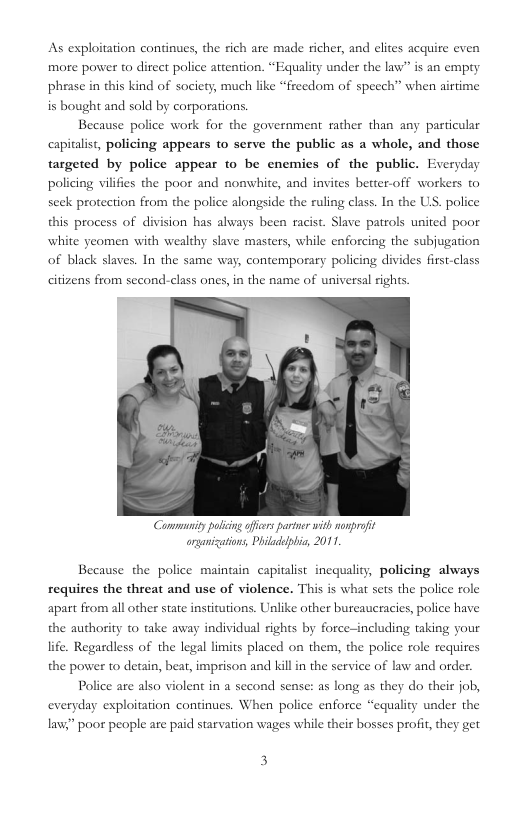
As exploitation continues, the rich are made richer, and elites acquire even more power to direct police attention. “Equality under the law” is an empry phrase in this kind of society, much like “freedom of speech” when airtime is bought and sold by corporations.  Because police work for the government rather than any particular capitalist, policing appears to serve the public as a whole, and those targeted by police appear to be enemies of the public. Everyday policing vilifies the poor and nomwhite, and invites better-off workers t© seck protection from the police alongside the ruling class. In the US. police this process of division has always been racist. Slave patrols united poor whi of black slaves. In the same way, contemporary policing divides first-class  e yeomen with wealthy slave masters, while enforcing the subjugation  citizens from second-class ones, in the name of universal rights  Communipy poling offiars pariner with nonprofit organications, Philadelpbia, 2011,  Because the police maintain capitalist incquality, policing always requires the threat and use of violence. This is what sets the police role apart from all other state institutions. Unlike other bureaucracies, police have the authority 0 take away individual rights by force-including taking your life. Regardless of the legal limits placed on them, the police role requires the power to detain, bear, imprison and killin the service of law and order.  Police are also violent in a second sense: as long as they do their job, everyday exploitation continues. When police enforce “equality under the law” poor people are paid starvation wages while their bosses profit, they get
evicted by the landlords who own their homes, and 0 on. No matter how nonviolent police forces become, this systemic violence will ahways remain. No amount of training, legal oversight, or reform can alter the fundamental violence of the police institution.  The only way to end police violence is through a revolutionary transformation of society, making wealth and resources freely available to al Far from reforming the police while maintaining their current role, this aim requires abolishing the police altogether.  Polie patrol skid row in Los Angels, uly 2014. Eight months lter LAPD offcers would shoo and kill “Arica,” skid row rsidens, e attenpting 1 xics i from bi tent. (Los Angels Times | Jabin Botfrd)

Prateters rallying againt plice siknce bk both dirctions of Interstate 80 in B Calirnia. Decenber 9, 2014. (Photo: Noah Berer, AP)
Il. THE STRATEGY  Cops don’t just kill They patrol schools, hospitals, and public transit. In most cites, they roam the hallways and walkways in housing projects and re stationed in the welfare office, the Walmart, the  apartment complexes. They movie theater and the park. In all these spaces, they enforce white supremacy and protect property and commerce over human life. In fact, they carry out a vital task for capitalism: disciplining poor, Black, queer, indigenous, trans, non-white and disabled people into accepting deteriorating living conditions, reproducing their social difference and isolation, and punishing any and all dissent agains this status quo of alienation and exploitation.  You can’t reform a landmine, but you can dismantle i, destroy the factories that made it, and dissolve the governments and businesses that profit off of its existence. In the same way, we’re not fighting for a new police-nicer, more diverse, with better training than their predecessors-nor even a new justice system. We’re fighting for a world without police. We’re working to disempower, disarm and disband police units and entire agencics wherever they operate, and revolutionize society as a whole.
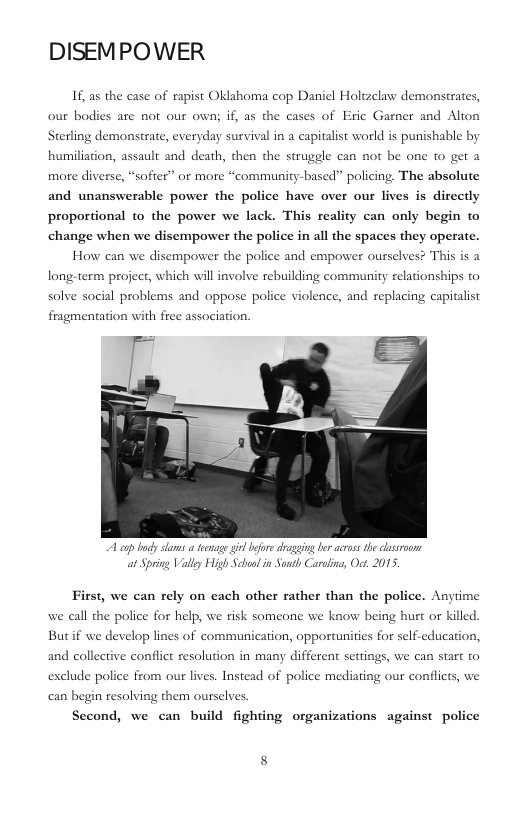
DISEMPOWER  If, as the case of rapist Oklahoma cop Daniel Holtzelaw demonstrates, our bodies are not our own; if, as the cases of Eric Garner and Alton Sterling demonstrate, everyday survival in a eapitalist world is punishable by humiliation, assault and death, then the strugele can not be one to get 2 more diverse, “softer” or more “community-based” policing. The absolute and unanswerable power the police have over our lives is directly proportional to the power we lack. This reality can only begin to change when we disempower the police in all the spaces they operate.  How can we disempower the police and empower ourselves? This is a long:-term project, which will involve rebuilding community relationships to solve social problems and oppose police violence, and replacing capitalist  fragmentation with free association.  A cqp by slams a tenage il efore dragging b acrass the classroon  at Spring Vally High School in Sonth Carolins, Oct. 2015.  First, we can rely on each other rather than the police. Anyime we call the police for help, we risk someone we know being hurt or killed. Butif we develop lines of communication, opportunities for self.education, and collective conflict resolution in many different settings, we can start © exclude police from our lives. Instead of police mediating our conflicts, we can begin resolving them ourselves  Second, we can build fighting organizations against police
violence. These could include groups specifically geared toward monitoring police conduct o challenging their legitimacy in our communities. At the same time, community, school and workplace groups of all types can oppose the expansion of police powers and respond to police violence when it happens.  Third, we can develop “cop frec zones” in our communities, once we ate strong enough to solve social problems ourselves and confront police impunity. This will involve reclaiming public spaces to air grievances, imagine alternatives and socialize, while challenging the fragmentation that capitalism produces and police enforce.” They could begin as temporary “No Cop Zones,” and expand as semi-permanent occupations that a community holds, supports, and defends.  Here are some concrete ideas for how to begin disempowering the police:  At Home + Develop community “phone trees” and rapid response networks t© relay important information, alert folks to police checkpoints, rids or surveillance, and respond to threats from the police in real time. Record police conduct, take collective action t stop police violence when it is  happening, and care for those victimized by it  + Study and share conflict mediation skills, so that minor beefs like noise complaints can be setled between ncighbors without involving the police. Begin building these skills in neighborhood and tenant associations.  * Build survivorled groups to defend against domestic violence and sexual assault. People turn w0 the cops when they have no other way to address violence in private spaces, but alternatives like support nerworks, criss centers and self-defense groups can begin to leave police intervention behind.  + Fight against eviction, whether from a house, an apartment, or a tent. Police exist t0 protect the property of landlords and bosses and enforce their ability o make working class folks pay for access o it. Build tenants’ unions, solidarity networks, eviction defense groups, or other organizations that can defend a neighbor’s access to keeping a roof over their head, regardless of their ability to pay for it. When the police  9
get called in to enforce an eviction, be there o keep them out and keep aneighbor in their home.  In the Streets  + Encourage neighbors (o refuse to talk to the police when they come snooping around the neighborhood. Protest and discredit police programs that incentivize neighbors to snitch and thus contribute 0 each others’ eriminalization and incarceration.  * Build neighborhood networks to intervene in police activity wherever it happens. Forms of this are already popping up around the US. and can be activated through existing lines of communication from ‘ongoing community, workplace or housing organizing. Draw examples from copwatch on how t record police interactions, but don’t stop at monitoring the police. Create a collective culture of resistance that intervenes and deters police from using force and arresting vulnerable targers.  * Build women, queer and trans led groups to defend ourselves against street harassment and queer bashing. When we are able 1o defend ourselves, we won’t have to rely on the same police who harass us in times of crisis  * Organize campaigns to repeal repressive police policies at local, state and federal levels, like Stop-and-Frisk in New York ity or Civil Gang Injunctions in Houston.  + Prevent the construction of police stations and other facilitics through protests and blockades. Set up informational tables outside of police stations and storefront locations to raise awareness about attempts 0 expand heavily policed areas.  * Support a militant protest culture to stop police from contralling and undermining demonsteations, and prevent arrests in the streets.  At School * Wage campaigns to remove police from schools, including clementary, secondary and higher education institutions. These efforts can be led by  10
student groups, eacher’s unions, or parent associations, on their own oF  in coalitions,  * Protest and shut down police recruitment campaigns, for cxample at  job faies or carcer days.  + Oppose police institutions using schools for their own purposes, whether through research partnerships that “reform” police while rebuilding their legitimacy, or cfforts to house riot police during major protests.  Grafii coerspart of  police mesage hat encorages aniching in New York Ciy:  On the Job  + Join with co-vorkers to disrupt material support for police departments or refuse service to cops, like the UPS workers who carried out a Hands Up, Don’t Ship action in Minneapolis. Remember, there is strength in numbers! Coordinate with co-workers to minimize the bosses’ retaliation for these kinds of actions.  + Demand that ot unions disaffiliate from police unions, like teaching assistants in California recently demanded of the AFL-CIO.  * Within existingjob-related organizations, develop the collective’s capaciy t0 defend against police repression. Study and develop strategies &  n
tactics for out-maneuvering the police when you need to defend picket lines, building occupations, or other protest actions. Bosses and cops work hand in hand to keep workers from winning any power on the job.  * Organize Know Your Rights workshops to minimize the legal impact of police interactions, whether on strike or at any other time.  DISARM  The BLM movement was born out of violence. The list of Black and Brown people that have been murdered by police is longer than many of us would like to acknowledge: in 2015, the police murdered 1,146 people nationally, and 2016 is shaping up to be just as deadly with 611 killed by the month of July  Out of all the victims of police terror, only a handful make headlines or become active martyrs in our siruggle. Slogans such as “1 can’t breathe” oe “Hands up, don’t shoot” serve as reminders of the violence we endure. And  a sign dlring a demonstration in Union Squars, New York City. May 2015,  the violence continues when we stand up and fight back: millions watched  as protesters from Baltimore to Baton Rouge were brutalized by the police. Police are granted an immense array of weapons that many of  us have experienced first hand. The Ferguson ebellion offered a perfect  12
example: in Ferguson, police showed out in force with armored vehicles, LRAD systems, stun grenades, short barreled assault ifles, camouflage and military geade body armor. As if this weren’t enough, police sl carried standard weapons such as handguns, tasers, batons, handeuffs and pepper spray, and they were trained in hand to hand combat to “subdue” civilians.  Surveillance and cyber technology are also major weapons in the hands of law enforcement agencies. An assortment of equipment such as stingray devices, license plate scanners, facial recognition and behavioral analytics software assist police in monitoring our actions and anticipating our next moves. They monitor social media and arsest people for daring to express ani-police sentiment. There have already been documented cases of the Department of Homeland Security surveilling BLM activists.  Police armaments are used every day to injure and kill poor people and people of color, and are further employed to repress protests and resistance. The only way to end police brutality and murder is to disarm the police entirely.  Disarming the police involves more than taking away officers’ deadly weapons. It also includes removing the “less than lethal” weapons, and cyber and surveillance tools, that police departments use to repress us. Ultimately it requires a revolutionary transformation of society as a whole,since removing their ability o inflict violence prevents police from maintaining capitalist exploitation and oppression. However, every effort to disarm the police provides our movement breathing room to survive, grow; and work toward this ultimate goal  Here are some ways to begin disarming the police * Close the pipeline between the military and the police, by shuting  down programs that sell military equipment 1o police departments, provide military craining to officers, or find veterans jobs in the police force,  * Expose and denounce political repression, including the use of paid informants, undercover officers, and social media monitoring of activists by police departments.  * Study and share security techniques for activists, including practical  methods of preventinginternet surveillance and decreasing the likelihood and effectiveness of infltration.  13
* Launch campaigns to remove police weapons in specific settings, such as schools, hospital, and ultimately on street patrol.  + Protest local, city and state budget appropriations for police forces and work 10 defund the police. This willdisrupt departments” abiliy to buy weapons, hire more officers, and make the job desirable by providing pay incentives.  DISBAND  We’re not the first to envision a world without police. Residents of Marinaleda, Spain have lived for 30 years without municipal police. In Mexico, indigenous communities in Guerrero developed their own sccurity in 1995 0 replace the corrupt police force, while Zapatista communities in Chiapas have resolved conflicts autonomously since driving out state authorities in 1994 All these efforts seck to disband police institutions and replace them with forms of collective, demoeratic power and conflict resolution. None of them s perfect, but they all indicate  way forward. Achieving police free communities is not a question of “i” but how:  Disbanding the police means more than the ereation of “community peacekeepers” who will continue to enforce capitalist exploitation, oppression and inequality through other means. Along with disempowering and disarming, disbanding police institutions aims at a larger goal: the abolition of police and policing entirely.  As police murders continue and superficial eforms prove unable to stop them, more and more people are recogaizing that the problem is not within police institutions-it is the institution of policing iself. As we stated in “The Problem” section, the only way to end police violence s to transform society, and make wealth and resources freely available to all. Far from reforming the policing while maintaining their current role, this aim requires abolishing the police altogether.  In other words, we’re not fighting for a new police-nicer, more diverse, with better training than their predecessors—nor even a new justice system. We’re working to disempower, disarm, and disband individual police units and entire agencies, and transform society as a whole. We’re fighting for 2 world without police.  14
Here are some steps to disband the police: * Transform how we think about crime, conflict and identity. We can break the association beween erime and violent punishment, justice and jail cells, and criminality and certain kinds of people. We can expose how “etime” talk is used to dehumanize black, indigenous, NBPOC, poor,  queer, unsuly and rebellious people. When we don’t think in terms of  punishment, control and division, we can begin o imagine what real justice might entail  * Fight to disband particular police units when they are involved in seandals or otherwi  policically vulnerable, as happened to the NYPD  Strcet Crimes Unit that murdered Amadou Diallo in 1999  Pratete holds a dsarm HPD sig at  Baltimrs solidariy ralyin Hlauston, TX. May 2015.  * Decommission police precincts when they’re threatencd by funding shortages, demographic changes, or challenges by popular protest  + Organize to dive police forces out of specific institutions, such as schools or hospitals. Instead of replacing them with private security, develop community safety teams that are democratically elected and directed by those they protect.  * Demolish the poliical power of police unions, including lessening their influence in local governments, and ultimately decertifying and disbanding their unions eniely:
* Once our movement is strong enough, disband police forces entirely in democratic self-governing areas, and replace them with systems of  community safety and conflict resolution.  The fight to disempower, disarm and disband the police will be long and comples. Strategies wil vary from place to place depending on conditions.  Do you have ideas for campaigns in your community, or are you already  involved in one? Follow and contribute to A Wortn Wrrtour POLCE to stay.  connected with the fight for a police-free world.  16
References  1. On the origins of the police in England and the US, see Miller, Wilbur (1977). Caps and bobiis: Polce autbority in New York and London, 1830-1870. Chicago: University of Chicago Press; Williams, K. (2004). Our enemies in b Palice and power in America. Brooklyn, NY: Soft Skull Press; and Hadden, Sally (2001). Skare patrols: Law and viokence in Virginia and the Carolinas. Cambridge, Mass: Harvard University Press.  2. See Neocleous, Mark. (2000). The fubricaton of socil orer: A critical theory of police power. London: Pluto Press.  3. Mike Davis provides a historical look at this changing landscape in the contextof Los Angeles. Davis, Mike. (2006). City of Quartz; New York: Verso  Press.

ABOUTUS  A Wotn Wirour PoLicr: is maintained by a collective of organizers from actoss the US. and internationally. We work to connect people struggling against the everyday violence of the police, and o provide practical, organizationl and theoretical tools for use in our movement.  We believe police violence and esploitation cannot be ended through reforms (better trained, better monitored, more friendly cops) but only with the totl abolition of the police as an institution. As we explained in this pamphlet,this is because police forces maintain the inequalities of capitalist society, and will continue to be violent and racist as long as they esist  At the same time, we know police abolition is only possible as part of a broader revolutionary project to abolish the state in its enirety, along with capitalism, white supremacy and patriarchy. The struggle against the police cannot be divided from the broader movement or treated as a single-issue campaign.  This is because “the police” is more than just a group of men and women who wear badges: it is also a historical project of division, upholding a social order where the lves of black, POC, poor, queer and trans people’s lives are forfeit. If we only disband police departments, their role could be replaced by non-uniformed security guards, white supremacist militias and patsiarchal family networks without fundamentally transforming our social relations. A world without police-not simply as police exist now, but as a  19
form of division—requires revolution.  For these reasons, we build our movement with police abolition as a goal, while recognizing that our struggle includes the total abolition of the state and eapital. Local campaigns can work toward these ends by degrading the power and effectiveness of police forces on the ground, and building the ‘capacity of our communities to govern themselves and keep themselves safe. Instead of providing police new tools and legitimacy through reform, this strategy lays the basis for a truly free society.  Contact Us:  Twitter: @No_Cop_Zone  Facebook: @AWorldWithoutPolice Instagram: @AWorldWithoutPolice Email: aworldwithoutpolice@riseup net
FURTHER READING  Agee, Christopher L. (2014). The Streets of San Francico: Polcing and the Creation of a Cosmapolitan Liberal Politics, 1950-1972. Chicago: University of Chicago Press.  Camp, Jordan and Heatherton, Christina, eds. (2016). Pofiing The Planet: Why the palicing eiss e 0 Black Lives Matter: New York: Verso.  Center for Research on Criminal Justice. (1975). The Iron fist and the et glove: An anapsis of the USS. polie. San Feancisco: Center for Research on Criminal Justice.  Creative Interventions. (2012). Creaive Interventions Toolkit: A Practical Guide 10 Stap Interpersonal Vilence  Guidotto, Nadia. (2011). “Looking Back: The Bathouse Raids in Toronto, 1981 in Capfie Genders. Eric A. Stanley and Nat Smith, Eds. Oakland, CA: AK Press. Pg 63-76.  Herbert, Steven. (2006). Ciizens, ops, and power: Reagnizing the limits of commnity. Chicago: University of Chicago Press.  Levi, Margaret. (1977). Bureaucratic insurgeney: The case of police unions. Lexington, Mass: Lesington Books.  Malcolm X Grassroots Movement. (2013). Let Your Motto Be Resistance: A Handbook on Organizing New Afan and Oppressed Commnities for Self Defense.  Mogul, Joey L., Andrea . Ritchie and Kay Whitlock. (2015). “The Ghosts  21
of Stonewall: Policing Gender, Policing Sex.” From Quer (Tn)Jusic The Criminalization of LGBT Peaple in the United States. Boston: Beacon Press, 2012.  Muhammad, Khalil Gibean. (2010). The condermmation of blackness: Race, cime, and the making of modern urban Americe. Cambridge: Harvard University Press  Murakawa, Naomi. (2014). The first il right: How libeals buil prison America Oxford: Oxford University Press.  Neocleous, Mark. (2000). The fabrication of socal orer: A critcal thory of police power: London: Pluto Press.  Rose City Copwatch. (2008). Alernativs fo Palic  Wacquant, Loic. (2009). Punishing the poor: The neoliberal gvernment of social  insecuriy. Durham: Duke University Press. Williams, Kristian. (2004). Our Enenvies in Blue: Polce and power in Anerica New York: Soft Skull Press. Williams, Kistian. (2011). “The other side of the COIN: counterinsurgency and community policing”” Inerfce 3(1).

AWORLDWITHOUTPOLICE.ORG AWORLDWITHO UTPO LIC E@RISEUP.NET

No copyright. Share a distribute.
A World Without Police, 2016.
Iagine a world without poic

W live in a sociely where almost crery social problem-from noisy neighbors o broken

tailights.-bas become a point o police intervention. The resultis an cpicemi o harassment

and violene. But what if we found otber waysfo sole our ssues? W hat i we rolled back.

police power, and abvlished the institution entirey? Here you are imited fo think and act
with ofber visionaris, and find ways to acheve policfiee workd
|. THE PRO BLEM

Police brtality activists ofen say that police are supposed to protect and
serve, and then denounce them for not doing so. Bur these assumptions
about the puspose of the police are mistaken. From their inception down to
the present, police forces have protected and served the wealthy few against
the many, and the white against the rest. Unequal enforcement and violence
aren't aberrations: they are a necessary past of the job.

Historically, police forces were created o protect the property of
businesses and the wealthy and enforce white supremacy. In cities they
formed to repress the growing numbers of poor people that accompanied
the tise of industrial capitalism, while on plantations and in agricultural
colonies they formed in response to the threat of slave revolt.

In England, the first police force was funded by wealthy merchants to
prevent theft on the commercial docks of London. This effort laid the basis
for the establishment of the London Metropolitan Police, the first modern
, police departments were

police force in the world, in 1829, In the U
established in the mid-1800s in the urban Nostheast to control the riots and
diseupii

street culture of the immigeant poor, proteet the property of the
middle class, and enforce fugitive slave laws. In the South police evolved out
of slave patrols, and focused on preventing slaves and free black people from
aiding escapes or carrying out insurrections.!

In every case, the police were invented to defend the property and
interests of the white ruling class. They prevented the esploited from
diseupting capitalist society, whether through antisocial behaviors or
conscious rebellion.

Today, despite the diversification of police services, the main
activity of police remains street patrol. Street patrols enforce a range of
ordinances 1o manage the poor and other populations seen as disorderly o
insubordinate. They use race-and especially blackness-as a key idens

Tamphins Square patce rot, New York City, 1874. Poice attacked an
nemployd people's demonstration demaning public works pogram:.

for potential targers. Police rarely focus on workplace abuses by bosses or
“white collar” crime by the wealthy. Instead they protect commercial areas,

and to 2 lesser extent, the property of the middle classes. Crucially, the most
widespread form of oppression in capitalist society is not policed at alk: our
exploitation on the job, where the value we create for employers s stolen as
profits. Exploitation of this kind is considered entirely normal and lawful, a
crime hidden in plain sight.

Today as in the past, police protect the living, working and
commercial arrangements that keep capitalism running, and those who
benefit from them.*

Because the fundamental role of the police s to defend this unequal
system, itis impossible for police to protect and serve everyone equally.
Police departments dircct their attention toward the racialized poor and
away from the wealthy, and leave everyday capitalist exploitation untouched.

2
As exploitation continues, the rich are made richer, and elites acquire even
more power to direct police attention. “Equality under the law” is an empry
phrase in this kind of society, much like “freedom of speech” when airtime
is bought and sold by corporations.

Because police work for the government rather than any particular
capitalist, policing appears to serve the public as a whole, and those
targeted by police appear to be enemies of the public. Everyday
policing vilifies the poor and nomwhite, and invites better-off workers t©
seck protection from the police alongside the ruling class. In the US. police
this process of division has always been racist. Slave patrols united poor
whi
of black slaves. In the same way, contemporary policing divides first-class

e yeomen with wealthy slave masters, while enforcing the subjugation

citizens from second-class ones, in the name of universal rights

Communipy poling offiars pariner with nonprofit
organications, Philadelpbia, 2011,

Because the police maintain capitalist incquality, policing always
requires the threat and use of violence. This is what sets the police role
apart from all other state institutions. Unlike other bureaucracies, police have
the authority 0 take away individual rights by force-including taking your
life. Regardless of the legal limits placed on them, the police role requires
the power to detain, bear, imprison and killin the service of law and order.

Police are also violent in a second sense: as long as they do their job,
everyday exploitation continues. When police enforce “equality under the
law” poor people are paid starvation wages while their bosses profit, they get
evicted by the landlords who own their homes, and 0 on. No matter how
nonviolent police forces become, this systemic violence will ahways remain.
No amount of training, legal oversight, or reform can alter the fundamental
violence of the police institution.

The only way to end police violence is through a revolutionary
transformation of society, making wealth and resources freely available to al
Far from reforming the police while maintaining their current role, this aim
requires abolishing the police altogether.

Polie patrol skid row in Los Angels, uly 2014.
Eight months lter LAPD offcers would shoo and kill “Arica,”
skid row rsidens, e attenpting 1 xics i from bi tent.
(Los Angels Times | Jabin Botfrd)

Prateters rallying againt plice siknce bk both dirctions of Interstate 80 in B
Calirnia. Decenber 9, 2014. (Photo: Noah Berer, AP)
Il. THE STRATEGY

Cops don't just kill They patrol schools, hospitals, and public transit.
In most cites, they roam the hallways and walkways in housing projects and
re stationed in the welfare office, the Walmart, the

apartment complexes. They
movie theater and the park. In all these spaces, they enforce white supremacy
and protect property and commerce over human life. In fact, they carry out
a vital task for capitalism: disciplining poor, Black, queer, indigenous, trans,
non-white and disabled people into accepting deteriorating living conditions,
reproducing their social difference and isolation, and punishing any and all
dissent agains this status quo of alienation and exploitation.

You can't reform a landmine, but you can dismantle i, destroy the
factories that made it, and dissolve the governments and businesses that
profit off of its existence. In the same way, we're not fighting for a new
police-nicer, more diverse, with better training than their predecessors-nor
even a new justice system. We're fighting for a world without police. We're
working to disempower, disarm and disband police units and entire agencics
wherever they operate, and revolutionize society as a whole.
DISEMPOWER

If, as the case of rapist Oklahoma cop Daniel Holtzelaw demonstrates,
our bodies are not our own; if, as the cases of Eric Garner and Alton
Sterling demonstrate, everyday survival in a eapitalist world is punishable by
humiliation, assault and death, then the strugele can not be one to get 2
more diverse, “softer” or more “community-based” policing. The absolute
and unanswerable power the police have over our lives is directly
proportional to the power we lack. This reality can only begin to
change when we disempower the police in all the spaces they operate.

How can we disempower the police and empower ourselves? This is a
long:-term project, which will involve rebuilding community relationships to
solve social problems and oppose police violence, and replacing capitalist

fragmentation with free association.

A cqp by slams a tenage il efore dragging b acrass the classroon

at Spring Vally High School in Sonth Carolins, Oct. 2015.

First, we can rely on each other rather than the police. Anyime
we call the police for help, we risk someone we know being hurt or killed.
Butif we develop lines of communication, opportunities for self.education,
and collective conflict resolution in many different settings, we can start ©
exclude police from our lives. Instead of police mediating our conflicts, we
can begin resolving them ourselves

Second, we can build fighting organizations against police
violence. These could include groups specifically geared toward monitoring
police conduct o challenging their legitimacy in our communities. At the
same time, community, school and workplace groups of all types can oppose
the expansion of police powers and respond to police violence when it
happens.

Third, we can develop “cop frec zones” in our communities, once
we ate strong enough to solve social problems ourselves and confront police
impunity. This will involve reclaiming public spaces to air grievances, imagine
alternatives and socialize, while challenging the fragmentation that capitalism
produces and police enforce.” They could begin as temporary “No Cop
Zones,” and expand as semi-permanent occupations that a community holds,
supports, and defends.

Here are some concrete ideas for how to begin disempowering the police:

At Home
+ Develop community “phone trees” and rapid response networks t©
relay important information, alert folks to police checkpoints, rids or
surveillance, and respond to threats from the police in real time. Record
police conduct, take collective action t stop police violence when it is

happening, and care for those victimized by it

+ Study and share conflict mediation skills, so that minor beefs like noise
complaints can be setled between ncighbors without involving the police.
Begin building these skills in neighborhood and tenant associations.

* Build survivorled groups to defend against domestic violence and
sexual assault. People turn w0 the cops when they have no other
way to address violence in private spaces, but alternatives like support
nerworks, criss centers and self-defense groups can begin to leave police
intervention behind.

+ Fight against eviction, whether from a house, an apartment, or a tent.
Police exist t0 protect the property of landlords and bosses and enforce
their ability o make working class folks pay for access o it. Build
tenants’ unions, solidarity networks, eviction defense groups, or
other organizations that can defend a neighbor's access to keeping a roof
over their head, regardless of their ability to pay for it. When the police

9
get called in to enforce an eviction, be there o keep them out and keep
aneighbor in their home.

In the Streets

+ Encourage neighbors (o refuse to talk to the police when they come
snooping around the neighborhood. Protest and discredit police
programs that incentivize neighbors to snitch and thus contribute 0
each others’ eriminalization and incarceration.

* Build neighborhood networks to intervene in police activity wherever
it happens. Forms of this are already popping up around the US.
and can be activated through existing lines of communication from
‘ongoing community, workplace or housing organizing. Draw examples
from copwatch on how t record police interactions, but don't stop
at monitoring the police. Create a collective culture of resistance that
intervenes and deters police from using force and arresting vulnerable
targers.

* Build women, queer and trans led groups to defend ourselves against
street harassment and queer bashing. When we are able 1o defend
ourselves, we won't have to rely on the same police who harass us in
times of crisis

* Organize campaigns to repeal repressive police policies at local, state
and federal levels, like Stop-and-Frisk in New York ity or Civil Gang
Injunctions in Houston.

+ Prevent the construction of police stations and other facilitics
through protests and blockades. Set up informational tables outside of
police stations and storefront locations to raise awareness about attempts
0 expand heavily policed areas.

* Support a militant protest culture to stop police from contralling and
undermining demonsteations, and prevent arrests in the streets.

At School
* Wage campaigns to remove police from schools, including clementary,
secondary and higher education institutions. These efforts can be led by

10
student groups, eacher’s unions, or parent associations, on their own oF

in coalitions,

* Protest and shut down police recruitment campaigns, for cxample at

job faies or carcer days.

+ Oppose police institutions using schools for their own purposes,
whether through research partnerships that “reform” police while
rebuilding their legitimacy, or cfforts to house riot police during major
protests.

Grafii coerspart of police mesage hat encorages
aniching in New York Ciy:

On the Job

+ Join with co-vorkers to disrupt material support for police
departments or refuse service to cops, like the UPS workers who
carried out a Hands Up, Don't Ship action in Minneapolis. Remember,
there is strength in numbers! Coordinate with co-workers to minimize
the bosses’ retaliation for these kinds of actions.

+ Demand that ot unions disaffiliate from police unions, like teaching
assistants in California recently demanded of the AFL-CIO.

* Within existingjob-related organizations, develop the collective’s capaciy
t0 defend against police repression. Study and develop strategies &

n
tactics for out-maneuvering the police when you need to defend picket
lines, building occupations, or other protest actions. Bosses and cops
work hand in hand to keep workers from winning any power on the job.

* Organize Know Your Rights workshops to minimize the legal impact
of police interactions, whether on strike or at any other time.

DISARM

The BLM movement was born out of violence. The list of Black and
Brown people that have been murdered by police is longer than many of
us would like to acknowledge: in 2015, the police murdered 1,146 people
nationally, and 2016 is shaping up to be just as deadly with 611 killed by the
month of July

Out of all the victims of police terror, only a handful make headlines
or become active martyrs in our siruggle. Slogans such as “1 can't breathe” oe
“Hands up, don't shoot” serve as reminders of the violence we endure. And

a sign dlring a demonstration in Union
Squars, New York City. May 2015,

the violence continues when we stand up and fight back: millions watched

as protesters from Baltimore to Baton Rouge were brutalized by the police.
Police are granted an immense array of weapons that many of

us have experienced first hand. The Ferguson ebellion offered a perfect

12
example: in Ferguson, police showed out in force with armored vehicles,
LRAD systems, stun grenades, short barreled assault ifles, camouflage and
military geade body armor. As if this weren't enough, police sl carried
standard weapons such as handguns, tasers, batons, handeuffs and pepper
spray, and they were trained in hand to hand combat to “subdue” civilians.

Surveillance and cyber technology are also major weapons in the
hands of law enforcement agencies. An assortment of equipment such as
stingray devices, license plate scanners, facial recognition and behavioral
analytics software assist police in monitoring our actions and anticipating
our next moves. They monitor social media and arsest people for daring to
express ani-police sentiment. There have already been documented cases of
the Department of Homeland Security surveilling BLM activists.

Police armaments are used every day to injure and kill poor people and
people of color, and are further employed to repress protests and resistance.
The only way to end police brutality and murder is to disarm the police
entirely.

Disarming the police involves more than taking away officers’ deadly
weapons. It also includes removing the “less than lethal” weapons, and cyber
and surveillance tools, that police departments use to repress us. Ultimately it
requires a revolutionary transformation of society as a whole,since removing
their ability o inflict violence prevents police from maintaining capitalist
exploitation and oppression. However, every effort to disarm the police
provides our movement breathing room to survive, grow; and work toward
this ultimate goal

Here are some ways to begin disarming the police
* Close the pipeline between the military and the police, by shuting

down programs that sell military equipment 1o police departments,
provide military craining to officers, or find veterans jobs in the police
force,

* Expose and denounce political repression, including the use of paid
informants, undercover officers, and social media monitoring of activists
by police departments.

* Study and share security techniques for activists, including practical

methods of preventinginternet surveillance and decreasing the likelihood
and effectiveness of infltration.

13
* Launch campaigns to remove police weapons in specific settings,
such as schools, hospital, and ultimately on street patrol.

+ Protest local, city and state budget appropriations for police forces and
work 10 defund the police. This willdisrupt departments” abiliy to buy
weapons, hire more officers, and make the job desirable by providing pay
incentives.

DISBAND

We're not the first to envision a world without police. Residents of
Marinaleda, Spain have lived for 30 years without municipal police. In Mexico,
indigenous communities in Guerrero developed their own sccurity in 1995
0 replace the corrupt police force, while Zapatista communities in Chiapas
have resolved conflicts autonomously since driving out state authorities in
1994 All these efforts seck to disband police institutions and replace them
with forms of collective, demoeratic power and conflict resolution. None
of them s perfect, but they all indicate way forward. Achieving police free
communities is not a question of “i” but how:

Disbanding the police means more than the ereation of “community
peacekeepers” who will continue to enforce capitalist exploitation, oppression
and inequality through other means. Along with disempowering and
disarming, disbanding police institutions aims at a larger goal: the abolition
of police and policing entirely.

As police murders continue and superficial eforms prove unable to stop
them, more and more people are recogaizing that the problem is not within
police institutions-it is the institution of policing iself. As we stated in “The
Problem” section, the only way to end police violence s to transform society,
and make wealth and resources freely available to all. Far from reforming the
policing while maintaining their current role, this aim requires abolishing the
police altogether.

In other words, we're not fighting for a new police-nicer, more diverse,
with better training than their predecessors—nor even a new justice system.
We're working to disempower, disarm, and disband individual police units
and entire agencies, and transform society as a whole. We're fighting for 2
world without police.

14
Here are some steps to disband the police:
* Transform how we think about crime, conflict and identity. We can break
the association beween erime and violent punishment, justice and jail
cells, and criminality and certain kinds of people. We can expose how
“etime” talk is used to dehumanize black, indigenous, NBPOC, poor,

queer, unsuly and rebellious people. When we don't think in terms of

punishment, control and division, we can begin o imagine what real
justice might entail

* Fight to disband particular police units when they are involved in
seandals or otherwi

policically vulnerable, as happened to the NYPD

Strcet Crimes Unit that murdered Amadou Diallo in 1999

Pratete holds a dsarm HPD sig at Baltimrs solidariy
ralyin Hlauston, TX. May 2015.

* Decommission police precincts when they're threatencd by funding
shortages, demographic changes, or challenges by popular protest

+ Organize to dive police forces out of specific institutions, such as
schools or hospitals. Instead of replacing them with private security,
develop community safety teams that are democratically elected and
directed by those they protect.

* Demolish the poliical power of police unions, including lessening
their influence in local governments, and ultimately decertifying and
disbanding their unions eniely:
* Once our movement is strong enough, disband police forces entirely
in democratic self-governing areas, and replace them with systems of

community safety and conflict resolution.

The fight to disempower, disarm and disband the police will be long and
comples. Strategies wil vary from place to place depending on conditions.

Do you have ideas for campaigns in your community, or are you already

involved in one? Follow and contribute to A Wortn Wrrtour POLCE to stay.

connected with the fight for a police-free world.

16
References

1. On the origins of the police in England and the US, see Miller, Wilbur
(1977). Caps and bobiis: Polce autbority in New York and London, 1830-1870.
Chicago: University of Chicago Press; Williams, K. (2004). Our enemies in b
Palice and power in America. Brooklyn, NY: Soft Skull Press; and Hadden, Sally
(2001). Skare patrols: Law and viokence in Virginia and the Carolinas. Cambridge,
Mass: Harvard University Press.

2. See Neocleous, Mark. (2000). The fubricaton of socil orer: A critical theory of
police power. London: Pluto Press.

3. Mike Davis provides a historical look at this changing landscape in the
contextof Los Angeles. Davis, Mike. (2006). City of Quartz; New York: Verso

Press.
ABOUTUS

A Wotn Wirour PoLicr: is maintained by a collective of organizers
from actoss the US. and internationally. We work to connect people
struggling against the everyday violence of the police, and o provide
practical, organizationl and theoretical tools for use in our movement.

We believe police violence and esploitation cannot be ended through
reforms (better trained, better monitored, more friendly cops) but only with
the totl abolition of the police as an institution. As we explained in this
pamphlet,this is because police forces maintain the inequalities of capitalist
society, and will continue to be violent and racist as long as they esist

At the same time, we know police abolition is only possible as part of
a broader revolutionary project to abolish the state in its enirety, along with
capitalism, white supremacy and patriarchy. The struggle against the police
cannot be divided from the broader movement or treated as a single-issue
campaign.

This is because “the police” is more than just a group of men and
women who wear badges: it is also a historical project of division, upholding
a social order where the lves of black, POC, poor, queer and trans people’s
lives are forfeit. If we only disband police departments, their role could be
replaced by non-uniformed security guards, white supremacist militias and
patsiarchal family networks without fundamentally transforming our social
relations. A world without police-not simply as police exist now, but as a

19
form of division—requires revolution.

For these reasons, we build our movement with police abolition as a
goal, while recognizing that our struggle includes the total abolition of the
state and eapital. Local campaigns can work toward these ends by degrading
the power and effectiveness of police forces on the ground, and building the
‘capacity of our communities to govern themselves and keep themselves safe.
Instead of providing police new tools and legitimacy through reform, this
strategy lays the basis for a truly free society.

Contact Us:

Twitter: @No_Cop_Zone

Facebook: @AWorldWithoutPolice
Instagram: @AWorldWithoutPolice
Email: aworldwithoutpolice@riseup net
FURTHER READING

Agee, Christopher L. (2014). The Streets of San Francico: Polcing and the
Creation of a Cosmapolitan Liberal Politics, 1950-1972. Chicago: University
of Chicago Press.

Camp, Jordan and Heatherton, Christina, eds. (2016). Pofiing The Planet: Why
the palicing eiss e 0 Black Lives Matter: New York: Verso.

Center for Research on Criminal Justice. (1975). The Iron fist and the et
glove: An anapsis of the USS. polie. San Feancisco: Center for Research
on Criminal Justice.

Creative Interventions. (2012). Creaive Interventions Toolkit: A Practical Guide
10 Stap Interpersonal Vilence

Guidotto, Nadia. (2011). “Looking Back: The Bathouse Raids in Toronto,
1981 in Capfie Genders. Eric A. Stanley and Nat Smith, Eds. Oakland,
CA: AK Press. Pg 63-76.

Herbert, Steven. (2006). Ciizens, ops, and power: Reagnizing the limits of
commnity. Chicago: University of Chicago Press.

Levi, Margaret. (1977). Bureaucratic insurgeney: The case of police unions.
Lexington, Mass: Lesington Books.

Malcolm X Grassroots Movement. (2013). Let Your Motto Be Resistance: A
Handbook on Organizing New Afan and Oppressed Commnities for Self
Defense.

Mogul, Joey L., Andrea . Ritchie and Kay Whitlock. (2015). “The Ghosts

21
of Stonewall: Policing Gender, Policing Sex.” From Quer (Tn)Jusic
The Criminalization of LGBT Peaple in the United States. Boston: Beacon
Press, 2012.

Muhammad, Khalil Gibean. (2010). The condermmation of blackness: Race, cime,
and the making of modern urban Americe. Cambridge: Harvard University
Press

Murakawa, Naomi. (2014). The first il right: How libeals buil prison America
Oxford: Oxford University Press.

Neocleous, Mark. (2000). The fabrication of socal orer: A critcal thory of police
power: London: Pluto Press.

Rose City Copwatch. (2008). Alernativs fo Palic

Wacquant, Loic. (2009). Punishing the poor: The neoliberal gvernment of social

insecuriy. Durham: Duke University Press.
Williams, Kristian. (2004). Our Enenvies in Blue: Polce and power in Anerica
New York: Soft Skull Press.
Williams, Kistian. (2011). “The other side of the COIN: counterinsurgency
and community policing”” Inerfce 3(1).
AWORLDWITHOUTPOLICE.ORG
AWORLDWITHO UTPO LIC E@RISEUP.NET