A Troublemakers Guide: Principles for Racial Justice Activists in the Face of State Repression
Web PDF • Imposed PDF• Raw TXT (OCR)
![“We will not cooperate against any of our co-defendants, nor accept any plea deals that cooperate with prosecutors at the expense of other co-defendants...[and] will refuse to accept that any of the charges or actions of law enforce- ment were necessary or justified. ... We will not say anything publicly or privately that has the possibility of harming indi- vidual defendants or defendants as a group.” Does your organization or group have agreements about how you deal with the police, ICE, grand juries or the FBI that all of your members would follow? About digital security? Do you have a commitment to financially, emo- tionally and legally support anyone who is targeted? Do you have a plan for those resources, such as a defense fund and alawyer? Do you have agreements on who has access to non-public organizational info? For more information about what you could prepare for, check out Bay Area Committee to Stop Police Repression’s “How prepared are you?” checklist at the end of this pamphlet. 3. Know your Rights & Don’t Talk to Any Cops Most people do not know their rights with a beat cop, let alone with ICE, the FBI, the NSA, or with a grand jury sum- mons. The state relies on this lack of knowledge to harass, coerce, arrest, and imprison people. For those of us who are white and/or class privileged, we were likely taught to believe “if we aren’t doing anything illegal, we don’t have anything to hide or fear.” We never know how the police will use information they get from us, but we can be sure it wil be used to harm our movement or other people. While there are some differences between agencies and state-by-state, this always applies: if an officer approaches you, ask “Am | free to go?” If the answer | blemakers’ Guide: Principes for Facial Jstca A he Face of izt Pepres](a-troublemakers-guide-principles-for-racial-justice-activists-in-the-face-of-state-repression-catalyst-project 14.png)



Princip \ctivists
In the Fa sion
CATALYST
PROJECT
Catalyst Project helps to build powerful multiracial move-
ments that can win collective liberation. In the service of
this vision, we organize, train and mentor white activists and
majority-white organizations to take action to end racism,
war and empire, and to support efforts to build power in
working-class communities of color. To learn more and to
download this pamphlet, go to www.collectiveliberation.org
Catalyst Project would like to thank Rachel Herzing, lsaac
Ontiveros, Lara Kiswani, Rob McBride, and Linda Evans for
their many years of organizing against state repression, and
for giving feedback on this document. Thank you to Scott
Braley for photos, to Justseeds Artist Cooperative for mak-
ing their graphics available, to Bay Area Committee to Stop
Political Repression for providing their assessment tool, and
to Terry Bisson for letting us use his poem.
Design by Design Action Collective.
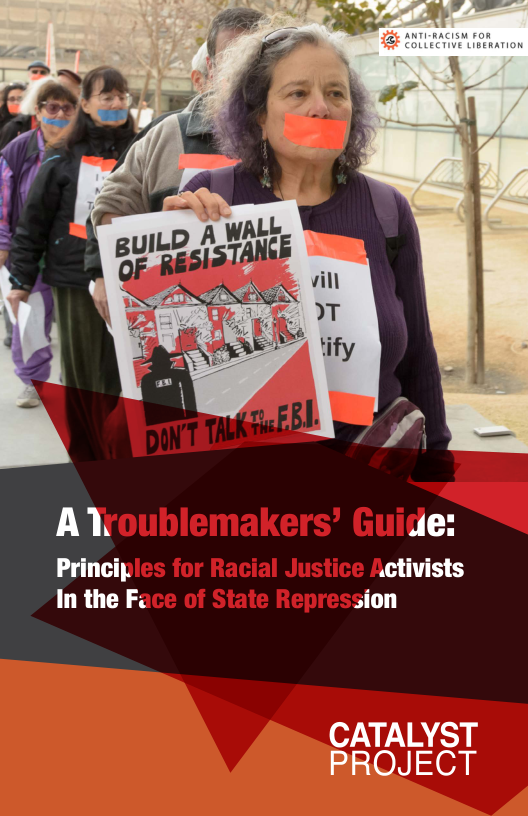
‘Gover photo: People around the Gountry demonsirate support or the Midwest 23 grand
ury osisters, 2010, Photo by Scott Braley. www scottbraley com
2 ATroublemakers Guide: Pincih al ustos Acthists I he Face of Stae Fop
Table of Contents
. Introduction
Il Why do the police respond with force to social
movements, especially those led by people of color?
What does it look like?
Ill. Principles of Anti-Racist Movement Security
1. Get into an Organization, Organizations are our Best
Defense
2. Build Political Unity and Make a Plan in Case You're
Targeted
Know your Rights & Don't Talk to Any Cops
Resist Grand Juries
If You or Your Organization Are Targeted, Go Public.
Prioritize Support to People and Organizations That
Are Targeted
7. Don't Spread Rumors or Amplify Conflict Between
Individuals or Organizations
+ Best Practices with Rumors
L L
+ Best Practices with Conflict
8. Follow the Security Protocols That are Being Asked
of You by Leaders
9. Respond to People’s Actions, Not Your Paranoia
10. Build Authentic Relationships and Be Accountable
IV. Resources
1. Assessment tool to prepare for political repression
by the state from Bay Area Committee to Stop
Political Repression
2. Resource list
V. RSVP, a poem by Terry Bisson
CataystProject 3
Introduction
This document offers suggested principles for building
stronger movements in the face of repression from our own
government.
In the last decade, social movements and the election of
Trump have created millions of new activists, most of whom
were ot alive or politically involved during the violent and
widespread state repression of social movements in the 60s
and 70s. They are generally unfamiliar with the tactics used
by the state to disrupt and undermine grassroots organizing,
and how to resist them in ways that strengthen our move-
ments. They may believe that the purpose of the police and
military is to protect them, and that any police brutality and
murders are caused by a few “bad apples.” In particular,
many white people believe that law enforcement officers are
positive and necessary forces for our society.
Rising resistance to state violence in communities of color
has called these beliefs into question for many people.
The Movement for Black Lives," the Palestinian libera-
tion movement, the migrant justice movement, and other
longstanding work against policing and imprisonment
have clearly exposed how state violence systematically
harms indigenous communities and communities of color.
Simultaneously, various whistleblowers have revealed wide-
spread government surveillance and have shown that the
National Security Agency and others have ongoing, easily
searchable access to our email, text, phone, and internet
traffic worldwide.
1. Roa the Movement fr Black Lives Polcy Patform a hips:/polcymiblcr/patom/
Yet, many of us and our organizations stilllack a coherent
analysis of how state repression of social movements and
working class communities of color maintains and enforces
capitalism, imperialism, white supremacy, and patriar-
chy. We also lack specific, agreed-upon principles of
how to keep our movements as safe as possible from
these ongoing attacks while we continue to be big and
bold in challenging the current racial, economic, and
social order. If we want our movements to succeed, we
must change this. There are many models from around the
world of how social movements have survived intense state
repression, from Argentina to Palestine, as well as here at
home.
We created this document to start important conversations
about how and why the state uses violence and coercion to
enforce social control. We hope it will contribute to build-
ing unity about the need to resist state repression by every
means possible—from campaign work to the culture and
practices of our organizations.
This document focuses on state repression, though repres-
sion from non-state actors such as white supremacists and
other far-right forces is also on the rise. These forces often
collaborate, and some of the information here will be useful
for both. We recommend some more resources on resisting
targeting from the far-right in the resource section.
This is a living document that is written primarily for white
activists and majority-white organizations in order to speak
to the specific ways white supremacy in movements inter-
acts with the white supremacy of the state. We welcome
feedback. We also welcome organizers in communities of
color to take this document and adjust it for your audience.
We hope that if you use it, you'll use it collectively — read
it with your crew or organization and talk about it, adjust it,
make agreements, make plans, and make change. All the
analysis and principles in this document are drawn from
generations of on-the-ground lessons and experiences, and
credit is due especially to the hard-won wisdom from the
people most targeted by state repression.
While we offer this document to defend social movements,
our battle against state repression has to be proactive and
not just defensive. We've got to support campaigns led
by people of color that defund, dismantle, and shift power
away from the repressive arms of the state - away from pris-
ons, cops, ICE, surveillance, and the military.
Fear is one of the state’s strongest weapons; if fear prevents
us from doing our work, it becomes a victory for the state.
Mass movement support, through strong
principles, politics, relationships, and
alliances are our best defense against
repression.
We need to achieve a balance between being well-informed
about potential repression, while not being paranoid or
intentionally keeping our movements small. Mass movement
support, through strong principles, politics, relationships,
and alliances are our best defense against repression. Any
movement seeking fundamental transformative change will
have to contend with threats from the state, and we have
many examples of people finding the courage to resist
that we can learn from. More than that, organizing against
repression can build our movements.
& ATroublemakers Guide: Pincis al ustos Acthists I he Face of Stae Fop
Why do the police respond with force
to social movements, especially
those led by people of color?
What does it look like?
Inthe U.S., most people are raised to believe that we live in
ademocracy that runs on “the consent of the governed.” In
fact, the constant threat and reality of state violence is used
to maintain a vast system of racial and economic oppres-
sion. Indeed, we understand that the purpose of policing is
to use force to protect the interests of the state, corpo-
rations and rich people from communities who want to
redistribute power and resources: people of color, indig-
enous people, working class people, immigrants, disabled
people, women, queer and trans people, and other social
movement activists.
Today as in past generations, FBI, police, and secret grand
juries are being used to attack these communities and
movements. These incidents are not isolated, and they are
not happening because the government wants to “solve
crimes.” They are an attempt to divide us, isolate outspo-
ken individuals, create fear and distrust among us, and
rewrite our history of resistance, labeling our actions as
“criminal” or “terrorist.”
Trump’s administration is already making moves to increase
imprisonment, policing, deportation, and political repression.
But Trump is building on the massive infrastructure/expan-
sion of state capacity for repression that Obama (and many
before him) built for this purpose. This isn't about a single
president, this is about the role of the U.S. government.
From the Occupy Movement to the Movement for Black
Lives, one doesn't have to think hard to imagine how the
state responds to social movements that challenge the
racial and economic status quo. We have seen tear gas,
batons, sound cannons, rubber bullets, and water hoses in
below-freezing temperature used from Ferguson to Standing
Rock. Yet, some of the state's methods are more insidious:
spreading false information; creating or intentionally wid-
ening divisions and conflict within movements; and using
violence and the criminal legal system to harass, harm and
intimidate activists and to scare off supporters.
To understand what the state is doing today, it's helpful to
remember what it has done in the past. From 1956-1971,
the Federal Bureau of Investigation (FBI) collaborated with
local law enforcement agencies around the country on
COINTELPRO? to covertly suppress, disrupt, discredit, and
destroy political organizations.
2. Acronymfor CoueterIligance Program. Tolam more about COINTELPRO,ses ous rasources
COINTELPRO represents the state’s strategy to prevent
movements and communities from overturning white
supremacy and capitalism. COINTELPRO is both a formal
program of the FBI and a term frequently used to describe a
conspiracy among government agencies—local, state, and
federal—to destroy movements for self-determination and
liberation for Black, Brown, Asian, and Indigenous struggles,
as well as mount an institutionalized attack against allies of
these movements and other progressive organizations.
The official program ended in 1971, but its tactics are still
used today:
* breaking into or raiding homes and offices to intimidate
people, gather information, and build legal cases
* imprisoning people on false charges for political or
non-political activity, through faking evidence & tes-
timony (even when people didn’t go to prison, large
amounts of time and resources were spent in defense)
* arresting people for political activity
* planting false information in the press; spreading misin-
formation about meetings and events; publishing false
documents in the name of organizations
* contacting employers to try to get activists fired or land-
lords to get people evicted
* “snitch jacketing”, or making people look like police
informants, to increase fear and distrust in organizations
and isolate individuals
* issuing grand jury subpoenas to intimidate activists,
drain resources and scare off support
* sending anonymous letters with death threats, accusing
Catabst Prject 8
targeted activists of cheating on their partners, or
spreading false information to amplify or create conflict
* Using informants or infiltrators to “raise controversial
issues at meetings to take advantage of ideological divi-
sions; promote conflict with other groups; or incite the
group to violent acts, even to the point of providing them
with weapons.”
The U.S. government also uses counterinsurgency tactics
against Third World nations: funding and training repres-
sive regimes that reign terror on their people; overt and
covert war-making, from ground invasions to drone strikes;
overthrowing democratically elected progressive and Left
governments and installing puppets; disrupting people’s
movements, and more. All of these actions take place in
the name of protecting our freedom and safety. In reality,
all of them protect the current racial, economic, and global
regimes of power and violence.
While learning about the tactics the state uses to disrupt
our movements can be scary, it's important to remember
that wherever people are working for a liberated future, we
gather strength from each other and find ways to resist.
Knowing this information empowers us and gives us tools to
build strong, creative resistance movements. Most tactics
of disruption rely on exploiting our movement's weaknesses,
but we can change those weaknesses. In this spirit, we offer
the following “Principles for Racial Justice Activists In the
Face of State Repression.”
3. it uroissonardpstio nfohamaibsckgroundlcontlpr
ic: Prncies for Facal
Faca of Siate Fepression
\
Organizations are our most effective and powerful way to
build the collective power that can make change. They
also keep us stronger. Many state repression tactics rely on
people being isolated and individualistic. Defense against
state repression requires strong relationships and collective
thinking.
ollective leadership also makes us stro
rganizations that prioritize leadership
development and building lots of people’s
adership are harder to take do
e undermined by
For example, a person who isn't practiced at thinking col-
lectively will have less understanding of how talking to the
police can put other people at risk. A “solo flyer” who is tar-
geted by a grand jury subpoena won't have the community
resources necessary to resist. People in an organization
are more likely to share a political analysis and a com-
mitment to each other that will protect the movement,
rather than just protect themselves. People in organiza-
tions can also be held accountable or better supported to
change if their behavior is problematic. Collective leadership
Catayst Proect 11
also makes us stronger. Organizations that prioritize lead-
ership development and building lots of people’s skills and
leadership are harder to take down than projects that can be
undermined by picking off a single leader who holds most of
the skills, experiences, networks and clout.
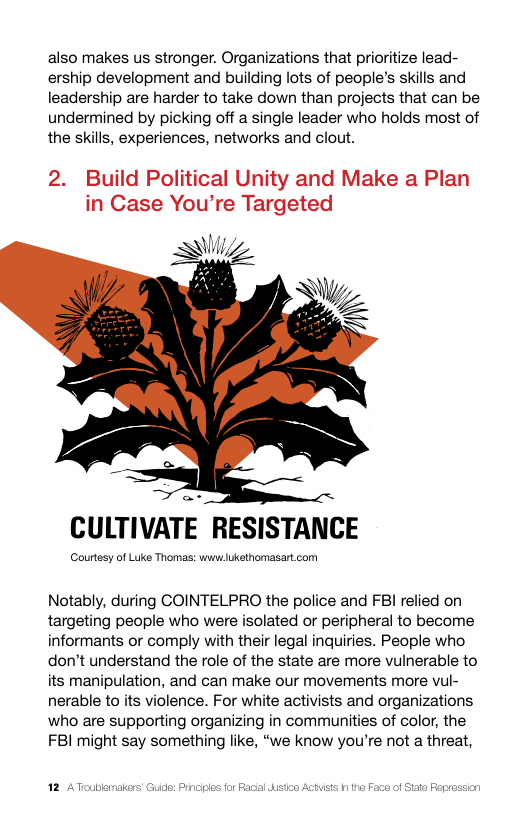
2. Build Political Unity and Make a Plan
in Case You’re Targeted
AW,
CULTIVATE RESISTANCE
Courtosy of Luke Thomas: wwilukethomasart com
Notably, during COINTELPRO the police and FBI relied on
targeting people who were isolated or peripheral to become
informants or comply with their legal inquiries. People who
don't understand the role of the state are more vulnerable to
its manipulation, and can make our movements more vul-
nerable o ts violence. For white activists and organizations
who are supporting organizing in communities of color, the
FBI might say something like, “we know you're not a threat,
we’re concerned about the people you're supporting.”
Defense against this kind of manipulation is one of the many
reasons political education is important.
Without political unity and a plan, members of a targeted
organization may keep law enforcement contact to them-
selves or comply with the police, putting organizations and
movements at risk. Intimidation s a core policing tactic, and
many people crack under the pressure if they don't have
strong political foundations and support. It's crucial that
we understand that attacks on individuals are attacks on
our organizations and movements, and act accordingly.
Even when targeting activists, the state often treats white
people differently than people of color. As anti-imperialist
political prisoner Marilyn Buck put it “in terms of dealing
with white people, the state thinks we can always come
home to them again.”
It’s crucial that we understand that
attacks on individuals are attacks on our
organizations and movements, and act
accordingly.
In situations of groups rather than individuals being pros-
ecuted, people can choose to make collective decisions
to protect the entire group, which helps protect its most
vulnerable members and can also expose the political
motivations of such attacks. The January 20th Washington
D.C. Inauguration Day protestors are going to trial as we
write this, and 135 of 200 defendants facing unprecedented
charges have released a unity statement.* They pledged:
4. T fllitysttement can be found a itdfend 20esitance org/dsfendants
Catayst Progct 13
“We will not cooperate against any of our co-defendants,
nor accept any plea deals that cooperate with prosecutors
at the expense of other co-defendants...[and] will refuse to
accept that any of the charges or actions of law enforce-
ment were necessary or justified. ... We will not say anything
publicly or privately that has the possibility of harming indi-
vidual defendants or defendants as a group.”
Does your organization or group have agreements about
how you deal with the police, ICE, grand juries or the
FBI that all of your members would follow? About digital
security? Do you have a commitment to financially, emo-
tionally and legally support anyone who is targeted? Do you
have a plan for those resources, such as a defense fund and
alawyer? Do you have agreements on who has access to
non-public organizational info? For more information about
what you could prepare for, check out Bay Area Committee
to Stop Police Repression’s “How prepared are you?”
checklist at the end of this pamphlet.
3. Know your Rights & Don’t Talk to Any
Cops
Most people do not know their rights with a beat cop, let
alone with ICE, the FBI, the NSA, or with a grand jury sum-
mons. The state relies on this lack of knowledge to harass,
coerce, arrest, and imprison people. For those of us who
are white and/or class privileged, we were likely taught to
believe “if we aren’t doing anything illegal, we don’t have
anything to hide or fear.” We never know how the police will
use information they get from us, but we can be sure it wil
be used to harm our movement or other people.
While there are some differences between agencies
and state-by-state, this always applies: if an officer
approaches you, ask “Am | free to go?” If the answer
|
blemakers’ Guide: Principes for Facial Jstca A he Face of izt Pepres
is yes, walk away. If it's no, you should not answer any
questions other than “What is your name?” You should
say “I am going to remain silent.” If you are searched,
say “I do not consent to this search.”
From the Center for Constitutional Rights’ “If An Agent
Knocks™:
The Fifth Amendment of the United States Constitution
protects you from being forced to reveal self-incriminating
information to law enforcement. This is easier to say than
to do. Agents are trained investigators: they have learned
the power of persuasion and the ability to make a person
feel scared, guilty or impolite for refusing their requests for
information. An agent may suggest that any unwillingness
to speak with her/him means you must have something to
hide. Sthe may suggest s/he only wants you to answer a few
questions and then s/he will leave you alone. The agent may
threaten to get a warrant. Don'’t be intimidated or manipu-
lated by an agent's threats or assurances. It is always best
to not talk without an attomey present...Clearly convey your
intention to remain silent. Say “'m ot talking to you,” or “I'd
like to talk to my lawyer before | say anything to you.”
ion to not talking to cops, don’t let cops in your
home or office, no matter what they say, unless they
have a valid warrant. A valid warrant must have the cor-
rect address, describe the area to be searched and what
they're looking for or the name and description of the per-
son to be arrested, be signed by a judge, and not be-out-of-
date. You can ask police to slip the warrant under the door,
and if any of these things are incorrect, tell them it's invalid.
Talk to anyone you live with about this, as they may try to
come when you're not home.
5. nitosicrustios o s
41
mARITY
ALAWITHAAdkbb
STANDING ROCK
STOP THE DAKOTA
ACCESS PIPELINE
) LI B
DEFEND THE LAND - PROTECT THE WATER
www.change.org/RezpectOurWater
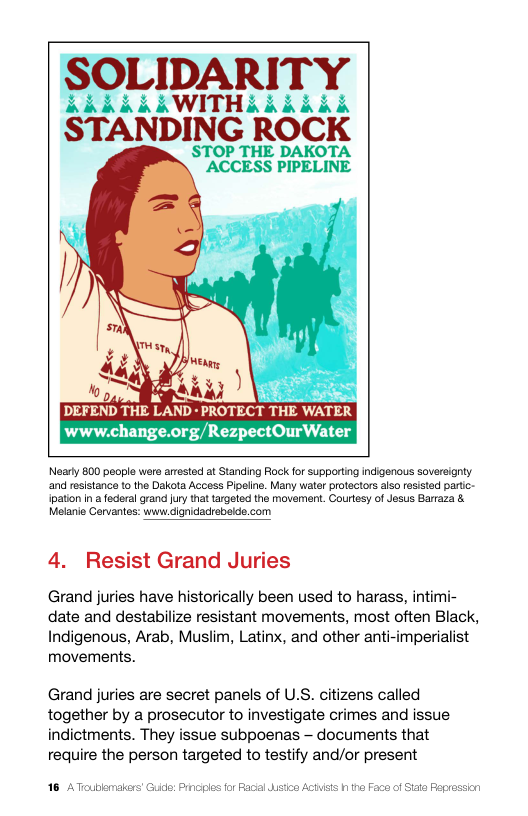
Nearty 800 peopla wera arested at Standing Rock fo supportng indigenous sovereigrty
and resistance to the Dakota Access Pipelie. Many water protectors also resisted partc-
ipation n a federal grand [ury that targotod the movement. Courtesy o Jesus Barraza &
Melanie Corvantes: www dignidacrebeide.com
4. Resist Grand Juries
Grand juries have historically been used to harass, intimi-
date and destabilize resistant movements, most often Black,
Indigenous, Arab, Muslim, Latinx, and other anti-imperialist
movements.
Grand juries are secret panels of U.S. citizens called
together by a prosecutor to investigate crimes and issue
indictments. They issue subpoenas — documents that
require the person targeted to testify and/or present
16 ATcubemalers Guide: Prn sicn Actisis h he Face of Site Peg
documents to the grand jury. The usual rules of evidence
do not apply in grand jury proceedings: there is no judge:
no defense attorneys are allowed; and anything a witness
says may be used against them and their movement. Grand
juries are witch hunts or “fishing expeditions” to learn
about movement connections and alliances, build crim-
inal cases or bring false charges, understand political
positions, and to make use of political differences. The
goal i to sow dissension and distrust. Even information
that seems innocent can be harmful when combined with
other information gathered by the grand jury investigation.
We believe it is important for people to
refuse to co-operate, in a long tradition of
grand jury resistors. Just as with FBI visits,
being public and transparent about grand
jury subpoenas will help build a public wall of
resistance and minimize distrust and fear in
our communities.
Refusal to co-operate with a grand jury can result in being jalled
for contempt for the lite of the grand jury, up to 18 months. Not
everyone who takes a non-collaboration stands goes to ail, but
this is a real risk. In the case of grand juries, the Jail time is meant
to coerce you into testifying. If you make it very clear that you will
never testify at a grand jury, this could help you avoid or reduce
Jailtime. It is precisely because of the secrecy and potentially
dangerous nature of the grand jury that we believe it is important
for people to refuse to co-operate, in a long tradition of grand
jury resistors. Just as with FBI visits, being public and transparent
‘about grand jury subpoenas will help build a public wall of resis-
tance and minimize distrust and fear in our communities.
If you are targeted by a grand jury, seek out a movement
lawyer immediately to make a plan. It's important to have
representation that understands grand juries as political,
and that you have movement interests, and not just per-
sonal ones. If you don't already have a lawyer in mind, try
contacting the National Lawyers Guild.¢ Once you under-
stand your legal situation, make a plan to inform organiza-
tions in your network, and consider going completely public.
5. If You or Your Organization Are
Targeted, Go Public
If you are approached or targeted by law enforcement about
the political activity of yourself or someone else, the first
step should be to talk to your organization and get legal
counsel from a movement lawyer (see above.) The sec-
ond step should be to make a plan to communicate with
allied organizations and the public about how you were
approached and your commitment to resist cooperation.
Political repression relies on secrecy, fear, and isolation.
Keeping information about being approached or targeted to
yourself will mean you have a much smaller support base. It
can also cause distrust and ruptures between organizations,
as it deprives other activists and organizations from the abil-
ity to prepare to defend themselves.
While it has the potential to cause serious harm, polit-
ical repression can also be used to build support for
our movements. Many campaigns to resist grand juries or
defend political prisoners have been successful at building
mass resistance, and there are many lessons we can learn
from them. Here are a few:
6. iossimnunigore
ic: Prncies for Facal
Faca of Siate Fepression
Afederal grand jury was convened in Alexandria, Virginia,
in November 2010, ostensibly to investigate any connec-
tions between WikiLeaks editor-in-chief Julian Assange
and U.S. Amy Private Chelsea Manning, who was
arrested 6 months earlier. Grand jury subpoenas were
issued to members of her support network and others
in the Boston area. In a highly-publicized effort to draw
attention to a politically-motivated grand jury and harass-
ment of Manning’s friends and supporters, one of her sup-
porters, David House, refused to answer questions when
called before the grand jury. Strong support for Manning
led to a commutation of her sentence after 7 years.
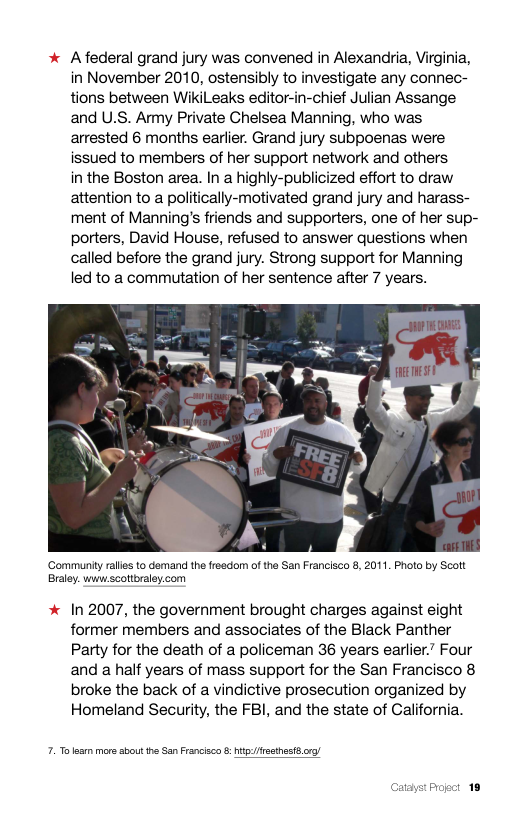
‘Gommuniy rallies to demand the fresdom of the San Francisco 8, 2011. Photo by Scott
Braley. www:scottbraley.com
In 2007, the government brought charges against eight
former members and associates of the Black Panther
Party for the death of a policeman 36 years earlier.” Four
and a half years of mass support for the San Francisco 8
broke the back of a vindictive prosecution organized by
Homeland Security, the FBI, and the state of California.
7. To s more sbou the San Francisca & hitfesthet g/
Catayst Progct 18
Two defendants pled to lesser charges and the others
had their charges dropped.
* In the early hours of Sept. 24, 2010, gun-toting fed-
eral agents in Chicago and Minneapolis burst into the
homes of anti-war and international solidarity activists.
Eventually 23 people were called before a grand jury —
and subsequently refused to cooperate with the gov-
emment’s witchhunt. Their case gained national support
because of their resistant stance.
6. Prioritize Support to People and
Organizations That Are Targeted
Some of our most important leaders of color from the 50s,
60s, and 70s were imprisoned or killed for their political
activity. Several, like Leonard Peltier and many former mem-
bers of the Black Panther Party, remain in prison more than
40 years later. To learn more about political prisoners in the
U.S., check out The Jericho Movement? which raises up the
voices of political prisoners and fights for their release. From
Palestine to Colombia, political imprisonment with very
harsh conditions such as solitary confinement is common,
often with U.S. political, economic, and military support.
Guaranteeing strong support and defense for those who are
politically persecuted empowers people to take the risks
necessary to build our collective resistance.
Guaranteeing strong support and defense
for those who are politically persecuted
empowers people to take the risks necessary
to build our collective resistance.
8. o ejerchomovermentcom/
20 AToublemalers' Guide: Prncies for Facal
o Actists h ha Face of Siata Pepr
Nt it N i N it it e it i |
o
OFF
ASSATA
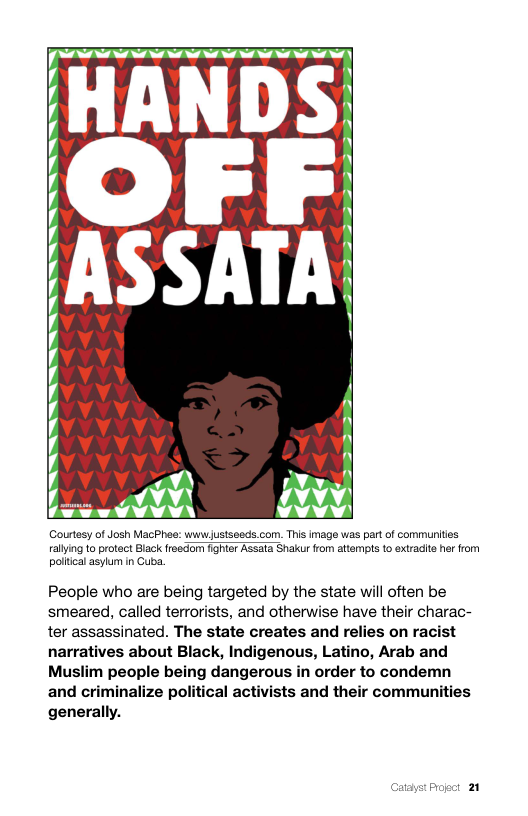
(Courtesy of Josh MacPhee: wwnwjustseods.com. This image was part of communities
rallying o protect Black freedom fighter Assata Shakur fom attempts 1o extradite he from
poliical asylum n Guba.
People who are being targeted by the state will often be
smeared, called terrorists, and otherwise have their charac-
ter assassinated. The state creates and relies on racist
narratives about Black, Indigenous, Latino, Arab and
Muslim people being dangerous in order to condemn
and criminalize political activists and their communities
generally.
Catayst Proect 21
It's important to use any access we have to the media or the
public to publicly defend targeted individuals and groups, to
question the dominant narrative, and to explicitly name the
racism of the attacks and the media coverage. Exposing the
tactics of state repression can build more support and help
make our movements stronger.
In the same vein, we must offer support to current and
future political prisoners. In addition to fighting for their free-
dom, there are many ways to support people—raising bail,
attending court hearings, writing support letters, visiting,
corresponding with them, and sending commissary money
while they are in jail or prison. Supporting their loved ones is
also a critical piece of community support for targeted activ-
ists. This includes financial assistance, help with childcare,
assisting with prison visiting, offering emotional support,
and helping children and partners deal with the stigma of
having an incarcerated parent.
7. Don’t Spread Rumors or Amplify
Conflict Between Individuals or
Organizations
One of COINTELPRO's key strategies was to create and
exacerbate conflict and distrust between individuals and
organizations. They used many tactics to do this: infiltrators
who were sent to stir things up, spread rumors and incite
conflict; fake communications that sparked distrust; “snitch
jacketing” or making people look like informants. The real
results of this interference was that organizations broke up,
coalitions collapsed, and people were left more vulnerable
to arrest and violence. Creating a strong, principled move-
ment culture is our best defense against this.
ic: Prncies for Facal
Faca of Siate Fepression
One of COINTELPRO’s key strategies was to
create and exacerbate conflict and distrust
between individuals and organizations.
Anyone involved in organizing knows that it's messy.
Mistakes are made, harm is caused, real political differences
exist. We organize in a context where we urgently need
structural change, and grassroots racial and economic jus-
tice forces have far less power than we need to create what
we dream. Many people in movements have survived a lot
of trauma, which can inform our work in positive ways, and
also can impact our behavior in ways that make working
together harder. And many people in movements act out
privilege based on their experiences of class, race, gender
and/or ability that creates toxic culture. All of our organi-
zations are imperfect. All of our organizations act out the
dynamics of oppression and privilege that we are steeped
in, though some do better than others at creating the trans-
formative culture we yearn for.
Creating a strong, principled movement
culture is our best defense against tl
White anti-racist culture can often foster a belief that the
best way to be anti-racist is to critique, ostracize and tear
down other people and organizations. This is amplified
in people who have been through formal higher educa-
tion, which often values criticism over all else. When you
combine these tendencies with the sense of entitiement
that comes with white privilege, it can often produce white
activists who are very skilled at criicizing people and orga-
nizations, and less skilled at navigating conflict, finding posi-
tive value and working toward personal and organizational
change.
Catayst Progct 23
How do we stay in relationship and accountable to each
other through all this?
Best Practices with Rumors about People or
Organizations, especially around conflict:
* When hearing about or asking after information, ask
yourself if you really need to know or if you're just
curious.
* Don't give any information about confiict or internal
dynamics of organizations to people who don't need to
know.
* Verify information from multiple primary sources before
believing it or acting on it.
* When other people are spreading rumors or information,
talk to them about why it's important not to spread this
type of information.
Best Practices with Conflict Between
Individuals and Organizations:
% Within our organizations and our movements, it's import-
ant to bring and receive critiques in principled ways. It
you have conflict with something that someone or an
organization is doing, talk to them directly and privately
with an aim to address the problem and an assumption
of good intentions. Bring in trusted outside support if you
need it—conflict mediation works.
* If conflict or violence is happening within your organiza-
tion, seek trusted support to address it as soon as pos-
sible. Many majority-white organizations let things sim-
mer until they explode, either because people with race
and/or class privilege tend to be scared of conflict, or
because the rest of our work feels urgent. Take the time
24 AToublmalers' Guide: Prncies for Racl dstn A
15 1 tha Face of Siae Peprassion
to address things before they get bigger than they need
to. It's also useful to have some internal agreements
about addressing harm/internal violence without relying
on the police.
5 s
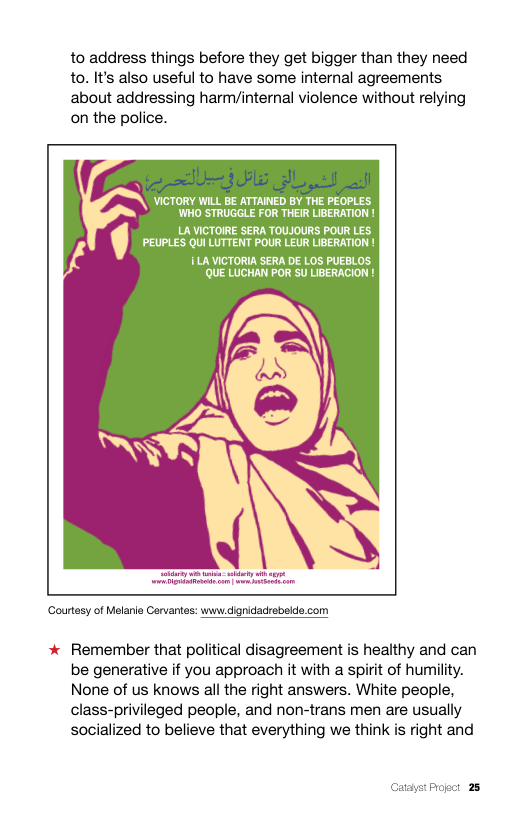
‘Courtesy of Melanie Cervantas: www.dignidadrebelde.com
* Remember that political disagreement is healthy and can
be generative if you approach it with a spirit of humility.
None of us knows all the right answers. White people,
class-privileged people, and non-trans men are usually
socialized to believe that everything we think is right and
smart and good. When in political disagreement, make
sure to notice, name, and adjust where these dynamics
might be surfacing.
* People who bring up internal dynamics around rac-
ism, classism, patriarchy, homophobia, transphobia or
ableism are sometimes called or treated as if they are
being “divisive.” Addressing the ways our organizations
play out greater societal dynamics around power, priv-
ilege and oppression is a crucial part of our movement
defense. Seek trusted outside support early and often.
* White activists—if there is a conflict between organiz-
ers or organizations of color, it is usually best not to get
involved. If you're considering involvement, ask yourself:
Do | have relationships with the people involved such
that it would make sense for me to play a role? Am |
being asked to play a role? Do | have specific skills to
navigate conflict that | am being asked to offer? Or, alter-
natively, am | getting involved because | am curious or
want to feel included? Am | putting myself between orga-
nizers of color in a way that will exacerbate conflict and
possibly have long term consequences? Am | aligning
myself with one side of a conflict without having all the
information? (hint: no one ever has all the information).
Remember that these confiicts leave organizations vul-
nerable, and treat any information you have about them
carefully and confidentially.
8. Follow the Security Approach/
Protocols that are Being Asked of
You by the Leaders of Projects,
Organizations, Events, or Actions that
You’re a Part of
26 AToublmalers' Guide: Prncides for Facl dstn A
15 1 tho Faco of S Piprossion
Organizations whose members are frequently targeted by
the state, or those who participate in a lot of direct action,
often have methods of keeping information and plans
secure. Sometimes, white activists and organizations do
not take these protocols seriously because our privilege
has shielded us from the most vicious and stealthy tac-
tics of the state. It's very important that white activists and
organizations are not a “weak link” in security practices,
especially when doing something that could be criminalized.
If you're not clear about what information is okay to share
with whom, or which method of communications should be
used, ask for clarification. Once you are clear, make sure
you follow all aspects of security that are being asked. Here
are a few examples:
* If you go to a meeting and people are talking about
something without phones, don't leave the meeting and
then talk about that thing in proximity to a phone.
* Don't tell private information about an action to anyone
who doesn't need to know.
* If people are communicating about something over
Signal (encrypted phone and text messaging program) or
another secure method, only use that form.
* If someone doesn't talk publicly about being undocu-
mented, trans, on parole or probation, or any other piece
of their experience that can increase vulnerability to state
violence, don't tell other people their status.
It’s very important that white activists
and organizations are not a “weak link” in
security practices.
atayst Progct 27
9. Respond to People’s Actions, Not
Your Paranoia
“Snitch jacketing” is a widely-used FBI tactic of planting
evidence, spreading rumors, or cutting plea deals that made
certain people look like informants, in order to sow distrust
and isolation. While we strongly believe in the power of
intuition, it's important that within our movements we
only respond to people’s actions, since we can’t ever
know someone’s true intentions. If someone is acting dis-
ruptive, being unaccountable, provoking conflict, spreading
rumors, or repeatedly trying to get us to escalate tactics in a
way that you haven't agreed on, confront the behavior and
hold the person accountable to changing. If after repeated
feedback someone is unable or unwilling to change, con-
sider asking them to leave the group. If you're just feeling a
weird vibe, remember that some people are just awkward.
10. Build Authentic Relationships and Be
Accountable
Many of COINTELPRO’s tactics created and exploited dis-
trust between people and organizations. We have to extend
trust and be worthy of trust by being accountable to each
other, our politics, and our best selves.
What if we treated our fragile, messy alliances as if our lives
depended on them? What if we understood that working
through political differences is a core part of our struggle,
and that the way to do that is by actively working together
and figuring it out in practice? What if we prioritized building
relationships as much as our task list? What if our organiza-
tions were more proactively addressing internal dynamics of
racism, classism, patriarchy, heterosexism, transphobia, and
ableism? What if we assumed that people who have acted
28 AToubkma
icl: Prnciles for Facal sta Actsis h tha Faca of Sata Fegres:
against their own values are capable of change when they
receive direct feedback and support? What if we assumed
there was truth in the feedback we receive, and made
active efforts to repair and rebuild? What if we all worked
hard every day, as Alicia Garza, a co-founder of Black Lives
Matter put t, to be “high impact, low ego?”
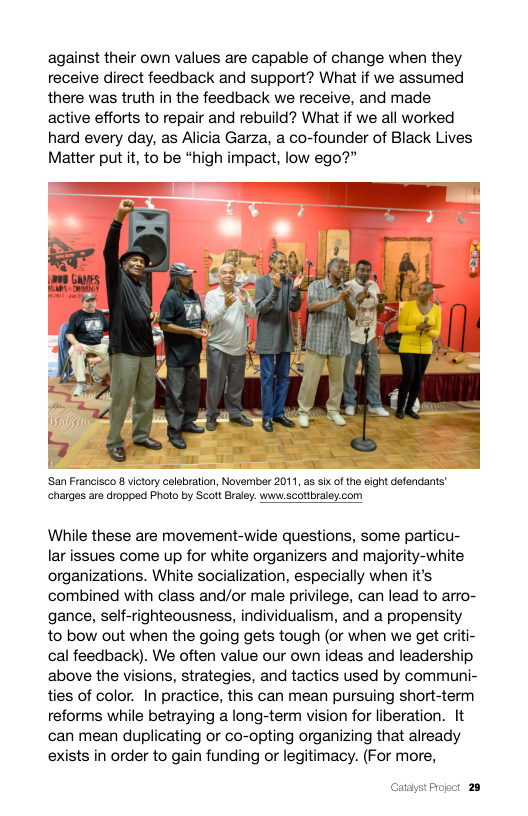
San Francisco 8 victory celebration, November 2011, as six of the eight defendants’
charges are dropped Photo by Scott Braley. wwwscottbraley.com
While these are movement-wide questions, some particu-
lar issues come up for white organizers and majority-white
organizations. White socialization, especially when it's
combined with class and/or male privilege, can lead to arro-
gance, self-righteousness, individualism, and a propensity
to bow out when the going gets tough (or when we get criti-
cal feedback). We often value our own ideas and leadership
above the visions, strategies, and tactics used by communi-
ties of color. In practice, this can mean pursuing short-term
reforms while betraying a long-term vision for liberation. It
can mean duplicating or co-opting organizing that already
exists in order to gain funding or legitimacy. (For more,
Catayst Progct 28
see “White Privilege in Social Justice Movements” in the
resources section below.) It can take many years to change
these behaviors, but we must change them. White activists
and majority-white organizations must become trustworthy.
Seek feedback regularly, especially where privilege might
prevent you from seeing the whole picture. Do what you
say you'll do when you say you'll do it, and communicate
when you can't. Be honest and generous. And when you
mess up, own it, repair it, and get back on the horse. If you
haven't screwed up, you're not risking enough. The stakes
are high and we need to support each other to grow braver
and more effective so we can build the kind of strong, broad
movements that can open up a future with safety, dignity,
and justice for everyone.
30 AToublemalers' Guide: Prncies for Facl dstn A
15 1 tha Face of Siae Peprassion
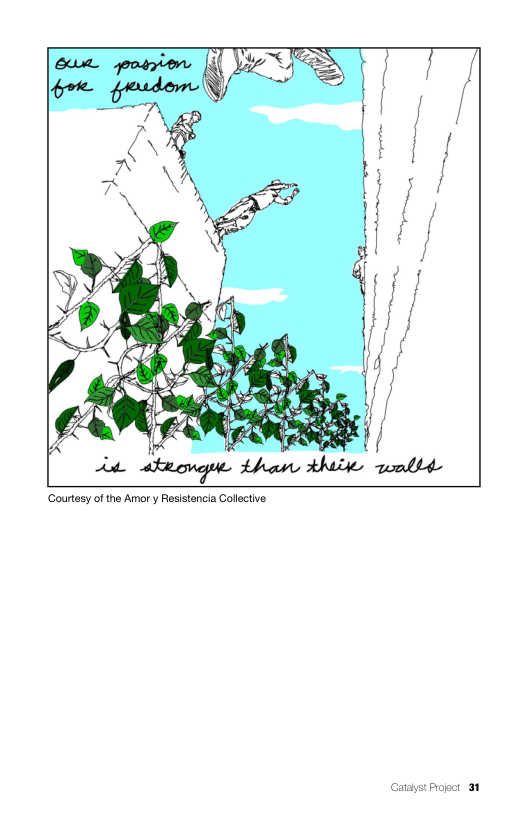
‘Courtesy of the Amor y Resistencia Collective.
Catayst Proect 31
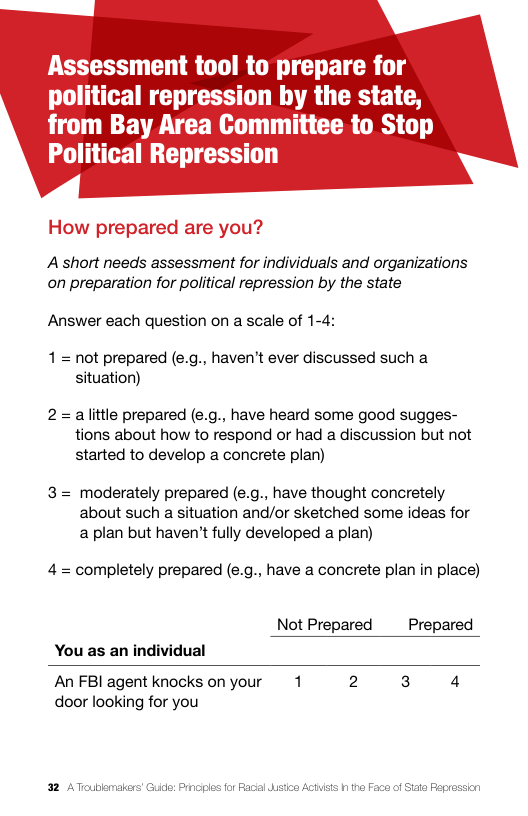
Assessment tool to prepare for
political repression by the state,
from Bay Area Committee to Stop
Political Repression
How prepared are you?
Ashort needs assessment for individuals and organizations
on preparation for political repression by the state
Answer each question on a scale of 1-4:
1 = not prepared (e.g., haven't ever discussed such a
situation)
2= alttle prepared (e.g., have heard some good sugges-
tions about how to respond or had a discussion but not
started to develop a concrete plan)
3= moderately prepared (e.g., have thought concretely
about such a situation and/or sketched some ideas for
aplan but haven't fully developed a plan)
4= completely prepared (e.g., have a concrete plan in place)
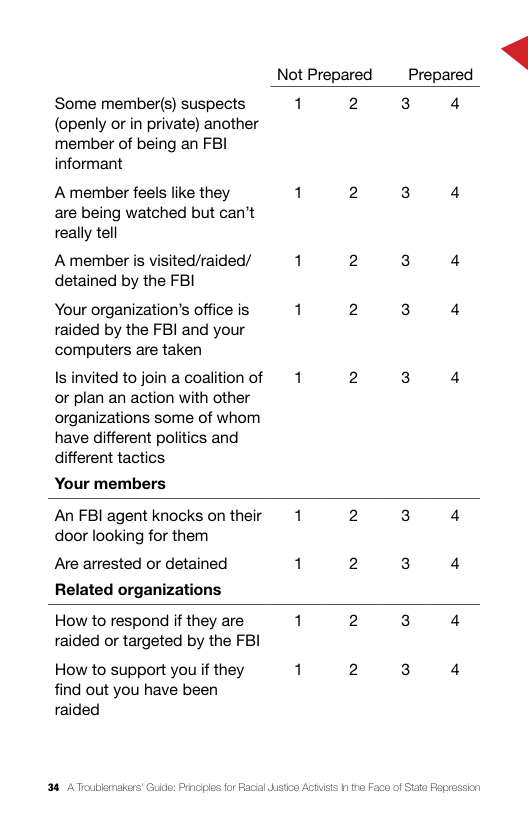
Not Prepared Prepared
You as an individual
An FBI agent knocks onyour 1 2 3 4
door looking for you
32 A Toublomakers' Guido: Prnciples for Rasal Wsto ACHSEs 1 the Faco of Siata Fegrossien
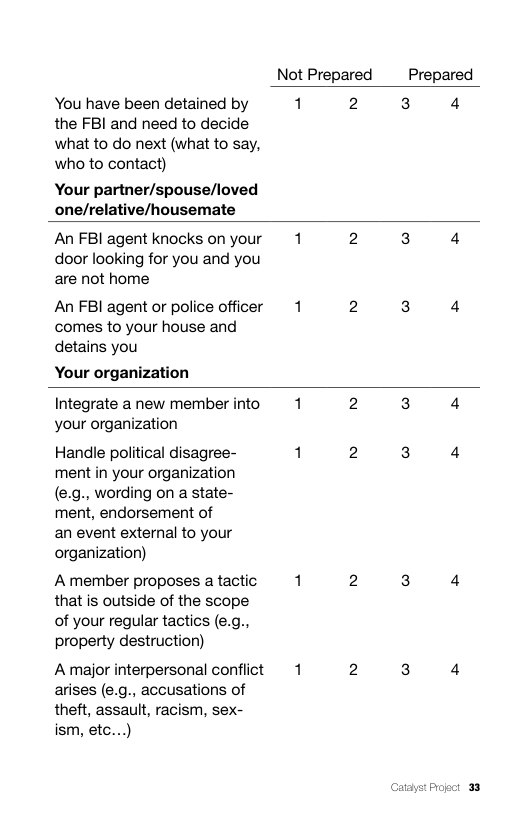
Not Prepared _Prepared
You have been detained by 1 2 3 4
the FBI and need to decide
what to do next (what to say,
who to contact)
Your partner/spouse/loved
one/relative/housemate
An FBI agent knocks onyour 1 2 3 4
door looking for you and you
are not home
An FBI agent or police officer 1 2 3 4
comes to your house and
detains you
Your organization
Integrate a new member into 1 2 3 4
your organization
Handle political disagree- 1 2 3 4
ment in your organization
(e.g., wording on a state-
ment, endorsement of
an event external to your
organization)
Amember proposes atactic 1 2 3 4
that is outside of the scope
of your regular tactics (e.g.,
property destruction)
Amajor interpersonal conflict 1 2 3 4
arises (e.g., accusations of
theft, assault, racism, sex-
ism, etc...)
Catayst Progct 33
Not Prepared _Prepared
Some member(s) suspects 1 2 3 4
(openly or in private) another
member of being an FBI
informant
A member feels like they 1 2 3 4
are being watched but can’t
really tell
A member is visited/raided/ 1 2 3 4
detained by the FBI
Your organization's office is 1 2 3 4
raided by the FBI and your
computers are taken
Is invited to join a coalion of 1 2 3 4
or plan an action with other
organizations some of whom
have different politics and
different tactics
‘Your members
An FBI agent knocks on their 1 2 3 4
door looking for them
Are arrested or detained 1 2 3 4
Related organizations
How to respond if they are 1 2 3 4
raided or targeted by the FBI
How to support you if they 1 2 3 4
find out you have been
raided
34 AToublemalers' Guide: Prncides for Racl dstn A
15 1 tha Face of Siae Peprassion
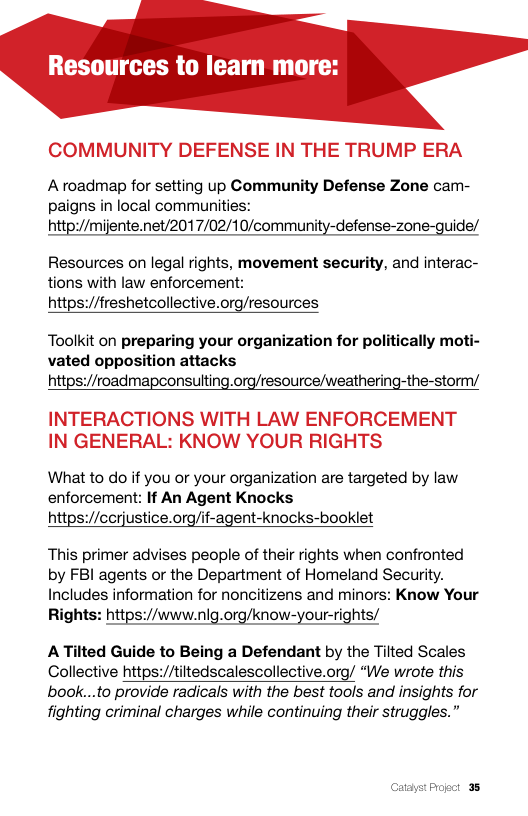
Resources to learn more:
COMMUNITY DEFENSE IN THE TRUMP ERA
Aroadmap for setting up Community Defense Zone cam-
paigns in local communities:
http:/mijente.net/2017/02/10/community-defense-zone-guide/
Resources on legal rights, movement security, and interac-
tions with law enforcement:
https://freshetcollective.org/resources
Toolkit on preparing your organization for politically moti-
vated opposition attacks
https://roadmapconsulting.org/resource/weathering-the-storm/
INTERACTIONS WITH LAW ENFORCEMENT
IN GENERAL: KNOW YOUR RIGHTS
What to do if you or your organization are targeted by law
enforcement: If An Agent Knocks
https://cerjustice.org/if-agent-knocks-booklet
This primer advises people of their rights when confronted
by FBI agents or the Department of Homeland Security.
Includes information for noncitizens and minors: Know Your
Rights: https://www.nlg.org/know-your-rights/
ATilted Guide to Being a Defendant by the Tilted Scales
Collective https://tiltedscalescollective.org/ “We wrote this
book...to provide radicals with the best tools and insights for
fighting criminal charges while continuing their struggles.”
o3
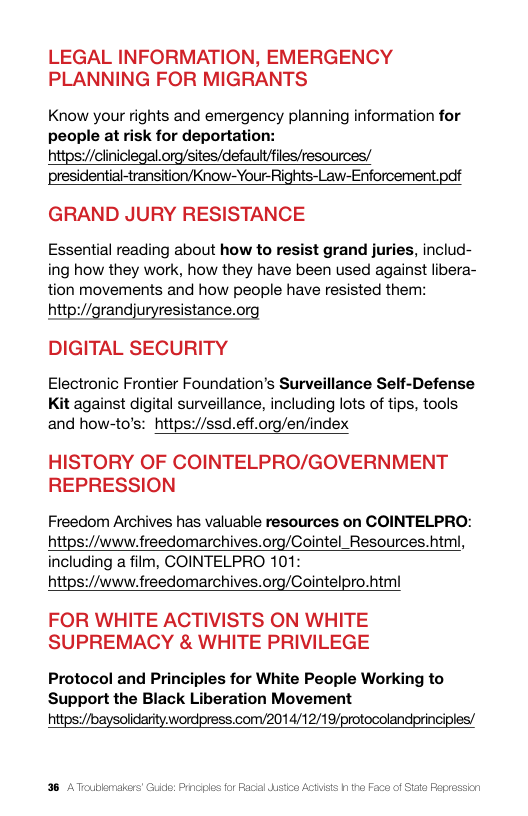
LEGAL INFORMATION, EMERGENCY
PLANNING FOR MIGRANTS
Know your rights and emergency planning information for
people at risk for deportation:
httpsy/ciniclegal.org/sites/defaultfiles/resources/
presidential-transitiorvKnow-Your-Rights-Law-Enforcement pdf
GRAND JURY RESISTANCE
Essential reading about how to resist grand juries, includ-
ing how they work, how they have been used against libera-
tion movements and how people have resisted them:
http://grandjuryresistance.org
DIGITAL SECURITY
Electronic Frontier Foundation’s Surveillance Self-Defense
Kit against digital surveillance, including lots of tips, tools
and how-to's: https://ssd.eff.org/en/index
HISTORY OF COINTELPRO/GOVERNMENT
REPRESSION
Freedom Archives has valuable resources on COINTELPRO:
https://www.freedomarchives.org/Cointel_Resources.html,
including a film, COINTELPRO 101:
https://www.freedomarchives.org/Cointelpro.htm
FOR WHITE ACTIVISTS ON WHITE
SUPREMACY & WHITE PRIVILEGE
Protocol and Principles for White People Working to
Support the Black Liberation Movement
htps://baysolidarity.wordpress.com/2014/12/19/protocolandprinciples/
38 A Toublomakers' Guido: Prnciples for Raal Wstio ACHSEs 1 the Faco of Siata Fegrossien
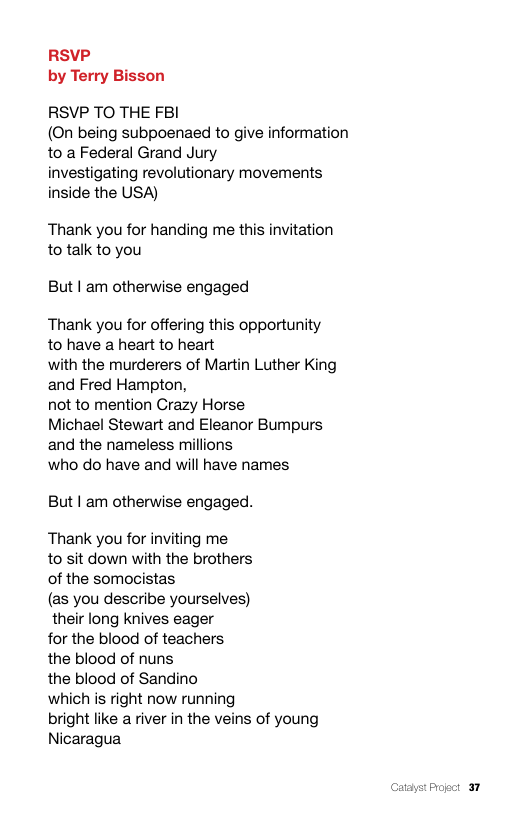
RSVP
by Terry Bisson
RSVP TO THE FBI
(On being subpoenaed to give information
to a Federal Grand Jury
investigating revolutionary movements
inside the USA)
Thank you for handing me this invitation
to talk to you
But | am otherwise engaged
Thank you for offering this opportunity
to have a heart to heart
with the murderers of Martin Luther King
and Fred Hampton,
not to mention Crazy Horse
Michael Stewart and Eleanor Bumpurs
and the nameless millions
who do have and will have names
But | am otherwise engaged.
Thank you for inviting me
to sit down with the brothers
of the somocistas
(as you describe yourselves)
their long knives eager
for the blood of teachers
the blood of nuns
the blood of Sandino
which is right now running
bright like a river in the veins of young
Nicaragua
Catayst Progct 37
But | am otherwise engaged.
Thank you for giving me this opportunity
to spit on the graves of Sacco and Vanzetti
to dishonor the memory of the Rosenbergs
or of my ex father in law
who spent 10 years not being an actor
rather than 10 minutes of being a collaborator
But | am otherwise engaged.
Thank you for inviting me to run with the hounds
howling through the ruined cities
trying to hunt down the
FALN, the BLA
the ten or the hundred most wanted
most ready and willing and able
to resist with arms
and heart and ideology
your world
wide crimes
But | am otherwise engaged.
And seriously, thanks
for giving me this chance
to stand fast with the Puerto Ricans
who have gone to jail silent since 1936
rather than drink from your bootprints,
To stand fast with the New Afrikans
who like Nat Turner “never said a mumbling word”
To stand fast with the Palestinians
steadfast in Israeli prisons
the Irish deep and defiant in Long Kesh,
the Africans on Robben Island
scorning your offers with songs
38 A Toublomaers' Guido: Prnciples for Rasal Wsto ACHSEs 1 the Faco of Siata Fegrossien
To stand fast with the children on Lumumba
and Che and Malcolm X
not to mention my own children
and your own as well
Thank you for this chance to stand
not with the defeated but the defiant
who pick up the gun
who pick up the pen
who pick up the baby and the struggle
Thank you for this chance
to stand with humanity against you
Don't mind if | do
April, 1985
Pogct 38
CATALYST
PROJECT
www.collectiveliberation.org