A Mountain River Has Many Bends: The Rojava Revolution
Web PDF • Imposed PDF• Raw TXT (OCR)


![Miltary: The main fighting force of Rojava is a volunteer militias (namely the YPG and YP]). The YPG/YP] have a combined forced of 40,000 lightly-armed fighters. Most of the weapons are light fircarms combined with Russian-made lightweight rocket launchers. They have also repur- posed about 40 garbage trucks and other heavy trucks into armored personnel carriers. They have no aircraft. Political Structure: Rojava is made up of three autonomous but confed- erated “cantons.” These cantons are not geographically contiguous. The decisionmaking structure is composed of various councils. The average size of neighborhood councils is 30-150 families. A city district / village council is made up of 5-17 neighborhood councils (along with worker, non-profit, and religious councils). City district councils elect two repre- sentatives to the city council (one man and one woman). They also elect security and YPG/YP] milicias.](a-mountain-river-has-many-bends-the-rojava-revolution-strangers-in-a-tangled-wilderness 6.png)



![protecting the Kurds and their culture. Between 1906 and 1925, Kurds created a number of powerful political and civic organizations to support Kurdish rights and development in Iran. By 1924, there were dozens of Kurdish newspapers, three radio stations, and half a dozen policical parties. In 1925, after oil was discovered in the country, the Shah seized power with backing of the West (namely the UK and US). Though the Shah gave lip service to the constitution of 1906, he started a Persianifi- cation campaign against the numerous minorities inside Iran, including the Kurds. This resulted in all-too-familiar Kurdish mass displacements, disappearances of civic and political leaders, prohibition of Kurdish lan- guage and culture, and military occupation of Kurdish regions. The 1979 Khomeini Revolution overthrew the despotic Shah regime but did not improve the lfe of Kurds. The new fundamentalist regime accelerated the nationalization process with laws and actions targeted against the Kurds and their culcure. One of the fist acts of the new regime was to launch a series of punishing military assaults to wrest away Kurdish control of the north. For six long bloody years, Iran put down Kurdish autonomy and resistance. In the early 20005 a new resistance group, ]-Pak, strongly associated with the PKK, started a military campaign against the Iranian state, resulting in 2 new round of state assaults on Kurdish villages. This time Iran added assassinations of Kurds in exile to their tools of repres- sion. The US and Europe remained mostly silent on the repression of the Kurds, focusing their support on reform-minded Iranians instead of independence-minded Kurds, mostly in deference to Turkey: At the same time, Turkey has shared intelligence (and perhaps joint military interven- tions) with Iran and vice-versa to stop Kurdish resistance. The repression of the Kurdish people in the four nation states of Tur- key, Syria, Iraq, and Iran follow a nearly identical pattern involving mass deportations, outlawing of cultural expressions and practices, forbidding the Kurdish language, and repressing civic and political organizations, eventually escalating to massive military assaults killing tens of thousands of Kurds and to the burning or bombing of villages into oblivion. The Western response to these atrocities has also followed a familiar patern of diplomatic silence and overall indifference complemented by periodic al- liances with Kurdish groups lacking any follow-through and ending with the branding of any armed Kurdish resistance as terrorism. The West has a vested interest in allowing this same process to continue, using the Kurds cime and time again as a scapegoat in regional alliances and manip- ulations of an ever-expanding web of complexity:](a-mountain-river-has-many-bends-the-rojava-revolution-strangers-in-a-tangled-wilderness 11.png)






![also immigrated to Rojava. Yazidis are a syncretic religion that has con- nections to Zoroastrianism, Judaism, and Islam. A small minority in Rojava follows a new form of Zoroastrianism, and there is also a very small pocket of Kurdish Jews. Most of these religious groups traditionally lived in communities side-by-side, partially due to forced resetdlements and self-exiles, and many even shared religious buildings. There is a also a high percentage of inter-faith marriages. Rojava has embraced its iversity and is explicit about its commitment t0 pluralism. They use the term radical pluralism to describe how their approach differs from the extreme sectarianism found in much of the re- gion. There are specific local councils for cach ethnic group and religious organization. In, addition upper councils (e.g. City and Regional Coun- cils) have ethnic quotas to ensure that allethnic groups are represented. A similar quota system exists in all ministries except the specific ethnic and. religious ministries. The Rojava Principles also enshrine a number of pro- tections for ethnic and religious minorities (including those withour any faith). Even militias and sccurity have explicit pluralistic characteristics with different ethnic and religious groups working together. Rojava has staked out a new path of pluralism that doesn’t currently exist anywhere clse in the region. Rojava has rejected the call of secu- larism, like that of Turkey; that oppresses religious organizations and practitioners in exchange for a pluralistic society, but instead has set itself as a safe haven of respect and political empowerment for cthnic minori- ties in the region. Feminism in the Rojava Republics Kurdish female fighters have recently been “discovered” and sensational- ized by Western media—even fashion magazines have entered the fray. But this media is simply glamorizing female fighters without paying but litdle attention to their politics. It s all 100 casy to fall ino the media trap of fetishizing the female fighters of the all-women Women’s Self-Defense Brigades (the YP]) and the mixed-gender General Self-Defense Brigades (the YPG) in Kurdistan without considering the implications of women choosing to be fighters in a very patriarchal society. The women who are fighting in Rojava are fighting for their lives and they are fighting for their rights as women against an enemy that rapes and sells women as](a-mountain-river-has-many-bends-the-rojava-revolution-strangers-in-a-tangled-wilderness 25.png)
![sex slaves. But this isn’t a new thing—women who have been fighting in the region for decades. In fact, traditionally, half the members of the PKK have been women. What is new about the women combatants of Rojava i their expliit feminism, a feminism that has become one of the founding principles of the Rojava experiment. Kurdish culture is gener- ally strongly patriarchal: male dominance is prevalent, and arranged and forced marriages are common. The YP] are not only fighting against ISIS, they are fighting for feminism and gender equality—and they’re doing it with ideas and bullets alike. The YPJ exists as a counterpoint to the YPG. Women of Rojava hope that at some point the YP] will no longer be necessary, but unil that point it will function as an entirely-female force for both fighting Roja- vals enemies and resolving social issucs. The YP) is meant to eventually become part of the YPG, but in a show of idealistic pragmaism, the KCK has designated that at least for the foresceable future the YP] as an exclusively female fighting force will be needed to balance out the tradi- tionally masculine-oriented militarism of armed militias such as the YPG (or its parent organizacion, the PYD). Furchermore, while the leadership ofall governing councils of the Rojava cantons are mandated to be com- posed of at least 40% of cither gender, the leadership of the YPG is often more like 50-60% women as it recruits heavily from the leadership of the YPJ. In addition to the YP] milita, the all-female security force Asayish-] (Asayish being the Kurdish for “Security”) is alone responsible for crimes involving women, children, domestic abuse, and hate crimes, while also independently operating checkpoints and conducting other functions of the *standard” Asayish. Of course, the YP] calls to mind other all-female fighting forces— perhaps most famously, the Mujeres Libres of the Spanish civil war. This parallelis both accurate and dangerous, as the Mujeres Libres did indeed form a fearsome fighting force for the inherently radical political notion of sexual and gender equality, but unfortunately they’ve also become an idea that many radicals have placed on a pedestal and exalted without secing the Free Women of Spain as human. We must not compound that same mistake with Orientalism when it comes to feminism in Rojava; these are real people risking their lives for powerful political ideas. They’re not the storybook women the media caricatured by popular media as “badass,” “sexy amazons” because they have taken up arms. One of the other ways the Rojavans have been fighting for the rights of women in Kurdistan has been the creation of all-women’s houses run e o 24 | rataion](a-mountain-river-has-many-bends-the-rojava-revolution-strangers-in-a-tangled-wilderness 26.png)
![by the Asayish-]. These are houses where any woman over the age of 15 can go and stay for as long as theyd like and receive free education, and then return home (if they so chose) whenever theyd like. No men are allowed in these houses, 50 as to protect the houses’ integrity and to ensure that the women feel comfortable and secure. There are currently 30 of these centers across Rojava. And as a response to suicides caused by forced marriage, the Asayish-] runs a hotline for women which offers emotional and physical support at any time. Feminism in Rojava transcends just the YP] and the Asayish] and is ‘one of the three founding principles of the Rojavan Revolution. Society; as envisioned in the Rojava Principles, must be set on a new path towards feminism and simply declaring support for feminism is not cnough. With this in mind, feminism is an essential practice of all social interactions in the three cantons, and women are considered true political actors with ‘genuine agency—which is revolutionary in and of itself APeople’s Economy ‘The Rojava revolution’s cconomic plan is called a “People’s Economy” to differentiate it from traditional market and socialist (.. state) economies. But though it posts itself as an alternative to the dualism of capitalism and communism, it s really not a fully formed model as of yet. There are three major concepts in the People’s Economy: commons, private property based on use, and worker-administered businesses. The Rojava economic experiment is less an implementation of a single concept than a jury-rigged system that must respond to the needs of a war and a crip- pling cconomic embargo. In 2010, 2 year before the Arab Spring exploded in Syria, the Rojava region provided over 40% of the country’s GNP and 70% of its exports despite only about 17% of Syria’s population living in the region. And. yet people in Rojava made well below the median income of the country. The Rojava region sits on the famous Mesopotamian Plain, between the Euphrates and Tigris rivers, and is the oldest agricultural center in the world. Until 2011, northern Syria exported grain, cotton, and meat to its neighbors and Europe and was the country’s largest producer of oil. Pleniful water from the region’s rivers allowed for cement factories and other medium industrial plants to be built in the area in the 19705 and.](a-mountain-river-has-many-bends-the-rojava-revolution-strangers-in-a-tangled-wilderness 27.png)


![support. Every day there are new resources (including this small book) that explain the complex history not only of the long Kurdish struggle but also that of the entire region. We can learn about it. This has been done before. For instance, the Palestinian struggle is also extremely com- plex and nuanced but the radical left has taken it upon itself to make the struggle understandable. We must educate ourselves and others on the Kurdish struggle and that in Rojava in particular instead of withdrawing from this historic situation or waiting for others, who do not share our poliics or the politics of the Rojava revolution, to explain it to us. There are many radicals suspicious of the Kurds, and by extension of Rojava, because of the US government’s military support of the YPG/ YP] fighters. The US has used Kurdish fighters as prosies for the past twenty years in various conflicts in the Middle East. There is a concern that Rojava is or will become a puppet state of US interests in the region, something most US radicals would not be willing to support. But sup- port for the anti-capitalist and anti-state revolution in Rojava can hardly be seen as implicit support for US political interests abroad. It scems dlear that the US’ current support of Rojava is simply a matter of prag- matism to further their attempt to “degrade” ISIS. The Rojava revolution is not specifically andi-American, but it is explicitly anti-capitalist and anti-state, which is something we can and should fully support. To ignore these facts s to play the same essentialist game that so often constricts Western radicals to filds of academia and theory. The geographical distance and isolation, along with a lack of any s able Kurdish immigrant population in the US, has made face-to-face connections difficult, thus forcing most people to rely on mainstream media for information about the region. While it is absolutely true that itis casier for radicals to travel to Chiapas, Greece, Palestine, or Ferguson than t0 northern Syria, we should not let that postpone our support and solidarity. Other means of communications have also been compromised because of the Syrian Government and the civil war. During the Arab spring the Syrian government severely limited the internet, going so far as to actually cut cable lines, and the civil war has since made internet extremely precarious in the region. The embargo and the closing of the Tarkish/Syrian border by the Turkish military has also severely limited both travel and the flow of information. This geographic and informa- tional isolation has undoubedly retarded some support from the West’s radical communities. But Mexico, the United States, and Isracl have all tried some versions of these reprehensible tactics before, in their attempts](a-mountain-river-has-many-bends-the-rojava-revolution-strangers-in-a-tangled-wilderness 31.png)



![PYD: Kurdish acronym for Partiya Yekitiya Demokrat, the Democratic Union Party. PYD is a Syrian political party that started in 2003, s affl- iated with the PKK, and is a member of the KCK. Recep Tayyip Erdogan: The current president of Turkey and the found- er of the ruling Justice and Development Party (AKP). He was elected to president in 2014 Rojava Canton: Any one of the three semi-autonomous regions in northern Syria. In late 2012, the KNC and PYD called for a Rojava Re- public free of Syrian government control. By 2013, YPG/YP] forces had liberated 9 cities and numerous villages in the north of Syria with a toral population of about 3.5 million. Rojava Confederation (AKA Rojava Republics): A confederation that consists currenly of the three autonomous Rojava cantons: Ciziré, Ko- bani, and Efrin. Salafist: A member of the conservative Sunni religious movement that secks to emulate the earliest Muslims. Often associared with jihad. SAVAK: An acronym for Sazeman-e Etteliit va Amniyat-c Keshuar, the Organization of Intelligence and National Security SAVAK was the Ira- nian secret police under the Shah, operating from 1957 — 1979. SAVAK is famous for both its brutality and its Western backing SNC: An acronym for the Syrian National Congress, which was formed in Istanbul in 2011. The SNC sought to be a coalition of opposicional groups, organizations, and political parties in Syria. Many of the found- ing members are Muslim Brotherhood in exile. Only one very small exile Kurdish party (the Kurdish Future Movement, which has split into two factions) joined the SNC. The SNC joined the National Coalition for Syrian Revolutionary and Opposition Forces (NCSROF) in 2012. Shiaz A minority sect of Islam. Shias (sometimes refered to as shiiites) believe that Mohommeds son-in-law and cousin Ali, as well as Alf’s de- scendants (the Imams), are free from human sin. e e 36 | ration](a-mountain-river-has-many-bends-the-rojava-revolution-strangers-in-a-tangled-wilderness 38.png)
![Sunni: Sunni is the majority sect of Islam. Sunnis follow the teachings of the first four Caliphs after the Prophet Muhammad. TEV-DEM: A shortening of Teugera Civaka Demokratik, the Movement for a Democratic Society. TEV-DEM is the political coalition of the Rojava area in Syria. In 2011, after massive protests against the Syrian regime, citizen groups and assemblies formed that were supported by the PYD and PKK. This coalition of groups formed into the TEV-DEM by late 2011, TEV-DEM sought to bring in people other than Kurds living in the region and had some success in getting Arabs, Christians, Yezedi, Assyrians, and Turkmen o actively participate in the TEV-DEM councils Yezedi: A Kurdish monotheistic religious minority that has been target- ed for complete destruction by ISIS. There are Yezedis in both Syria and Ingq YPG: A Kurdish acronym for Yekineyén Parastina Gel, the Peoples Pro- tection Units. The YPG was founded in 2004 by the PYD but did not actually become active until 2012, The YPG is a coed militia that makes up the main fighting force for the Rojava region. There are about 45,000 0 50,000 women and men fighting in the YPG. YPJ: Kurdish acronym for Yekineyén Parastina Jiné, the Women’s Protec- tion Units. The idea for the YP] appeared as carly as 2006 but the YPJ did not become active until 2012. They are an armed, all-female militia, 10,000 strong, that alongside the YPG make up the main fighting force of Rojava.](a-mountain-river-has-many-bends-the-rojava-revolution-strangers-in-a-tangled-wilderness 39.png)



A mountain river has many bends:
an introduction 10 the Rojava revoluion
excerpted from
ASmall Key Can Open A Large Door:.
The Rojava Revolution
We offe this zine o the world s0 that people may learn about
the Rojava revolution happening right now in northern Syria. We
offr it in slidarity with the Rojavans in strugele o that readers
might be inspired not only o support the people living in Rojava,
bt that hey take controlof heir oun live, wherever they are.
This zine is an excerpt from the book A Small Key Can
Open A Large Door, published in March 2015 by Strangers
In A Tangled Wildernes. The ful book collcts thi introduction
together with numerous interviews, public statements, irthand
accounts, and other artcles that help give context to the struggle
in Rojava. The book is available from Combustion Books (w.
combustionbooks.org), is distributor AK Press (wnwr.akpress.org),
and major book retilers.
Long lve the Rojava revolution!
Strangers in a Tangled Wilderness
map s current as of November, 2014
Rojava:
facts at a glance
&
Name: “Rojava’ is a word that means both “West” and “Sunset” in Kurd-
ish. Each canton has its own anthem and flag
Geagraphy: Rojava liesin the northern part of Syria and the western part
of Kurdistan. The area stretches over 1,437 square miles (making it a bit
bigger than Rhode Island), and it is home to a total of 380 cities, towns,
and villages.
Population: At the sart of the Syrian civil war, Rojava was home to nearly
3.5 million people. Now, it is home to a litcle over 2.5 million (roughly
twice the population of Rhode Island). Nearly a million people have fled,
many to refugee camps in Turkey and Iraq. The most populous city in
Rojava is Qamislo (Ciziré Canton), with more than 400,000 people.
Economics: Rojava’s major economic resource is oil. The region produces
about 40,000 barrels of crude oil a day. All Syrian refineries were lo-
cated in the south of the country, so Rojava has had to build its own
DIY refinery: Before the war there were some industries, namely concrete
production sites and metal foundries, but the production from these in-
dustries has been disrupted by the civil war. Rojava is considered the
breadbasket of Syria, cradled where it is becween the Tigris and Euphrates
sivers. The region major agricultural products are sheep, grain, and cot-
ton. It was the only agricultural region in Syria to have a thriving export
business prior to the war and the resulting embargo.
Miltary: The main fighting force of Rojava is a volunteer militias (namely
the YPG and YP]). The YPG/YP] have a combined forced of 40,000
lightly-armed fighters. Most of the weapons are light fircarms combined
with Russian-made lightweight rocket launchers. They have also repur-
posed about 40 garbage trucks and other heavy trucks into armored
personnel carriers. They have no aircraft.
Political Structure: Rojava is made up of three autonomous but confed-
erated “cantons.” These cantons are not geographically contiguous. The
decisionmaking structure is composed of various councils. The average
size of neighborhood councils is 30-150 families. A city district / village
council is made up of 5-17 neighborhood councils (along with worker,
non-profit, and religious councils). City district councils elect two repre-
sentatives to the city council (one man and one woman). They also elect
security and YPG/YP] milicias.
A mountain river has many bends.
O From a Kurdish folk song
715 NEARLY AN IMPOSSIBLE TASK TO CHART THE BENDS AND TRIBUTARIES
of one of the worlds longest running contemporary resistance move-
ments—a_one-hundred-and-fifty-year-old struggle that stretches from
the opulence of the Ottoman Empire to today'’s bloody civil wars in Syria
and Traq. Books could be and have been written about the history, re-
sistance, and hope for freedom of more than twenty-five million Kurds
scattered across four belligerent and oppressive nation states. This slim
volume is not 2 comprehensive history of this complex people and their
enduring struggle, nor is it an essay on the Machiavellian geopolitics that
have kept tens of millions of people oppressed for generations. This book
is 2 bridge—between us radicals in the West, who have become cynical
0 the idea that anything can really change, and those who have dared an
experiment in fieedom in one of the most dangerous parts of the world
against enemies so absurdly repressive and savage they seem to have come
from a Hollywood script. We need some context to truly understand the
words and ideas of the rebels of Rojava, else we can be casily seduced by
over-simplifications and distortions—like the claims that the struggle in
Rojava is a replay of the Spanish Revolution, or that it is a sophisticat-
ed public relations makeover for a Maoist national liberation struggle.
These misunderstandings are not uniquely held by radicals—even the US
government scems confused, the state department has various Rojavan
groups on the terrorist watch list while at the same time the pentagon
calls Kurdish fighters dangerous and illegal terrorists.
With so much misinformation and confusion about this litcle under-
stood struggle, it is too casy for radicals to simply look the other way,
admitting there is so much we don't know and understand. In today's
world of stifling state and corporate control it would be a mistake and
a betrayal of solidarity to ignore the struggles of this obscure region of
northern Syria now called Rojava. To inspire our own work at home, we
need to hear from those creating fragile and imperfect oases of freedom.
The people risking their lives in the rubble of Kobani need our support
not only to resist the reactionary fanatic butchers that seck to kill every
‘one of them but also as they try to create a stateless society based on ideals
of freedom and equality:
The Kurds are an ethnically non-Arab group in the Middle East. Tien-
ty-cight million of them inhabit a region known as Kurdistan, which spans
adjacent areas of Syria, Turkey, Iran, and Irag. By echnicity and language,
the Kurdish people are closer to Persians than they are to other peoples in
the region. In ancient times Kurdish city-states were conquered and sub-
jugated by Persians, Romans, and Arab invaders. All of these conquerors
struggled 10 subdue the Kurds, often remarking on the Kurd' “stubborn
demand of autonomy” (Xenophone). By the time of the rise of the Otto-
man Empire in the 15005, the Kurds had secured some autonomy through
a string of independent principalities stretching from Syria to Iraq. The
Ottomans left them alone for the most part unil the beginning of the 19*
century, when a number of bloody battles were fought to bring the inde-
pendent arcas under the control of Constantinople. The first major 19"
century Kurdish uprising, Badr Khan Beg, took place in 1847. The Otto-
mans crushed this and subsequent uprisings, but the demand for Kurdish
independence continued throughout the rest of the century.
Ac the end of World War I, the constitutional monarchist party of
Tarkey, the “Young Turks,” began a systematic ethnic cleansing of the
Kurds and, more infamously, the Armenians. From 1916 to 1918 the
Young Turks forcibly deported 700,000 Kurds, more than half of them
dying during the brutal process. On August 10, 1920, after the conclu-
sion of World War I, the defeated Ottomans were compelled to sign the
Treaty of Seves. The treaty splic up the Ottoman empire, at the time
dubbed “the sick man of the Bosphorus,” into a number of independent
non-Turkish states, which were to include an independent Kurdistan.
But in 1922 the Tarkish national movement, led by Mustafa Kemal
Ataturk, 2 vehement Turkish nationalist and milicary officer, won the
War of Independence and abolished the sultanate. This violent change
of regimes forced England and the other allied powers to rencgotiate
the terms of the treaty with the fledgling narionalist state of Tarkey. The
e o 6 | eation
Treaty of Sévres was scrapped, and a new treaty, the Treaty of Lausanne,
was signed by Ataturk and his nationalist congress July 24,, 1923. The
Treaty of Lausanne gave Kurdistan back to Turkey, faling to even rec-
ognize that the Kurds existed. That same year, Ataturk decreed some 65
laws aimed at destroying Kurdish identity: renaming them “Mountain
Tarks;” outlawing public use of the Kurdish language; making Kurdish
celebrations illegal; forcibly changing Kurdish names of streets, villages,
businesses, etc. to “proper Turkish” names; confiscating huge tracts of
Kurdish communal lands; seizing Kurdish community funds; eliminat-
ing all Kurdish or Kurd-sympathetic organizations or political parties;
and so on. The few years of hope following the Treaty of Sévres slipped
into many decades of brutal sate repression
Iraq Iran, and Syria, in which there were sizable Kurdish populations,
also sough to keep the Kurds subjugated. The end of World War I simply
switched Ottoman imperial oppression of the Kurds to the more sys-
tematic oppression of four authoritarian nation states, all of which had
been cither created or miliarily propped up by the major allied victors of
WWI as their protectorates.
Today's Syria was established as a French Colonial Mandate after the
dismembering of the Ottoman Empire. At the time of the signing of
the Treaty of Lausanne, 18% of people living in the French Mandate
identified as Kurdish, making them the largest minority in the colony.
After a number of failed uprisings by Syrian Arabs, the French adopt-
ed a divide-and-conquer strategy. They filled their colonial armies with
Kurds, Christians, Druze, and other cthnic minoricies and gave signif-
icant governing powers o Kurdish regional tribal leaders. When Syria
gained independence from France in 1946 it quickly attacked its “in-
ternal enemies.” Close to 200,000 Kurds had their identity papers taken
away and were declared stateless, allowing the new Syrian Republic to
seize their land and property and to conscript them into forced labor. The
new Arab-controlled republic changed all the names of Kurdish towns
and resettled Arab Bedouins into most of the Kurd villages and towns to
serve as police. In the first decades after independence, Kurdish organi-
zations and customs were prohibited, and thousands of Kurdish political
and tribal leaders were arrested. In 1973, Syrian officials decided to create
an Arab corridor along the Tarkish border and displaced about 150,000
Kurds without compensation. The 1980s and 90s saw periodic flare-
ups of Kurdish demands for recognition of their culture and civil rights,
which were often met with deadly interventions by the Syrian police or,
in some cases, the army: Despite the systematic neglect and abuse of the
Kurds within its own borders, Syria became an important training base
and refuge for the Turkish PKK—a Marxist-Leninist organization dedi-
cated to securing rights for the Kurds in Turkey—unil the 1990 Syria
was playing a game of “my enemy's enemy is my friend” against Turkey; a
policy that set the stage for the current events in Rojava.
In Iraq, the Kurdish situation was similarly cruel, though there it was
the British who were the primary architects of their suffering, modem
Iraq having been created s a result of the Sykes-Picot Agreement of
WWI. The treaty of Lausanne effectively torpedoed Kurdish hopes for
independence in Northern Iraq, and so the Kurds began a protracted
campaign of armed struggle against their new British overscers. The Brit-
ish used acrial bombardments and punitive village burnings in order to
crush the ongoing Kurdish revolts in the Northeast of Iraq. After putting
down three unsuccessful but very bloody revolts, the British formally
transferred control of Iraqi Kurdistan to the newly formed Kingdom of
Iraq, which functioned as a British puppet state until a series of military
coups eventually clevated the Baath party to power in 1968. The Kurds
continued to struggle against the various Iraqi military regimes, both mil-
itarily and politically. In 1946 they formed first the Kurdish Democratic
Party and later, in 1975, the Patriotic Union of Kurdistan. Eventually
finding themselves in an uneasy truce with the Ba'ath party in the carly
705, Iraqi Kurds experienced a few bricf years of relative calm before
Saddam Husscin came to power in 1979. Almost immediately; Saddam
entered into the decade-long Iran-Iraq war, during which he brought par-
ticular brutality down onto the Iraqi Kurds because he believed they were
not sufficiently Iraqi and thus implicitly supported Iran. In the al-Anfal
Campaign of 1986-89 alone, between 100,000 and 200,000 Kurdish
civilians were massacred with chemical weapons and in concentration
camps. The war would end in a draw; but Iraq would not stay out of
conflict for long it was invaded by the United States and its NATO allies
firstin 1990 and then again in 2003. The Kurds would use both of these
conflicts to leverage as much advantage as possible, which ultimately led
0 the establishment of the Kurdistan Regional Government (KRG) in
1991 and its de jure independence in 2005
In Tran, Kurdish dreams of autonomy affer generations of Persian and
Ottoman oppression started before World War I during Iran's 1906 Con-
stitutional Revolution. The new constitution guaranteed many rights
but did not explicitly mention ethnicity, so there were no specific rights
e o 8 | ation
protecting the Kurds and their culture. Between 1906 and 1925, Kurds
created a number of powerful political and civic organizations to support
Kurdish rights and development in Iran. By 1924, there were dozens
of Kurdish newspapers, three radio stations, and half a dozen policical
parties. In 1925, after oil was discovered in the country, the Shah seized
power with backing of the West (namely the UK and US). Though the
Shah gave lip service to the constitution of 1906, he started a Persianifi-
cation campaign against the numerous minorities inside Iran, including
the Kurds. This resulted in all-too-familiar Kurdish mass displacements,
disappearances of civic and political leaders, prohibition of Kurdish lan-
guage and culture, and military occupation of Kurdish regions. The 1979
Khomeini Revolution overthrew the despotic Shah regime but did not
improve the lfe of Kurds. The new fundamentalist regime accelerated the
nationalization process with laws and actions targeted against the Kurds
and their culcure. One of the fist acts of the new regime was to launch
a series of punishing military assaults to wrest away Kurdish control of
the north. For six long bloody years, Iran put down Kurdish autonomy
and resistance. In the early 20005 a new resistance group, ]-Pak, strongly
associated with the PKK, started a military campaign against the Iranian
state, resulting in 2 new round of state assaults on Kurdish villages. This
time Iran added assassinations of Kurds in exile to their tools of repres-
sion. The US and Europe remained mostly silent on the repression of
the Kurds, focusing their support on reform-minded Iranians instead of
independence-minded Kurds, mostly in deference to Turkey: At the same
time, Turkey has shared intelligence (and perhaps joint military interven-
tions) with Iran and vice-versa to stop Kurdish resistance.
The repression of the Kurdish people in the four nation states of Tur-
key, Syria, Iraq, and Iran follow a nearly identical pattern involving mass
deportations, outlawing of cultural expressions and practices, forbidding
the Kurdish language, and repressing civic and political organizations,
eventually escalating to massive military assaults killing tens of thousands
of Kurds and to the burning or bombing of villages into oblivion. The
Western response to these atrocities has also followed a familiar patern of
diplomatic silence and overall indifference complemented by periodic al-
liances with Kurdish groups lacking any follow-through and ending with
the branding of any armed Kurdish resistance as terrorism. The West
has a vested interest in allowing this same process to continue, using the
Kurds cime and time again as a scapegoat in regional alliances and manip-
ulations of an ever-expanding web of complexity:
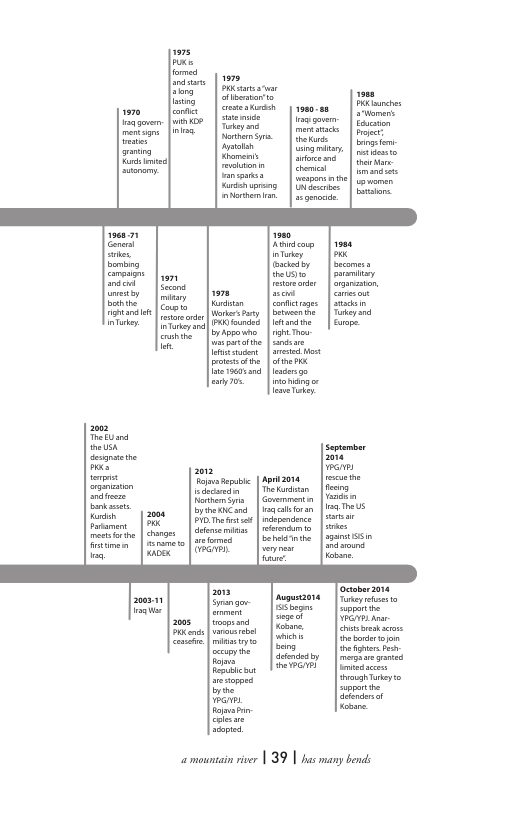
In 1978, in a tea house in Istanbul, 2 new chapter in Kurdish resis-
tance began with the founding of the Kurdistan Workers Party (PKK)
The PKK was the first militant Kurdish resistance group to espouse ex-
plicitly Marist ideology. It called for a communist Kurdistan and was a
reflection of Turkey's radical left student and worker uprisings that had
started that year. Immediately after its founding, the PKK conducted
a string of high-profile assassinations and bombings in southern Tur-
key along with a highly successful recruitment drive. Part of the sccret
to the PKK' success in recruiting was its charismatic leader, Abdullah
Ocalan—also known as Apo—and the party’s emphasis on recruiting not
only men but women. In 1980, there was another Tarkish miliary coup,
aimed to restore order in the state. That year saw the arrest of some of
the PKK top leadership and the exile of most of the central committee to
Syria and Western Europe. The Turkish military was able to thwart many
PKK operations and put pressure on PKK strongholds and training bases
in the southeast. The PKK found its ability to act inside Tarkey limited
and began its first bombing operations in Europe. The PKK also found
parters in other radical Marsist groups like the Palestinian Liberation
Organization (PLO), the Communist League of Iran, and the ASALA, 2
Marxist Armenian guerrilla group. These groups had more connections
and better access to resources than the relatively new PKK did in exile
With the PKK central committee scattered and its training bases and
offices in Turkey shut down, a more decentralized structure began to
appear. Training bases were setup and operations were conducted in 2
variety of European (Belgium and Germany) and Middle Eastern coun-
tries (notably Iraq and Syria). In 1984, after civilian rule was restored in
Tarkey and a number of political prisoners were released, the PKK was
again able to rebuild its milicant presence in Turkey. The PKK launched
a full-scale guerrilla war, mostly in the south of Turkey bust occasional-
Iy reaching as far north as Istanbul. They employed a variety of tactics
including kidnappings, industrial sabotage, assassinations of police and
milicary officers, and bombings while also providing social services and
cultural evens for the repressed Kurdish communities in the south. The
new Turkish civilian government responded with the collective punish-
ments of entire villages, milicary occupation of the Kurdish regions, and
a series of draconian laws targeted at the PKK and their alleged Kurd-
ish supporters. Tens of thousands of people in Turkey; including a great
many civilians (90% of them Kurdish), lost their lives in this conflict,
which lasted unil a ceasefire was declared in 2013,
e ane 10 | rtaion
Turkey has always considered the PKK a terrorist organization, mak-
ing it official in 1979. NATO, of which Turkey has been key member
since 1952, was lobbied heavily by Tarkey in the 19905 to add the PKK.
and its sister organizations to the official terrorist watch-list, and in 2003
NATO conceded. The year before, both the EU and the US added the
PKK to their terrorist lists, where they remain to this day. A number of
Western countries with strong economic and political links to Turkey
have used the “terrorist” designation to hound the PKK by seiring assets,
deporting PKK supporters, shutting down satellite and radio stations
sympathetic to the PKK, and providing billions in aid to Turkey for “its
war on terrorism.” Trkey has also used the PKK's terrorist label to avoid.
riticisms of human rights abuses and to ignore over a dozen internation-
al courts’ rulings against their treatment of Kurds. Today Tarkey has over
a hundred Kurdish organizations on its terrorist st yet it refuses to place
ISIS on that same list. It is clear that Turkey is less interested in waging
awar on terrorism than it is in waging a war against the Kurdish people.
The Islamic State of Iraq and al-Sham (IS1S) declared itself to be the
only legitimate Islamic Caliphate in mid-2014, going so far as to re-
name itself simply the Islamic Scate (1S). ISIS has seized large swathes of
territory across Eastern Syria and Western Iraq, and it is now the most
well-funded and well-armed jihadist group in the world. ISIS operates
with a daily hunger for atrocity previously unknown in the region, resur-
recting practices of mass rape, sex slavery, and crucifixion, and it happily
announces policies of ethnic cleansing and genocide. Turkey and other
major regional powers have been wary of dircctly confronting ISIS, in-
stead secking to transform the threat of such a group into political capital
and concessions from world powers.
Despite its current meteoric rise, ISIS did not burst recently onto the
scene in a simplistic blitzkrieg of hardline puritanical Sunni ideology—it
has been building its forces since the American invasion of Iraq in 2003,
Formerly an offshoot of Al-Qaeda in Iraq ISIS gained valuable miliary
experience fighting NATO forces in Fallujah during the initial years of
the Coalition Occupation of Irag eventually rebranding iself the Islamic
State of Iraq. Propheric rebranding aside, the Islamic State of Iraq built
its formidable force in Iraq during the mid and late 20005 before shifting
focus to the growing unrest and chaos of the Syrian civil war. ISIS con-
siders practitioners of anything besides their own brand of Sunni Islam
0 be infidels deserving death, and takes special pleasure in annihilating
Shia Muslims and minorities such as the Yazidis and the Kurds—both
of whom would be among the few groups to stand up to their orgy of
violence and slaughter.
The Great Game:
World Powers and the Kurds
The Kurdish Question has never been a strictly regional affair. Since
before World War I until today, powers stretched over the entire globe—
from Australia to America—nhave been involved in this issue. From Iraq
t0 Egypt, the Kurds have been used as pawns to leverage the players of the
region. Just like in a game of chess, the Kurdish pawn is often sacrificed
t0 gain a better position on the board. Over and over again, foreign pow-
ers interven for a bricf period of time, encouraging Kurdish rebellion
just to withdraw support at crucial points and sacrificing the Kurds when
they are no longer needed. Sometimes world powers support one Kurd-
ish rebellion while simultancously backing another regime’s crackdown
on Kurdish villages only a few hundred miles away across the border.
Kurdish autonomy has been used as a functional and disposable tool for
achieving other countries’ agendas from the realignment of the region af-
ter WWI, the rise of Soviet power, through the Cold War and the spread
of Nasserism, to George Bush Sr.s New World Order. Kurdish autono-
my has always been a means to end, never an end to itself, for the many
states that have gotten involved over the years. Owing to their precarious
position, the Kurds have been led to naively believe, decade after decade,
that the world powers actually cared about their cause while they were
being manipulated for someone else’s momentary geopolitical advantage.
The Soviet Unions relationship o both its own 450,000 Kurds and
the Kurds in Kurdistan was also marked mostly by state suspicion and
repression. In the first years of the Soviet Union, Kurds, like many other
minority groups, were forcibly displaced and a special regional govern-
ment unit was set up to monitor them. This regional unit was reorganized
several times and ultimately disbanded in 1930 when the Stalnist central
government feared it had become too sympathetic to the Kurds. Un-
der Stalin, tens of thousands of Kurds were deported from Azerbaijan
and Armenia to Kazakhstan, while Kurds in Georgia became victims of
the purges that followed the end of WWIL. Through the 1960s, various
measures were taken by the Soviet Regime to marginalize and oppress
e e 12 | taion
its Kurdish population. In the 19805 the PKK, the only Kurdish polici-
cal party to partner with Kurds in the USSR, began collaboration with
Kurds living in the Transcaucasia region and made serious inroads with
the population there. By 1986, non-armed PKK support organizations
had formed in the USSR, though they were technically llegal. According
to Turkish press, there was even a PKK organization in Kazakhstan in
2004,
For the most part the Soviet Union, and later the Russian Federa-
tion, has not been involved dircctly with Kurdish Independence since
the 1940, when it supported an autonomous Kurdish state in Iran.
Despite the PKK's carly communist roots, the Soviet Union never sup-
ported it because of the USSR ties with Syria and Turkey. Today the
Russian Federation is reluctant to actively support Kurdish independence
in Kurdistan because of its own restive minoriies, including the Russian
Kurds. At various times the PKK has sought support for training bases,
weapons, resources, and a place for exiles from other communist regimes,
including Cuba, Angola, Viemam and others, but not a one of those
countries was interested in supporting their communist cousins in such
a complicated geopolitical area without backing from the USSR. Some
socialist countries did bring up UN resolutions, and most of the Soviet
sphere voted for measures in support of Kurdish autonomy in Kurdistan.
Russia, along with UN Security Council member China, has also refused
to designate the PKK or any other Kurdish political groups as terrorist
organizations.
Western governments and organizations such as NATO have been
involved in one side or another of the Kurdish questions since the ear-
ly 19 century at the dawn of the Kurdish autonomy movement. The
French and the Briish foreign offices have used various regional Kurds
and their dreams of autonomy as prosies to secure their mandates in
the Middle East and to thwart each other. During particular erises, for
example immediately following World War I and World War I, shadowy
diplomats were shuttling between Paris or London to Kurdish shepherd
villages, bringing a lctle aid and vague promises of support if the Kurds
supported their particular political machinations. European powers did
not limit their role to just the territory of Kurdistan cither, and also used
their home countries to get involved in the Kurdish Question. Countries
like Germany, Belgium, and the Netherlands for a while allowed mili-
tant Kurdish training bases to operate on their soil but would raid and
shut them down depending on the geopolitical winds of the time. Greece
supplied Kurds in Turkey and housed exiled PKK officials in order to
punish Turkey for their 1974 invasion of Cyprus, but after coming to
agreement on trade with Turkey they kicked the PKK out and stopped
all aid. France even tied to use Kurds to slow Algerian independence,
despite the fact that there were no Kurds in Algeria, by implying they
may give them territory in a French-owned Algeria
The US was late t0 the show of manipulating the Kurds' desire for
freedom. During the Cold War the US mostly found itself siding with
the Shah of Iran and using CIA personnel and resources to help both
repress the Kurds in Iran and foment Kurdish rebellions in Iraq. The
US stuck to covert operations, and thus lile was known unil recently
about US involvement in the Kurdish Question. During the first Gulf
War, when Iraq occupied the oil-rich emirate of Kuwait in August 1990,
Saddam Husscin became America’s enemy number one. Yet from 1987
unil the Iragi invasion of Kuwait, the US said nothing. At times, the US
even supported Iraq in the UN, when Saddam Hussein was gassing tens
of thousands of Kurds and bombing whole Kurdish towns and villages.
But at the beginning of the First Gulf War, George Bush Sr. publicly de-
clared Kurds are the US's “natural allies” and suggested they should revolt
against the Baghdad regime. Of course, Bush Sr. knew that the Kurds
had already been fighting the Ba'athist regime in a bloody, fificen-year,
on-again off-again civil war.
After the war, the US put in place an incffective no fly zone, which ap-
parently did not include helicopters, to “protect the Kurds " Thousands
of Kurds and other civilians in northern Iraq were killed by Saddams
milicary while US planes flew overhead doing nothing. During the sec-
‘ond Gulf War, the US asked again for the peshmerga (the milicary forces
of Iraqi Kurdistan) to help rid the country of the Baathist regime. This
time, the Kurds decided to focus on securing the north for themselves
and on creating an army that could defend itself—they'd learned their les-
son from the first Gulf War. Today the Kurdistan Regional Government
(KRG) exists not because the US protected the Kurds, but because they
took US and coalition aid and resources to prepare their own defense.
The KRG also pursued its own diplomatic strategy with the fledgling and.
factious National Iraqi Congress
Many other countries, from China to Australia, have interfered in the
Kurdish Question, ultimately thwarting the Kurdish dream of freedom
across a unified Kurdistan. Today almost all countries in the West have
designated Kurdish milicant groups as terrorists while at the same time
e e 14 | rataion
trying to enlist their help in the war against the Islamic State and other
Jihadist groups. It scems the Kurds have lost some of their naivee and
have learned that being temporary sacrificial pawns for the West will not
aid their cause in the long run. The lesson of the second Gulf War and the
recent Syrian civil war is that the Kurds must rely on their own forces to
have any hope of securing autonomy and justice for their people.
From Red Star to Ishtar’s Star
While the PKK was not founded by die-hard communists, it soon be-
came a classic Maoist national liberation struggle party complete with an
unquestioned charismatic “father of the people”, Abdullah Ocalan, aka
Apo. There wasltle to differentiate the PKK from the dozens of Mao-in-
spired milicant liberacion groups of the late 19705 and 1980s.
The PKK weren't the only committed Marxists in Kurdistan— a
number of other smaller groups existed, some claiming to be Leninists,
Trotskyites, or even Titoists. But the peasant-based insurrectionary phi-
losophy of Maoism, as espoused by the polit-bureau and the leadership
of the PKK, was by far the most popular and militarily effective means of
resisting oppression.
The PKK’s flamboyant embrace of communism garnered some sup-
port from the calcified old Left parties of Western Europe, but it failed
to produce much in the way of real solidarity. While certain Maoist
ideas appealed to Kurds eager to rid themselves of authoritarian state
repression, those same ideas alienated a lot of potential, more liberal,
supporters. Thus, the PKK’s struggles were largely ignored and some-
times condemned by possible sympathizers in and outside the region.
The emphasis on centralization in Maoist communism also alienated
many of the social leaders inside Kurdistan. The Kurds traditionally have
been socially and policically organized by loosely connected tribes and
have supported tribal leaders who had distinguished themselves in some
way other than heredity. Periodically, Kurds formed large, temporary
confederations of tribes to mount uprisings and military actions. Politi-
cal parties have never gained the monopoly on political organizing that
they have in many other parts of the world—it wasnit uncommon for a
Kurd to be pare of a few political parties and switch berween them based
on how successful they were. Despite these cultural obstacles, the PKK
championed hardline communism until well after the fall of the Soviet
regime.
For the PKK, the crisis in their communist faith didn' occur until
1999 when their leader Ocalan was arrested in Nairobi by the MIT
(Turkish military intelligence), flown back to Turkey, and incarcerat-
ed on a prison island upon which he was the only inmate. The Turkish
media showed a humiliated Ocalan, “the Terrorist of Turkey” harmless
and in chains. With their leader captured and no obvious successor, the
PKK's central committee was thrown into crisis. The increasingly mil
tant tactics of bombings, roadside ambushes, and suicide bombers were
not working, and the rise of Jihadi attacks in the Middle East and the
West made the PKK scem just like another Islamic terrorist organiza-
tion despite its communist ideology: This, combined with the collapse of
commaunism in Eastern Europe and Russia, led to a period of ideological
soul-searching for the PKK and its leader.
Thousands of miles away, on January 1, 1994 (five years before
Ocalan's capture) a new type of liberation struggle kicked off in the for-
gotten mountain jungles of Chiapas, Mexico. The Zapatistas, with their
red star flag and their black masks, burst onto the world stage and quickly
inspired the progressive Left around the world. A small Mayan liberation
struggle had risen from the Lacandon Jungle of Southern Mexico and
declared themselves autonomous. These politically savvy revolutionaries
created a new type of lefiist insurrectionary political configuration they
called Zapatismo. Zapatismo situated itself as a mode of liberation and.
lefiist struggle that rejected hicrarchy, party control, and aspirations to
create a State apparatus. The architects of this new configuration had
spent years in hardline Marxist guerilla organizations in Mexico before
rejecting that model of struggle and secking a new approach.
Ocalan and the other leaders in the central committee of the PKK
were familiar with the rapid rise and success of the Zapatistas. A year
before his arrest, Ocalan had spoken to PKK party leaders about Zapa-
tismo at a two-day conference. And in his first months of imprisonment,
Apo had a “crisis of faich” regarding doctrinaire Marxist ideology and its
ability to free the Kurds. Ocalan, who spent much of his lfe espousing a
hardline Stalinist doctrine, started to reject Marxism-Leninism in favor
of direct democracy. He had concluded that Marsism was authoritari-
an, dogmaric, and unable to creatively reflect the real problems facing
the Kurdish resistance. In prison, Apo started reading anarchist and
post-Marist works including Emma Goldman, Foucault, Wallerstein,
e oone 16 | rataion
Braudel, and Murray Bookchin. Ocalan was particularly impressed with
Bookchin’s anarchist philosophy of ecological municipalism, going so far
as to demand that all PKK leaders read Bookehin. From inside prison,
Ocalan absorbed Bookchin's ideas (most notably Bookchin's Civilization
Narratives) and wrote his own book based on these ideas, The Roots of
Civilization (2001). Tt was Bookehin's Ecology of Freedo (1985), howev-
ex, which Ocalan made required reading for all PKK milicants. It went on
to influence the ideas found in Rojava.
In 2004, Ocalan tried to arrange a meeting with Bookchin through
his lawyers, describing himself as Bookchin's “student” and cager to adapt
Bookchinsideas to the Kurdish question. In particular, Ocalan wanted to
discuss his newest manuscript, I Defense of People (2004), which he had
hoped would change the discourse of the Kurdish struggle. Unfortunate-
ly for Ocalan, the 83-year-old Bookchin was too il to accept the request
and sent back a message of support instead. Murray Bookchin died of
congested heart failure two years later, in 2006. A PKK congress held
later that year hailed the American thinker as “one of the greatest social
scientists of the 20th century,” and vowed that “Bookchin's thesis on the
state, power, and hierarchy will be implemented and realized through our
struggle.... We will put this promise into practice, this as the first society
that establishes a tangible democratic confederalism.” Five years later, in
2011, the Syrian civil war gave the Kurds a chance to try to make good
on their promise.
The Syrian civil war began as part of the general uprisings in spring
2011 in North Africa and the Middle East that the West dubbed the
“Arab Spring.” Kurds from a variety of political backgrounds joined
students, Islamists, workers, political dissents, and others in calling for
the end of the repression of the Assad dictatorship. Syrian President
Bashar al-Assad, however, had learned the lessons of Tunisia, Libya,
and Egypt and quickly sent in troops to crush the growing democratic
movement. By autumn, the mostly peaceful protests that had taken
place in the spring had morphed into a full-on armed insurrection
against the Assad regime.
When the protests first began, Assad's government finally granted citi-
zenship to an estimated 200,000 stateless Kurds in an effort to neutralize
potential Kurdish opposition. By the beginning of 2012, when over 50%
of the country was controlled by rebel groups and Islamic milicias, and
Assad's forces were spread thin, the regime decided to pull all military
and government officials out of the Kurdish regions in the north, in effect
handing the region over to the Kurds and Yezedis living there. Oppo-
sition groups, most prominently the PKK-aligned Democratic Union
Party (PYD), created a number of coalition superstructures to administer
the region. There was tension between PYD and parties aligned with
the Kurdish Regional Government (KRG) in Iraq, however, and at one
time there were even two competing coalitions: the PYD-backed Na-
tional Coordination Committee for Democratic Change (NCC) and the
KRG-aligned Kurdish National Council (KNC). In carly 2012, when it
looked like the tension between the two groups might result in armed
conflic, the President of the KRG Massoud Barzani and leaders of the
PKK brought the two groups together to form a new coalition called
the Supreme Kurdish Council (SKC) made up of over fifteen political
parties and hundreds of community councils. Within months of form-
ing, the SKC changed its name to the Democratic Society Movement
(TEV-DEM) and added non-Kurdish groups, political parties, and orga-
nizations to the coalicion. The TEV-DEM created an interim governing
body for the Rojava region.
The TEV-DEM's program was heavily influenced by the PYD's ideas
of “democratic confederalism,” which the PKK had adopted as their of-
ficial platform in a people’s congress on May 17%, 2005. According to
the platform, and subsequent documents and proclamations from Ro-
java, “democratic confederalism of Rojava is not a State system, it is the
democratic system of a people without a State... It akes s power from
the people and adopts to reach selfsufficiency in every field, including
economy” In Rojava, Democratic Confederalist ideology has three main
planks: libercarian municipalism, radical pluralism, and social ccology.
The TEV-DEM have been implementing this new social vision on a
massive scale in Rojava since carly 2012. The PKK has attempted (and
succeeded to some degree) to implement democratic confederalism in
scattered villages in Turkey along the Iraq border since 2009, experiments
that served as an inspiration for much of the Rojava revolution. This
vision, in both Turkey and in Rojava, draws heavily from contemporary
anarchist, feminist, and ecological though.
e oone 18 | rtaion
Stateless Government:
Radical Democracy and Decentralization
How do you base a government on anarchism? Rojava is not the first, and
hopefully won't be the last, experiment in creating a new form of a decen-
tralized non-state government without hierarchy. In the past two years,
two-and-half million people in Rojava have been participating in this
new form of governance, a governance related to that of the Spanish Rev-
olution (1936), the Zapatistas (1994), the Argentinian Neighborhood
Assembly Movement (2001-2003), and Murray Bookchins libertarian
municipalism. Despite some similaricies to these past experiments and
ideas, what is being implemented in war-torn Rojava is unique—and
i’s extremely ambitious. It no hyperbole to say that this revolution in
northern Syria i historic, especially for anarchists
At the core of this social experiment are the variety of “local coun-
cils” that encourage maximum participation by the people of Rojava.
The Kurdish people have a long history of local assemblies based on
tribal and familial allegiances. These semi-formal assemblies have been
an important practice of social organizing for Kurds for hundreds of
years, so it is no surprise that the face-to-face assemblies soon became
the backbone of their new government. In Rojava, neighborhood
assemblies make up the largest number of councils. Every person (in-
cluding teenagers) can participate in an assembly near where they live.
In addition to these neighborhood assemblies, there are councils based
on workplaces, civic organizations, religious organizations, political
partics, and other affinity-based councils (e.g. Youth). People ofien are
part of a number of local councils depending on their life circumstanc-
es. These councils can be as small as a couple dozen people or they
can have hundreds of participants. But regardless of size, they operate
similarly. The councils work on a dircct democracy model, meaning
that anyone at the council may speak, suggest topics to be decided
upon, and vote on proposals (though many councils use consensus for
their decision-making). It is unclear how membership is determined
in these councils, but we know that the opposition movement coun-
cils prior to 2012 had no fixed membership and anyone showing up
at assembly could fully participate. It is also unclear how often these
councils meet and who determines when they meet. It is known that
the neighborhood assemblies in the Efrin Canton meet weekly, as does
one of the hospital workers' councils. These local councils make up
the indivisible unit of Rojava democracy. Larger bodies (c.g. Supreme
Council of the Rojava cantons) are populated with representatives from
these local councils. All decisions from these “upper councils” must
be formally adopted by the local councils o be binding for their con-
stituents. This s very different from the federalist tradition, in which
the federation supersedes local control. In August 2014, for example, a
regional council decided that local security forces could carry weapons
while patrolling a city, but three local assemblies did not approve this
decision, s0 in those local assembly areas security must refrain from
carrying weapons. The role of the “upper councils” is currently limited
to coordination berween the myriad of local councils while all power
is still held locally. Representatives to the “upper councils” rotate fre-
quendy, with a maximum term set by the “upper council,” but local
councils often create their own guidelines for more frequent rotation of
their representatives. The goal of the Rojava council system s to maxi-
mize local power and to decentralize while achieving a certain necessary
degrec of regional coordination and information-sharing,
The remaining government above the upper council level scems sim-
ilar t0 a council parliamentary system with rorating representarives, an
exccutive branch composed of canton co-presidents, and an independent
judiciary. All governmental power emanates from the councils, and the
councils retain local autonomy, thus forming a confederation. The con-
federation is made up of three autonomous cantons that have their own
ministrics and militias. There is no federal government in the Rojava can-
ton system. Voluntary association and mutual aid are key conceprs for the
confederation, as these ideas protect local autonomy. Voluntary associa-
tion leads to radical decentralization, severely limiting any organizational
structures above the primary decision-makers of the local councils. All
bodies beyond the local councils must have proportional representation
of the ethnic communities in the canton and at least 40% gender balance
(this includes all ministries). Most ministries have co-ministers with one
male and one female minister, with the exception of the Women's Min-
ister. Most decisions by the Supreme Council need support of 2/3 of the
delegates from the upper councils. Any canton recains autonomy from
Supreme Council decisions and may override them in their own People's
Assembly (the largest upper council of any region) while still being part
of the confederation. This bottom-up decentralization secks to preserve
the maximum level of autonomy for local people while encouraging max-
imum political participation.
e e 20 | rtaion
Both internal and external security for the cantons is administered by
each canton's People’s Assembly. The local security, which are equivalent
0 police, are called Asayish (security in Kurdish). The Asayish are elect-
ed by local councils and serve a specific term determined by the local
council and the canton's People’s Assembly. The Asayish have also their
own assembly (but not one that can send representarives to the People’s
Assembly), in which they elect officers and make other decisions. In ad-
dition to the Asayish, there are people’ self-defense militas o provide
security from outside threats (g, currently the Islamic State, but this
could also include regional and state government forces). These milicias
elect their own officers but are directly responsible to the canton's People's
Assembly. Both the Asayish and the people’s self-defense milicias have
two organizations: one a female-only group and the other co-cd. Militias
that are providing murual aid in another canton (Asayish are for the most
part forbidden to work in other cantons) maust follow that canton's Peo-
ple’s Assembly but can recain their own commanders and unis. In times
of peace, the cantons do not maintain standing militia service.
Rojava’s relationship with the Syrian state is yet to be tested. The Ro-
java Canton Confederation is not set up as a state. It draws instead on
the idea of dual power, an idea first outlined by the French anarchist
Proudhon. The KCC described dual power as *a strategy of achieving a
libertarian socialist economy and political and social autonomy by means
of incrementally establishing and then networking institutions of direct
participatory democracy” to contest the existing authority of state-capi-
talism. Rojava currently has set out a path of co-existence with whatever
state arises from the Syrian civil war and to the current alignment of
neighboring states (namely Turkey, Iraq, and Iran) that encompass Kurd-
istan. People in Rojava would maintain their Syrian citizenship and
participate in the Syrian state so long as it doesn't direcrly contradict
the Rojava principles. This uncasy co-cxistence is the reason the cantons
have explicitly forbidden national flags, have not created a new currency,
a forcign ministry, or national passports and identity papers, and why
they do not have a standing army. It is unclear if the people of Rojava
plan to maincain this relationship with the state or what would happen
in conflictual situations.
Rojava i neither a state nor a pure anarchist society. It is an ambitious
social experiment that has rejected the seduction of state power and na-
tionalism and has instead embraced autonomy, direct democracy, and
decentralization to create a freer society for people in Rojava. The Rojava
principles have borrowed from anarchism, social ecology, and feminism
in an attempt to chart a societal vision that emphasizes accountabili-
ty and independence for a radically pluralistic community. It is unclear
whether this experiment will move towards greater decentralization of
the kind Bookchin suggests and the Zapatistas have implemented or if
it will become more centralized and federal as, happened afier both the
Russian and Spanish revolutions. What is happening right now is a his-
toric departure from tradicional national-liberation struggle and should
be of great interest to anti-authoritarians everywhere.
Radical Pluralism
While we see the Rojava revolution as a Kurdish movement, we should
not overlook the dynamic pluralism of the region and the aspirations of
the peoples of the three cantons that make of the Rojava Confederation.
We should also take into account the fact tha the Kurds themselves are
not a homogenous people, but instead one made up of numerous dis-
tinct tribal groups and four religions. The Kurdish diaspora had found
numerous Kurds, including many of the Kurd's ideological leaders,living
i cities and attending universities across Europe. This culture exposure
helped instil a tolerant and pluralisic outlook in Kurdistan. The Rojava
Principles not only talk about pluralism and diversity in regards to eth-
nicity and faith, but have created organizing structures to maximize these
principles in pracice.
The Rojava region is dominated by Kurds, with around 6% of the
population identifying as Kurdish. The remaining 35% is made up of
Arabs, Armenians, and Assyrians. There has been immigration of both
Kurds and non-Kurds to the region from war-torn areas of Syria. It is
estimated (though the numbers are very unreliable) that over 200,000
people have relocated to Rojava since the beginning of the war from oth-
ex parts of Syria. A substantial number of these new immigrants belong
o religious and ethnic minorities from Syria and Eastern Irag.
As regards religion, the Kurds are the most diverse ethnicity in the
region. The majority of Kurds (55-65%) are Sunni Muslims, belonging
t0 the Shafi sect. There are also Muslim Kurds who follow Shia, Suf, and
Alawi traditions. There is a sizable number of Christian Kurds, many
of whom immigrated to Rojava afier the start of the war. Yazidis have
e o) 22 | taion
also immigrated to Rojava. Yazidis are a syncretic religion that has con-
nections to Zoroastrianism, Judaism, and Islam. A small minority in
Rojava follows a new form of Zoroastrianism, and there is also a very
small pocket of Kurdish Jews. Most of these religious groups traditionally
lived in communities side-by-side, partially due to forced resetdlements
and self-exiles, and many even shared religious buildings. There is a also
a high percentage of inter-faith marriages.
Rojava has embraced its iversity and is explicit about its commitment
t0 pluralism. They use the term radical pluralism to describe how their
approach differs from the extreme sectarianism found in much of the re-
gion. There are specific local councils for cach ethnic group and religious
organization. In, addition upper councils (e.g. City and Regional Coun-
cils) have ethnic quotas to ensure that allethnic groups are represented. A
similar quota system exists in all ministries except the specific ethnic and.
religious ministries. The Rojava Principles also enshrine a number of pro-
tections for ethnic and religious minorities (including those withour any
faith). Even militias and sccurity have explicit pluralistic characteristics
with different ethnic and religious groups working together.
Rojava has staked out a new path of pluralism that doesn't currently
exist anywhere clse in the region. Rojava has rejected the call of secu-
larism, like that of Turkey; that oppresses religious organizations and
practitioners in exchange for a pluralistic society, but instead has set itself
as a safe haven of respect and political empowerment for cthnic minori-
ties in the region.
Feminism in the Rojava Republics
Kurdish female fighters have recently been “discovered” and sensational-
ized by Western media—even fashion magazines have entered the fray.
But this media is simply glamorizing female fighters without paying but
litdle attention to their politics. It s all 100 casy to fall ino the media trap
of fetishizing the female fighters of the all-women Women's Self-Defense
Brigades (the YP]) and the mixed-gender General Self-Defense Brigades
(the YPG) in Kurdistan without considering the implications of women
choosing to be fighters in a very patriarchal society. The women who are
fighting in Rojava are fighting for their lives and they are fighting for
their rights as women against an enemy that rapes and sells women as
sex slaves. But this isn't a new thing—women who have been fighting
in the region for decades. In fact, traditionally, half the members of the
PKK have been women. What is new about the women combatants of
Rojava i their expliit feminism, a feminism that has become one of the
founding principles of the Rojava experiment. Kurdish culture is gener-
ally strongly patriarchal: male dominance is prevalent, and arranged and
forced marriages are common. The YP] are not only fighting against ISIS,
they are fighting for feminism and gender equality—and they're doing it
with ideas and bullets alike.
The YPJ exists as a counterpoint to the YPG. Women of Rojava hope
that at some point the YP] will no longer be necessary, but unil that
point it will function as an entirely-female force for both fighting Roja-
vals enemies and resolving social issucs. The YP) is meant to eventually
become part of the YPG, but in a show of idealistic pragmaism, the
KCK has designated that at least for the foresceable future the YP] as an
exclusively female fighting force will be needed to balance out the tradi-
tionally masculine-oriented militarism of armed militias such as the YPG
(or its parent organizacion, the PYD). Furchermore, while the leadership
ofall governing councils of the Rojava cantons are mandated to be com-
posed of at least 40% of cither gender, the leadership of the YPG is often
more like 50-60% women as it recruits heavily from the leadership of the
YPJ. In addition to the YP] milita, the all-female security force Asayish-]
(Asayish being the Kurdish for “Security”) is alone responsible for crimes
involving women, children, domestic abuse, and hate crimes, while also
independently operating checkpoints and conducting other functions of
the *standard” Asayish.
Of course, the YP] calls to mind other all-female fighting forces—
perhaps most famously, the Mujeres Libres of the Spanish civil war. This
parallelis both accurate and dangerous, as the Mujeres Libres did indeed
form a fearsome fighting force for the inherently radical political notion
of sexual and gender equality, but unfortunately they've also become an
idea that many radicals have placed on a pedestal and exalted without
secing the Free Women of Spain as human. We must not compound that
same mistake with Orientalism when it comes to feminism in Rojava;
these are real people risking their lives for powerful political ideas. They're
not the storybook women the media caricatured by popular media as
“badass,” “sexy amazons” because they have taken up arms.
One of the other ways the Rojavans have been fighting for the rights
of women in Kurdistan has been the creation of all-women's houses run
e o 24 | rataion
by the Asayish-]. These are houses where any woman over the age of
15 can go and stay for as long as theyd like and receive free education,
and then return home (if they so chose) whenever theyd like. No men
are allowed in these houses, 50 as to protect the houses' integrity and to
ensure that the women feel comfortable and secure. There are currently
30 of these centers across Rojava. And as a response to suicides caused
by forced marriage, the Asayish-] runs a hotline for women which offers
emotional and physical support at any time.
Feminism in Rojava transcends just the YP] and the Asayish] and is
‘one of the three founding principles of the Rojavan Revolution. Society;
as envisioned in the Rojava Principles, must be set on a new path towards
feminism and simply declaring support for feminism is not cnough. With
this in mind, feminism is an essential practice of all social interactions in
the three cantons, and women are considered true political actors with
‘genuine agency—which is revolutionary in and of itself
APeople’s Economy
‘The Rojava revolution’s cconomic plan is called a “People’s Economy” to
differentiate it from traditional market and socialist (.. state) economies.
But though it posts itself as an alternative to the dualism of capitalism
and communism, it s really not a fully formed model as of yet. There
are three major concepts in the People’s Economy: commons, private
property based on use, and worker-administered businesses. The Rojava
economic experiment is less an implementation of a single concept than
a jury-rigged system that must respond to the needs of a war and a crip-
pling cconomic embargo.
In 2010, 2 year before the Arab Spring exploded in Syria, the Rojava
region provided over 40% of the country’s GNP and 70% of its exports
despite only about 17% of Syria’s population living in the region. And.
yet people in Rojava made well below the median income of the country.
The Rojava region sits on the famous Mesopotamian Plain, between the
Euphrates and Tigris rivers, and is the oldest agricultural center in the
world. Until 2011, northern Syria exported grain, cotton, and meat to
its neighbors and Europe and was the country’s largest producer of oil.
Pleniful water from the region's rivers allowed for cement factories and
other medium industrial plants to be built in the area in the 19705 and.
1980s. However, since the start of the Syrian civil war, the infrastruc-
ture required to support these economic actvities has been falling apart.
Power, communications, roads, and railways have all been seriously com-
promised. Failed infrastructure, constant war, and a strictly-enforced
embargo (most notably by Turkey, which shares Rojava’s only stable bor-
der), have ruined the traditional economy of the area. In 2012, the PYD
launched what it originally called the Social Economy Plan, which would
later be renamed the People’s Economy Plan (PEP). The PEP was based
on the writings of Ocalan and the lived experiences of Kurds in North
Kurdistan (southern Turkey).
Traditional “private property” was abolished in late 2012, meaning
all buildings, land, and infrastructure fell under control of the various
city councils. This did not mean people no longer owned their homes
or businesses, however. The councils implemented an “ownership by
use” sovereign principle, a principle that could not be overturned by any
council. Ownership by use means that when a building like 2 home or a
business is being used by a person or persons, the users would in fact own
the land and structures but would not be able to sell them on an open
market. Ocalan wrote that use ownership is what prevents speculation
and capital accumulation which in tum leads to exploitation. Aside from
property owned by use, in principle any other property would become
commons. This abolishing of private property did not extend to com-
modities like automobiles, machines, electronics, furniture, ete. but was
limited to land, infrastructure, and structures.
The commons encompasses land, infrastructure, and buildings not
owned by individuals but held in stewardship by the councils. Councils
can wrn over these public goods to individuals t be used. Commons
are conceived of a5 a way to provide both a safety net for those without
resources and 2 way to maximize use of the material resources of the
commaunity. Commons also include the ecological aspects of the region
including water, parks, wildlife and wilderness, and even most livestock.
According to Dr. Ahmad Yousef, an cconomic co-minister, three-quarters
of traditional private property is being used as commons and one quar-
ter s sill being owned by use of individuals. The economic plan (PEP)
posics that the commons are robust enough economically that there is
1o need for taxes, and since the beginning of the Rojava revolution there
have been no taxes of any type.
Worker administration is the third leg of the stool of the economic
plan. Workers are to control the means of production in their workplace
e o) 26 | taion
through worker councils that are responsible o the local councils. Ac-
cording to the Ministry of Economics, worker councils have only been
set up for about one third of the enterprises in Rojava so far. Worker
councils are coordinated by the various cconomic ministries and local
councils to assure a smooth flow of goods, supplics, and other essentials
The PEP also calls for all economic activity in the cantons o be cco-
logically sound. It is unclear who has responsibilicy for this, whether it is
the workers' councils, the local councils, the City Councils, or the Peo-
ples’ assemblies. Throughout the various statements from the economic
ministrics, one sees mention over and over again about the primacy of
ecologically sensible industry—but details are lacking,
The PEP is also vague when it comes to its reationship with other econ-
omies inside and outside of Syria. A substantial amount of the current
economic activity in the region comes from black marke oil being sold
outside the region. In Autumn, 2014, representatives of Rojava travelled
around Europe looking to create “trading partners” and seemed to be sug-
gesting a standard free market policy, while at the same time eliminating
banks and other financial institutions inside Rojava. The Rojava canton
principles also clearly state that the region will not produce ts own money
or bonds, so it is unclear how such trading relationships between other
‘governments would actually come to pass even if the embargo islified.
The strength of the PEP scems to be in how it humanizes cconomics
for local people. It achieves this by both having commons available to
the community to provide for those in need and by creating small-scale
limited ownership to promote and meet local needs and markets. Worker
administration increases and expands participation in the local cconomy
and makes the economy more accountable to those directly affected by
i The PEP secks to create a self-sufficiency that is aligned with ecolog-
ical stewardship that actually puts people and the planet before profits.
In short, the PEP is trying to create localized participatory economics to
match the localized participatory governance.
Rojava Can't Wait
and Neither Can We
Radicals in the West have been maosly silent as regards the Rojava Revo-
lution, and we find ourselves in a strange situation where the mainstream
media scems more interested in these events than we are. There are of
course a number of reasons, and excuses, for this lack of interest in the
revolutionary experiment going on in Northern Syria
The most commaonly voiced objection on the Left to supporting the
Rojava revolution is that its motives are unclear or suspect. Anarchists
have a long history of sceing popular revolutions in other places being
neutered by liberal clements or even hijacked by Lefiist authoricarian
groups. Many on the Left are concerned by the role the PKK and its
proxies play in this revolution. The PKK had a thirty-year history of un-
wavering support for a Stalinist/Maoist idcology and practice that has
rightfully alienated much of the libertarian Left in the West. In particular,
the PKK's hardline authoritarianism and their sectarian tendency to vio-
lently silence any dissent among radicals in Kurdistan has rightfully seen
support for the PKK dry up in Europe and in North America. But for
more than a decade now, since Ocalan has been jailed, the PKK has been
claiming a more anarchistic organizing model and have since worked
with a number of other radical groups. More importantly, Rojava, which
has a strong PKK proxy presence through the PYD, has not only rejected
authoritarianism in words and writings but more obviously in practice.
Even if one remains skeprical of the PKK and PYD, the fact that current-
ly there is nothing authoritarian or sectarian in the political structures of
Rojava should give the West some cause to hold their skepricism.
Whether this is because the PKK has changed of its own volition or
because it was forced to change by the people doesn't really matter. The
‘only question in this regard is how is the revolution is being manifested in
words and actions, and whether these actions and words are authoritarian
or sectarian. Any sincere analysis of the past two years in Rojava shows
an honest commitment to pluralistic and decentralized ideas, words, and
practice. The PKK's sketchy past makes it that more incumbent on West-
ern revolutionaries and anarchists to support the Rojava revolution now.
If the PKK has ot really changed, then we need to support and buttress
where we can the ideology of anti-authoritarianism and radical decentral-
ization to avoid any compromise of the current revolution by the PKK or
any other authoritarians of the left. And if the PKK as changed, then all
the more reason to support a political project that is authentically radical
and liberacory.
Many of us are rightfully confused by the complexitis of the Kurd-
ish struggle and the politics of the region. This is understandable, but
complexity should not be an excuse for us withholding solidarity and
e o 28 | rtion
support. Every day there are new resources (including this small book)
that explain the complex history not only of the long Kurdish struggle
but also that of the entire region. We can learn about it. This has been
done before. For instance, the Palestinian struggle is also extremely com-
plex and nuanced but the radical left has taken it upon itself to make the
struggle understandable. We must educate ourselves and others on the
Kurdish struggle and that in Rojava in particular instead of withdrawing
from this historic situation or waiting for others, who do not share our
poliics or the politics of the Rojava revolution, to explain it to us.
There are many radicals suspicious of the Kurds, and by extension of
Rojava, because of the US government's military support of the YPG/
YP] fighters. The US has used Kurdish fighters as prosies for the past
twenty years in various conflicts in the Middle East. There is a concern
that Rojava is or will become a puppet state of US interests in the region,
something most US radicals would not be willing to support. But sup-
port for the anti-capitalist and anti-state revolution in Rojava can hardly
be seen as implicit support for US political interests abroad. It scems
dlear that the US' current support of Rojava is simply a matter of prag-
matism to further their attempt to “degrade” ISIS. The Rojava revolution
is not specifically andi-American, but it is explicitly anti-capitalist and
anti-state, which is something we can and should fully support. To ignore
these facts s to play the same essentialist game that so often constricts
Western radicals to filds of academia and theory.
The geographical distance and isolation, along with a lack of any s
able Kurdish immigrant population in the US, has made face-to-face
connections difficult, thus forcing most people to rely on mainstream
media for information about the region. While it is absolutely true that
itis casier for radicals to travel to Chiapas, Greece, Palestine, or Ferguson
than t0 northern Syria, we should not let that postpone our support and
solidarity. Other means of communications have also been compromised
because of the Syrian Government and the civil war. During the Arab
spring the Syrian government severely limited the internet, going so far
as to actually cut cable lines, and the civil war has since made internet
extremely precarious in the region. The embargo and the closing of the
Tarkish/Syrian border by the Turkish military has also severely limited
both travel and the flow of information. This geographic and informa-
tional isolation has undoubedly retarded some support from the West's
radical communities. But Mexico, the United States, and Isracl have all
tried some versions of these reprehensible tactics before, in their attempts
t0 suppress support for other struggles, and that didnt stop us then. And
if the danger is greater in Rojava, then so t0o is the necessity of our
support. Every week activists in Rojava and elsewhere are opening up
channels of communications that we should be actively engaged i
There are numerous excuses for why radicals in the US might wish
0 wait to support the revolution in Rojava, but we can' afford to wai
While it is obvious the brave revolutionaries of Rojava could use our
support now, we also need the Rojava revolution for our own work here
in the West. Revolutionary politics in the West have been waiting far too
long for an infusion of new ideas and practices, and the Rojavan Revolu-
tion inall of its facets is something we should support if we take our own
politics at all seriously. The people of Rojava cannot wait for our support,
and so0 t00 can we not wait for the selective safety of hindsight to analyze
the revolution now unfolding. The people of Rojava have chosen to fight,
and so must we.
e e 30 | rataion
A Lexicon
Abdullah Gcalan (AKA Apo): 67-year-old Kurdish founder and pres-
ident of the PKK. He has been imprisoned by the Tarkish government
since 1999, He is the current president of the PKK and isits main ideo-
logical archirect.
AKP: Actonym for Adalet ve Kalknma Partisi, the Justice and Develop-
ment Party, Turkey's ruling political party. AKP is a socially conservarive
political party and uses draconian measures like censorship, arrests, and
overwhelming force against demonstrations of dissent in Turkey.
al-Nusra Front: This relatively large and organized Syrian militia s a
branch of Al Qaeda, started in the summer of 2012,
Al-Anfal Campaign: Genocide committed against the Kurds and other
minorities in Iraq between 1986 and 1989 by Iraqi forces loyal to the
Baathist Party under Saddam Hussein.
Alawite: Shia religious minority found in Lebanon, Turkey, and most
prevalenly in Syria. Bashar Al-Assad derives much of his support from
this echno-religious group.
Asayish: The Kurdish word for “Security” and the name of the Kurdish
commanity protection forces within the Rojava cantons, also the main
police force within the KRG
Ba'athist Party: Pan-Arab Nationalist movement that lrer went on to hold
power in both Iraq and Syria under different factions. Secular and nominally
lefist, but in realty very dictatorial and milicaristic, the Baathist Party is
perhaps most famous for becoming the politial party of Saddam Husscin.
amountain river | 31 | has many bends
BDP: Turkish acronym for Barsy ve Demokrasi Partisi, the Peace and
Democracy Party. BDP is a Turkish policical party founded after the
Democratic Society Party (DTP) was banned by Turkish courts in 2008
for being a front for the PKK. The BDP is the current political party
most sympathetic to Kurdish rights and the PKK in Turkey: There is
a currendly an investigation by Turkish authorities into this political
pary.
FSA: Acronym for the Free Syrian Army, which was originally called the
Free Officers Movement (FOM). It was started in 2011 by defecting Syr-
ian milicary officers who refused to attack protestors and “declared war”
on any armed force that did. The FSA leadership is made up of mainly
Sunni ex-milicary officers. It welcomes defections from all parts of the
Syrian Government's security forces (police and military) and has sought
t0 coordinate the various militia groups in Syria. It currently i estimated
t0 have a force of about 40,000. It supports and is supported by both the
SNC and National Coalition for Syrian Revolutionary and Opposition
Forces (NCSROP).
HPG: Kurdish acronym for Hezén Parastina Gel, the People’s Defense
Force. The HPG is technically the official name of the PKK's armed wing
but it s often used interchangeably with PKK. In 1992 it was changed to
Kurdistan National Liberty Army (ARGK) but most seill efer to it by its
old name HPG or just PKK.
HRK: Kurdish acronym for Hézén Rojbilata Kurdistan, the East Kurdis-
tan Defense Forces. HRK is the armed wing of the PJAK in Iran. The
HRK have carried out ambushes, industrial saborage, and robberies
aimed against the Iranian state since 2005. A few thousand people on
both sides of the conflict have died as the result of the fighing,
1515: The Islamic State of Iraq and Syria, also known as The Islamic
State of Iraq and Al-Sham, The Islamic State of Iraq and The Levant, and
more recently The Islamic Stace (1S). ISIS is hardline conservative Sunni
jihadist group formed as a radical offshoot of Al-Qaeda It is incredibly
violent, practicing crucifixion and sex slavery. ISIS controls a large swath
of territory in Syria and Iraq and declared itselfa caliphate with its capital
in Ar-Raqqah, Syria
e e 32 | taion
KADEK: Kurdish acronym for Kurdistan Freedom and Democracy Con-
gress, the name the PKK adopted for itslf for awhile in 2002. one of the
many names that the PKK.
KCK: Kurdish acronym for Koma Civakén Kurdistan, the Group of Com-
munities in Kurdistan. An umbrella organization, started by the PKK in
2007 to replace the KKK (Koma Komalén Kurdistan) to put in practice
the ideas of Democratic Confederalism. It is an international group and
covers Kurdish groups in Turkey, Syria, Iran, Iraq, and ex-USSR regions.
Most of the KCK's activities have been in southern Turkey.
KNC: Acronym for the Kurdish National Congess in Syria. The KNC
is a policical coalition that came about as a result of the Syrian civil war.
The KRG sponsored the first meetings of the KNC in 2011 to address
the Syrian crisis and what it meant to Kurds. Since 2011, the KNC has
grown 0 include fificen Kurdish political parties in Syria including the
PYD. The KNC differs from the Syrian National Congress (SNC) be-
cause the KNC demands decentralization (as oppose to federalist aims)
and autonomy from any Syrian governmen
KDP: Acronym for the Kurdish Democratic Party. The KDP is one of the
main policical parties in Iraqi Kurdistan and is opposed by the PUK. The
KDP was founded in 1946 during the collapse of the Kurdish Republic
of Mahabad in Iran. The KDP started as and for many decades was a
broad coalition of communist and socialist groups. During the First Per-
sian War (the Iran/lraq war) i repositioned itself as more of a nationalist
and populist coalition with some social-democraric groups included.
Kongra-Gel: The name of the general Assembly of the KCK (and pri-
or o that, the KKK). The Kongra-Gel has five subdivisions: political
ideology, social services, politicalfinternational, military, and women's
divisions.
KRG: Kurdish acronym for the Kurdistan Regional Government in Iraq,
The KRG has 2 unicameral parliament known s the IKP (Iraqi Kurdis-
an Parliament). The KRG has both a president and prime minister that
share executive and legislative powers. The President of the KRG is the
commander-in-chicf of the peshmerga forces. The city of Exbil (known
in Kurdish as Hewler) i the capital of the KRG. The KRG governs about
8.5 million people spread over 15,000 square miles in norchern Iraq,
While the KRG was initially created after years of bloody fighting by a
treaty signed by the Iraqi government in 1970, this treaty wasn' fully im-
plemented unil after the first Gulf War in 1992. The KRG was written
into the new Iragi constitution in 2005. There are sill boundary disputes
benween the Iragi government and the KRG, particularly as the KRG has
annexed lucraive oil-fields south and east of Erbil.
Kurdistan: An Ill-defined region straddling Turkey, Syria, Iraq, and Iran
composed of mostly Kurdish communities. Kurdistan is not internation-
ally recognized. North Kurdistan is in Turkey, East Kurdistan s in Iraq
and Iran, and West Kurdistan is in Syria.
KWU: The acronym for the Kurdish Women's Union. The KWU is part
of the KDP and was founded in 1952. It has a strong impact on the KDE,
especially around social services and economics,
Mahabad Republic: The Mahabad Republic (aka Republic of Kurd-
istan) was a short-lived independent Kurdish state situated in northern
Tran from 1946-7. It was backed by the Soviet Union and was eventually
crushed by the Iranian government when the USSR withdraw support
MIT: Turkish acronym for Mili ltibbarat Tskilats, the National Intelli-
‘gence Organization. MIT was founded in 1965. This is the governmental
organization most responsible for coordinating the repression of the
Kurds in Turkey today. In US terms, it is the equivalent of a combination
of the FBI and CIA. The PKK and other Kurdish organizations sup-
porting Kurdish rights and self-determination are tracked, suppressed,
arrested, and killed by the MIT.
Newroz: New Year's Day, the most important holiday of the Kurds
This mid-March festival is often used s policical demonstration against
Kurdish repression.
NCSROF: The acronym for the National Coalition for Syrian Revolu-
tionary and Opposition Forces. The NCSROF started in 2012 to bring
rebel armed groups into a coalition alongside strctly political opposicion
partiesforganizations. The SNC is the largest partner in the coalition,
controlling 22 of the 63 members of coalition. Their goal is to create an
e one) 34 | rataion
interim government, a truth and reconciliation committee to look into
war crimes, and to be the “voice of opposition to the Assad regime’” o
the rest of the world. They also helped unify and amplify the Free Syrian
Asmy (FSA).
Ottoman Empire: A massive empire that lasted for over six centuries
and included the traditional homeland of the Kurds. The empire was
dismembered after losing in World War I and a number of states were
born out of the defeated empire, including Iran, Iraq, Syria, and Turkey.
Persian: Persian is a word for both a people and a language. Persians
are non-arabic people (whom the Kurds are related to) mostly found in
present-day Iran. Persian subgroups and languages can be found in such
countries as: Iran, Tajikistan, Afghanistan, Turkey, Oman, Kuwait, Azer-
baijan, and Usbekistan.
Peshmerga: A Kurdish word that translates roughly as “those who con-
front death.” Peshmerga has been the name of the Kurdish movements'
fighting forces since 1921. Today, peshmerga is the official name of the
KRG's armed forces. There are currently over a 100,000 men and women
in the peshmerga armed forces in Iraq (of which, about 35,000 work
inside the Iragi National Armed Forces).
PJAK: Kurdish acronym for the Partipa Jiyana Azad a Kurdistané, the
Free Life Party of Kurdistan. PJAK is a large Kurdish militant and polit-
ical organization in Iran that was founded in 2004, Itis strongly aligned
with the PKK. There is strong coordination and sharing of resources be-
tween the PKK and PJAK. PJAK is a member of the KCK.
PKK: Kurdish acronym for Partiya Karkerén Kurdistani, the Kurdistan
Workers party, the Kurdish militant international organization.
PUK: Acronym for the Patriotic Union of Kurdistan. PUK is one of the
main political parties in Iraqi Kurdistan and was founded in 1975. The
KRGS current president, Fuad Massum, is a member of the PUK. PUK
is a moderate socialist political coalition made up of five smaller lefiist
organizations.
amountain river | 35 | has many bends
PYD: Kurdish acronym for Partiya Yekitiya Demokrat, the Democratic
Union Party. PYD is a Syrian political party that started in 2003, s affl-
iated with the PKK, and is a member of the KCK.
Recep Tayyip Erdogan: The current president of Turkey and the found-
er of the ruling Justice and Development Party (AKP). He was elected to
president in 2014
Rojava Canton: Any one of the three semi-autonomous regions in
northern Syria. In late 2012, the KNC and PYD called for a Rojava Re-
public free of Syrian government control. By 2013, YPG/YP] forces had
liberated 9 cities and numerous villages in the north of Syria with a toral
population of about 3.5 million.
Rojava Confederation (AKA Rojava Republics): A confederation that
consists currenly of the three autonomous Rojava cantons: Ciziré, Ko-
bani, and Efrin.
Salafist: A member of the conservative Sunni religious movement that
secks to emulate the earliest Muslims. Often associared with jihad.
SAVAK: An acronym for Sazeman-e Etteliit va Amniyat-c Keshuar, the
Organization of Intelligence and National Security SAVAK was the Ira-
nian secret police under the Shah, operating from 1957 — 1979. SAVAK
is famous for both its brutality and its Western backing
SNC: An acronym for the Syrian National Congress, which was formed
in Istanbul in 2011. The SNC sought to be a coalition of opposicional
groups, organizations, and political parties in Syria. Many of the found-
ing members are Muslim Brotherhood in exile. Only one very small exile
Kurdish party (the Kurdish Future Movement, which has split into two
factions) joined the SNC. The SNC joined the National Coalition for
Syrian Revolutionary and Opposition Forces (NCSROF) in 2012.
Shiaz A minority sect of Islam. Shias (sometimes refered to as shiiites)
believe that Mohommeds son-in-law and cousin Ali, as well as Alf's de-
scendants (the Imams), are free from human sin.
e e 36 | ration
Sunni: Sunni is the majority sect of Islam. Sunnis follow the teachings of
the first four Caliphs after the Prophet Muhammad.
TEV-DEM: A shortening of Teugera Civaka Demokratik, the Movement
for a Democratic Society. TEV-DEM is the political coalition of the
Rojava area in Syria. In 2011, after massive protests against the Syrian
regime, citizen groups and assemblies formed that were supported by
the PYD and PKK. This coalition of groups formed into the TEV-DEM
by late 2011, TEV-DEM sought to bring in people other than Kurds
living in the region and had some success in getting Arabs, Christians,
Yezedi, Assyrians, and Turkmen o actively participate in the TEV-DEM
councils
Yezedi: A Kurdish monotheistic religious minority that has been target-
ed for complete destruction by ISIS. There are Yezedis in both Syria and
Ingq
YPG: A Kurdish acronym for Yekineyén Parastina Gel, the Peoples Pro-
tection Units. The YPG was founded in 2004 by the PYD but did not
actually become active until 2012, The YPG is a coed militia that makes
up the main fighting force for the Rojava region. There are about 45,000
0 50,000 women and men fighting in the YPG.
YPJ: Kurdish acronym for Yekineyén Parastina Jiné, the Women's Protec-
tion Units. The idea for the YP] appeared as carly as 2006 but the YPJ
did not become active until 2012. They are an armed, all-female militia,
10,000 strong, that alongside the YPG make up the main fighting force
of Rojava.
o
[ g
S pm g
sepaisrasean
iy
[y
[ ——
o e e e
oty i [Seer
3¢ Rjasa | 38 | eolution
et
i
::r-er.‘k
ot
Pt
o
[P
s
[ty s
oy
i e | 39 | sy ends
There's a revolution going on in northern
Syria, one that challenges everything we know
about government and society and freedom.
The world watched in horror last autumn as the
ruthless Islamic State (commonly referred to as ISIS)
marched on the small city of Kobani in northern Syria.
No one expected the city to survive the artack. But it did.
Mixed-gender militias with small arms held one of the
most feared armies in the world at bay. The smoke cleared,
and Kobani still stood.
And western media attention moved on.
The YPG and the YP), the militias who held the city,
‘were fighting for their lives and their land. But even more
than that, they were fighting to defend their revolution:
the Rojava Revolution. When the Assad regime began
0 fall, Kurds and other ethnic minorities in northern
Syria carved out pockets of liberty and started one of the
greatest social experiments the world has ever scen. Based
on their own history of struggle and on the writings of
social ecologist Murray Bookehin, the people of Rojava
have developed an anti-state and anti-capitalist way of lfe.
1¢s a way of life that values feminism, direct democracy;
ecological stewardship, and ethnic, linguistic, and
religious pluralism. And right now, 2.5 million people
are trying their hardest to defend their revolution against
ISIS attacks from the south and an international rade
embargo ruthlessly enforced by Turkey to the north
Between language barricrs, cultural barriers, and
an international trade embargo, it can be hard o
understand what is happening there. It can be hard to
understand how to support the people of Rojava in
their revolution. This, then, is an introduction to that
struggle, to that revolution. It’s an introduction we hope
will inspire readers to act in solidarity with Rojava. Its an
introduction we hope will inspire readers to act for their
own fieedom
published in 2015 by Strangers in a Tangled Wilderness
WWW.TANGLEDWILDERNESS.ORG