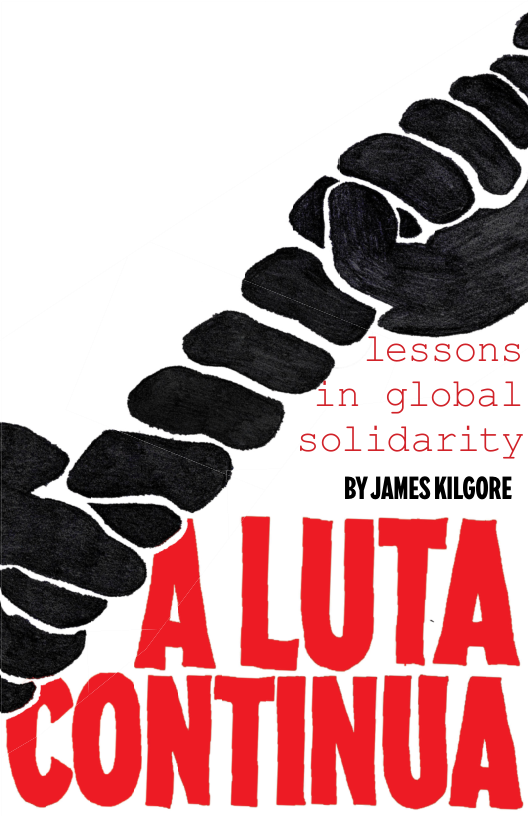
A Luta Continua: Lessons in Global Solidarity
Web PDF • Imposed PDF• Raw TXT (OCR)
![“Your love that goes into fighting for justice extends beyond your own com- munity, beyond your own national bor- ders to others and that you understand in your gut that no one will be free until everyone is free. And that you could have an economic, a political analysis, of how that works, you could look at the similarities between incarceration of women in Palestine and incarceration of women in the United States and draw out all of those similarities but that every time you see one, you are talking about it You feel as if you are talking about your own life. The feeling that you get when you see connections being made is like the joy of falling in love, the joy of winning something.” LAURA WHITEHORN activist, former political pisoner, co-founder of Release Aging People in Prison (RAPF] = 2](a-luta-continua-lessons-in-global-solidarity-james-kilgore 23.png)
![Writer and historian Roxanne Dunbar-Ortiz stressed exam- ining another legacy in keeping international solidarity alive: the socialist tradition of the Soviet Union, “The fall of the Soviet Union scared me A to death...I think it had a bigger impact 7 than any of us ever analyzed..for the last 30 years I get my hopes up that something is going to happen, and the Z only thing happening is a sort of = anarchism but they didn’t have a N program. [Theyl] just talked about \ getting rid of the state...” 2](a-luta-continua-lessons-in-global-solidarity-james-kilgore 33.png)

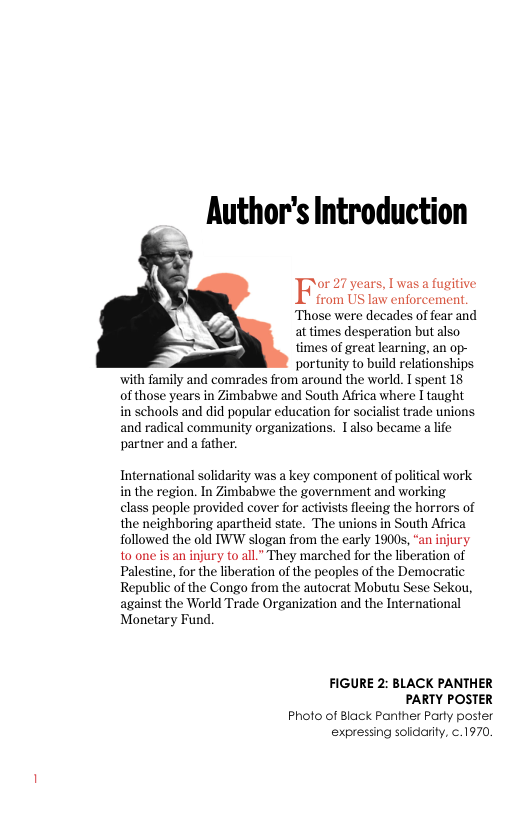
Author's Introduction
or 27 years, I was a fugitive
from US law enforcement.
‘Those were decades of fear and
at times desperation but also
times of great learning, an op-
portunity to build relationships
with family and comrades from around the world. T spent 18
of those years in Zimbabwe and South Africa where I taught
in schools and did popular education for socialist trade unions
and radical community organizations. 1also became a life
partner and a father.
International solidarity was a key component of political work
in the region. In Zimbabwe the government and working
class people provided cover for activists flecing the horrors of
the neighboring apartheid state. The unions in South Africa
Tollowed the old TWW slogan from the early 19005, “an injury
10 one is an injury (o all.” They marched for the liberation of
Palestine, for the liberation of the peoples of the Democratic
Republic of the Congo from the autocrat Mobutu Sese Sekou,
against the World Trade Organization and the International
Monetary Fund
FIGURE 2: BLACK PANTHER
PARTY POSTER
Photo of Black Panther Party poster
expressing solidarity, ¢.1970.
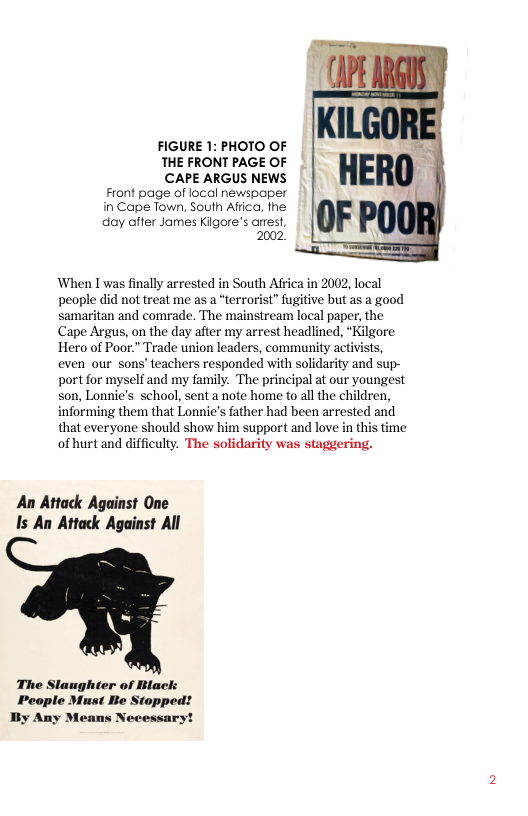
FIGURE 1: PHOTO OF
THE FRONT PAGE OF
CAPE ARGUS NEWS
Front page of local newspaper
in Cape Town, South Africa, he
day affer James Kigore's arrest,
2002
‘When I was finally arrested in South Africa in 2002, local
people did not treat me as a “terrorist” fugitive but as a good
samaritan and comrade. The mainstream local paper, the
Cape Argus, on the day after my arrest headlined, “Kilgore
Hero of Poor.” Trade union leaders, community activists,
even our sons’teachers responded with solidarity and sup-
port for myself and my family. The principal at our youngest
son, Lonnie’s school, sent a note home to all the children,
informing them that Lonnie’s father had been arrested and
that everyone should show him support and love in this time
ofhurt and difficulty. The solidarity was staggering.
An Attack Against One
Is An Attack Against All
The Slaughter of Black
People Must e Stopped!
By Any Means Necessary!
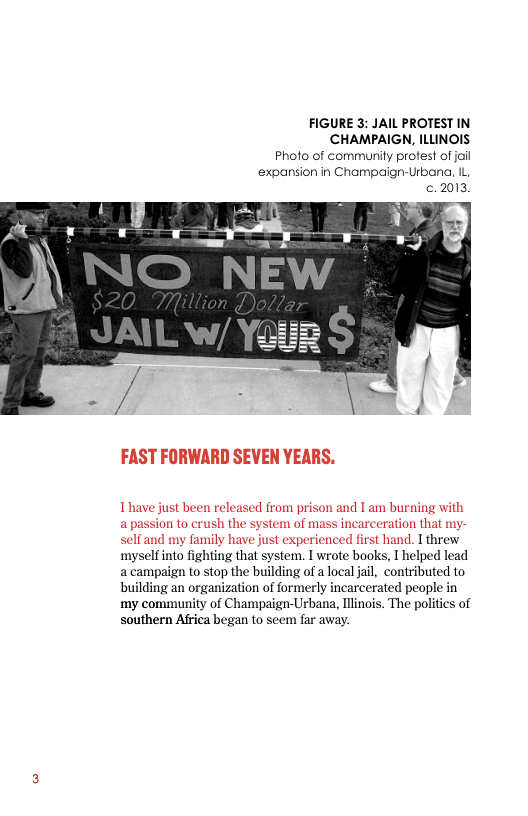
FIGURE 3: JAIL PROTEST IN
CHAMPAIGN, ILLINOIS
Photo of communily protest of jail
expansion in Champaign-Urbana, 1L,
. 2013,
FAST FORWARD SEVEN YEARS.
Thave just been released from prison and T am burning with
a passion to crush the system of mass incarceration that my-
self and my family have just experienced first hand. I threw
myselfinto fighting that system. I wrote books, I helped lead
a campaign to stop the building of a local jail, contributed to
building an organization of formerly incarcerated people in
my community of Champaign-Urbana, inois. The politics of
southern Africa began to seem far away.
FAST FORWARD FIFTEEN MORE YEARS.
Ihave been working on the issue of mass incarceration for
‘more than a decade. The work has gone up and down, with
the flow of mass mobilization and popular opinion. Bt at
‘some point I realize that the politics of fighting mass
imprisonment keeps getting narrower in focus.
In most circles of radical
prison reform, even the
circles of abolition,
people talk very little
about anything that
happens outside the US.
We are not aware of mass death by super exploitation in the
cobalt mines that bring us our cellphones and tablets. We
don’t worry too much when people in Haiti drown in massive
floods and hurricanes. While we want people to feel our
pain, we often don't recognize the suffering of others.
‘We chant slogans like
“nothing about us
without us,” but all too
often, we are only about us,
not about our comrades and fellow sufferers in the dungeons and
olive orchards of the world where the US is dropping bombs or
supplying the drivers of genocidal campaigns and poverty. More-
over, we do lttle to support our own political prisoners here in the
US who have spent 30, 40, even 50 years behind bars fighting for a
transformed society.
Al this has prompted me to take a step back, to remember what
‘an injury to one is an injury to all” demands of us. If we are to
move forward as a movement of radical or revolutionary change,
i we are to really progress down the road of abolition, we need a
global perspective, like what has characterized our movements
and global movements in the past.
forts of activists to demand a ceasefire and liberation in Palestine.
But it is not enough. We need to push faster forward. We need to
not only imagine a world without prisons and wars, but imagine
how we build organizations that can make that hap-
pen and then set about building those organizations.
\\ “The spark of this international solidarity has been lit by the ef-
As part of this effort, we have created these zines to
remind us of the need for international solidarity, to
help us refresh our memory of the history of people
in the US and beyond in building campaigns and or-
ganizations driven by connecting the dots of freedom
fights around the world. We need this spirit of
internationalism revived.
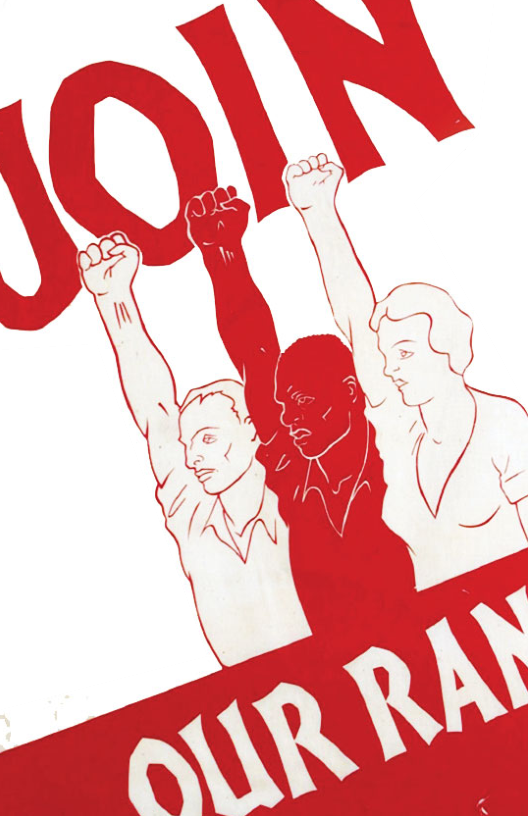
FIGURE 4: REBEL ART GROUP'S
“JOIN OUR RANKS” BANNER
Pholo of banner from left-wing arfist
collective Rebel Art Group's collection of
socialist banners and placard produced
in the 1930's.
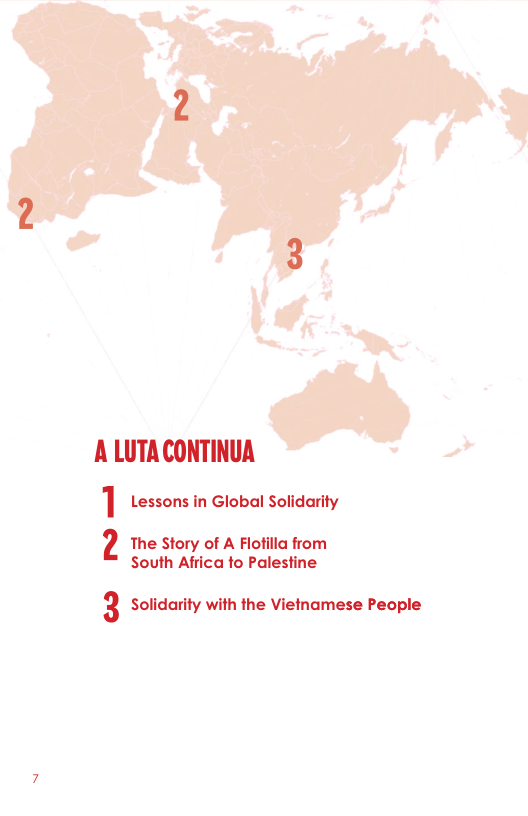
A LUTACONTINUA
1 Lessons in Global Solidarity
z The Story of A Flotilla from
South Africa fo Palestine
3 Solidarity with the Vietnamese People
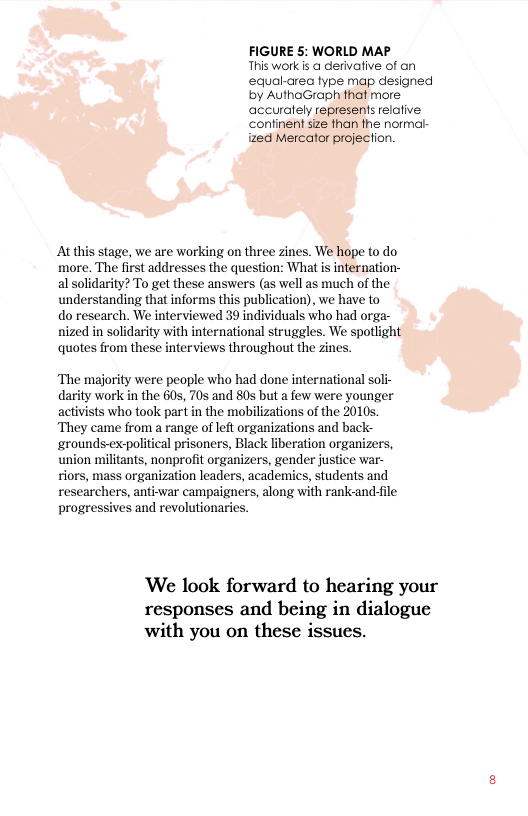
FIGURE 5: WORLD MAP
This work & @ dervative of an
equal-area type map designed
by AuthaGraph that more
accuralely represents relofive
continent size than the normal-
ized Mercator projection.
At this stage, we are working on three zines. We hope to do
more. The first addresses the question: What s internation-
al solidarity? To get these answers (as well as much of the
understanding that informs this publication), we have to
do research. We interviewed 39 individuals who had orga-
nized in solidarity with international struggles. We spotlight
quotes from these interviews throughout the zines.
‘The majority were people who had done international soli-
darity work in the 60s, 70s and 805 but a few were younger
activists who took part in the mobilizations of the 2010
They came from a range of left organizations and back-
‘grounds-ex-political prisoners, Black liberation organizers,
union militants, nonprofit organizers, gender justice war-
tiors, mass organization leaders, academics, students and
researchers, anti-var campaigners, along with rank-and-file
progressives and revolutionaries.
‘We look forward to hearing your
responses and being in dialogue
with you on these issues.
Background
International solidarity has a rich history. Since the
mid-19th century it has been a fundamental principle of:
« communist and socialist movements
« anarchist organizations
« lefttrade unions
« many global campaigns for peace and justice.
Though infrequently recognized, likely the earliest
act of international solidarity in North Ameri-
ca was the relationship between Maroon and
indigenous communities. The solidarity between
Maroon communities and indigenous peoples o=
throughout the Americas in response to settler
colonialism and slavery set an important exam-
ple of how people come together to resist
oppression.
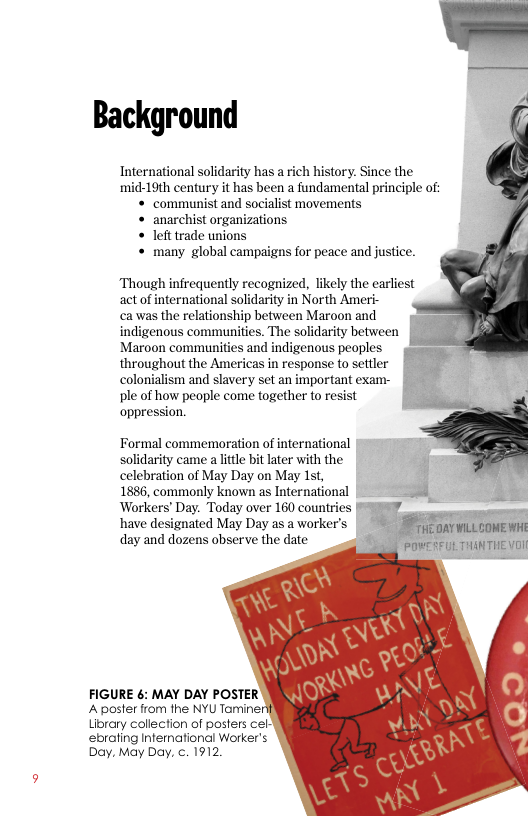
Formal commenoration of international
solidarity came alitle bit later with the
celebration of May Day on May 1st, J
1886, commonly known as International = ¢
Workers' Day. Today over 160 countries [* 57 -
have designated May Day as a worker’ i oavmLLconE Wi
day and dozens observe the date | POVEREUL THINTHE VD!
FIGURE é: MAY DAY POSTER
A poster from the NYU Taminer
Library collection of posters cel-
ebrating Infernational Worker's
Day, May Day, c. 1912
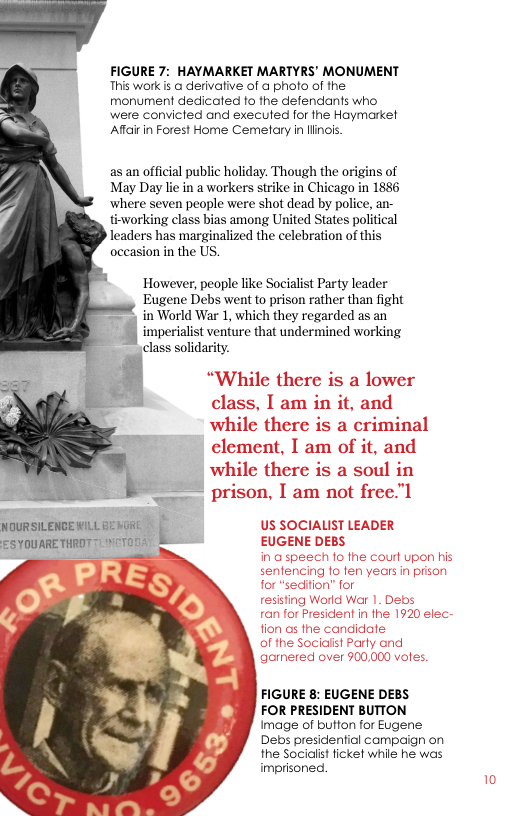
FIGURE 7: HAYMARKET MARTYRS' MONUMENT
This work s a derivative of @ photo of the
monument dedicated fo the defendants who
were convicted and execuled for the Haymarke!
Affairin Forest Home Cemelary in llinois.
as an official public holiday. Though the origins of
May Day lie in a workers strike in Chicago in 1886
‘where seven people were shot dead by police, an-
tiworking class bias among United States political
leaders has marginalized the celebration of this
oceasion in the US.
However, people like Socialist Party leader
Eugene Debs went to prison rather than fight
% in World War 1, which they regarded as an
| imperialist venture that undermined working
class solidarity,
FIGURE 8: EUGENE DEBS
FOR PRESIDENT BUTTON
Image of button for Eugene.
Debs presidential campaign on
the Socialit ficke! whie he was
imprisoned.
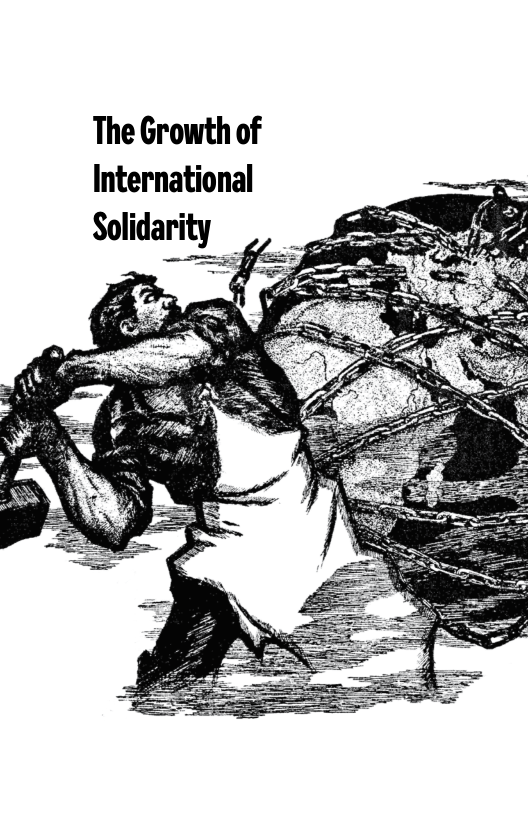
The Growth of
International
Solidarity
Perhaps the most prominent example of international
solidarity in the 20th century was the Soviet Union's.
establishment of a Communist International (known as
the Comintern) in 1919, The Comintern brought together
more than 50 communist parties from across the world
in opposition to the imperialist protagonists of World War
1. The Comintern lasted until 1943 and was an important
force in opposing fascism in the 1930s, largely through
the recruitment of communists and anarchists from
around the world to join the international brigades to
fight fascism in the Spanish Civil War.
In the 19605, 70s and 80s many locally-based groups
emerged in the US leftto support national liberation
struggles and revolutions in the Global South. They
targeted freedom fights in South Africa, Central America,
Chile, Mozambique, Angola, Western Sahara, East Timor
and most famously, Vietnam. Moreover, people on the
left in the US looked to the writings of international revo-
lutionaries to help guide their struggles. In study groups
and liberation schools, people read the works of famous
left theoreticians like Marx, Engels and Lenin but also
Tooked to global writers: Mao Zedong, Kwame Nkrumah,
Che Guevara, Frantz Fanon, Antonio Gramsci, Amilcar
Cabral, Simone deBeauvoir, Alexandra Kollontai,
Emma Goldman, CLR James, Carlos Marighela Fidel
Castro, and Selma James,
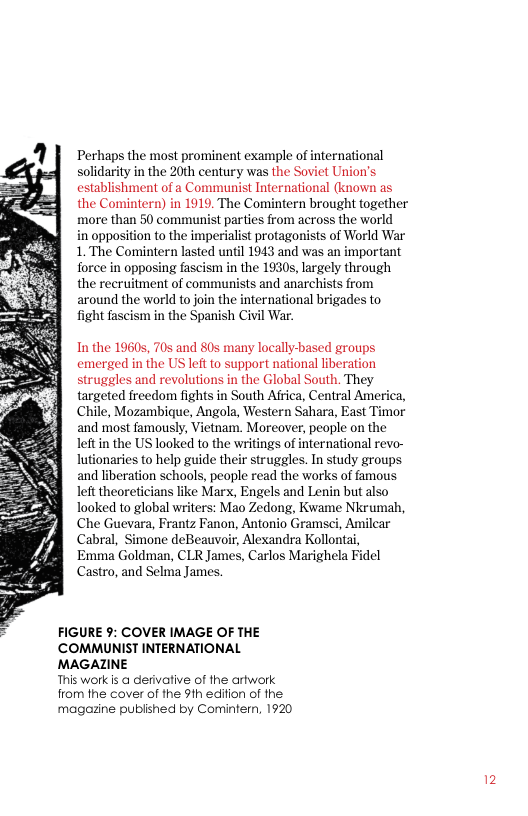
FIGURE 9: COVER IMAGE OF THE
COMMUNIST INTERNATIONAL
MAGAZINE
This work is @ derivative of the artwork
from the cover of the 9th edifion of he
magozine published by Comintern, 1920
‘The Black liberation movement and its key leaders Martin
Luther King, Malcolm X, Kwame Ture (formerly known as
Stokely Carmichael), Ella Baker and the Black Panther Par-
ty were at the forefront of many of these efforts. Several of
these Black leaders expressed their international solidarity
by leaving the US to live overseas in countries that had won
their freedom through armed struggle. Ture went to live
in Guinea, Black Panthers Eldridge Cleaver and Katherine
Cleaver relocated to Algeria, and the leader of the Deacons
of Defense in North Carolina, Robert F. illiams lived in
Cuba and China.
During this period, some smaller nations even offered
military resources for international solidarity, notably Cuba
‘which sent over 30,000 troops to fight against apartheid
South Afica’s incursion into Angola in 1975. Much, though
notaal, of this solidarity supported overthrowing capitalism
and establishing some form of socialist rule.
Even after the demise of the Comintern, many of these
struggles and solidarity groups drew backing from the Sovi-
et Union as a counter pole to global capitalism. Regardless of
the limitations of the Soviet Union’s socialist experiment, its
‘mere existence created a framework for people to imagine
‘what an alternative world could look like. For elders of
today, that alternative framework was part of the terrain on
which they matured as political actors. For younger activists,
such an alternative framework remains something to be
imagined and constructed.
After the fall of the Soviet Union in 1989, the character of
international solidarity changed. We saw a decline in inter-
national solidarity in the practice of left organizations and
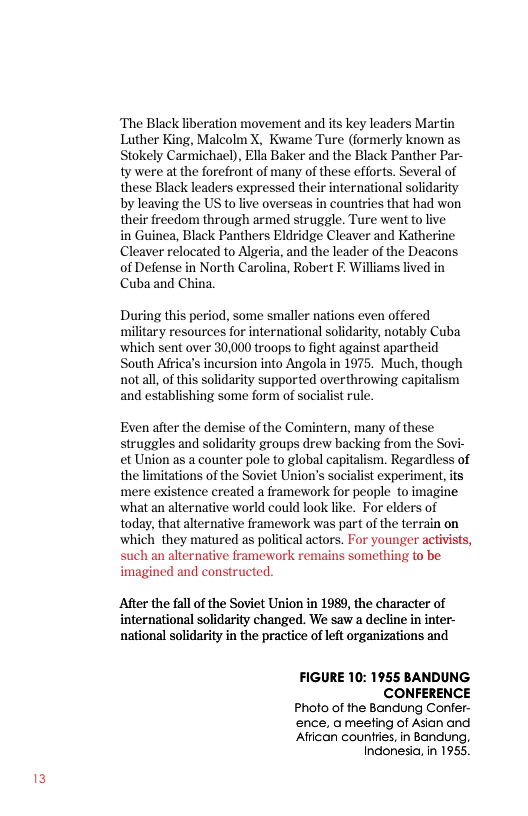
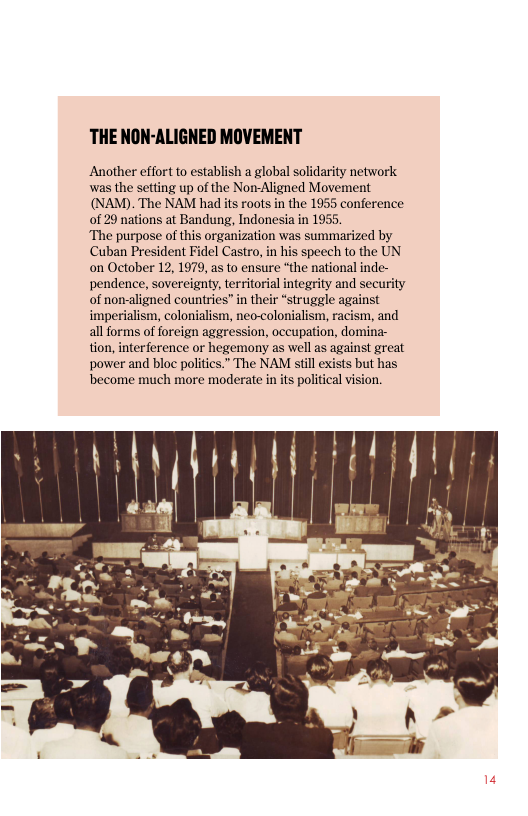
FIGURE 10: 1955 BANDUNG
CONFERENCE
Photo of the Bandung Confer-
ence, ameefing of Asian and
‘Afican counties, in Bandung,
Indonesia, In 1955.
THE NON-ALIGNED MOVEMENT
Another effort to establish a global solidarity network
was the setting up of the Non-Aligned Movement
(NAM). The NAM had its roots in the 1955 conference
of 29 nations at Bandung, Indonesia in 1955.
The purpose of this organization was summarized by
Cuban President Fidel Castro, in his speech to the UN
on October 12, 1979, as to ensure “the national inde-
pendence, sovereignty, territorial integrity and security
of non-aligned countries” in their *struggle against
imperialism, colonialism, neo-colonialism, racism, and
all forms of foreign aggression, occupation, domina-
tion, interference or hegemony as well as against great
power and bloc politics.” The NAM still exists but has
become much more moderate in its political vision.
movements. Yet, people continued to mobilize on issues
with global implications.n opposition to the formation of the
World Trade Organization (WTO) and the Iraq War, in the
founding of Occupy, in supporting the uprisings related to
Arab Spring in 2011-2012, and to protest police killings of
Black people in the US. However, due to a lack of resources
and political clarity, no organizational pole emerged to tie
these struggles together at a global level and build enduring
bonds of solidarty.
Despite the massive increase in the supportfor the revolu-
tionary framework of abolition, the notion of global solidarity
largely remains at the margins. While mobilizations in sup-
port of Gaza have sparked a new wave of internationalism,
its permanence remains in question. We cannot afford to let
itlapse.
We need to rethink what
international solidarity
looks like in this period,
how we can learn
from the past to build
more expansive left
organizations, and what
place internationalism has
in building transformative
movements based on
abolition and socialism
in the future.
Two Strands of
International Solidarity
International solidarity means different things to
different people. In our ws a wide range of
perspectives surfaced. But ultimately, we
that there are two main strands of international
solidarity. “
“An injury to one
is an injury to all”
THE INDUSTRIAL WORKERS OF THE WORLD
Aslogan created in the ecrly 1900 by the.
Industrial Workers of the World (also
The Wobhblies) but now used by labor
organizations around the world,
ez
One strand stresses building relationships, making a
personal or even spiritual connection to people or a
cause beyond one’s own personal realm or physical
‘borders. This form of solidarity has existed in many
forms but has no universally accepted model or
archetype. We could call it the spirit of international
solidarity. Many interviewees emphasized acknowledg-
ing that spirit and the actions of people who practice
international solidarity in the face of genocide, systemic
racism, climate catastrophe, gender oppression, mass
incarceration and the expansion of surveillance and
artificial intelligence.
‘The other strand focuses on providing material or mili-
tary support to a specific struggle against imperialism.
Typically the vehicle for this sort of solidarity has been
a political organization or a government, but grassroots
‘groups have also provided this kind of support.
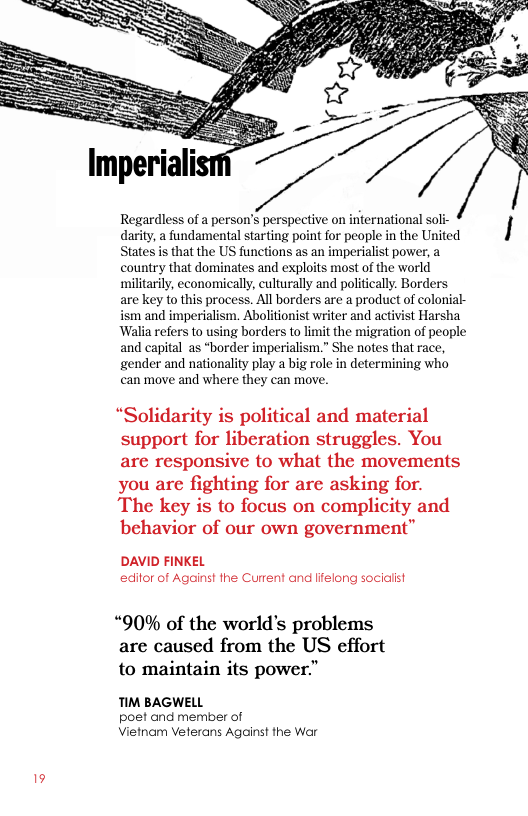
Regardless of a person's perspective on international soli-
darity, a fundamental starting point for people in the United I
States is that the US functions as an imperialist power, a
country that dominates and exploits most of the world
militarily, economically, culturally and politically. Borders
are key to this process. All borders are a product of colonial-
ism and imperialism. Abolitionist writer and activist Harsha
Walia refers to using borders to limit the migration of people
and capital as “border imperialism.” She notes that race,
gender and nationality play a big role in determining who
can move and where they can move.
“Solidarity is political and material
support for liberation struggles. You
are responsive to what the movements
you are fighting for are asking for.
The key is to focus on complicity and
behavior of our own government”
DAVID FINKEL
edior of Against the Current and lfelong sociaiist
“90% of the world's problems
are caused from the US effort
to maintain its power."
TIM BAGWELL
poet and member of
Vietnam Veterans Against the War
\« PO RS
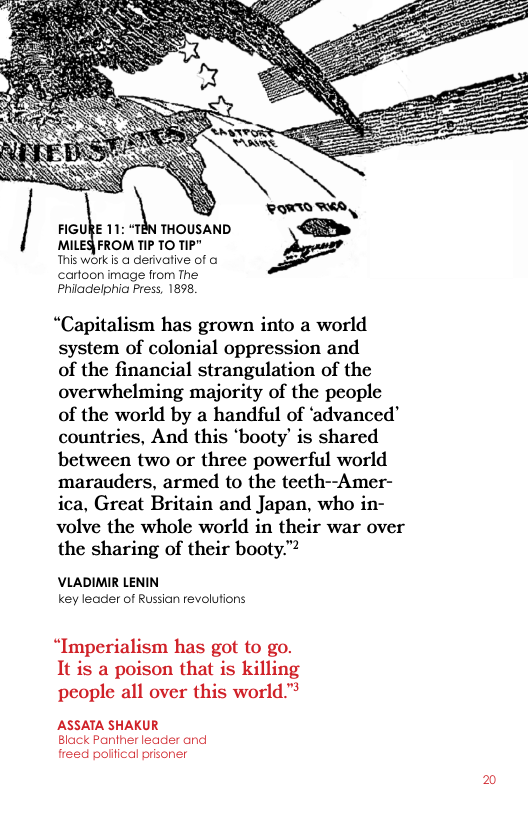
FIGURE 11: “TEN THOUSAND
MIlE& FROM TIP TO TIP"
This work is @ dervative of o
cartoon image from The
Philadelphia Press, 1898,
“Capitalism has grown into a world
system of colonial oppression and
of the financial strangulation of the
overwhelming majority of the people
of the world by a handful of ‘advanced’
countries, And this ‘booty’ is shared
between two or three powerful world
marauders, armed to the teeth--Amer-
ica, Great Britain and Japan, who in-
volve the whole world in their war over
the sharing of their booty.”
VLADIMIR LENIN
key leader of Russian revolutions
“Imperialism has got to go.
It is a poison that is killing
people all over this world™
ASSATA SHAKUR
Black Panther leader and
freed political prisoner
2
The Spirit of
International Solidarity
v people stressed that building
was not just about proy
supplies and arms to freedom fighters but ths
includes a certain spirit, a kind of love and determina-
tion that acknowledges our humanity and positionali-
ty, an understanding that no one is free until we all
are free.
“When I think about international
solidarity, I think about decentering...
what it means to be in the belly of the
beast, right? It's...something that be-
gins with humility...it essentially boils
down to being willing to learn...decen-
tering the West and listening to what
they demand of you."
JINDU OBIOFUMA
New York-based afforney
and organizer
~
iy, ”
>
”
A SSUW
“Your love that goes into fighting for
justice extends beyond your own com-
munity, beyond your own national bor-
ders to others and that you understand
in your gut that no one will be free
until everyone is free.
And that you could have an economic,
a political analysis, of how that works,
you could look at the similarities
between incarceration of women in
Palestine and incarceration of women
in the United States and draw out all
of those similarities but that every time
you see one, you are talking about it
You feel as if you are talking about your
own life.
The feeling that you get when you
see connections being made is like
the joy of falling in love, the joy of
winning something.”
LAURA WHITEHORN
activist, former political pisoner,
co-founder of Release Aging
People in Prison (RAPF]
=
2
2
understand are the
“What I've come to ‘
feminist insights,
ideas that it's about N\
care, which is it's a
feeling as opposed to \
the political practice
of staging it within the
labor strike ... it's to
support each other, but
also to learn from each \
other ... caring for each
other and helping each
other out in this struggle, - ’
realizing that your libera- =
tion is tied with the others
..and that the scale of being ~ b,
able to do it internationally 1
or transnationally is maybe '
more difficult, because you
always have the issue
of language.” ‘
FARANAK MIRAFTAB
arian exile who feacher af fhe
Universiy of linois and works with,
and leams form grassroofs groups :
across the world
in visible demonstrations
\ of support; it is also built
through everyday deeds of
translation, deep under-
\ standing of cach other’s
struggles, and long-term
R relationship building.
These are the solid foun-
’ dations upon which we can
)
build our solidarity.”
\ DIANNE FEELEY
long fime sociailst activist, member of infer
nationdl brigade fhat went fo Nicaragua in
§ the 19805 to plant frees in support of
the revolution
- “Solidarity is not only found
2
25
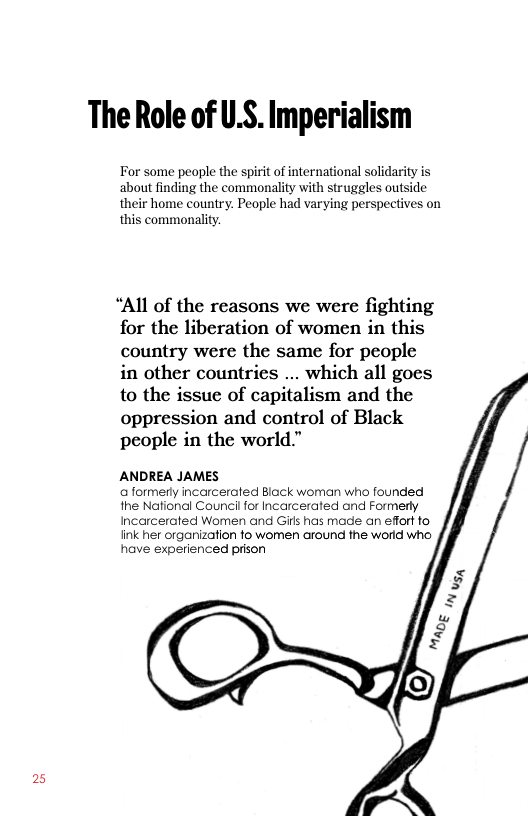
The Role of U.S. Imperialism
For some people the spirit of international solidarity is
about finding the commonality with struggles outside
their home country. People had varying perspectives on
this commonality.
“All of the reasons we were fighting
for the liberation of women in this
country were the same for people
in other countries ... which all goes
to the issue of capitalism and the
oppression and control of Black
people in the world.”
ANDREA JAMES
a formerty incarcerated Black woman who founded
the National Council for Incarcerated and Formerly
Incarcerated Women and Gils has made an efort fo
fink her organizafion fo women around the world who
have experienced prison
But for people in the US that sense of commonality, comes
with the recognition of the culpability and complicity pec-
ple in the US have in regard to that system of oppression.
Award-winning Native American historian Roxanne
Dunbar-Ortiz noted that “being citizens of the most milita-
ristic, wealthiest and extensive imperialist power in human
history, we have an enormous responsibiliy.” Historian
Barbara Ransby agreed that people in the US have a special
role to play in both speaking and in offering informed and
strategic solidarity.”
One Palestinian youth activist we spoke with warned against
‘making simplistic analogies. She stressed that though
there has long been solidarity between Palestinian freedom
fighters and Black liberation forces in the US, their struggles
have important differences. She summarized it by saying
that our “oppression rhymes” rather than replicates.
Itis also important to make sure that solidarity does not
become charity. Ken Salo is an educator from South Africa
who works to build transnational solidarities through critical
dialogue and collective action. As he puts t, “If you're gonna
help save me, you're wasting your time, but if you're here
because you see your future tied up with mine, then join
the club.
2
27
SOLIDARITY AS A LEARNING PROCESS
Anumber of people described the building of international
solidarity as a complex and protracted process of learning,
action and organization building. But also, there were
cautionary comments, reminding folks in the US they need
to lay clear cut foundations at home before deciding to build
with people from other counties, especially those with
political, economic and cultural realities very different from
the United States. This requires serious study about the
conditions in other places, an eagerness to listen to people
‘when they tell their story and paying close attention to how
people build effective organizations in a variety of contexts.
Activists emphasized that solidarity work s not only connect-
ing to other people’s struggles butalso learning from them,
that itis not “just about us.”
Veteran anti-imperialist fighter Bill Ayers, who
cofounded the Weather Underground, and has
written many books on liberatory education and
‘movement building stressed that international
solidarity is an act of imagination, education and
construction.
“Our imagination can see a horizon that's
much bigger than the horizon we were
starting with. I think that's an important
Iesson from movement building and from
internationalism. We have to build it. We
have to educate for it. We have to fight for it
But we also can accept allies from all over
the place, as we build that movement”
1e8E806808E/IY
Minnesota-based Ethiopian activist and academic
Tamrat Tademe concurred with Ayers, noting that
solidarity is “learned.”
“Solidarity is a heart-centered affinity people
have with all oppressed people. It learned!
It doesn't come innately, especially, when
the Empire trains us to stay in our silos
narcissistically.”
v
veasesecs
Claude Marks, activist, founder of the Freedom
Archives, and former USheld political prisoner,
contended that building international connections
must be part of all political work:
‘here are ways of internationalizing every
aspect of the struggle... the only salvation we
can hope for is to embrace that as a global set
of issues”
)
Mexican-born migrants rights activist Maru Villal-
pando stressed that internationalism means building
global networks and learning from those networks.
“We're in communication every day with peo-
ple around the world...we are waiting to learn
from other struggles. We need to find out what
our role would look like as allies, what kind of
influence can we have..what kind of lessons
do they have for us that we can use... it's an
exchange as well of learning..
resgsoseessy
2
2388,
FH
283ET
S35¢c5%
8%s22
353£58
To be effective international
solidarity needs to operate
ale. But what does scale
mean? For some it requires
first building a solid foun-
dation at hom
involves s
KEN SALO
educator from South Africa
Why the decline of solidarity?
‘The twenty-first century has witnessed a decline
in sustained structures of international solidarity.
Interviewees cited several factors that
contributed to this:
« the rise of nonprofits in place of grassroots
mass movements
« the fall from grace of many national
liberation movements which were icons
of late twentieth century activists
« the absence of the Soviet Union as a counter
pole to capitalist imperialism
« the rise of free market capitalism
(also known as neoliberalism)
« the absence of left
organizations that carry
the legacy and lessons of the
past including left unions
« Anincrease in nationalism
and xenophobia
Writer and historian Roxanne
Dunbar-Ortiz stressed exam-
ining another legacy in keeping
international solidarity alive:
the socialist tradition of the
Soviet Union,
“The fall of the Soviet Union scared me
A to death...I think it had a bigger impact
7 than any of us ever analyzed..for the
last 30 years I get my hopes up that
something is going to happen, and the
Z only thing happening is a sort of
= anarchism but they didn't have a
N program. [Theyl] just talked about
\ getting rid of the state...”
2
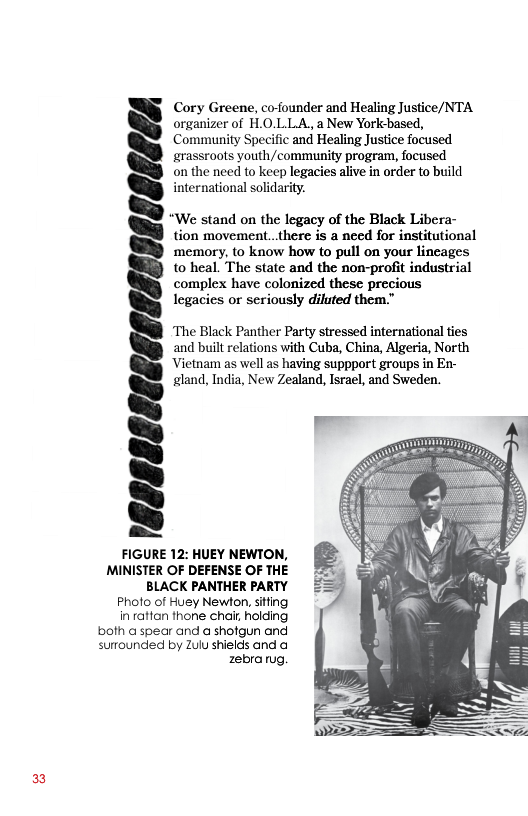
Cory Greene, co-founder and Healing Justice/NTA.
organizer of HO.LLA, a New York-based,
Community Specific and Healing Justice focused
grassroots youth/community program, focused
on the need to keep legacies alive in order to build
international solidarity.
“We stand on the legacy of the Black Libera-
tion movement..there i a need for institutional
memory, to know how to pull on your lincages
{0 heal. The statc and the non-proft industrial
complex have colonized these precious
legacies or seriously diluted them.”
‘The Black Panther Party stressed international ties
and built relations with Cuba, China, Algeria, North
Vietnam as well as having suppport groups in En-
gland, India, New Zealand, Israel, and Sweden.
168E8EEEEE0EEEI00088¢64,
FIGURE 12: HUEY NEWTON,
MINISTER OF DEFENSE OF THE
BLACK PANTHER PARTY
Photo of Huey Newlon, stting
in ratfan thone chair, holding
both a spear and a shotgun and
surounded by Zulu shields and a
zebrarug.
British born activisteriminologist Tony Platt
looked at still another problematic aspect of the
legacies of international solidarity in the USthe
weakness of left political organizations.
“One of the key issues in the United States
is the lack of a consistent national left over
a long period of time. I mean, whatever we
think about the lefts in European countries
and other places that most countries in the
world have a left, that has a long history and
has a narrative and history that they pass on
to new generations. The United States doesn't
have that”
Veteran Puerto Rican activist Alfredo Lopez, a
Senior Adviser to MediaJustice and a Founder of
Radical Elders, was particularly critical of the rise
of non-profits as forces that undermined solidarity:
the foundations entered the movement space, rela-
beled it as *Social Justice” and put forward a more
‘moderate agenda.
uth organizer Posey,
linoi
echoed Lopez's views.
“We're navigating 501c(3) bureaucracy not
looking at how o get people out of prison nor
how do we get youth out of prison in Nigeria."
I18888E86EEE!
24
The Future of Solidarity
Tum no single organization, country o intellectual
stands as a beacon, the force that connects us to ev-
eryone else’s struggle. In the past, activists and ordinary
people turned to political parties, radical governments or the
collected works of chosen international thinkers to light the
way. We can learn lessons from the past but they are only a
foundation for building the future.
‘We have to construct the rest ourselves, using new mate-
ials, new ideas to confront new realities and build what is
appropriate for the moment. This publication aims to help
us use histories and commentaries on international solidarity
to move forward, to understand why we need international
solidarity, why we need to imagine not only a new world but
international solidarity should look like
How do we combine historical wisdom with lessons we have
learned from more recent struggles about white supremacy,
class, climate, organizational democracy, patriarchy, gender,
ableism, heteronormativity, borders, indigenous struggles
and so much more?
“We are the people
who will make peace
for the whole world if
we become free™
LEILA KHALED
“It's a necessity for our movement to
see all of the ways that capitalism and
imperialism and colonialism, as well
as neocolonialism, divide us... What
we're fighting is that we sce that local-
izing the fight is only part of the solu-
tion and the larger solution is forming
the strongest possible solidarity with
people who are fighting in similar cir-
cumstances elsewhere.”
RUTH WILSON GILMORE
activist, author, and co-founder of the aboliionist organiza-
tion, Crifical Resistance
ENDNOTES
1. Eugene Debs, “Statement fo the Court pon Being Convicted of
Violaling the Sedifion Act,” ranscip! of speech fo fhe courl, Cleve.
1and, Ohi, September 18, 1918, hifps:/jvwww.mondsts org/archive/
s works/1918/court htm.
2. Viadimir Lerin, “Impericlm: The Highest Stage of Capitalism
[1916)," i Lenin's Selecied Works Vol 1. (Progress Publiners, 1963),
667-766
3. Assata Shaku, “Yesterday s Not 100 Soon.” inferview by Dorsey.
Nunn, 1996, video, hifps:/fwww.youtube.com/walchv=TD-Suzl
4. Leila Khaled, “When people fse, fhe occupants begin fo shiver”
ranscrpt of address fo l infemafional Diemmes of Humanity
Conference, Johannesburg, South Afiica, October 14, 2023, hitps://
peoplesdispatch org/2023/10/30efio-kholed-when-people - he.
occupants begin-fo-shiver.
| "
ACKNOWLEDGEMENTS
his work is the product of the efforts of many people.
First and foremost, credit goes to the brilliant creative
artist Vic Liu who designed the visuals for this zine (includ-
ing lots of magnificent hand drawings).
An extra vote of gratitude also goes to key members of
the Community Justice Exchange staff who have been so
supportive and helpful in conceptualizing this and connect-
ing me with individuals and organizations. Special kudos to
Pilar Weiss, Rachel Foran, and Mon Mohapatra.
‘This collection would not have been possible without the
numerous brilliant, dedicated internationalists and activists
who shared their experiences and insights. These are Alfre-
do Lopez, Amanda Klonsky, Barbara Kessel, Barbara Rans-
by, Belden Fields (RIP). Bill Ayers, Charisse Burden-Staley,
Claude Marks, Corey Greene, Craig Gilmore, David Finkel,
David Gilbert, Debbie Kilroy, Debbie Southern, Diana Block,
Dianne Feeley, Faranak Miraftab, Ida McCray, Jindu Obiofu-
ma, Joel Grier, Kelly Gillespie, Ken Salo, Laura Whitehorn,
Leigh-Ann Naidoo, Linda Evans, Maru Mora Villalpondo,
Max Elbaum, Mike Klonsky, Nadya Tannous, Posey, Rick
Ayers, Roxanne Dunbar-Ortiz, Ruthie Gilmore, Steven Pitts,
‘Tamrat Tademe, Tim Bagwell, Wendy Thompson and Woods
Ervin
APPENDIX—FIGURES & IMAGES
Figure 1: Front Page of Cape Argus News. Courtesy of
James Kilgore.
Figure 2: An Attack Against One Is An Attack Against
Al ca 1970, Offset lithograph on paper, 22.25 17.5
in. Collection of the Oakland Museum of Caifornia, All
Of Us Or None Archive. Gift of the Rossman Family.
Figure 3: Jail Protest in Champaign, llinois. Courtesy of
James Kilgore.
Figure 4: Rebel Art Group's “Join Our Ranks” Banner. Rebel
‘Arts Group, ¢ 1930. Courtesy of Poster Museum.
Adapted from original source with modifications.
Figure §: AuthaGraph World Map. Justinkunimune via Wik
pedia Commons, 2024. Public Domain. Adapted from
original source with modiifications.
Figure 6: May Day Poster. Courtesy of Tamiment Library &
Robert . Wagner Labor Archives, NYU Special Collec-
tions,
Figure 7: Haymarket Martyrs’ Monument. DA Sonnenfield
via Wikipedia Commons, 2016. Public Domain. Adapted
from original source with modifications
Figure 8: Eugene Debs for President Button. Courtesy of the
Eugene V. Debs Foundation, Terre Haute, Indiana
Figure 9: Cover Image of The Communist Infernational
Magazine. Accessed via Wikipedia Commons, 2010.
Public Domin. Adapted from original source with mod-
ifications
Figure 10: 1955 Bandung Conference. National Archives
of the Republic of Indonesia. Accessed at https://www.
unesco.org/en/memory-world/asian-african-confer-
ence-archives
Figure 11: “Ten Thousand Miles from Tip fo Tip." Accessed
via Wikipedia Commons. Public Domain. Adapted from
original source with modifications.
Figure 12: Huey Newton, Minister of Defense of the Black
Panther Parly. Blair Shapp. Collection of the Library of
Congress.
Al other ilustrations by Vic Liv
£
WE ARE NOTHING IF WE
ALK ALONE; WE ARE
EVERYTHING WHEN
WE WALK TOGETHER
IN STEP WITH OTHER
DIGNIFIED FEET.
SUBCOMANDANTE MARCOS
Zapatista Army of National Liberation
This zine series was created by James Kigore
during his Building Communily Power fellowship af
Commurity Justice Exchange. This i the first Zine in o
series called *A Luta Confinua” which can be found
af bitly/infisolidarityzines
For more information, please contact
infisolicarity@communityjusticeexchange.org
Tine designed by Vic Liu.