A Guide on Civilian Oversight RE Copperwood Mining Project
Web PDFImposed PDFRaw TXT (OCR)
How you can protect these Q  A guide to citizen oversight in regards to the copperwood mining project in the porcupine mountains
Introduction  Bystander intervention is how we disrupt harm happening in real time. Think of it like calling someone out for telling a sexist joke, stepping in when you see someone is being treated unfairly, or being discriminated against. This zine is a call to action and reference for how we, as the communities effected, can intervene and even prevent the harm of extractive industries (pipelines, CAFOs, mines, etc.). We don’t want to just sit idly by and read about how our environment is being destroyed. We want to actively fight to protect what’s left for future generations, and we hope you do too. This zine was written by a small group of people that care for our earth, and want to show people that we really can make a difference if we work together and put our minds to it.  Citizen Oversight Pros and Cons  Can delay or stop the project Takes a lot of time Low risk of repression Involves bureaucracy We cando it ourselves Requires research  An excuse to hike the porkies | Often involves long drives  Anti-Copyright! Reprint this zine freely even without naming the source. It may be used, distorted or destroyed in any manner whatsoever. Follow @GitchigamiGuardians for more! 06/27/2024
Citizen Oversight  Much of this zine focuses on citizen oversight of active construction projects. citizen oversight simply means that ordinary people are taking the time to go and look at construction activity and report violations of permits to regulatory agencies.  The possible violations are explained in the permits granted to the project. These permits often add to standing policies from groups like the Environmental Protection Agency, Occupational Safety and Health Administration, and other regulating agencies or laws.  These violations could include working during prohibited hours, failing to follow safety requirements, or illegal dumping. It may also look like reporting endangered species habitat in work zones or unexpected contamination on the work site.  While there are some regulatory processes in place already, the current system is deeply flawed, as will be explained on the next pages.  citizen oversight is not a silver bullet. It is a labor intensive process that requires lots of research and collaboration with various agencies. However citizen oversight can be effective at ensuring corporate accountability.
Permitting and Third Party Oversight  Corporations apply for permits from various government agencies when building new infrastructure projects like mines. They are also responsible for complying with all other relevant laws.  The government is responsible for approving permits and passing relevant laws. These laws may be influenced by corporate lobbying but they are supposed to ensure environmental and human protections.  Because monitoring projects is expensive and time consuming, the government outsources the responsibility of monitoring Corporate compliance to private companies. This is called Third Party Oversight and also ensures the government doesn’t levy unjustified fines.  Third Party Oversight companies are certified by the government but chosen and paid for by the Corporations. This dynamic means Corporations often hire Third Party Oversight companies that overlook their missteps.  This special relationship between corporations and third party oversight agencies means it often falls on citizen oversight efforts to identify and report violations.  Another challenge for civilians is the need to navigate complex bureaucracies. The best resources for understanding this system are the people who work within the government systems. Having conversations with workers can be critical to successfully navigating these systems
Applies for permits ’\ <SR Lobbies for policy e  :Government:  Corporationii  Outsources project monitoring| responsibilities  monitors permit and policy compliance  Enforces fines and penalties  Approves Permits  { Third Party."-: Oversight  Individuals can also fill this role by reporting violations to the state agencies responsible for enforcement!
Case Study: Rover Pipeline  In 2017 the Rover pipeline was being built in southeastern Michigan and a group of concerned citizens took it upon themselves to monitor the pipeline. The citizen oversight group looked at the permits for the pipeline and noticed they were signed by the Water Resource Division (WRD) at the Department of Environmental Quality, now known as the Department of Environment, Great Lakes and Energy (EGLE).  The group sent in photos of construction violations to contacts they found online on the department website, however the staff was unresponsive. Eventually a group of citizens showed up to the office and were able to speak with a supervisor who they were able to build a relationship with.  One day while monitoring the pipeline, a civilian smelled gasoline. They noticed a sheen on the water and were able to acquire a sample in an empty plastic water bottle. They called their contact at the WRD who told them that pollution was WRD’s responsibility, but spills or suspected pollutant contamination are under the jurisdiction of the Remediation and Redevelopment Division.  Because it was an active contamination, the organizers contacted the federal National Resource Center (NRC) run by the U.S. Coast Guard. The NRC reached out through their response tree to the appropriate contacts in EGLE who came out and collected the sample civilians collected and tested the water themselves.
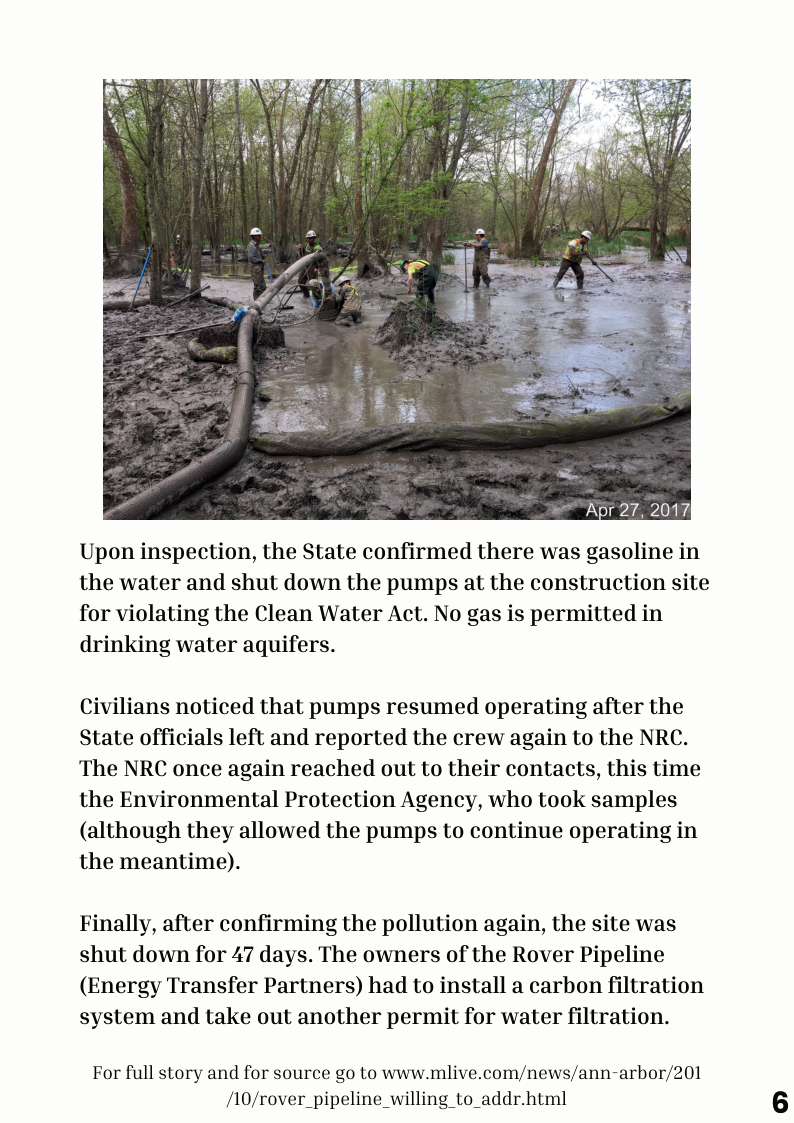
Upon inspection, the State confirmed there was gasoline in the water and shut down the pumps at the construction site for violating the Clean Water Act. No gas is permitted in drinking water aquifers.  Civilians noticed that pumps resumed operating after the State officials left and reported the crew again to the NRC. The NRC once again reached out to their contacts, this time the Environmental Protection Agency, who took samples (although they allowed the pumps to continue operating in the meantime).  Finally, after confirming the pollution again, the site was shut down for 47 days. The owners of the Rover Pipeline (Energy Transfer Partners) had to install a carbon filtration system and take out another permit for water filtration.  For full story and for source go to www.mlive.com/news/ann-arbor/201 /10/rover_pipeline_willing to_addr.html
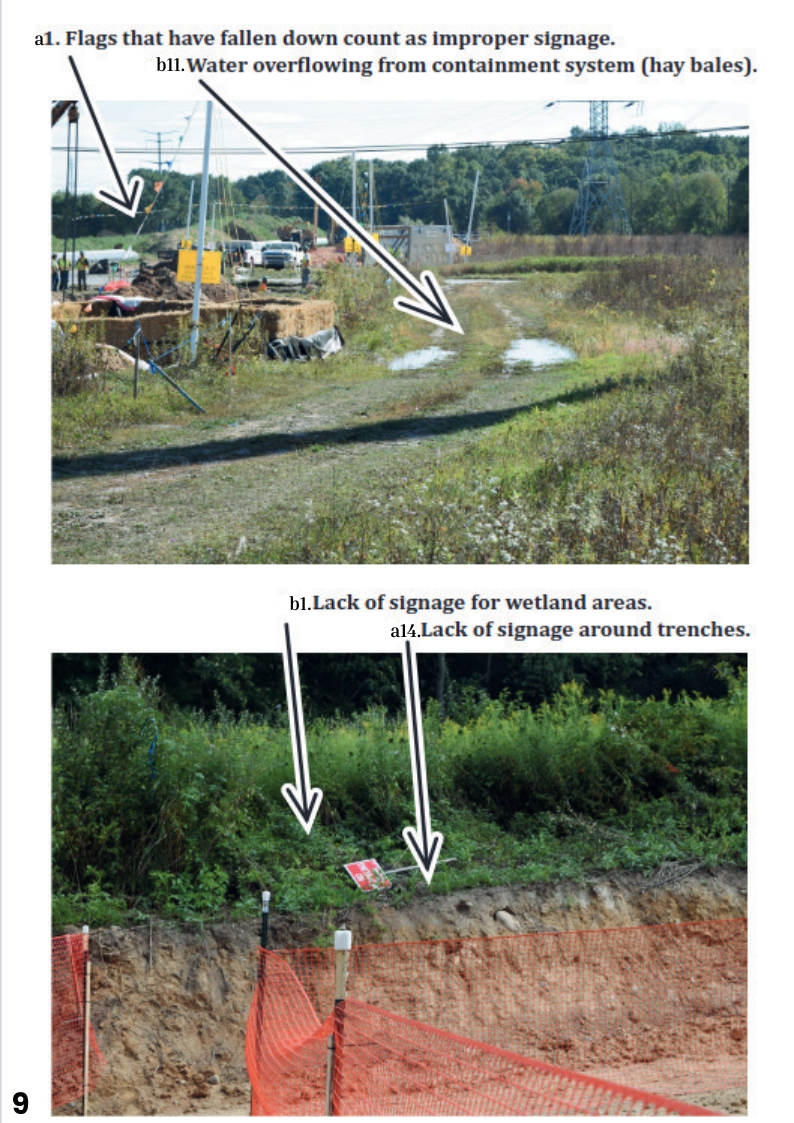
Common Violations (a)  1.No signage at entrance - signage should specify any endangered species.  2.Endangered species habitat. If you see an endangered species take pictures.  3.Working outside of easement - marked by blue spray paint to mark construction boundaries.  4. Improper use of access roads. Crews must remain on the designated roads and right of ways. Driving outside the easement with construction equipment is not allowed.  5.Dust plumes due to construction equipment moving.  6. Construction vehicles parked on public property and not in designated parking areas.  7.Trucks tracking mud from construction sites onto public roads or outside of construction areas.  8.Brush, wood chips and other waste from excavation sites not in the permitted area.  9.Lack of signalers directing traffic on roads or trails.  10.Workers without proper safety gear (hard hats).  11.Lack of required construction vehicles.  12.8ilt fences/silt stockings that are damaged and are in need of repair - used to keep soil from eroding, especially after rainfall of 0.5in or more.  13.Sediment screens/erosion control fences absent or fallen down.  14.Lack of safety fencing around residences and trenches.  15.Spilled fuel or other fluids.  16.Gas or diesel containers must be in contained areas with “Flammable” signage.  17. Illegal burning is common, call the local fire marshal. Be careful, dangerous chemicals may be released in the air.
Wetland Violations (b)  1.No signage at wetland areas — examples: “Wetland Area 53” or “Water body 53”.  2. No refueling or greasing equipment in wetland area — should be posted on sign.  3.All equipment parked overnight and/or fueled has to be atleast 100ft from a water body  4.No sediment curtain (Erosion Control Devices) on creeks or improperly placed sediment curtains.  5.No silt fencing surrounding creeks and/or silt fencing not secured properly.  6.8ilt build-up above silt line on fencing.  7.Gas or diesel containers are not allowed in wetland areas.  8.0il on creeks and wetlands (may appear as “rainbow” on water surface - note this can also occur naturally due to plants.)  9.Water downstream from construction is stirred up/murky (i.e. turbidity).  10.Driving equipment in the wetlands, off equipment  ramps.  11.Water overflowing from containment structures or off the easement.  How to get to the mine site? Drive up county road 519 North of Wakefield, MI until you come across a sign on your left that says “Ottawa, National Forest Hiking Trail, North  Country Trail”. Right next to that sign should be a parking lot for the north country trail. Hike that trail west toward black river harbor until vou hear equipment or see a clearing on your right (about 5-15 minutes of’ hiking should get you there).
al. Flags that have fallen down count as improper signage. bll.Water overflowing from containment system (hay bales).  bl.Lack of signage for wetland areas. al4Lack of signage around trenches.
Reporting steps  1.Collect evidence using photos,  videos, and if relevant sample collection.  2.1dentify your location, including  your coordinates and the  relevant regulations that are  being violated.  3.Contact the departments responsible for approving any relevant permits and notify field agents of violation.  4. Follow up daily until resolved.  a12. Any broken fencing or overflow should be reported!  \ofe a15. Contaminants in ‘water may look like sheens, or mud stirred up in water.  In Case of Emergency Anyone witnessing an oil spill, chemical release or maritime security incident should call the National Response Center (NRC) hotline at 1-800-424-8802.  The NRC is an emergency call center that fields initial reports and forwards information to the appropriate federal/state agencies (like the Department of Environmental Quality, FERC or ACE and others).  This is for reporting emergencies. Plants can create an oily sheen on the water. Do not use this line for frac outs (drilling mud). Do not use this line as part of a symbolic action.  Do not file false reports.  10
Tips for collecting evidence  Anyone is allowed to observe, record and report environmental hazards and construction violations. You have the right to be on, and record from public land. That being said, get as close as you can and if you’re feeling brave go further.  Document violations with photo and video. Photos are easier and more useful to share when submitting complaints, but videos will be useful in case of litigation.  You may collect water or other samples. Use specialized equipment if possible, but clean plastic water bottles also work.  Note: Monitoring agencies should take their own samples, make sure you get a card from whatever agency comes out.  Safety Notes  Construction sites and mines are dangerous.  Be aware of your surroundings.  Wear sensible clothing like work pants and closed toe shoes. Bring water, sunscreen, snacks and any other  necessary supplies like cameras or cell phones.  You have a right to be on any public road or trail. Expect to encounter private security or hired police. Bring a buddy and film any tense interactions.  Know your rights and do your research before you go.
A  . e . & ™2 Dealing With Police T  _-Every interaction with law enforcement L can be dangerous.  Police are armed and trained to use  lethal force. Police are taught to prioritize their control of a situation above all else.  olice are known to target environmental activists.  Even if you have a right to be somewhere, law enforcement officers may order you to move. Failure to obey a police order may result in arrest.  Police and construction workers are also known to lie, so always bring a buddy and record your interactions.  Police may not search your vehicle without consent, if they do so illegally while you are filming, repeatedly state “Ido not consent to a search”  If you are stopped by the cops, ask if you are free to leave. If you are detained and questioned, we suggest saying this:  I want to talk to a lawyer I will not talk without a lawyer present  Iinvoke my 5th amendment right and  wish to remain silent 12
Submitting Evidence  The hardest part of citizen oversight is the research to find who to contact for what. To make it easier for you we’ve done most of this research already. For submitting evidence of most of the violations, the Water Resources Division is going to be the responsible party. It’s best to send it to as many people in the agency as you can (but only people that can actually do something about it). If after a while of submitting evidence it seems like nothing has happened, it can be a good idea to dial up the office and ask them about it. The people you’re going to want to email for the water resource division are:  Kayla Conklin - Marquette District Office Water Resources Unit ConklinK3@michigan.gov - 906-869-4703 Office Address - 1504 W. Washington St., Marquette 49855  Lindsey Ringuette - Marquette District Office Water Quality Unit RinguetteL@Michigan.gov - 906-250-3819 Office Address - 1504 W. Washington St., Marquette 49855  Kristi Wilson -Marquette Resources Enforcement Unit WilsonK17@michigan.gov - 906-236-0380 Office Address - 1504 W. Washington St., Marquette 49855  For reporting violations that are specifically related to dust plumes or illegal burning, you’re going to want to notify the Michigan Air Quality Division.  For reporting violations that are specifically related to  contamination, you’re going to want to notify Remediation And Redevelopment.  13
We’ve seen many reports get lost in the shuffling paperwork of bureaucracy. You may want to start by reaching out to the departments or boards that are signing the project permits.  Many public officials want to help but are hamstrung by immense workloads, the chain of command, or department policy. So as you go about this important, difficult work, look for allies and try to build relationships within the agencies you interact with.  1t is all of our responsibility to ensure our communities are safe and sustainable. This is hard work so take care of  yourself, but it’s only a thankless job until someone thanks you for it - so let us be the first to sincerely say:  \n «\" V\  —‘ L)  14
- PROTECT  ~ WHATS LE

How you can
protect these Q

A guide to citizen oversight in
regards to the copperwood mining
project in the porcupine mountains
Introduction

Bystander intervention is how we disrupt harm happening
in real time. Think of it like calling someone out for telling a
sexist joke, stepping in when you see someone is being
treated unfairly, or being discriminated against. This zine is
a call to action and reference for how we, as the
communities effected, can intervene and even prevent the
harm of extractive industries (pipelines, CAFOs, mines, etc.).
We don’t want to just sit idly by and read about how our
environment is being destroyed. We want to actively fight
to protect what's left for future generations, and we hope
you do too. This zine was written by a small group of people
that care for our earth, and want to show people that we
really can make a difference if we work together and put
our minds to it.

Citizen Oversight Pros and Cons

Can delay or stop the project Takes a lot of time
Low risk of repression Involves bureaucracy
We cando it ourselves Requires research

An excuse to hike the porkies | Often involves long drives

Anti-Copyright! Reprint this zine freely even
without naming the source. It may be used,
distorted or destroyed in any manner whatsoever.
Follow @GitchigamiGuardians for more!
06/27/2024
Citizen Oversight

Much of this zine focuses on citizen oversight of active
construction projects. citizen oversight simply means that
ordinary people are taking the time to go and look at
construction activity and report violations of permits to
regulatory agencies.

The possible violations are explained in the permits granted
to the project. These permits often add to standing policies
from groups like the Environmental Protection Agency,
Occupational Safety and Health Administration, and other
regulating agencies or laws.

These violations could include working during prohibited
hours, failing to follow safety requirements, or illegal
dumping. It may also look like reporting endangered species
habitat in work zones or unexpected contamination on the
work site.

While there are some regulatory processes in place already,
the current system is deeply flawed, as will be explained on
the next pages.

citizen oversight is not a silver bullet. It is a labor intensive
process that requires lots of research and collaboration
with various agencies. However citizen oversight can be
effective at ensuring corporate accountability.
Permitting and Third Party
Oversight

Corporations apply for permits from various government
agencies when building new infrastructure projects like
mines. They are also responsible for complying with all
other relevant laws.

The government is responsible for approving permits and
passing relevant laws. These laws may be influenced by
corporate lobbying but they are supposed to ensure
environmental and human protections.

Because monitoring projects is expensive and time
consuming, the government outsources the responsibility
of monitoring Corporate compliance to private companies.
This is called Third Party Oversight and also ensures the
government doesn’t levy unjustified fines.

Third Party Oversight companies are certified by the
government but chosen and paid for by the Corporations.
This dynamic means Corporations often hire Third Party
Oversight companies that overlook their missteps.

This special relationship between corporations and third
party oversight agencies means it often falls on citizen
oversight efforts to identify and report violations.

Another challenge for civilians is the need to navigate
complex bureaucracies. The best resources for
understanding this system are the people who work within
the government systems. Having conversations with
workers can be critical to successfully navigating these
systems
Applies for permits ’\ <SR
Lobbies for policy e

:Government:

Corporationii

Outsources
project monitoring|
responsibilities

monitors permit
and policy
compliance

Enforces fines
and penalties

Approves
Permits

{ Third Party."-:
Oversight

Individuals can
also fill this role by
reporting
violations to the
state agencies
responsible for
enforcement!
Case Study: Rover Pipeline

In 2017 the Rover pipeline was being built in southeastern
Michigan and a group of concerned citizens took it upon
themselves to monitor the pipeline. The citizen oversight
group looked at the permits for the pipeline and noticed
they were signed by the Water Resource Division (WRD) at
the Department of Environmental Quality, now known as
the Department of Environment, Great Lakes and Energy
(EGLE).

The group sent in photos of construction violations to
contacts they found online on the department website,
however the staff was unresponsive. Eventually a group of
citizens showed up to the office and were able to speak with
a supervisor who they were able to build a relationship
with.

One day while monitoring the pipeline, a civilian smelled
gasoline. They noticed a sheen on the water and were able
to acquire a sample in an empty plastic water bottle. They
called their contact at the WRD who told them that
pollution was WRD’s responsibility, but spills or suspected
pollutant contamination are under the jurisdiction of the
Remediation and Redevelopment Division.

Because it was an active contamination, the organizers
contacted the federal National Resource Center (NRC) run
by the U.S. Coast Guard. The NRC reached out through their
response tree to the appropriate contacts in EGLE who
came out and collected the sample civilians collected and
tested the water themselves.
Upon inspection, the State confirmed there was gasoline in
the water and shut down the pumps at the construction site
for violating the Clean Water Act. No gas is permitted in
drinking water aquifers.

Civilians noticed that pumps resumed operating after the
State officials left and reported the crew again to the NRC.
The NRC once again reached out to their contacts, this time
the Environmental Protection Agency, who took samples
(although they allowed the pumps to continue operating in
the meantime).

Finally, after confirming the pollution again, the site was
shut down for 47 days. The owners of the Rover Pipeline
(Energy Transfer Partners) had to install a carbon filtration
system and take out another permit for water filtration.

For full story and for source go to www.mlive.com/news/ann-arbor/201
/10/rover_pipeline_willing to_addr.html
Common Violations (a)

1.No signage at entrance - signage should specify any
endangered species.

2.Endangered species habitat. If you see an endangered
species take pictures.

3.Working outside of easement - marked by blue spray
paint to mark construction boundaries.

4. Improper use of access roads. Crews must remain on
the designated roads and right of ways. Driving outside
the easement with construction equipment is not
allowed.

5.Dust plumes due to construction equipment moving.

6. Construction vehicles parked on public property and not
in designated parking areas.

7.Trucks tracking mud from construction sites onto
public roads or outside of construction areas.

8.Brush, wood chips and other waste from excavation
sites not in the permitted area.

9.Lack of signalers directing traffic on roads or trails.

10.Workers without proper safety gear (hard hats).

11.Lack of required construction vehicles.

12.8ilt fences/silt stockings that are damaged and are in
need of repair - used to keep soil from eroding,
especially after rainfall of 0.5in or more.

13.Sediment screens/erosion control fences absent or
fallen down.

14.Lack of safety fencing around residences and trenches.

15.Spilled fuel or other fluids.

16.Gas or diesel containers must be in contained areas with
“Flammable” signage.

17. Illegal burning is common, call the local fire marshal. Be
careful, dangerous chemicals may be released in the air.
Wetland Violations (b)

1.No signage at wetland areas — examples: “Wetland Area
53” or “Water body 53”.

2. No refueling or greasing equipment in wetland area —
should be posted on sign.

3.All equipment parked overnight and/or fueled has to be
atleast 100ft from a water body

4.No sediment curtain (Erosion Control Devices) on creeks
or improperly placed sediment curtains.

5.No silt fencing surrounding creeks and/or silt fencing
not secured properly.

6.8ilt build-up above silt line on fencing.

7.Gas or diesel containers are not allowed in wetland
areas.

8.0il on creeks and wetlands (may appear as “rainbow” on
water surface - note this can also occur naturally due to
plants.)

9.Water downstream from construction is stirred
up/murky (i.e. turbidity).

10.Driving equipment in the wetlands, off equipment

ramps.

11.Water overflowing from containment structures or off
the easement.

How to get to the mine site?
Drive up county road 519 North of Wakefield, MI until you come across a
sign on your left that says “Ottawa, National Forest Hiking Trail, North

Country Trail”. Right next to that sign should be a parking lot for the
north country trail. Hike that trail west toward black river harbor until
vou hear equipment or see a clearing on your right (about 5-15 minutes of’
hiking should get you there).

al. Flags that have fallen down count as improper signage.
bll.Water overflowing from containment system (hay bales).

bl.Lack of signage for wetland areas.
al4Lack of signage around trenches.

Reporting steps

1.Collect evidence using photos,

videos, and if relevant sample
collection.

2.1dentify your location, including

your coordinates and the

relevant regulations that are

being violated.

3.Contact the departments
responsible for approving any
relevant permits and notify field
agents of violation.

4. Follow up daily until resolved.

a12. Any broken
fencing or
overflow should
be reported!

\ofe
a15. Contaminants in
‘water may look
like sheens, or
mud stirred up
in water.

In Case of Emergency
Anyone witnessing an oil spill, chemical release or maritime security
incident should call the National Response Center (NRC) hotline at
1-800-424-8802.

The NRC is an emergency call center that fields initial reports and
forwards information to the appropriate federal/state agencies (like the
Department of Environmental Quality, FERC or ACE and others).

This is for reporting emergencies.
Plants can create an oily sheen on the water.
Do not use this line for frac outs (drilling mud).
Do not use this line as part of a symbolic action.

Do not file false reports.

10
Tips for collecting evidence

Anyone is allowed to observe, record and report
environmental hazards and construction violations. You
have the right to be on, and record from public land. That
being said, get as close as you can and if you're feeling brave
go further.

Document violations with photo and video. Photos are
easier and more useful to share when submitting
complaints, but videos will be useful in case of litigation.

You may collect water or other samples. Use specialized
equipment if possible, but clean plastic water bottles also
work.

Note: Monitoring agencies should take their own samples,
make sure you get a card from whatever agency comes out.

Safety Notes

Construction sites and mines are dangerous.

Be aware of your surroundings.

Wear sensible clothing like work pants and closed toe
shoes. Bring water, sunscreen, snacks and any other

necessary supplies like cameras or cell phones.

You have a right to be on any public road or trail.
Expect to encounter private security or hired police.
Bring a buddy and film any tense interactions.

Know your rights and do your research before you go.

A

. e . &
™2 Dealing With Police T

_-Every interaction with law enforcement
L can be dangerous.

Police are armed and trained to use

lethal force.
Police are taught to prioritize their
control of a situation above all else.

olice are known to target environmental activists.

Even if you have a right to be somewhere, law enforcement
officers may order you to move. Failure to obey a police
order may result in arrest.

Police and construction workers are also known to lie, so
always bring a buddy and record your interactions.

Police may not search your vehicle without consent, if they
do so illegally while you are filming, repeatedly state
“Ido not consent to a search”

If you are stopped by the cops, ask if you are free to leave. If
you are detained and questioned, we suggest saying this:

I want to talk to a lawyer
I will not talk without a lawyer present

Iinvoke my 5th amendment right and

wish to remain silent 12
Submitting Evidence

The hardest part of citizen oversight is the research to find
who to contact for what. To make it easier for you we've
done most of this research already. For submitting evidence
of most of the violations, the Water Resources Division is
going to be the responsible party. It’s best to send it to as
many people in the agency as you can (but only people that
can actually do something about it). If after a while of
submitting evidence it seems like nothing has happened, it
can be a good idea to dial up the office and ask them about
it. The people you're going to want to email for the water
resource division are:

Kayla Conklin - Marquette District Office Water Resources Unit
ConklinK3@michigan.gov - 906-869-4703
Office Address - 1504 W. Washington St., Marquette 49855

Lindsey Ringuette - Marquette District Office Water Quality Unit
RinguetteL@Michigan.gov - 906-250-3819
Office Address - 1504 W. Washington St., Marquette 49855

Kristi Wilson -Marquette Resources Enforcement Unit
WilsonK17@michigan.gov - 906-236-0380
Office Address - 1504 W. Washington St., Marquette 49855

For reporting violations that are specifically related to dust
plumes or illegal burning, you're going to want to notify the
Michigan Air Quality Division.

For reporting violations that are specifically related to

contamination, you're going to want to notify Remediation
And Redevelopment.

13
We’ve seen many reports get lost in the shuffling
paperwork of bureaucracy. You may want to start by
reaching out to the departments or boards that are signing
the project permits.

Many public officials want to help but are hamstrung by
immense workloads, the chain of command, or department
policy. So as you go about this important, difficult work,
look for allies and try to build relationships within the
agencies you interact with.

1t is all of our responsibility to ensure our communities are
safe and sustainable. This is hard work so take care of

yourself, but it’s only a thankless job until someone thanks
you for it - so let us be the first to sincerely say:

\n
«\" V\

—‘
L)

14
- PROTECT

~ WHATS LE