A Feral Life: One Last Nihilist Exposition
Web PDF • Imposed PDF• Raw TXT (OCR)
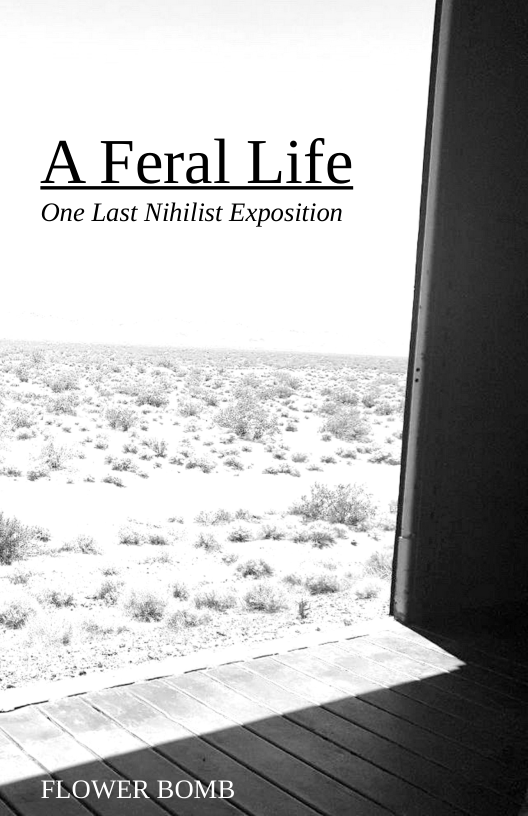




A Feral Life
One Last Nihilist Exposition
FLOWER BOMB
Some believe in a grand collectivity — a togetherness above and beyond any
single individual. This interpretation of reality views a single life as a
complex web of different lives all interconnected and interactive with one
another, where ideas are recycled through the filtration of each individual
interpretation. And so each individual responds to those ideas in unique
‘ways that ultimately influence and shape the reality of others - some more
directly than others depending on proximity and personal relationship. How
people, on an individual level, are impacted by a single individual’s actions
orlifestyle depends on the values of each person.
‘With such a diversity of unique individuals, each accompanied by an infinite
range of emotions, I can’t help but feel the civilizing attempt to universally
categorize behaviors or actions as positive or negative - good or bad - fails
upon inception. Drawn from what is commonly known as morality, this
binary attempt is self-evidently a mere human construct, based on how it
relies on a human-centric interpretation of reality. Through the lens of
morality, all things in reality are perceived with the same binary dualism
that's used to uphold every form of hierarchal oppression: white supremacy
for a white and non-white dualism, male supremacy for a male and female
dualism, human supremacy for a human and animal dualism, and so on.
What I have come to understand personally for myself is that morality
functions as a humanist narrative that artificially divides animals into so-
called human and non-human categories. This division is manufactured for
the sole purpose of social control aimed at ordering life in a way that
suppresses any animal instincts and spontaneity expressed by anyone
socially identified as human. This also places human as categorically god-
comparison to all other beings, utilizing ideas of discipline and purity
in order to discourage unbridled exploration beyond the ideological
frameworks neccessary for upholding industrial civilization. 1 believe it is
here that the roots of a mechanistic way of thinking become interwoven with
one’s perception of the world around them, creating an atificial separation
between the individual and their surroundings. Morality ~prohibits
spontaneous play and interaction with one’s surrounding, like a glass wall
‘with a filter that distorts one’s perception of the world on the other side. This
filtered view is the binary dualism that creates social differences that only
exist within the frame work of supremacist ideologies. Blackness exists
because of the imposition of white supremacy. Woman exists because of the
imposition of patriarchy and male supremacy. Animal exists as a derogatory
for uncivilized human. Anarchy exists in the face of a coerced, symmetric
order.
A quick side note - I wonder if leftists who glorify technology are aware of
the ever-expanding alienation it creates — from the division of labor
necessary in operating machines built to ravage the earth for materials, to the
alienation technological devices create through the slow degradation of face-
to-face interactions. Is strange that those who believe strongly in unity
‘would adhere so strongly to that which s designed to separate.
An individual can either learn to adapt to and live in this ever-increasingly
alienated reality, fine-tuned by industrial society, o - if they are so brave -
pursue experiences that smash the glass wall that all at once separates and
filters reality.
In practice, morality influences the way people behave and act. The logical
conclusion of this influence is a population of people imagining themselves
and each other only within the confines of a limited worldview - one which
can only be understood through more binary interpretation. But despite the
glass wall that attempts to filter and guide our perception of reality, the
anarchy of imagination and independent thought causes chaos. As long as
the concept of morality has existed, the idea of good and bad have continued
to escape conceptual uniformity. Words and definitions lose their rigidity to
the thought-crime of curiosity, causing perceptions of reality to change.
‘Whether an action or behavior is considered morally right or wrong depends
on what definition is assigned to right or wrong, and who assigned it in the
first place.
1 find it worthy to question who it was that so long ago was considered the
most qualified to create those definitions, and by what criteria was that
person chosen as the authority to create those definitions in the first place?
Historically, at least according to popular opinion, these definitions were
instructed by a god, and therefore by proxy his followers. But what about
people who don't believe in a god? Where does their definition of right or
wrong come from? The thought-crime of curiosity didn’t just encourage
changes to the perception of right or wrong. While shifting its meaning
depending on the individual perceiving an action or behavior, and depending
on the creator of the action and behavior, curiosity also brought into question
the very existence of god. This is not only an example of how concepts
change, like the way a river bends around a curve, but also an example of
how individual uniqueness resists conformity to_ideological standards
normally set in place to encourage social rigidity. Just as every individual is
uniquely different beyond measure, the definition of positive or negative -
2
good or bad - is subject to infinite variation. Only through coercive
enforcement can moralist values be maintained, and even then, anarchy st
takes place.
‘To make this shit simple, what may be considered positive for one individual
might be understood as negative by another. And despite the enforcement of
morality by the church and State, there are individuals who either live by a
different interpretation of morality — or live with no morality at all.
‘The numerous social and economic benefits of social conformity in general,
and with the personal embracing of morality in particular, demonstrate a
pattern found within this binary social order; a society requires a level of
behavioral coercion in order to function - including those who are punished
for disobedience and those who are rewarded for their conformity. Those
‘who are disobedient and punished are used to scare others into conformity,
and those who are rewarded are used to motivate conformity. The bottom
line is social control. With that understanding I am led to understand that the
primary function of morality is conformity through mental governance. From
this perspective, 1 understand morality to be a value system socially
constructed with the intention of niversally ingraining preset codes of
conduct in order to systematically govern the behavior and actions of a
dense population of people. And I don’t find it to be mere coincidence that
the same binary interpretation of reality that's inherent to morality is similar
to that found in all forms of oppression ~ including the oppressive power of
industrial society itself, which to this day continues to expand its control and
domination over all that's wildly insubordinate. Over a vast population of
people, control begins on an individual level - the target of every form of
oppression.
‘Where industrial society fails in s efforts to control and dominate those
actively refusing assimilation — the insubordinate wild ~ moralism is
exposed as having failed at controlling and dominating all. Ultimately, every
individual with enough courage and motivation by circumstances in constant
flux decides for themselves what they consider good or bad. But since any
given society requires social unity and communalism, a universalizing
definition of good and bad is necessary in order to maintain social cohesion.
Therefore all individuals within the confines of that society must equally
conform their unique ideas of good and bad to an agreed commonality. And
followed by this agreement and surrendering to collective consciousness
‘comes a reified experience of the world
3
1 believe without morality, a person is exposed to a life without the
sanitization of a pre-configured, civilizing framework of value and meaning.
In my opinion this allows for greater potential in developing individualized
values based on personal desires and practicality rather than social
conformity. This could include a renewed understanding of ones elf through
adventurous self-creativity and individual power.
After discarding my christianity in my mid-teens, and even further down the
e discarding my internal sense of moral duty and loyalty to leftist
organizing, a life of my own didn’t come to me in a neat package of
positivity. Instead I found myself facing a vast nothingness that stretched on
for eternity. Intimidated at first, I stepped out into it squinting my eyes,
desperate 1o find some hidden meaning to it all... But there wasn't any. It
‘wasn’t until 1 pushed myself, continuing to move and breathe, and having
stopped reaching for something to hold onto, that I begin to smile and laugh
maniacally at the overwhelming sense of freedom that existed before me.
And followed by a diminishing fear came a loss of gravity where I found
myself suspended by the realization of infinite potential and possibility. Any
notions of good o bad - positive or negative - simply became irrelevant. All
T could feel was moment-to-moment experience between every breath,
affirmed with every heartbeat.
It was around that point that I begin to find difficulty believing in the idea of
a peaceful, harmonic social interconnectedness. Because while it is easy to
see how we are all, in fact, interconnected and interwoven, not everyone is
in harmonic relationship with another. So not everyone will understand this
perceived interconnectedness to be a peaceful or desirable one. Even the
‘words comfortable and desirable are subjective to individual definition and
interpretation. And while our individual experiences influence one another
on a shared planet, we do not always come to the same conclusions. And
sometimes these differences in conclusions lead to radically different
outcomes. For example we share the earth with cows, chickens, pigs, deer,
and fish — yet their lives are significantly reduced in quality due to the
collective decisions that a majority of humans have decided to act upon.
Therefore, as long as there exists a moral entitlement to the bodies of non-
human animals granted by the concept of human supremacy, non-human
animals will never be allowed the full potential of a wild experience free
from commodity status.
1f one were to apply this same crititical view of morality and its binary
thinking to even the concepts used in the idea of togetherness, I believe it is
easy to see that even the idea of unity is subjective to individual
interpretation and therefore could never accurately be used in a
universalizing context. Depending on the individual, unity could mean a
grouping of people based on categorization (for example, identity politics),
or a group of individuals who desire to be together based on personal choice
and/or compatibility. While one can acknowledge individuals as all being
part of a whole in a planetary sense, this does not necessarily mean unity in
terms of personal desire. Geography (or specifically, location) do not imply
personal affinity.
Despite attempts to unify a so-called superior species through the social
construction of the human identity category, there are individuals within this
category who work tirelessly to socially and institutionally preserve
hierarchical divisions i.e, white supremacists, homophobes, patriarchs, and
50 on. Despite the appearance of a co-existing togetherness with the earth,
many people continue to dominate and destroy eco-systems, mutilate non-
human animals with slaughterhouses, and consume them after having
arbitrarily designated them as so-called food items.
‘The idea of togetherness is only an idea if what materializes is a world built
by a divide and conquer mentality. For example, the Human and Animal
distinction reinforces a separation so deep within that - rather than accepting
ourselves as animals - many are offended when humans and animals are
compared in any way. Despite the common ground we might (literally)
share, personal differences are vast.
Despite what people think should exist in the world, it is detrimental to our
full understanding of the world around us to deny the reality that these
divisions ultimately do exist. The biggest differences, and perhaps maybe
even the most emotionally influential, are those involving the desire for
personal freedom.
Just as everyone is unique, so is each individual’s concept of freedom. Just
as our interconnectedness can be easily observed and experienced, so can
our differences in how we relate to industrial society. While there are those
who feel liberated more by technology and industrial progress, there are
those who feel imprisoned by it. A vivisectionist whose appreciation for life
and freedom also drives the justfication for restraint and torturous
experimentation on non-human animals. While on the other hand a vegan
‘whose appreciation for life and freedom may also drive the jusification for
erating non-human animals from vivisection labs. Or for each individual
‘who desires law and order, there is an individual who desires ungovernable
eration.
All living beings become endlessly polarized when it comes to a matter of
freedom - especially in a world so heavily dominated by the domesticating
notions of right or wrong, and mechanized by the rigidity and limitations of
a scientific worldview. All behavioral variation and insubordination is
condemned to social and institutional cages for coerced conformity, making
violent attack a final act of self-preservation.
So in acknowledging a grand interconnectedness, observed in how social
relationships are influenced by one another, what is the reason for its
glorification in social circles? Of course, different people have different
reasons, but one theory I have for its popularity and massifying appeal
centers on how populations of people who are traumatized by an ever-
alienating industrial society find comfort in ideas that suggest they are not
alone. This would explain why political movements or organizations are
such a popular response to societal problems. Industrial society in general,
and capitalism in particular create and uphold a dualism of desirable solitude
and fearful isolation.
Capitalism encourages a value system of private property ownership
protected by the violence of the State. As an ideology reproduced on an
individual level by those who materialize it in their daily lives, it expands as
the number of those materializing it increase in population. So
understandably, over a wide enough land-base, an ideology is applied, and
all those living within its parameters are subject to its control and power.
With such little individual power against the collectivist power of the
capitalist society, it makes sense for individuals to feel isolated and alone.
Not only are individuals up against the capitalist system, but by the same
principles of private property ownership, people become competitive with
‘one another as a means for survival. Each individual is then further isolated
not only from the earth but from others who are forced into a competitive
mindset for survival. The same way that ownership of the wild leads to the
practice of commodifying and carving up non-human animals, the earth is
also commodified and carved up into borders and teritories, which are then
6
carved up into cities, blocks, and then finally, housing and lawns. This is the
lusion of togetherness disguising an underlying tension of social
competition and isolation.
‘While survival in the wild can be and certainly has been compet
range and resource availability was much more vast prior to industrial
civilization. Similar to morality, capitalism — also an ideological human
construct — maintains a rigid and confining binary interpretation of reality:
the rich and the poor. So generally speaking, it makes sense that people who
experience the most isolating aspects of capitalism and industrial society are
more likely to gravitate toward ideas of togetherness. And I believe it to be
true — there is power in numbers! People can become activated and
energized just by seeing large demonstrations of people angry about their
mpoverished conditions, filling the streets and walkways, flowing through
areas normally restricted for cars and motorized transportation. The Occupy
Movement demonstrated power in numbers in a way that terrified the State
to rolling media blackouts and positioning rooftop snipers above marches
a few cities. And from my own personal experience, there is nothing quite
like the lawless pandemonium of hundreds - or even thousands - of people
‘who have actively decided to become ungovernable, even if only for a few
nights, and even if for reasons that are not all congruent. These ruptures of
disorder have throughout history highlighted the limitations of police and
military power, as well as examples of instinctual mutual aid which can
blossom between strangers. So what brings these ruptures of joyous
destruction to an end?
Just as a breakdown in law and order happens, so does a breakdown in even
the most well-organized revolt. Despite its precise coordination of actions
across the country, the Occupy Movement succumbed not only to a cancer
of ideological differences among the radicals involved, but to a decrease in
social popularity in general. And even the most riotous, informal mass-scale
rebellions succumb to decomposition as individuals gradually disperse back
into the routine of capitalist conformity. Some will say this necessitates
movement building and mass radical education. But as observable as our
terconnected togetherness on this planet, so are our personal differences
‘which breakdown the foundation of every formal organization.
T suspect another reason many cling to the idea togetherness is due to a hope
for something big enough to defeat all the sources of misery experienced in
our current existence. But (gathering from the saddening stories of radical
7
bumn-outs) this hope all too often carries along with it the tragedy of
insurmountable disappointment and perceived personal failure. In a society
that conditions people to measure each other’s worth by how much they
produce, one can see how an inability to produce solutions to the infinitely
complex problems of capitalism could be internalized as a personal failure.
But in my personal opinion, this sense of failure is most likely the product of
an over-simplistic understanding of the world — an understanding limited by
a mechanistic way of viewing industrial society. This perspective presents
industrial society as merely a collection of broken parts that can simply be
repaired with so-called proper tools. Quite often, the so-called proper tools
are mass organizing and unity. And when mass organizing and unity don’t
‘work, one falls into personal despair. Because if organizing others under a
singular ideology is to be understood and accepted as impossible (or even
undesirable), what other solutions are there? Perhaps even the concept of
Solution itself is merely a social construct intended to put forth the illusion
of control.
As 1 have mentioned in previous writing, a class analysis of industrial
society is limited, but not at all useless! 1, (and 1 believe many others), can
not deny the reality that it s, in fact, the working class who possesses the
power to build worlds. And it is the working class who possesses the power
to expand this current world further — as well as the power to tear it all
down! But despite the unity of the working class and all of its collective
efforts put forth to build every inch of industrial society, there is a lack of
unity and collective desire to rebel, which keeps industial society
functioning and expanding. And it is this same lack of unity and collective
desire that, year after year, continues to fail every leftist movement
attempting to organize the working class for the overthrow of capitalism and
the State. The common denominator here is a perception of the working
class as a monolith ~ devoid of individuals who on a personal level, have
independently decided their own lives. Those who want to work and have no
objections to contributing to the expansion of industrial society will continue
to work, and those who do not want to contribute to the expansion of
industrial society will drop out.
Within each and every individual is the power to make choices and take
action. While decisions and actions can be - and often are - driven or
influenced by external factors, 1 believe the will to act is primal and self-
driven. Despite the possibility of starvation, an individual may still choose
not to work. Despite the existence of police, an individual may still choose
to break the law. Despite the traum:
8
industrial society, an individual may still decide to live through it. And many
individuals do survive without work and in illegal ways while evading arrest
and jail. Sometimes an individual becomes so immersed with instinct and
reaction that solutions become integral to the experience of acting.
For some, the idea of interconnected unity is appealing because without the
group, organization, or even The Movement, there is fear and uncertainty.
Life without law and order, routine and social conformity is unfamiliar and
vulnerable, leaving only the blunt force of one’s unfiltered individuality
exposed before them. When all social constructions, labels, or identity
categories are abandoned, all that s left is an open nothingness that — in the
face of society, group-think, and social organization - is subject to harsh
judgment and discouragement. The same interconnectedness portrayed as
harmonic unity also interlocks our social relationships like . prison,
discouraging individualized escape. As I mentioned earlier, in a society
where one’s worth is measured by how much they produce, abandoning
everything - including a life of surrendering ones’s self to the continued
production of industrial society - exposes the deep divisions concealed
‘within the illusion of unity. In pursuit of one’s freedom from all categorical
roles and identities, and all philosophical and ideological guidance, one
becomes the ungovernable creator of their destiny - but also an enemy to
those who are determined to continue governing the lives of others. An
individual who reclaims their life in joyful pursuit of anarchy may face
hostility and criticism by those who fear to do the same. Misery can be used
as a form of social bonding and as a coping mechanism between individuals.
‘When a person refuses the chains of social conformity, the order of passive
submission is upset, leading to social tension between the fearful and the
courageous. (For example, those socially designated as woman are subject to
bitter mockery and harassment for simply embracing confidence and
personal independence.) It sn’t just the institutional establishment that has a
problem with dissenting views and lifestyles — all those individuals who
make up the establishment consider them problematic as well, often envying
the escape of free-thinking individuals.
1t's one thing to talk about anarchism as a philosophy. But for some, it's a
way of life that speaks for itself. In a world so heavily determined by
arbitrary codes and social constructs, words and even language itself become
imited by an inherent inability to express the actions and experiences of
those who create anarchy with a feral life. Because how exactly does one
9
summarize the seamless experience of day to day negation without political
confinement? The variety of politicized labels constructed to convey ideas
also works to confine one’s perception of freedom. As the building blocks of
domestication, words and language have been used 5o extensively to uphold
notions of servitude and social conformity. And since the values and social
organization of industrial society communicate with this language of
subjugation, some individuals make the choice to embrace nothingness as an
actualization of iconoclastic self-creati
Industrial society, through years of group-think and patriotic propaganda
promoting the illusion of harmonic unity, conditions a person to fear their
ndividual self. The perception of individualism that most people have
(including self-identifying anarchists) is an individualism that’s encouraged
in order to facilitate competition with others. Under capitalism, individual
‘competition results in individual degradation as the individual assumes an
increasingly mechanistic mentality. When hierarchies are produced by win
and lose binary interpretations of reality, an individual becomes consumed
by an imaginary sense of superiority over another. Despite the social
interconnectedness of a capitalist society, inequality reigns because
hierarchy and the threat of poverty are necessary tools for motivating wage-
slavery. With this capitalist association with individualism, alongside the
social indoctrination of collective subordination, an individual may fear
taking on a life of their own beyond the realm of this familiar life
The fear of venturing out of civilized, normal life is most often based on
how industrial society propagates its successes of technological progress
with claims of providing wealth and eco-friendly consumerism. Fear is a
useful social currency for discouraging individualist independence. Despite
vast differences, leftists (and right-wingers alike) claim that their movement,
their ideology, or their way of life is more fulfilling, and therefore should be
enforced upon all. The common denominator shared between leftism, right-
wing politics, and industrial society as a whole is the presention of a
universalizing vision of life intended to be uncritically consumed by all. All
three propagate their visions of the world as the most just and morally
righteous, while also politicizing the idea of unity and togetherness as a
finalizing touch to their neatly wrapped gift to the world. Not only are each
of their attempts to socially re-organize the world fundamentally anti-
individualist, but also naive in assuming all people want the same thing.
10
Sometimes I have to ask, what does it mean to be fulilled? Is this another
example of language seeking to filter and re-define reality? I guess for me,
fulfillment implies an end to desire. And I have to wonder what world could
ever exist where desire s pacified by some all-encompassing fulfillment. It
is clear that right wing and left wing politics have definitions of fulfillment
ine-tuned to support their versions of reality. In my opinion, the concept of
fulfillment (and other positivist notions) are deployed as political tools for
deception and seduction by those who view individual beings as machines
devoid of impulsive desires, lacking the capacity for an imagination that
changes seamlessly with the fluidity of personal experience.
Speaking of changes, lately I've begun imagining expressing my ideas and
thoughts with more face to face interactions rather than through the medium
of writing. I could surely do both, and have been for quite some time. But as
T write this, I feel I have reached a point in my life where I am finding the
activity of writing these texts as limiting as the very words themselves. It is
fun and easy to do during the winter, or spontaneously during or after
exciting experiences at riots, etc. But I think I am ready to shift my focus
onto something else.
Over the years, 1 have made many accomplices and enemies with the
circulation of my writing — these literary expressions of my thoughts,
experiences, and ideas. And I am deeply moved by the kind things many of
‘you have said — as well as the awful things too! Maybe I will pick up writing
again if the desire overcomes my hesitation to open a computer and type in a
coffee shop, or in a notepad under a bridge while waiting for a train, or
during or after a riot — or even after an exhilarating heist! Maybe I will write
again from within the confines of a prison cell - because really though, let’s
be honest, how much damage to this industrial leviathan can one really do
‘within the limitations of legality? How much freedom can one really reclaim
‘without provoking those who benefit from enslavement? (But of course, I'll
do my best not to get caught)
50 t0 the readers of my writing, 1 bid you a literary farewell! If my writing
has inspired you to think differently, it is only because you had the courage
to read something unfamiliar to you in the first place. if any of my writing
has encouraged you to live more freely, it was only because you possessed
the power to reclaim your life and live on your own terms. On paper, I am
just an idea that you read aloud in your head with your own voice.
1
To dispel any potential future conspiracy theories or internet rumors, this is
not a suicide note of any sort! Instead 1 venture out in all directions, alive
and well, deeper into a world of both interconnectedness and ruthless
divisions, prepared for both loving accomplices and hateful enemies, and
everything in between, and whatever unimaginable beyond. To my enemies
of various socialized orientation, perhaps one day we will meet and our
hostile tension will detonate with cathartic brilliance!
T want to riot. So much more than I already have. And I don’t want to wait.
‘With or without accomplices beside me I want to shake shit up, disrupt the
silent conformity of industrialized relationships, and make trouble for those
‘who demand my passive obedience! If everything is s futile and hopeless as
the pessimists insist, then let this funeral be a rave!
1 disperse, becoming one with the flora and fauna, my anarchy expressed
‘with destructive creativity in this colonial land of law and order.
Long live anarchy!
~Flower Bomb, December, 2023
2
13
14