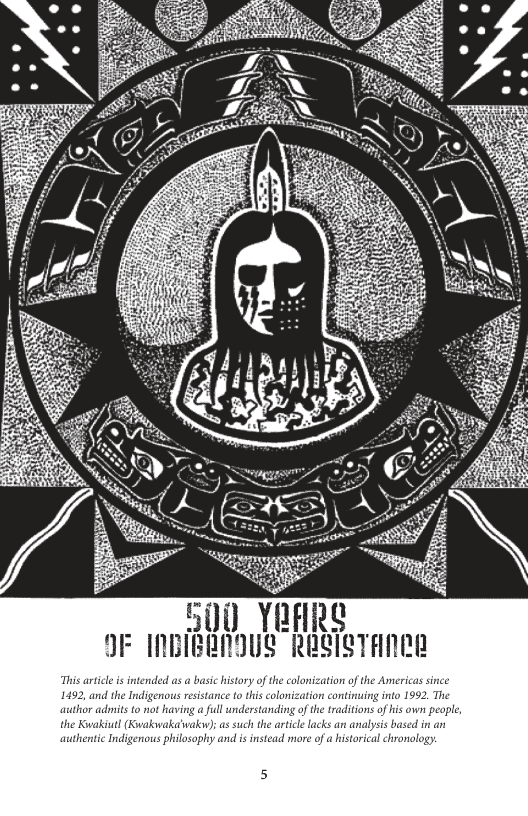
500 Years of Indigenous Resistance
Web PDF • Imposed PDF• Raw TXT (OCR)
![THE BRNICIGE BEGINS On October 12,1492 saling board the Santa. €€/ i ) Lo Maria under finance from the Spanish crown, Cristoforo Colombo stumbled upon the island o Guanaban (eeeed tobeSonSavador. . SWelled nde e o sn marks e oweome o With greed, Colombo’s voyage would quickly prove far more hcrative than the opening of new wrade (1111 tHETT routes, s far as Europe was concerned. 1 was on Guanahani that Colombo it 14 1] ger was encountered Taino Aravaks, whom he titled “Indians, believing he had in fact reached Asia. 7@ OUS.” For this initial encounter, Colormbos own log : stands as testimony to his own greed: —Aztec testimonial No sooner had we concluded the formali- ties of aking possession of the isand than people began to come o the beach... They are friendly and well-dispositioned people who bear no arms except for small spears. “They ought to make good and skilled servants... think they can easily be made Christians,for they scem to have no rligon. If it pleases Our Lord, 1 will take six o them to Your Highnesses when depart. (from Colombo’s log, October 12, 1492) True to his word, iflitte else, Colombo kidnapped about 9 Taino during his journey through the Bahamas, and anticipated even more kidnap- pings and enslavement, these people are very unskiled i arms. Your Highnesses will See this for yourselves when I bring you the seven that L have. taken. Aftr they learn our languages shal return them, unless Your Highnesses order that the entise population be taken to Castlle,or held captive here. With 50 men you could subject everyone and make them do what you wished. (Colombass g, October 14, 1492) 2 Robert H. Fusan, T Lag of Critopher Coombs,Internaional arine Pubih ing Co. Maine, 1987, pg. 3. Ihid g, 80, Colomba s nconsstent o the ctul pusmbe o Tinohe kidnapped.](500-years-of-indigenous-resistance-ohtohkin 11.png)



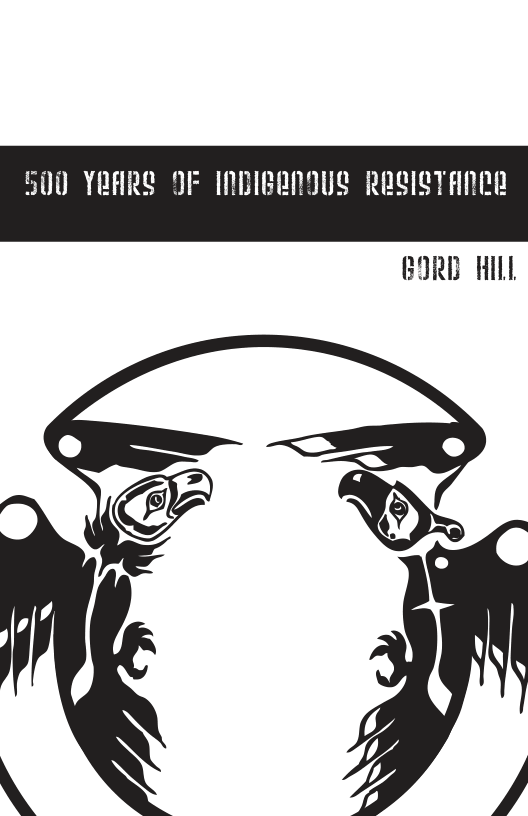
500 YRARS OF INDIGENIUS RASISTANCE
BIRD HIlL
500 YBARY
OF INGIBRNIUS RE
© Gord Hill 2009
“This edition © PM Press 2009
Allrights reserved. No part of this book may be transmitted in any form
by any means without permission in writing from the publisher
Cover and interior design by Daniel Meltzer
1STHNL
10987654321
Library of Congress Control Number: 2009901389
ISBN 978-1.60486-106.8
Published by:
PM Press
PO Box 23912
Oakland, CA 94623
wwwpmpress.org
Printed in the USA on recycled paper.
THBLE 9F eanTents
1
15
18
2
27
30
35
37
40
43
50
58
63
66
Foreword
Introduction
‘The Pre-Columbian World
‘The Genocide Begins
Expansion, Exploitation, and Extermination
‘The Penetration of North America
‘The European Struggle for Hegemony
‘Tragedy: The United States is Created
Revolutions in the “New World”
Manifest Destiny and the US. Indian Wars
Afrikan Slavery, Afrikan Rebellion, and the US. Civil War
Black Reconstruction and Deconstruction
‘The Colonization of Canada
Extermination and Assimilation: Two Methods, One Goal
‘The People AIM for Freedom
‘The Struggle for Land
In Total Resistance
FORBUIRE
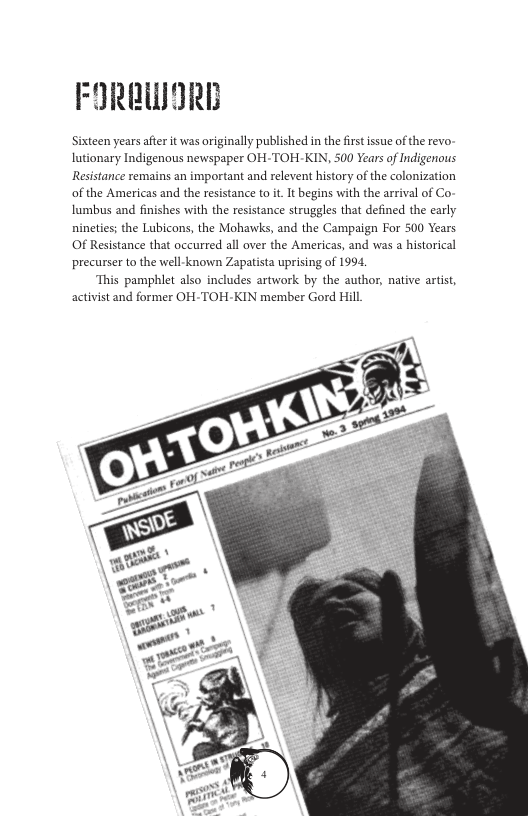
Sixteen years after it was originally published in the firstissue of the revo-
lutionary Indigenous newspaper OH-TOH-KIN, 500 Years of Indigenous
Resistance remains an important and relevent history of the colonization
of the Americas and the resistance to t. It begins with the arrival of Co-
lumbus and finishes with the resistance struggles that defined the early
nineties; the Lubicons, the Mohawks, and the Campaign For 500 Years
Of Resistance that occurred all over the Americas, and was a historical
precurser to the well-known Zapatista uprising of 1994,
‘This pamphlet also includes artwork by the author, native artist,
activist and former OH-TOH-KIN member Gord Hill
o 500 YAARS
OF INDEANIUY RASTSTANCA
INTRABUATION
‘Throughout the year 1992, the various sates which have profited from the
colonization of the Americas will be conducting lavish celebrations of the
“Discovery of the Americas. Spain has spent billon of dollars for celebra-
tions in conjunction with Expo '92 in Seville In Columbus, Ohio, a $100
million quincentennial celebration plans on entertaining several million
tourists. CELAM, the association of South America’s Catholic bishops, has
organized a gathering to celebrate the *fifth centenary of the evangeliza-
tion of the Americas” to be presided over by the Pope. As well, there is
a wide selection of museum exhibit, ilms, TV shows, books and many
other products and activites focusing on Columbus and the “Discovery’s
allpresenting one interpretation of the 50 years following 1492. The main
thrust of this interpretation is that the colonization process—a process of
‘genocide—has, with a few “bad spots’ been overall a mutually beneficial
process. The “greatness” of European religions and cultures was brought
to the Indigenous peoples, who in return shared the lands and after “acci-
dentally” being introduced to European discase, simply died off and whose
descendants now il the urban ghettos as alcoholics and welfare recipients.
Of course, few “remnants” of Indian cultures were retained, and there are:
even a few “professionl” Indian politcians running around.
‘That was no “Discovery”—it was an American Indian Holocaust!
Uniil ecently, commonly accepted population level ofthe Indigenous
‘peoples on the eve of 1492 were around 10-15 millin. This number contin-
ues to be accepted by individuals and groups who see 1492 as a “iscovery”
in which only a e million Indians died—and then mostly from diseases
More recent demographic studies place the Indigenous population at be-
tween 7010 100 million peoples, with some 10 million in North America, 30
million in Mesoamerica, and around 50 to 70 million in South America.
Today, in spite of 500 years of a genocidal colonization, there are
an estimated 40 million Indigenous peoples in the Americas. In Guate-
mala, the Mayan peoples make up 60.3 percent of the population, and
in Bolivia Indians comprise over 70 percent of the total population. De-
spite this, these Indigenous peoples ack any control over their own lands
and comprise the most exploited and oppressed layers of the population,
characteristcs that are found also in other Indigenous populations in the
setler states of the Americas (and throughout the world).
THE PRA-COLUMBIAN WORLE
Before the European colonization of the Americas, in that time of life
scholars refer to as “Pre-history” or “Pre-Columbian’, the Western
hemisphere was a densely populated land. A land with its own peoples
and ways of life, as varied and diverse as any of the other lands in the
world. In fact, it was not even called “America” by those peoples. If
there was any reference to the land as a whole it was as Trtle Island, o
Cuscatlan, or Abya-Yala.
‘The First Peoples inhabited every region of the Americas, living
within the diversity of the land and developing cultural lifeways depen-
dent on the land. Their numbers approached 70-100 million peoples
prior to the European colonization.”
Generally, the hundreds of different nations can be summarized
within the various geographical regions they lived in. The commonality
of cultures within these regions is in fact a natural development of people:
building lfeways dependent on the land. As well, there was extensive in-
teraction and interrelation between the people in these regions, and they
all knew each other as nations.
Inthe Arctic region ive()the Inuitand Aleut, whoselifeways evolve(d)
around the hunting of sea mammals (Beluga whales, walruses, etc) and cari-
‘bou, supplemented by fishing and trading with the people to the south.
South of the Arctic, in the Subarctic region of what is today Alaska,
the Northwest Territories, and the northern regions of the Canadian
provinces live(d) predominantly hunting and fishing peoples. The varia-
1. Sourcsfo the popaltion f ndigenus peopls prior to 1492 include:
Henry . Dobyns, Natie American Historcal Demography: A Crtcal
Bibliogaphy. University o Idiana Press, 1976; “Esimating Aboriginal
Popultion: An Appraisal of Techniqueswith New Hemispheric £t
wrent Anthroplegy, No. 7. 1966
. Plet Chanu, Conquite e Exlotaion de Nowwsau Mondes (XVie
Sicl) Paris, 1969 (estimate populaton at 50-100 milln).
« Willim _Jacobs, “The Tipof an Iecberg, Revisionin i Wilan and
Mary Quartely, No 31, 1974 estimates population at50-100millon).
+ Woodrow Wison Borah, “Americaas Model: The Demographic Impact
of Eurapesn Expansion Uponthe Non-Europesn World: in Actas
Memorias XXV Congres Iternacional de Americansias, Mexico, 1962
estimates popalaton a 100 million). Source: Roxanie Dunbar O,
Indians of the Americas,Pracer Publishes, N York, 1981
BORD HILL
tions of these lands range from open tundra to forests and lakes, rivers,
and streams. The Cree, Chipewyan, Kaska, Chilcotin, Ingalik, Beothuk,
and many other nations inhabit(ed) this region, hunting bear, goats, and
deer in the west, musk oxen and caribou further north, or buffalo further
south i the praiies
Altogether in the Arctic and Subartic regions there lived perhaps as
many as 100,000 people.
On the Pacific Northwest coast,stretching from the coasts of Alas.
ka and British Columbia (BC) down to northern Californis, live(d) the
Tlingit, Haida, Tsimshian, Kwakwaks'wakow, Nuu-chah-nulth, Nusalk,
Salish, Yarok, and many others. These peopls developed a lfeway re-
volving around fishing. The peoples of this region numbered as many
as four million.
Between the Pacifc coastal mountain range and the central phins
in what is today southern BC, Washington, Oregon, Idaho and Mon.
tana, lve(d) the Sahaptin (Nez Perce), Chopunnish, Shoshone, Siksikas
(Blackfeet), and others. These peoples numbered around 200,000,
To the east were people of the plains, encompassing a vast region
from Texas up o partsof southern Alberta, Saskatchewan, and Manitoba,
castward to North and South Dakota, Minnesota, Wisconsin, Mis
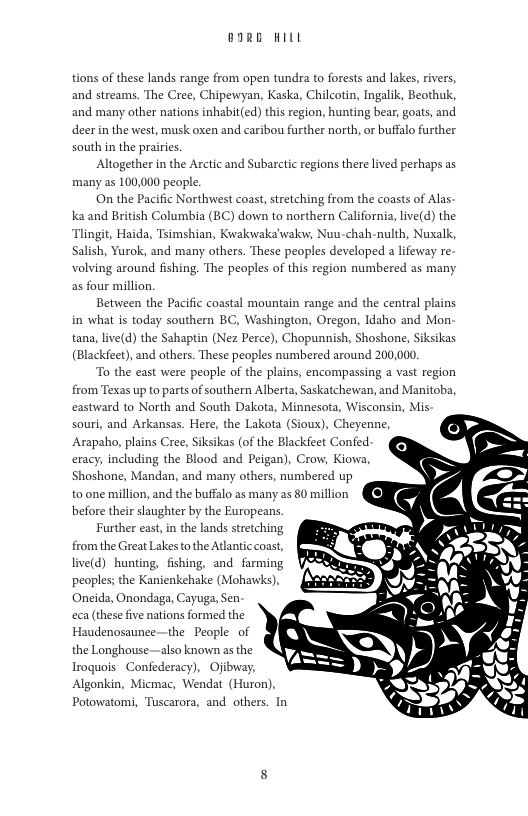
Here, the Lakota (Siowx), Cheyenne,
Arapaho, plains Cree, Siksikas (of the Blackfeet Confed.
eracy, including the Blood and Peigan), Crow, Kiowa,
Shoshone, Mandan, and many others, numbered up
t0 one million, and the buffalo as many as 80 million
before their slaughter by the Europeans
Further cast in the lands sretching
from the Great Lakestothe Atantic coast,
live(d) hunting, fishing, and farming
peoples; the Kanienkehake (Mohawks),
Oneida, Onondaga, Cayug, Sen
eca (these five nations formed the
Haudenosaunee—the People. of
the Longhouse—also known as the
Iroquois Confederacy), Ojibway;
Algonkin, Micmac, Wendat (Huron),
souri, and Arkans
Potowatomi, Tuscarora, and others. In
500 YOIRS OF INDISENDUG ROSISTARC
this woodland region, stretching from Ontario, Quebec, and New York,
down o the Carolinas, lived up to two million peoples
South ofthis area, from parts of the Virginias down to Florida, west
of the Gulf of Mexico including Mississippi and Louisiana, live(d) the
Muskogee-speaking Choctaw, Creek, and Chikasaw, the Cherokee, Nat-
chez, Tonkawa, Atakapa, and others. One of the most fertle agricultural
belts in the world, farming was ell established supplemented by hunting
and fishing. These peoples numbered between two and three million.
Eastof this area, in the southwvestern United States, extending down
o northern Mexico and California, live(d) agrarian and nomadic peo-
pls: the Pucblo, Hopi, Zun, the Yamun-speaking Hualapai, Mojave,
Yuma, and Cocopa, the Uto-Aztecan speaking Pimas and Papagos, and
the Athapascans consisting of the Navajo (Dine) and Apache peoples.
‘These peoples,altogether, numbered about two million.
In the Mesoamerican region, including Mexico, Guatemala and Be.
lize,live(d) the numerous agricultural peoples, whose primary staple was
maize: the Aztecs, Texacoco, Tlacopan, and the Mayans —in the Yucatan
peninsula. Here, large city-states with stone and brick buildings and pyr-
amids,as wellas extensive agrarian waterways consisting of dams and ca
nals were built. Written languages were published in books, and the
study ofastronomy and mathematics was vell established. A
calendar system more accurate than any in Europe during
the 15th century was developed. Altogether, these peo
ples numbered around 30-40 million.
In the Caribbean basin, including the coastal a
eas of Colombia, Venezuela, Costa Rica,
and the many small islands
uba, Hispaniols, Puerto Rico
etc live(d) hunting, fishing, and agrar
ian peoples such as the Carib, Aravak,
Warao, Yukpa, Pavjanos, and
others. These peaples numbered
around five million.
In all of South America
there were as many as 40-50
million peoples.
9
BORD HILL
In the Andean highlands of Peru and Chile live(d) the Inca peoples,
‘comprised of the Quechua and Aymara. In the south of Chile live(d) the
Mapuche, and in the lowland regions—including the Amazon region—
live(d) the Yanomami, Gavioe, Txukahame, Kreen, Akarore, and others.
South of the Amazon region, in Argentina, Paraguay, and Uruguay, live(d)
the Ayoreo, Ache, Mataco, Guarani, and many others. In the southern-
most lands live(d) the Qawasgar, Selk'nam, Onu, and others.
‘With a few exceptions, the First Nations were classless and commu-
nitarian societies, with strong matrilineal features. The political sphere
of Indigenous lfe was not dominated by men, but was in many cases
the responsibility of women. Elders held a position of importance and
‘honour for their knowledge. There were no prisons, for the First Nations
‘peoples had well developed methods of resolving community problems,
and there was—from the accounts of elders—very litle in anti-social
crime. Community decisions were most frequently made by consensus
and discussions amongst the people.
But the First Nations were not perfect, being humans they had, and
still have,their inconsistencies and practises that are not positve.
Some examples can be seen as the armed conflcts between nations
throughout the Americas, and practises of slavery amongst the Pacific
Northwest coast peoples and in the Mesoamerican region. However, even
here the forms of warfare reflcted similar developments throughout the
world, and in any case never approached the genocidal methods devel-
‘oped, in particular, in Europe. Warfare was the practise of explicitly war-
ior societies. The accounts of savery, although there i no way to explain
it away, differed sharply from the Europeans in that it was not based on
racism, nor was it a fundamental characteristic which formed the eco-
nomic basis of these societies
‘The history of the First Nations must always be analyzed critically;
those who tll us that history are rarely ever of the Indigenous peoples.
10
THE BRNICIGE BEGINS
On October 12,1492 saling board the Santa. €€/ i ) Lo
Maria under finance from the Spanish crown,
Cristoforo Colombo stumbled upon the island
o Guanaban (eeeed tobeSonSavador. . SWelled
nde e o sn marks e oweome o With greed,
Colombo’s voyage would quickly prove far
more hcrative than the opening of new wrade (1111 tHETT
routes, s far as Europe was concerned.
1 was on Guanahani that Colombo it 14 1] ger was
encountered Taino Aravaks, whom he titled
“Indians, believing he had in fact reached Asia. 7@ OUS.”
For this initial encounter, Colormbos own log :
stands as testimony to his own greed: —Aztec testimonial
No sooner had we concluded the formali-
ties of aking possession of the isand than people began to come
o the beach... They are friendly and well-dispositioned people
who bear no arms except for small spears.
“They ought to make good and skilled servants... think they can
easily be made Christians,for they scem to have no rligon. If
it pleases Our Lord, 1 will take six o them to Your Highnesses
when depart. (from Colombo's log, October 12, 1492)
True to his word, iflitte else, Colombo kidnapped about 9 Taino during
his journey through the Bahamas, and anticipated even more kidnap-
pings and enslavement,
these people are very unskiled i arms. Your Highnesses will
See this for yourselves when I bring you the seven that L have.
taken. Aftr they learn our languages shal return them, unless
Your Highnesses order that the entise population be taken to
Castlle,or held captive here. With 50 men you could subject
everyone and make them do what you wished.
(Colombass g, October 14, 1492)
2 Robert H. Fusan, T Lag of Critopher Coombs,Internaional arine Pubih
ing Co. Maine, 1987, pg.
3. Ihid g, 80, Colomba s nconsstent o the ctul pusmbe o Tinohe kidnapped.
BORD HILL
‘Throughout Colombass log of this first voyage,there is constant reference
to the notion that the Taino believe the Europeans to be descended from
heaven, despite the fact that [neither] Colombo nor any of his crew un-
derstood Arawak. Another consistency in Colombass log s the obsession
with gold, to which there are 16 references in the first two weeks alone,
13 in the following month, and 46 more in the next five weeks, despite
the fact that Colombo found very little gold on either Guanahani or any
of the other islands he landed on.
In a final reference to Colombasslog, one can also find the dual mis-
sion Colombo undertook:
Your Highnesses must resolve o make them [the Taino—Oh.
“Toh-Kin ed] Christians. belive thal i thi effort commences, in
ashort time a multtude of peoples will be comvrted 1o our Holy
Faith, and Spain will cquire great domains and riches and all of
ther vilages. Beyond doubi there is a very geeat amount of gold
i this country...Mso,thre ar precious stones and pearls, and an
infinite quantity o spices. (Colombass og, November 11,1492)
‘The dualiy of Colombo’s mission, and the subsequent European invasion
that followed, was the Christianization of non-Europeans and the expro-
priation of their lands. The two goals are not unconnected; “Christianiza-
tion” was not merely a program for European religious indoctrination,
it was an attack on non-European culture (one barrier to colonization)
and alegally and morally sanctioned form of war for conquest. “Even his
name was prophetic to the world he encountered—Christopher Colum-
bus translates to ‘Christ-bearer Colonizer” *
iill on his first voyage, Colombo meandered around the Caribbean
and eventuall established the first Spanish settlement, Natividad; on the
island of Hispaniola (today Haiti and the Dominican Republic). Leaving
about 35 men on Hispaniola, Colombo and his crew returned to Spain to
gather the materials and men needed for the coming colonization, and to
report to the crown o his journey.
In September, 1493, Colombo returned to Hispaniola with a flect of
17 ships and 1,200 men. The detachment that had been left on Hispan-
iola had been destroyed following outrages by the Spaniards against the
‘Taino. The resistance had already begun.
L i pg 107
5 Akvesasne Noes, Vol.9,No. 4, 1977
12
500 YOIRS OF INDISNILE RRSISTARED
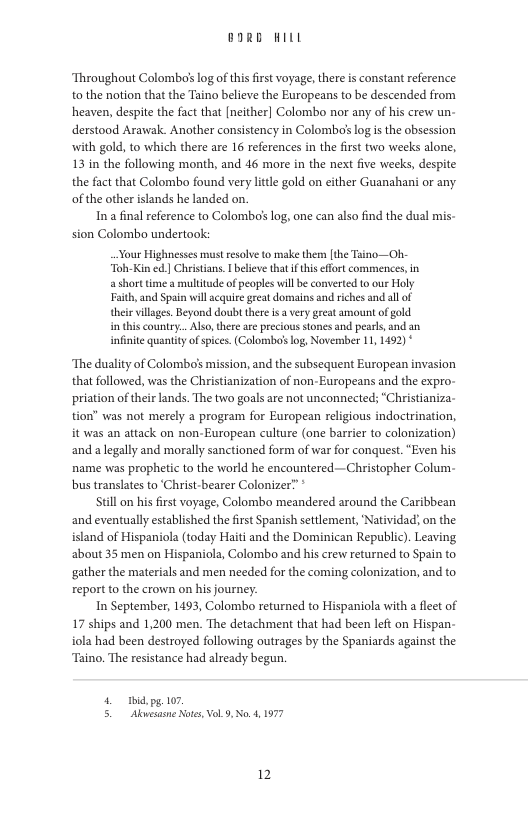
Colombo would make four voy-
agesinall the remaining two n 1498
and 1502, Hisvoyages around the Ca
ribbean brought him to what is now
‘Trinidad, Panama, Jamaica, Venezu:
ela, Dominic, and several other is
lands—capturing Native peoples for
slavery and extorting gold through a
quota of a hawks bell of gold dust o
be supplied by every Native over the
age of 14 every 3 months. Failure to
il the quota ofien entailed cutting
the ‘violators’ hands off and leaving
them to bleed to death. Hundreds of
Carib and Arawak were shipped to
Spain as slaves under Colombois gov-
ernorship, 500 alone following his
second voyage. Indeed, the absence
ofa“great amount of gold” in the Ca.
ribbean had Colombo devising another method of financing the colonization:
“The savage and cannibalistic Carib should be exchanged as slaves against
livestock to be provided by merchants in Spain. (Letter to Queen Isabella)
Colombo died in 1506, but following his initial voyage to the Ameri.
cas, wave upon wave of first Spanish, then Portuguese, Dutch, French and
British expeditions followed, carrying with them conquistadors, merce
naries, merchants, and Chritian missionaries.
Hispaniola served as the first beachhead, used by the Spanish as 2
staging ground for armed incursions and reconnaissance missions,jusi
fied through the ‘Christianization’ progeam; one year after Colombo's first
voyage, Pope Alexander V1 in his Inter Cetera Divina Papal Bull granted
Spain all the world not already possessed by Christian sates, excepting the
region of Brazil, which went to Portugal.
While the Spanish lad the groundwork for their colonization plans,
other European nations began to send their own expeditions.
In 1497, Giovanni Caboto Motecataluna (John Cabot), financed by
England, crossed the Athantic and charted the Atantic coast of North
America. Under the commission of Henry VII to “conquer, occupy, and
possess” the lands of “heathens and infidels, Cabot reconnotered the
Newfoundland coast—kidnapping three Micmacs in the process
13
NP N W P NPV S
BORD HILL
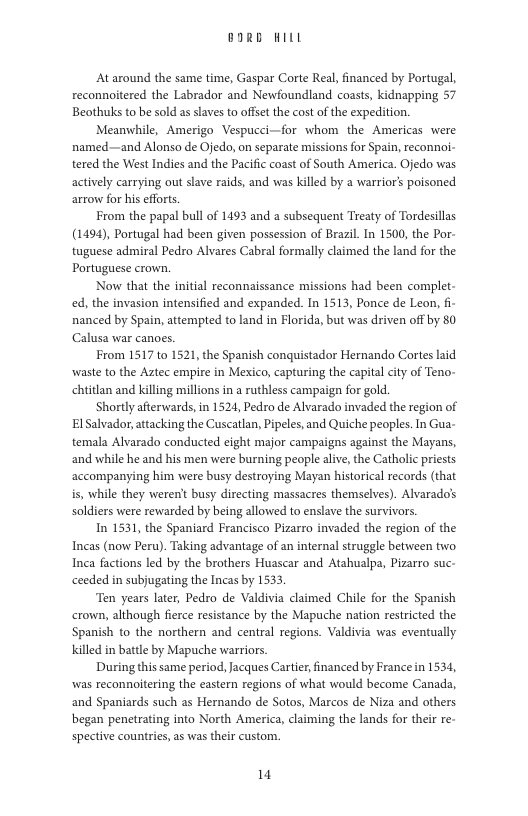
Ataround the same time, Gaspar Corte Real,financed by Portugal,
reconnoitered the Labrador and Newfoundland coasts, kidnapping 57
Beothuks to be sold asslaves to offset the cost of the expedition.
Meanwhile, Amerigo Vespucci—for whom the Americas were
named-—and Alonso de Ojedo, on separate missions for Spain, reconnoi-
tered the West Indies and the Pacific coast of South America. Ojedo was
actively carrying out slave raids, and was killed by a warrior’ poisoned
arrow for his efforts.
From the papal bull of 1493 and a subsequent Treaty of Tordesillas
(1494), Portugal had been given possession of Brazil. In 1500, the Por-
tuguese admiral Pedro Alvares Cabral formally claimed the land for the
Portuguese crown.
Now that the initial reconnaissance missions had been complet-
ed, the invasion intensified and expanded. In 1513, Ponce de Leon, fi-
nanced by Spain, attempted to land in Florida, but was driven off by 80
Calusa war canoes.
From 1517 to 1521, the Spanish conquistador Hernando Cortes laid
waste to the Aztec empire in Mexico, capturing the capital city of Teno-
chtitlan and killing millions in a ruthless campaign for gold.
Shortly afterwards, in 1524, Pedro de Alvarado invaded the region of
El Salvador, attacking the Cuscatlan, Pipeles, and Quiche peoples. In Gua-
temala Alvarado conducted eight major campaigns against the Mayans,
and while he and his men were burning people alive, the Catholic priests
accompanying him were busy destroying Mayan historical records (that
is, while they weren't busy directing massacres themselves). Alvarados
Soldiers were rewarded by being allowed to enslave the survivors.
In 1531, the Spaniard Francisco Pizarro invaded the region of the
Incas (now Peru). Taking advantage of an internal struggle betyween two
Inca factions led by the brothers Huascar and Atahualpa, Pizarro suc-
ceeded in subjugating the Incas by 1533.
Ten years later, Pedro de Valdivia claimed Chile for the Spanish
crown, although fierce resistance by the Mapuche nation restricted the
Spanish to the northern and central regions. Valdivia was eventually
Killed i battle by Mapuche warriors.
During this same period, Jacques Cartir,financed by France in 1534,
was reconnoitering the eastern regions of what would become Canada,
and Spaniards such as Hernando de Sotos, Marcos de Niza and others
began penetrating into North America, claiming the lands for their re-
spective countries, as was their custom.
1
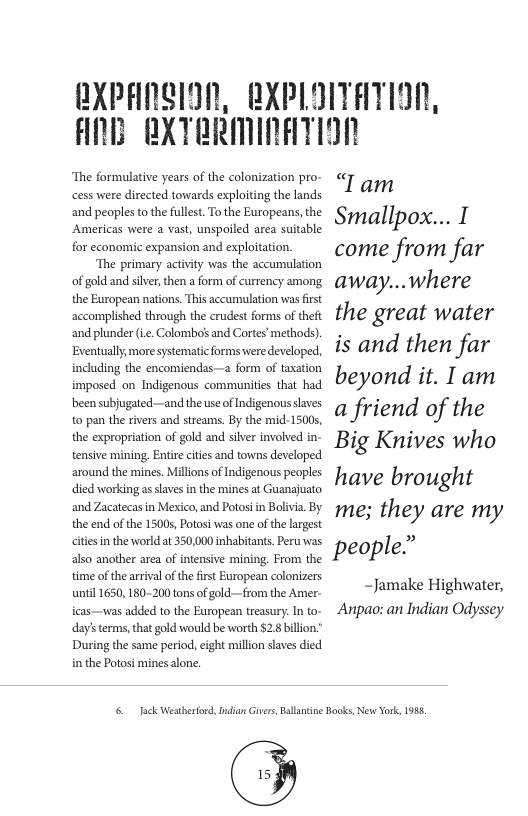
QXPANSION, BXPLAITATION,
AN exTeRmInATION
‘The formulative years of the colonization pro- ¢
cess were directed towards exploiting the lands Tam
andpeopes o he st Tothe Enopesss e Sy g[poyy... |
ofgold and s, then a form of currency smong - AW(LY... where
the European nations. This accumulation was first
sccomplished through the crudest forms of et £1€ great water
and phunder (. Colombos and Cortes methods.
Fventully more sysematic forms weredeveoped, 19 A1 then far
including the encomiendas—a form of taxation
impencd an g st bea O€YONA. it I am
been subjugated —and the se o Indigenous slaves i
o e s 3y et 50, @ friendl of the
the expropriation of geld and sier imvobed - Bigr Knjves who
tensive mining. Enire cities and towns developed.
ound e mnes Milkons o ndgenos el fy gy broyght
died orkingassaves n the mines at Guanjuato
and Zacatecas in Mexico,and Potosiin Bolivia. By~ 1372 thzy are my
the end ofthe 15005, Potosi was one ofthe lrgest
ctes in the worldat 350,000 ibabitants. Peru was »
o amothr v of mensive ining From he 2 €O le.
time of the arrval of thefirst European colonizers ;
unt 1650, 180-200 s fgold—fom he Amer.~Jamake Highwater,
icas—was added to the Furopean tressury Into- ~ Aripao: an Indian Odyssey
day'sterms, that gold would be worth §2. bilion
During the same period, ight millon savesdied
in the Potos mines alone.
6 Jack Weatherford, ndian Givers, Ballantine Books, New York, 1988
Ch
BORD HILL
Slavery was another major economic activity. Not only for work n the
mines, but also for export to Europe. In Nicaragua alone, the first ten years of
intensive slaving, beginning in 1525, saw an estimated 450,000 Miskitu and
Sumu peoples shipped to Europe. Tens of thousands perished in the ships that
transported them, Subsequently,the slav trade would turn to Afika, begin-
ning in the mid-1500s when Portuguese colonists brought Afikan slaves to
Brazil to cut cane and clear forest area for the construction of settlements
and churches. An estimated 15 million Afrikan peoples would be brought as
slaves to the Americas by 1800, and a further 40 million or so perished in the
transatlantic crossing in the miserable conditions of the ships holds.
In areas such as the highlands of northern Chile, Peru, Guatemala,
and Mexico, where the climate was more suitable, the Spanish were able to
grow crops such as wheat, cauliflower, cabbage, lettuce, radish, sugar cane,
and later grapes, bananas, and coffee. By the mid-1500s, using slave labour,
many of these crops—particularly wheat and sugar cane—were large:-scale
exports for the European markets.
In other areas, sprawling herds of cattle were established. Herds which
rarely exceeded 800 o 1,000 in Spain reached as many as 8,000 in Mex-
ico. By 1579, some ranches in northern Mexico had up to 150,000 head
of cattle” The efects of extensive land-clearing for the crops and ranches
and intensive mining culminated in increasing deforestation and damage to
the lands. More immediately for the Indigenous peoples in the region, par-
ticularly those who lived on subsistence agriculture, was the dismantling of
destruction of agrarian ways replaced by export crops.
In order to carry out this expansion and exploitation, the subjugation
of he First Nations was a necessity, and the task of colonizing other peoples
was one in which the Europeans had had plenty of experience
I sense, the first people colonized under the proft motivation by
the use ofabour.were the European and English peasantry lreand,
Boheria and Catalonia were olonized. The Moorish nation, as well
astheJudaic Sephardic nation,were physically deported by the Crown
of Casile from the licrian peninsula.. All the methods for reocation,
deportation and expropriation, were already practsed if not perfcted.”
Prior to Colombo's 1492 voyage, the development of a capitalist mode of
production emerging from feudalism had dispossessed European peasants
of independent production and subsistence agriculture. Subsequently, they
7. Alfed W Crosby, “The Biologial Consequencesof 1452' Report o the
Americas Vol XXV Xo.2.pg 11
5 Roxanne Dunbar Oris, Indiansof the Americas, Pracger Publishers,
New York, 1954
16
500 YOIRS OF INDISNILE RRSISTARED
were to enter into a relationship of forced dependence to land-owners and
manufacturers, leading to periods of intense class struggle, particularly as
the Industrial Revolution (fueled by the expropriation of materials from the
Americas and Afrika) loomed ever larger.
Indeed, the majority of Europeans who emigrated to the Americas
in the 16th, 17th, and 18th centuries were impoverished merchants, pe-
tit-bourgeois traders, mercenaries, and Christian missionaries all hoping
0 build their fortunes in the New World and escape the deepening class
straification that was quickly developing. However, the first permanent
settlements were limited, their main purpose being to facilitate and main-
tain areas of exploitation. During the entire 16th century; only an estimated
100,000 Europeans were permanent emigrants to the Americas.
“Their effects, however, were overwhelming; in the same 100-year peri-
od, the populations of the Indigenous peoples declined from 70-100 million
toaround 12 million. The Aztec nation alone had been reduced from around
30 million to 3 million in one 50-year period. The only term which describes
this depopulation is that of Genocide; an American Indian holocaust
Apologists for the Genocide attribute the majority of deaths to the
introduction of disease epidemics such as smallpox and measles by
unknowing Europeans.
While attempting to diminish the scale and intensity of the Geno-
cide (other forms of this diminishment are claiming the population of the
Americas was a much smaller portion than generally accepted demograph-
ic numbers), such a perspective disregards the conditions in which these
diseases were introduced. Conditions such as wars, massacres, slavery,
scorched earth policies and the subsequent destruction of subsistence ag-
riculture and food-stocks, and the accompanying starvation, malnutrition,
and dismemberment of communally-based cultures.
‘These conditions were not introduced by “unknowing” Europeans;
they were parts of a calculated campaign based on exploitation in which
the extermination of Indigenous peoples was a crucial factor.
European diseases introduced into these conditions came as an after-
effect of the initial attacks. And their effects were disastrous. Once the f-
fects of the epidemics were realized however,the use of biological warfare
was also planned in the form of infected blankets and other textiles sup-
plied to Indigenous peoples.”
5. Fuancs enning. The Ivason of Americ: s, Coloialsn, and the Cant
of Conquest, Universiy of North Carolina Pres, 1975, feings documents
the ctitieofthes st colonies, ol eyingon peiod manuscrpts.
17
THE PRNATRATION
OF NIRTH AMERICH
‘While the Spanish were destroying the Caribbean and Mesoamerican re-
gion, the Portuguese were carrying out similar campaigns in Brazil. The
patterns established by the Spanish would be repeated by the Portuguese:
during the 16th and 17th centuries in Brazil, Uruguay, and Paraguay.
By the beginning of the 17th century, the Spanish and Portuguese
had penetrated virtually every region in the southern hemisphere, estab-
lishing numerous settlements faclitated with the help of esuit and Fran-
ciscan missionaries, as well as mines, ranches, and plantations. Despite
all this, there were still large areas in which European claims to lands
remained a theoretical proposition; these areas remained outside of Eu-
ropean control with firce Indigenous resistance. This was particularly so
in the southern regions.
During this period, French, Dutch, and advance elements of the
British also established settlements in the Caribbean.
In 1604, the French occupied the island of Guadaloupe, folowed by
the island of Martinique and various smaller islands in the West Indies.
In 1635 they occupied what is now French Guiana.
Meamwhile, the Dutch occupied a coastal region that would eventu-
ally become Surinam (Dutch Guiana) as wel as setlements established
by the Dutch West India Company in the area of Belize (which would
ater become a Britsh colony).
‘The Dutch, French, and British were relatively limited in their ex-
ploits in the South Americas, and it would be in North America where
their main efforts would be directed.
As has already been noted, French expeditions had penetrated the
north-eastern regions of what would become Quebec and the Atlantic prov-
inces,inthe 1530s.In 1562 and 1564, the French attempted to establish set-
tlements in South Carolina and Florida, but were driven out by the Spanish
(who had claimed Florida in 1539 during de Soto's perilous expedition).
In 1585 the British also attempted settlements, on Roanoke Island
in North Carolina, and again in 1586. Both attempts failed when the set-
tlers-to-be were unable to survive.
500 YoRRS OF
Ben2Ue RRSIeTANCY
In the period up to 1600, more recon
naissance missions were conducted; n 1576
Martin Frobisher charted the Arctic coasts
encountering Inuuk, and in 1578 Franci
Drake charted the coast of California
Meanwhile the Spanish were pushing
into North America from their bases in
southern Mexico, encountering resistance
from Pucblos and others.
In the beginning of the 1600s, as the
horse spread. throughout the southwest
and into the plains, Samuel de Champlain
expanded on Cartier's earlier expedition,
penetrating asfar west as Lake Huron and
Lake Ontario. His attacks on Onondago
communities, using Wendat ~(Huron)
warriors, would turn the Haudenosaunce
against the French.
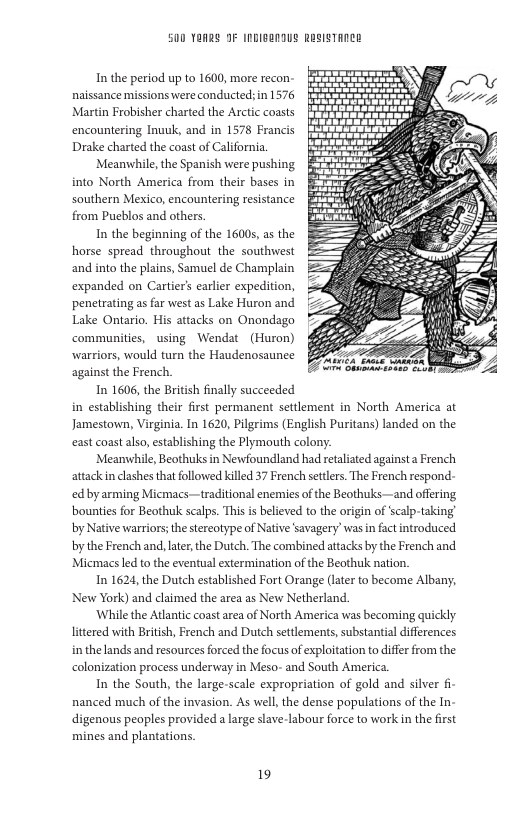
In 1606, the British finally succeeded
in establishing their first permanent settlement in North America at
Jamestown, Virginia. In 1620, Pilgrims (Englsh Puritans) landed on the
east coast also, establishing the Plymouth colony.
Meamvhile, Beothuks in Newfoundland had retalated against a French
attack n clashes thatfollowed killed 37 French setlers. The French respond:
ed by arming Micmacs—traditional enemies of the Beothuks—and offering
‘bounties for Beothuk scalps. This i believed to the origin of scalp-taking
by Native warriors; the sereotype of Native ‘savagery’ was in factintroduced
by the French and, later, the Dutch. The combined atacks by the French and
Micmacs led to the eventual extermination of the Beothuk nation.
In 1624, the Dutch established Fort Orange (late to become Albany,
New York) and claimed the area as New Netherland.
‘While the Atlantic coast area of North America was becoming quickly
littered with British, French and Dutch settlements, substantial differences
in the lands and resources forced the focus of exploitation to differ from the
colonization process underway in Meso- and South America.
In the South, the large-scale expropriation of gold and silver fi
nanced much of the invasion. As well, the dense populations of the In-
digenous peoples provided a large slave-labour force to work in the first
mines and plantations.
19
BORD HILL
In contrast, the Europeans who began colonizing North America
found a lower population density and the lands, though fertle for crops
and abundant in fur-bearing animals, contained little in precious metals
accessible to 17th century European technology.
‘The exploitation of North America was to require long.term activi-
tes which could not rely on Indigenous or Afrikan slavery but which in
fact which required Indigenous participation. Maintaining colonies thou-
sands of miles away from Europe and lacking the gold which financed the
Spanish armada, the colonial forces in North America would have to rely
on the gradual accumulation of agricultural products and the fur trade.
In this way, the initial settlements relied largely on the hospitality
afforded them by the Native peoples. Earler attempts at European settle-
ments had faled for precisely this reason, as the Europeans found them-
Selves almost completely ignorant of the land.
‘The growing European colonies quickly set about acquiring already
cleared and cultivated land, and their expansionist policies led to fierce
‘competition between the colonies. This bitter struggle for domination of
land and trade frequently began and ended with attacks against Indig-
enous communities. One of the firs of these trategic attacks’ occurred
in 1622 when a force from the Plymouth colony massacred a group of
Pequots. In retaliation, Pequote warriors attacked a settlr village at Wes-
sagusset, which was then abandoned and subsequently absorbed into the
‘dominion of the Plymouth colony, which had coveted the trade and land
enjoyed by the Wessagusset setlers
By 1630, the Massachusetts Bay colony had been established, and
“New England: once only a vague geographical expression, came to apply
in practise to the colonies of New Plymouth, Salem, Nantucket, Rhode
Island, Connecticut, New Haven and others.
‘The expansionist drives of the Massachusetts colonists consisted of
massacres carried out against first the Pequot and eventually the Narra-
gansets between 1634 and 1648
It was in this period that the transition between European depen-
dence on Native peoples began to be reversed. Through the establishment
and expansion of European colonies, increased contact with First Nations
brought extensive trading, as wellas disease epidemics and conflct.
‘Trade gradually served to break up Indigenous societies
Indian industry became lessspecialized and divided as it entered
into closer rlations of exchange with European industry. For the
2
500 YOIRS OF INDISNILE RRSISTARED
Indians, intersocietal commerce triumphed by subordinating and
ciminating all crats except those dicctly reated o the Europe-
anIndian trade, whil ntertribaltrading telations survived only
insofarasthey served the purposes of intersocietal trade. "
‘Thus, trade with European industry developed a relationship of growing
dependence on the European colonists. The items traded to Natives—
fles—were of European manufac-
ture and supply: The trade also disrupted and changed traditional Native:
metal pots, knives, and occasionally
methods in other ways, with the introduction of alcohol and extermina-
tionist forms of warfare —including torture—under the direction of the
colonialists, as well as an overall escalation in warfare in the competition-
driven fur trade and introduction of European rifles
‘While disease epidemics began to spread throughout the Atlantic
coastal area, the colonialists also relied to a large extent on exploiting
and exaggerating already existing hostilites betueen First Nations, as the
Spanish and Portuguese had also done in their campaigns,
“The grim epics of Cortes and Pizareo, not 1o speak of Colum-
bus himself, testify o the miltary abiltesof Spanish soldiry,
bul these need to b compared as wel with the great faiures of
Narvaez, Coronado and de Soto-. (The conquistadors) did not
conquer Mesico and Peru unaided. Native alies were indispens-
able...North of Netw Spain,invasion sarted ater,so Frenchmen,
Dutchmen, and Englishmen found native communities. already
reduced by epidemic rom base populations that never ap-
proached the size of Mexico. "
It was at this time that the concept of treaty making began to take hold.
In keeping with the English colonists early plans of keeping some level of
peace with the Natives, a in 1606 when,
the Virginia Company of London instructed s colonists to buy
astock of cor from the ‘naturals before the English intention to
settle permanently should become evident. The Company's chicfs
were st that‘you cannot cary yourselves so towards them but
they wil grow discontented with your habitator:
0. 1hid py.55.
1L hid py 3
12 thid py 76
21
BORD HILL
‘The initial English (and Dutch) settlers began the process of purchasing
land, supplemented as always with armed force against vulnerable Indig-
enous nations (such s those decimated by disease or already engaged in
wears with more powerful First Nations).
It remains unclear as to what the First Nations understood of the
local purchasing process, but some points are clear; there was no prac-
tise of private ownership of land, nor of selling land, among or betsween
the Peoples prior to the arrival of the colonialists: there were however
agreements and pacts between First Nations in regards to access to
hunting or fishing areas. This would indicate treaties were most likely
understood as agreements between First Nations and settler communi-
s over use of certain areas of land, as well as nonaggressiveness pacts.
In either case, where First Nations remained powerful enough to deter
initial settler outrages the treaties were of litle effect f they turned out
t0 be less than honourable, and there was enough duplicity, fraud, and
thet contained in the treaties that they could not be considered bind-
ing Practises such as orally translating one version of a treaty and sign-
ing another on paper were frequent, as was taking European proposals
in negotiations and claiming that these had been agreed upon by all —
when in fact they were being negotiated. As well, violations of treaty
agreements by settlers was commonplace, particularly as, for example,
the Virginia colony discovered the profitability of growing tobacco (in-
troduced to the settlers by Native peoples) and began expanding on
their initial land base.
Gradually, First Nations along the Atlantic found themselves dis-
possessed of their lands and victims of settler depredations. One of the
first conflctsthat seriously threatened to drive the colonialist forces back
into the sea broke out in 1622, when the Powhatan Confederacy, led by
‘Opechancanough, attacked the Jamestown colony.
Clashes continued until 1644, when Opechancanough was captured
and killed. By the mid-1600s, clashes between Natives and settlers be-
gan to increase. Tensions grew as the Europeans became more obtuse
and domineering in their relationship with the First Nations. In 1655
for example, the so-called ‘Peach Wars’ erupted between colonialists of
New Netherlands and the Delaware Nation when a Dutchman killed a
Delaware woman for picking a peach tree on the colonies ‘property. The
Settler was subsequently killed and Delaware warriors attacked several
2
500 YOIRS OF INDISNILE RRSISTARED
Dutch settlements. The fighting along the Hudson River lasted until 1664
when the Dutch forced the Delaware nation into submission by kidnap-
ping Delavare children as hostages.
In 1675 the Narragansetts, Nipmucs, and Wapanoags, led in part
by Metacom (also known as King Philip by the Europeans) rebelled
against the colonies of New England following the English arrest and
execution of three Wapanoags for the alleged killing of a Christianized
Native, believed to be a traitor. The war ended in 1676 after the English
colonialists—making use of Native allies and informers—were able to
defeat the rebellion. Metacom was killed, and his family and hundreds
of others sold to slavers in the West Indies. The military campaign car-
ried out by the colonial forces decimated the Narragansett, Nipmuc,
and Wapanoag nations
Meanwhile in 1680, 2 Pueblo uprising led in part by the Tewa Medi-
cine man Pope succeeded in driving out the Spanish from New Mexico.
By 1689, Spanish forces were able to once again subjugate the Pucblos.
By the late 1600s, the competition between European states would
dominate the colonization process in North America.
23
THE BURDPAAN STRUGGLA
FOR Hesemany
Although colonial wars had been fought in the past between France,
Spain, the Netherlands, and England, and conflicts had erupted between
their colonies in the Americas, the late 1680s and the following 100 year
period was to be a time of bitter struggle between the Europeans for
‘domination. This period of European wars was to be played out also in
the Americas, “To a great extent, the battle for colonies and the wealth
they produced was the ultimate battlefield for state power in Europe”
Beginning in 1689 with King Willian's War between the French and the
English, which evolved into Queen Annés War (1702-13),to King George's
‘War (1744-48) and culminating in the so-called ‘French and Indian War
(1754-63) the batlesfor colonial possessionsn the Americas mirrored those
raging across Europe in the same period, except that in North American and
in the Caribbean, the European struggle for hegemony n the emerging world
trade market would employ heavy concentrations of Native warriors.
‘While the British emerged victorious from the ‘Great War for Empire,
and the French defeated ceding Hudson Bay, Acadia, New France and other
territores n aserie of traties, those who were most affected by the Europe-
an struggles were the Native peoples of the Atlntic regions. The falloutfrom
those wars was the virtual extermination of some Indigenous peoples, includ-
ing the Apalachees in Florida,the establishment of colonial ltary garrisons
and outposts, a general militarization of the region with heavier armaments
and combat veterans, and the subsequent expansion of colonial settlements,
extending their frontiers and pushing many First Nations further west.
During the period of the colonial wars, Indigenous resistance did
not end, nor was it limited to aiding their respective ‘allies.
In 1711, the Tuscaroras attacked the English in North Carolina and
fought for two years, until the English counter-insurgency campaign left
hundreds dead and some 400 sold into slavery. The Tuscaroras fled north,
Setling among the Haudenosaunee and becoming the Sixth Nation in 1722
1. Ontiop.ci.
500 YOIRS OF INDISNILE RRSISTARED
In 1715, the Yamasee nation rose up against the English in South Car
olina, but were virtually exterminated in a ruthless English campaign.
In 1720, the Chickasaw nation warred against French occupation,
until Frances capitulation to England in 1763, Similarly, Fox resistance to
French colonialism continued from 1720 to around 1735,
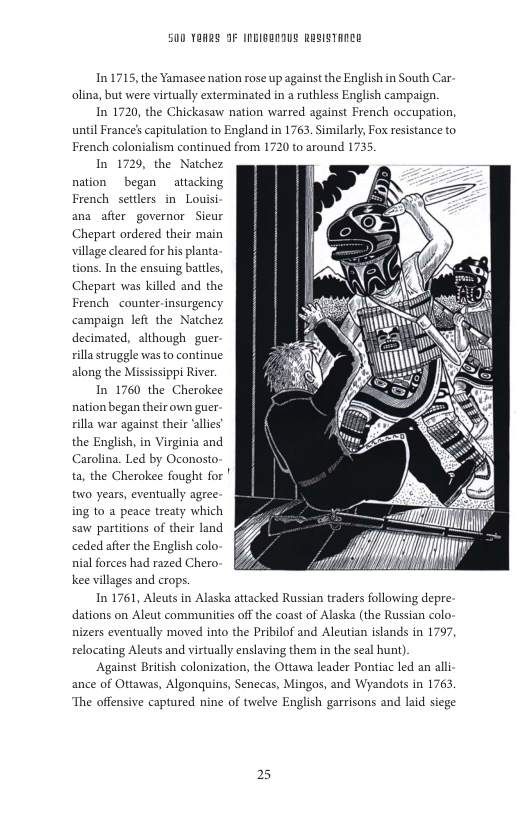
In 1729, the Natchez
nation began attacking
French settlers in Louisi
ana afier governor Sieur
Chepart ordered their main
village cleared for his planta.
tions. In the ensuing batiles,
Chepart was killed and the
French counter-insurgency
campaign left the Natchez
decimated, although guer.
rilla struggle was to continue
along the Mississippi River.
In 1760 the Cherokee
nation began their own guer
rilla war against their allies’
the English, in Virginia and
Carolina. Led by Oconosto-
ta, the Cherokee fought for '
two years, eventually agree
ing to a peace treaty which
saw partitions of their land
ceded after the English colo.
nial forces had razed Chero
ke villages and crops.
In 1761, Aleuts in Alaska attacked Russian traders following depre.
dations on Aleut communities off the coast of Alaska (the Russian colo.
nizers eventually moved into the Pribilof and Aleutian islands in 1797,
relocating Aleuts and virtually enslaving them in the seal hun)
Against British colonization, the Ottawa leader Pontiac led an alli
ance of Ottawas, Algonquins, Senecas, Mingos, and Wyandots in 1763
The offensive captured nine of twelve English garrisons and laid siege
BORD HILL
to Detroit for six months. Unable to expand the insurgency or draw in
promised French assistance, Pontiac eventually negotiated an end to the
conflictin 1766,
‘Added to this period of warfare was the continuing spread of disease:
epidemics. In 1746 in Nova Scotia alone, 4,000 Micmacs had died of dis-
ease. With the defeat of France, the British had acquired vast regions of
formerly French territory; unbeknownst to the many First Nations who
lived on those lands, and with whom the French never negotiated any
land treaties nor recognized any form of Native it
Atthis time,
the Briish government sized the opportunity o consolidate
tsimperial position by structuring formal,constitutional ela-
tions with._natives I the Proclamation of 1763, it announced ts
intention of concilatng those disgrunted tribes by recognizing
thei land rights, by scuring 1 them control of unceded land,
and by enteing into a nation-to-nation relationship.
‘The Royal Proclamation of 1763 provided for a separate ‘Indian Territory’
west of the Appalachians and the original Thirteen Colonies. Wi
territory there was to be no purchasing of land other than by the crown
In the colonies now under British control,including Newfoundland, Lab-
rador, Quebec, Nova Scotia, as well as the Thirteen Colonies, setlers oc-
cupying unceded Native lands were to be removed, and private purchases
of lands occupied by or reserved for Natives was prohibited—these lands
could only be purchased by the crown in the presence of the First Nations.
s grand as these statements were, they were routinely violated by
colonialists and rarely enforced. Indeed, one year following the proclama-
tion, Lord Dunmore—the governor of the Virginia colony—had already
breached the demarcation line by granting to veterans of the ‘French and
Indian War' who had served under him lands which were part of the
Shawnee nation. The Shawnee retalition was not short in coming, but
Dunmores challenge to British control was to precipitate in form and
substance another period of conflict that would see the colonization pro-
cess expand westward. And that period of conflict would underline the
realintent of the Royal Proclamation as a strategic document in the de-
fense of British colonial interests in North America.
in this
14 Jobn . Milly, “The Early Indian Acts: Developmental Strategy and Constit
tionalChange’ s Long As The Sun Shines and Witer Fows, University of BC
Pres 198 p. 6.
2
TRABADY: THE uniTap
STATAS 1S CREATAR
‘With the dominance of British power on a world scale, the European
struggle for hegemony in the Americas was nearing its end. Subsequent-
Iy the 18th and 19th centuries were to be a period of wars for indepen-
dence that would force the European states out of the Americas. Fore-
most among these wars was the independence struggle that would lead
to the birth of the United States.
Emerging from the Great War for Empire, Britain found itselfvictori-
ous butalso heavilyin debt. To defray the cost of maintaining and defend-
ing the colonies, Briain substantially changed its colonial policies. Large
portions of the financial costs of the colonies were placed directly on the
colonies themselves through a series of taxes. The imposition of the taxes
incited the settlers to demand taxes be imposed only with their consent.
In fact, the question of taxes was part of a wider debate about who should
control and profit from colonialism, the colonies or the colonial centres.
By 1775, setler protests and revolts had culminated in a general war
for independence that continued until 1783, when the British capitulated
and ceded large portions ofis teritories along the Atlantic.
“Tha the British colonial forces did not lose more territory can be
attributed much to the participation of numerous First Nations on the
side of the British; the Royal Proclamation was thus a strategy to damp-
en Native resistance to British colonialism (as in the eruption of King
George's War in 1744 when Micmacs alied themselves with the French
and, following the Treaty of Aix-la-Chapelle in 1748, continued fighting
the Britsh, who then concluded a treaty of “Peace and Friendship” with
the Micmacs), s wellas a method of forming military aliances with First
Nations, if not at least their neutrality in European conflicts
Asin previous European struggles, Indigenous peoples were used as
expendable troops, and the extensive militrization further consolidated
settler control,
“The end of the war saw thousands of Whites, United Empire
Loyalists, lock to Nova Scots. They came in such numbers and
spread so widely over the Maritime region that it was considered
BORD HILL
necessary to divide Nova Scoti into three provinees to ease ad-
ministrative problems; New Brunswick, Cape Breton, Nova Sco-
iaand Il S.-Jean, so0n t be renamed Prince Edward Island.
To the south, the rebellious setlers were establishing their newly-created
United States. For the First Nations in this region, the war had been par-
ticularly destructive; the colonial rebels had carried out scorched-earth
‘campaigns against the Shawnee, Delaware, Cherokee, and the Haudeno-
saunee (who had suffered a splt with the Oneidas and Tuscaroras allying
themselves with the revolutionaries). Here again the Royal Proclamation
remained a useful tool in reinforcing the British colonial frontier and
retaining Native allies,
Adherence o the principles of the. Proclamation..semained the
basis of Bitin's India policy for more than half s century, and
explains the success o the Britsh in maintaining the Indians as
alliesin Brtai's wars in North America... Even when Britan lost
‘much of its North American terrtory ater 1781, and it Indian
allieslost their traditionsl lands as result of thei Britsh all-
ance, the Crown purchased and from the Indians living within
Britsh terrtory and gave i o their alis who moved north...”
Having consolidated the Thirteen Colonies along the Atlantic seaboard,
the independent United States quickly set about expanding westward,
launching military campaigns to extend the frontiers of settlement.
‘One of the first of these campaigns began in 1790 under the order of
President George Washington. Consisting of about 1,100 Pennsylvania,
Virginia, and Kentucky militiamen led by Brigadier General Josiah Har-
mar,the force was quickly defeated by a confederacy of Miami, Shawnee,
Ojibway, Delaware, Potawatomi, and Ottawa warriors led by the Miami
chief Michikinikwa (Little Turtle). A second force was dispatched and
defeated in November, 1791. Finally in 1794, a large force led by Gen-
eral Anthony Wayne defeated the confederacy, now led by Turkey Foot,
near the shores of Lake Erie. Warriors who survived made their way
to the British Fort Miami garrison. But the British—former allies of
many of the First Nations in the confederacy during the revolutionary
war—refused them shelter, and hundreds were slaughtered at the gates
15, Geonge . G.Stanly, " Lomg s the Sun Shinesand the Wter Flows: An
Historial Comment’ . pg, 5-6.
16, Jobn L Tobias, Protcton, Civlzaton, Assmilation: An Orline Hisory of
(Canadds ndian Polcy bid pg. 4.
28
500 YoRRS OF
Ben2Ue RRSIeTANCY
by Waynes soldirs. Although the confederacy was es.
sentially broken, the Miami would continue armed
esistance up to 1840,
The ‘Indian Wars’ launched by the US.
continued for the next 100 years, following
an exterminationist policy that was aimed at
destroying Native nations and securing those
remnants who survived in (what was then be-
lieved) barren and desolate reserves. Once the
People were contained in these Bantustans,
the next step was the destruction of Na
tive culture under the auspices
of then-emerging governmental
agencies.
As the US. moved to a igher
level of war against First Nations,
it also began moving against com
peting European powers sl pes.
ent in the Americas
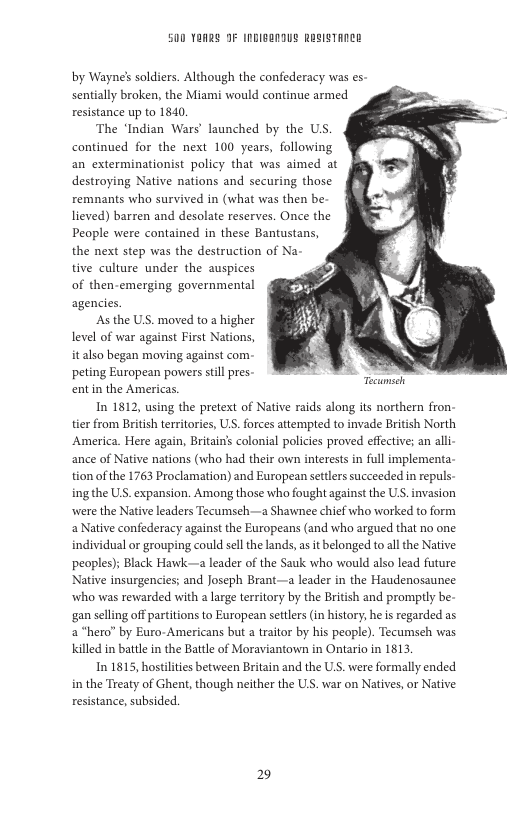
Tecumseh
In 1812, using the pretext of Native raids along its northern fron-
tier from British territories, US. forces attempted to invade Britsh North
America. Here again, Britain's colonial policies proved effective; an alli-
ance of Native nations (who had their own interests in full implementa:
tion of the 1763 Proclamation) and European setlers succeeded i repuls
ing the U, expansion. Among those who fought against the ULS. invasion
were the Native leaders Tecumseh—a Shawnee chief who worked to form
2 Native confederacy against the Europeans (and who argued that no one:
individual or grouping could sell the lands,asit belonged to al the Native
peoples); Black Hawk—a leader of the Sauk who would also lead future
Native insurgencies; and Joseph Brant—a leader in the Haudenosaunee
who was rewarded with a large teritory by the British and promply be-
gan selling off partitions to European setlers (in history, he s regarded as
“hera” by Earo- Americans but a traitor by his people). Tecumseh was
Killed in battle in the Battle of Moraviantown in Ontario in 1813
In 1815, hostilities between Britain and the UsS. were formally ended
in the Treaty of Ghent, though neither the US. war on Natives, or Native
resistance, subsided.
29
RAVALUTIONG 1IN THR
“new wors”
Following the American Revolution, movements for independence
began breaking out in South and Central America
Despite the seemingly monolithic appearance of Spanish or Portu-
guese colonialism in the first three centuries following the European in-
vasion, and despite the genocidal policies of the conquistadors, Native
resistance continued. Particularly in, for example, the interior region of
the Yucatan Peninsula, the lowland forests of Peru, the Amazon region,
and even in the Andean highlands—which had suffered such a severe
depopulation; between 1532 and 1625, the population of the Andean
peoples is estimated to have declined from 9 million to 700,000. In these:
regions, colonial domination was continually challenged and formed the
base for resistance movements that began even in the 1500s.
Among the first of these revolts was the Vilacabamba rebellion of
1536 led by Manqu Inka. Although the insurgency was unable to expand
and failed to drive the Spanish out, the rebels were able to establish a
“liberated zone” in the Vilacabamba region of present-day Bolivia for the
next three decades. * The ending of the initial revolt is recognized as the
execution of another leader, Tupac Amaru I in 1572
Other major insurgencies also broke out in Ecuador in 1578, 1599,
and 1615, The ltza of Tayasal in the Yucatan Peninsula remained unsub-
jugated until 1697
“Europeans found it particularly diffcult to establish effective trans-
portation and communication faciltes in the forest lowlands of the Maya
area.. Though the Spaniards achieved formal sovereignty over Yucatan
with relative ease, many local Maya groups successfully resisted effective:
domination..for centuries.” "
17, il Rivera Csicanqul, “Aymara Past, Aymara Futu Reort o the Ameri
cas Vol. XXV No.3,pg. 20
1. John S Henderson, The Workd ofthe Ancint Maya, Cornel University Prss,
1981, pg. 32
500 YOIRS OF INDISNILE RRSISTARED
Keeping pace with colonial developments in North America, the
Spanish introduced a series of laws in the 17th century known as the
Leyes de Indias. Similar to the later 1763 Proclamation introduced in
British North America, the laws partitioned the Andean region into a
“Republic of Spain’ and a ‘Republic of Indians'—each with its own sepa-
rate courts,laws and rights. The Leyes de Indias were, “from the point of
view of the colonial state..a pragmatic measure to prevent the extermina-
tion of the [ Indigenous] labour force..” *
Despite its seeming “liberalism’ forced labour accompanied by tax
laws remained in place, and the regulation was never fully enforced.
In 1742, Juan Santos Atahualpaled an Indigenous resistance movement
in Peru comprised largely of Yanesha (Amuesha) and Ashaninka (Campa)
‘peoples that fought offSpanish colonization for more than a century:
Inthe 18th century,Indigenous resistance broke out in a major revolt in
the colony of Upper Peru (now Bolivia), led by Jose Gabriel Tupac Amaru
Much has been writen about the 1780 Indian rebellon led by
Jose Gabril Tupag Amaru and hi successors; less i known.
about the Chayanta and Siksika revolts which accurred at the
same time, th latter led by Julian Apasa Tupaq Katari. For more
than halfa century, colonial tax laws had provoked a groundswell
of protest...In mid-1780, an apparently spontancous evolt broke
outin Macha, n the province of Chayania, to frce an Indian
eacique, Tomas Katari,jaild aftr a dispute with local mes-
tizo authorities.. Then in November 1780, Jose Gabriel Tupaq
Amaru led a well-organized rebelion in Tungasuc, near Cuzco.
Julan Apasa Tupaq Katari, an Indian commoner from Sullkaw
(sikasika) rose up and lid scge to La Paz from March to October
1781 during which one fourth o theciy’s population died. After
the defea n April 1781 of Tupaq Amaru in Cuzco, the rebel-
lion shifed to Azangaro, where his reltives Andres and Dicgo
Cristobal led the struggle. Andres successully laid siege to Sorata
in August o that year, but by November he and Dicgo Cristobal
were forced to surrender to the Spanish authorites. The rebellion
was crushed by the beginning of 1782
‘The leaders, perceived or real, were captured and executed; they were
quartered, decapitated, or burned alive.
19, Syl Rivera Cosicanqul op it
. idpg21
B
BORD HILL
‘While Indigenous resistance continued and frequently sent shock-
waves throughout the ranks of the colonialists —including Spaniards and
Creoles (descendants of Spanish settlers in the Americas)—the colonies
themselves began to experience movements for independence comprised
of Creoles and Mestizos.
‘The backgrounds to the movements for independence—like in the
US.—are found in the oppressive taxation and monopolisic trade laws
imposed by the colonial centers, both of which constrained the economic
‘growth of the colonies. As well, Creoles were generally by-passed for co-
lonial positions which went to agents born in Spain.
“The first major settlr revolt was in 1809 i the colony of Upper Peru
(Bolivia), which succeeded in temporarily overthrowing Spanish authori-
ties. In 1810 Colombia declared its independence, followed one year later
by Venezuela. In 1816, Argentina declared its independence, and the next
year General Jose de San Martin led troops actoss the Andes to “liberate:
Chile and Peru from the Royalist forces” Wars for independence spread
quickly, and Spanish royalist forceslost one colony after another in decisive:
conflicts, culminating in the Battle of Ayacucho in 1824 in Peru, which
effectively diminished Spain's domination in the Americas (which was al-
ready dampened by Napoleon's invasion of Spain in the same period).
‘Although the independence movements succeeded in overthrowing
Spanish and Portuguese forces, they were led by, and in the interests of,
Creole eltes—with the assistance of land-owners and merchants,
the revolutionsfor independent tate formation in the Americas
i the late 18th and carly 19th centuries must be seen as being in
the mode of European nation-state formation fo the purposc of
capitalst development. Although they were anti-‘mother coun-
oy, they were not anti-colonial just s the formation of Rhodesia
and South Africa s staes were not anticolonial events). *
‘The present-day Confederation of Indigenous Nationalites of Ecuador
(CONAIE) describes the independence of Ecuador, for example, as
not mean(ing) any change in our living conditions it s nothing
more than the passage of power from the hands o the Spaniards
tothe hands ofthe Creoles.
21, Rosanne Dunbar Ortiz op it
22, Quoted n Les Fied“Ecusdor Pan-Indian Uprising Rport o the Ameri-
s, Vol XXV No.3,p 41
2
500 YOIRS OF INDISNILE RRSISTARED
Asin the US. example, the newly-independent states quickly set about
consolidating their positions politically and militarily and pursuing
economic expansion.
‘The result wasan eruption of wars between the independent states over
borders, trade, and ultimately for resources. In 1884 the War of the Pacific
began, involving Boliva, Chile and Peru in adispute over access o nitrate
resource. From 1865-70, Argentina, Brazil, and Uruguay alled themselves
against Paraguay in the bloody War of the Triple Alliance—a war in which
Paraguay lost a large amount ofits male population—primarily Guarani
Asin North America, these and other conflcts most adversely affect-
ed the First Nations peoples. The majority of those who died in the War of
the Triple Alliance were Native. As well, the militarization that occurred
created large reserves of well-equipped, combat-experienced troops. In
Argentina and Chile, these military reserves were directed against invad-
ing then unsubjugated regions where Mapuche resistance had persisted
for centuries. Between 1865 and 1885, a militaized frontier existed from
which attacks against the Mapuche were conducted. Tens of thousands of
Mapuche were killed, the survivors dispersed to reservation areas.
In the 1870s, the development of vulcanization in Europe led to an in-
vasion of the Upper Amazon regions of Brazil, Colombia, Ecuador, Peru,
and Bolivia—where rubber trees would eventually supply the world market.
In the Putumayo river region of northern Peru and Colombia alone, 40,000
Natives were killed between 1886 and 1919 (by 1920, its estimated that the
depopulation of the rubber areas had reached 95% in some areas). *
Itwas in this post-independence period that—arising from the com-
plete transition from Feudalism to capitalism in Earope—new forms of
European domination were being introduced. Briefly, this consisted of
the introduction of bank loans directed primarily at developing infra-
structures for the export of raw and manufactured materials: roads, ra
ways, and ports, particularly in the mining and agricultural industries.
In the 1820, English banks loaned over 21 million pounds to former
Spanish colonies. Through the debts, and the subsequent import of Eu-
ropean technology and machinery necessary for large-scale mining and
agribusiness—necessary to begin repayment of the loans—dependence
23 Andrew Gray,“The Amerindians of Souh Amercs Mineity Righ's Group
eport No. 15, London, 1957, . 5.
33
BORD HILL
was gradually established (and continues today in the form of the Inter-
national Monetary Fund and the World Bank, controlled by the G-7). *
During the same period, the US. was also setting footholds i the re-
gion. In 1853, five years after gold was discovered in previously unknown
arcas in Central America, US. marines invaded Nicaragua. In 1898, fol-
lowing the Spanish-American War, Puerto Rico and Cuba were annexed
tothe U, (Puerto Rico remains today as the last US. colonial nation). As
well,US. forces occupied the Philippines—carrying out massacres of men,
women, and children—and Hawaii came under US. control in 1893, With
these actions the UL established itslf a5 an emerging capitalist power, and
the eventual extent of UsS. imperialism was beginning to take shape.
On a global scale, the development of imperialism had now estab-
lished itself internationally; the full division of the world between pre-
dominantly European powers and the US. was complete (and would
subsequently lead to two world wars).
24, -7 the grouping ofthe seven ot advanced industraied countrisa the
time: Britin, Canads, Feance, lly, Germany pan, and the USA. T 1995
the Group was oined by Russia and is nnw known s the G-5. The Group.
meets sanually o dtermin world sconomic poiciess ogether they hold
dominant poiions i the world sconnic arder.
34
MANIFAST GASTINY AND
THE U.S. INGIAN TARS
While the US. was in the process
of establishing itself as an impe-
ralist world power, it was stll
struggling to consolidate itself as
2 continental base and countering
armed resistance by First Nations.
Prior to the US.-Briish War
of 1812, Louisiana was purchased
from France, in 1803, and Spain
had ceded Florida in 1819. By
1824, the Bureau of Indian Affirs
was organized as part of the War
Department. Miltary campaigns
were launched against First Na-
tions, from the Shawnee of the
Missisippi Valley to the Semi-
nole in Florida. At the same time,
the legalistc instruments for oc-
cupation were being introduced.
In 1830 the Indian Removal Act
was implemented, and in 1834
Congress reorganized the various
departments dealing with Indian
repression by creating the US.
Department of Indian Affairs, and the Indian Trade and Intercourse Act
wehich redefined the ‘Indian Territory’ and Permanent Indian Frontier. The
“Indian Territory’ had been previously defined in 1825 as lands west of the
Misissippi. Following the formation of the territories of Wisconsin and
Towa, the frontier was extended from the Mississippi to the 95th meridian.
‘The Indian Removal Act was directed at forced relocation of Natives east
of the 95th meridian o the west oft. In 1838, U, troops forced thousands of
BORD HILL
Cherokee into concentration camps, from which they were forced westward
‘on the Trail of Tears I the midst of winter, one out of every four Cherokees
died from cold, hunger, or diseases. Many other nations were forcibly relocat-
ed: the Choctaws, Chickasaws, Creeks, Shawnees, Miamis, Ottawas, Wendats
‘and Delawares. The ‘Permanent Indian Frontier'was a militarized line of US.
garrisons,similar o that in Argentina and Chile during the same period.
But the ‘Indian Frontier’ was ot to hold. Like the British Royal Proc-
lamation of 1763, the restictions on Europeans settling or trading in these:
regions were routinely ignored. With the ULS. annexation of northern Mexico
in 1848, the US. acquired the territoris of Txas, Clifornia, New Mexico, Ar-
izona, Utah and Colorado. The same year, gold was discovered in Calfornia
‘With these two events, the largescal invasion of the ‘Indian Territory’ was
underway. Under the ideology of Manifest Destiny, the US. was tolauncha -
newed period of genocidal war against those regions and First Nations which
remained unsubjugated. The theatre of war extended from the Great Lakes
region around Minnesota, south of the Rio Grande, and west to California,
extending north to Washington state. It was a period of war which involved
many First Nations: the Lakota, Cheyenne, Commanche, Kiowa, Yakima, Nez
Perce, Walla Walla, Cayuse, Arapaho, Apache, Navajo, Shoshone, Kickapoos,
and many others. It was also a war from which many Native leaders would
leave alegacy ofstrugele tha, ke those struggles in South and Mesoamerica,
would remain as symbols of resistance to the European colonization: Crazy
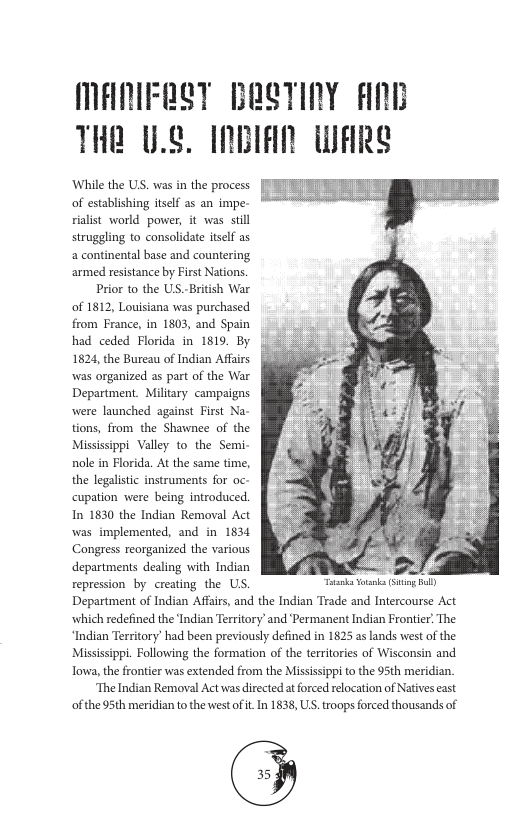
Horse, Tatanka Yotanka (Siting Bull), Ten Bears,Victorio, Geronimo, Quanah
Parker, Wovoka, Black Ketle, Red Cloud, Chief Jseph, and so many others.
‘Although theIndian Wars'of this period were by no means one-sided —
the US. forces suffered many defeats—the US. colonial forces succeeded in
gradually and rathlessly gaining dominance. Various factors contributed to
thi, following the patterns of previous campaigns against Native peoples:
the continuing spread of diseases such as measles, smallpox, and cholera
(between 183770, at least four major smallpox cpidemics swept through
the western plains, and between 1850-60 a cholera epidemic h the Great
Basin and southen plains): the use of informers and traitors and the over-
whelming strength of UL, forces in both weaponry and numbers ofsoldiers.
‘Combined with outright treachery and policie of extermination, these fac-
tors continued to erode the strength of once-powerful First Nations.
One of the major turning points in this period can be seen as
the USS. Civil War.
36
AFRIBAN QLAVARY
AERIGAN RABALLIN,
ARG THE U.S. RIVIL WAR
Ostensibly a moral crusade to “abolish slavery’, the US. Civil War of
1861-65 was in reality a conflict between the commercial and industrial
development of the North against the agrarian stagnation based on Afri
kan peoples’slave labour of the South.
By the 19th century, 10 to 15 million Afrikan peoples had been
relocated to the Americas by first Portuguese, then English, Spanish,
and US. colonialists.
‘These peoples came from all regions of Afrika: Sen-
egal, the Ivory Coast, Angola, Mozambigue, etc.—and.
from many Afrikan Nations: e Yoruba, Kissi, Senefu,
Foulah, Fons, Adjas, and many others
Enslaved, these peoples were forced to labour in the
mines, textile mills, factories, and plantations that served
first the European markets and, after the wars for indepen.
dence, the newly-created nation-states of the Americas.
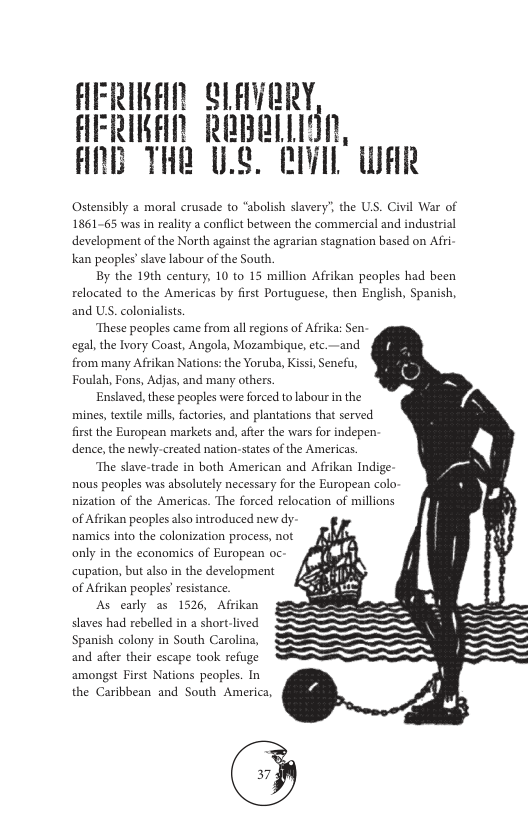
The slave-trade in both American and Afrikan Indige.
nous peaples was absolutely necessary for the European colo.
nization of the Americas. The forced relocation of millions
of Afiikan peoples also introduced new dy.
namics into the colonization process, not
only in the economics of European oc
cupation, but also in the development
of Afrikan peoples’resistance,
As erly as 1526, Afrikan
slaves had rebelled in a shortlived
Spanish colony in South Carolina,
and afier their escape took refuge
amongst First Nations peoples. In
the Caribbean and South America,
BORD HILL
where Afrikan slavery was first centered, large revolts frequently broke
out and escaped Afrikan slaves took refuge amongst Caribs and Arawaks.
In Northeast Brazil, an Afrikan rebellion succeeded in organizing the ter-
ritory of Palmares—which grew to one-third the size of Portugal
Probably one of the most famous Afrikan and Native alliances was
the example of the escaped Afrikan slaves and the Seminole in Florida.
‘The escaped Afrikans had “formed liberated Afrikan communities as a
Semi-autonomous part of the sheltering Seminole Nation” * Together,
these two peoples would carry out one of the strongest resistance strug-
gles against the US. The so-called Seminole Wars began in 1812 when
‘Georgia vigilantes attempted to recapture Afrikans for enslavement, and
continued for thirty years under the US. campaign of relocations. The
Seminole Wars, under the fanatical direction of President Jackson, were
the most costly of the U, ‘Indian Wars’; over 1,600 UL, soldiers were
killed and thousands wounded at the cost of some §30 million. Even
after this, the Seminole-Afrikan guerrillas remained unsubjugated. The
Solidarity between the Afrikans and the Seminoles is most clear in the
Second Seminole War of 1835. The Seminoles, under Osceola, refused to
accept relocation to Oklahoma—one of the key disagreements also be-
ing the UL, insistence on separation of the Afrikans from their Seminole
brothers and sisters. The ULS. forces relaunched their war, and were never
able to achieve a clea victory.
By the mid-1800s, slavery was viewed by some parts of the US. rul-
ing class as an obstacle to economic growth and expansion. The anti-
slavery campaign, led by the North, was a practical effort to free land and
Iabour from the limitations of the closed system of plantation agriculture
based on slave labour;
Slavery had become an abstacle o both the continued growth of
setter society and the interests of the Euro- Amerikan bour
geoisie, It was not that slaery was unprofitable el 1t wss,
Worker for worker, much more proftabl than white wagelabour
Alfrkan slaves in ndustry costth capitalists less than one-third
the wages o white workingmen... But the American capitalists
needed o grealy expand theirlabour force. While the planters
elived that importing new millions of Afrikan saves would
‘most profitably meet this need, it was clea tha this would only
25. 1 saka Setlers: The Myt of the Whi Proearar, Morningstar Pres, 1989,
[
38
500 YOIRS OF INDISNILE RRSISTARED
add fuel 0 the fires of the already insurrectionary Afekan colony.
Profithad to be seen not only in the squeezing of few more dol-
lars on a short-term, individual basis, but in terms of the needs of
an entire Empire and itsfoture. And it was not ust the demand
forlabou alone that outmoded the slave system. Capitalism
needed giantarmies of setlers, waves and waves of new European
shock-tr0ops o help conquer and hold new territory,to develop
itfor the bourgeoisic and garrison i against the oppressed.*
‘The “insurrectionary fires” had already dealt the occupation forces a
shocking blow in 1791 in the Haitian Revolution. Afrikan slaves, led in
part by Toussaint LOuverture, rebelled and defeated Spanish, English,
and French forces, establishing the Haitian Republic that offered citizen-
ship to any Native or Afrikan peoples who wanted it
‘There were also increasing revolts within the LS., including the 1800
revolt in Virginia led by Gabriel Prosser, and Nat Turner's revolt in 1831
which killed sixty settlers “The situation became more acute as the de-
veloping capitalist economy created trends of urbanization and indus-
tralization. In the early 1800s the Afrikan population of many cities was
rising faster than that of Euro- Americans” * The revolts led by Gabriel
and Turner had caused discussions in the Virginia legislature on ending
slavery, and public alles had been held in Western Virginia demanding
an all white Virginia.
‘Combined, these factorsled the North to agitate for an end to slavery
as one specific form of exploitation. In turn, the Southern states, led by
plantation owners and slavers, threatened to secede from the Union. The
Civil War began.
2. hid py 25
2. hidpgt
39
BLARK RACINSTRULTION
NG pACONSTRUCTION
‘The beginning of the U, Civil War in 1861 posed various problems for
the northern Union ruling class. Not only was the war for the preserva
tion of an expanding continental empire, but it also opened up a sec
‘ond front: that ofa liberation struggle by enslaved Afrikan peoples. With
a population of four million, the rising of these Afrikans in the South
proved crucial in the defeat of the Confederacy: By the tens of thousands,
Afikan slaves escaped from the savers and enlisted in the Union forces.
‘This massive withdrawal of slave-labour hit the Southern economy hard,
and the Northern forces were bolstered by the thousands.
Towards the end of the War in 1865, those Afrikans who did not
escape began a large-scale strike following the defeat of the Confederacy:
‘They claimed the lands that they had laboured on, and began arming
themselves—not only against the Southern planters but also against the
Union army. Widespread concerns about this ‘dangerous position of Af
rikans in the South led to ‘Black Reconstruction’; Afrikans were prom.
ised democracy, human rights, self-government and popular ownership
of the land. In realty, it was a strategy for returning Euro-American
dominance involving:
1. The milltary repression of the most organized and miliant
Afrikan communities
2. Pacifying the Afrikan peoples by neocolonilism, using ele-
‘ments of the Afrikan peit-bourgeoisc to lead their people into
embracing US. citizenship as the answer t0all problems. Instead
afn
onhood and lieraton,the neo-colonial agents old the
‘masses that thei democratic demands coukd be met by folloving,
the Northeen setler capitlist...”
2 hid py. 3.
500 YOIRS OF INDISNILE RRSISTARED
Following this strategy, Union army forces attacked Afrikan communities
who were occupying land, forcing tens of thousands offcollectively held land
and arresting the“leaders Afrikan troops who had foughtinthe Union army
were quickly disarmed and dispersed, o sent tofightas colonial troops in the
‘ongoing “Indian Wars", White supremacis terrorist organizations formed,
‘one of the most infamous—but not the only—being the Ku Klux Klan.
Under the 14th Amendment to the U, Constitution, Afrikans be-
came US, citizens,including the right to vote. Through the neo-colonial-
ist strategy of Reconstruction, Afrikans were able to push through re-
forms including integrated juries, protective labour reforms, divorce and
property rights for women, and an involvement in local government.
However, even these small reforms were too much for Southern
‘Whites. Reconstruction was vigorously resisted—not only by former
slaves and planters but also by poor Whites who flacked to organiza-
tions such as the KKK, White Caps, White Cross, and the White League.
‘Thousands of Afrikans were killed during state elections as the White
Supremacist groups conducted terrorist campaigns aimed at countering
the gains of Reconstruction and preserving White supremacy.
In 1876-77, the final accommodation between Northern capital
and the Southern planters was reached in the ‘Hayes-Tilden deal
“The South promised to accept the dominance of the Northern
bourgeoisic ovr the entire Empire, and t permit the Republi-
can candidate Rutherford B. Hayesto succeed Grant n the US.
Presidency.In return, the Northern bourgeoisie agreed o et the
planters have regional hegemony over the South, and to withdraye
thelas of the occupying Union troops s that the Klan could take
careof the Afikans a they wished. While the guarded remnans
of Reconstruction held out here and there for some years (Afr-
Kan Congressmen were elected from the South unil 1895), the
critcalyear of 1877 marked their conclusive defeat.
Not insignificantly during this same period, Northern working class
‘Whites were engaged in a vicious class struggle for an 8 hour work day,
even as Afrikans were under attack by the KKK and other racist orga-
nizations. And, at the same time, lttle notice was made of the military
extermination campaigns being carried out against Native peoples.
». i pg aL
a1
BORD HILL
During the War, many First Nations attempted to remain “neutral”
in the South, although some promises by the Confederacy for land stimu-
Iated some First Nations to side with the South. But “neutrality” i not the
same as passive; Native peoples continued their own resistance to coloni-
zation. From 1861-63 the Apaches led by Cochise and Mangas Colorado
fought occupation forces,a resistance that would continue until 1886 when
Geronimo was captured. The Santee also engaged the US. military from
1862-63 led by Little Crow. In 1863-64, this war would shift o North Da-
Kota under the Teton. In 1863, the Western Shoshone fought settlers and
attacked military patrols and supply routes in Utah and Idaho. That same
Year, the Navajo rebelled in New Mexico and Arizona.
‘With the completion of the transcontinental railroad in 1869, set-
tlement of the West increased rapidly. The militarization from the Civil
‘War, and the ability to supply and facilitate large-scale military opera-
tions, opened up the final period in the “Indian Wars” In the post-Civil
‘War period, the genocidal process of colonization was to enter a new
phase, even at the price of thousands of ULS. troops dead and wound-
ed, and each dead Indian coming at the price of $1 million. By 1885,
the last great herd of bufalo would be slaughtered by Euro-American
hunters—this also forming a part of the counter-insurgency strategy of
depriving the Plains Indians of their primary food source. Five years
ater, 350 Lakotas would be massacred at Chankpe Opi Wakpala, the
creck called Wounded Knee.
4
THE CLONIZATION
OF RHRAGA
In contrast to the US. campaign
of extermination, the colonization
process in Canada lacked the large.
scale military conflicts that char
acterized the US. “Indian Wars”
Although many Euro-Canadians’
would like to believe that these dif.
ferences in colonization lic in fun.
damentally different values, cul
tures, etc., they are no more than
the result of differences in colonial
practises rooted in basic economic
needs and strategies. As can be seen
in the aftermath of the US. War for
Independence, there followed a pe.
iod of rapid expansion and settle
ment. Following the consolidation
of the *13 Britsh colonies along the
North Atlantic, and armed with a
list thrust (the Monroe
Doctrine and the ideology of ‘manifest destiny ) the entrepreneurs coniol-
pre-imper
ling the new state machinery dispatched their military forces rapidly across
North Americs”.
Canada, on the other hand, did not fight a war for independence and
remained firmly a part of the British Empire.
As previously discussed, the first major colonization of what would
become eastern “Canada” was carried out by France. Between 1608 and
1756, some 10,000 French settlers had arrived in Canada. The “French
30, Buro-Canadian: term usd todisinguih between descendant of Eropeans
inthe US-and thos in Canad.
31 Oniop.ci.
BORD HILL
and Indian Wars” of the 18th century resulted in the defeat of the French
forces; the subsequent Treaty of 1763 established Britsh rule over New
France (now Quebec). With the Quebec Act of 1774, the province of
Quebec was expanded, Briish criminal law established, and the feudal
administration implemented by France remained largely unchanged.
Conflicts related to civil matters and property remained regulated under
French civil low. The scigneurial system, a feudal system in which the
land of the province was given in grant from the King to seigneurs (usu-
ally lower nobility and from the Church), who, in turn, rented the land
to peasants in return for an annual rent (called tithes, payable in goods
of products raised on the land), was continued. As with the 1763 Royal
Proclamation, the Quebec Act secured the loyalty of the French clergy
and aristocracy in the UsS. War for Independence.
As a result of the wars of the 18th century, French settlement had
grown 10 60,000 as soldiers employed by France swelled the French pop-
ulation. The expansion of the province under the Quebec Act had seized
alarge portion of the “Indian territory” and placed it under Crown juris-
iction. Following the U, War for Independence, some 40,000 loyalists
fled the former British colonies and settled in Canada, occupying more
Native lands—particularly that of the Haudenosaunce. Briish colonial
authorities went to some lengths to acquire land while placating the still
‘geo-militarily important Indians. *
‘While the colonialists were busy consolidating the administra-
tion of “British North America’, the Pacific Northwest was coming
under increased reconnaissance.
Beginningin 1774, the frstrecorded colonizers into the area of British:
Columbia came aboard the Spanish ship Santiago. Four years later,an ex-
pedition led by James Cook descended upon the area, leading to the estab-
lishment of a large and profitable fur trade. The dominance of the fur trade
52, Negotistons with the Misssaugs ofsouthern Ontaio were conducted 5
early a 1781, providing nd for communites from the Haudenosaunee.
whase nds ere suppled o Brtis loyalits i ststegic deensive e
along the US. border. Between 1781 and 1536,23 suchand cssons were
Conducted. No trestes bt instead “sinple el estte desls” n whichthe
Bt paid it goods andter money In 1818 theprsctise wss adopted of
pying annuitie. By 1830 hes annual payments wee diccted st biding
Houses nd purchasing urmequipment—in line with changing coloia prac-
tses. “This was then fllowd by theestabshment of the band fund sy,
e As Lo a the Sun Sine, of. it g, .
44
500 YOIRS OF INDISNILE RRSISTARED
would last until around 1854 when European
settlement began to increase rapidly along
with the mining and logging industries. Asa
result ofthe early dominance of the fur trade,
which relied on Native collaboration, British
colonizers curtailed their military operations.
Nevertheless, conflicts did erupt, primarily
against British depredations. As more ships
frequented the area, clashes spread with at
tacks on colonial vessels and the shelling of
Native villages.
Even before European settlement in BC,
the impact of the traders was disastrous. For
example, from 1835 when the first census
was taken of the Kwakwakawakw nation,
t0 1885, there was befween a 70 to 90 per
cent reduction in population (from around
10,70010 3,000). In an all too fariliar pat
tern, the intrusion of European traders had
set into motion disease epidemics, even as
carly as the 17805 and '90s. In 1836, 2 small
pox epidemic hit the northern coast, and the
fur trade was “depressed allthat winter and.
the following spring” * Following an inva.
sion of gold hunters into the region in 1858,
oneof the most devastating epidemics struck.
in 1862, killing at east 20,000 Indians.
Meanwhile, in British North America,
the geo-military importance of the First
Nations was quickly being eroded. With
the influx of loyalists after the ULS. War for
Independence, the European population
had grown and was strategically garrisoned
33, Dara CulhaneSpeck,An Enorin
34, Wilion Duff,“The Indan Hisoryof
[
Bt Cab
enent, Talonbooks, Vancouve, 1987 . 72
C, Vol 1. The Impact o the Wit Ma -
thropolgy in BC, Memnie No. 5, 1964, BC Provincial Museum, Victora 1965 (Fist
Ediion). pg 12
35 Ihid g 4243
BORD HILL
in key military areas—conflicts with the U, were predicted. As well as
further increasing the European population in the region, the War of
1812 and US. policies of moving Natives from the northern frontier had
broken up confederacies and greatly diminished the power of the First
Nations in the area. After this, British colonial policies changed from
essentially forming military alliances to a higher level of colonization
through policies of breaking down the collective power of First Nations.
Christianization and an overall Europeanization of Native peoples was
developed as official policy. By the 1850s, an instrument had been created
t0 this end: “The Gradual Civilization Act of 1857
“The Act was based upon the assumption that the ullcivilization
of the tribes could be achieved only when Indians were brought
into contact with individualized property... Any Indian..adjudged
by aspecial board of examiners o be educated ree from debt,
and of good mral character could on application be awarded
twenty hectares of land...
Here, the “civilzation of the tribes” should be read as the elimination of
the basis of Native cultures and de facto the First Nations as nations. The
twenty hectares of land were to be taken from the reserve land base, sub-
sequently breaking up the collective and communitarian land practises of
Native peoples and replacing these with individual parcels of and; all the
easier, from the viewpoint of the colonizer, to achieve the long:term goal
of completely eliminating First Nations as nations and leaving nothing
but dispersed, acculturated, peoples to be assimilated into European so-
ciety. The patriarchal dimensions of forced-assimilation were also clear:
only males could be so enfranchised.” A Commission of Inquiry had fur-
ther recommended that reserve lands be restricted to a maximum of 25
acres per family, and that Native organization be gradually replaced with
2 municipal form of government.
‘Atthe same time, new methods in acquiring land were developed. Be-
ginning in 1850 and continuing into the 20th century, series of traties
were “negotiated” in which Native nations ceded immense tracts of land in
return for reserve land, hunting and fishing rights, education, medical care,
and the payment of annuities. The frst such treaties were the Robinson
treaties, which would be renegotiated in 1871 as Treaties No. 1 and No. 2.
36 John, Mily i pg 55
Adsisory Counclln the Sats of Women,Indian Rightsfor Indian Women,
Canada 1978, pg. 27-28.
6
500 YOIRS OF INDISNILE RRSISTARED
“Ihe relationship between the immediste requirements of the
internal imperialis expansion snd the trcatics i remarkable
“The firtofthese treates was sought, according o a 19h centary
historia fest-hand report, in consequence ofthe discovery of
mincrals on the shores of Lake Huron and Superior.. The prairc
reatcs were obained immediately in advance of gricultural
settement, and the treaty which includes parts of the Northwest
Territoris was negotiated immediately upon the discovery of o
in the Mackensie Vlley.
‘While the colonizers knew what they wanted in proposing the trea-
ties, Native peoples were unprepared for the duplicty and dishonour of the
treaty-seekers. When a commission journeyed to the Northwest Territories
to investigate unfulflled provisions of Treaties 8 and 11, they found that
Ata number of mectings, Indians who claimed to have been
present a the time when the Treatis were signed stated that they
definitely did not recall hearing about the land entitlement n the
reaties. They explained that poor inerpreters were sed and
theirchiefs and head men had signed even though they did not
know whal the Treaties contained. ”
‘The treaties were important aspectsof the pan for the expansion of Canada
‘westward and economic development based on resource extraction and ag-
riculture. Indeed, the Confederation of Canada in the British North Amer-
ica Act of 1867 was aimed primarily at consolidating the then-existing
eastern provinces and faciltating in this westward expansion; the primary
instruments of this were the trans-Canada railway, telegraph lines, and
roads. This expansion was seen not only as economically necessary but also
politicaly urgent as the UL, was expanding westward at the same time.
‘The invasion of the prairie regions was not without conflict. The
most significant resistance in this period was that of the Metis peo-
ples—descendants of primarily French and Scottish settlers and Cree—
in what would become Manitoba. The Red River Rebellion, also known
as the First Riel rebellion after Louis Riel, a Metis leader, erupted fol-
lowing an influx of Euro-Canadian settlers and the purchase of the ter-
ritory from the controlling Hudsons Bay Company, by the government
35 Donald R Colborne, Norman Ziotkin, “Tntcrnal Candian Inperialism and
the Natve People’ Inperialisn, Natioralism, and Canada, Marsis Istivte
of Toronto Between theLines and New Hogtown Pes, 1987 pg, 164
39. i, pg 167 Quote fom Report ofthe Commission sppiate toivesigte
the unbifilled provisions of Trestis 8 and 113 they apply o the Indiansof
the Mackensie Distrct, 195, pys. -4
a7
BORD HILL
of Canada. The rebellion was directed against the annexation of the
territory over the Metis—who numbered some 10,000 in the region. A
force of 400 armed Metis seized a small garrison and demanded dem-
ocratic rights for the Metis in the Confederation. The following year
the Manitoba Act made the territory a province. However,ffteen years
later in 1885 the Metis along with hundreds of Cree warriors under the
chiefs Big Bear and Opetecahanawaywin (Poundmaker) were again en-
gaged in widespread armed resistance against colonization. For almost
four months the resistance continued against thousands of government
troops which, unlike in 1870, were now transported quickly and en
masse on the new Canadian Pacific railway. After several clashes the
Metis and Cree warriors were eventually defeated; the Cree and Me-
s guerrillas imprisoned, killed in battles or executed. Another Metis
leader, Gabriel Dumont, escaped to the ULS.
‘The Metis and Cree resistance of 1885 was the final chapter of armed
resistance in the 19th century. However,the use of military force in con-
trolling Native peoples was already being bypassed by the Indian Act of
1876, itself a reaffirmation and expansion on previous legislation con-
cerning Native peoples. This Act, with subsequent additions and changes,
remains the basis of Native legislation in Canada today:
Under the Indian Act, the federal government through its Depart-
ment of Indian Affairs is given complete control over the economic, so-
cial, and political affirs of Native communities. More than just a legisla-
tive instrument to administer “Indian affais’ the Indian Act was and is
anattack on the very foundations of the First Nations as nations. Besides
restricting hunting and fishing, criminalizing independent economic
ivelihood (ic.in 1881 the Act made it illegal for Natives to “sell, barter or
traffic fsh), the Actalso declared who was and who was not an Indian, it
removed “Indian status” from Native women who married non-Natives,
and criminalized vital aspects of Native organization and culture such as
the potlatch, the sun-dance, and pow-wow. Everything that formed the
political, social, and economic bases of Native societies was restricted;
the culture was attacked because it stood as the inal barrier of resistance
to European colonization. In the area of political organization,
“The Indian Act(of 1880)ereated a new branch of th civil service
that was 0 be called the Department o Indian Affaie. It once
again empowered the superintendent general o impose the lec-
tive system of band government...In addition,this new legisla-
48
500 YOIRS OF INDISNILE RRSISTARED
tion allowed the superintendent general 1o deprive the traditionl
leaders of ecognition by stating that the only spokesmen of the
band were those men elected according to..the Indian Act.*
In 1894, amendments to the Act authorized the forced relocation of Na-
tive children to residential boarding schools, which were seen as superior
to schools on the reserves because they remove the children from the
influence of the Native community. Isolated children in the total con-
trol of Europeans were easier to break; Native languages were forbidden
andall customs, values, eligious traditions and even clothing were to be
replaced by European forms. Sexual and physical abuse were common
characteristcs of these schools, and their effects have been devastatingly
effective in partially acculturating generations of Native peoples.
‘The Indian Act followed earlie legislation in that the long-term ob-
jective was the assimilation of Christianized Natives, gradually removing
any “special status” for Native peoples and eliminating reserves and treaty
rights; all of which would make the complete exploitation of the land a
simple task. As part of this strategy of containing and repressing Native
peoples who did not assimilate, and who were thus an obstacle to the
full expansion of Canada, the Indian Act also denied the right to vote to
Native peoples and implemented a pass system similar i not the forerun-
nerto the Pass Laws in the Bantustans of South Africa (it should also be
noted that Asian peoples were denied the right to vote as well and were
subjected to viciously racist campaigns in BC by both the government
and the labour movement; only in 1950 were Native and Asian peoples
given this illustrious” right).
40 John L Tobis, op.cit pg 6.
49
AXTARMINATION ANG ASSIMILATION:
T MATHINS, Jna BUAL
In the early 19005, the population of Native peaples in North America
had reached their lowest point. In the U, alone this population had
declined to some 250,000. As in Canada, Native peoples had been con.
signed tolargely desolate land areas and the process of assimilation began
through government agencies such as the Bureau of Indian Affars. Here
t0o, residential schools, criminalization of Native cultures, and contral of
political and economic systems were the instruments used. Native peo-
ples, like those in Canada, were viewed as obstacles to be crushed in the
drive for profits.
In both countries, resistance to this assimilation continued in vari
ous forms: potlatches and sun-dances were continued in clandestinity
and the elected band councils opposed. As well, Native peoples began
forming organizations to work against government polices. In 1912, the
Alaska Native Brotherhood was formed by the Tlingit and Tsimshian at
Sikta. That same year, the Nishga Land Claims Petition was presented
to the Canadian government concerning the recognition of aboriginal
title o treaties had or have been signed with First Nations in BC [as of
1991] —with the exception of a north-eastern corner of BC included in
Treaty No. 8 and some minor treaties on Vancouver Island. Yet Natives
in BC had found themselves dispossessed of their territory and subjected
to the Indian Act.In 1916 the Nishga joined with the interior Salish and
formed another inter-tribal organization, the Allied Tribes of BC. Funds
)
500 YoRRS OF
Ben2Ue RRSIeTANCY
dienos Land Wi Uned S, 1521577
were raised, meetings held, and petitions sent to Ottawa. In 1927, a spe.
cial Joint Committee of the Senate and House of Commons found that
Natives had “not established any claim to the lands of BC based on ab-
original o other title” * That same year Section 141 was added to the
Indian Act prohibiting raising money and prosecuting claims to land or
retaining a lawyer.
‘While the European nations would lead the world into two great
wars for hegemony, political instability and economic depredations
formed the general patiern in South and Central America. Military
regimes backed by US. and British imperialism carried out genocidal
policies and severe repression against Indigenous peoples. As in North
America, Indigenous peoples were consigned to desolate reserve lands
where the state or missionaries retained control over political economic,
social and cultural systems. However, in contrast to the colonization of
North America, where Native peoples were viewed as irrelevant to eco-
nomic expansion, the Indians of South and Central America remained as
substantial sources of exploited labour. With the large-scale investments
from the imperialist centres in the form of loans, the export of primary
resources took priority. The ‘rubber boon was one example, with tens of
thousands of Indians dying in forced labour, relocations, and massacres
carried out by major land owners, companies, and hired death squads.
In the wake of the rubber boom, Colombia, Ecuador and Peru
became battlegrounds for a war between oil companics. Sub-
sidiaries of Shell and Exxon ought for exploration rights in the
Amazon, even to the extent of becoming involved in 3 border war
L. Quotedin Wilon Duf, op.cit. .65
51
BORD HILL
between Ecuador and Peru in 1941.. In Brazil.87 Indian groups
were wiped out n thefirst half of the 20th century from coptact
with expanding colonial frontiers—especiall rubber and mining
i the northwest,catle n the northeast,agriculture n the south
and cast,and from road building throughout allregons.
‘While policies o forced assimilation were occasionally articulated, mil-
itary and paramilitary forces were to remain an essential part of con-
trolling Native commaunities and opening up territories to exploitation
‘The most violent manifestation of this repression came in El Salvador
in 1932, where as many as 30,000 people, primarily Indian peasants,
were massacred following an uprising against the military dictatorship
that took power the year prior. While the massacres were carried out
under the guise of “anti-communism’, USS. and Canadian naval ves-
sels stood offshore, and UsS. Marines in Nicaragua were put on alert
However, as the US. Chief of Naval Operations later testified before
Congress, “it was found unnecessary for the US. ..and British forces
to land, as the Salvadorian government had the situation in hand” ©
During the same period in Colombia, the Indian leader Quintin Lame
helped initiate struggles for land and developed an Indigenous philoso-
phy of resistance; in the early 1980s, his legacy would live on in the In-
dian guerrilla group “Commando Quintin Lame", Gonzalo Sanchez was
another leader who helped organize the Supreme Council of Indians in
Natagaima, Colombia, in 1920.
‘Afier World War II significant changes in the world capitalist econ-
omy would see increased penetration of the Amazon and other low-
land forest regions in South America. In the post-War period, the ULS.
emerged in a dominant position in the world economy and would sub-
Sequently move to open up markets for economic expansion. In Western
Europe and Japan, as part of the Marshall Plan, some $30 billion in loans
and aid was pumped into the economies to rebuild these countries as
US. markets and, not nsignificantly, as a base of containment against the
USSR (military alliances were also created through NATO and SEATO,
positioned against the East Bloc).
42, Andes Grapop.ci,py. &
43, Queted n Noam Chomsky,Turing the id: The U, and Latin Amerca,
Black Rose Baoks, Montzes 987, pg. 44
52
500 YoRRS OF
Ben2Ue RRSIeTANCY
Southand Central Amer
ica were to be brought firmly.
under US. control, a process.
begun during the early 19005
as the US. moved to replace
Britain as the dominant im.
perialist nation in the region,
even paying off debts owed
to Britain. As part of the US.
post-War plans, South and
Central America would also
receive billions of dollars in
direct financial aid from the
US. and from private trans
national banks. This aid al-
lowed the “underdeveloped” countries to industrialize by importing
modern technology from the US. (in fact, as part of UsS. financial aid,
the loans had to be spent in the U.S.). The enormous debts incurred in
this process guaranteed dependence and opened up these countries to
multinational corporations. As well, international organizations such
as the World Bank, International Bank for Reconstruction and Devel.
opment, and the Agency for International Development (AID) were
formed to provide multilateral funding aimed largely at the agro-export
sectors, resource extraction, hydro-electric projects and infrastructure
(roads, communications, etc.) necessary for the development of those
industries. Linked to this “aid” scheme is the International Monetary
Fund, which doesn't fund specific projects but instead steps in with bal
ance of payments support when a country is unable to pay its debts.
‘These projects and the overall industrialization opened up areas for
frther exploitation; penetration of areas such as the Amazon and large
scale expropriations accelerated in the 1960s, further devastating Indig
enous peoples and leading to renewed campaigns of extermination.
OF course, all this economic restructuring did not occur without
growing resistance. With growing movements against imperialism, in-
cluding peasant unions,students, workers, guerrllas and Indians, a sub
stantial part of the ‘aid” included military training, weapons, and equip-
53
BORD HILL
ment. US. Special Forces troopers were not only in Southeast Asia, they
were also quite busy in Central America, training death squads and di-
recting massacres. As part of an overall counterinsurgency campaign, the
militarization precipitated an upward spiral of violence. In Guatemala
alone, between 1966-68, some 8,000 people were slaughtered by Gua-
temalan soldiers under the direction of U, Green Beret advisors; ULS.
pilots flew US. planes on bombing missions. Paramilitary groups/death
Squads hunted down “subversives” n collaboration with the government,
military, multinationals, and land-owners.* The main targets of this cam-
paign, dubbed “Operation Guatemala’ were the Mayan peoples.
‘Another aspect of the counter-insurgency plans was that of population
control. Primarily the focus of ULS. state-funding, the Agency for Interna-
tional Development (AID) was established in 1961. Using the false pre-
text of “over-population problem’ instead of imperialism, as the cause of
mass poverty and starvation, population control came to be championed as
the most important dilemma facing the “modern world” Under the guise:
of “family planning’, AID began funding for a wide-range of public and
private organizations, foundations, and churches who provided training,
equipment, and clnics for birth control programs. Between 1968 and 1972,
“funds earmarked for population programs through legisation and obligat
ed by AID amounted to more than $250 million’* South America received
the largest percentage of this funding. Besides educational materia, birth
control pills, 1UDs, and other pharmaceuticals developed by a profitable
‘gene and biotechnology industry in the imperiaistcentres, the main thrust
of population control remains seriization. Between 196571, an estimated
1 million women in Brazil had been sterlized.* In Puerto Rico, 34% of all
women of child-bearing age had been strilized by 1965." Between 1963-
65, more than 40,000 women in Colombia had been sterilized.* In contrast
t0 these programs in the “Third World',the imperialst centres see estric-
tions on abortion and struggles for womens reproductive choice. But even
here there s a double standard for non-European women:
4. Tom Bary, Deb Preusch, and Beth Wood, Dollrsand Dictators,Grove Prss
. New York, 1983, py. 122
45, Bonnle Mas, The Polical Ecnomy o Populason Contol n Lati Anerca, Ei-
tions Latin America, Montrel 1972, p. .
16 Ihidpg 19
7. I pg 4L
45, “Groving Fight AgainstStelzation of Ntive Women Abesasne Notss Vol 11
No.l, Winter 1979, py 29
54
500 YOIRS OF INDISNILE RRSISTARED
Lee Brightman, Usited Native Americans President, estimates.
that of the Natve population of 800,000 (in the US),as many as
42% of the women of childbearing age and 10% of the men...have
been sterilized... The first offcal inquiry into the serilization of
Native women..by Dr. Conie Uri..reported that 25,000 Indian
women had been permanently steilzed within Indin Health
Services fcilties lone through 1975... According o 8 1970
fon study, 20% of married Black women had bee steril-
ized,almost three tmes the percentage of white married wornen.
“There was a 180% ise in the number of sterilzations performed
during 1972-73 in New York City municipal hospitas which
serve predominantly Puerto Rican neighbourhoods. *
frtiliz
Similar results were found in Inuit communities in the Northwest Ter-
ritories. Clearl; “overpopulation” is not an issue in North America, nor
is it in South or Central America. Rather, it is 2 method for reducing
specific portions of the population who would organize against their op-
pression and who have no place in the schemes of capital. In other words,
*Itis more effective to kill guerrillas in the womb'.
Of all the South American countries that underwent massive indus-
trialization after World War I, Brazil i probably the most well known.
Following a 1964 coup backed by the US., IMF and multinationals, for-
eign investment rose steadily. Between 1964-71, over $4 billion had been
‘pumped into Brazil through the World Bank, AID, IDB, and others. *
Betwveen 1900-57, the Indigenous population of Brazil had declined
from over 1 million to less than 200,000" through the rubber boom,
ranching, and mining industries. Following the 1964 coup and the rise
in foreign investment, the penetration of the Amazon region in particu-
lar was increased. As these industries invaded even more Indian lands,
a renewed campaign of extermination accompanied them. Indians were
hunted down by death squads, their communities bombed and massa-
cred, and disease epidemics purposely spread through injections and in-
fected blankets. In the 1960s alone,
Ofthe 19,000 Mondueurus believed to have existed in the 305,
nly 1200 were left The strength of the Guaranis had been
reduced from 5,000 0 300. There were 400 Carajas left out of
9. hid py 29
50, Supysaa: A Documentary Rport o th Conciions of dian Popls in
Bvazi, Idigena nc and American Friends of Besil Nov. 1974, pg 45,
s bidpge
52 Norman Lewis,‘Genockd Spysauaop.cit. p. 5.
55
BORD HILL
4000, Of the Cintas Largas, who had been attacked from the s
and driven into the mountains, possibly 500 had survived out
of 10,000.. Some ke the Tapaiunas—in this cas from a gift of
sugar laced with arsenic—had disappeared altogether ™
Al these atrocities were part of a “pacification’” campaign aimed at elimi-
nating the Indians, who here too were seen as obstacles to “development”
‘The government agencies responsible for “Indian affairs” were some of
the worst agents i this campaign, so much so that the poorly-named In-
dian Protection Service had to be disbanded and replaced by the National
Indian Foundation (FUNAI). Not surprisingly; the only real changes were
in the names. By 1970, plans for building an extensive road system for all
the industries that had recently invaded the Amazon were announced.
‘The following year, the president of FUNAI signed a decree which read
“Assistance to the Indian will be as complete as possible, but cannot ob-
struct national development nor block the various axes of penetration
into the Amazon region.” The Trans- Amazonic road system resulted in
the forced relocation of some 25 Indian nations and thousands of deaths.
‘The struggle against the roads continues today,
Brazil is only one exampl; similar developments occurred in other
South American countries.
Seemingly in contras to these extermination campaigns, Canada ap-
peared to be moving towards a much more “liberal” epoch; why, Natives
had even been given the “rght” o vote, the pass laws had been scrapped,
and potlatches were once again permitted! In fact,the Indian Act tself was
being viewed by some as an impediment to the assimilation of Native peo-
ples. The combined effects ofthe Indian Act, the residential schools, etc. had
So debiltated Native peoples that they were almost no longer needed; once:
‘povwerful culturalbases, such a the potlatch, were reduced to near spectacles
for the enjoyment of Euro-Canadians similar to rodeo shows. By 1969, the
‘government went so far as to artculate ts goals in the aptly-named “White
Paper’ the intent was to end the special legal and constitutional satus of
Natives, and to deny the relevancy of treaty rights. Ostensibly a policy to
“help’ the Indian, the paper even suggested a total revision of the Indian Act
and a gradual phasing out of the Department of Indian Affars over five
year period. In the denial oftreaty rights and land claims, the paper sated,
S5, “The Pltis o Genocid Agsinst the Indians of Bl Supy<aop it p, 35
51, Government of Canads, Sutementof th Governnent of Canada on Iudian
Polcy, 1969, pg. 1.
56
500 YOIRS OF INDISNILE RRSISTARED
“These aboriginal claims to land are so general and undefned that
itis not realisti o think of them a specific claims capable of
semedy excep through a policy and program that wil end injus-
tice to Indians as members of the Canadian community.
During the same period, Canada was moving towards increased re-
Source extraction. This had begun in the 1950s especially in the min-
ing of uranium for nuclear energy and as export for the U.S. nuclear
energy and weapons industry. Uranium mining was centred primarily
in Saskatchewan and in the USS. southwest. As well, there was increased
oil and gas exploration in the North and the development of hydro-
electric projects. What better way to push through these dangerous and
damaging projects than by accelerating the governments long-term as-
similation policy and denying Native land itle? Clearly, extermination
campaigns in Brazil and assimilation policies in Canada are two sides
of the same coin: destroying Native nations and opening up the lands
to further exploration. What these governments didnt count on was the
continued resistance of Native people.
57
THE PROPLE AIM FOR FREGDIM
‘Along with an explosion ofinternational sruggles in the 1960s, including na-
tionalliberation movements in Afrika, Asia, and in the Americas, there was
an upsurge in Native peoples resistance. This upsurge found its background
in the continued struggles of Native peoples and the development of the
struggle against continued resource extraction throughout the Americas.
Tn South and Central America Native resistance grew alongside the
student, worker, womenis and guerrilla movements, which were com-
prised largely of Mestizos in the urban centres.
In Ecuador, the Shuar nation had formed a federation based on re-
gional associations of Shuar communities in 1964, and was influential in
the development of other Indigenous organizations; it would also be the
focus of government repression as in 1969 when its main offices were
burnt down and ts leaders attacked and imprisoned. In 1971, the Indig-
enous Regional Council of Cauca (CRIC) was formed in Colombia by
2,000 Indians from 10 communities. CRIC quickly initiated a campaign
for recuperating stolen reserve lands. In Bolivia, two Aymaran organiza-
tions were formed: the Minka and the Movimiento Tupac Katari. Na-
tional and international conferences were held in various countries, and
by 1974 a conference in Paraguay drew delegates from every country in
South and Central America from a large number of Indian nations.
A primary focus of these Indigenous movements was recuperating sto-
Ien lands, and widespread occupations, protests, and road blockades were or-
ganized. In Chile, Mapuches began “fence-running’—moving fences which
Separated reserve lands from farm lands and extending the reserve terrtory:
In Mexico, Indigenous peasants caried out large-scale occupations: by 1975
there were 76 occupations n Sinaloa alone, and some 25,000 acres of and oc-
cupied in Sinaloa and Sonora. By December of 1976, tens of thousands occu-
pied land in Sonora,Sinaloa, Durango, and Coahuila.* Of course, these and
many other occupations and protests did not occur without severe repres-
sion. Assassinations, massacres, destruction of communities, and scorched
earth policies were directed against the Indigenous movements.
. “Mesico—TheSruggle or th Land’ Iigena Vol 3 No.1, Sum-
2830,
500 YOIRS OF INDISNILE RRSISTARED
Similarl; the reclaiming
of traditional Indian lands
was also a primary focus of
struggle in North America
One of the first of these oc-
cupations in this period was
the seizing of the Seaway In-
ternational Bridge in Ontario
by Mohawks, in December
1968. The action was to pro-
test the Canadian state’ de-
cision to levy customs duties
on goods carried across the
international border by Mo-
hanwks,despite a treaty which
stipulated thi right and the fat that the border area was on Mohawk land.
‘The occupation ended when RCMP and Ontario Provincial Police stormed
the bridge and arrested 48 Mohawks. However, the struggle of the Mo
hawks was to precipitte occupations which were to follow as a “Red Na-
tionalism / Red Power” movement swept across both Canada and the US.,
alongside Black, Chicano, and Puerto Rican liberation movements.
In 1968, the American Indian Movement (AIM) was formed in Min
neapolis-St. Paul. At first an organization modeled afier Euro-American
Left groups and inspired in part by the Civil Rights strugles of the 1950
and 605, a wellas the Black Panthers, AIM organized against police vio-
lence, racism, and poverty.Initally urban-based and predominantly cen
tred in the Dakotas and Nebraska, AIM quickly became a widespread
movement represented in both urban ghettos and rural reserve areas
Although AIM members would be involved in many of the struggles
that would develop—partly because AIM was an international movement
and ot regional—AIM itself was only one part of the “Red Nationalist
movement. In 1968, the National Aliance for Red Power had formed on
the West Coast and the following year Indians occupied Alcatraz Island in
San Francisco harbour, claiming they had “discovered” it; the occupation
would last 19 months and would become known as the first major event
in the struggle for “Red Power” Another aspect of this period was the con
tinuing local and regional daily struggles, independent though not totally
unrelated from the emerging Native liberation movement, in communi-
R0 TN
BORD HILL
ties fighting theft of land, poverty, pollution, etc. In 1970, for example, 200
Metis and Indians occupied the Alberta New Start Centre at Lac La Biche,
protesting against the federal government’ cancelation of the program.
‘That same year, AIM participated in the occupation of Plymouth
Rock and the Mayflower ship replica on “Thanksgiving Day’ as well as
organizing protests and actions against the BIA (Bureau of Indian Af-
fairs). In South Dakota, protest at the Custer Courthouse was attacked
by police, leading to a riot in which the court and several buildings were
burned down. In 1972, AIM organized the “Trail of Broken Treaties
Caravan; and prepared a 20 point position paper concerning the general
conditions of Native peoples in the U, The Trail ended in Washington,
DC, where demonstrators occupied and destroyed the offces of the BIA.
‘The following year traditionalists n the Pine Ridge reservation n South
Dakota requested AIM support after a campaign of terror led by Tribal
President Dick Wilson and BIA thugs. On February 27, a caravan of people
went to Wounded Knee for council—the ste of the 1890 massacre. The
area was almost immediately surrounded by police, and a one day meeting
turned into a 71 day armed occupation in which 300 people resised a large:
military and paramiltary force consisting of FBI agents, BIA police, local
and state police, and miliary personnel. Two Natives were shot dead, two
wounded, and one Federal Agent wounded. Three weeks into the liberation
of Wounded Knee, the Independent Oglala Nation was established.
“The Independent Oglala Nation was more than justa brave
gesture by aband of esieged Indians. I represented the gravest
threat in more than a century o the plans of the US. government
o subdue the Native peopie o the US. and to deprive them of
thei lands for the exploitation and profitof whit interests
As supplies dwindled and the military prepared for a final assault, the
defenders decided to withdraw. On May 7, about half the peopl filtered
through the enemy lines, and the following day about 150 who remained
laid down their arms. In the period following, the FBI, BLA, and Wilson's
regime conducted a campaign of terror; by 1976 as many as 250 people
in and around Pine Ridge were dead, including 50 members of AIM.
Shootings, firebombings, assaults, and assassinations were carried out by
‘Wilson's goons and in conjunction with the FBI's Counter-Intelligence
Program (COINTELPRO). On June 26, 1975, an FBI raid on an AIM en-
56, *On the Road to Wounded Knee Indian Nation Vol 3, Ne 1, Apel 1976 py. 1.
500 YOIRS OF INDISNILE RRSISTARED
campment resulted in afire-fight in which
two FBI agents and an Oglala, Joseph
Stuntz, were shot dead. Although
Stuntz’death was never investi-
gated, nor were the many other
killings of Oglala traditional-
ists and AIM members during
this period, the FBI launched
2 campaign to imprison AIM
members for the two dead
agents. Eventually Leonard
Peltier would be convicted of
the killings in a trial that showed
nothing more than that the FBI had
fabricated evidence and testimony:
In the same year as the liberation of
‘Wounded Knee, AIM was also established in Canada following the Cache:
Creck highway blockade in BC. The blockade was against poor housing
conditions on a nearby Native reserve. In November of that year, the Indian
Affais office in Kenora, Ontario was occupied for one day by Ojibways.
‘The following year, members of the Ojibway Warrior’s Society and AIM
initiated an armed occupation of Anicinabe Park, near Kenora, from July
22 to August 8. Two months earlir, Mohawks from Akwesasne and Kah-
nawake had occupied Moss Lake in upper state New York, reclaiming and
renaming the area Ganienkeh—Land of the Flnt,the traditional name for
the Kanienkehake, People of the Flint. After a shooting incident between
‘White vigilantes and Mohawks, police insisted on entering Ganienkeh to
investigate but were refused entry: As the threat of police raid increased,
Nativs, including some veterans from Wounded Knee, rushed to Ganien-
keh. Bunkers were built and defensive lines established. In the end, police:
withdrew (in 1977, the Mohawks agreed to leave Moss Lake in exchange for
land in Clinton County, which is closer to Kahnawake and Akwesasne).
On September 14, 1974, the “Native People’s Caravan” left Vancou-
ver,initiated by Natives who had participated in the Anicinabe Park oc-
cupation. Similar to the Trail of Broken Treaties, the Caravan demanded
recognition and respect for treaty and aboriginal rights, settlement of
Native land claims, an end to the Indian Act, and an investigation of the
61
BORD HILL
Department of Indian Affairs by Natives aimed at dissolving it. By Sep-
tember 30th, the Caravan had brought around 800-900 Natives to Parlia-
ment Hill in Ottawa. Instead of a meeting with parliament, the protest
faced riot police and barricades. As police attacked the demonstration,
clashes broke out,leaving dozens of Natives and nine police injured.
In 1976, the “Trail of Self. Determination” left the west coast of
the ULS. as one of many anti-Bicentennial protests organized by Native
peoples. Its purpose was to get the government’s answer to the points
raised by the 1972 caravan. As in that protest, government officials
refused to meet with the people and 47 demonstrators were arrested
at the BIA offices in Washington, DC.
It was also during this period that Native peoples began organizing
around international bodies. In the US., members of AIM and numer-
ous traditional leaders and elders formed the International Indian Treaty
Conference, in 1974.
“The thrust of the Treaty Conference i for recognition of
treaties by the ULS. as a means of restoring sovereign relations
between the native nations and that country. Then, there will
be moves o control exploitatio, return control of native lands
to..the native nation, and a eturn of forms of government ap-
propriate o each nation. ”
“The IITC was the first Indian organization to apply for and receive UN
Non-Governmental status. Delegates from the IITC, CRIC, and other
South and Central American Indigenous organizations formed the basis
for developing legalistic frameworks based on international laws aimed at
restoring sovereign nation status for First Nations. Conferences such as the
1977 UN-sponsored NGO meeting on “problems of Western Hemisphere
Indigenous Peoples” o the Fourth International Russell Tribunal in 1980,
were organized to examine and document the continuation of genocidal
pracises, and to develop policies concerning these issues. The end result of
these conferences appears o be a forum for documenting genocide, and, at
best, exerting some level of international pressure on particular countries.
As AIM member Russell Means has stated, It appears useless to appeal to
the US. orits legal system to restore its honor by honoring s treaties”* In
light of the recent UN rolein the ULS.-led Gulf War, and ts recent repeal of
the condemnation of Zionism as racism, the UN itself scems useless
57, “North American Sovereign Natio
S8, Abvesane Notes Vo 8 No. 6,
Akvesasne Notes Vol § No. 4, . 16,
62
THR STRUBELA FOR LANG
derwent profound changes
following and as a result
of the Second World War.
In the post-War economic
boom, plans for new energy
policies began to be formu.
latedin the US. and Canada.
Asalready noted, oneaspect
of these plans was based on
uranium mining and its ap-
plication in nuclear energy
and weapons systems. As
well, plans for diverting
water andjor hydro-elctric
pover from Canada to the
US. were also formulated [ETT————
in 1964 through the Nerth b ot m N Qe
American Water and Power Alliance (NAWAPA). Following the 1973 “Oil
Crisi’ plans for developing “internal” energy sources were intensified. In
the USS, this energy policy was dubbed “Project Independence’
Itseems clear that the US. government has anticipated that
American natives—Like those of other colonized areas of the
world who have tried to resit the theftof their natural resourc.
es—might put up a ight..T)his seems the most logical conclu
sion to draw from Senate Bill 326, an expansion o the Federal
Energy Act of 1974 into a US. centred ‘comprehensive energy
policy. Section 616 ofthis Bill proposes that the Energy Admin-
istrator s authorized to provide for participation of military pes-
sonnel in the performance of his functions’ and that armed forces
personnel so asigned wil be, in efect, an independent energy
army, under the direct control of the Department of Energy. ”
the Thind itenational
59, Paula Giss, “The Lt Indisn War: For Energy” Rport
Indian Treaty Confeence,June 15-19, 1977.
BORD HILL
As well in 1971 a group of electrical power generation companies and
‘government resources bureaucratsissued the North Central Power Study,
“which proposed the development of coal strip mining in Montana, Wy-
‘oming, and the Dakotas. " *
In Canada, these plans can be seen in the hydro-electric projects
built in Manitoba and in James Bay, northern Quebec. There was also
the penetration of the Canadian north with oil and gas exploration,
the Mackenzie Valley pipeline, uranium mining in Saskatchewan, etc.
In the US., the new energy policies precipitated various attacks on
Native nations,
In 1974, Public Law 93-531 was passed authorizing the partition of
joint Hopi and Navajo lands in northern Arizona and the forced reloca-
tion of some 13,000 people. The purpose of the relocation was ostensibly
to resolve a false “Hopi-Navajo land dispute”. In fact, there are some 19
billion tons of coal in this land. Another example i that of Wounded
Knee. During World War II, a northwestern portion of the Pine Ridge
reservation was “borrowed” by the federal government for use as an aeri-
al gunnery range. It was to be returned when the war ended.
Wel, the war ended in 1945 and along about 1970, some of the
traditional people on the reserve started asking ‘Where is our
and? We wantit back. What had happened was that a certain
agency. NASA, had circled a satellte and that satllt was cicled
i co-operation with..the National Uranium Research and
Evaluations Insttute. Whal they discovered was tht there was a
particulalyrich uranium deposit within..the gunnery range.
Dick Wilson was put in place as Tribal Council President, financed,
supplied and backed by the government, with the purpose of having
him sign over the gunnery range lands to the US. government. On June
26,1975, Dick Wilson signed this 10 per cent of the Pine Ridge reserve
Iand to the federal government on the same day that the FBI raided the
AIM encampment
In a period barcly exceeding 200 years, the 100% of the teritory
which wasin Indigenous hands in 1600, was reduced to 10%
and over the next 100 years to 3%. We rtain nominal rights
@
61, Ward Cliurchill,"Leonard Plier, Policl Prisoner: A Case History of the Land.
Rip-O, Red Road 2, June 199, p. 6.
500 YOIRS OF INDISNILE RRSISTARED
0 sbout 3% of our original teritory within the USA todsy:
Native peoples were consigaed towhat s thought o be the
mostuscles possible and... ronicall,from the perspectve of
the Predator, this turned out o be theLand which contined
about 25 of what the US. considers to be ts domestic uranium
escrve. Pechaps 25% of the readily accessble ow-sulphur cos.
Perhaps 1/5 of the ol and natural gas. Vietsally all of the copper
and bausit... Thre s gold. There are renewable resources and.
wate rights in the arid west.
Similar comparisons can be found in Canada and the countries of
South and Central America. With massive changes in industrialization
andin energy demands, along with new technologies i locating and ex-
tracting resources,the colonization process has, since the Second World
‘War, entered a new phase. Along with these flashpoints arising from the
“Last Indian War: For Energy’, there are the daily demands of capital in
other industries such as forestry, fishing, rubber, agriculture, ranching,
etc.and in land for military weapons testing, training, tc.
‘Taking into account these developments since World War II, and
the colonization process prior to i, an understanding of the history of
Indigenous resistance becomes more clear. Most importantly, however,
this resistance continues today:
@ bidpg
6
I TOTHL RESISTANCA
“Now that war is
being forced upon
us, we will turn our
hearts and minds to
war and it too we
will wage with all our
might... Our Spirits
are strong. We are
together at last with
ourselves and the
world of our ancestors;
we are proud before
our children and our
generations unborn...
We are free. No yoke
of white government
oppression can contain
us. We are free”
~Mohawk Nation Office,
August 27, 1990
In March 1990, the Moharwks of Kane-
satake occupied the Pines—traditional
lands which also contain the peoples
cemetery and a lacrosse field—against
the Municipality of Okas plans to ex
pand an adjacent golf course over the
Pines. The golf course expansion was
part of Okds plans to expand a lucra
tive tourist industry. On July 11, over
100 members of the Quebec Provin:
cial Police (SQ) attacked the barri
cades, opening fire on mostly women
and children and firing tear-gas and
concussion grenades. Members of the
Kahnawake Warrior’s Society and war
iors from Kanesatake returned fire. In
the exchange of fire, one SQ officer was
Killed. Following the fire-fight in the
Pines and the retreat of the police, War
iors from Kahnawake seized the Mer
cier Bridge—a major commuter bridge
into Montreal—to_deter a second SQ
attack. More barricades were erected on
roads and highways around both Kane-
satake and Kahnawake by hundreds of
Mohawk women and men—setting nto
motion one of the longest armed stand.
offs in North America in recent history.
‘The stand-off, which saw hundreds of
police and over 4,000 troops from the
Canadian Armed Forces deployed, ini-
tiated widespread solidarity from Native:
peoples across Canada; road and rai-
500 YOIRS OF INDISNILE RRSISTARED
way blockades were erected, Indian Affais offices occupied, demonstra-
tions held, and sabotage carried out against railway bridges and electrical
power lines. The vulnerability of such infrastructure was well known, and
in fact this possibility of an escalation of Native resistance was a main
part of why there was no massacre carried out
against the Natives and supporters who held
out in the Treatment Centre. On Septem.
ber 26, the last remaining defenders made
the collective decision to disengage—not
surrender—and began to move out of the
area. They were, in theory, walking home,
refusing to surrender for they had com.
mitied no “crimes” in defending sov.
ereign Mohawk land. Needless
to say, the colonialist occu
pation forces disagreed and
captured the ~ defenders,
subjecting some of the
Warriors o torture in
cluding beatings and
mock executions.
At the same
time, members of
the Peigan Lone
fighter's Society had
diverted the sacred
Oldman River away
from a dam system in
Alberta and confronted
the RCMP Milton
Born With A Tooth
would subsequently be
arrested for firing two
warning shots into the air.
He has since been sen
tenced to 18 months
67
BORD HILL
s well the Li'wat nation in BC erected road blockades on their
traditional land in an assertion of thei sovereignty and as part of the soli-
darity campaign with the Mohawks. Four months laer the RCMP would
raid the blockade and arrest some 50 Lil'wat and supporters, on Novem-
ber 6. On November 24, a logging operation on Lubicon Cree land in
northern Alberta was attacked and some $20,000 damage inflicted on
vehicles and equipment. Thirteen Lubicon Cree including Chief Bernard
‘Ominayak were subsequently charged with the action but have yet to be
puton trial. They have refused to recognize the trial as having any juris-
diction on Lubicon Cree land.
During the same period, Indigenous peoples in South America were
carrying forward their struggles
In Bolivia in October 1990, some 800 Indians from the Amazon re-
gion—Moxenos, Yuracares, Chimanes and Guaranies —walked 330 miles
from the northern city of Trinidad to La Paz in a month-long “March
for Land and Dignity” When the march reached the mountain pass that
separates the highlands from the Amazon plains, thousands of Aymaras,
‘Quechuasand Urus from across the Bolivian highlands were there to greet
them, Like the struggles of their sisters and brothers in North America,
this march was against logging operations as well as catle ranching on
Indian land
In Ecuador, from June 4th to 8th, 1990, a widespread Indigenous up-
rising paralyzed the country. Nearly all major roads and highways were
blocked, demonstrations and festivals of p to 50,000 spread throughout
the country, despite massive police and military repression. Demonstra-
tions were attacked, protesters beaten, tear-gassed and shot. Through
the coordination of CONAIE (Confederacion de Nacionalidades del
Ecuador)—a national Indian organization formed in 1986—a 16 point
“Mandate for the Defense, Life, and Rights of the Indigenous Nation-
alties” was released. The demands included control of Indian lands,
constitutional and tax reforms, and the dissolution of various govern-
ment-controlled pseudo-Indian organizations. The government agreed
to negotiations on the demands; the uprising had restricted food supplies
to the urban areas, disrupted water and electricity supply, closed down
schools, and occupied oil wells, airports, and radio stations. The Indig-
enous uprising had effectively shut down the country.
68
500 YOIRS OF INDISNILE RRSISTARED
In this way; the Campaign for 500 Years of Indigenous Resistance in
1992 forms an important point in this history: “In our continent, history
can be divided into 3 phases; before the arrival of the invaders; these five
hundred years; and that period, beginning today, which we must define and
build” (Campaign 500 Years of Resistance and Popular Resistance).
I THA SPIRIT OF CRAZY HORSR
1 THE SPIRIT OF TUPHE KATHRI
I TOTHL RESISTANCA
69