25 Years On The Move
Web PDFImposed PDFRaw TXT (OCR)
25 Years on the Move  MOVE  May 1996

Contents  JOHN AFRICA’S ORGANIZATION Community Involvement  Public Appearances and Media Coverage Frank Rizzo and The Police  Police Brutality  MOVE Baby Murdered  Beating The Courts  ‘THE SET-UP  May 20, 1977 Demonstration  Standoff  Murder trial  30 To 100 Year Sentences  Outwitting The Feds  Seeking Justice  Mumia Abu-Jamal — Part 1  Osage Avenue  1  13  15  17  19  21  23  25  33  35  37  39  a1  3
‘The City turns A Deaf Ear May 13, 1985 Bombing and Fire Murder in the Alley  Blaming The Victim  Prisons  Coming Home  O1d Faces in New Places Mumia Abu-Jamal — Part 2 P.CRA. Appeals  Staying On The MOVE  Modern justice in the Birthplace of the Constitution  MOVE: Belief & Practice Our Religion — life NATURAL LAW Self defense Right and wrong ‘The System MOVE’s Work Being a Revolutionary PERSECUTION ‘The Duration of the Struggle LEADERS Living As A Revolutionary Family Our Children Appearance Raw Food and Distortion  5  a7  19  51  53  55  57  59  61  63  6  67 67 67 68 68 68 6 70 70 70 7 7 7 72 72
Caring for Life ‘The Name MOVE  73 73

JOHN AFRICA’S ORGANIZATION  The MOVE Organization surfaced in Philadelphia during the carly 1970s. Characterized by dreadlock hair, the adopted surname “Africa” a principled unity, and an uncompromising commitment to their belief, members practiced the teachings of MOVE founder JOHN AFRICA.  MOVE’S WORK IS TO STOP INDUSTRY FROM POISONING THE AIR, THE WATER, THE SOIL, AND TO PUT AN END TO THE ENSLAVEMENT OF LIFE — PEOPLE, ANIMALS, ANY FORM OF LIFE. THE PURPOSE OF JOHN AFRICA’S REVOLUTION IS TO SHOW PEOPLE HOW COR- RUPT, ROTTEN, CRIMINALITY ENSLAVING THIS SYSTEM IS. SHOW PEOPLE THROUGH JOHN AFRICA’S TEACHING, THE TRUTH, THAT THIS SYSTEM IS THE CAUSE OP ALL THEIR PROBLEMS (ALCOHOLISM, DRUG AD- DICTION, UNEMPLOYMENT, WIFE ABUSE, CHILD PORNOGRAPHY, EVERY PROBLEM IN THE WORLD) AND TO SET THE EXAMPLE OF REVOLUTION FOR PEOPLE TO FOLLOW WHEN THEY REALIZE HOW THEY’VE BEEN OPPRESSED, REPRESSED, DUPED, TRICKED BY THIS SYSTEM, THIS GOVERNMENT AND SEE THE NEED TO RID THEMSELVES OF THIS CCANCEROUS SYSTEM AS MOVE DOES.
MOVE  all experience hath shown, that mankind are more disposed to suffer, while evils are sufferable, than to right themselves by abolishing the forms to which they are accustomed But when a long train of abuses and usurpations, pursuing invariably the same object, evinces a design to reduce them under absolute despotism, it is their right, it is their duty, to throw off such government and to provide new guards for their future security”  United States Declaration of Independence
Community Involvement  During the early 1970’s MOVE was based in the Powrlion Village section of West Philadelphia. Members valued the per- sonal discipline and physical strength derived from hard man- ual labor, and maintained a hefty work schedule of daily activ- ities such as exercising, scrubbing floors, running dogs, chop- ping fire wood, shoveling snow, sweeping the street, etc.  Demonstrating their reverence for all forms of life. MOVE looked after neighbors’ pets, helped homeless people find places to live, assisted the elderly with home repairs, inter- vened in violence between local gangs and college fraternities, and helped incarcerated offenders meet parole requirements through a rehabilitation program. After adopting MOVE’S way of natural living, many individuals overcame past problems of drug addiction, physical disabilities, infertility and alcoholism.  MOVE purchased a large Victorian house at 309 North 33" Street, which became then headquarters. One of MOVES fundraising activities was a very popular car wash at this location. At regular study sessions for people interested in the teachings of JOHN AFRICA, MOVE welcomed dissenting views as an opportunity to showcase their belief and sharpen their oratorical skills, which they knew would be tested in their revolutionary struggle.  “IT1S THE POSITION OF MOVE TO CONFRONT ANY SPEAKER, SO-CALLED INFORMED PER- SONALITIES, ALLEGED LEADERS WHO SAY THEY HAVE ANSWERS TO THE VERY SERIOUS  PROBLEMS OF PEOFE, AND DEMAND THAT
10  THEY SUBSTANTIATE, QUALIFY WHAT THEY ARE SAYING OR STOP MISLEADING PEOPLE. INFORMATION IS IN THE ABILITY TO INFORM, AND WHEN YOU HAVE NO INFORMATION TO GIVE, YOU CAN ONLY MISINFORM, THIS 1S THE STATED POLICY OF MOVE. TO STAMP OUT MISINFORMATION. FOR WHEN YOU DO NOT HAVE A SOLUTION, ALL YOU CAN OFFER 1S THE PROBLEM."  MOVE
Public Appearances and Media Coverage  MOVE began attending public appearances of such noted personalities as Jane Florida, Dick Gregory, Alan Watts, Roy Wilkins, Julian Bond, Richie Havens. Walter Mondale, Buck- minster Fuller, Maharishi Mahesh Yogi, Caesar Chavez, and Russel Means. When questions were taken from the audience, MOVE challenged the speakers. Many were receptive, some were hostile, but none could refute JOHN AFRICA’s wisdom.  To expose injustice, oppression and disrespect for Life, MOVE used strategized profanity and non violent protest in demonstrations at zo0os, pet shops, political rallies, public forums and media offices. By 1974, MOVE was appearing in public with increasing frequency protesting the abuse of Life in any form.  IF OUR PROFANITY OFFENDS YOU. LOOK AROUND YOU AND SEE HOW DESTRUC- TIVELY SOCIETY IS PROFANING ITSELF. IT IS THE RAPE OF THE LAND, THE POLLUTION OF THE ENVIRONMENT, THE BETRAYAL AND SUFFERING OF THE MASSES BY COR- RUPT GOVERNMENT THAT IS THE REAL OBSCENITY.  MOVE  The mainstream media began a long history of inaccu- rate, distorted and misdirected coverage. MOVE’s unique  1
appearance, alarming profanity and unconventional behavior got prominent attention, but their penetrating analysis and proposed solutions were largely ignored as were their exten- sive community assistance efforts. While those who actually met MOVE members could see their remarkable strength and health, dehumanizing news accounts perpetuated the falsehood that members never bathed and were unhealthy. Protests of unfair coverage by the Black-owned Philadelphia Tribune were resolved when the editors agreed to run a column entitled. “ON THE MOVE". Coordinated by JOHN AFRICA to be written by MOVE members, the feature ran for about a year, starting in June of 1975  12
Frank Rizzo and The Police  Throughout the 1970k, Frank Rizzo was the premier figure in Philadelphia government, he started as a street cop and rose through the ranks, eventually serving as Police Commissioner from 1967-73. During this time, he gained notoriety for his “tough-guy” law enforcement tactics and racist attitude. In Philadelphia’a Black ghettos, Rizzo’s predominantly white police force was resented, feared and hated.  Capitalizing on his name recognition and tough-on-crime image, Rizzo mobilized sufficient voters to be elected mayor of the city for two terms from 1972 until 1980, Having built his career on opposing Black efforts to challenge the status quo, he ran the city with a prominent and heavy-handed police force that had a national reputation for brutality.  Philadelphia’s overblown and unrestrained police depart- ment was a prime example of the type of injustice the system precipitated, so it was inevitable that MOVE would start to speak out against them. As with other issues, this was done using peaceful demonstrations. When MOVE successfully focused attention on police abuses, many community groups across the city sought MOVE assistance with similar demon- strations in their own neighborhoods. As a result of this activism, the police began a concerted campaign of harass- ment against MOVE, breaking up demonstrations by arresting MOVE members on disorderly conduct charges o violations of whatever local ordinances could be made to apply.  ‘The fact that MOVE’S headquarters was located in an area of real estate speculation on the border of a university campus brought further legal entanglement. Beginning in 1975, the  13
complaints of some neighboring property owners led to involvement of the Department of Licenses and Inspections and ultimately a civil suit by the city against MOVE. On November 18, Judge, G. Fred DiBona, on of Rizzo’s associates, ruled that city inspectors, with the assistance of the police could enter MOVE’s house to inspect it, but the case dragged on through numerous continuances and an appeal by MOVE to the Pennsylvania Supreme Court.  1
Police Brutality  MOVE never let the threat of being taken to jail interfere with planned demonstrations. Only a pre-selected group, which excluded pregnant women and breast feeding mothers, would plan to get arrested if the cops started trouble. Yet events soon proved that police harassment was not limited to demonstrations alone.  Late in the evening of May 9. 1974 two pregnant MOVE women Janet and Leesing Africa were taking a short walk to the corner store to get something to eat. They were stopped and questioned by police officers who became abusive and skimmed Janet stomach-first against a police car. The two were subjected to very rough handling and jailed overnight without food or water. Both women lost their babies due to miscarriages. MOVE immediately began demonstrating at the 18" District police station where the incident occurred.  By 1975, clashes between MOVE and the police readied increasingly brutal proportions, though the city denied its role in any abusive handling. Members at demonstrations were getting beaten bloody on a regular basis, yet MOVE’s deep commitment only led to more determined protests On April 29. 1975 a MOVE demonstration against ill-treatment of jailed members at the police administration building led to several arrests. Alberta Africa, who was pregnant was dragged from a holding cell, held spread eagle by four officers and repeatedly kicked in the stomach and vagina by a matron named Robinson, suffering a miscarriage as a result  Despite police violence against MOVE individuals who had not even been born many MOVE mothers did bear children,  15
and did so naturally, without drugs or medical assistance, in ac- cordance with JOHN AFRICA’s teachings. Sue Africa, in spite of several police beatings throughout her pregnancy, had a son, Tomaso, born at the 33" Street headquarters on August 4, 1975 Janine Afica’s baby Life Africa was born March 8, 1976 but murdered by police less than a month later. (Tomaso was later ‘murdered by the city May 13, 1985.)  16
MOVE Baby Murdered  In March 28, 1976, seven jailed MOVE members were re- leased late in the evening and arrived home after midnight Of- ficers in at least ten police cars and wagons pulled up in front of the 33" Street house and said MOVE was creating a distur- bance. When Chuck Africa told police to leave MOVE alone, Officer Daniel Palermo grabbed him and began to beat him as other cops pulled out nightsticks and set upon MOVE members Six MOVE men were arrested and beaten so viciously they suf- fered fractured skulls, concussions and chipped bones. Robert Africa was struck over the head with a nightstick that broke in two from the force or the blow, Janine Africa was trying to protect her husband Phil Africa, when she was grabbed by a cop, thrown to the ground with 3-week old Life Africa in her arms, and stomped until she was nearly unconscious. The baby’s skull was crushed.  ‘The next morning, MOVE notified the media that the police had brutally attacked them and that a baby had been raped. An officer’s bat and the broken nightstick were displayed outside MOVE headquarters. Police denied that any beating took place or that a baby was killed, and claimed that the baby probably never existed because there was no birth certificate. They then arrested the member who had shown the bat and nightstick to the press, on charges of receiving stolen property. To prove the death to a skeptical media, MOVE invited the press and lo- cal politicians to dinner at their headquarters. Those accepting the invitation included city councilmen Joseph Coleman and Lucien Blackwell, and Blackwell’s wife, Janine. After the meal,  17
the guests were shown the baby’s body. (Janine Blackwell her- self was later elected to city council in 1991)  MOVE’s column in the Philadelphia Tribune which had documented the birth of Life Africa 3 weeks earlier, in a series of pieces covering the March 28" attack. Interviews with sev- eral neighbors who had witnessed the incident were featured. Yet no charges were filed against the officers involved in the baby’s murder. Instead the District Attorney’s office pursued prosecution of the six MOVE members arrested that night MOVE was prepared to present evidence of a long-standing Rizzo-directed campaign of harassment that culminated in the death of Life Africa. But before all the testimony could be presented, Judge Merna Marshall dismissed the case, thereby thwarting the chance to prove a citywide conspiracy against MOVE in a court of law. Dismissing felony charges of aggravated assault on cops was virtually unheard of in Philadelphia  18
Beating The Courts  By confronting the judicial system as an organized, coordi- nated group not afraid to o to jail, MOVE was able to run circles around the procedures and expose the fallacy of jus- tice. Ignoring the status and elevation of judges, MOVE re- ‘mained seated when the order “All rise!” was given, and never addressed the judge as “your honor” They also rejected plea bargain offers and public defenders.  In the early years defendants who were released on bail and given a court date would often send a brother or sister mem- ber to the trial if they couldn’t make it themselves. Most judges at that time couldn’t tell MOVE members apart and sentenced the apparent “defendant” who would be taken into custody and held for the duration. The original defendant, often arrested again before his or her sentence expired, would just give po- lice the name of another member, leading the system into ever deepening confusion over who was who.  During a trial, MOVE attacked the legitimacy of the court, demonstrating contradictions in such concepts as the pre- sumption of innocence, freedom of religion and the right to free speech. When defendants refused to blindly submit to a judge’s arbitrary dictates, they were either ejected from the room, bound and gagged, or cited for contempt. MOVE spectators were often cited for contempt, too. Sheriffs proved to he just as brutal as the city’s cops, at times beating MOVE members in the very presence of judges. All these incidents only generated more cases, and as time went on, MOVE’S prac- tice of appealing at every opportunity further compounded an already overwhelming caseload.  19
By 1976 literally hundreds of MOVE cases were clogging Philadelphia’s justice system. Court administrators realized that in a typical MOVE case the city was spending thousands of dollars to prosecute what had often started out as a trivial trumped up misdemeanor charge. To save money, the courts began to dismiss MOVE cases in wholesale lots.  During the summer of 1976, MOVE began concentrating on setting up chapters in other states and refrained from further demonstrations. To provide a healthy environment for the chil- dren, MOVE secured a mortgage on a 96-acte farm in Virginia Meanwhile, Frank Rizzo resented a group of self-proclaimed revolutionaries wreaking havoc in the courts and exposing his brutal police department. And with no more demonstrations, there were none of the usual opportunities to harass and ar- rest MOVE.  2
THE SET-UP  On November 5, 1976 a hearing was held before judge Edward Blake regarding several different MOVE cases. Some 20 MOVE defendants, all out on bail, appeared in court. Many were given sentences and despite their intention to appeal, Blake ordered them taken into custody. On the way to a holding cell, sheriff Jerry Saunders began beating one hand cuffed young MOVE member, Dennis Africa, and a brief scuf- fle ensued. Sheriffs looked up all those who came in Dennis’ defense, then also arrested and brutalized Robert, Valerie and Rhonda Africa who had played no part in the altercation. Nearly 9 months pregnant, Rhonda went into premature labor, giving birth 1o a bruised and injured baby that died within ‘minutes.  Charges of assault and resisting arrest against those in- volved were later dismissed except for Robert. Conrad and Jerry Africa, who were given bail. The case marked a new era in the conflict between MOVE and the courts. After hundreds of cases and years of hearings, MOVE had accumulated a thorough knowledge of what could typically be expected from the courts at every stage of the process. The courts, in turn, had settled into a grudging tolerance of MOVE’s behavior such as the refusal to stand when a judge entered the room. At a pre-trial hearing on February 7, 1977, judge Paul Ribner ordered sheriffs to force Robert to stand as the judge came in. Ribner then issued bench warrants for Jerry and Conrad despite Robert’s explanation that they were out of town that day, and would be present at the next listed hearing, Offers around MOVE headquarters, who normally would not have  21
immediate knowledge of bench warrants due to the usual bu- reaucratic delays began taunting MOVE and talked of forcibly entering the house with the warrants as legal justification.  Asthe ease continued, MOVE could see that Ribner’s odd de- mands and threats and the unusually large number of armed police and sheriff’s present in the courtroom created a situa- tion in which a physical courtroom confrontation could result in some “accidental” MOVE injuries or deaths. After the defen- dants refused to participate further, Ribner tried them in absen- tia and instead of the usual county jail time, gave them longer slate prison sentences. They were soon shipped off to Grater- ford prison, about 30 miles outside of Philadelphia. MOVE was outraged at sucha blatant set-up and railroading of Robert Con- rad and Jerry who were now political prisoners.  2
May 20, 1977 Demonstration  In tale April of 1977, MOVE set up a sister organization called the “Seed of Wisdom” in Richmond. Virginia. In less than a week Virginia police provoked a minor confrontation by surrounding the house and attempting to take custody of the children. Meanwhile, MOVE foresaw the possibility that Philadelphia police could storm their 33 Street headquarters, Kill those inside, and blame the victims for their own deaths in an operation similar to the type of government terrorism used against the Black Panthers. Information from sympathetic sources in city government confirmed that plans for some type of police operation had indeed been made. To safeguard the Philadelphia base, MOVE staged a major demonstration May 20,1977 on a platform outside their house. They demanded the release of their political prisoners and an end to the violent harassment by the city. To keep an increasingly brutal police force at bay, some members held firearms. Police used to hold back a crowd of on-lookers, but the growing numbers of people soon broke through police lines and swarmed around the platform to hear MOVE speak.  E TOLD THE COPS THERE WASN’T GONNA BE ANY MORE UNDERCOVER DEATHS. THIS TIME THEY BETTER BE PREPARED TO MUR- DER US IN FULL PUBLIC VIEW, CAUSE IF THEY CAME AT US WITH FISTS, WE WERE GONNA COME BACK WITH FISTS. IF THEY CAME WITH CLUBS, WE’D COME BACK WITH CLUBS, AND IF THEY CAME WITH GUNS,  2
WED USE GUNS TOO. WE DON’T BELIEVE IN DEATH-DEALING GUNS, WE BELIEVE IN LIFE. BUT WE KNOW THE COPS WOULDN’T BE SO QUICK TO ATTACK US IF THEY HAD TO FACE THE SAME STUFF THEY DISHED OUT SO CASUALLY ON UNARMED DEFENSELESS FOLK”  MOVE  Aware that the Third Amendment guarantees the right to bear arms on one’s own property, Police Commissioner Joseph ONeill told reporters, “Under the constitution you have a right to speak your mind and apparently that’s what they re doing. Yet four days later, the city sidestepped the lack of firearms vio- Iations by having Judge Lynne Abraham issue warrants for 11 MOVE members on riot charges and “possession of an instru- ment of crime” The media unfairly depicted MOVE as illegal gun-toting bandits  2
Standoff  Police set up a 24-hour watch around MOVE’s headquarters to arrest members when they came off the property. On June 12, 1977 Sue Africa left the premises and was apprehended a few blocks away. The other members remained at the house as ‘months passed and police continued to watch and wait.  MOVE had filed a $26 million civil suit against the city for the March 28, 1976 death of Life Africa and the brutality lead- ing to miscarriages from 1974-76, but the standoff prevented MOVE plaintiffs from attending the hearing and the suit was thrown out of court. While the standoff continued, some Philadelphia politicians and reporters went to the Virginia area, where MOVE’s farm was located, and spread slanderous misinformation among people on adjoining properties by describing MOVE as a group of drug-taking cannibals who would slaughter everyone’s livestock. The rumors set off a rash of complaints to the Realtor who demanded that MOVE pay off the entire mortgage at once. Unable to raise the full sum, MOVE lost their farm.  Rule 1100 of Pennsylvania Criminal Procedures sets a time limit of 180 days within which to either execute an arrest war- rant or file for an extension. On November 20%, the deadline on the MOVE warrants passed. The next day the DA’s office filed a late request for an extension. (They may have forgotten to file on time or were just accustomed to bending the laws when prosecuting MOVE) Judge Edward Blake granted the untimely extension. (Blake became the Common Pleas Court President Judge in 1991)  2
Throughout the standoff, mediators and negotiators from a ‘number of community coalitions and intervention agencies re- layed messages between the city and MOVE in an attempt to come to a peaceful settlement. But talks always broke down over the issue of releasing MOVE political prisoners. MOVE would not compromise. Their demand for Robert, Conrad, Jerry and Sue’s freedom was absolutely non negotiable. Mediation went nowhere as city personnel were telling MOVE, off the record, “We’ll kill all of you before we let your people out of jail. A federal agent who had begun lurking around the bar- ricades likewise informed MOVE that the Feds were going to infiltrate, disband and destroy them.  To force the warned MOVE members from the house, Rizzo got court approval to starve them out. On March 16, 1970 an army of hundreds of cops invaded the neighborhood and sealed off a four block area. While sharpshooter posts and machine gun nests were set up, workmen shut off the water to MOVE’s headquarters. Those inside included pregnant women, nursing babies, children and animals. Rizzo boasted that the perimeter was so tight “a fly couldn’t get through” When various commu- nity members, who opposed Rizzo’s cruel tactic, made human- itarian attempts to rush the barricades with food and water for MOVE, they were arrested and beaten by the police.  With loudspeakers and amplification, members exposed the folly of the city’s action in sending thousands of dollars a day on police overtime just to stand around and watch MOVE. As police in stake-out posts at surrounding rooftops, apartments, and parked patrol cars were treated to a steady stream of revo- lutionary commentary, supervisors instructed their men not to listen to any thing MOVE said, after too many officers began to seriously consider what they heard.  There was a great deal of discussion in police ranks regard- ing the handling of MOVE. Some cops had taken to tossing bottles, rocks and firecrackers into MOVE’s yard, hoping to provoke a confrontation. But it only resulted in a police fist-  2
fight wherein two officers got i a seuffle with a third one who had been throwing rocks at MOVE babies.  Rizz0’s attempt to starve MOVE out continued for almost two months, capping off nearly a year of continuous 24-hour police surveillance that had begun on May 20, 1977. Traffic had been detoured, neighbors had to show identification going to and from their own homes, and reporters noted that city spend- ing for police overtime had passed the million dollar mark. On April 4, 1978 thousands marched around city hall in a massive demonstration protesting the city’s barbaric action. As the ab- surdity of Rizzo’s police siege became internationally known. Philadelphia became an embarrassment to the human rights initiatives of President Jimmy Carter and United Nations Am- bassador Andrew Young,  Under federal pressure to end the stalemate, city officials pushed for a negotiated settlement, but with MOVE standing firm in their demands, the city had no real leverage. For Rizzo it became a matter of making the necessary concessions, but doing it in such a way that his tough-guy “law and order” im- age remained intact. The city announced terms of a settlement in May of 1978, though final clarification was still going on be- hind the scenes. To save face, the city had made certain oral promises that were not spelled out on paper so as to cover up the fact that court procedures would be bypassed to spring MOVE’s political prisoners.  MOVE was wary of making deals with a government that had historically broken every treaty ever made with Native Americans, but the final terms of the agreement gave them what they wanted, so any broken promises would only further expose the system’s deception and lack of good faith. Imple- ‘mentation of the agreement began on May 3". Escorted by civilian observers, the police took MOVE members, one at a time, to the police administration building where they were arraigned and released on their own recognizance. The barri- cades and roadblocks surrounding the area were pulled open.  27
To the chagrin of anxious ATP agents police and DA person- nel, all the MOVE “guns” and “explosives” cops had spotted at one time or another were revealed to be inoperable dummy firearms or road flares disguised as dynamite. A search of the house with metal detectors found nothing incriminating. On May 8%, Jerry, Conrad, Robert and Sue Alrica were released. ‘The DA’s office, headed by Ed Rendell, agreed to dispose of Al pending MOVE cases within 4-6 weeks and thereby purge MOVE from the court system. In order to prevent the start of another quagmire of contempt charges, the city arranged that attorney Oscar Gaskins would handle all remaining legal pro- ceedings and members themselves would not make any court appearances. The agreement also provided that during a 90-day period. the city would assist MOVE in finding another Location in which to reside.  MOVE’s victory was impressive. The confrontation initiated on May 20, 1977 had succeeded. without bloodshed. in frecing their political prisoners and forcing Rizz0’s cops to back down. It also provided a powerful example of a fully dedicated and committed group of people fighting the system and winning,  Rendell’s promise to dispose of all pending MOVE cases was ablatant lie. The 90-day time period, which bad been deseribed to MOVE as a working timetable, was misrepresented to the ‘media as an absolute deadline. The promise to assist MOVE in findings new place to live was never completed, and the city began demanding that the house had to he razed.  Judge Fred DiBona, who only had jurisdiction in the civil suit still pending from three years earlier suddenly began is- suing orders to MOVE regarding the criminal case that were never a part of the agreement MOVE had found DiBona to be particularly arrogant in the past, and as his conflicting direc- tives and unagreed-to demands became intolerable, Phil and Sue Affica attempted to resolve the problem by going to see the judge on May 23%. Although it was not a legal court hear- ing but an informal meeting in the judge’s chambers. DiBona  28
wound up citing Phil for contempt and revoking his bl status previously set by the terms of the agreement. Before long the city was funneling the entire MOVE dispute through Diona’s courtroom, bypassing other judges not as closely aligned with Rizzo  At a hearing on August 2, 1978, DiBona ruled that MOVE, had violated the 90 day ‘deadline’ and should have vacated the house. Police surveillance officers could testify to only actually secing three members present at the house that morning, but the city was so bent on hunting down and framing MOVE mem- bers that by the time the hearing was over, DiBona had sen- tenced attorney Osear Gaskins for contempt and signed bench warrants authorizing police to arrest practically every known MOVE adult, including Robert, Conrad, Jerry and Sue Afica ‘These four and most other members were not in the house and couldn’t possibly have violated an order to vacate it  On August 5%, Philadelphia authorities, in collaboration with Virginia police staged a midnight raid on the Richmond home of two MOVE women and 14 children. Storming in at gunpoint, they arrested Gail and Rhonda Africa. The legal justification for these arrests was Gail and Rhonda’s alleged failure to leave a house they weren’t within @ hundred miles of.  By August of 1978 the government had: 1} Searched MOVE’s house to insure the absence of weapons and explosives. 2) Con- tinued to keep the house under surveillance after the search, 3) Manufactured the appearance of a legal basis to arrest MOVE, and 4) Kept legal impropricties out of media coverage while making MOVE out to be the villains with a 90-day deadline myth. Rizzo was now in a position o use his favorite solution to civie conflicts: Brute force and lots of it  On Tuesday, August 8", hundreds of cops in flak jackets  3 Street location at dawn  and riot helmets surrounded the 3 and ordered MOVE to surrender. Police then rolled in specially  ‘madified construction vehicles and tore down the fence and  2
smashed out the windows. Just before 7:00 am, MOVE was no- tified by bullhorn “Uniformed officers will enter your house for the purpose of taking each of you into custody. Any resis- tance or use of force will be met with force” In the next hour a total of 45 armed police entered and slowly searched the three story house only to find that MOVE was barricaded in the base- ment. Around 8:00 am, firemen pried off the boarded up base- ment windows and turned on water cannons. MOVE adults were soon wading in rising water with children in their arms in danger of drowning. Suddenly, gunshots rung out and po- lice throughout the area opened fire. In the short period of sus- tained gunfire, Officer James Ramp was fatally wounded. Three other policemen and several firemen were also hit. (The min- utes of a police stall meeting two days later noted one captain’s opinion of “an excessive amount of unnecessary firing on the part of police personnel when them were no targets per se to shoot at” One of the stake-out officers later admitted under oath that lie had emptied his carbine into the very basement from which he heard sereaming women and crying children.) After the gunshots subsided and tear gas was fired in, MOVE adults began carrying children out of the basement and were immediately arrested by angry cops.  Later in the day, the large crowds that had gathered in the area were chased down and broken up by police on horseback Many people were knocked to the ground and brutally beaten. Others were chased into their very homes and assaulted by po- Tice.  As police grabbed the twelve adults and eleven children coming out of the basement, MOVE mothers had limit babies snatched from their arms before being handeuffed and taken away. Al the adults were mistreated and beaten by arresting officers eager to vent then rage. One such arrest was captured on him unbeknownst to officers Joseph Zagame, Charles Geist, Terrance Mulvihill and Lawrence D’Ulisse. As Delbert Africa emerged from a basement window empty-handed  30
with outstretched arms (see back cover), Zagame, without provocation, smashed him in the face with a police helmet as D’Ulisse connected with a blow from the butt of a shotgun. Knocked to the ground, Delbert was then dragged by his hair across the street where the other officers set upon him, savagely kicking him in the head kidneys and groin.  Initial denials of police brutality became difficult to main- tain after video tapes of the beating were broadcast. Only af- ter the resulting public outery arose did the DA’s office take any action. A special grand jury was impaneled which even- tually handed down indictments. Not until a few years later were Zagame, Geist and Mulvihill brought to trial on assault charges. On February 3, 1981 just before the jury was to start deliberating, Judge Stanley Kubacki made a surprising depar- ture from normal procedures and ordered the jury dismissed and the officers acquitted, despite irrefutable photographic ev- idence that they had indeed beaten Delbert. Ed Rendell’s of- fice never brought charges against Officer D’Ulisse. Though his identity and participation in the brutality were well known and documented.  Three months alter the  quittal, Geist’s wife, Carolyn, who was also a police officer, shot him during a domestic dispute, he went into a coma and died 8 months later. It was revealed that site had been battered by her abusive husband on many oc- casions but the police supervisors she had pleaded to for help had urged her to keep quiet so as not to expose his sadistic tendencies while be was on trial for beating Delbert. (Zagame, D’Ulisse, and Mulvihill all took part in the 1985 MOVE con- frontation, each carrying an automatic weapon and firing it during the course of the day. Mulvihill committed suicide in May of 1989)  Immediately following the August 8* assault, the standard police version of events was that MOVE fired the first shot. Yet the limited number of civilian eyewitnesses, mostly reporters, who had been allowed past police barricades had different ac-  31
counts. Radio reporters Richard Maloney and Larry Rosen both recalled hearing the first shot come form a house diagonally across the street where they saw an arm holding a pistol out of asecond floor window.  Although destroying the evidence of a crime is llegal, police sent in bulldozers and had the area leveled by noun, destroying the house, the foundations, and the trees in the yard. No efforts were made to preserve the crime scene, inscribe chalk marks or measure ballistic angles  With his typical showmanship and bravado, Rizzo held an afternoon city hall press conference around a prominently dis- played table of weapons said to have been removed from the now demolished house. As to whether or not this was the last Philadelphia would see of MOVE, Rizzo stated, “The only way we’re going to end them is — get that death penalty back in, put them in the electric chair and I’ll pull the switch” (Before the year’s end, Pennsylvania did reinstate the death penalty, but not retroactively)  Prior to August 8% at the request of attorney Oscar Gask- ins, Judge Calvin Wilson had issued a temporary restraining order in prevent the house from being demolished, but City Solicitor Sheldon Albert had ignored it. At a preliminary hear- ing on a motion, to dismiss based cm destruction of evidence, MOVE argued dial the destruction of the house prevented them from proving that it was impossible for any MOVE member to have shot Officer Ramp. The Illinois case of Black Panthers Fred Hampton and Mark Clark was cited, where the preservation of the crime scene enabled investigators to prove that all the bul- Tet holes in the walls and doors were the result of police gunfire. Judge Merna Marshal denied MOVE’s petition and held them over for trial. (Her health failing, Marshal was unable to pre- side to the end of the hearing and died of leukemia December 30,1979  32
Murder trial  With nine co-defendants all representing themselves, nine court appointed back-up attorneys, plenty of press, and an au- dience of MOVE supporters. the extensive hearings on pre-trial ‘motions became long, drawn out affairs with the atmosphere ofa cireus. MOVE’S sharp wit and grueling cross-examinations exhausted the patience of several judges who would resort to having members thrown out of court. As a condition of re- admittance, the judge would demand a yes or no answer to the question, “Do you promise to behave if L allow you to return?" Invariably, the reply was, “I will do what’s right”.  ‘The trial by Judge Edwin Malmed, which became the longest and costliest in Philadelphia history, did not get started until December of 1979. Among the initial prosecution witnesses was Chief Inspector George Fencl, head of the civil affairs unit who, along with Rizzo, was one of the mam orchestrators of the plot to eliminate the MOVE Organization. At past trials and hearings, the courts had often thwarted MOVE’s attempts to get high ranking co-conspirators put on the witness stand. Seizing the opportunity, MOVE proceeded to grill Fencl with a vengeance. After four solid days of turbulent cross- examination. Judge Malmed finally cut off the questioning and excused the exhausted witness. The following day, Tuesday January 1b, 1950, the courts were closed fora holiday.  On Wednesday MOVE came to the trial enraged, the day be- fore, police had retaliated by staging another raid in Richmond Virginia where two MOVE women and many children were living including several whose parents were August 8 defen- dants. MOVE demanded the trial be recessed until they could  33
ascertain tin whereabouts and welfare of their sons and daugh- ters. Malmed refused. Some of the more vehement defendants were thrown out as the judge attempted to proceed against the repeated objections of concerned parents. Over the next two days, hostilities continued until finally Malmed had all the de- fendants removed from the courtroom. He then ordered the back-up attorneys to takeover the case despite MOVE’s insis- tence that no attorneys were to represent them even in their absence. None of the defendants were allowed to attend the remaining 47 days of their own trial.  31
30 To 100 Year Sentences  On May 8, 1980, after 67 days of trial. Judge Malmed pro- nounced Janine, Debbie, Janet, Merle, Delbert. Mike, Edward Phil and Chuck Africa guilty of third degree murder, conspir- acy, and multiple counts of attempted murder and aggravated assault. Each defendant was given a sentence of 30 to 100 years  Several days after the verdict. Malmed was a guest on a lo- cal talk radio show, journalist Mumia Abu-Jamal cutted in and asked the judge, “Who shot James Ramp?” Maimed replied, ‘I haven’t the faintest idea” and went on to say that since MOVE members wanted to be tried as a family, he convicted them as a family. Three other adults had also been in the house on Au- gust 8%, yet two were never convicted and Consuewella Dot- son, who refused to disavow MOVE, was later sentenced in a separate trial to 10-20 years by Judge Levy Anderson who added on another three and a half years for contempt. The nine defendants protested that they were convicted only because of their unwavering allegiance to MOVE rather than for any com- plicity in the death of a policeman.  The legal grounds for Rizzo’s military operation were 21 bench warrants signed the week before August 8% Judge DiBona issued these warrants because MOVE members had failed to appear in court at the August 2 hearing where he ruled they had violated a 90 day ‘deadline’ to vacate the house. On January 31, 1980 judge DiBona died, yet his warrants were not withdrawn. Only 9 MOVE members had been arrested on August 8% The other 12 warrants remained outstanding, although: 1) MOVE had never agreed loan absolute 90-day deadline, 2) Judge DiBona never had jurisdiction on the  35
criminal matter, 3) The terms of the agreement stated attorney Osear Gaskins would represent MOVE and no members would be required to attend any hearings, 4) By August 8", any member who wasn’t arrested obviously had vacated the house, and 5) After August 8 the house no longer existed. Such technicalities were no obstacle to the District Attorney’s version of due process. On the basis of a dead judge’s bench warrants, Ed Rendell’s office fabricated criminal fugitive warrants, and the campaign to hunt down and destroy MOVE. continued.  36
Outwitting The Feds  During the standoff in the summer of 1977, federal AIF agents had gotten Donald Glassey, a former MOVE associate, to implicate the organisation in a bomb making and gun running scheme. But when 10 indictments were handed down on September 1, 1977, only two actual MOVE members were named: Vincent and Alfonso Africa. It took federal agents over three years to find them. Meanwhile, Glassey was put in the federal witness protection program.  On May 13, 1981, the Feds arrested nine MOVE members in Rodiesieiy, New York. Vincent and Alfonso were extradited to Philadelphia for a trial on the bomb making and weapons. barges. New York state judge Andrew Celli warned Pennsyl nia officials he might release the others based on their argu- ments that the fugitive warrants for them were illegal. Fearful of losing their quarry, Rendell’s office then came up with ex- tradition warrants signed by Governor Dick Thornburgh, and MOVE members were taken back to Philadelphia.  At legal proceedings, Sue, Carlos, Alberta, Dennis, Conrad, Raymond and Jerry Africa, the lack of validity of the original warrants was repeatedly disregarded. In Alberta’s case, judge Kendall Shoyer ordered her bound and gagged to keep her from raising the issue  InJuly of 1981, Vincent Africa, also known as JOHN AFRICA and Alfonso Africa conducted their own defense in a trial at the federal courthouse in Philadelphia. The case was called “JOHN AFRICA vs. THE SYSTEM”. Unconcerned about the lies and dis- tortions of the prosecutor’s witnesses, Vincent slept through much of the case as cops, ATF agents, explosives experts and  37
former MOVE associates testified. In an impassioned closing argument, his only formal remarks to the court, Vincent made no direct rebuttal to the governments evidence and testimony, but instead condemned the entire reformed world system and exposed the courts as mere tools of the industry that profits from poisoning the air, water and food necessary for all Life. ‘The government was stunned when the jury declared Vincent and Alfonso innocent on all charges.  38
Seeking Justice  After the August 8% confrontation, MOVE’s primary activ- ity became securing the release of innocent members facing not only 30-100 years in prison, but the wrath of a vindictive prison system and its abusive guards. Several members went on hunger strikes to obtain the basic rights other inmates received. Both the police department’s callous attitude and MOVE’S de- termination and commitment only intensified after Rizzo’s Jan- uary 1980 departure from ofice.  In January 19 79, and again in 1980, MOVE held large out- door rallies on the anniversary of August 8" to draw atten- tion to the injustices the city continued to perpetrate MOVE also published their own newspaper. the First Day, to correct widespread misconceptions.  According to MOVE belief, one cannot expect to receive jus- tice from a system that has none and continues to demonstrate its blatant lack of justice time and time again. Nevertheless, MOVE diligently appealed the August 8 convictions so as not to be accused of abandoning the prescribed grievance pro- cedures before taking a confrontational stance. Higher courts denied all these appeals.  MOVE then sought to meet with any city officials who would hear out their complaint against the legal system. Com- mon Pleas Court President judge Edward Bradley admitted there were inconsistencies in the August 8" convictions but declined to take any action. District Attorney Ed Rendell outright refused to meet with MOVE or with lawyers willing to discuss the case on MOVE’s behalf. Councilman Lucien  39
Blackwell and city council chairman Joseph Coleman were non-committal.  Beginning in 1982, MOVE met several times with city managing director Wilson Goode who entered and won the mayoral election during 1983. After reviewing MOVE’S claims, Goode agreed that MOVE had been denied justice and promised to remedy the situation, but not until ater he took office as mayor. Such words and promises from a politician meant nothing to MOVE. Based on his actions and deeds, Goode had turned his hack on the injustice.  10
Mumia Abu-Jamal — Part 1  One of the few media people to accurately report on MOVE and make a serious effort to understand the organization was Mumia Abu-Jamat, a highly regarded Philadelphia journalist and president of the local chapter of the Association of Black journalists. Throughout the 1978 confrontation and resulting trials, his in- depth MOVE coverage often left him at odds with his employers. Rather than compromise his integrity as a jour- nalist, he began free-lance reporting while driving a cab at night to support his family. On December 9%, 1981 around 4:00 am, Mumia was driving through downtown Philadelphia when he came upon William Cook, his own brother, whose car had been stopped by a police officer. What happened in the next few minutes has become obscured by conflicting testimony, al- tered or missing evidence, and misleading inflammatory public- ity. By the time back-up police arrived on the scene, gunshots had been fired, Mumia was badly wounded, and Officer Daniel Faulkner was dead. During his arrest and subsequent hospital- ization, Mumia was abused and beaten by police, His brother was charged with aggravated assault, though later testimony and evidence indicated the officer had beat William over she head with a flashlight hand enough to draw blood.  Charged with first degree murder, Mumia maintained his innocence and, like MOVE members in trials he had reported on, exercised his constitutional right to argue his own case. ‘The high publicity trial was presided over by Judge Albert Sabo who quickly denied Mumia’s request to be represented by JOHN AFRICA. During jury selection. Mumia put his well honed interviewing skills to use. As his impressive dignity  a1
and eloquence became apparent to prospective jurors, Sabo stripped Mumia of his right to conduct the defense and ordered the court appointed attorney, Anthony Jackson to take over the case. Mumia then refused to participate in a blatant railroading and his version of the crime scene events was never recounted.  Some eyewitnesses saw a man running from the scene who was never identified by police. Others gave descriptions of the gunman that did not match Mumia appearance. The political nature of the case became apparent when prosecutor Joseph McGill argued that Mumia deserved the death penalty because of slate merits he made over 12 years earlier as a Black Panther spokesman. The jury, from which over ten Blacks were system- atically excluded and on which two Blacks remained, returned averdict of guilty and a sentence of death.  12
Osage Avenue  MOVE operates on the principle that hard work pays off in good health. Long hours of legal and political work did not prevent members from keeping to their normal day to day ac- tivities which included a special dedication to relieving the suf- fering of animals. MOVE put out hundreds of pounds of food for birds, dogs, squirrels, and fish on a daily basis.  “MOVE’S AIM IS NOT TO MAKE ENEMIES BUT MOVE’S AIM IS EQUALLY MOT TO COMPRO- MISE LIFE BECAUSE WE ARE COM PEI LED TO PROTECT LIFE, DOGS CATS RATS FISH DIRT GRASS TREES BIRDS BEETLES WORMS ARE ALL LIFE. FEEDING LIFE, PROTECTING LIFE, KEEPING THE STREETS, THE EMPTY LOTS, THE PARKS FREE OF SHARP OBJECTS THAT WILL HURT ANIMALS AND PEOPLE 1S AS MUCH AN OBLIGATION TO JOHN AFRICA’S REVOLUTION AS FIGHTING THESE POLITICIANS”  MOVE  During the early 1980 several MOVE members and many children lived in a row house at 6221 Osage Avenue on the western edge of the city. Baskets of fresh fruit and vegetables were put outside to encourage passing children and adults to eat strong food rather than junk food. MOVE also built stoves and supplied firewood to people without heat, checked on the elderly living alone and built dog houses for pet owners who  13
Kept their dogs outside in the winter. In warmer months one of MOVES fundraising activities was a thriving watermelon busi- ness. The fruits were transported on large hand-made wooden carts that provided a hearty workout as members pulled them through the streets. MOVE let customers sample each water- ‘melon before buying and always replaced any that were unsat- isfactory.  Long hours of hard work kept MOVE always on the move, and maintained the strong family bond the organization revered. Yet one of the most troubling of deals during the years on Osage Avenue was the task of comforting and reassuring the children of imprisoned members, when the pain of separation from their parents left them grief-stricken and erying  a1
The City turns A Deaf Ear  By the end of 1981, government officials on all levels had proved ineflective and unwilling to take any action against the unjust imprisonment of innocent MOVE members. The media ignored the issue altogether. On December 25, 1983 MOVE by~ passed the news blackout in a direct appeal to the public by us- ing loudspeakers on their house to inform people of the injus- tices and the city’s conspiracy against them. When some Osage Avenue residents complained about the noise, MOVE told them they should put pressure on the city to do something about the innocent people in jail, because allowing such an injustice to go unchallenged meant anyone, including the neighbors them- selves, could be set-up, framed and locked away. The neighbors instead put their trust in the government and sought a way to get MOVE out of the neighborhood.  A few weeks later Wilson Goode took over as mayor. While many Philadelphians were glowing with pride at the install- ment of the city’s first Black mayor, behind the scenes Goode reneged on his earlier promise to MOVE and took no action as another confrontation took shape. Anticipating how far the city would go to silence them, MOVE began fortifying their Os- age Avenue home. Meanwhile the police made preparations for a murderous assailant by secretly obtaining from the FBI over 17 pounds of the powerful military explosive “C4 in violation of police regulations, FBI policies, and federal laws regarding the transfer of explosives.  As months wore on, news stories began covering MOVE once again but focused on the Osage Avenue neighbors’ disagreements with MOVE rather than MOVE’s long standing  5
legal dispute in the city. After MOVE held a meeting with Osage residents in May of 1984 to explain their position, police stepped up their intimidation and harassment campaign Between June and October, Alfonso Africa was arrested and beaten bloody several times by police, and shot (non fatally) during one arrest. On August 8, 1984, hundreds of police and firemen spent the day surrounding the Osage block in what came to be viewed as a dry run for the later disaster, but MOVE would not be provoked. Frustrated with city officials inability to resolve the conflict, the Osage neighbors asked Governor Dick Thornburgh to intervene but he refused to get involved. (And when he later headed the US. Justice Department, Thornburgh declined to investigate the very May 13 1985 catastrophe he could have averted)  6
May 13, 1985 Bombing and Fire  MOVE told negotiators attempting to avert a risis at the last in mine that if the city could refute any claim regarding past improper legal procedures, and if any one official would initiate an honest investigation o the 1978 incident, MOVE would call off the confrontation. Officials and the media ignored this.  On May 8%, Alfonso Affica was sentenced to 5 years for ill re ate rung an officer during a prior arrest. On May 11%, police obtained tin arrest warrant for Alfonso (even though lic was already in jail) and used it two days later to justify a tear gas assault on Alfonso’s home tn Chester Pennsylvania. The only adult present, his wife Mary, was arrested and their 5 children were taken away as police ransacked the house.  To provide a legal basis for the Osage Avenue at tack, Judge Lynne Abraham signed arrest warrants on May 11" for Ra- mona, Conrad, Frank and Teresa Africa on charges of disor- derly conduct and terroristic threats. The next day police evac- uated the 6200 block of Osage Avenue and towed away parked  On Monday, May 13", police and firemen launched a full scale military assault on the MOVE row house using tear gas, water cannons, shot guns, Uzi’s, M-16’s, silenced weapons, Browning Automatic Rifles. M-60 machine guns, a 20mm antitank gun, and a 50 caliber machine gun. Some of these weapons were illegally obtained with the help of the US. Alcohol, Tobacco, and Firearms Agency.  a7
Between 6:00 and 7:30 am, police flooded the area with tear gas and fired over 10,000 rounds of ammunition at the house knowing there were women and children inside. They also tried to blast through the walls with the military explosives the FBI had illegally provided. None of these measures succeeded in driving MOVE from the house late in the afternoon, a state police helicopter was used to drop a bomb on the roof which started a fire that officials deliberately allowed to burn. It soon spread to the adjoining row houses, eventually burning down the centre block of some 60 home  8
Murder in the Alley  With their house in flames, MOVE members repeatedly tried to exit but were met with police gunfire which killed some of the adults and children in the alley behind the house. One adult, Ramona Africa, and one child, Birdy Africa, escaped the fire and were taken into custody. Six adults and five children were Killed, including Rhonda Africa, Birdy’s mother.  Mayor Goode later claimed he had ordered that MOVE chil- dren be taken into custody in the few days before the assault whenever they were seen away from the house. Investigations revealed that the very morning of May 13 when a known MOVE vehicle carrying children attempted to drive down Os- age Avenue, police pulled aside the barricade to let it through.  ‘The bombing of Osage Avenue became international news overnight. Media reports the next day indicated that a gun fight continued in the alley behind the house after the bomb was dropped, but the story soon changed. At a press conference, Police Commissioner Gregore Sambor, who was himself in the vicinity of the alley, initially confirmed that police had fired at this time, but after conferring with aides, corrected himself to say they did not. Several months later, investigators questioned all the officers involved. When police sharpshooter William Stewart mentioned stake-out officers firing their Uzi’s in the al- ley around 7:30 pm, his attorney quickly stopped the interview to confer with him privately. Several firemen testified that they heard automatic gunfire in the evening. A bolt-action rifle, two shotguns, and two revolvers were the only weapons found in the ashes of the MOVE house.  19
Philadelphia police had finally outdone themselves in de- pravity, making it all the more difficult for their partners in crime, the Medical Examiners Office, to cover for them, as was done in both the August 8, 1978 case and Murmia Abu-Jamal’s case in 1981. Medical Examiner personnel made a deliberately Iate arrival on the scene, after a crane had scooped through the debris, obliterating the exact recovery positions. The bodies were then left unrefrigerated, and examination of blood spec- imens and lung tissue was delayed long enough to make test results inconclusive as to the cause of death. On the basis of the May 13" mishandling, the Philadelphia Medical Examiner’s Of- fice later had their certification revoked.  50
Blaming The Victim  At Ramona Africa’s trial, both Judge Michael Stiles and prosecutor Joseph McGill indicated to the jury that police and city officials would lie equally punished at some other proceeding by a separate jury. Ramona’s jury found her guilty of riot and conspiracy and she was sentenced to 16 months to 7 years. Lt. Frank Powell, who dropped the bomb, and Officer William Klein, who assembled it, refused to testify, citing the Fifth Amendment protection against self-incrimination.  Mayor Goode appointed a special commission to investigate the catastrophe. Their findings were critical of city officials but the commission had no power to indict. In 1986, District Attor- ney Ron Castille impaneled a grand jury to investigate criminal wrongdoing on the part of the city. Not withstanding 11 deaths, 60 homes burned to the ground, unauthorized possession of military explosives, and a fire that was deliberately allowed to burn out of control, Castille’s grand jury followed his rec- ommendations and returned not a single indictment. (Castille Iater had only hollow excuses to explain why a scathing report by an independent team of nationally known forensic experts, hired by Castille’s own office to review the evidence, was never shown to the grand jury) A federal grand jury investigating civil rights violations also returned no indictments. Al of these investigations limited the scope of their inquiries to events sur- rounding May 13, 1983 and neglected to look at earlier legal im- proprieties, most notably the continuing unjust imprisonment of the nine MOVE members arrested on August 8, 1978,  In 1987, Wilson Goode was re-elected mayor. He and his sup- porters considered this a vindication of the disastrous handling  51
of May 13™. Others saw his victory as a grim necessity. The op- posing candidate was Frank Rizzo.  Before cold blooded murder in broad daylight could be per- ‘manently swept under the rug, Ramona filed a civil suit against selected officials and the city itself for violation of her civil rights on May 13 The case proceeded at a very slow pace as federal judges changed their minds regarding who could ul- timately be held responsible. At one point, federal magistrate ‘William Mail actually ruled dial dropping the bomb was not ex- cessive force. Ramona immediately appealed this ruling which a three judge panel later overturned. but the issue was again appealed to the US. Supreme Court by the city.  52
Prisons  THIS SYSTEM DIDN’T BUILD PRISONS WITH CORRECTIONS IN MIND. THEY BUILT PRISONS. WITH SLAVERY AND THE MONEY TO BE HAD FROM ENSLAVING IN MIND. JAILS ARE MONEY MAKING INSTITUTIONS, WITHOUT PRISONS THE SHERIFS, SUPERINTENDENTS, WARDENS, MATRONS AND GUARDS WOULD BE OUT OF JOBS AND POLITICIANS WOULD BE OUT OF THE THOUSANDS OE DOLLARS FROM THE INDUSTRY OF PRISONS,  MOVE  For years Pennsylvania has been filling prisons to over- crowding faster than they could build new ones. JOHN AFRICA’s analysis is borne out of the fact that by the 1990s, prison construction had become the largest growth industry in the courttry, The US government maintains its facade of being a “Free” society by denying the existence of any US. political prisoners, despite numerous Black Panthers, Native American leaders, Puerto Rican independence fight- ers and other political activists imprisoned for their beliefs and associations. In attempts to break them, these officially unacknowledged political prisoners are commonly subject to intensified harassment and torture.  At prison locations in the remote areas of Pennsylvania, MOVE members have endured years of repeated physical and ‘mental abuse. Delbert, Carlos, and Chuck Africa were kept in solitary confinement for over six years for refusing to violate  53
MOVE belief by cutting their hair. MOVE women Janet, Janine. Merle, Debbie, Consuewella, Sue and Alberta Africa upheld their religious belief by refusing to give blood samples and were repeatedly put in solitary confinement, sometimes for as long as three years. Sadistic prison guards were delighted to inform Delbert, Janet, Sue, Phil, Janine and Consuewella Africa that their children were killed in the police assault on May 13, 1985  ‘The MOVE family stays in close contact through letters and as many visits and phone calls as the prisons allow. This takes a considerable amount of time and money as inmates must make collect calls and most of the prisons are along day’s drive away.  51
Coming Home  As several MOVE members became eligible for parole, the Pennsylvania Board of Probation and Parole issued a special stipulation that any potential MOVE parolee agree not to as- sociate with other MOVE members as a condition of being released. All those eligible refused to abide by this unconsti- tutional stipulation and remained incarcerated. One at a time, ‘members eventually began to come home only after their max- imum sentences expired: Alberta Africa in 1988 after 7 years, Alfonso Africa in 1990 after 5 years, Ramona Africa in 1992 after 7 years, and Sue Africa in 1992 after 12 years.  Upon her release on May 13, 1992, Ramona made numerous radio and television appearances as public respect and admi- ration for her strength and endurance made her a somewhat reluctant celebrity. Drawing a parallel with Black South Africans’ fight to free themselves from the legal persecution of Apartheid, Ramona stated the family Africa was stronger, more committed than ever before and would continue their work to free all MOVE prisoners. Contradicting the sanitized grand jury findings, she also confirmed that police had opened fire on MOVE as they tried to exit the burning house in 1981  In the fall of 1993, the Parole Board finally conceded to ‘mounting pressure to lft the special MOVE stipulation. Carlos Africa was granted parole and released December 9, 1993 after 12 years of inc: followed on January 6, 1994 nearly 16 years after her arrest.  ceration. Consuewella Affica’s release soon  “DESPITE OUR FAMILY BEING MASS MUR- DERED, DESPITE THE FACT THAT WE’VE  55
56  BEEN IN JAIL FOR YEARS FOR A CRIME WE DID NOT COMMIT. DESPITE BEING LOCKED UP IN SOLITARY CONFINEMENT FOR YEARS AT A TIME, DESPITE ALL THE PHYSICAL AND MENTAL TORTURE WE’VE BEEN SUBJECTED TO BY THIS SYSTEM, WE AIN’T SLOWIN’ DOWN, AIN’T BACKING DOWN ONE BIT, WE ARE GETTING STRONGER THANKS TO JOHN AFRICA”  MOVE
Old Faces in New Places  After May 13", MOVE would forever be a part of Philadel- phia history. Thousands of features, editorials, articles, and in- terviews were followed by documentaries, books, and plans for afeature-length movie. A decade of biased and distorted stories spawned anew generation of misinformation, though the truth did begin to emerge here and there. To set the record straight, MOVE supporters published 20 YEARS ON THE MOVE in late 1991  As Wilson Goode’s second term ended, Frank Rizzo made another bid to get his old job back, but died of a heart attack July 16,1991, In January of 1992, Ed Rendell became the mayor of Philadelphia and faced the daunting task of refurbishing the city’s poor image, tarnished by corruption scandals, serial Killers, a bankruptey erisis, and the stigma of being “the city that dropped the bomb". In 1994, Justice Rolf Larson (who had remarked during MOVE’s August 8 murder trial, “they ought to hang those niggers in cages from the ceiling and try them that way”) was removed from the Pennsylvania Supreme Court for improperly obtaining prescription drugs. Former Philadel- phia DA Ron Castille was elected to fll the vacancy. Former judge Lynne Abraham (who had signed MOVE warrants in 1977 and 1985) became the city’s new District Attorney.  Years of sacrifice in blood and lives had eaed MOVE a formidable credibility and integrity that kept police from at- tempting the intimidation and harassment tactics of the early days when members were arrested and beaten constantly. While alot of cops still wished all MOVE members were dead, killing the intangible legacy of Osage Avenue could never  57
be accomplished with guns and bombs, the city switched to a tactic of focusing attention elsewhere in the hopes that government culpability in the tragedy would be quietly forgotten and history books could be censored accordingly. MOVE countered this new ploy with the same dedication and commitment they applied to past confrontations. Forums, demonstrations, and other public events were held yearly on the anniversaries of August 6 and May 13" in 1994, MOVE resumed publication of the First Day newspaper. Members kept busy with increasing requests to speak to students, community groups, political activists, and interviewers across the country,  58
Mumia Abu-Jamal — Part 2  After he was transferred in a prison far from Philadelphia in 1983 and his regular appeals were debted, Mumia was written off by the mainstream and largely forgotten by the general pub- lic. MOVE however, stood by Muria through thick and thin In reporting on the August 8, 1978 confrontation and resulting trials, Mumia had taken a bold stand for truth and justice. He had also bucked the status quo and thrown away a chance to be a network news anchor. The payback took many years and extracted enormous personal sacrifice, but eventually Mumia’s career as a journalist came full circle in an unprecedented way, and MOVE played an instrumental role.  While confined to the bleak isolation of death row, Mumia never lost his journalistic instincts and continued to write about what he saw, heard and felt. By 1990, some of his articles had appeared in The Yale Law Journal, The Nation, and other publications. In 1991, the MOVE Organization, through the coordination of JOHN AFRICA consolidated local support for Mumia by forming the Concerned Family and Friends of Mumia Abu-Jamal, headed by Pam Africa. The committee set about lobbying, educating. and fund-raising, and through years of dedicated hard work grew from a small community group to an international collective. Renowned defense at- torney Leonard Wemglass was enlisted to re-investigate the  Starting in 1993, The International Concerned Family and Friends began publishing The Jamal Journal, Mumias own newspaper. In 1994, National Public Radio agreed to air a series of audio recordings of Mumia reading his commentaries,  59
but under pressure from the Fraternal Order of Police the plans for broadeast were cancelled.  In January of 1995, Tom Ridge became governor of Penn- sylvania. Unlike his predecessor, Ridge was an avid proponent of capital punishment, and the first execution in Pennsylva- nia since 1962 was soon carried out. In early May Live From Death Row a 215-page hardback collection of Mumia’s writings was published and became available in bookstores nationwide. Ridge’s June 1995 signing of Mumia’s death warrant brought a storm of international protest.  60
P.C.R.A. Appeals  Pennsylvania’s Post-Conviet ion Collateral Relief Act (PCRA) allows prior convictions to be re-examined under claims of newly discovered evidence, constitutional violations, or ineffective assistance of counsel. It is rare for a new trial to be granted through the PCRA pracess, possibly because few convicted defendants can afford the cost of a full-scale re-investigation. Whereas just staying in contact with the outside world is difficult enough, conducting witness inter- views, consulting with experts, and re-examining evidence is virtually impossible from a prison cell. Additionally, post-trial appeals often deal more with complex interpretations and case precedents of the judicial process, rather than the specific crime scene events.  Mostof MOVE’S legal materials from the August 8, 1978 case (and much of Mumia Abu-Jamal’s legal documentation) were destroyed in the fire May 13, 1985. In light of these constraints, the nine August 8" defendants were not able to file for PCRA’ appeals until the early 10905 when they enlisted the assistance of an attorney. As of early 1996, due to repeated delays and continuances, the case is stll pending.  In June of 1995, after years of extensive research, a team of Tawyers led by Leonard Weinglass filed a PCRA appeal for Mu- ‘mia Abu-Jamal, which documented gross misconduct and con- stitutional violations in what was anything but a fair trial by a jury of one’s peers. Researchers discoverered that Mumia had been watched and targeted by the FBI since he was 14 years old, and that Judge Sabo had sentenced more people to death than any other sitting judge in the country. Claiming that he could  61
be fair to both sides, Sabo denied a motion to be recused and presided over the PCRA evidentiary hearing, Abandoning even the pretense of impartiality, Sabo attacked defense counsel, jail- ing one for attempting to enter into evidence a defense exhibit, and fining another $1,000 for failing to move fast enough be- fore the hearings were ended, even the major media editorials were acknowledging that Sabos injudicious and openly biased conduct made the proceedings a farce. In the fall of 1993, the case went to the State Supreme Court after Sabo refused to gram Mumia a new trial.  62
Staying On The MOVE  Many MOVE people who were children in 1978 now have children of their own making, the original MOVE members grandparents. Predictions of MOVE’S demise after May 13. 1985 were proved false by the organizations steady re- emergence as a visible, active entity. A quarter century since first appearing in Philadelphia, the MOVE Organization stays in touch with an international list oi contacts and maintains a full schedule of speaking engagements. Ramona Africa has been invited to speak at such respected institutions as Harvard University, thus fulfilling a decades-old prophecy of JOHN AFRICA. To satisfy an ever increasing demand for informa- tion about the organization Sue, Ramona and Carlos Africa embarked on a European speaking tour in February of 1996, with stops in London, Amsterdam, Brussels, and other cities. MOVE’s activities continue at a vigorous clip and the ongoing struggle for Munia Abu-Jamal’s freedom has become a major part of their work MOVE has also begun working in solidarity with support groups for all US. political prisoners including Leonard Peltier, Linda Evans, Mutulu Shakur, Geronimo ji Jaga, Marilyn Buck, Sundiata Acoli, and many others Government propaganda mischaracterizing MOVE as terror- ists has occasionally led to speculation on the possibility of an- other violent confrontation. However, a factual review of past conflicts reveals that the ones to initiate violence have always been police, sheriffs, or other government agents. Invariably, MOVE’s first stance in any conflict has been to put out infor- mation through demonstrations, protests, letters, interviews, ete. Only if the opposition chooses to react with less peaceful  63
‘methods, will MOVE respond in kind. Whether the weapons used to attack them are fists, clubs, guns, bombs, tear gas, tape recorders, cameras, fax machines, or lap tops, MOVE members will defend themselves masterfully with the strategy of JOHN AFRICA  “THIS GOVERNMENT GONNA ALWAYS HAVE A PROBLEM ‘TIL THEY LET OUR PEOPLE COME HOME. AND WE DON’T CARE HOW THESE OFFICIALS DO IT, WHAT KIND OF FACE-SAVING EXCUSES OR SCAPEGOATING TACTICS THEY COME UP WITH TO COVER UP THE FACT THAT THEY’VE HAD NINE IN- NOCENT PEOPLE IN JAIL FOR OVER 17 YEARS, AND AN INNOCENT MAN ON DEATH ROW?"  MOVE  61
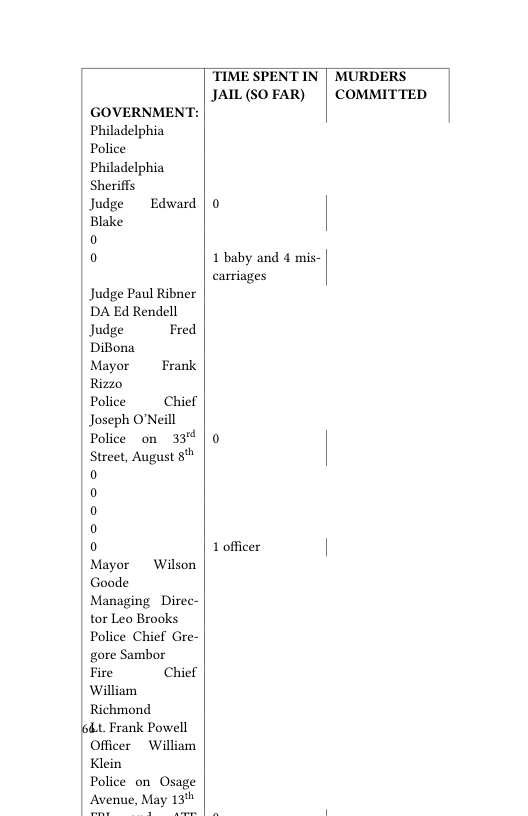
Modern justice in the Birthplace of the Constitution  6
GOVERNMENT: Philadelphia Police Philadelphia Sheriffs  Judge  Edward Blake  0  0  Judge Paul Riber  DA Ed Rendell Judge Fred DiBona  Mayor  Frank Rizzo  Police  Chief Joseph O’Neill Police on 33" Street, August 8™  Mayor  Wilson Goode  Managing Direc- tor Leo Brooks Police Chief Gre- gore Sambor  Fire Chief William Richmond  At Frank Powell Officer  William Klein  Police on Osage Avenue, May 13  TIME SPENT IN JAIL (SO FAR)  1 baby and 4 mis- carriages  1 officer  MURDERS COMMITTED
MOVE: Belief & Practice  The MOVE Organization is a family of strong, serious deeply committed revolutionaries founded by a wise, percep- tive, strategically minded Black man named JOHN AFRICA. The principle of our belief is explained in a collection of writings we call “The Guidelines. authored by JOHN AFRICA. To honor our beloved founder, and acknowledge the wisdom and strength he has given us, we say “LONG LIVE JOHN AFRICA"  Our Religion — life  JOHN AFRICA taught us that Life is the priority. Nothing is more important or as important as Life, the force that keeps us alive. All life conies from one source, from God, Mom Nature, Mama. Each individual life is dependent on every other life, and alllife has a purpose, so allliving things, things that move, are equally important, whether they are human beings, dogs, birds, fish, trees, ants, weeds, rivers, wind or rain. To stay healthy and strong, life must have clean air, clear water, and pure food. If deprived of these things, life will cycle to the next level, or as the system says “die”  NATURAL LAW  We believe in natural law, the government of self. Man-made Taws are not really laws, because they don’t apply equally to ev- eryone and they contain exceptions and loopholes. Man-made  67
laws are constantly being amended or repealed. Natural law stays the same and always has. Man’s laws require police, sher- s, armies, and courts to enforce them, and lawyers to explain them. True law is self explanatory and self enforcing. In the undisturbed jungles, oceans and deserts of the world, there are 1o courtrooms or jails. The animals and plants don’t need them. No living being has to consult a law book to be able to know if they have to cough, sneeze or urinate. Natural law says that when you see something getting too close to your eye, you will blink, whether you are a German shepherd or a Supreme Court Justice.  Self defense  Al living things instinctively defend themselves. This is a God-given right of all lfe. If a man goes into a bears cave, he violates and threatens the bears place of security. The bear will defend his home by instinctively fighting off the man and elimi- nating him. The bear is not wrong, because self defense is right  Right and wrong  The fact that something is legal under the system’s laws, doesn’t make it right. Slavery was legal. Killing Native Ameri- cans and stealing their land was all done legally. JOHN AFRICA taught us that what is right applies equally, across the board. If something is right, it’s right for all of lfe, with no separations  ‘The System We don’t believe in this reform world system — the govern-  ment, the military, industry and big business. They have his- torically abused, raped and bartered Life for the sake of money.  68
‘These rulers and policy-makers don’t care who they kill, en- slave, cripple, poison or disease in their quest for money. They have made material wealth a priority over Life. Marvels of sci- ence and technological so called advancements all stem from the system’s greed for money and disrespect for life. But a per- son who is suffocating or drowning doesn’t call out for dia- monds, gold or wads of money. Each person will do a1 in their power for a breath of air, because is a necessity and money is worthless. Over the last century, industry has raped the earth of countless tons of minerals, bled billions of gallons of oil from the ground, and enslaved millions of people to manufacture cars, trucks, planes and trains that further pollute the air with their use. And because of the billions of dollars in profits to be made, the system will favor artificial transportation over the legs and feet Mama gave us to Walk and run with. Big busi- ness and industry are responsible for the mass production and  mass manufacturing of cigarettes, alcohol, and drugs, which are used to extract further profits from people while keeping them sick and addicted. Politicians are put in place to legalize, endorse and protect industry and big business, therefore we don’t believe in politics at all  MOVE’s Work  MOVE’s work is revolution. JOHN AFRICA’s revolution, a revolution to stop man’s system from imposing on life, to stop industry from poisoning the air, water and soil and to put an end to the enslavement of all life. Our work is to show people how rotten and enslaving this system is and that the system is the cause of homelessness, unemployment, drug addiction, alcoholism, racism, domestic abuse, AIDS, crime, war, all the problems of the world. We are working to demonstrate that people not only can fight this system, they must fight this sys-  6
tem if they ever want to free themselves from endless suffering and oppression.  Being a Revolutionary  Revolution starts with the individual. It starts with a per- son making a personal commitment to do what’s right. You can’t turn someone into a revolutionary by making them chant slogans or wave guns. To understand revolution you must be sound. Revolution is not imposed upon another, it is kindled within them. A person can talk about revolution, but if they are still worshiping money or putting drugs into their bodies, or beating their mate, they obviously haven’t committed them- selves to doing what’s right. Revolution is not a philosophy, it is an activity.  PERSECUTION  We are a deeply religious organization. We know that the current political system resents our clean, righteous example and wants o stop us from exposing their corruption, even if they have to kill us. Just as Jesus was labeled a radical and per- secuted to death by the politicians of his day for what he said, we know how threatening our message is to those in power and why they come down so hard on us. We expect it and we are prepared for it  ‘The Duration of the Struggle  We don’t measure our success with reference to a calendar. As long as we do what’s right, the only way things can turn out is right, regardless of time. We are not anxious or impa- tient and we will not compromise our principles for quick, tem- porary results. We don’t necessarily expect to see a dramatic  70
change in this system in our lifetime or our children’s lifetime. We know that many hundreds of years til degeneration and imposition will take many hundreds of the initial turning of the tide has to start somewhere. JOHN AFRICA began that process through the MOVE Organization. LONG LIVE JOHN AFRICA!  ars to correet, but  LEADERS  Our organization was founded by JOHN AFRICA, however, he is not our leader. JOHN AFRICA has equipped each of us with the wisdom, strength and understanding to lead ourselves. Using the strategy of JOHN AFRICA, we know we can’t fail Everything that happens to us happens a certain way, because its supposed to.  Living As A Revolutionary Family  All committed MOVE members take the last name ‘Africa” out of reverence for out founder JOHN AFRICA, and to show that we are family, a unified body moving in one direction. We have black, White and Puerto Rican members from upper and Tower class backgrounds, both college and street (mis)educated. While we do not need the system’s legal institution of mar- riage, we do adhere to the natural law that requires one male and one female to mate and produce new life. We are monoga- mous. JOHN AFRICA taught us that childbearing is a natural, instinetive function of a mother and requires no drugs or hos- pital stays.  Our Children  We dearly love our children. We protect them and watch over them so they will become healthier and stronger than we  7
ourselves. We are all one family and all the adults help to look after the kids. We don’t punish them through beatings or phys- ical abuse. If they do something wrong, the whole family takes part in giving them direction and showing them what’s right We don’t send them off to school for the system’s brainwash- ing and indoctrination. We stay close to our children and they stay close to us,  Appearance  Our hair is left the way nature intended, uncombed and un- cut. Though we don’t favor using the system’s chemicals, cos- metics, and disposable conveniences, we do spend a good deal of time keeping ourselves and our surroundings clean and tidy. We dress functionally, in clothing that doesn’t interfere with our active lives,  Raw Food and Distortion  ‘The diet JOHN AFRICA gave us consists of fresh raw food. Wealways keep plenty of wholesome raw food on hand and eat whenever our bodies tell us to, not according to artificial meal- time standards. We make sure no one around us goes hungry, because we know that good food is an essential requirement of life. We acknowledge that some of us were raised on the system’s food, or “distortion” as we call it. Doing the work we do can also put us under a lot of pressure when parent and child or husband and wife are separated by the system’s oppression. So it is not uncommon to see some of us eating cooked food on occasion. However, you will never see a committed MOVE: member use drugs, cigarettes or alcohol. The hundreds of miles that the system has placed between us and some of our brothers and sisters in distant prisons has also forced us to use cars to maintain the close contact our family is used to. But we look  72
forward to the day when we can live together the way we want to, without the need for air polluting technology.  Caring for Life  To keep ourselves healthy and strong, we rely on plenty of exercise as well as good hard physical labor. Scrubbing floors sweeping walks and running dogs are daily tasks. Maintaining the hundreds of pounds of food we keep stocked is a big job, too. We have seeds for the birds, nuts for the squirrels, raw meat for the dogs and cats, and fruits and vegetables for the people. We love all lfe. I is tremendously upsetting for us to see someone mistreat an animal and we will take immediate action to stop anyone from beating a dog, throwing stones at birds, or causing similar impositions on innocent life  ‘The Name MOVE  ‘The word MOVE is not an acronym. It means exactly what it says. MOVE, work, generate, be active. Everything that’s alive moves. Ifit didn’t, it would be stagnant, dead. Movement is the principle of life. And because MOVE’s belief is lfe, our founder, JOHIN Africa, gave us the name “MOVE". When we greet other, we say “ON THE MOVE!"  “THE POWER OF TRUTH IS FINAL" — JOHN AFRICA  73


‘The Anarchist Library Anti-Copyright  MOVE 25 Years on the Move May 1996  hitps://archive.org/details/on_the_move_25_1996/  theanarchistlibrary.org

25 Years on the Move

MOVE

May 1996
Contents

JOHN AFRICA’S ORGANIZATION
Community Involvement

Public Appearances and Media Coverage
Frank Rizzo and The Police

Police Brutality

MOVE Baby Murdered

Beating The Courts

‘THE SET-UP

May 20, 1977 Demonstration

Standoff

Murder trial

30 To 100 Year Sentences

Outwitting The Feds

Seeking Justice

Mumia Abu-Jamal — Part 1

Osage Avenue

1

13

15

17

19

21

23

25

33

35

37

39

a1

3
‘The City turns A Deaf Ear
May 13, 1985 Bombing and Fire
Murder in the Alley

Blaming The Victim

Prisons

Coming Home

O1d Faces in New Places
Mumia Abu-Jamal — Part 2
P.CRA. Appeals

Staying On The MOVE

Modern justice in the Birthplace of the Constitution

MOVE: Belief & Practice
Our Religion — life
NATURAL LAW
Self defense
Right and wrong
‘The System
MOVE's Work
Being a Revolutionary
PERSECUTION
‘The Duration of the Struggle
LEADERS
Living As A Revolutionary Family
Our Children
Appearance
Raw Food and Distortion

5

a7

19

51

53

55

57

59

61

63

6

67
67
67
68
68
68
6
70
70
70
7
7
7
72
72
Caring for Life
‘The Name MOVE

73
73
JOHN AFRICA’S
ORGANIZATION

The MOVE Organization surfaced in Philadelphia during
the carly 1970s. Characterized by dreadlock hair, the adopted
surname “Africa” a principled unity, and an uncompromising
commitment to their belief, members practiced the teachings
of MOVE founder JOHN AFRICA.

MOVE'S WORK IS TO STOP INDUSTRY FROM
POISONING THE AIR, THE WATER, THE SOIL,
AND TO PUT AN END TO THE ENSLAVEMENT
OF LIFE — PEOPLE, ANIMALS, ANY FORM
OF LIFE. THE PURPOSE OF JOHN AFRICA'S
REVOLUTION IS TO SHOW PEOPLE HOW COR-
RUPT, ROTTEN, CRIMINALITY ENSLAVING
THIS SYSTEM IS. SHOW PEOPLE THROUGH
JOHN AFRICA'S TEACHING, THE TRUTH,
THAT THIS SYSTEM IS THE CAUSE OP ALL
THEIR PROBLEMS (ALCOHOLISM, DRUG AD-
DICTION, UNEMPLOYMENT, WIFE ABUSE,
CHILD PORNOGRAPHY, EVERY PROBLEM IN
THE WORLD) AND TO SET THE EXAMPLE
OF REVOLUTION FOR PEOPLE TO FOLLOW
WHEN THEY REALIZE HOW THEY'VE BEEN
OPPRESSED, REPRESSED, DUPED, TRICKED
BY THIS SYSTEM, THIS GOVERNMENT AND
SEE THE NEED TO RID THEMSELVES OF THIS
CCANCEROUS SYSTEM AS MOVE DOES.

MOVE

all experience hath shown, that mankind are
more disposed to suffer, while evils are sufferable,
than to right themselves by abolishing the forms to
which they are accustomed But when a long train
of abuses and usurpations, pursuing invariably the
same object, evinces a design to reduce them under
absolute despotism, it is their right, it is their duty,
to throw off such government and to provide new
guards for their future security”

United States Declaration of Independence
Community Involvement

During the early 1970's MOVE was based in the Powrlion
Village section of West Philadelphia. Members valued the per-
sonal discipline and physical strength derived from hard man-
ual labor, and maintained a hefty work schedule of daily activ-
ities such as exercising, scrubbing floors, running dogs, chop-
ping fire wood, shoveling snow, sweeping the street, etc.

Demonstrating their reverence for all forms of life. MOVE
looked after neighbors’ pets, helped homeless people find
places to live, assisted the elderly with home repairs, inter-
vened in violence between local gangs and college fraternities,
and helped incarcerated offenders meet parole requirements
through a rehabilitation program. After adopting MOVE'S way
of natural living, many individuals overcame past problems of
drug addiction, physical disabilities, infertility and alcoholism.

MOVE purchased a large Victorian house at 309 North
33" Street, which became then headquarters. One of MOVES
fundraising activities was a very popular car wash at this
location. At regular study sessions for people interested in
the teachings of JOHN AFRICA, MOVE welcomed dissenting
views as an opportunity to showcase their belief and sharpen
their oratorical skills, which they knew would be tested in
their revolutionary struggle.

“IT1S THE POSITION OF MOVE TO CONFRONT
ANY SPEAKER, SO-CALLED INFORMED PER-
SONALITIES, ALLEGED LEADERS WHO SAY
THEY HAVE ANSWERS TO THE VERY SERIOUS

PROBLEMS OF PEOFE, AND DEMAND THAT

10

THEY SUBSTANTIATE, QUALIFY WHAT THEY
ARE SAYING OR STOP MISLEADING PEOPLE.
INFORMATION IS IN THE ABILITY TO INFORM,
AND WHEN YOU HAVE NO INFORMATION
TO GIVE, YOU CAN ONLY MISINFORM, THIS
1S THE STATED POLICY OF MOVE. TO STAMP
OUT MISINFORMATION. FOR WHEN YOU DO
NOT HAVE A SOLUTION, ALL YOU CAN OFFER
1S THE PROBLEM."

MOVE
Public Appearances and
Media Coverage

MOVE began attending public appearances of such noted
personalities as Jane Florida, Dick Gregory, Alan Watts, Roy
Wilkins, Julian Bond, Richie Havens. Walter Mondale, Buck-
minster Fuller, Maharishi Mahesh Yogi, Caesar Chavez, and
Russel Means. When questions were taken from the audience,
MOVE challenged the speakers. Many were receptive, some
were hostile, but none could refute JOHN AFRICA's wisdom.

To expose injustice, oppression and disrespect for Life,
MOVE used strategized profanity and non violent protest
in demonstrations at zo0os, pet shops, political rallies, public
forums and media offices. By 1974, MOVE was appearing in
public with increasing frequency protesting the abuse of Life
in any form.

IF OUR PROFANITY OFFENDS YOU. LOOK
AROUND YOU AND SEE HOW DESTRUC-
TIVELY SOCIETY IS PROFANING ITSELF. IT IS
THE RAPE OF THE LAND, THE POLLUTION
OF THE ENVIRONMENT, THE BETRAYAL
AND SUFFERING OF THE MASSES BY COR-
RUPT GOVERNMENT THAT IS THE REAL
OBSCENITY.

MOVE

The mainstream media began a long history of inaccu-
rate, distorted and misdirected coverage. MOVE's unique

1
appearance, alarming profanity and unconventional behavior
got prominent attention, but their penetrating analysis and
proposed solutions were largely ignored as were their exten-
sive community assistance efforts. While those who actually
met MOVE members could see their remarkable strength
and health, dehumanizing news accounts perpetuated the
falsehood that members never bathed and were unhealthy.
Protests of unfair coverage by the Black-owned Philadelphia
Tribune were resolved when the editors agreed to run a
column entitled. “ON THE MOVE". Coordinated by JOHN
AFRICA to be written by MOVE members, the feature ran for
about a year, starting in June of 1975

12
Frank Rizzo and The Police

Throughout the 1970k, Frank Rizzo was the premier figure
in Philadelphia government, he started as a street cop and rose
through the ranks, eventually serving as Police Commissioner
from 1967-73. During this time, he gained notoriety for his
“tough-guy” law enforcement tactics and racist attitude. In
Philadelphia’a Black ghettos, Rizzo's predominantly white
police force was resented, feared and hated.

Capitalizing on his name recognition and tough-on-crime
image, Rizzo mobilized sufficient voters to be elected mayor
of the city for two terms from 1972 until 1980, Having built his
career on opposing Black efforts to challenge the status quo, he
ran the city with a prominent and heavy-handed police force
that had a national reputation for brutality.

Philadelphia’s overblown and unrestrained police depart-
ment was a prime example of the type of injustice the system
precipitated, so it was inevitable that MOVE would start to
speak out against them. As with other issues, this was done
using peaceful demonstrations. When MOVE successfully
focused attention on police abuses, many community groups
across the city sought MOVE assistance with similar demon-
strations in their own neighborhoods. As a result of this
activism, the police began a concerted campaign of harass-
ment against MOVE, breaking up demonstrations by arresting
MOVE members on disorderly conduct charges o violations
of whatever local ordinances could be made to apply.

‘The fact that MOVE'S headquarters was located in an area
of real estate speculation on the border of a university campus
brought further legal entanglement. Beginning in 1975, the

13
complaints of some neighboring property owners led to
involvement of the Department of Licenses and Inspections
and ultimately a civil suit by the city against MOVE. On
November 18, Judge, G. Fred DiBona, on of Rizzo's associates,
ruled that city inspectors, with the assistance of the police
could enter MOVE's house to inspect it, but the case dragged
on through numerous continuances and an appeal by MOVE
to the Pennsylvania Supreme Court.

1
Police Brutality

MOVE never let the threat of being taken to jail interfere
with planned demonstrations. Only a pre-selected group,
which excluded pregnant women and breast feeding mothers,
would plan to get arrested if the cops started trouble. Yet
events soon proved that police harassment was not limited to
demonstrations alone.

Late in the evening of May 9. 1974 two pregnant MOVE
women Janet and Leesing Africa were taking a short walk to
the corner store to get something to eat. They were stopped
and questioned by police officers who became abusive and
skimmed Janet stomach-first against a police car. The two
were subjected to very rough handling and jailed overnight
without food or water. Both women lost their babies due to
miscarriages. MOVE immediately began demonstrating at the
18" District police station where the incident occurred.

By 1975, clashes between MOVE and the police readied
increasingly brutal proportions, though the city denied its
role in any abusive handling. Members at demonstrations
were getting beaten bloody on a regular basis, yet MOVE's
deep commitment only led to more determined protests On
April 29. 1975 a MOVE demonstration against ill-treatment
of jailed members at the police administration building led
to several arrests. Alberta Africa, who was pregnant was
dragged from a holding cell, held spread eagle by four officers
and repeatedly kicked in the stomach and vagina by a matron
named Robinson, suffering a miscarriage as a result

Despite police violence against MOVE individuals who had
not even been born many MOVE mothers did bear children,

15
and did so naturally, without drugs or medical assistance, in ac-
cordance with JOHN AFRICA's teachings. Sue Africa, in spite
of several police beatings throughout her pregnancy, had a son,
Tomaso, born at the 33" Street headquarters on August 4, 1975
Janine Afica’s baby Life Africa was born March 8, 1976 but
murdered by police less than a month later. (Tomaso was later
‘murdered by the city May 13, 1985.)

16
MOVE Baby Murdered

In March 28, 1976, seven jailed MOVE members were re-
leased late in the evening and arrived home after midnight Of-
ficers in at least ten police cars and wagons pulled up in front
of the 33" Street house and said MOVE was creating a distur-
bance. When Chuck Africa told police to leave MOVE alone,
Officer Daniel Palermo grabbed him and began to beat him as
other cops pulled out nightsticks and set upon MOVE members
Six MOVE men were arrested and beaten so viciously they suf-
fered fractured skulls, concussions and chipped bones. Robert
Africa was struck over the head with a nightstick that broke
in two from the force or the blow, Janine Africa was trying
to protect her husband Phil Africa, when she was grabbed by
a cop, thrown to the ground with 3-week old Life Africa in
her arms, and stomped until she was nearly unconscious. The
baby’s skull was crushed.

‘The next morning, MOVE notified the media that the police
had brutally attacked them and that a baby had been raped. An
officer’s bat and the broken nightstick were displayed outside
MOVE headquarters. Police denied that any beating took place
or that a baby was killed, and claimed that the baby probably
never existed because there was no birth certificate. They then
arrested the member who had shown the bat and nightstick
to the press, on charges of receiving stolen property. To prove
the death to a skeptical media, MOVE invited the press and lo-
cal politicians to dinner at their headquarters. Those accepting
the invitation included city councilmen Joseph Coleman and
Lucien Blackwell, and Blackwell’s wife, Janine. After the meal,

17
the guests were shown the baby’s body. (Janine Blackwell her-
self was later elected to city council in 1991)

MOVE's column in the Philadelphia Tribune which had
documented the birth of Life Africa 3 weeks earlier, in a series
of pieces covering the March 28" attack. Interviews with sev-
eral neighbors who had witnessed the incident were featured.
Yet no charges were filed against the officers involved in the
baby's murder. Instead the District Attorney’s office pursued
prosecution of the six MOVE members arrested that night
MOVE was prepared to present evidence of a long-standing
Rizzo-directed campaign of harassment that culminated in
the death of Life Africa. But before all the testimony could
be presented, Judge Merna Marshall dismissed the case,
thereby thwarting the chance to prove a citywide conspiracy
against MOVE in a court of law. Dismissing felony charges
of aggravated assault on cops was virtually unheard of in
Philadelphia

18
Beating The Courts

By confronting the judicial system as an organized, coordi-
nated group not afraid to o to jail, MOVE was able to run
circles around the procedures and expose the fallacy of jus-
tice. Ignoring the status and elevation of judges, MOVE re-
‘mained seated when the order “All rise!” was given, and never
addressed the judge as “your honor” They also rejected plea
bargain offers and public defenders.

In the early years defendants who were released on bail and
given a court date would often send a brother or sister mem-
ber to the trial if they couldn’t make it themselves. Most judges
at that time couldn't tell MOVE members apart and sentenced
the apparent “defendant” who would be taken into custody and
held for the duration. The original defendant, often arrested
again before his or her sentence expired, would just give po-
lice the name of another member, leading the system into ever
deepening confusion over who was who.

During a trial, MOVE attacked the legitimacy of the court,
demonstrating contradictions in such concepts as the pre-
sumption of innocence, freedom of religion and the right to
free speech. When defendants refused to blindly submit to
a judge’s arbitrary dictates, they were either ejected from
the room, bound and gagged, or cited for contempt. MOVE
spectators were often cited for contempt, too. Sheriffs proved
to he just as brutal as the city’s cops, at times beating MOVE
members in the very presence of judges. All these incidents
only generated more cases, and as time went on, MOVE'S prac-
tice of appealing at every opportunity further compounded an
already overwhelming caseload.

19
By 1976 literally hundreds of MOVE cases were clogging
Philadelphia’s justice system. Court administrators realized
that in a typical MOVE case the city was spending thousands
of dollars to prosecute what had often started out as a trivial
trumped up misdemeanor charge. To save money, the courts
began to dismiss MOVE cases in wholesale lots.

During the summer of 1976, MOVE began concentrating on
setting up chapters in other states and refrained from further
demonstrations. To provide a healthy environment for the chil-
dren, MOVE secured a mortgage on a 96-acte farm in Virginia
Meanwhile, Frank Rizzo resented a group of self-proclaimed
revolutionaries wreaking havoc in the courts and exposing his
brutal police department. And with no more demonstrations,
there were none of the usual opportunities to harass and ar-
rest MOVE.

2
THE SET-UP

On November 5, 1976 a hearing was held before judge
Edward Blake regarding several different MOVE cases. Some
20 MOVE defendants, all out on bail, appeared in court. Many
were given sentences and despite their intention to appeal,
Blake ordered them taken into custody. On the way to a
holding cell, sheriff Jerry Saunders began beating one hand
cuffed young MOVE member, Dennis Africa, and a brief scuf-
fle ensued. Sheriffs looked up all those who came in Dennis’
defense, then also arrested and brutalized Robert, Valerie and
Rhonda Africa who had played no part in the altercation.
Nearly 9 months pregnant, Rhonda went into premature labor,
giving birth 1o a bruised and injured baby that died within
‘minutes.

Charges of assault and resisting arrest against those in-
volved were later dismissed except for Robert. Conrad and
Jerry Africa, who were given bail. The case marked a new era
in the conflict between MOVE and the courts. After hundreds
of cases and years of hearings, MOVE had accumulated a
thorough knowledge of what could typically be expected from
the courts at every stage of the process. The courts, in turn,
had settled into a grudging tolerance of MOVE's behavior
such as the refusal to stand when a judge entered the room.
At a pre-trial hearing on February 7, 1977, judge Paul Ribner
ordered sheriffs to force Robert to stand as the judge came
in. Ribner then issued bench warrants for Jerry and Conrad
despite Robert's explanation that they were out of town that
day, and would be present at the next listed hearing, Offers
around MOVE headquarters, who normally would not have

21
immediate knowledge of bench warrants due to the usual bu-
reaucratic delays began taunting MOVE and talked of forcibly
entering the house with the warrants as legal justification.

Asthe ease continued, MOVE could see that Ribner's odd de-
mands and threats and the unusually large number of armed
police and sheriff's present in the courtroom created a situa-
tion in which a physical courtroom confrontation could result
in some “accidental” MOVE injuries or deaths. After the defen-
dants refused to participate further, Ribner tried them in absen-
tia and instead of the usual county jail time, gave them longer
slate prison sentences. They were soon shipped off to Grater-
ford prison, about 30 miles outside of Philadelphia. MOVE was
outraged at sucha blatant set-up and railroading of Robert Con-
rad and Jerry who were now political prisoners.

2
May 20, 1977 Demonstration

In tale April of 1977, MOVE set up a sister organization
called the “Seed of Wisdom” in Richmond. Virginia. In less
than a week Virginia police provoked a minor confrontation
by surrounding the house and attempting to take custody of
the children. Meanwhile, MOVE foresaw the possibility that
Philadelphia police could storm their 33 Street headquarters,
Kill those inside, and blame the victims for their own deaths in
an operation similar to the type of government terrorism used
against the Black Panthers. Information from sympathetic
sources in city government confirmed that plans for some type
of police operation had indeed been made. To safeguard the
Philadelphia base, MOVE staged a major demonstration May
20,1977 on a platform outside their house. They demanded the
release of their political prisoners and an end to the violent
harassment by the city. To keep an increasingly brutal police
force at bay, some members held firearms. Police used to
hold back a crowd of on-lookers, but the growing numbers of
people soon broke through police lines and swarmed around
the platform to hear MOVE speak.

E TOLD THE COPS THERE WASN'T GONNA
BE ANY MORE UNDERCOVER DEATHS. THIS
TIME THEY BETTER BE PREPARED TO MUR-
DER US IN FULL PUBLIC VIEW, CAUSE IF
THEY CAME AT US WITH FISTS, WE WERE
GONNA COME BACK WITH FISTS. IF THEY
CAME WITH CLUBS, WE'D COME BACK WITH
CLUBS, AND IF THEY CAME WITH GUNS,

2
WED USE GUNS TOO. WE DON'T BELIEVE
IN DEATH-DEALING GUNS, WE BELIEVE IN
LIFE. BUT WE KNOW THE COPS WOULDN'T
BE SO QUICK TO ATTACK US IF THEY HAD TO
FACE THE SAME STUFF THEY DISHED OUT
SO CASUALLY ON UNARMED DEFENSELESS
FOLK”

MOVE

Aware that the Third Amendment guarantees the right to
bear arms on one’s own property, Police Commissioner Joseph
ONeill told reporters, “Under the constitution you have a right
to speak your mind and apparently that's what they re doing.
Yet four days later, the city sidestepped the lack of firearms vio-
Iations by having Judge Lynne Abraham issue warrants for 11
MOVE members on riot charges and “possession of an instru-
ment of crime” The media unfairly depicted MOVE as illegal
gun-toting bandits

2
Standoff

Police set up a 24-hour watch around MOVE's headquarters
to arrest members when they came off the property. On June
12, 1977 Sue Africa left the premises and was apprehended a
few blocks away. The other members remained at the house as
‘months passed and police continued to watch and wait.

MOVE had filed a $26 million civil suit against the city for
the March 28, 1976 death of Life Africa and the brutality lead-
ing to miscarriages from 1974-76, but the standoff prevented
MOVE plaintiffs from attending the hearing and the suit was
thrown out of court. While the standoff continued, some
Philadelphia politicians and reporters went to the Virginia
area, where MOVE's farm was located, and spread slanderous
misinformation among people on adjoining properties by
describing MOVE as a group of drug-taking cannibals who
would slaughter everyone’s livestock. The rumors set off a
rash of complaints to the Realtor who demanded that MOVE
pay off the entire mortgage at once. Unable to raise the full
sum, MOVE lost their farm.

Rule 1100 of Pennsylvania Criminal Procedures sets a time
limit of 180 days within which to either execute an arrest war-
rant or file for an extension. On November 20%, the deadline on
the MOVE warrants passed. The next day the DA's office filed
a late request for an extension. (They may have forgotten to
file on time or were just accustomed to bending the laws when
prosecuting MOVE) Judge Edward Blake granted the untimely
extension. (Blake became the Common Pleas Court President
Judge in 1991)

2
Throughout the standoff, mediators and negotiators from a
‘number of community coalitions and intervention agencies re-
layed messages between the city and MOVE in an attempt to
come to a peaceful settlement. But talks always broke down
over the issue of releasing MOVE political prisoners. MOVE
would not compromise. Their demand for Robert, Conrad, Jerry
and Sue's freedom was absolutely non negotiable. Mediation
went nowhere as city personnel were telling MOVE, off the
record, “We'll kill all of you before we let your people out of
jail. A federal agent who had begun lurking around the bar-
ricades likewise informed MOVE that the Feds were going to
infiltrate, disband and destroy them.

To force the warned MOVE members from the house, Rizzo
got court approval to starve them out. On March 16, 1970 an
army of hundreds of cops invaded the neighborhood and sealed
off a four block area. While sharpshooter posts and machine
gun nests were set up, workmen shut off the water to MOVE's
headquarters. Those inside included pregnant women, nursing
babies, children and animals. Rizzo boasted that the perimeter
was so tight “a fly couldn't get through” When various commu-
nity members, who opposed Rizzo's cruel tactic, made human-
itarian attempts to rush the barricades with food and water for
MOVE, they were arrested and beaten by the police.

With loudspeakers and amplification, members exposed the
folly of the city's action in sending thousands of dollars a day
on police overtime just to stand around and watch MOVE. As
police in stake-out posts at surrounding rooftops, apartments,
and parked patrol cars were treated to a steady stream of revo-
lutionary commentary, supervisors instructed their men not to
listen to any thing MOVE said, after too many officers began
to seriously consider what they heard.

There was a great deal of discussion in police ranks regard-
ing the handling of MOVE. Some cops had taken to tossing
bottles, rocks and firecrackers into MOVE's yard, hoping to
provoke a confrontation. But it only resulted in a police fist-

2
fight wherein two officers got i a seuffle with a third one who
had been throwing rocks at MOVE babies.

Rizz0's attempt to starve MOVE out continued for almost
two months, capping off nearly a year of continuous 24-hour
police surveillance that had begun on May 20, 1977. Traffic had
been detoured, neighbors had to show identification going to
and from their own homes, and reporters noted that city spend-
ing for police overtime had passed the million dollar mark. On
April 4, 1978 thousands marched around city hall in a massive
demonstration protesting the city's barbaric action. As the ab-
surdity of Rizzo's police siege became internationally known.
Philadelphia became an embarrassment to the human rights
initiatives of President Jimmy Carter and United Nations Am-
bassador Andrew Young,

Under federal pressure to end the stalemate, city officials
pushed for a negotiated settlement, but with MOVE standing
firm in their demands, the city had no real leverage. For Rizzo
it became a matter of making the necessary concessions, but
doing it in such a way that his tough-guy “law and order” im-
age remained intact. The city announced terms of a settlement
in May of 1978, though final clarification was still going on be-
hind the scenes. To save face, the city had made certain oral
promises that were not spelled out on paper so as to cover
up the fact that court procedures would be bypassed to spring
MOVE's political prisoners.

MOVE was wary of making deals with a government that
had historically broken every treaty ever made with Native
Americans, but the final terms of the agreement gave them
what they wanted, so any broken promises would only further
expose the system’s deception and lack of good faith. Imple-
‘mentation of the agreement began on May 3". Escorted by
civilian observers, the police took MOVE members, one at a
time, to the police administration building where they were
arraigned and released on their own recognizance. The barri-
cades and roadblocks surrounding the area were pulled open.

27
To the chagrin of anxious ATP agents police and DA person-
nel, all the MOVE “guns” and “explosives” cops had spotted
at one time or another were revealed to be inoperable dummy
firearms or road flares disguised as dynamite. A search of the
house with metal detectors found nothing incriminating. On
May 8%, Jerry, Conrad, Robert and Sue Alrica were released.
‘The DA's office, headed by Ed Rendell, agreed to dispose of
Al pending MOVE cases within 4-6 weeks and thereby purge
MOVE from the court system. In order to prevent the start of
another quagmire of contempt charges, the city arranged that
attorney Oscar Gaskins would handle all remaining legal pro-
ceedings and members themselves would not make any court
appearances. The agreement also provided that during a 90-day
period. the city would assist MOVE in finding another Location
in which to reside.

MOVE's victory was impressive. The confrontation initiated
on May 20, 1977 had succeeded. without bloodshed. in frecing
their political prisoners and forcing Rizz0's cops to back down.
It also provided a powerful example of a fully dedicated and
committed group of people fighting the system and winning,

Rendell's promise to dispose of all pending MOVE cases was
ablatant lie. The 90-day time period, which bad been deseribed
to MOVE as a working timetable, was misrepresented to the
‘media as an absolute deadline. The promise to assist MOVE in
findings new place to live was never completed, and the city
began demanding that the house had to he razed.

Judge Fred DiBona, who only had jurisdiction in the civil
suit still pending from three years earlier suddenly began is-
suing orders to MOVE regarding the criminal case that were
never a part of the agreement MOVE had found DiBona to be
particularly arrogant in the past, and as his conflicting direc-
tives and unagreed-to demands became intolerable, Phil and
Sue Affica attempted to resolve the problem by going to see
the judge on May 23%. Although it was not a legal court hear-
ing but an informal meeting in the judge’s chambers. DiBona

28
wound up citing Phil for contempt and revoking his bl status
previously set by the terms of the agreement. Before long the
city was funneling the entire MOVE dispute through Diona’s
courtroom, bypassing other judges not as closely aligned with
Rizzo

At a hearing on August 2, 1978, DiBona ruled that MOVE,
had violated the 90 day ‘deadline’ and should have vacated the
house. Police surveillance officers could testify to only actually
secing three members present at the house that morning, but
the city was so bent on hunting down and framing MOVE mem-
bers that by the time the hearing was over, DiBona had sen-
tenced attorney Osear Gaskins for contempt and signed bench
warrants authorizing police to arrest practically every known
MOVE adult, including Robert, Conrad, Jerry and Sue Afica
‘These four and most other members were not in the house and
couldn’t possibly have violated an order to vacate it

On August 5%, Philadelphia authorities, in collaboration
with Virginia police staged a midnight raid on the Richmond
home of two MOVE women and 14 children. Storming in at
gunpoint, they arrested Gail and Rhonda Africa. The legal
justification for these arrests was Gail and Rhonda’s alleged
failure to leave a house they weren't within @ hundred miles
of.

By August of 1978 the government had: 1} Searched MOVE's
house to insure the absence of weapons and explosives. 2) Con-
tinued to keep the house under surveillance after the search, 3)
Manufactured the appearance of a legal basis to arrest MOVE,
and 4) Kept legal impropricties out of media coverage while
making MOVE out to be the villains with a 90-day deadline
myth. Rizzo was now in a position o use his favorite solution
to civie conflicts: Brute force and lots of it

On Tuesday, August 8", hundreds of cops in flak jackets

3 Street location at dawn

and riot helmets surrounded the 3
and ordered MOVE to surrender. Police then rolled in specially

‘madified construction vehicles and tore down the fence and

2
smashed out the windows. Just before 7:00 am, MOVE was no-
tified by bullhorn “Uniformed officers will enter your house
for the purpose of taking each of you into custody. Any resis-
tance or use of force will be met with force” In the next hour a
total of 45 armed police entered and slowly searched the three
story house only to find that MOVE was barricaded in the base-
ment. Around 8:00 am, firemen pried off the boarded up base-
ment windows and turned on water cannons. MOVE adults
were soon wading in rising water with children in their arms
in danger of drowning. Suddenly, gunshots rung out and po-
lice throughout the area opened fire. In the short period of sus-
tained gunfire, Officer James Ramp was fatally wounded. Three
other policemen and several firemen were also hit. (The min-
utes of a police stall meeting two days later noted one captain’s
opinion of “an excessive amount of unnecessary firing on the
part of police personnel when them were no targets per se to
shoot at” One of the stake-out officers later admitted under
oath that lie had emptied his carbine into the very basement
from which he heard sereaming women and crying children.)
After the gunshots subsided and tear gas was fired in, MOVE
adults began carrying children out of the basement and were
immediately arrested by angry cops.

Later in the day, the large crowds that had gathered in the
area were chased down and broken up by police on horseback
Many people were knocked to the ground and brutally beaten.
Others were chased into their very homes and assaulted by po-
Tice.

As police grabbed the twelve adults and eleven children
coming out of the basement, MOVE mothers had limit babies
snatched from their arms before being handeuffed and taken
away. Al the adults were mistreated and beaten by arresting
officers eager to vent then rage. One such arrest was captured
on him unbeknownst to officers Joseph Zagame, Charles
Geist, Terrance Mulvihill and Lawrence D'Ulisse. As Delbert
Africa emerged from a basement window empty-handed

30
with outstretched arms (see back cover), Zagame, without
provocation, smashed him in the face with a police helmet as
D'Ulisse connected with a blow from the butt of a shotgun.
Knocked to the ground, Delbert was then dragged by his
hair across the street where the other officers set upon him,
savagely kicking him in the head kidneys and groin.

Initial denials of police brutality became difficult to main-
tain after video tapes of the beating were broadcast. Only af-
ter the resulting public outery arose did the DA's office take
any action. A special grand jury was impaneled which even-
tually handed down indictments. Not until a few years later
were Zagame, Geist and Mulvihill brought to trial on assault
charges. On February 3, 1981 just before the jury was to start
deliberating, Judge Stanley Kubacki made a surprising depar-
ture from normal procedures and ordered the jury dismissed
and the officers acquitted, despite irrefutable photographic ev-
idence that they had indeed beaten Delbert. Ed Rendell’s of-
fice never brought charges against Officer D'Ulisse. Though his
identity and participation in the brutality were well known and
documented.

Three months alter the

quittal, Geist's wife, Carolyn, who
was also a police officer, shot him during a domestic dispute,
he went into a coma and died 8 months later. It was revealed
that site had been battered by her abusive husband on many oc-
casions but the police supervisors she had pleaded to for help
had urged her to keep quiet so as not to expose his sadistic
tendencies while be was on trial for beating Delbert. (Zagame,
D'Ulisse, and Mulvihill all took part in the 1985 MOVE con-
frontation, each carrying an automatic weapon and firing it
during the course of the day. Mulvihill committed suicide in
May of 1989)

Immediately following the August 8* assault, the standard
police version of events was that MOVE fired the first shot. Yet
the limited number of civilian eyewitnesses, mostly reporters,
who had been allowed past police barricades had different ac-

31
counts. Radio reporters Richard Maloney and Larry Rosen both
recalled hearing the first shot come form a house diagonally
across the street where they saw an arm holding a pistol out of
asecond floor window.

Although destroying the evidence of a crime is llegal, police
sent in bulldozers and had the area leveled by noun, destroying
the house, the foundations, and the trees in the yard. No efforts
were made to preserve the crime scene, inscribe chalk marks
or measure ballistic angles

With his typical showmanship and bravado, Rizzo held an
afternoon city hall press conference around a prominently dis-
played table of weapons said to have been removed from the
now demolished house. As to whether or not this was the last
Philadelphia would see of MOVE, Rizzo stated, “The only way
we're going to end them is — get that death penalty back in,
put them in the electric chair and I'll pull the switch” (Before
the year's end, Pennsylvania did reinstate the death penalty,
but not retroactively)

Prior to August 8% at the request of attorney Oscar Gask-
ins, Judge Calvin Wilson had issued a temporary restraining
order in prevent the house from being demolished, but City
Solicitor Sheldon Albert had ignored it. At a preliminary hear-
ing on a motion, to dismiss based cm destruction of evidence,
MOVE argued dial the destruction of the house prevented them
from proving that it was impossible for any MOVE member to
have shot Officer Ramp. The Illinois case of Black Panthers Fred
Hampton and Mark Clark was cited, where the preservation of
the crime scene enabled investigators to prove that all the bul-
Tet holes in the walls and doors were the result of police gunfire.
Judge Merna Marshal denied MOVE's petition and held them
over for trial. (Her health failing, Marshal was unable to pre-
side to the end of the hearing and died of leukemia December
30,1979

32
Murder trial

With nine co-defendants all representing themselves, nine
court appointed back-up attorneys, plenty of press, and an au-
dience of MOVE supporters. the extensive hearings on pre-trial
‘motions became long, drawn out affairs with the atmosphere
ofa cireus. MOVE'S sharp wit and grueling cross-examinations
exhausted the patience of several judges who would resort to
having members thrown out of court. As a condition of re-
admittance, the judge would demand a yes or no answer to the
question, “Do you promise to behave if L allow you to return?"
Invariably, the reply was, “I will do what's right”.

‘The trial by Judge Edwin Malmed, which became the longest
and costliest in Philadelphia history, did not get started until
December of 1979. Among the initial prosecution witnesses
was Chief Inspector George Fencl, head of the civil affairs unit
who, along with Rizzo, was one of the mam orchestrators of
the plot to eliminate the MOVE Organization. At past trials
and hearings, the courts had often thwarted MOVE's attempts
to get high ranking co-conspirators put on the witness stand.
Seizing the opportunity, MOVE proceeded to grill Fencl
with a vengeance. After four solid days of turbulent cross-
examination. Judge Malmed finally cut off the questioning and
excused the exhausted witness. The following day, Tuesday
January 1b, 1950, the courts were closed fora holiday.

On Wednesday MOVE came to the trial enraged, the day be-
fore, police had retaliated by staging another raid in Richmond
Virginia where two MOVE women and many children were
living including several whose parents were August 8 defen-
dants. MOVE demanded the trial be recessed until they could

33
ascertain tin whereabouts and welfare of their sons and daugh-
ters. Malmed refused. Some of the more vehement defendants
were thrown out as the judge attempted to proceed against the
repeated objections of concerned parents. Over the next two
days, hostilities continued until finally Malmed had all the de-
fendants removed from the courtroom. He then ordered the
back-up attorneys to takeover the case despite MOVE's insis-
tence that no attorneys were to represent them even in their
absence. None of the defendants were allowed to attend the
remaining 47 days of their own trial.

31
30 To 100 Year Sentences

On May 8, 1980, after 67 days of trial. Judge Malmed pro-
nounced Janine, Debbie, Janet, Merle, Delbert. Mike, Edward
Phil and Chuck Africa guilty of third degree murder, conspir-
acy, and multiple counts of attempted murder and aggravated
assault. Each defendant was given a sentence of 30 to 100 years

Several days after the verdict. Malmed was a guest on a lo-
cal talk radio show, journalist Mumia Abu-Jamal cutted in and
asked the judge, “Who shot James Ramp?” Maimed replied, ‘I
haven't the faintest idea” and went on to say that since MOVE
members wanted to be tried as a family, he convicted them as
a family. Three other adults had also been in the house on Au-
gust 8%, yet two were never convicted and Consuewella Dot-
son, who refused to disavow MOVE, was later sentenced in
a separate trial to 10-20 years by Judge Levy Anderson who
added on another three and a half years for contempt. The nine
defendants protested that they were convicted only because of
their unwavering allegiance to MOVE rather than for any com-
plicity in the death of a policeman.

The legal grounds for Rizzo's military operation were 21
bench warrants signed the week before August 8% Judge
DiBona issued these warrants because MOVE members had
failed to appear in court at the August 2 hearing where he
ruled they had violated a 90 day ‘deadline’ to vacate the house.
On January 31, 1980 judge DiBona died, yet his warrants were
not withdrawn. Only 9 MOVE members had been arrested
on August 8% The other 12 warrants remained outstanding,
although: 1) MOVE had never agreed loan absolute 90-day
deadline, 2) Judge DiBona never had jurisdiction on the

35
criminal matter, 3) The terms of the agreement stated attorney
Osear Gaskins would represent MOVE and no members
would be required to attend any hearings, 4) By August 8",
any member who wasn't arrested obviously had vacated the
house, and 5) After August 8 the house no longer existed.
Such technicalities were no obstacle to the District Attorney’s
version of due process. On the basis of a dead judge’s bench
warrants, Ed Rendell's office fabricated criminal fugitive
warrants, and the campaign to hunt down and destroy MOVE.
continued.

36
Outwitting The Feds

During the standoff in the summer of 1977, federal AIF
agents had gotten Donald Glassey, a former MOVE associate,
to implicate the organisation in a bomb making and gun
running scheme. But when 10 indictments were handed down
on September 1, 1977, only two actual MOVE members were
named: Vincent and Alfonso Africa. It took federal agents over
three years to find them. Meanwhile, Glassey was put in the
federal witness protection program.

On May 13, 1981, the Feds arrested nine MOVE members
in Rodiesieiy, New York. Vincent and Alfonso were extradited
to Philadelphia for a trial on the bomb making and weapons.
barges. New York state judge Andrew Celli warned Pennsyl
nia officials he might release the others based on their argu-
ments that the fugitive warrants for them were illegal. Fearful
of losing their quarry, Rendell’s office then came up with ex-
tradition warrants signed by Governor Dick Thornburgh, and
MOVE members were taken back to Philadelphia.

At legal proceedings, Sue, Carlos, Alberta, Dennis, Conrad,
Raymond and Jerry Africa, the lack of validity of the original
warrants was repeatedly disregarded. In Alberta’s case, judge
Kendall Shoyer ordered her bound and gagged to keep her from
raising the issue

InJuly of 1981, Vincent Africa, also known as JOHN AFRICA
and Alfonso Africa conducted their own defense in a trial at the
federal courthouse in Philadelphia. The case was called “JOHN
AFRICA vs. THE SYSTEM”. Unconcerned about the lies and dis-
tortions of the prosecutor’s witnesses, Vincent slept through
much of the case as cops, ATF agents, explosives experts and

37
former MOVE associates testified. In an impassioned closing
argument, his only formal remarks to the court, Vincent made
no direct rebuttal to the governments evidence and testimony,
but instead condemned the entire reformed world system and
exposed the courts as mere tools of the industry that profits
from poisoning the air, water and food necessary for all Life.
‘The government was stunned when the jury declared Vincent
and Alfonso innocent on all charges.

38
Seeking Justice

After the August 8% confrontation, MOVE's primary activ-
ity became securing the release of innocent members facing
not only 30-100 years in prison, but the wrath of a vindictive
prison system and its abusive guards. Several members went on
hunger strikes to obtain the basic rights other inmates received.
Both the police department’s callous attitude and MOVE'S de-
termination and commitment only intensified after Rizzo's Jan-
uary 1980 departure from ofice.

In January 19 79, and again in 1980, MOVE held large out-
door rallies on the anniversary of August 8" to draw atten-
tion to the injustices the city continued to perpetrate MOVE
also published their own newspaper. the First Day, to correct
widespread misconceptions.

According to MOVE belief, one cannot expect to receive jus-
tice from a system that has none and continues to demonstrate
its blatant lack of justice time and time again. Nevertheless,
MOVE diligently appealed the August 8 convictions so as
not to be accused of abandoning the prescribed grievance pro-
cedures before taking a confrontational stance. Higher courts
denied all these appeals.

MOVE then sought to meet with any city officials who
would hear out their complaint against the legal system. Com-
mon Pleas Court President judge Edward Bradley admitted
there were inconsistencies in the August 8" convictions but
declined to take any action. District Attorney Ed Rendell
outright refused to meet with MOVE or with lawyers willing
to discuss the case on MOVE's behalf. Councilman Lucien

39
Blackwell and city council chairman Joseph Coleman were
non-committal.

Beginning in 1982, MOVE met several times with city
managing director Wilson Goode who entered and won
the mayoral election during 1983. After reviewing MOVE'S
claims, Goode agreed that MOVE had been denied justice and
promised to remedy the situation, but not until ater he took
office as mayor. Such words and promises from a politician
meant nothing to MOVE. Based on his actions and deeds,
Goode had turned his hack on the injustice.

10
Mumia Abu-Jamal — Part 1

One of the few media people to accurately report on MOVE
and make a serious effort to understand the organization was
Mumia Abu-Jamat, a highly regarded Philadelphia journalist
and president of the local chapter of the Association of Black
journalists. Throughout the 1978 confrontation and resulting
trials, his in- depth MOVE coverage often left him at odds with
his employers. Rather than compromise his integrity as a jour-
nalist, he began free-lance reporting while driving a cab at
night to support his family. On December 9%, 1981 around 4:00
am, Mumia was driving through downtown Philadelphia when
he came upon William Cook, his own brother, whose car had
been stopped by a police officer. What happened in the next
few minutes has become obscured by conflicting testimony, al-
tered or missing evidence, and misleading inflammatory public-
ity. By the time back-up police arrived on the scene, gunshots
had been fired, Mumia was badly wounded, and Officer Daniel
Faulkner was dead. During his arrest and subsequent hospital-
ization, Mumia was abused and beaten by police, His brother
was charged with aggravated assault, though later testimony
and evidence indicated the officer had beat William over she
head with a flashlight hand enough to draw blood.

Charged with first degree murder, Mumia maintained his
innocence and, like MOVE members in trials he had reported
on, exercised his constitutional right to argue his own case.
‘The high publicity trial was presided over by Judge Albert
Sabo who quickly denied Mumia’s request to be represented
by JOHN AFRICA. During jury selection. Mumia put his well
honed interviewing skills to use. As his impressive dignity

a1
and eloquence became apparent to prospective jurors, Sabo
stripped Mumia of his right to conduct the defense and
ordered the court appointed attorney, Anthony Jackson to
take over the case. Mumia then refused to participate in a
blatant railroading and his version of the crime scene events
was never recounted.

Some eyewitnesses saw a man running from the scene who
was never identified by police. Others gave descriptions of the
gunman that did not match Mumia appearance. The political
nature of the case became apparent when prosecutor Joseph
McGill argued that Mumia deserved the death penalty because
of slate merits he made over 12 years earlier as a Black Panther
spokesman. The jury, from which over ten Blacks were system-
atically excluded and on which two Blacks remained, returned
averdict of guilty and a sentence of death.

12
Osage Avenue

MOVE operates on the principle that hard work pays off in
good health. Long hours of legal and political work did not
prevent members from keeping to their normal day to day ac-
tivities which included a special dedication to relieving the suf-
fering of animals. MOVE put out hundreds of pounds of food
for birds, dogs, squirrels, and fish on a daily basis.

“MOVE'S AIM IS NOT TO MAKE ENEMIES BUT
MOVE'S AIM IS EQUALLY MOT TO COMPRO-
MISE LIFE BECAUSE WE ARE COM PEI LED
TO PROTECT LIFE, DOGS CATS RATS FISH
DIRT GRASS TREES BIRDS BEETLES WORMS
ARE ALL LIFE. FEEDING LIFE, PROTECTING
LIFE, KEEPING THE STREETS, THE EMPTY
LOTS, THE PARKS FREE OF SHARP OBJECTS
THAT WILL HURT ANIMALS AND PEOPLE
1S AS MUCH AN OBLIGATION TO JOHN
AFRICA'S REVOLUTION AS FIGHTING THESE
POLITICIANS”

MOVE

During the early 1980 several MOVE members and many
children lived in a row house at 6221 Osage Avenue on the
western edge of the city. Baskets of fresh fruit and vegetables
were put outside to encourage passing children and adults to
eat strong food rather than junk food. MOVE also built stoves
and supplied firewood to people without heat, checked on the
elderly living alone and built dog houses for pet owners who

13
Kept their dogs outside in the winter. In warmer months one of
MOVES fundraising activities was a thriving watermelon busi-
ness. The fruits were transported on large hand-made wooden
carts that provided a hearty workout as members pulled them
through the streets. MOVE let customers sample each water-
‘melon before buying and always replaced any that were unsat-
isfactory.

Long hours of hard work kept MOVE always on the move,
and maintained the strong family bond the organization
revered. Yet one of the most troubling of deals during the
years on Osage Avenue was the task of comforting and
reassuring the children of imprisoned members, when the
pain of separation from their parents left them grief-stricken
and erying

a1
The City turns A Deaf Ear

By the end of 1981, government officials on all levels had
proved ineflective and unwilling to take any action against the
unjust imprisonment of innocent MOVE members. The media
ignored the issue altogether. On December 25, 1983 MOVE by~
passed the news blackout in a direct appeal to the public by us-
ing loudspeakers on their house to inform people of the injus-
tices and the city’s conspiracy against them. When some Osage
Avenue residents complained about the noise, MOVE told them
they should put pressure on the city to do something about the
innocent people in jail, because allowing such an injustice to
go unchallenged meant anyone, including the neighbors them-
selves, could be set-up, framed and locked away. The neighbors
instead put their trust in the government and sought a way to
get MOVE out of the neighborhood.

A few weeks later Wilson Goode took over as mayor. While
many Philadelphians were glowing with pride at the install-
ment of the city's first Black mayor, behind the scenes Goode
reneged on his earlier promise to MOVE and took no action
as another confrontation took shape. Anticipating how far the
city would go to silence them, MOVE began fortifying their Os-
age Avenue home. Meanwhile the police made preparations for
a murderous assailant by secretly obtaining from the FBI over
17 pounds of the powerful military explosive “C4 in violation
of police regulations, FBI policies, and federal laws regarding
the transfer of explosives.

As months wore on, news stories began covering MOVE
once again but focused on the Osage Avenue neighbors’
disagreements with MOVE rather than MOVE's long standing

5
legal dispute in the city. After MOVE held a meeting with
Osage residents in May of 1984 to explain their position,
police stepped up their intimidation and harassment campaign
Between June and October, Alfonso Africa was arrested and
beaten bloody several times by police, and shot (non fatally)
during one arrest. On August 8, 1984, hundreds of police and
firemen spent the day surrounding the Osage block in what
came to be viewed as a dry run for the later disaster, but
MOVE would not be provoked. Frustrated with city officials
inability to resolve the conflict, the Osage neighbors asked
Governor Dick Thornburgh to intervene but he refused to
get involved. (And when he later headed the US. Justice
Department, Thornburgh declined to investigate the very May
13 1985 catastrophe he could have averted)

6
May 13, 1985 Bombing and
Fire

MOVE told negotiators attempting to avert a risis at the last
in mine that if the city could refute any claim regarding past
improper legal procedures, and if any one official would initiate
an honest investigation o the 1978 incident, MOVE would call
off the confrontation. Officials and the media ignored this.

On May 8%, Alfonso Affica was sentenced to 5 years for ill
re ate rung an officer during a prior arrest. On May 11%, police
obtained tin arrest warrant for Alfonso (even though lic was
already in jail) and used it two days later to justify a tear gas
assault on Alfonso’s home tn Chester Pennsylvania. The only
adult present, his wife Mary, was arrested and their 5 children
were taken away as police ransacked the house.

To provide a legal basis for the Osage Avenue at tack, Judge
Lynne Abraham signed arrest warrants on May 11" for Ra-
mona, Conrad, Frank and Teresa Africa on charges of disor-
derly conduct and terroristic threats. The next day police evac-
uated the 6200 block of Osage Avenue and towed away parked

On Monday, May 13", police and firemen launched a full
scale military assault on the MOVE row house using tear gas,
water cannons, shot guns, Uzi's, M-16's, silenced weapons,
Browning Automatic Rifles. M-60 machine guns, a 20mm
antitank gun, and a 50 caliber machine gun. Some of these
weapons were illegally obtained with the help of the US.
Alcohol, Tobacco, and Firearms Agency.

a7
Between 6:00 and 7:30 am, police flooded the area with tear
gas and fired over 10,000 rounds of ammunition at the house
knowing there were women and children inside. They also
tried to blast through the walls with the military explosives the
FBI had illegally provided. None of these measures succeeded
in driving MOVE from the house late in the afternoon, a state
police helicopter was used to drop a bomb on the roof which
started a fire that officials deliberately allowed to burn. It soon
spread to the adjoining row houses, eventually burning down
the centre block of some 60 home

8
Murder in the Alley

With their house in flames, MOVE members repeatedly tried
to exit but were met with police gunfire which killed some of
the adults and children in the alley behind the house. One adult,
Ramona Africa, and one child, Birdy Africa, escaped the fire
and were taken into custody. Six adults and five children were
Killed, including Rhonda Africa, Birdy's mother.

Mayor Goode later claimed he had ordered that MOVE chil-
dren be taken into custody in the few days before the assault
whenever they were seen away from the house. Investigations
revealed that the very morning of May 13 when a known
MOVE vehicle carrying children attempted to drive down Os-
age Avenue, police pulled aside the barricade to let it through.

‘The bombing of Osage Avenue became international news
overnight. Media reports the next day indicated that a gun fight
continued in the alley behind the house after the bomb was
dropped, but the story soon changed. At a press conference,
Police Commissioner Gregore Sambor, who was himself in the
vicinity of the alley, initially confirmed that police had fired at
this time, but after conferring with aides, corrected himself to
say they did not. Several months later, investigators questioned
all the officers involved. When police sharpshooter William
Stewart mentioned stake-out officers firing their Uzi's in the al-
ley around 7:30 pm, his attorney quickly stopped the interview
to confer with him privately. Several firemen testified that they
heard automatic gunfire in the evening. A bolt-action rifle, two
shotguns, and two revolvers were the only weapons found in
the ashes of the MOVE house.

19
Philadelphia police had finally outdone themselves in de-
pravity, making it all the more difficult for their partners in
crime, the Medical Examiners Office, to cover for them, as was
done in both the August 8, 1978 case and Murmia Abu-Jamal's
case in 1981. Medical Examiner personnel made a deliberately
Iate arrival on the scene, after a crane had scooped through
the debris, obliterating the exact recovery positions. The bodies
were then left unrefrigerated, and examination of blood spec-
imens and lung tissue was delayed long enough to make test
results inconclusive as to the cause of death. On the basis of the
May 13" mishandling, the Philadelphia Medical Examiner’s Of-
fice later had their certification revoked.

50
Blaming The Victim

At Ramona Africa’s trial, both Judge Michael Stiles and
prosecutor Joseph McGill indicated to the jury that police
and city officials would lie equally punished at some other
proceeding by a separate jury. Ramona’s jury found her guilty
of riot and conspiracy and she was sentenced to 16 months to
7 years. Lt. Frank Powell, who dropped the bomb, and Officer
William Klein, who assembled it, refused to testify, citing the
Fifth Amendment protection against self-incrimination.

Mayor Goode appointed a special commission to investigate
the catastrophe. Their findings were critical of city officials but
the commission had no power to indict. In 1986, District Attor-
ney Ron Castille impaneled a grand jury to investigate criminal
wrongdoing on the part of the city. Not withstanding 11 deaths,
60 homes burned to the ground, unauthorized possession of
military explosives, and a fire that was deliberately allowed
to burn out of control, Castille’s grand jury followed his rec-
ommendations and returned not a single indictment. (Castille
Iater had only hollow excuses to explain why a scathing report
by an independent team of nationally known forensic experts,
hired by Castille's own office to review the evidence, was never
shown to the grand jury) A federal grand jury investigating
civil rights violations also returned no indictments. Al of these
investigations limited the scope of their inquiries to events sur-
rounding May 13, 1983 and neglected to look at earlier legal im-
proprieties, most notably the continuing unjust imprisonment
of the nine MOVE members arrested on August 8, 1978,

In 1987, Wilson Goode was re-elected mayor. He and his sup-
porters considered this a vindication of the disastrous handling

51
of May 13™. Others saw his victory as a grim necessity. The op-
posing candidate was Frank Rizzo.

Before cold blooded murder in broad daylight could be per-
‘manently swept under the rug, Ramona filed a civil suit against
selected officials and the city itself for violation of her civil
rights on May 13 The case proceeded at a very slow pace
as federal judges changed their minds regarding who could ul-
timately be held responsible. At one point, federal magistrate
‘William Mail actually ruled dial dropping the bomb was not ex-
cessive force. Ramona immediately appealed this ruling which
a three judge panel later overturned. but the issue was again
appealed to the US. Supreme Court by the city.

52
Prisons

THIS SYSTEM DIDN'T BUILD PRISONS WITH
CORRECTIONS IN MIND. THEY BUILT PRISONS.
WITH SLAVERY AND THE MONEY TO BE HAD
FROM ENSLAVING IN MIND. JAILS ARE MONEY
MAKING INSTITUTIONS, WITHOUT PRISONS
THE SHERIFS, SUPERINTENDENTS, WARDENS,
MATRONS AND GUARDS WOULD BE OUT OF
JOBS AND POLITICIANS WOULD BE OUT OF
THE THOUSANDS OE DOLLARS FROM THE
INDUSTRY OF PRISONS,

MOVE

For years Pennsylvania has been filling prisons to over-
crowding faster than they could build new ones. JOHN
AFRICA's analysis is borne out of the fact that by the 1990s,
prison construction had become the largest growth industry
in the courttry, The US government maintains its facade
of being a “Free” society by denying the existence of any
US. political prisoners, despite numerous Black Panthers,
Native American leaders, Puerto Rican independence fight-
ers and other political activists imprisoned for their beliefs
and associations. In attempts to break them, these officially
unacknowledged political prisoners are commonly subject to
intensified harassment and torture.

At prison locations in the remote areas of Pennsylvania,
MOVE members have endured years of repeated physical and
‘mental abuse. Delbert, Carlos, and Chuck Africa were kept in
solitary confinement for over six years for refusing to violate

53
MOVE belief by cutting their hair. MOVE women Janet, Janine.
Merle, Debbie, Consuewella, Sue and Alberta Africa upheld
their religious belief by refusing to give blood samples and
were repeatedly put in solitary confinement, sometimes for
as long as three years. Sadistic prison guards were delighted
to inform Delbert, Janet, Sue, Phil, Janine and Consuewella
Africa that their children were killed in the police assault on
May 13, 1985

‘The MOVE family stays in close contact through letters and
as many visits and phone calls as the prisons allow. This takes a
considerable amount of time and money as inmates must make
collect calls and most of the prisons are along day’s drive away.

51
Coming Home

As several MOVE members became eligible for parole, the
Pennsylvania Board of Probation and Parole issued a special
stipulation that any potential MOVE parolee agree not to as-
sociate with other MOVE members as a condition of being
released. All those eligible refused to abide by this unconsti-
tutional stipulation and remained incarcerated. One at a time,
‘members eventually began to come home only after their max-
imum sentences expired: Alberta Africa in 1988 after 7 years,
Alfonso Africa in 1990 after 5 years, Ramona Africa in 1992
after 7 years, and Sue Africa in 1992 after 12 years.

Upon her release on May 13, 1992, Ramona made numerous
radio and television appearances as public respect and admi-
ration for her strength and endurance made her a somewhat
reluctant celebrity. Drawing a parallel with Black South
Africans’ fight to free themselves from the legal persecution
of Apartheid, Ramona stated the family Africa was stronger,
more committed than ever before and would continue their
work to free all MOVE prisoners. Contradicting the sanitized
grand jury findings, she also confirmed that police had opened
fire on MOVE as they tried to exit the burning house in 1981

In the fall of 1993, the Parole Board finally conceded to
‘mounting pressure to lft the special MOVE stipulation. Carlos
Africa was granted parole and released December 9, 1993 after
12 years of inc:
followed on January 6, 1994 nearly 16 years after her arrest.

ceration. Consuewella Affica’s release soon

“DESPITE OUR FAMILY BEING MASS MUR-
DERED, DESPITE THE FACT THAT WE'VE

55
56

BEEN IN JAIL FOR YEARS FOR A CRIME WE
DID NOT COMMIT. DESPITE BEING LOCKED
UP IN SOLITARY CONFINEMENT FOR YEARS
AT A TIME, DESPITE ALL THE PHYSICAL AND
MENTAL TORTURE WE'VE BEEN SUBJECTED
TO BY THIS SYSTEM, WE AIN'T SLOWIN'
DOWN, AIN'T BACKING DOWN ONE BIT, WE
ARE GETTING STRONGER THANKS TO JOHN
AFRICA”

MOVE
Old Faces in New Places

After May 13", MOVE would forever be a part of Philadel-
phia history. Thousands of features, editorials, articles, and in-
terviews were followed by documentaries, books, and plans for
afeature-length movie. A decade of biased and distorted stories
spawned anew generation of misinformation, though the truth
did begin to emerge here and there. To set the record straight,
MOVE supporters published 20 YEARS ON THE MOVE in late
1991

As Wilson Goode's second term ended, Frank Rizzo made
another bid to get his old job back, but died of a heart attack
July 16,1991, In January of 1992, Ed Rendell became the mayor
of Philadelphia and faced the daunting task of refurbishing
the city’s poor image, tarnished by corruption scandals, serial
Killers, a bankruptey erisis, and the stigma of being “the city
that dropped the bomb". In 1994, Justice Rolf Larson (who had
remarked during MOVE's August 8 murder trial, “they ought
to hang those niggers in cages from the ceiling and try them
that way”) was removed from the Pennsylvania Supreme Court
for improperly obtaining prescription drugs. Former Philadel-
phia DA Ron Castille was elected to fll the vacancy. Former
judge Lynne Abraham (who had signed MOVE warrants in
1977 and 1985) became the city’s new District Attorney.

Years of sacrifice in blood and lives had eaed MOVE a
formidable credibility and integrity that kept police from at-
tempting the intimidation and harassment tactics of the early
days when members were arrested and beaten constantly.
While alot of cops still wished all MOVE members were dead,
killing the intangible legacy of Osage Avenue could never

57
be accomplished with guns and bombs, the city switched to
a tactic of focusing attention elsewhere in the hopes that
government culpability in the tragedy would be quietly
forgotten and history books could be censored accordingly.
MOVE countered this new ploy with the same dedication
and commitment they applied to past confrontations. Forums,
demonstrations, and other public events were held yearly on
the anniversaries of August 6 and May 13" in 1994, MOVE
resumed publication of the First Day newspaper. Members
kept busy with increasing requests to speak to students,
community groups, political activists, and interviewers across
the country,

58
Mumia Abu-Jamal — Part 2

After he was transferred in a prison far from Philadelphia in
1983 and his regular appeals were debted, Mumia was written
off by the mainstream and largely forgotten by the general pub-
lic. MOVE however, stood by Muria through thick and thin
In reporting on the August 8, 1978 confrontation and resulting
trials, Mumia had taken a bold stand for truth and justice. He
had also bucked the status quo and thrown away a chance to
be a network news anchor. The payback took many years and
extracted enormous personal sacrifice, but eventually Mumia's
career as a journalist came full circle in an unprecedented way,
and MOVE played an instrumental role.

While confined to the bleak isolation of death row, Mumia
never lost his journalistic instincts and continued to write
about what he saw, heard and felt. By 1990, some of his articles
had appeared in The Yale Law Journal, The Nation, and other
publications. In 1991, the MOVE Organization, through the
coordination of JOHN AFRICA consolidated local support
for Mumia by forming the Concerned Family and Friends of
Mumia Abu-Jamal, headed by Pam Africa. The committee
set about lobbying, educating. and fund-raising, and through
years of dedicated hard work grew from a small community
group to an international collective. Renowned defense at-
torney Leonard Wemglass was enlisted to re-investigate the

Starting in 1993, The International Concerned Family and
Friends began publishing The Jamal Journal, Mumias own
newspaper. In 1994, National Public Radio agreed to air a
series of audio recordings of Mumia reading his commentaries,

59
but under pressure from the Fraternal Order of Police the
plans for broadeast were cancelled.

In January of 1995, Tom Ridge became governor of Penn-
sylvania. Unlike his predecessor, Ridge was an avid proponent
of capital punishment, and the first execution in Pennsylva-
nia since 1962 was soon carried out. In early May Live From
Death Row a 215-page hardback collection of Mumia’s writings
was published and became available in bookstores nationwide.
Ridge's June 1995 signing of Mumia's death warrant brought a
storm of international protest.

60
P.C.R.A. Appeals

Pennsylvania’s Post-Conviet ion Collateral Relief Act
(PCRA) allows prior convictions to be re-examined under
claims of newly discovered evidence, constitutional violations,
or ineffective assistance of counsel. It is rare for a new trial
to be granted through the PCRA pracess, possibly because
few convicted defendants can afford the cost of a full-scale
re-investigation. Whereas just staying in contact with the
outside world is difficult enough, conducting witness inter-
views, consulting with experts, and re-examining evidence is
virtually impossible from a prison cell. Additionally, post-trial
appeals often deal more with complex interpretations and
case precedents of the judicial process, rather than the specific
crime scene events.

Mostof MOVE'S legal materials from the August 8, 1978 case
(and much of Mumia Abu-Jamal's legal documentation) were
destroyed in the fire May 13, 1985. In light of these constraints,
the nine August 8" defendants were not able to file for PCRA'
appeals until the early 10905 when they enlisted the assistance
of an attorney. As of early 1996, due to repeated delays and
continuances, the case is stll pending.

In June of 1995, after years of extensive research, a team of
Tawyers led by Leonard Weinglass filed a PCRA appeal for Mu-
‘mia Abu-Jamal, which documented gross misconduct and con-
stitutional violations in what was anything but a fair trial by a
jury of one’s peers. Researchers discoverered that Mumia had
been watched and targeted by the FBI since he was 14 years old,
and that Judge Sabo had sentenced more people to death than
any other sitting judge in the country. Claiming that he could

61
be fair to both sides, Sabo denied a motion to be recused and
presided over the PCRA evidentiary hearing, Abandoning even
the pretense of impartiality, Sabo attacked defense counsel, jail-
ing one for attempting to enter into evidence a defense exhibit,
and fining another $1,000 for failing to move fast enough be-
fore the hearings were ended, even the major media editorials
were acknowledging that Sabos injudicious and openly biased
conduct made the proceedings a farce. In the fall of 1993, the
case went to the State Supreme Court after Sabo refused to
gram Mumia a new trial.

62
Staying On The MOVE

Many MOVE people who were children in 1978 now have
children of their own making, the original MOVE members
grandparents. Predictions of MOVE'S demise after May
13. 1985 were proved false by the organizations steady re-
emergence as a visible, active entity. A quarter century since
first appearing in Philadelphia, the MOVE Organization stays
in touch with an international list oi contacts and maintains
a full schedule of speaking engagements. Ramona Africa has
been invited to speak at such respected institutions as Harvard
University, thus fulfilling a decades-old prophecy of JOHN
AFRICA. To satisfy an ever increasing demand for informa-
tion about the organization Sue, Ramona and Carlos Africa
embarked on a European speaking tour in February of 1996,
with stops in London, Amsterdam, Brussels, and other cities.
MOVE's activities continue at a vigorous clip and the ongoing
struggle for Munia Abu-Jamal's freedom has become a major
part of their work MOVE has also begun working in solidarity
with support groups for all US. political prisoners including
Leonard Peltier, Linda Evans, Mutulu Shakur, Geronimo ji
Jaga, Marilyn Buck, Sundiata Acoli, and many others
Government propaganda mischaracterizing MOVE as terror-
ists has occasionally led to speculation on the possibility of an-
other violent confrontation. However, a factual review of past
conflicts reveals that the ones to initiate violence have always
been police, sheriffs, or other government agents. Invariably,
MOVE's first stance in any conflict has been to put out infor-
mation through demonstrations, protests, letters, interviews,
ete. Only if the opposition chooses to react with less peaceful

63
‘methods, will MOVE respond in kind. Whether the weapons
used to attack them are fists, clubs, guns, bombs, tear gas, tape
recorders, cameras, fax machines, or lap tops, MOVE members
will defend themselves masterfully with the strategy of JOHN
AFRICA

“THIS GOVERNMENT GONNA ALWAYS HAVE
A PROBLEM ‘TIL THEY LET OUR PEOPLE
COME HOME. AND WE DON'T CARE HOW
THESE OFFICIALS DO IT, WHAT KIND OF
FACE-SAVING EXCUSES OR SCAPEGOATING
TACTICS THEY COME UP WITH TO COVER
UP THE FACT THAT THEY'VE HAD NINE IN-
NOCENT PEOPLE IN JAIL FOR OVER 17 YEARS,
AND AN INNOCENT MAN ON DEATH ROW?"

MOVE

61
Modern justice in the
Birthplace of the
Constitution

6
GOVERNMENT:
Philadelphia
Police
Philadelphia
Sheriffs

Judge Edward
Blake

0

0

Judge Paul Riber

DA Ed Rendell
Judge Fred
DiBona

Mayor Frank
Rizzo

Police Chief
Joseph O'Neill
Police on 33"
Street, August 8™

Mayor Wilson
Goode

Managing Direc-
tor Leo Brooks
Police Chief Gre-
gore Sambor

Fire Chief
William
Richmond

At Frank Powell
Officer William
Klein

Police on Osage
Avenue, May 13

TIME SPENT IN
JAIL (SO FAR)

1 baby and 4 mis-
carriages

1 officer

MURDERS
COMMITTED
MOVE: Belief & Practice

The MOVE Organization is a family of strong, serious
deeply committed revolutionaries founded by a wise, percep-
tive, strategically minded Black man named JOHN AFRICA.
The principle of our belief is explained in a collection of
writings we call “The Guidelines. authored by JOHN AFRICA.
To honor our beloved founder, and acknowledge the wisdom
and strength he has given us, we say “LONG LIVE JOHN
AFRICA"

Our Religion — life

JOHN AFRICA taught us that Life is the priority. Nothing is
more important or as important as Life, the force that keeps us
alive. All life conies from one source, from God, Mom Nature,
Mama. Each individual life is dependent on every other life, and
alllife has a purpose, so allliving things, things that move, are
equally important, whether they are human beings, dogs, birds,
fish, trees, ants, weeds, rivers, wind or rain. To stay healthy and
strong, life must have clean air, clear water, and pure food. If
deprived of these things, life will cycle to the next level, or as
the system says “die”

NATURAL LAW

We believe in natural law, the government of self. Man-made
Taws are not really laws, because they don't apply equally to ev-
eryone and they contain exceptions and loopholes. Man-made

67
laws are constantly being amended or repealed. Natural law
stays the same and always has. Man's laws require police, sher-
s, armies, and courts to enforce them, and lawyers to explain
them. True law is self explanatory and self enforcing. In the
undisturbed jungles, oceans and deserts of the world, there are
1o courtrooms or jails. The animals and plants don't need them.
No living being has to consult a law book to be able to know
if they have to cough, sneeze or urinate. Natural law says that
when you see something getting too close to your eye, you will
blink, whether you are a German shepherd or a Supreme Court
Justice.

Self defense

Al living things instinctively defend themselves. This is a
God-given right of all lfe. If a man goes into a bears cave, he
violates and threatens the bears place of security. The bear will
defend his home by instinctively fighting off the man and elimi-
nating him. The bear is not wrong, because self defense is right

Right and wrong

The fact that something is legal under the system’s laws,
doesn't make it right. Slavery was legal. Killing Native Ameri-
cans and stealing their land was all done legally. JOHN AFRICA
taught us that what is right applies equally, across the board. If
something is right, it's right for all of lfe, with no separations

‘The System
We don’t believe in this reform world system — the govern-

ment, the military, industry and big business. They have his-
torically abused, raped and bartered Life for the sake of money.

68
‘These rulers and policy-makers don't care who they kill, en-
slave, cripple, poison or disease in their quest for money. They
have made material wealth a priority over Life. Marvels of sci-
ence and technological so called advancements all stem from
the system’s greed for money and disrespect for life. But a per-
son who is suffocating or drowning doesn't call out for dia-
monds, gold or wads of money. Each person will do a1 in their
power for a breath of air, because is a necessity and money is
worthless. Over the last century, industry has raped the earth
of countless tons of minerals, bled billions of gallons of oil from
the ground, and enslaved millions of people to manufacture
cars, trucks, planes and trains that further pollute the air with
their use. And because of the billions of dollars in profits to be
made, the system will favor artificial transportation over the
legs and feet Mama gave us to Walk and run with. Big busi-
ness and industry are responsible for the mass production and

mass manufacturing of cigarettes, alcohol, and drugs, which
are used to extract further profits from people while keeping
them sick and addicted. Politicians are put in place to legalize,
endorse and protect industry and big business, therefore we
don't believe in politics at all

MOVE’s Work

MOVE's work is revolution. JOHN AFRICA's revolution, a
revolution to stop man’s system from imposing on life, to stop
industry from poisoning the air, water and soil and to put an
end to the enslavement of all life. Our work is to show people
how rotten and enslaving this system is and that the system
is the cause of homelessness, unemployment, drug addiction,
alcoholism, racism, domestic abuse, AIDS, crime, war, all the
problems of the world. We are working to demonstrate that
people not only can fight this system, they must fight this sys-

6
tem if they ever want to free themselves from endless suffering
and oppression.

Being a Revolutionary

Revolution starts with the individual. It starts with a per-
son making a personal commitment to do what's right. You
can’t turn someone into a revolutionary by making them chant
slogans or wave guns. To understand revolution you must be
sound. Revolution is not imposed upon another, it is kindled
within them. A person can talk about revolution, but if they
are still worshiping money or putting drugs into their bodies,
or beating their mate, they obviously haven't committed them-
selves to doing what's right. Revolution is not a philosophy, it
is an activity.

PERSECUTION

We are a deeply religious organization. We know that the
current political system resents our clean, righteous example
and wants o stop us from exposing their corruption, even if
they have to kill us. Just as Jesus was labeled a radical and per-
secuted to death by the politicians of his day for what he said,
we know how threatening our message is to those in power
and why they come down so hard on us. We expect it and we
are prepared for it

‘The Duration of the Struggle

We don't measure our success with reference to a calendar.
As long as we do what's right, the only way things can turn
out is right, regardless of time. We are not anxious or impa-
tient and we will not compromise our principles for quick, tem-
porary results. We don't necessarily expect to see a dramatic

70
change in this system in our lifetime or our children’s lifetime.
We know that many hundreds of years til degeneration and
imposition will take many hundreds of
the initial turning of the tide has to start somewhere. JOHN
AFRICA began that process through the MOVE Organization.
LONG LIVE JOHN AFRICA!

ars to correet, but

LEADERS

Our organization was founded by JOHN AFRICA, however,
he is not our leader. JOHN AFRICA has equipped each of us
with the wisdom, strength and understanding to lead ourselves.
Using the strategy of JOHN AFRICA, we know we can't fail
Everything that happens to us happens a certain way, because
its supposed to.

Living As A Revolutionary Family

All committed MOVE members take the last name ‘Africa”
out of reverence for out founder JOHN AFRICA, and to show
that we are family, a unified body moving in one direction. We
have black, White and Puerto Rican members from upper and
Tower class backgrounds, both college and street (mis)educated.
While we do not need the system’s legal institution of mar-
riage, we do adhere to the natural law that requires one male
and one female to mate and produce new life. We are monoga-
mous. JOHN AFRICA taught us that childbearing is a natural,
instinetive function of a mother and requires no drugs or hos-
pital stays.

Our Children

We dearly love our children. We protect them and watch
over them so they will become healthier and stronger than we

7
ourselves. We are all one family and all the adults help to look
after the kids. We don't punish them through beatings or phys-
ical abuse. If they do something wrong, the whole family takes
part in giving them direction and showing them what's right
We don't send them off to school for the system’s brainwash-
ing and indoctrination. We stay close to our children and they
stay close to us,

Appearance

Our hair is left the way nature intended, uncombed and un-
cut. Though we don't favor using the system’s chemicals, cos-
metics, and disposable conveniences, we do spend a good deal
of time keeping ourselves and our surroundings clean and tidy.
We dress functionally, in clothing that doesn't interfere with
our active lives,

Raw Food and Distortion

‘The diet JOHN AFRICA gave us consists of fresh raw food.
Wealways keep plenty of wholesome raw food on hand and eat
whenever our bodies tell us to, not according to artificial meal-
time standards. We make sure no one around us goes hungry,
because we know that good food is an essential requirement
of life. We acknowledge that some of us were raised on the
system’s food, or “distortion” as we call it. Doing the work we
do can also put us under a lot of pressure when parent and child
or husband and wife are separated by the system’s oppression.
So it is not uncommon to see some of us eating cooked food
on occasion. However, you will never see a committed MOVE:
member use drugs, cigarettes or alcohol. The hundreds of miles
that the system has placed between us and some of our brothers
and sisters in distant prisons has also forced us to use cars to
maintain the close contact our family is used to. But we look

72
forward to the day when we can live together the way we want
to, without the need for air polluting technology.

Caring for Life

To keep ourselves healthy and strong, we rely on plenty of
exercise as well as good hard physical labor. Scrubbing floors
sweeping walks and running dogs are daily tasks. Maintaining
the hundreds of pounds of food we keep stocked is a big job,
too. We have seeds for the birds, nuts for the squirrels, raw
meat for the dogs and cats, and fruits and vegetables for the
people. We love all lfe. I is tremendously upsetting for us to
see someone mistreat an animal and we will take immediate
action to stop anyone from beating a dog, throwing stones at
birds, or causing similar impositions on innocent life

‘The Name MOVE

‘The word MOVE is not an acronym. It means exactly what it
says. MOVE, work, generate, be active. Everything that's alive
moves. Ifit didn't, it would be stagnant, dead. Movement is the
principle of life. And because MOVE's belief is lfe, our founder,
JOHIN Africa, gave us the name “MOVE". When we greet other,
we say “ON THE MOVE!"

“THE POWER OF TRUTH IS FINAL"
— JOHN AFRICA

73
‘The Anarchist Library
Anti-Copyright

MOVE
25 Years on the Move
May 1996

hitps://archive.org/details/on_the_move_25_1996/

theanarchistlibrary.org