Kamau Sadiki (Trifold NYCABC)
PDFRaw TXT (OCR)
WHO IS KAMAU SADIKI?  Kamau Sadiki is a former member of the Black Liberation Army (BLA) who is currentdly serving a life sentence for the killing of an Atlanta police officer in November of 1971 Sadiki’s case was part of a renewed campaign during the early 2000s to target former revolutionaries from the 1960s and 70s.  BACKGROUND  In 1969, at the young age of sixteen, Sadiki (known at the time as Freddy Hilton) joined the Black Panther Party, working out of the Jamaica office in Queens, New York. He worked primarily in the Free Breakfast Program, providing free meals to children in the community.  He has been described by those who knew him as a passionate young man who “internalized the 10 Point Program and Platform, the 3 Main Rules of Discipline and 8 Points of Attention of the Panther Party. When the Free Breakfast Program was over for the day, he reported to the office, gathered his papers and received his assignment for the day, and went out into the community to sell his papers. While selling his papers he continued to educate the people, while organizing tenants, ‘welfare mothers, whomever he came in contact.”  COINTELPRO and the BLA  As part of the ongoing FBI’s Counter-Intelligence Program (COINTELPRO), the US government engaged in an offensive campaign to neutralize and destroy the Black Panther Party. In a 1968 memorandum, the FBI director had instructed agents to “submit imaginative and hard-  counter-intelligence measures aimed at crippling the BPP” within a context of “gang warfare” and “attendant threats of murder and reprisal.”  Many members of the Black Panther Party feltthey had no choice but to go underground or risk imprisonment or death. Kamau Sadiki was one of those individuals. Before going underground, Sadiki had already been arrested twice for an alleged assault on a police officer and weapons possession. It was only a matter of time before he became a target. It was at this time he joined the ranks of the newly formed Black Liberation Army (BLA), an organization that engaged in a counter-offensive campaign against the State.  In August of 1971, Sadiki and a dozen other of the Black Liberation Army moved from New York to a house in DeKalb County, Georgia. The group allegedly underwent rigorous training in marksmanship, survival, first aid, map reading and perfecting plans for bank expropriations.  On November 3, 1971, shorty after midnight, Atlanta officer James Greene was shot three times and killed while sitting in a parked police van. His gun and badge were taken from the scene.  A week after Atanta patrolman Greene was killed, police raided the group’s house due to an investigation into a bank expropriation at the Fulton National Bank a month prior. Eight members of the Black Liberation Army were arrested. Sadiki was not present during the raid.  Around the same time of the raid, Sadiki was stopped with another Black Liberation Army member at a roadblock in North Carolina following the shooting of a Catawba County deputy sheriff. Two other BLA members (Robert Brown and William Owens) were convicted of that action. There was no indication of Sadiki’s involvement but he and his co-defendant,  Avon White, were convicted on charges of carrying concealed weapons. They were both sentenced to a six-month prison term. Afterhis release, Sadiki went back underground and returned to New York. It would not take long before he came under the attention of law enforcement. In September of 1972, Samuel Cooper, arrested in the raid and later escaped from DeKalb County jail, was captured in Miami. While in custody, Cooper claimed that Sadiki and another BLA member, Twymon Meyers were responsible for the killing of Greene. Despite the information provided by Cooper, the District Attomey did not feel he had enough evidence to indict the two men.  In January of the following year, six members of the Black Liberation Army, including Kamau Sadiki, were indicted for various actions police claimed were connected to the organization. Sadiki was indicted on federal charges following the expropriation of funds from the Manufacturer’s Hanover Trust Company in the Bronx in September of 1972. He managed to avoid amest until he was captured on June 7, 1973, as part of a federal stakeout.  In December of that year, he and his co- defendant, Assata Shakur, stood trial for the bank expropriation. The case ended in a mistrial. They were tried a second time, but the jury acquitted the two BLA members. Both, however, remained in detention for additional charges relating to two separate incidents. Sadiki was charged with the shooting of two cops in March of 1973 and was acquitted. However, in July of 1974, Sadiki was tried in another bank expropriation that took place in Queen in April of 1973, This time he was found guilty and sentenced to five years in prison.
It is important to note that during these trials, Assata Shakur was pregnant with a child she shared with Sadiki, which she had while in custody. Assata would later escape to Cuba.  RELEASE & NEW CHARGES  Sadiki was released from prison in 1981, attempted to live a life of normalcy and stability, dedicated himself to Islam, and worked at the local telephone company for more than 18 years. During that time, he raised his two daughters, both of whom finished college and are now married with families of their own.  In the early 20005, police agencies throughout the country began investigating old cases relating to the revolutionary movements of the 60s and 70s. In 2001, NYPD detectives investigating another matter discovered that Sadiki had once been associated with the Black Liberation Army and was a suspect in the killing of Officer Greene. The detectives contacted the Atlanta Police Department, which reopened the case. Using the statements from Samuel Cooper from 1972, the police were able to extradite Sadiki and charge him with the killing of Greene. Ronald Anderson, Malik Abdur-Razzaq (formerly Robert Brown) and Avon White, all former BLA members turned informants, stated they heard Sadiki and Twymon Myers admit to the killing and testified as much in court. Myers was no longer alive following a shootout with police in November of 1973  Despite the govemment’s case, Kamau Sadiki has claimed his innocence in Greene’s killing. He states that the government has refused to allow testimony from witnesses that would exonerate him. An example of this is the testimony of Ignae ‘Thomas. Thomas, the former spouse of the BLA  leader, John Leo Thomas, states that she heard both ‘Twymon Myers and John Thomas admit to the killing. Ignae stated that John Thomas was guilt-ridden that he allowed others to think that Sadiki was responsible for the murder. The government claims their rejection of this testimony was due to Thomas’ loyalty to Sadiki.  During the initial stages of the investigation, investigators told Sadiki that unless he helped the US government capture Assata Shakur, he would “die in prison.” They told him that if he worked with them and “got Assata to leave Cuba” and go to some other country where they could apprehend her that they would not prosecute him on the killing of Greene.  Sadiki refused to participate in the government’s plot against Assata and was subsequently convicted in October 2003 or Greene’s murder. He was sentenced to life in prison plus ten years to run consecutively.  Sadiki suffers from several ailments, including Hepatitis C, Cirthosis of the Liver and Sarcoidosis. Because of these conditions, his health has continued to deteriorate. In late 2018, doctors were looking to amputate Sadiki’s foot rather than treat an infected wound. Thankfully, due to growing pressure from supporters, the doctors treated the would instead of amputation. It is for this reason that support for his liberation is so critical.  WRITE TO KAMAU SADIKI: Kamau Sadiki* #0001150688  Augusta State Medical Prison  3001 Gordon Highway  Grovetown, Georgia 30813  *Address envelope to Freddie Hilton.  Local groups supporting Kamau Sadiki NYC Anarchist Black Cross (NYC ABC) nycabc@riseup.net  FB/IG/TWITTER: @nycabc  KAMAU SADIKI
WHO IS KAMAU SADIKI?

Kamau Sadiki is a former member of the Black
Liberation Army (BLA) who is currentdly
serving a life sentence for the killing of an
Atlanta police officer in November of 1971
Sadiki’s case was part of a renewed campaign
during the early 2000s to target former
revolutionaries from the 1960s and 70s.

BACKGROUND

In 1969, at the young age of sixteen, Sadiki
(known at the time as Freddy Hilton) joined the
Black Panther Party, working out of the Jamaica
office in Queens, New York. He worked primarily
in the Free Breakfast Program, providing
free meals to children in the community.

He has been described by those who knew him
as a passionate young man who “internalized the
10 Point Program and Platform, the 3 Main Rules
of Discipline and 8 Points of Attention of the
Panther Party. When the Free Breakfast Program
was over for the day, he reported to the office,
gathered his papers and received his assignment
for the day, and went out into the community to sell
his papers. While selling his papers he continued
to educate the people, while organizing tenants,
‘welfare mothers, whomever he came in contact.”

COINTELPRO and the BLA

As part of the ongoing FBI’s Counter-Intelligence
Program (COINTELPRO), the US government
engaged in an offensive campaign to neutralize
and destroy the Black Panther Party. In a 1968
memorandum, the FBI director had instructed
agents to “submit imaginative and hard-

counter-intelligence measures aimed at crippling
the BPP” within a context of “gang warfare”
and “attendant threats of murder and reprisal.”

Many members of the Black Panther Party feltthey had
no choice but to go underground or risk imprisonment
or death. Kamau Sadiki was one of those individuals.
Before going underground, Sadiki had already been
arrested twice for an alleged assault on a police
officer and weapons possession. It was only a matter
of time before he became a target. It was at this
time he joined the ranks of the newly formed Black
Liberation Army (BLA), an organization that engaged
in a counter-offensive campaign against the State.

In August of 1971, Sadiki and a dozen other
of the Black Liberation Army moved from New
York to a house in DeKalb County, Georgia. The
group allegedly underwent rigorous training in
marksmanship, survival, first aid, map reading
and perfecting plans for bank expropriations.

On November 3, 1971, shorty after midnight,
Atlanta officer James Greene was shot three times
and killed while sitting in a parked police van.
His gun and badge were taken from the scene.

A week after Atanta patrolman Greene was
killed, police raided the group’s house due to
an investigation into a bank expropriation at
the Fulton National Bank a month prior. Eight
members of the Black Liberation Army were
arrested. Sadiki was not present during the raid.

Around the same time of the raid, Sadiki was stopped
with another Black Liberation Army member at a
roadblock in North Carolina following the shooting
of a Catawba County deputy sheriff. Two other BLA
members (Robert Brown and William Owens) were
convicted of that action. There was no indication of
Sadiki’s involvement but he and his co-defendant,

Avon White, were convicted on charges of
carrying concealed weapons. They were
both sentenced to a six-month prison term.
Afterhis release, Sadiki went back underground
and returned to New York. It would not take
long before he came under the attention of law
enforcement. In September of 1972, Samuel
Cooper, arrested in the raid and later escaped
from DeKalb County jail, was captured in
Miami. While in custody, Cooper claimed that
Sadiki and another BLA member, Twymon
Meyers were responsible for the killing of
Greene. Despite the information provided by
Cooper, the District Attomey did not feel he
had enough evidence to indict the two men.

In January of the following year, six members
of the Black Liberation Army, including Kamau
Sadiki, were indicted for various actions police
claimed were connected to the organization.
Sadiki was indicted on federal charges
following the expropriation of funds from the
Manufacturer’s Hanover Trust Company in
the Bronx in September of 1972. He managed
to avoid amest until he was captured on
June 7, 1973, as part of a federal stakeout.

In December of that year, he and his co-
defendant, Assata Shakur, stood trial for
the bank expropriation. The case ended in a
mistrial. They were tried a second time, but the
jury acquitted the two BLA members. Both,
however, remained in detention for additional
charges relating to two separate incidents.
Sadiki was charged with the shooting of two
cops in March of 1973 and was acquitted.
However, in July of 1974, Sadiki was tried in
another bank expropriation that took place in
Queen in April of 1973, This time he was found
guilty and sentenced to five years in prison.

It is important to note that during these trials,
Assata Shakur was pregnant with a child she
shared with Sadiki, which she had while in
custody. Assata would later escape to Cuba.

RELEASE & NEW CHARGES

Sadiki was released from prison in 1981,
attempted to live a life of normalcy and stability,
dedicated himself to Islam, and worked at
the local telephone company for more than
18 years. During that time, he raised his two
daughters, both of whom finished college and
are now married with families of their own.

In the early 20005, police agencies throughout
the country began investigating old cases relating
to the revolutionary movements of the 60s and
70s. In 2001, NYPD detectives investigating
another matter discovered that Sadiki had once
been associated with the Black Liberation Army
and was a suspect in the killing of Officer Greene.
The detectives contacted the Atlanta Police
Department, which reopened the case. Using the
statements from Samuel Cooper from 1972, the
police were able to extradite Sadiki and charge
him with the killing of Greene. Ronald Anderson,
Malik Abdur-Razzaq (formerly Robert Brown)
and Avon White, all former BLA members turned
informants, stated they heard Sadiki and Twymon
Myers admit to the killing and testified as much
in court. Myers was no longer alive following
a shootout with police in November of 1973

Despite the govemment’s case, Kamau Sadiki
has claimed his innocence in Greene’s killing. He
states that the government has refused to allow
testimony from witnesses that would exonerate
him. An example of this is the testimony of Ignae
‘Thomas. Thomas, the former spouse of the BLA

leader, John Leo Thomas, states that she heard both
‘Twymon Myers and John Thomas admit to the killing.
Ignae stated that John Thomas was guilt-ridden that he
allowed others to think that Sadiki was responsible for
the murder. The government claims their rejection of
this testimony was due to Thomas’ loyalty to Sadiki.

During the initial stages of the investigation,
investigators told Sadiki that unless he helped the US
government capture Assata Shakur, he would “die in
prison.” They told him that if he worked with them
and “got Assata to leave Cuba” and go to some other
country where they could apprehend her that they
would not prosecute him on the killing of Greene.

Sadiki refused to participate in the government’s plot
against Assata and was subsequently convicted in
October 2003 or Greene’s murder. He was sentenced
to life in prison plus ten years to run consecutively.

Sadiki suffers from several ailments, including
Hepatitis C, Cirthosis of the Liver and Sarcoidosis.
Because of these conditions, his health has
continued to deteriorate. In late 2018, doctors were
looking to amputate Sadiki’s foot rather than treat
an infected wound. Thankfully, due to growing
pressure from supporters, the doctors treated
the would instead of amputation. It is for this
reason that support for his liberation is so critical.

WRITE TO KAMAU SADIKI:
Kamau Sadiki* #0001150688

Augusta State Medical Prison

3001 Gordon Highway

Grovetown, Georgia 30813

*Address envelope to Freddie Hilton.

Local groups supporting Kamau Sadiki
NYC Anarchist Black Cross (NYC ABC)
nycabc@riseup.net

FB/IG/TWITTER: @nycabc

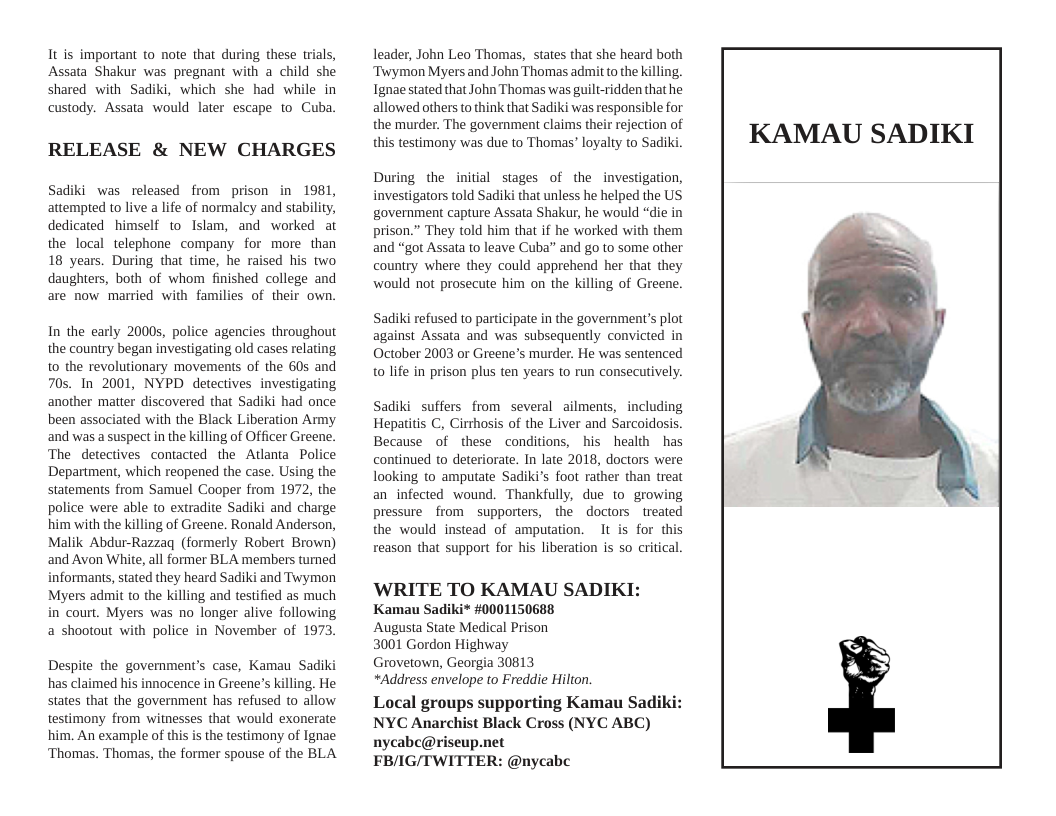
KAMAU SADIKI