Kamau Sadiki (LAABCF Flyer)
PDF• Raw TXT (OCR)
In the end, charges were dropped for
all but two former BLA members,
Herman Bell and Jalil Muntagim. In
2002, police in Minnesota reopened
an investigation into the death of a
local police officer, which led to the
arrest of Ronald Reed, a former mem-
ber of the Black United Front
In 2001, NYPD detectives investi-
another matter discovered that
had once been associated with
the Black Liberation Army and was a
suspect in the killing of Officer
Greene. The detectives contacted the
Atlanta Police Department, which re-
opened the case. Using the statements
from Samuel Cooper from 1972, the
police were able to extradite Sadiki
and charge him with the killing of
Greene. Ronald Anderson, Malik
Abdur-Razzaq (formerly Robert
Brown) and Avon White, all former
BLA members tumed informants,
stated they heard Sadiki and Twymon
Myers admit to the killing and testi-
fied as much in court. Myers was no
longer alive following a shootout with
police in November of 1973,
Despite the government’s case,
Kamau Sadiki has claimed his inno-
cence in Greene’s killing. He states
that the government has refused to
allow testimony from witnesses that
would exonerate him. An example of
this i the testimony of Ignae Thomas.
‘Thomas, the former spouse of the
BLA leader, John Leo Thomas, states.
that she heard both Twymon Myers.
and John Thomas admit to the killing
Ignae stated that John Thomas was
guilt-ridden that he allowed others to
think that Sadiki was responsible for
the murder. The government claims
their rejection of Iznae Thomas’ tes-
timony was because her loyalty to
Sadiki would give her cause to make
false statements.
During the initial stages of the in-
Vestigation, investigators told Sadi
that unless he helped the US govern-
‘ment capture Assata Shakur, he would
“die in prison.” They told him that if
he worked with them and "got Assata.
o leave Cuba” and go to some other
country where they could apprehend
her that they would not prosecute him
on the killing of Greene.
Sadiki refused to participate in the
‘government’s plot against Assata and
was subsequently convicted in Octo-
ber 2003 or Greene’s murder. He wi
sentenced 1o life in prison plus ten
‘years to run consecutively.
Sadiki suffers from several ailments,
including Hepatitis C, Cirrhosis of the
Liver and Sarcoidosis. Because of
these conditions, his health has con-
tinued to deteriorate. In late 2018,
doctors were looking to amputate
Sadiki’s foot rather than treat an in-
fected wound. Thankfully, due to
‘erowing pressure from supporters, the
doctors treated the would instead of
amputation. It is for this reason that
support for his liberation i so eritical.
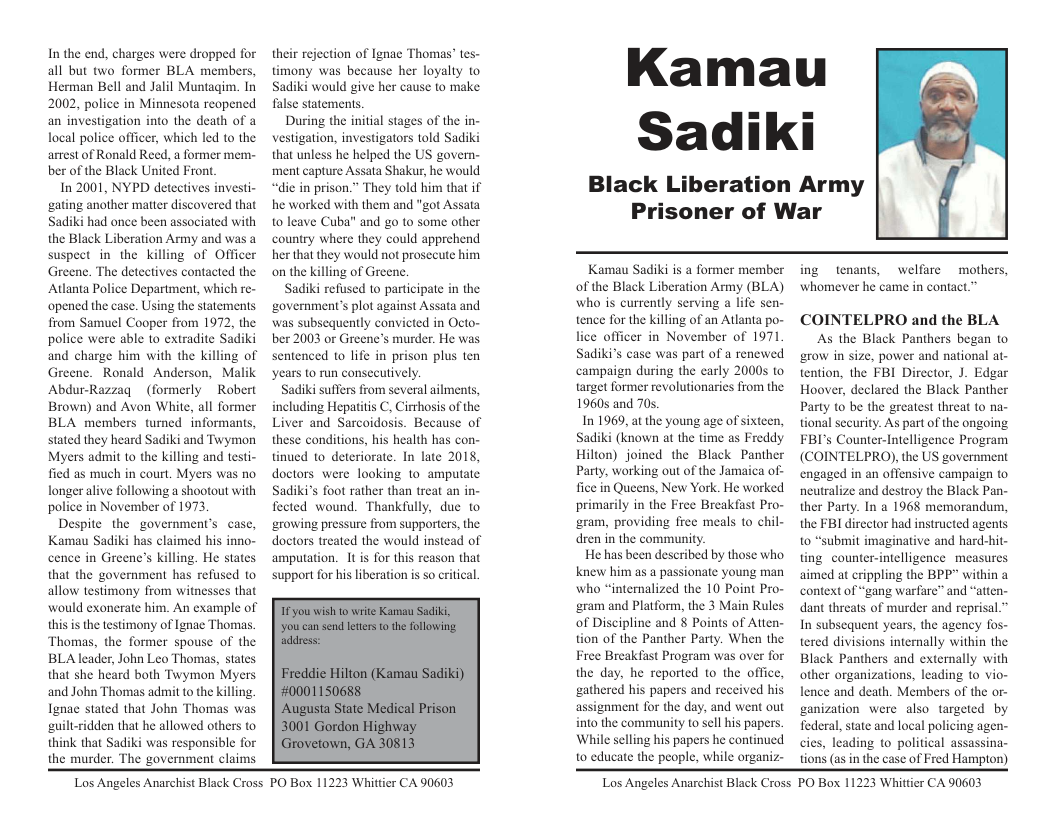
Kamau
Sadiki
Black Liberation Army
Prisoner of War
Kamau Sadiki is a former member
of the Black Liberation Army (BLA)
who is currently serving a life sen-
tence for the killing of an Atlanta po-
lice officer in November of 1971
Sadiki’s case was part of a renewed
campaign during the early 20005 to
target former revolutionaries from the
19605 and 70s.
In 1969, at the young age of sixteen,
Sadiki (known at the time as Freddy
Hilton) joined the Black Panther
Party, working out of the Jamaica of-
fice in Queens, New York. He worked
primarily in the Free Breakfast Pro-
gram, providing free meals to chil-
dren in the community.
He has been described by those who
knew him as a passionate young man
who “internalized the 10 Point Pro-
‘eram and Platform, the 3 Main Rules
of Discipline and § Points of Atten-
tion of the Panther Party. When the
Free Breakfast Program was over for
the day, he reported to the office,
gathered his papers and received his
assignment for the day, and went out
into the community to sell his papers.
While selling his papers he continued
o educate the people, while organiz-
ing tenants, welfare mothers,
whomever he came in contact”
COINTELPRO and the BLA
As the Black Panthers began to
row in size, power and national at-
tention, the FBI Director, J. Edgar
Hoover, declared the Black Panther
Party 10 be the greatest threat to na-
tional security. As part of the ongoing.
FBI’s Counter-Intelligence Program
(COINTELPRO), the US government
engaged in an offensive campaign to
neutralize and destroy the Black Pan-
ther Party. In a 1968 memorandum,
the FBI director had instructed agents.
to “submit imaginative and hard-hit-
ting counter-intelligence measure
aimed at crippling the BPP” within a
context of “gang warfare” and “atten-
dant threats of murder and reprisal.”
In subsequent years, the agency fos-
tered divisions internally within the
Black Panthers and externally wit
other organizations, leading 10 vio-
lence and death. Members of the or-
ganization were also targeted by
federal, state and local policing agen-
cies, leading to political assassina-
tions (as in the case of Fred Hampton)
Los Angeles Anarchist Black Cross PO Box 11223 Whittier CA 90603
Los Angeles Anarchist Black Cross PO Box 11223 Whittier CA 90603
and/or fabricated convictions (as in
the case of Geronimo Ji-Jaga Pratt )
Many members of the Black Pan-
ther Party felt they had no choice but
0 go underground or risk imprison-
ment or death. Kamau Sadiki was one
ofthose individuals. Before going un-
derground, Sadiki had already been
arrested twice for an alleged assault
ona police officer and weapons pos-
session. It was only a matter of time
before he became a target. It was at
this time he joined the ranks of the
newly formed Black Liberation Army
(BLA), an organization that engaged
in a counter-offensive campaign
against the State.
In August of 1971, Sadiki and a
dozen other members of the Black
Liberation Army moved from New
York to a house in DeKalb County,
Georgia. The group allegedly under-
went rigorous training in marksman-
ship, survival, first aid, map reading
and perfecting plans for bank expro-
priations.
On November 3, 1971, shortly after
midnight, Atlanta_officer James
Greene was shot three times and
Killed while sitting in a parked police
van. His gun and badge were taken
from the scene
A week after Atlanta patrolman
Greene was killed, police raided the
‘roup’s house due to an investigation
into a bank expropriation at the Fulton
National Bank a month prior. Eight
members of the Black Liberation
Army were arrested. Sadiki was not
present during the raid. One month
later, ten individuals escaped from the
county jai, including the cight mem-
bers of the Black Liberation Army.
However, it would not be long before.
most of those who escaped would ei-
ther turn themselves back in or be ar-
rested.
“My joining the Black Pan-
ther Party and consequently
the Black Liberation Army
was a response to the op-
pressive climate that existed
in America at the time.”
- Kamau Saiki
‘Around the same time of the raid,
Sadiki was stopped with another
Black Liberation Army member at a
roadblock in North Carolina follow-
ing the shooting of a Catawba County
deputy sheriff. Two other BLA mem-
bers (Robert Brown and William
Owens) were convicted of that action.
There was no indication of Sadiki’s
involvement but he and his co-defen-
dant, Avon White, were convicted on
charges of carrying concealed
weapons. They were both sentenced
o a six-month prison term.
After his release, Sadiki went back
underground and retumned to the New
York area. However, it would not take.
long before he came under the atten-
tion of law enforcement. In Septem-
ber of 1972, Samuel Cooper, one of
the men who escaped from DeKalb
County jail who remained at-large,
was captured in Miami. While in cus-
tody, Cooper claimed that Sadiki and
another BLA member, Twymon Mey-
ers were responsible for the killing of
Greene. Despite the information pro-
vided by Cooper, the District Attorney
did not feel he had enough evidence
1o indict the two men
In January of the following year, six
members of the Black Liberation
Army, including Kamau Sadiki, were
indicted for various actions police
claimed were connected to the organ-
ization. Sadiki was indicted on federal
charges following the expropriation
of funds from the Manufacturer’s
Hanover Trust Company in the Bronx
in September of 1972 He managed to
avoid arest until he was captured on
June 7, 1973, as part of a federal
stakeout
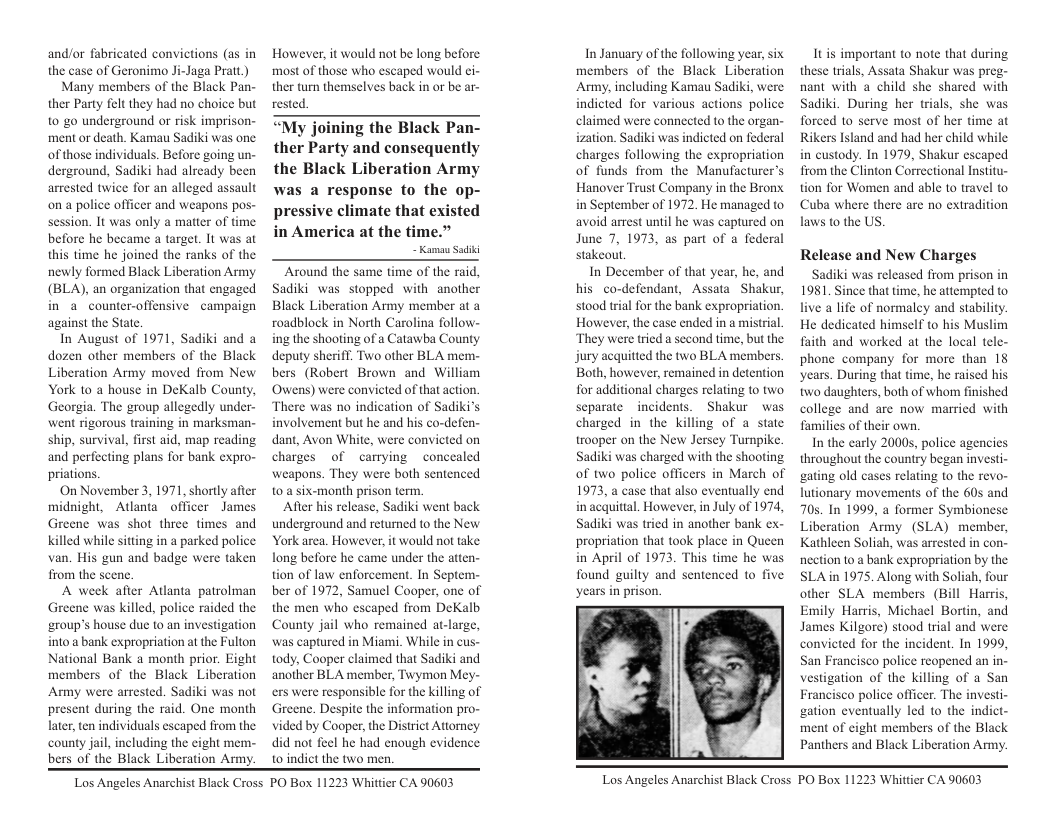
In December of that year, he, and
his co-defendant, Assata Shakur,
stood tral for the bank expropriation.
However, the case ended in a mistrial.
They were tried a second time, but the
jury acquitted the two BLA members
Both, however, remained in detention
for additional charges relating to two.
separate incidents. Shakur was
charged in the killing of a state
trooper on the New Jersey Turnpike.
Sadiki was charged with the shooting
of two police officers in March of
1973, a case that also eventually end
inacquittal. However, in July of 1974,
Sadiki was tried in another bank ex-
propriation that took place in Queen
in April of 1973. This time he was
found guilty and sentenced to five
‘years in prison.
Itis important to note that during
these trials, Assata Shakur was preg-
nant with a child she shared with
Sadiki. During her trials, she was
forced 1o serve most of her time at
Rikers Island and had her child while
in custody. In 1979, Shakur escaped
from the Clinton Correctional Institu-
tion for Women and able to travel to
Cuba where there
laws o the US.
are no extradition
Release and New Charges
Sadiki was released from prison in
1981. Since that time, he attempted to
live a life of normaley and stability.
He dedicated himself to his Muslim
faith and worked at the local tele-
phone company for more than 1§
‘years. During that time, he raised his
two daughters, both of whom finished
college and are now married with
families of their own,
In the early 20005, police agencies
throughout the country began investi-
gating old cases relating to the revo-
lutionary movements of the 60s and
70, In 1999, a former Symbiones
Liberation Army (SLA) member,
Kathleen Soliah, was arrested in con-
nection to a bank expropriation by the
SLAin 1975. Along with Soliah, four
other SLA members (Bill Harris,
Emily Harris, Michael Bortin, and
James Kilgore) stood trial and were
convicted for the incident. In 1999,
San Francisco police reopened an in-
vestigation of the killing of a San
Francisco police officer. The investi-
gation eventually led to the indict-
ment of eight members of the Black
Panthers and Black Liberation Army.
Los Angeles Anarchist Black Cross PO Box 11223 Whittier CA 90603
Los Angeles Anarchist Black Cross PO Box 11223 Whittier CA 90603